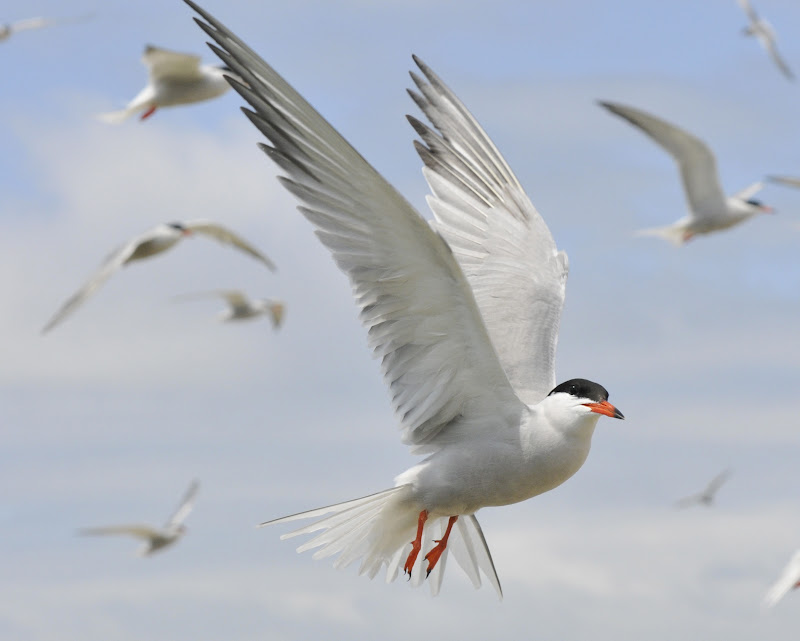
Common Terns on Monomoy

Common Tern Census on South Monomoy Island
Cape Cod Massachusetts;  15 & 16 June 2012

In 2010 there were 6,450 Common Tern (COTE) nests censused in the Common Tern colony located on the northern tip of South Monomoy Island, about three miles south of the Chatham Lighthouse. In 2011 there were 6,904 nests.

We just censused for 2012 and are a bit optimistic that the verified numbers will be higher; Kate Iaquinto, the US F&W Wildlife Biologist for the Monomoy National Wildlife refuge is estimating about 7,250 for this year. {The numbers are in — Kate Iaquinto, the staff biologist says there are 8105 pairs of Common Tern this year; 7762 on South Monomoy and 343 pair of Minimoy. There are only 7 pairs of Roseate Terns; 1 on South Monomoy and 6 on Minimoy. There were 441 pair of Laughing Gull on South Monomoy. The USF&W allows 1000 pairs of Laughing Gulls before considering controls.}

This is the first of at least two blog pages on that census. This page will be on terns and the second page will be on Laughing Gulls and Willets.

The Monomoy (Island) National Wildlife Refuge is one of the few wilderness areas in the eastern United States. It is described as a 7604 acre refuge but at low tide there is that much again and more exposed as sand or mud flats.

Directly south of the southeast corner of Chatham, Massachusetts there are several great bands of sand that keep the Atlantic out of Nantucket Sound as they reach down toward Long Island New York. These strands of glacial detritus form a variety of ever-changing barrier beaches. They have been there for centuries but never in the same configuration from year to year. This year, in 2012, the easterly barrier is called South Beach and reaches down from the Chatham Light several miles until it dog-legs west and connects to South Monomoy Island more than a mile south of the northern tip. In order to reach this connection it completely bypasses North Monomoy Island’s two miles of sand and dune. On the inland side, forming Nantucket Sounds’s western edge is a rather new bit of ground called Minimoy. There are now those four patches of land and associated flats; North and South Monomoy, Minimoy, and South Beach.

Monomoy’s history is a story in itself so I will jump right into the Common Tern census for 2012. On Friday and again on Saturday (June 15 & 16) the staff biologists (Kate Iaquinto and Stephanie Koch) led about twenty people into the dunes of South Monomoy. The COTEs nest on sandy patches within the vegetated dunes. American Beach Grass is the predominant plant species in the dunes and over the north half of the colony it is essentially a monocrop. The twenty people were divided in two groups which when censusing were two “lines”; shoulder to shoulder tip-toeing through a maze of nests and eggs.

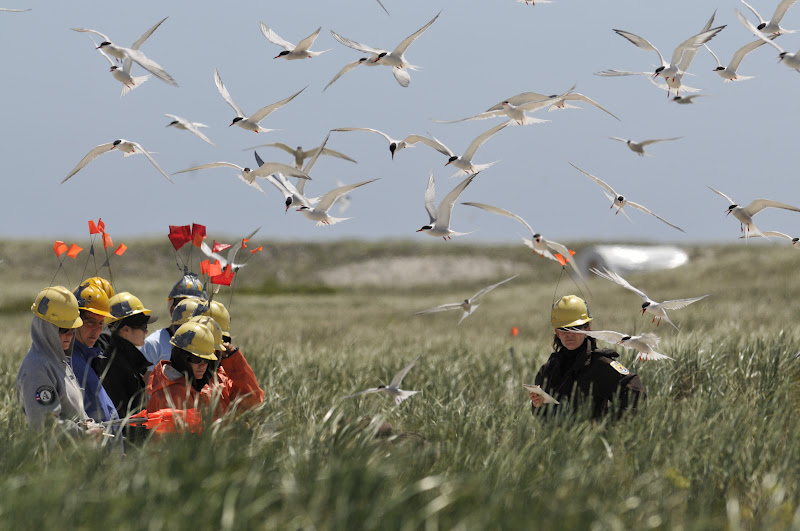
The “line” in the picture above is decked out in hardhats with flagging extending upward. The flags and the hats help deter, deflect, and prevent the Common Terns from poking into your scalp. It works almost all the time. If you reach your hand outward or upward it is likely to get nipped. The line consists of the counters and the single person to the right is the recorder. The line moves slowly, counting and reporting. The recorder keeps the notes despite the physical and noisy assault by terns.
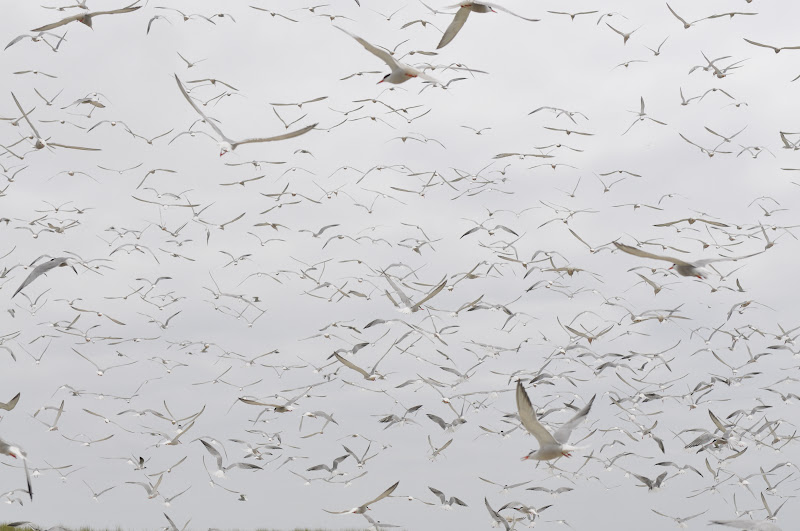
The birds nest colonially; often with hundreds of nests is a small patch of suitable ground. The ground on North Monomoy consists of Beach Grass meadows where the shorebird called Willet will nest, sparse areas of vegetation with exposed sand where the COTEs nest, and occasional patches of lush vegetation where the Laughing Gull (LAGU) will nest. There are almost no other birds out here at this time of year. But as you can see above, there are lots of Common Terns.


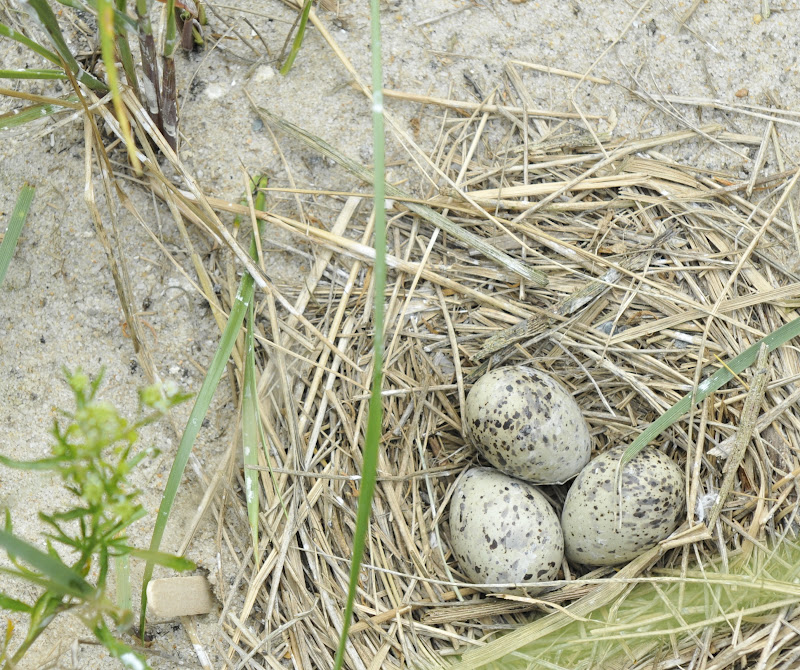
We were looking for areas where the Common Terns were nesting and then announcing the nest size by shouting out the number of eggs. In order to keep others from counting the same nest and in order to allow for recounts to verify accuracy we would put a possible stick in the sand next to the nest. And then shuffle on a few feet or inches to shout out another egg-number at another nest. The recorders were yelling back “got it” or “got them both” as we assaulted them with a barrage of numbers. All this while in a flock of rather angry, and hugely noisy, terns who didn’t see the management value of being censused.

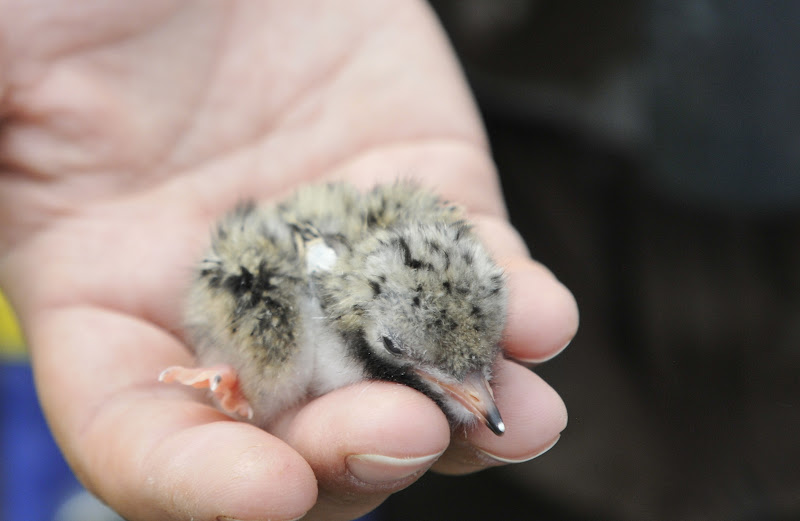
Occasionally we would happen on a nest with chicks though the census was timed to avoid chicks. The chick above still has its white bill-tip that allowed it to “unzip” its eggshell and enter the bright, sandy, noisy world of fish and flight. It must be a shock. Almost all of our nests had eggs, not chicks, and only one of the nests had fully hatched. The nests were usually two or three eggs; but some had one or four and there was one with five eggs. Fledging by Common Terns is considered good if four nests produce five flighted young; 1.25 young per nest or so. That means that more than half the eggs we counted will not become flying terns; they will be predated by: Great-horned Owls; Black-crowned Night-Herons; Laughing, Herring and Great Black-backed Gulls and occasionally mammals as well. The nesting choice of an island helps eliminate skunks, mink, foxes, feral cats, weasels, and eastern coyotes as predators – usually. The “line” I was on counted more than 2000 nests the first day and about 1300 the second day. At two to three eggs per nest that means that there will be about 7500 youngsters striving to become part of this noisy band of seafarers. There were at least an equal number counted by the other “line”.

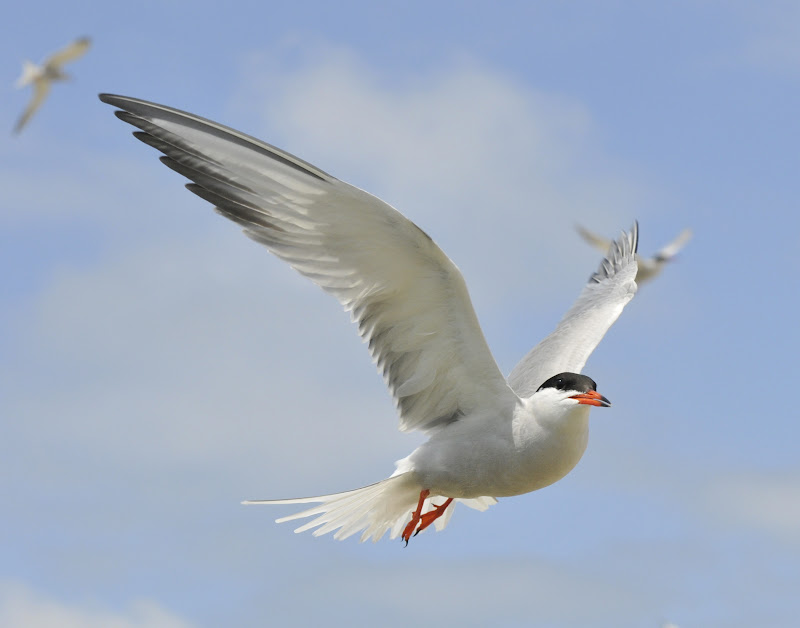
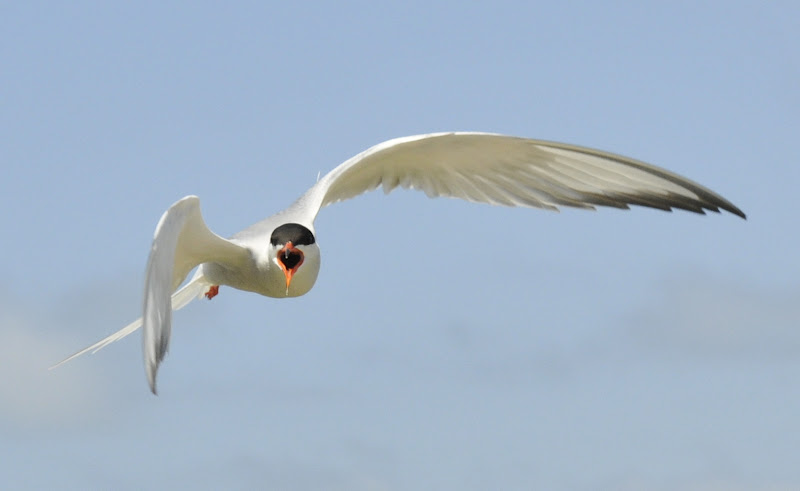
The birds were in our faces as we slowly walked the “line” through their nesting sites. Their behavior was certainly understandable. Their presence gave us time to watch them fly. Common Terns are extraordinary flyers. They are highly migratory and over a year’s time, with most of them nesting in the northern temperate regions of Eurasia and North America and then wintering as far south as Australia, New Zealand, Cape Horn, and Cape Point and lingering all all the shorelines in between they travel ten to twenty thousand miles each. While feeding young here in eastern Massachusetts an adult might make a half dozen fishing forays of ten miles each, each day, for the six weeks or so it takes for the young to grow and fly. Then they feed them at sea.

A Common Tern is 12-13 inches from bill to tail tip. The wing spend is between 30 and 39 inches. In most cases and at most times of year it takes four them to make a pound. Everything they do is done by a four-ounce bird. They can live in the wild for twenty to thirty years. Unlike humans, and most mammals, they don’t get older. Of course they get older but they don’t age. Each year is a repeat of the previous year; long flights, mating, nesting, feeding young, and many more long flights. You don’ become a gray-haired COTE and retire after a certain number of years. You live, behave, and repeat.
… and you may get an attitude.

The next blog page will show Willet and Laughing Gulls censused the same days……

An Afternoon (and Night) in the AU Bush

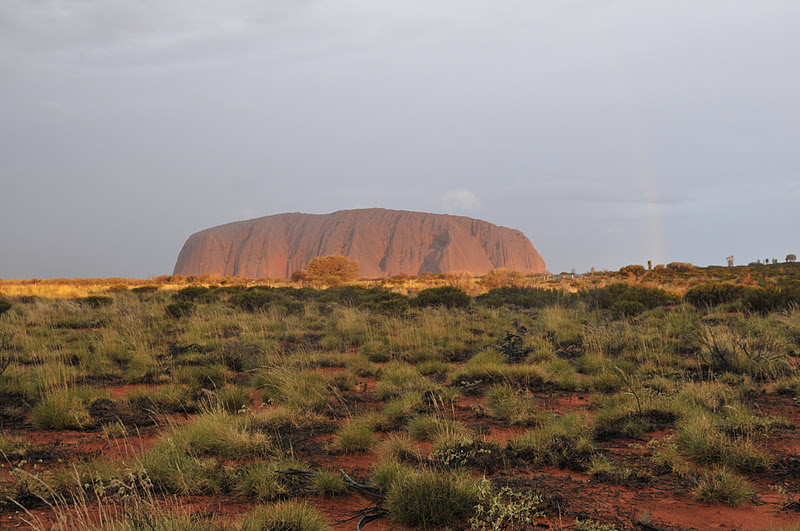
In the USA you would have to be in rural New Mexico or Arizona, probably on federal land, to find the empty spaces that are so very common in Australia. There are tens of thousands of square miles (actually square kilometers) of roadless, empty-of-humans, mulga-covered, hot & dusty, and sometimes flooded back land. The Australian Outback is incorporated into huge cattle stations; where 1000 hectares per cow isn’t enough. The soils are often red from iron oxidation and the moniker The Great Red Center applies to a huge portion of the continent. The iconic views of this area are seen in the Olgas and Uluru (Ayer’s Rock), but the emptiness is often flat and runs from horizon to horizon. It is just marvelous.

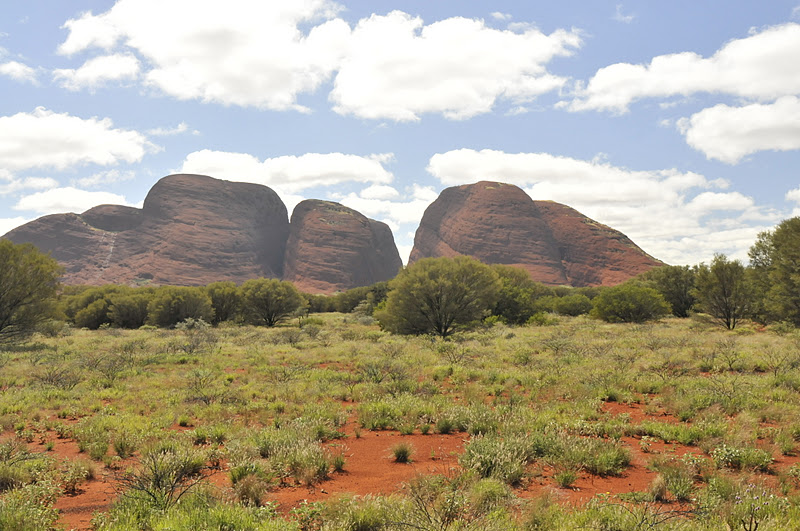
 The Olgas (Kata Tjuta) are a collection of 36 rounded rocks left behind as the overlaying mountains eroded away. They are conglomerate in nature and look like huge molded lumps of puddingstone. They rise almost 1800 feet above the surrounding landscape and are almost totally without vegetation.

Uluru, Ayer’s Rock, is a remnant of the same mountain formations that once covered the entire center of the continent. It is easier to envision these formations as uplifts of sedimentary rock rather than remnants. Uluru still has a pathway, with a rope to hold onto, on one end but the local Aboriginals prefer that the rock not be climbed.

The sinuous MacDonnell Ranges mountains are similar in origin. The image to the left (over one of the sewage lagoons outside Alice Springs) shows one end of the low esker-like range on the left and another on the right with the Heavitree Gap in the middle. The “mountains” of the MacDonnell Range have gaps spaced along their length. They are surprisingly rugged for smallish geologic structures; but remember they are the remnants of huge mountains that once loomed over this area.

The above was a bit of a digression; I want to spend some time with the features of the Murray River drainage along the southern edge of New South Wales where it abuts Victoria. Fran and I were in Deniliquin, a farm town that services a rather large surrounding area. It looks like a medium-sized town but is really a small town. We have very similar situations all through our mid-west and west. We drove through town a few times and ate dinner at a place that seemed like a Grange Hall more than a restaurant. The food was fine and the people were, as usual, very pleasant and accommodating. We were welcome (and welcomed) everywhere in Australia.

The afternoon in the bush was the prelude to an evening and then night in the bush. We were out at about 6:00am and (with a two hour break in mid-afternoon) were out until after midnight. Nothing can beat eighteen hours of birding; what a great day. The afternoon was focused on sand hills habitat and then we went on to a eucalypt woodland unlike anything we had seen before. It was to be simply a fantastic day.

On the way out to the west of Deniliquin we stopped at a creek and flooded roadside verge where there were a dozen of more Spotted Crakes and a couple Spotless Crakes as well. It was odd to see a patch of cattails growing in what looks like a desert. Obviously the water remains in this area, despite sunshine and succulent plants throughout, pretty much year round.

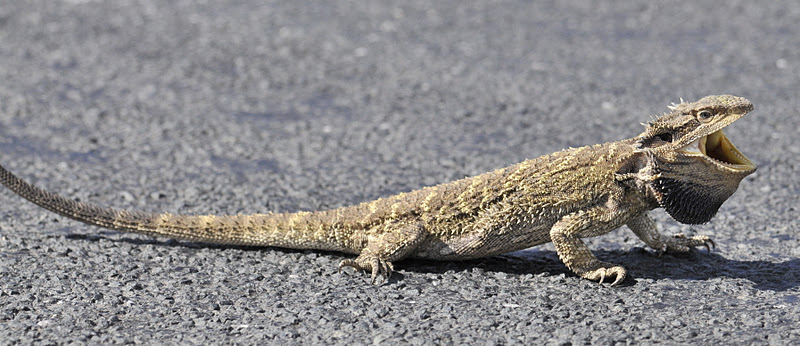
The Bearded Dragon lizard is a widespread reptile in Australia. I’ll do a blog page on reptiles some day, but this one was at the cattail swamp area where we had lots of crakes and it seems appropriate to include it here a change of pace for the non-birders.

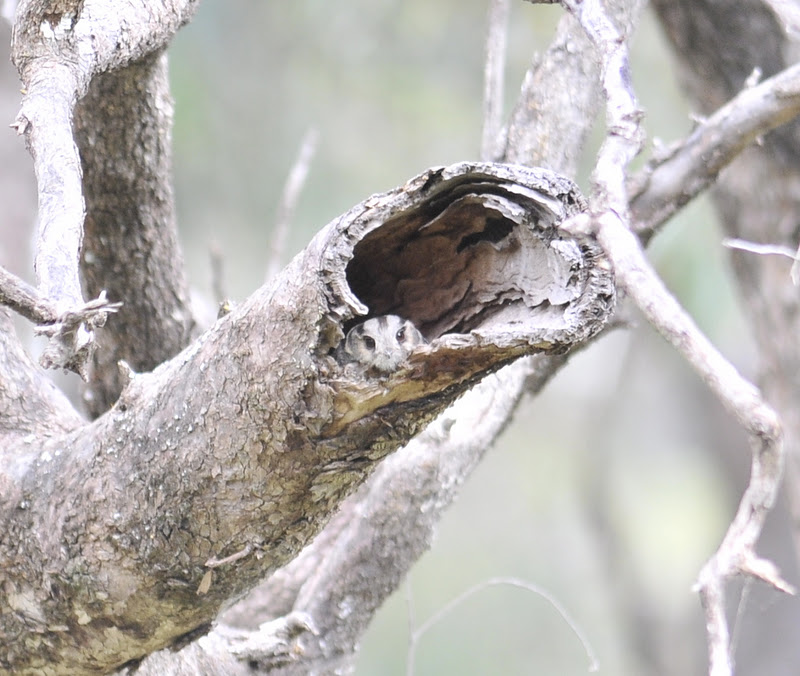
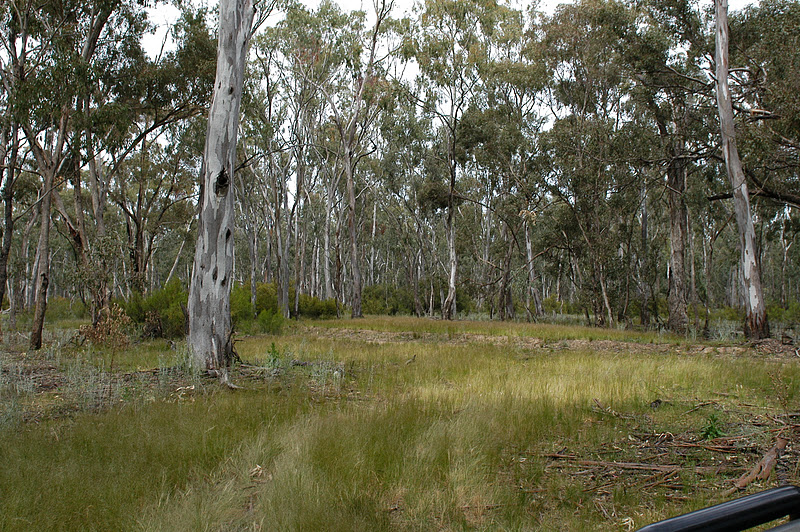
The dry area that we finally ventured into was a foot or two lower than the level of the gravel road and was vegetated with a shrubby eucalyptus trees and rather lush grasses. As moisture is not permanent here, the fallen branches decay very slowly and we worked our way through and around this woodland for a while. There were several honeyeaters and a few wood-swallows as we walked. Finally we looked ahead about thirty-five yards into the broken stub of a tree; the cutest bird in the world looked back! We thought it might be a doll or a kid’s teddy-bear, but it was an Owlet-Nightjar. This is one of Australia’s special birds; rather widespread actually but thin on there ground and not easy to locate and see. We were thrilled.

The image of the Owlet-Nightjar is not great as we didn’t want to approach too closely and the bird was (obviously) aware of us. So I clicked a few long range images and this is what I got. The face looks like a cute mammal more than a bird.

Australia has been without land contact (excluding Antarctica) for over 50,000,000 years and there are lots of endemic plants, birds, reptiles, and of course marsupial mammals that occur no where else (or perhaps the islands to the north) on earth. The marsupials exploded and survived without competition from the more efficient (? – maybe just more predacious) placental mammals. It wasn’t until there arrivals of humans and the dingo that things really began to change on this remote island continent.

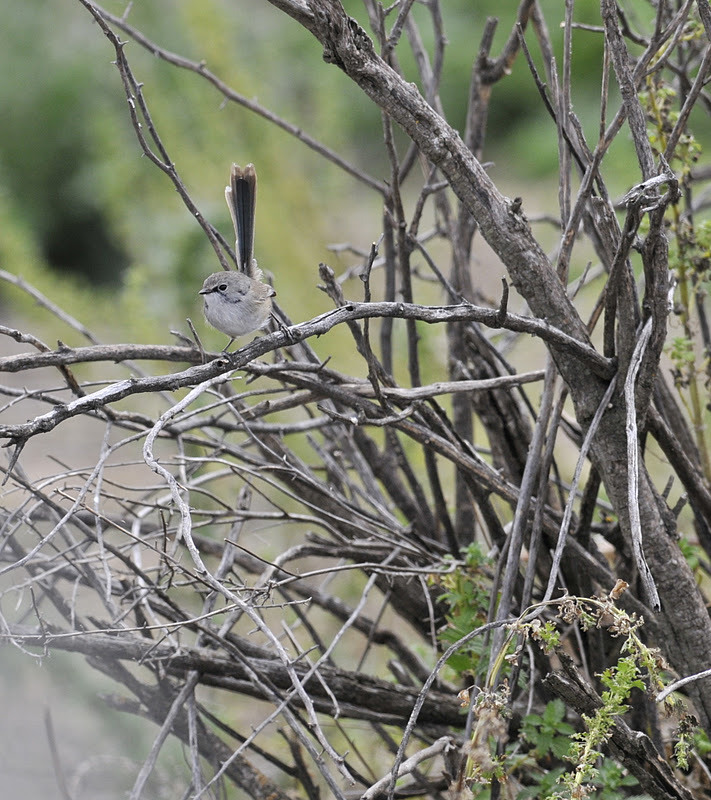
Another common bird group throughout Australia is the complex of the Fairy-Wrens. There are several that are called species and lots of populations and geographic forms that only show the difficult work that taxonomists are faced with. Yes, DNA has helped create relationship-groups but DNA shows a flow of genes more than a series of discrete steps and where to draw a line in genetic similarities is still subjective.

The kangaroos, wallabies, pademelons, and tree kangaroos are all hopping marsupials adapted to the varied habitats of the region. Tree Kangaroos are now found only in the Australian tropical forests (but are more common in Borneo and Papua New Guinea). The others are all found throughout the country. The kangaroos are the largest in stature and the Red Kangaroo is the largest of them all. The image below is of a large buck Red Kangaroo and a couple smaller grayer females that we happened on way while we were out in the middle of nowhere. The male was stunning in size and deportment. The females are called “blue-flyers” because they are faster than the males and the gray fur is often a slate-blue color.

Red Kangaroos, like all kangaroos, have to move their legs as a pair. These big guys can cover 25 feet in a single hop and reach speeds of more than thirty miles and hour. The males can stand (when upright) at over six feet and will often weigh more than two hundred pounds. They are the world’s largest marsupial and yet would be dwarfed by some of the fossil kangaroos that have been unearthed. A Red Kangaroo can live to over twenty years old in the wild; though they are shot as pests if they wander onto ranches or are too common along roadways. They are the Australian equivalent of our insurance company’s white-tailed deer as there are great numbers of roadway strikes involving all sorts of kangaroo-types in Australia.

The Red Kangaroos stand six foot tall and sometimes more. They eat grasses and are thus disliked by ranchers; but they are stately and impressive.

Cape Cod Sea Birds

Seabirds in June 2012

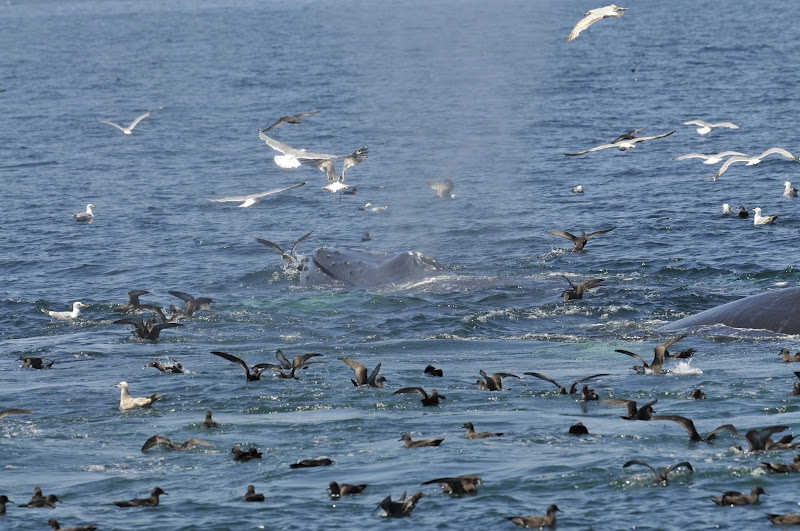
The previous blog showed a few of the whale images taken June 10th about 25 miles east of Chatham Light off the coast of Massachusetts. There were about 80 whales and thousands of shearwaters attending to a profusion of Sand Lance. The whales were mostly humpbacks although a few Minke skittered in and out as well. The whales were feeding inside bubble clouds and were seen in groups up to six individuals as part of the many bubble-teams. Most associations were of fewer whales and one individual kick-fed without joining the bubble gangs during the four hours we were with them.

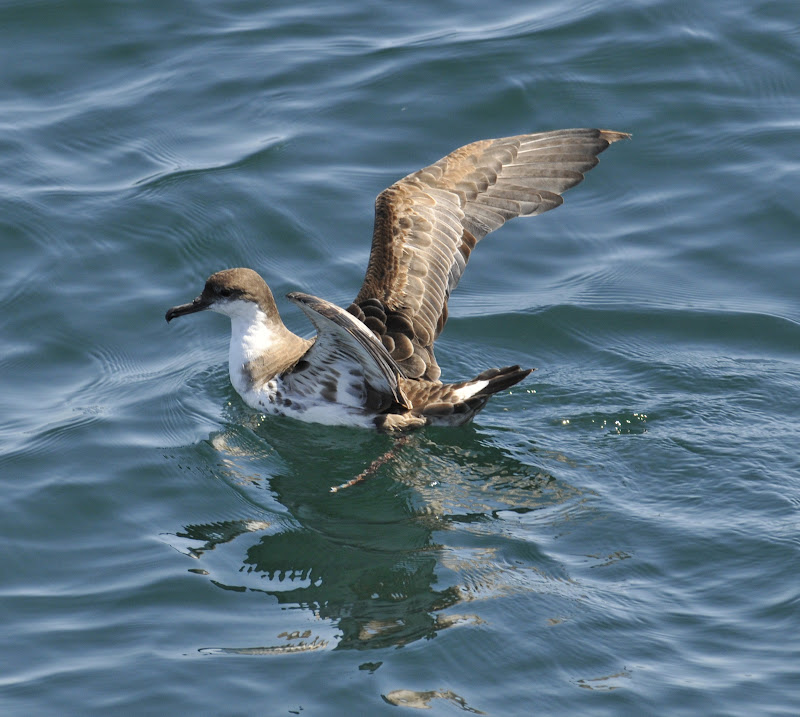
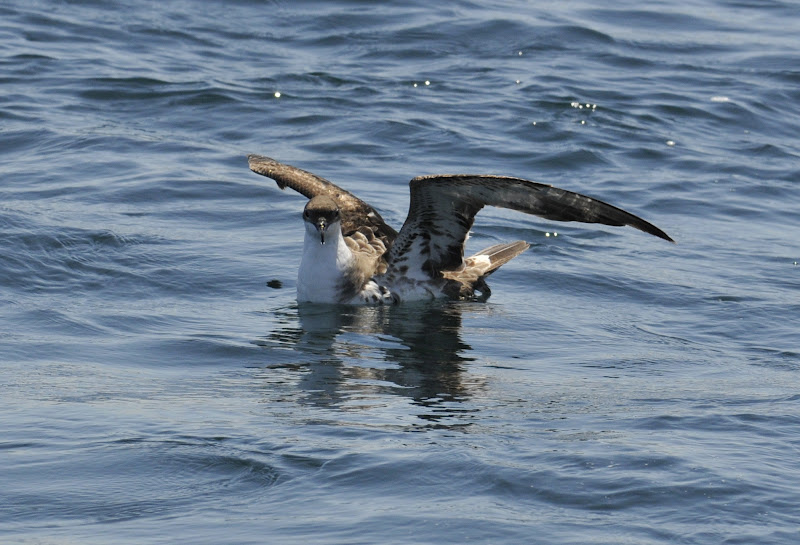
One of the many marvels of this scene were the attending sea birds. Estimates of Sooty Shearwaters exceeded 3000 and there were Great and Manx Shearwaters as well. In the feeding mix were a couple Pomarine Jaegers and we saw two Parasitic Jaegers as we traveled to and from the feeding area. The bird surprise for the day was (perhaps) two fold; Wilson’s Storm-Petrels were nearly absent and we had two Razorbills on the way around Race Point (Provincetown) heading home to Plymouth.

Great Shearwaters are usually very common in Gulf of Maine and coastal Massachusetts waters – and I am sure they will be more common as we move through the summer months. However, there are only a handful out there right now. The water is green with phytoplankton and there are tons of Sand Lance; the small forage fish that is the basis of Massachusetts fisheries (and whaleries and sea birderies as well – I know those aren’t real words but they imply the importance of these small fishes).
Great Shearwaters have a wingspan of about 44 inches and they rarely weigh two pounds; 30 ounces is about average. They nest at the edge of the Southern Ocean; mainly on the islands of Nightingale, Inaccessible, Tristan de Cunha, and Gough. Adult birds start a long migration north in April and molt worn feathers in the waters off New England and the Canadian Maritimes in July, August, and September. They return to the very far south; often via Greenland, Ireland, and the western European coast, in September and October and lay eggs deep in the Southern Hemisphere in November. 
Great Shearwaters are strong and direct flyers. They bound and shear through heavy weather with ease. They eat small fish and squid from the surface and just below the surface though they are capable of deeper fishing forays. Here in Massachusetts they are associated with Sand Lance and often with groups of feeding whales – as we saw this past Sunday.

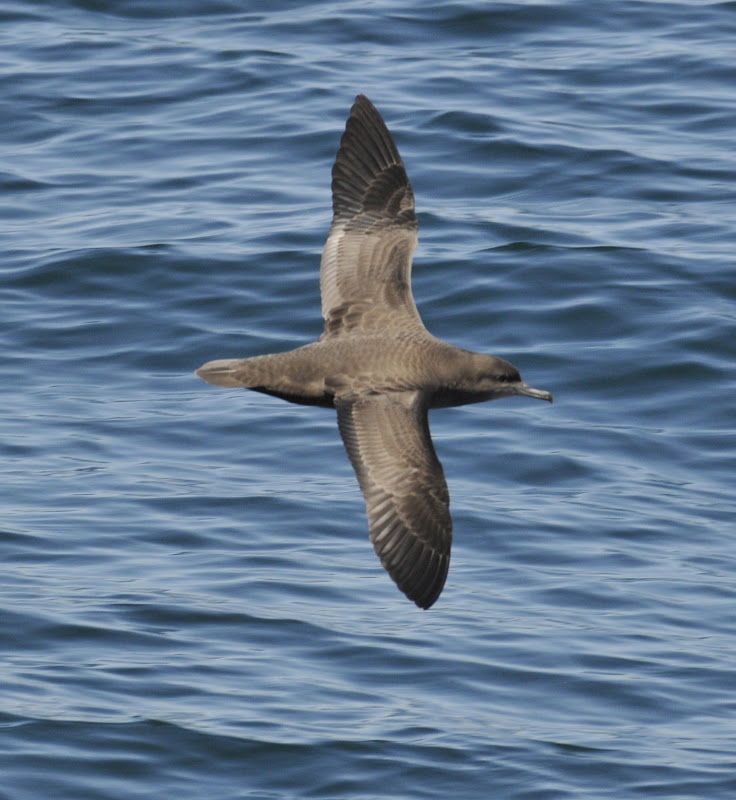
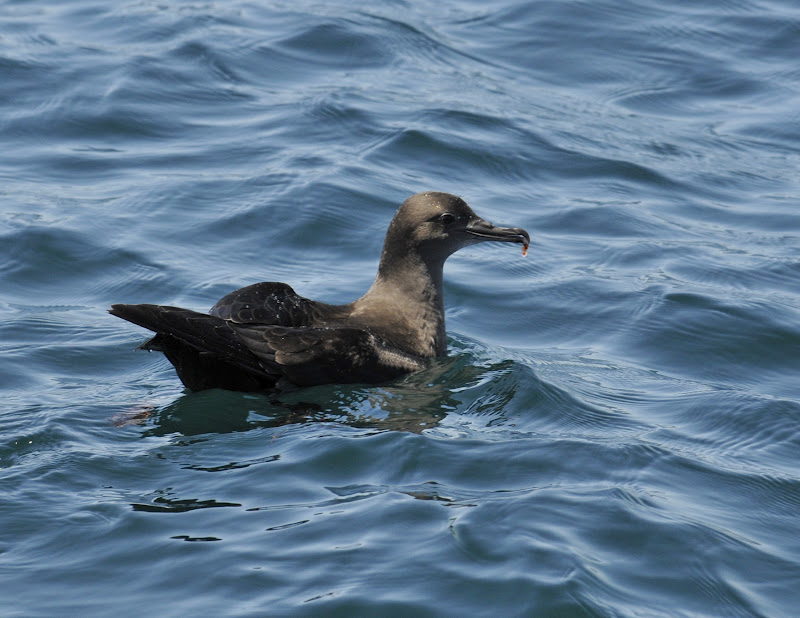
There were only about 30-35 Great Shearwaters and about the same number of Wilson’s Storm-Petrels out there ; however there were thousands of Sooty Shearwaters. I put 3000 as my number (in eBird) but some observers went a bit higher and some a bit lower. The Sooty Shearwater (below five images) is uniformly dark except the underwing is often silvery/shiny, the tail is dark brown and the underside is usually a bit lighter. 
The wing span of an average Sooty is 40 inches and the body length is about 17 inches. They weigh (on average) 28 ounces or about a pound and three-quarters. This varies by sex, season, feeding habits, and location on the migratory route. There is little to eat in the middle latitudes of the planet so they are probably thrilled to see the Sand Lance after crossing the Tropics and the Equator.
As a species the Sooty Shearwater is an abundant seabird. There are huge numbers in the Pacific and the Atlantic (and smaller numbers in the Indian) Oceans after their breeding season deep in the Southern Hemisphere. They can migrate past a point of land along the California coast (say Monterey) in the tens of thousands a day. They nest widely around the Southern Ocean. Large numbers on the New Zealand islands well to the south of Stewart Island (like and smaller populations off the tip of South America on both the Argentine and Chilean sides.

Sooty Shearwaters are one of the species that has been called “mutton bird”. In New Zealand the Maori people still harvest young shearwaters, pluck them, and then salt them. They are stored in a bucket and keep about a year. The birds harvested this way are youngsters about fledging age. There are stories that say they taste like fish and others that say they taste like mutton – I have never tried it. 
The picture below was taken in a butcher shop in New Zealand in 2012. The proprietor showed me a stored-in-brine muttonbird waiting for a buyer.

There are still millions of Sooty Shearwaters around the world, but because the overall population numbers have been declining quite rapidly there is great concern about the health of the species and the health of the oceans. The bird, like almost all pelagic species, is on a watch list.

The number of whales and seabirds was very large and the adrenaline flowed freely. But we had to travel a great distance to find this group of birds; they were not widespread and not in many of their usual haunts. This was an exciting day most certainly but every day with sea birds is both exciting and tinged with despair. Forage fish are being harvested in huge nets; 20 and more tons of small fish are scooped up in a single haul. The harvest is un monitored at this point and the turtles, mammals, and other by-catch is not reported and certainly not understood. Sardines, anchovies, capelin, sand lance, herring, mackerel, and  other “forage” fishes are often ignored by fisheries managers and this will eventually have disastrous results.
There will be at least one more blog entry for this outing — jaegers and an overview will follow shortly. 

Humpback Whales at Work

June 10th (2012) was a glorious day here on Cape Cod. It was also glorious about 25 miles east of Chatham in the Atlantic. The New England Coastal Wildlife Alliance had a fundraising WhaleWatch trip and I was lucky to go along as a sort of staff birder (thank you to Krill Carson and NECWA). We traveled straight and fast past Provincetown and Stellwagen Bank as there were few birds or mammals in that area and we made it well off Chatham by about 10:30am. There were pelagic birds and whales everywhere!

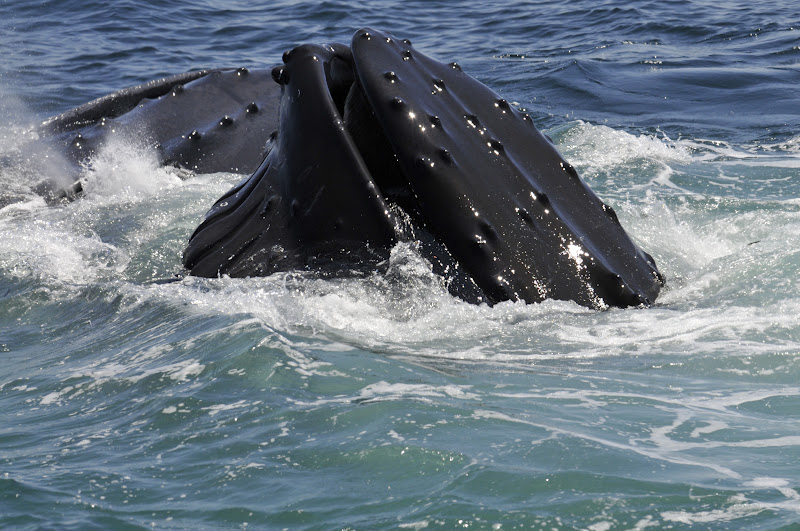
The whales in the (3) images above and below are coming to the surface after swimming through bubble nets that the whales created by blowing bubbles; and that that kept the Sand Lance confused and contained. The whales were not feeding very deep and bubble nets were made and penetrated, by mouth-open whales, in only a minute or two. There were places where four, five, and even six whales were participating in the bubble rings. As the light-colored bubbles ascended it was often easy to see the Sand Lance scurry about trying to form or reform schools or find a way into clear water where they could see what was happening. It was often frantic.

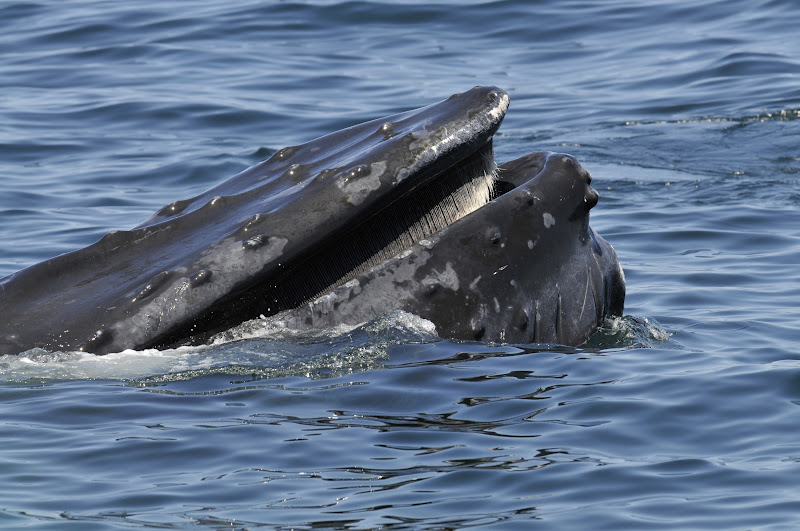
The whale above has taken in a huge gulp of sea water; hopefully full of Sand Lance. It will now squeeze the water out through the baleen and concentrate the fish. The pleats, or rorquals, are the pleated parts of the under throat and anterior belly can expand greatly. There can be hundreds of gallons of fish-rich water drawn in this ante room. Once the water has been forced out of the “gullet” the fish are swallowed down a rather small throat. Where we were Sunday, there had be millions of Sand Lance as there were whales and birds in profusion. A wet and salty buffet table like you rarely see.

The whale above is moving forward allowing the density of the ocean water to push against the water-swollen gullet. This forces the water out and empties the holding chamber. All but one of the whales we saw were bubble feeding; but the water was so rich in food they may have been able to harvest their meal without using bubble nets at all. many of the whales fed alone but it seemed that many loose associations of bubble-blowing whales had formed.
The pleats are about three inches across in an adult and expand like an accordion or concertina. The bellies of Humpback Whales are often mottled and patterned with white. The coloration on the underside of the tail is also patterned with white and serves as a “fingerprint” for identifying individual whales.

The birds in the above and below image show the relationship that develops between sea birds and the large mammals. It was not uncommon for hundreds of Sooty Shearwaters to fly to the rising bubbles. They knew a whale would appear and there would be a scattering of fish as well. In some cases that sat and waited occasionally on the whale’s snout as the Herring Gull above is doing. But more often that sat near bubbles and waited to snap up the frantic fleeing fish.
The image below shows another way to empty the load of water collected while fishing; gravity. By rising quite vertically the water drains out at the rear of the mouth near the hinge of the jaw. 

 As there were so many whales and birds out there on Sunday past, I plan on a few more pages to show the birds and whales in more detail — stay tuned.

Australian Wetland Birds

The birds that use wetlands are many and varied. There are herons and egrets, spoonbills and ibises, sandpipers, and terns, and gulls and raptors. There are as many and as varied a group of wetland birds as there are woodland or grassland birds. In migration there are all sorts of birds that end up at the edge of the sea or great lakes because the wind altered their flight path or they haven’t yet learned the right path to follow. Many birds can fly for long periods of time and cover great distances. Water birds are often required to fly long distances to find a suitable wetland for breeding or feeding.

In this blog I will mention and show some of Australia’s freshwater wetland birds. There will be a few large wading birds and a few rails & crakes, and the inland sort of sandpiper types that you might come across. Each has a preferred habitat. I will show the more usual wetland birds not the occasional or unique wetland birds; some will be very common and other much less so. This page will be done primarily with captions as there isn’t much of a story here. There will be other pages that deal with costal birds.

In the Great Red Center or in any of the outback area, the wetlands are ephemeral; evaporating or running off into larger streams quite rapidly. Hence, birders often visit sewage lagoons in desert areas as they are more permanent that natural wetlands. Tucson’s Ruthrauff Road (now there are four birding areas provided by the wastewater people), Hornsby Bend in Austin or the Alice Spring’s water treatment plant in central Australia are all birding destinations; as are hundreds of other locations. Water is the basis of life on earth and wetlands are often the most diverse and densely populated habitat.
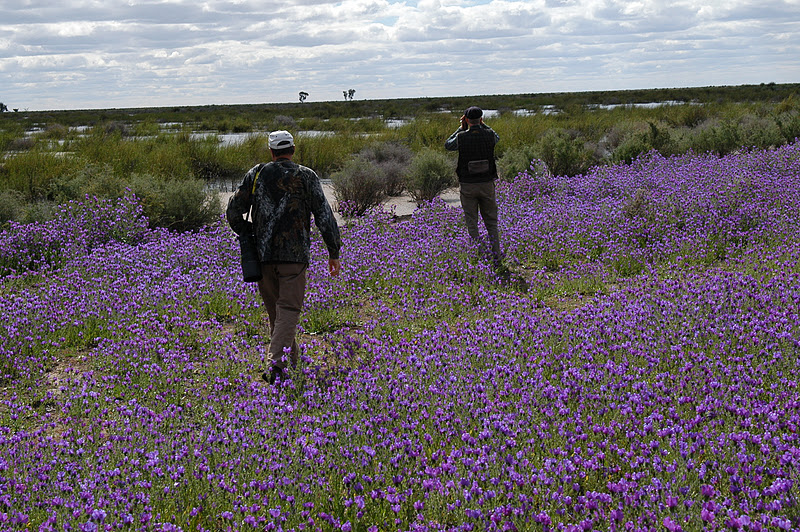
The floral carpet added incongruity to this large expanse of dry-land wetland. We were in a rather dusty area and then it simply became wet and the “lake” covered hundreds of acres. The water was rarely over 6″ deep and though the ground was slimy with fine mud it was not vegetated by more than a handful of plant species. The Painted Snipe toward the end of this blog page were photographed here.
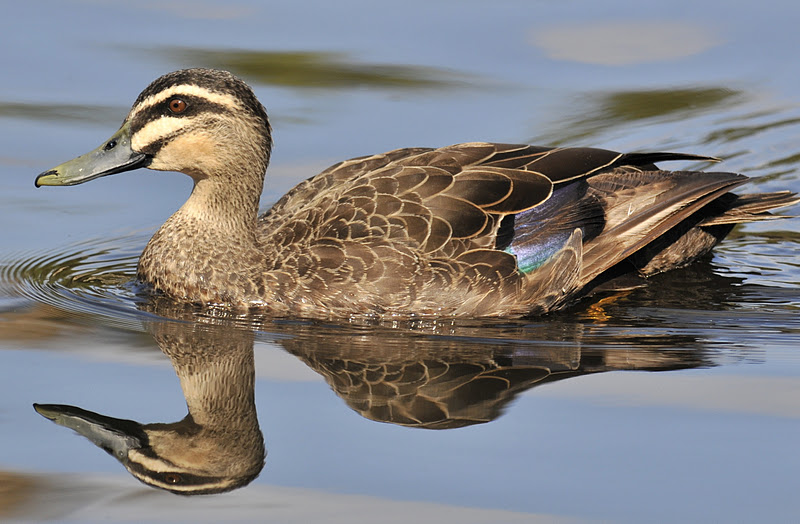
The Mallard is now a worldwide species and it has many cousins across the globe. The Australian bird that is the closest relative to the Mallard is the Pacific Black Duck, a rather elegant Mallard-type. This is a common bird of freshwater wetlands and is common in urban parks and rural rivers.
The Dusky Moorhen is another common bird found in cities as well as out in the country. The moorhens (or gallinules) are found worldwide and most likely share a rather recent common ancestor. Birds of the wetlands are often strong and long distance flyers and thus find there way easily from island to island sometimes covering thousands of miles in a single flight.
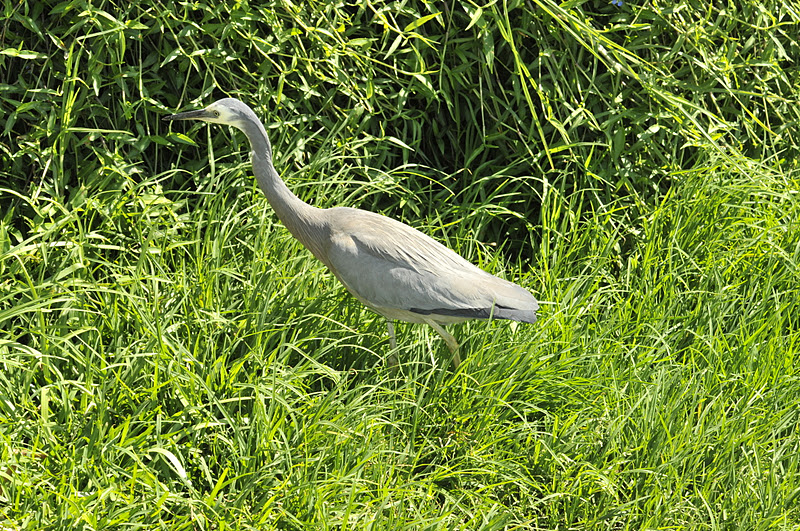
The White-faced Heron is found everywhere but the driest of the outback deserts. It is a bird that can make a living on the coast, in estuaries, or in any of the inland wetlands. 
Many of the more common sandpipers have adapted to areas that are not so wet. we think of plovers and sandpipers as coastal birds because many of us are coastal and during migration many of the birds are coastal as well. However, in Asia, Africa, and Australia there are many birds with sandpiper origins that do not necessarily live near water. The Masked Lapwing was called masked plover for many years. It is in the same group as the plovers of the African savannas. This is a bird found in yards, parks, farm lands, and is not shy at all. It helps that Australian people and dogs are not very aggressive. 
There are two spoonbills in Australia; the Royal and the Yellow-billed. These are species that avoid the most arid deserts but are otherwise widespread. The Royal Spoonbill shown above was found in the Royal Botanical Garden in downtown Sydney amongst parrots, cockatoos, and thousands of large bats called Flying Foxes. 
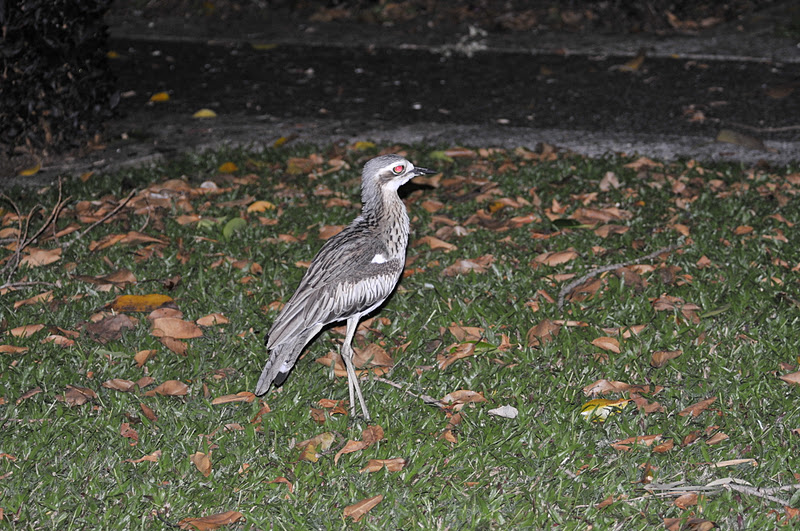
Another city bird is the Bush Stone-curlew. The bird above was photographed at night on the lawn of the public library in Cairns. This is a bird of the night as can be easily determined by the large eye. It is well camouflaged and will freeze if threatened. They are rather widespread but never too common. They are said to be birds of the open woodland and beaches. In this day and age the open woodlands are often residential areas.
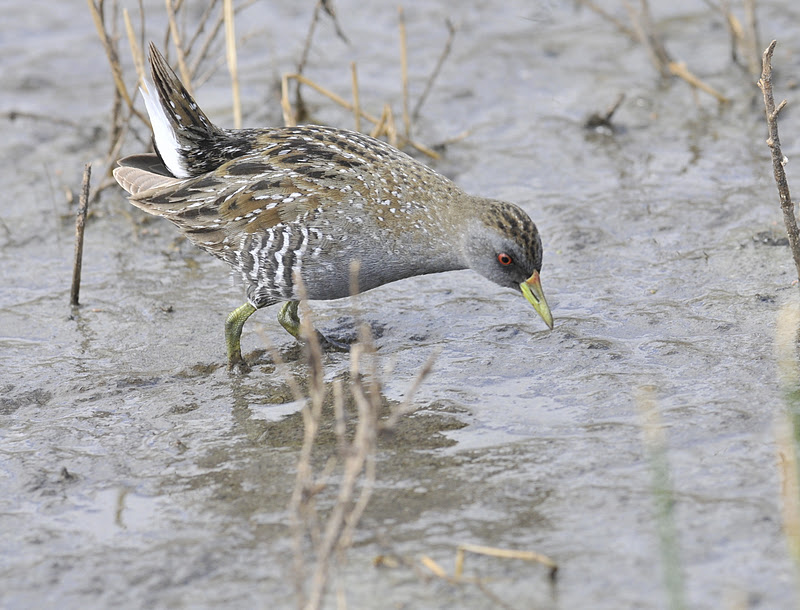
The Australian Spotted Crake is what we call a rail here in North America and a very common one. We saw a hundred of these birds or more and they were rarely shy or retiring. As a matter of fact they were often in roadside drainage swales and seen from a fast-moving vehicle.
The Purple Swamphen is found on almost all of the western pacific islands. This is a testament to its ability to fly; despite its appearance as a chicken-like creature it can get up and go.  In New Zealand the same species is called by its Maori name, Pukeko. 
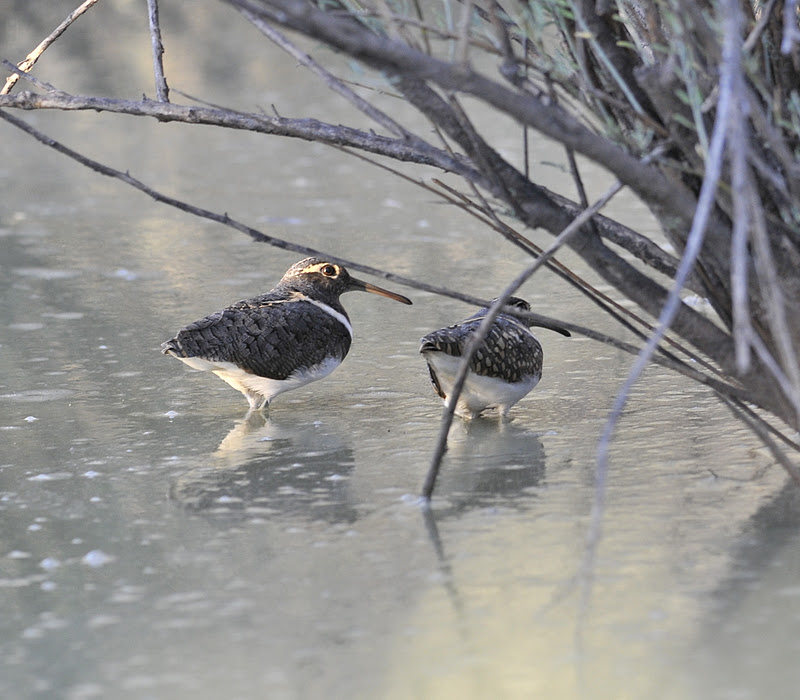
The Australian Painted Snipe (above and below) were found in an area that was covered with shallow water and had a shrub cover throughout. They were not easy to find or see, but they stayed still as we carefully edged around into position to get a look.
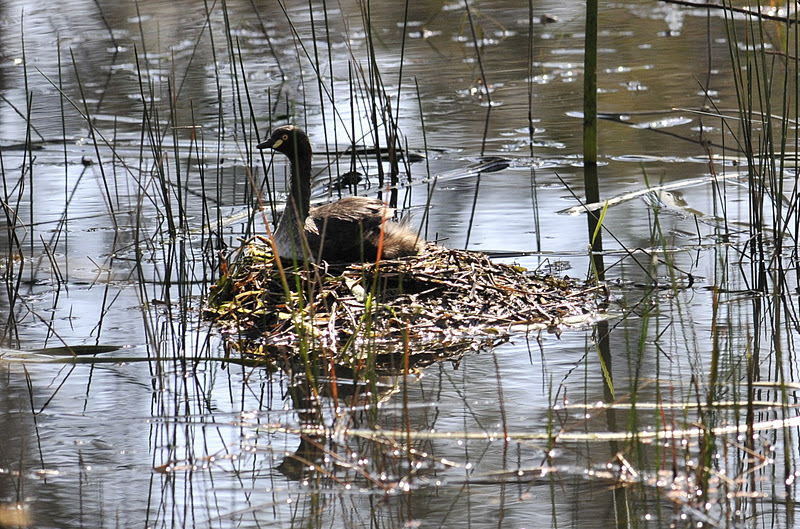
Grebes are a wetland bird with ancient roots. They have lobed toes, not webbed feet and they are excellent swimmers and divers. They can compress their feathers and sink out out sight without a ripple. The bird sown above is an Australasian Grebe.

Deniliquin – New South Wales

Fran and I drove north enjoying the views and countryside of northern Victoria and eventually southern New South Wales. There are farms and farming operations in this area, but much of the land is unable to receive dependable water so great expanses are simply rangeland or paddocks for grazing cattle and sheep. Much of the water in the rivers, as mentioned previously, is controlled and distributed for various uses by municipal powers. There is still a great deal of water when it rains and, or course, much less when it doesn’t. The dams and weirs and channels and canals send water out from the main river bed to those who need it and use it for agriculture or municipal purposes. Most of the land that we saw was dry and was now vegetated with livestock-resistant plants; many of which have become more common than the ranchers and habitat managers like to see. But when cattle or sheep remove the best tasting and most nutritious plants the invasive plants (whether alien or merely bad-tasting) can, and do, move in.

It was very surprising to see how much water sat on the surface of this land. It looks dry and it is dry. But there are fine sediments (perhaps clay or clay-like) that clog the pores between what seem to be sand particles which then allows for slow infiltration of surface water; most water that lands on and stays on the surface, evaporates. There were huge areas of water that was never more than a few inches deep. Flat land, impervious soils, and rain are a good recipes for shallow pannes. These shallow pannes were well-used by ducks, grebes, rails & crakes, and inland sandpipers like snipe; or in this case Painted Snipe.
Shallow wetlands form after the rains on great expanses of impermeable soil. An area like this can be dry and wet intermittently and hold all sort of wildlife. We wandered through a great deal of this sort of habitat with Fran always on the lookout for spiders and snakes.

I realize that we take very pictures of cultural things. I have lots of pictures of Sydney and a few of Alice Springs but not much else. I will make an effort to show the people, buildings, and land better over the next year.

We stayed in a small cabin at a Caravan Park in Deniliquin. This is sort of a resort, campground, and trailer park rolled into one. There are spaces for “caravans” or travel trailers with water and electricity, there are tenting spaces, pull-offs for people in vans, and there are cabins with kitchens and real beds; we opted for the latter. It was a pleasant place to stay; we later took another similar lodging in a different town that was significantly less pleasant. Most of the other people in the park were on vacation, fishing, or doing short-term work in the area.

Woodlands throughout Australia are pretty much all eucalypts – eucalypts of all sorts as there are about 400 species in the country (and less than ten species that don’t grow naturally in Australia). Many of them grow in mono-crop forests and some have a nice park-like feel to them. Other woodlands are thick and impenetrable.

 Each of the forests has a floral and faunal community specific to it. There are birds, mammals, insects, and reptiles restricted to certain plant communities. The plant communities are restricted by evolved adaptations to soil types, available moisture, elevation, slope, temperature, sunlight, and so on. The intersection of various conditions creates biomes or specific habitats within which the various organisms survive. You can’t grow a cactus in a swamp or skunk cabbage in a desert now can you.
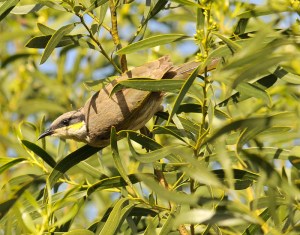
The Singing Honeyeater is one of the birds that is rather widely found. We found it in eucalypts as you can see by the leaves, but they are found throughout the continent west of the east coast mountain range. In actuality the Great Dividing Range divides Australia in many ways; the population is largely along the east coast and the great expanse of dry and forbidding “outback” is to the west of the mountains.

The geologic history of Australia speaks to isolation. New Zealand split off about 80 million years ago and since then Australia has been associated with Antarctica or (for the past 45,000,000 years) on its own. Australia traveled alone for more than 30,000,000 years with its cargo of Gondwanan life. Pollen from eucalyptus trees (and Acacia) first appears in soils and rocks from about 25,000,000 ago. For the last 25,000,000 years Australia has been drifting north at a a rate of an inch or two a year; Antarctica has been stuck at the pole for about the same amount of time. The real point of all those numbers is to reference the long isolation of Australia and Australian life forms. They have had tens of millions of years to adapt and evolve generally unaffected by much of anything at all except their own climate and others on this island-continent; at least until humans arrived about 40,000 years ago. (Yes I really mean 40,000 years ago. The earliest North American signs of humans are well less that half that age.) Once humans arrived things began to change.

When climate changes the plant community will change as well and that will be followed by a change in animal populations, presence, and density. We are already seeing that as the earth warms; many plants in the arctic are now growing further north than they did when it was colder further north. The heat held by cities has also changed the floral and faunal components of large areas.
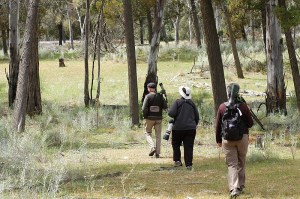
In Deniliquin we had a guide to get us through the large and remote expanses as we looked for secretive and uncommon birds. Success often requires help as good luck, good intentions, and physical effort are often not good enough. 

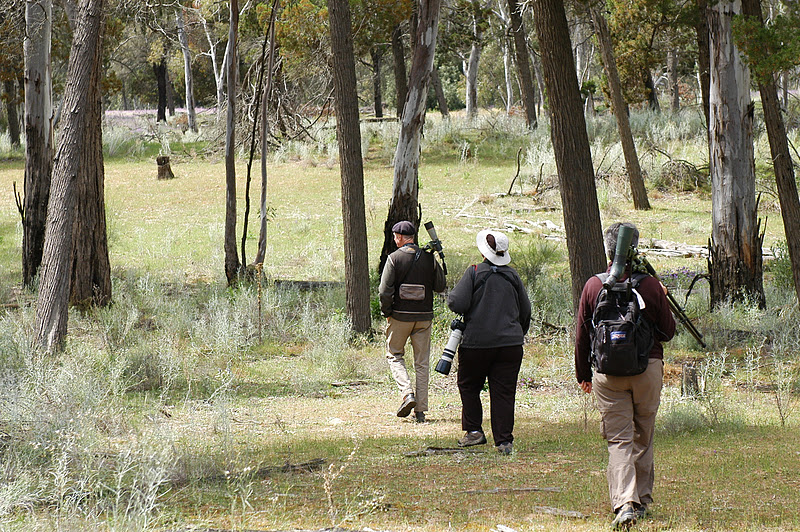
We walked these lovely woodlands looking for whatever we could find. As you can see we added another birder for part of our Deniliquin stay; Olivia from Mississippi, who had been birding in Australia for about six months. Many of the forest birds were similar to our flycatchers and chickadee groups in habitat choice and behavior. There was also a group that lived like North American nuthatches or tropical wood-creepers. There were parrots and birds of prey as well. We saw a few kangaroos in this area but most mammals are less active in the day time and would be easier to see at night (if only we could).
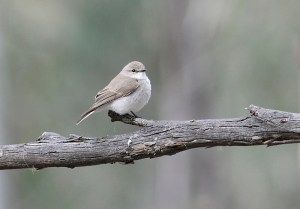
The Jacky Winter is a rather drab little flycatcher/robin type of bird, that sits rather quietly flicking its tail sideways, showing the white edges. It was a common bird of the open woodlands and was often seen on fence rows in farmland. The name comes from its song which is said to sound like “jacky-jacky winter-winter-winter”. 

The Hooded Robin is a woodland bird and is much like European robins not North American robins, which are actually rather large thrushes.  The Hooded Robin is a widespread species but not very common. Many of the Australian robins have red caps or chests, or heads. they are a rather attractive group of birds overall.

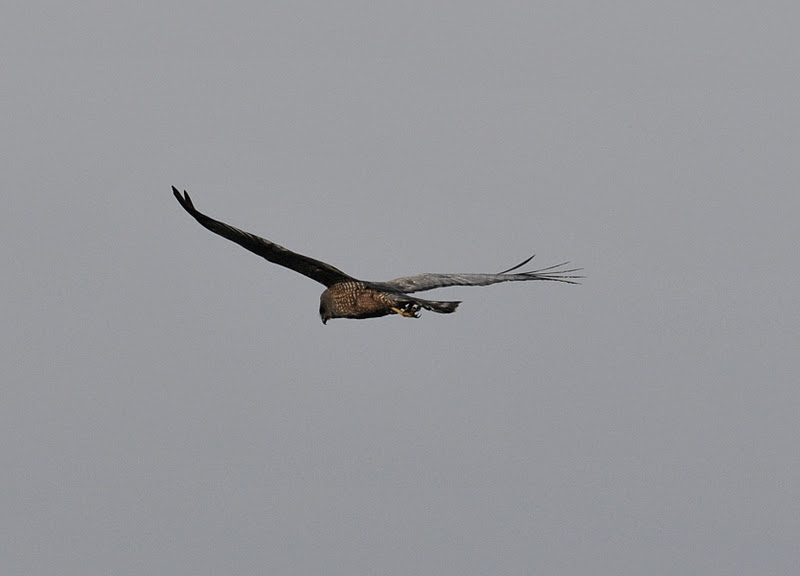
We traveled through riparian woodlands, open scrub land, narrow streams with emergent vegetation, and several eucalypt woodlands in the Deniliquin area. The habitat variation was a treat to see and provided many creatures with specific adaptations or preferences. Over the grass lands (the fields or paddocks often lined with old eucalypts) we saw quite a few birds of prey. The Whistling Kite was always in sight as was the Black-shouldered Kite and the Brown Falcon was not uncommon. However, it was the Spotted Harrier (shown below) that was the raptorial highlight of the day. Though we never were able to get too close to them, we watched a pair and grabbed a few images, as they worked over a large paddock.

We were in Deniliquin for three nights and enjoyed two half days and two whole days out in the field. The next couple blogs will be about this area. But, before departing it might be good to check in on Fran’s spider phobia.

The image to the right is of snake tracks across a dusty road we were birding along. We were in and out of the bush (wait ’til you see the pictures of the Owlet-Nightjar!) and never saw a snake; here or anywhere, not even a road kill. But when we returned to the car after birding this area there were three sets of snake tracks crossing the road within fifty feet of where we parked. The tracks shown were made by a large animal; over 100 pounds and probably ten feet long. This one was likely a Carpet Python (one of several species that use that name). We were never sure if they came after we arrived or crossed the road as we entered the bush where they were resting. It was disappointing not to see them but rather nice they headed away from us rather than toward us.

Fran never batted an eye about the snakes she was only concerned about spiders and I will have a good deal more to say about spiders later on.

The Deniliquin portion of the trip will continue in the next installment.
Northern Victoria – farmland and empty places

Australia gives whole new meaning to the phrase “yard bird”. Where we have chickadees, robins, and crows in modest numbers, the Australian yard will have an array of parrots, cockatoos, miners, and honeyeaters. The bird immediately below is a Noisy Miner – one of the Honeyeater tribe, and a very common bird whether in a suburban yard or in the bush country.

The white bird (below) with the pinkish and blue facial patch is a Long-billed Corella, one of the large cockatoos. These birds were very common and there were usually Sulphur-crested Cockatoos mixed in with them. They were common where we were, but have a limited range overall. In the places where they occur they are often very common but you have to be in western Victoria, the very eastern part of South Australia, or in southeastern Tasmania in order to be assured of seeing this species.

The rosy-colored parrot in the picture below the Corella is another very common bird called the Galah – the local pronunciation is “ga-LAH” rather than “gala” as an American would say. It took some getting used to the abundance of cockatoos and parrots. In many cases the tree-loving parrots were very hard to get a good look at but the big ones, and others that fed on the ground, were very much at ease in most cases.

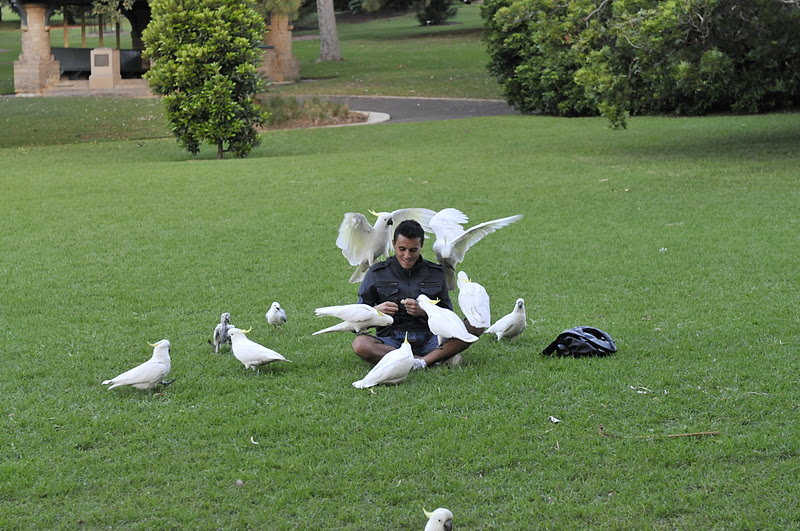
The large Sulphur-crested Cockatoos (as shown in the 3rd image below) are often rather tame features of urban parklands. They were also very common in farmland outside the cities. As they probe in sod (and rip and tear and dig) they do favor maintained grassy areas. The call of the Sulphur-crested Cockatoo (and most parrots of any kind) is a loud raucous screech – quite unpleasant overall.

It was not uncommon to see hundreds of any of these cockatoos each day. There was nothing special about finding them daily as they were pretty much everywhere; suburban yards, remote desert bush, or seasonally flooded areas. The largest of them, the Sulphur-crested, could be seen a half-mile away scattered like so many piles of snow. There are three Corella species and two of the large crested cockatoos. As with many animals (of all sorts) some have very specific adaptations and are found within rather restricted plant communities.

As we headed north from the airport outside Melbourne, eventually to the southern edge of New South Wales, we were immediately in farm land. The fields and paddocks were quite green as this corner of the continent gets a reasonable bit of rain and had been wet in the weeks before we arrived. We had two days to reach our next hot spot so we puttered along and deviated from the main roads whenever we felt the urge to get into the bush.

There are few roads in most of Australia and most side roads are gravel. Some are black-topped wide enough for one car to travel comfortably – when a car approaches you each drive with one side of the car on black-top and the other on gravel. Driving on the left was an experience that we talked our way through at every turn -“OK here comes a roundabout, we will stay left and peel off onto the second roadway”. We did pretty well. It was very helpful that the roads are rural and the people considerate. (However, there was that awful last day when our GPS took us on a two-hour tour of all the roads in downtown Melbourne instead of letting us hop onto a toll road directly to the airport. That was a trying bit of driving even if it was the last day and we were somewhat experienced.)

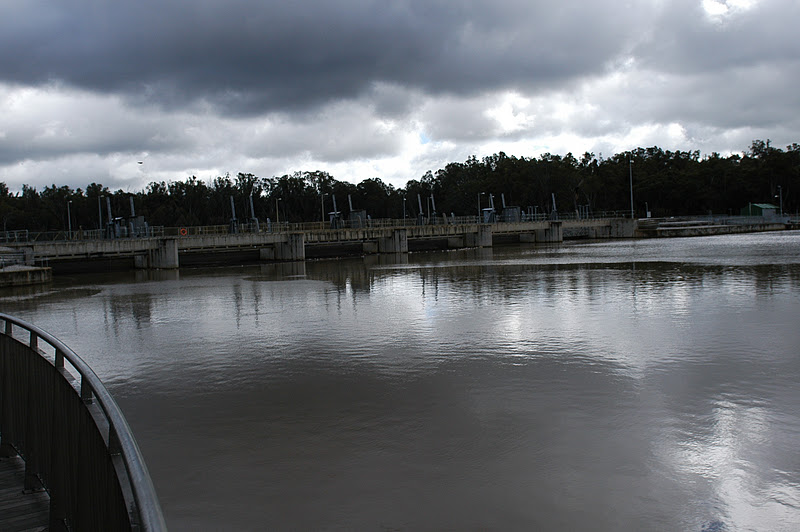
The rivers were running pretty full and the weirs were controlling a great deal of water. You can imagine how precious water is in a dry country and how thoroughly it has become a resource; bought, sold, channeled, and held in all the watercourses. This large weir (The Torrumbarry Weir on the Murray River) was pretty far out in the bush. It was rather a surprise to come across this large water control device as we thought we were miles from any sort of industrialized activities. There were hundred of various cockatoos in this area as well as cormorants and riparian wildlife and fish in the fish ladders.

 The Brown Falcon is a good bit like the Peregrine Falcon that is thinly, but widely, spread in North America.  It was not the most common bird of prey but we saw several. We saw many Wedge-tailed Eagles every day, Brown Falcons on several days, and ten to twenty Whistling Kites each day. There are no vultures or Buteos (like Red-tailed Hawks here in the USA) in Australia but there are Kites, Eagles, Sea-Eagles, Accipiters, and Harriers. Most of the pictures I took of eagles and such are of birds in flight and they don’t offer much to the blog.

Once we were well north of Melbourne the Red-rumped parrot was common. Like many birds there are significant plumage differences between males and females and young and old. A flock of these stubby-beaked parrots was never easy for me but Fran noticed the red and always called them correctly. Subtle colors, especially the reds, have always been hard for me to notice.
The Rosellas (and Lorikeets) were common but not easily seen as they typically fed deep in the leafy vegetation. This bird was catching the early morning sun in a residential area that we happened on. One side of the road was rather nice homes and the other side was pasture land. It was a good spot for birds and a very nice place for this long-tailed beauty.

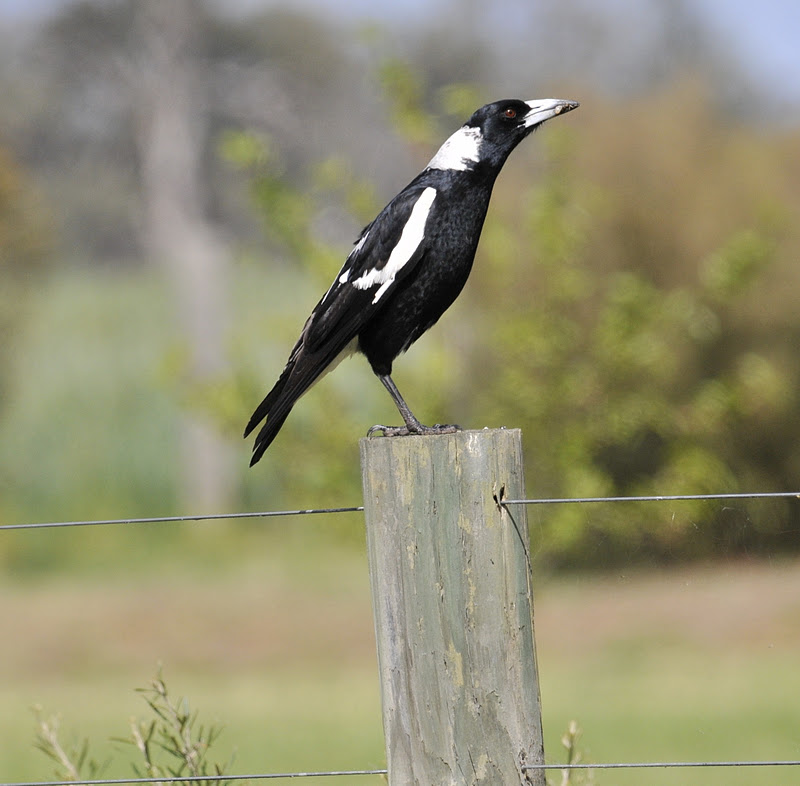
The Australian Magpie is a bird that is very widespread through the western edge of the country and the entire eastern half. There are eight populations with differing amounts of black and white providing the sub-specific clues. The “white-backed” groups tend to be in the cooler south and in far west, where the “black-backed” populations are found in the east and along the northern edge of this island continent. They behave much like North American crows and are closely related to the butcherbirds, woodswallows, and currawongs – all groups that are not found in North America. They became very regular roadside friends. It was quite impressive to note the pattern changes as we headed north from Tasmania through Victoria and into New South Wales.

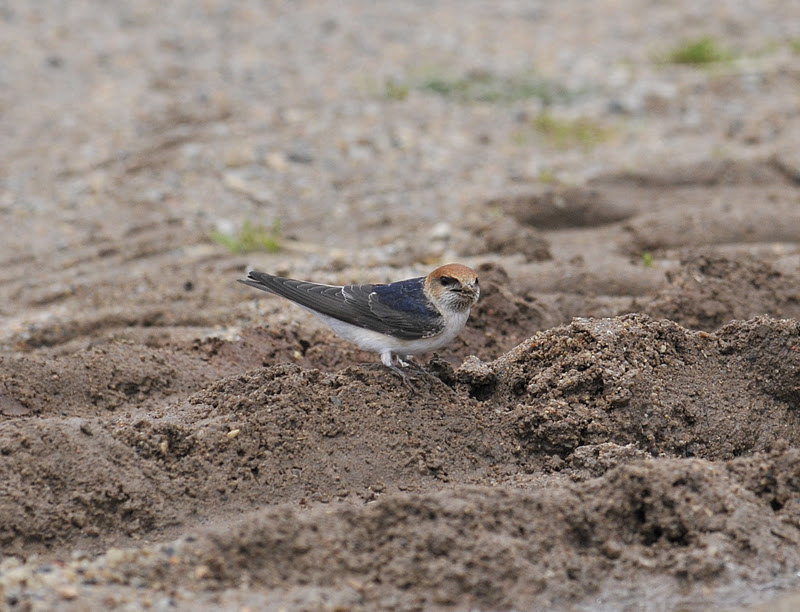
In the USA we have the Barn Swallow as our representative of a very large worldwide group of swallows; the Hirundo group. (We have swallows from other groups as well – 8 swallows and martins nest in the US)  Our Barn Swallow is found in Europe, Asia, Africa, and much of the western Pacific. The bird gathering mud for its bottle-shaped mud nest is called the Fairy Martin. There are half a dozen swallow or martins in Australia; 5 of these are Hirundo swallows.
The vegetation in the dryer parts of the Australian countryside consists of mulga and other Eucalypts as well as Acacia and a much lesser number of other groups. However, in the suburbs and parks, and in suitably humid habitats the Banksia and bottlebrushes are well represented. The vegetation found in Australia is very different from what we have in North America. There seems to be little doubt that the plants of Australia (especially the Eucalypts) have developed in ways as unique as the resident mammals.

Australia — Ancient Land & Ancient People

Uluru or Ayer’s Rock sits in the great red center, the outback. It is a remnant from millions of years ago and millions of years of erosional forces. Australia, like the rest of the earth’s surface has been through a lot.
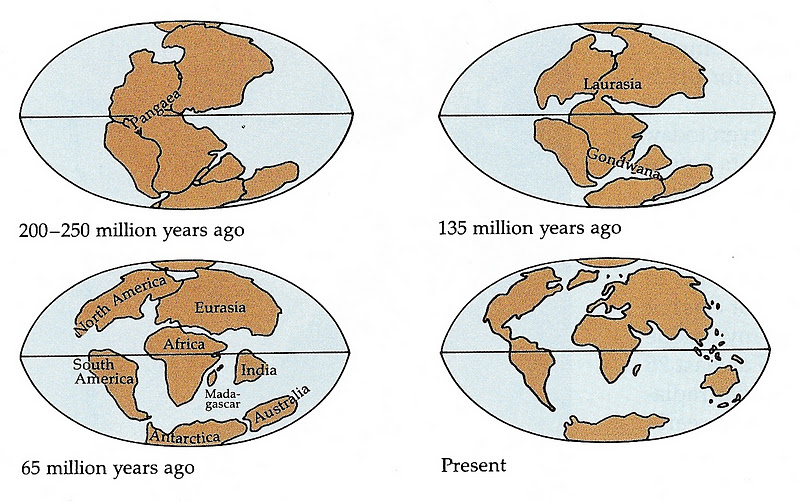
This page will recapitulate the last 200,000,000 years – no problem. Please don’t change the channel, put the remote down – this will be quite painless and very superficial. Bear with me…. I promise not to go back to the Big Bang or the first life forms or the development of an atmosphere.
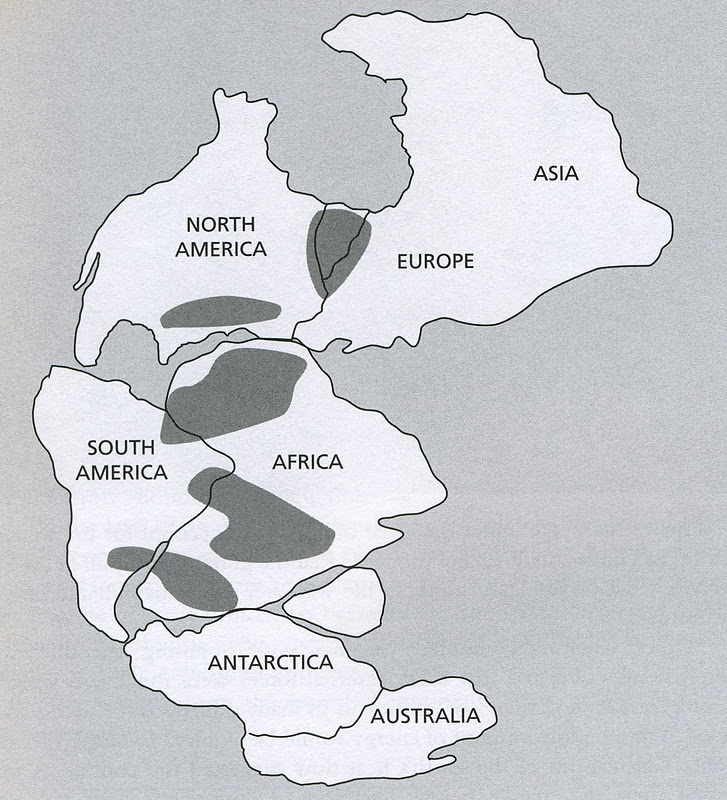
Once upon a time all the continents were clustered together. This was a mass of land called Pangea or “all land” About 180,000,000 years ago the top and bottom halves began to drift apart. The result (eventually) was Laurasia in the north and Gondwana in the south. 
Incidentally, India is that little unlabeled triangle between Africa and Antarctica. It was to be sent out from there like a spit-out watermelon seed to eventually crash (only 10,000,000 years ago) into southern Asia; bulldozing debris into what is now earth’s youngest mountain range.
Over the last 150,000,000 years the earth’s crust has been ever-morphing into new configurations. The way it is now is what we call “the world”. But it is only the world for the moment because things are still moving, always changing. India is still riding into Asia and the Himalayas are getting taller. The mid-Atlantic ridge grows about an inch a year and Iceland is being split in half by volcanic activity. In the southern part of the world New Zealand is getting the Icelandic treatment via earthquakes from moving plates.

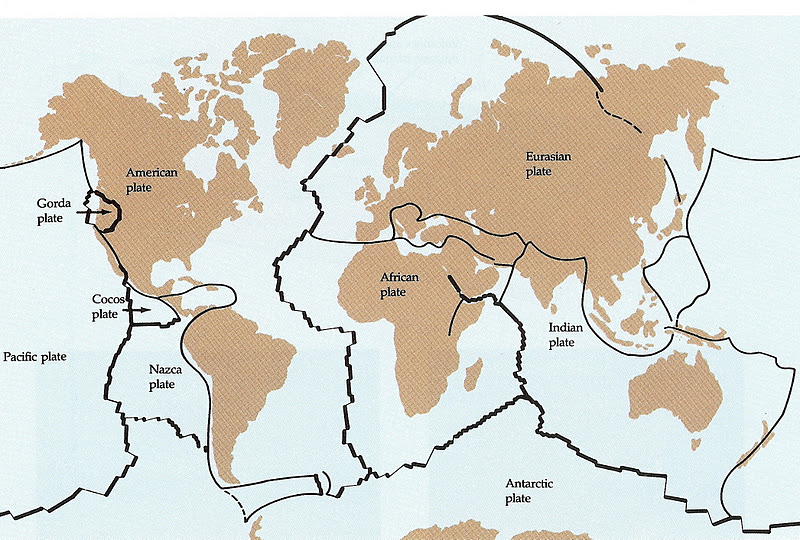
 The earth is cracked and crazed into a few major crustal plates and a few small ones as well. The edges are pretty well marked on the surface by volcanoes, earthquakes, and disharmonious features.

The Pacific Basin is a very active area. Australia sits in the middle of the huge Indian Plate (now being referred to as the Australian Plate by many) and has no volcanoes and few earthquakes of any sort on the continent itself. It is merely along for the ride. But look below to poor New Zealand. It is right on the edge of the plate. It is riding on the blade of the bulldozer that is rubbing against the huge pacific Plate and has been plowed and buried more than once. The Pacific Basin is very active but Australia is very quiet, very flat, very hot, and will likely move north over the next few million years.

The land forms in Australia have been weathered/abraded/eroded due to wind and rains during the passage of immense blocks of time. Today Australia’s rivers run brown and the annual (or occasional) floods carry away millions of tons of mineral earth. The heaviest rains are in the north and the northeast. Flooding elsewhere is irregular. Visitors may see rain in Cairns or Brisbane or Sydney. Melbourne had rain during the President’s Cup golf tournament in November of 2011. But once you get inland from the Great Dividing Range it is dry – often very dry.

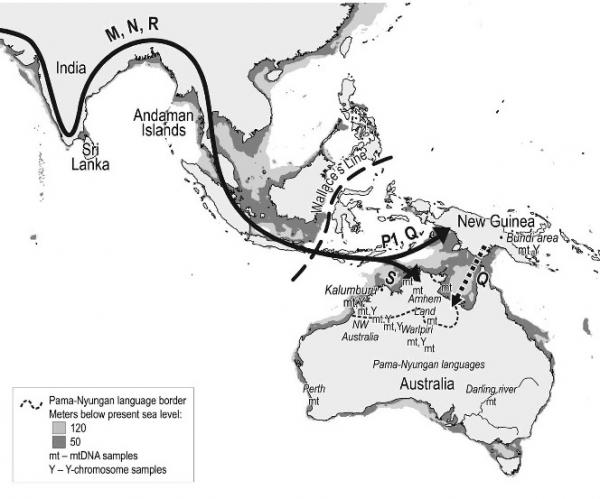
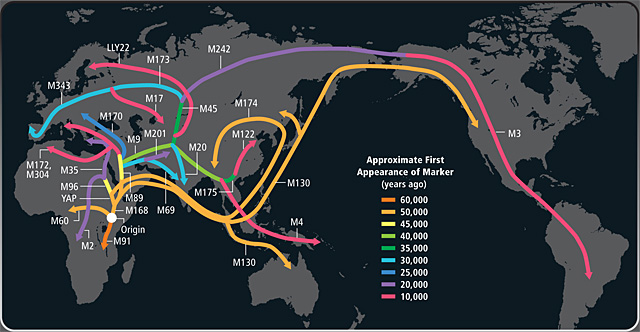
The first peoples of Australia are referred to as Aboriginals and they arrived well before the Europeans. The first people of Australia were certainly here 40,000 years ago and there are some who think they arrived as much as 100,000 years ago. The out-of-Africa route that they followed probably crossed India and then traversed Sri Lanka before crossing the water and land to northern Australia. The Genome Project by National Geographic has linked Australian Aboriginals to the people of Sri Lanka.

One thing to keep in mind is that 40,000 years ago (and back more than 100,000 years) the oceans were much lower and much more land was exposed. Any place where the water is now less than 400′ deep was land when the ice of the glaciers collected and held water. So back when the people were first arriving in Australia much of the oceanic area now surrounding the Philippines, Sumatra, Malaysia, New Guinea, and the Sundas was dry land. There were places where ocean water remained but there were not wide expanses as we now see when we look at a world map.

It was first thought that the first Aboriginal peoples arrived in northern Australia in the manner the map below implies. It was thought that they followed the coast from India to Bangladesh, to Myanamar (Burma), to Thailand, to Malaysia, to Sumatra and so on settling both New Guinea and Australia. But the DNA evidence seems to have them doing more what is shown at the bottom – crossing India to Sri Lanka and down from there. The lower map shows the pathways of genetic markers and is more of a life-flow chart.

Lastly, for those who have made it this far, let me offer a few images of the Australian countryside. Much of the interior of the continent is arid. There are great deserts and rock formations. there are skeletal remains of mountain ranges and lots of dry land.

.
The outback is characterized by mulga and acacia shrubs, shallow panes that hold water in the occasional rains, and vast expanses of what appears to be inhospitable land. The image does not show Uluru (formerly Ater’s Rock) but an area between Alice Springs and Uluru on the Curtain St.

The Olgas are a cluster of less-eroded conglomerate rock in the area of Uluru. The vegetation is seasonal and rain-dependant. However the vegetation at the base of the rocks is more permanent in the same manner that roadside vegetation often does better than plants well off a road. The rocks shed water into the immediate area.
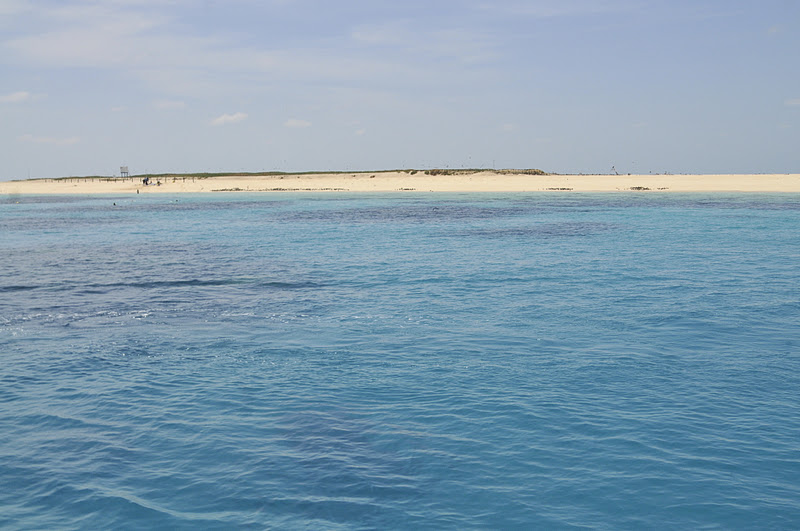
The Great Barrier Reef is off Australia’s northeast coast and contains hundreds and hundreds of islets and reefs each different from the last. As oceans have risen during the past 40,000 years (due to glacial melting) millions of square miles of land has been inundated. In some places conditions were right for reef-building corals to get started. As water rises several things can happen to a reef; it will be submerged, shaded and die or it can grow upward or if the water is from freshwater land source it can die from lack of essential aquatic minerals.
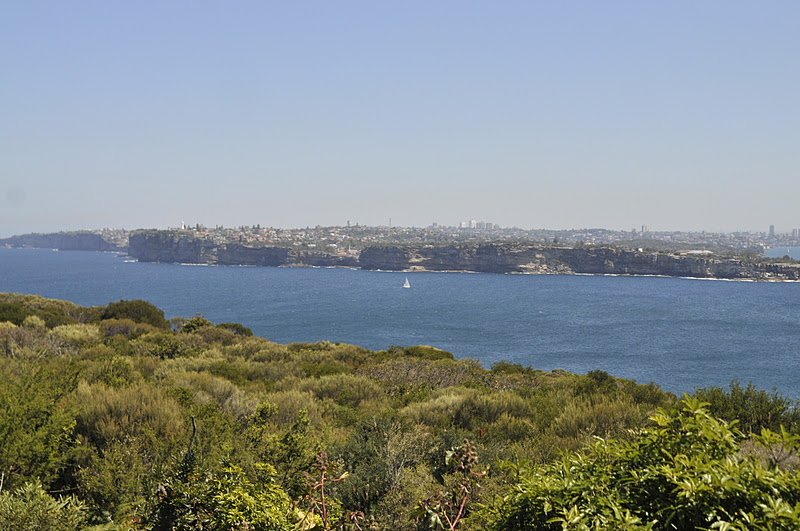
We often think of Sydney as a bustling city with lovely parks, spectacular bays and coves and vistas, and as the home of the Sydney Bridge and Opera House. But the east coast, and this east coast city, is much more than that.
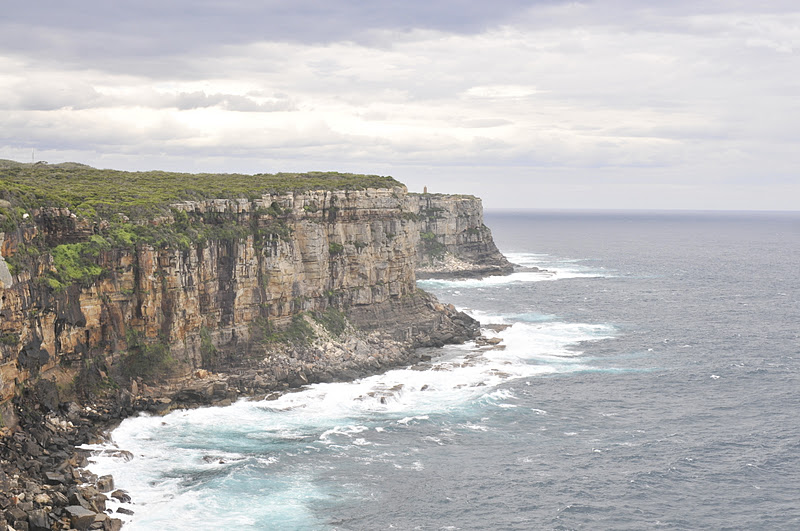
The substrate that makes up the Sydney area is a hard sandstone that has been used for building and for building on. In many areas the coast consists of cliffs, rocks, and small sand beaches.
The famous beaches of the Sydney area (like Manly and Bondi) are within an hours drive of the Central Business District. Sydney Harbor has a small mouth opening to the sea that is protected by these cliffs. Once inside you will find a convoluted maze of points and bays. The sandy beaches are area that trap littoral sand on the ocean side of the cliffs. The city provides a complex ferry system to move citizens from home to work and all around the harbor.

Each place you visit is but a function of the geology. Look at the overall structure of an area; marvel at earthquakes and honor volcanoes.

Tasmania – Well Worth the Trip

The author of a book on the natural history of Tasmania, Ted Davis, is a friend ours and lives on Cape Cod here in Massachusetts – go figure. We picked Ted’s brain and got some ideas about how to visit this island-state. We first allowed two days and then upped it to three full days and two half days — and that was no where near enough. Actually the author of Where to See Birds in Victoria, who lives in Victoria, Australia, was equally helpful as he corresponded by email and answered questions (equally silly to those questions we asked Ted) without snickering. All in all we were very lucky in planning the trip and found everyone we corresponded with to be gracious and helpful.

But back to Tasmania. This is a beautiful island. It reminds me, at least along the east coast, of areas like Maine and Nova Scotia near Peggy’s Cove. A lovely shore with trees, rocks, and pocket beaches of white sand. Our plane touched down a bit late, we located our rental car after declining the mini that was offered we ended in a brand new Renault for $8 a day more. I pulled over to the left-hand side of the road and we headed off to the north; our destination was, what turned out to be the very small town of, Triabunna. (That is pronounced like as pastry clerk might; “why don’t you “try a bunna” today?”)

The ride was great fun. We headed rather quickly uphill into our first eucalyptus forest and saw our first wallaby (dead on the road). We stopped and took the view here and there and birded and enjoyed the countryside – and Tasmania has lots of countryside. Like most of Australia there are lovely places and few people. Thus coastal communities that would be bursting with tourists and clogged with traffic here are much more low key and enjoyable down there. There were dozens of places where we said, “I could live here”. Most Australians who fish or vacation along the shore have a caravan (a small pull-behind trailer) or rent in the community they vacation in. Thus we saw very few second homes or condos anywhere in the country. All in all it seemed comfortable and unhurried.

We went to Tasmania for several reasons; there are twelve endemic birds, everyone says it is nice, and, of course, the off-chance of seeing a Tasmanian Devil. We did see the endemics and Tasmania is really very nice, but the devil takes a lot of work and driving to see – and we didn’t. As we headed north from the airport we came across a road-killed Bennett’s Wallaby. There was a Forest Raven picking away at the animal’s soft parts. This rather grotesque activity was recorded when we stopped to walk the edges of the roadside forest enjoying the vistas. When we reached the towns of Orford and Triabunna we spoke to people about the wallaby and the raven. They mentioned that in the olden days (less than 20 years ago!) it would be Tasmanian Devils that came in the night to help clean the road edges of carcasses. But the devils have all but died off on the eastern portion of the island due to a cancer (DFTD – devil facial tumor disease, a non-viral transmissible disease) that causes tumors on the face and eventually causes difficulty eating and eventual starvation. The tumors mostly occur on the face and this makes the transmission of the disease rather easy via shared food items or fighting/biting.

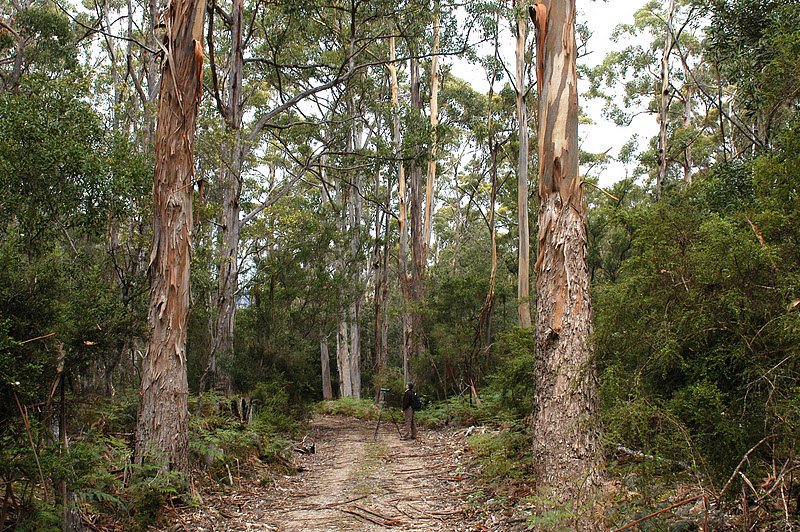
Most of the trails in the parks are wide and pretty well maintained. Here Fran stands among shaggy-barked eucalypts, scanning up 100′ and more for passing birds and maybe a koala. There is a concerted effort to remove feral plants and animals (dogs, cats, rats, and a range of plants) from the parks. As many of the creatures evolved with minimal predation they lack many of the evasive characters we see in creatures from other continents. 

We came to Triabunna because we wanted to get to a National Park called Maria Island and Triabunna (I like saying Triabunna) was the place to catch the boat. We stopped in at the Visitor’s Center (a usual and well-staffed Australian feature) down at the boat ramp and learned about the town. We also learned about Maria Island, the ferry, accommodations, where to have dinner (and where not to have dinner), and enjoyed the vivacious ladies (Marian & Elizabeth) at the information place. We got our room and went for a drive through the countryside looking at the terrain and its birds before dining on calamari and rump steak. We were rewarded on both counts; that is with the terrain and the birds, not so much with the dinner. As I mentioned, Tasmania is lovely; even the Aussies come here for vacation. It is quite southerly and is thus the cooler part of the continent and its forests and lands are more lush than the continental portion of the country and the birds are rather tame and abundant. Much as Texans and Floridians head north in June, Jul, and August, the Australians head for Tasmania in the summer.

We caught the boat for Maria Island the next morning. It was a one-hour ride to the island’s pier. During the ride we had a few Pacific Common Dolphins and a non-stop commentary by Michael Cook the captain. He is a young man who is running for Town Council and cuts a rather dashing (local, a bit eccentric, bright-eyed, and concerned for the area) figure both on shore and at the helm. It was cool and a bit gloomy with a sporadic heavy mist and he was lightly clad and barefoot. Not unlike many coastal folks along the south shore and here on Cape Cod.

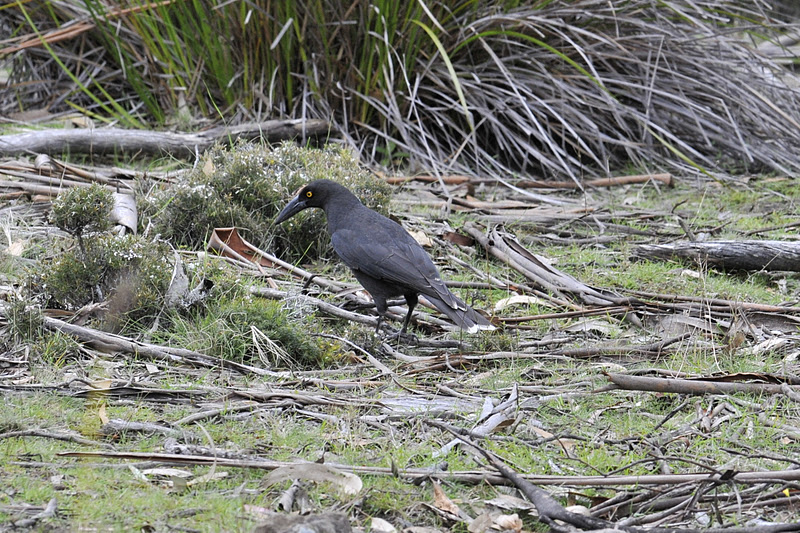
The Black Currawong is a Tasmanian endemic. We saw several on Maria Island. They are in the same family as Butcherbirds and Woodswallows. The most common member of this group is the very common Australian Magpie.
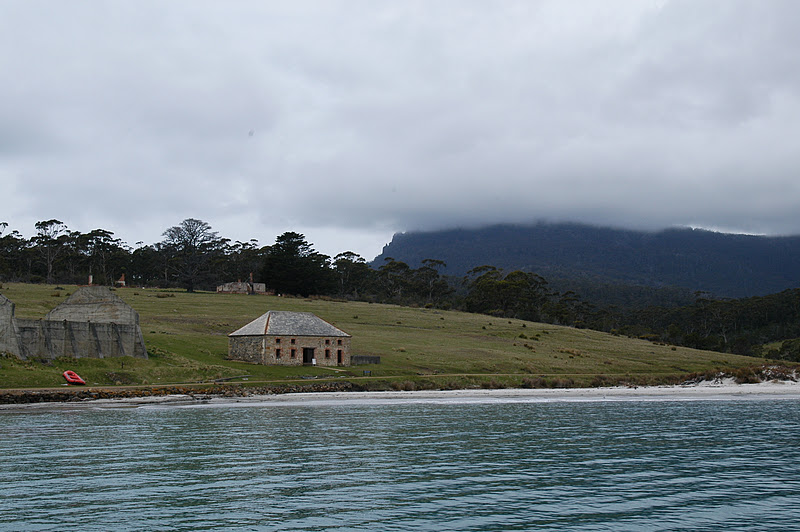
Maria Island has been occupied by modern colonists since 1880 or so and has been home to a silk-making  industry, vineyards, farming until 1972 when it became a National Park. The old buildings stand as a reminder of these earlier times. There are miles of trails and wildlife is abundant on Maria Island. Of course coastal Aboriginal peoples used this area for tens of thousands of years before the Europeans arrived. The coastal Aboriginal group (Tyreddeme) were quite flush with food and were much more sedentary that those peoples of the outback (this name for the remote, arid portion of the country applies to about 80% of the land). Like many of Australia’s early settlements the island housed convicts for about fifty years. It was an active detention area from 1825 to 1832 and again from 1842 to 1851. Three of the old stone buildings remain.
We never knew quite what to expect in Tasmania, actually throughout Australia. In the USA we are familiar with habitats and seasonal uses by wildlife. Things change all the time but there are generalities that remain useful in planning, thinking, and in identifying. In Australia we were way out of synch. Did things migrate? If so, is it to or from where we are? What time of day or year do they sing, display, call, feed, wander, or hide? On Maria Island we were lucky to see many of the native animals. The above Wombat was with its mother and just hunkered down to wait for us to pass. They were just snuffling around in the mid-day gloom. We also saw single adult animals.
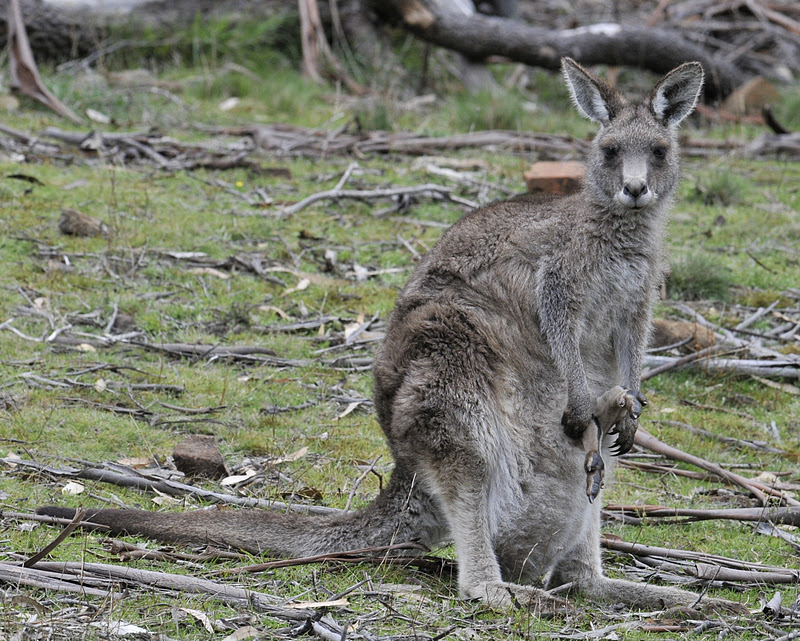
There are several hopping animals on Maria; both kangaroos and wallabies can be found. We had lots of Eastern Gray Kangaroos on the open grassy areas and a couple (probable) Red-necked Wallabies in the forest. If you look closely at the female Eastern Gray in the photo above you can see the feet of the joey that has clambered headfirst into the female’s pouch. The family to which kangaroos belong also contains wallabies, wallaroos, pademelons, and tree kangaroos. In general the kangaroos are the largest and the pademelons are the smallest. The Tree Kangaroos are now largely found only on the islands to the north (like New Guinea) and are tropical forest animals. The kangaroos are the large grazers much like antelope, bison, and deer and the wallabies and pademelons are more equivalent to rabbits and dik-diks, the smallish grazing animals found on other continents. 
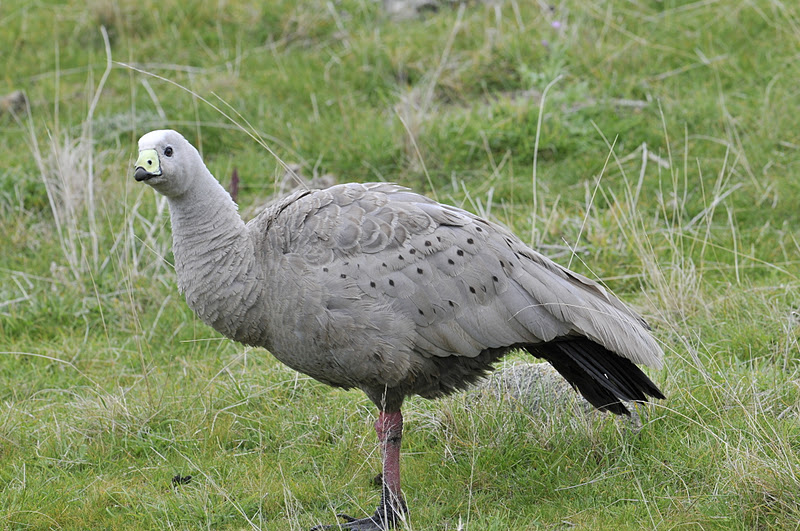
The Cape Barren Goose is a strange goose-like bird that may be a shelduck or a swan or a goose or a member of the now-extinct New Zealand goose group. Perhaps DNA-work will provide this bird with a taxonomic home in the near future. It is a rare goose of southeastern Australia’s islands. It can drink salt and brackish water and thus can remain on the offshore islands year-round. It is named for Cape Barren Island where it was first sighted by Europeans; however many small islands along the SE Australian coast were named Goose Island by early explorers.
Call me crazy but I like this mega-beaked gull. It may look like a Great Black-backed (eastern North America) or a Kelp Gull (southern South America) but the Pacific Gull is especially cool having this huge red-tipped beak. It may be rather common and easy to see in appropriate habitats – all you have to do is travel the south coast of Australia or the east coast of Tasmania and you will find them. The Pacific Gull reaches adult plumage after 8-10 molts taking five years.
The Tasmanian Native Hen (TNH) is a flightless gallinule of impressive size. Like the birds of New Zealand the Australian birds, mammals, and reptiles had only a few rapacious predators. There are many carnivorous animals to be sure but flight was not always necessary for escape and survival. New Zealand leads the way way with both ancient and modern flightless birds as there were no mammal predators in New Zealand at all until dogs and cats were introduced. But, in fact, many preadtor-free Pacific Ocean islands have evolved flightless birds (usually water birds like rails and gallinules). The TNHen is found in grassy areas and thus can be seen around agricultural areas. It is certain that modern land use has allowed the TNHen population to grow. There is certainly more grass now that 200 years ago and almost certainly more native hens. We found them in remote parkland and developed farm land as well as in urban areas at (street runoff) retention basins in the middle of Hobart.
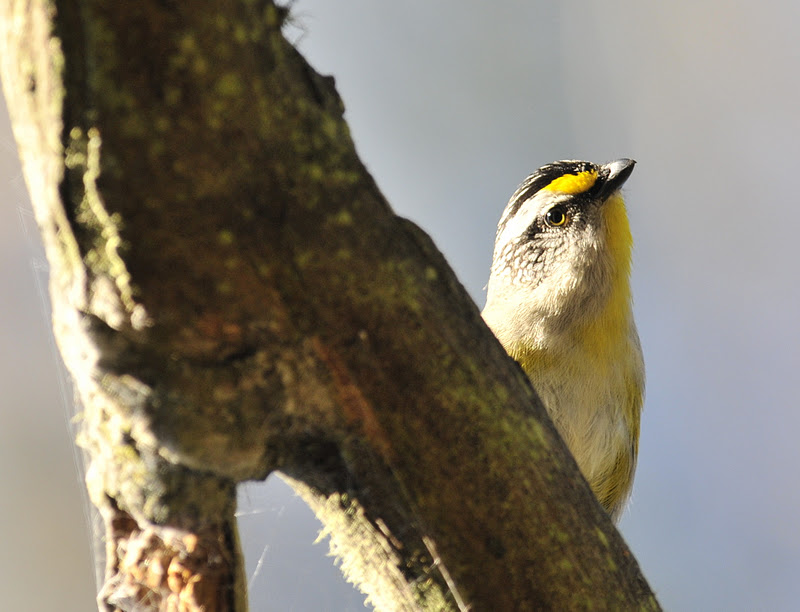
The birds shown above and below are pardalotes (par-dah-lote {as in float}). There are three species of pardalote in Australia and we saw two of them in Tasmania. The Striated Pardalote is seen above and the Forty-spotted Pardalote is below. The other species is simply called the Spotted Pardalote as it has way too many spots to count. 
They are all tiny birds that nest in burrows or holes in trees and spend time foraging throughout the forest, often in the canopy. We were lucky to get images of them. 
The striated (above) happened to be building a nest in a hole in a branch in a eucalypt that was right above us as we waited for the 40-spotted to return to an area where it was said to be building a nest. We hunkered down for well over an hour and were rewarded by visits from both species. We never would have found the 40-spotted without help from a local photographer (also hunkered down and covered with ferns) as they were no longer singing (as with many species of animal, once mating starts and house-building begins the romance ends). 
The Striated Pardalote is quite common throughout most of Australia and we saw it in many places. There are six named races or populations of this “stripe-crowned” pardalote. Geographic isolation and adaptation drives evolution.
The, very rare, Forty-spotted Pardalote can be reliably seen only in southeastern Tasmania and then is restricted (largely) to two islands (Maria and Bruny).

 As I said we had a great visit to Tasmania. It is a lovely place for naturalists to hang out and we now understand why Ted Davis chose it as a place to visit again and again. Frans says it all!!

.