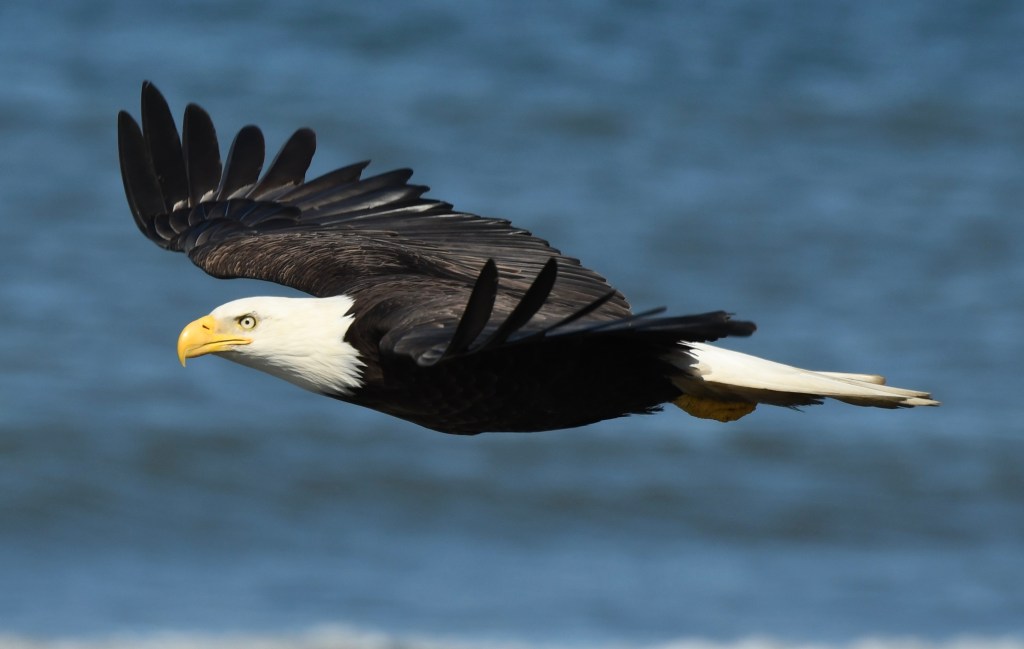
The iconic Bald Eagle is a common bird of the Alaskan coast – and inland as well. It its mostly a fish eater and coastal birds are easy to spot. We watched one catch a salmon a good quarter-mile offshore and swim (a wing-flapping over-arm stroke) holding the fish in submerged talons. After this heroic effort the female eagle came and took the fish. They both eventually ate from the carcass but the female let it be known that she held all the cards. He was, perhaps, the hunter and chef; but more likely he was the waiter, server, and bus boy.
I put this Bald Eagle photo here because Alaskan eagles are so common and familiar that anyone who has been to Alaska would wonder where the eagle was if I didn’t. In fact this page which will show some of the birds of the Kenai Peninsula and will not mention eagles again. There is just to much variety to see in that area. The Kenai is a bulge of the mainland that sticks sort of to the southwest and underneath Anchorage and start of the Aleutian Peninsula. The towns of Homer, Seward, Seldovia, and Soldotna are out on the Kenai. Fishing has long been the reason to live on this beautiful land mass; but now tourism, birding, and hiking are competing with fishing. There are bears and moose all over the place out here so hikers need to be aware. But there are birds as well; sandpiper types, gulls and terns, grouse, and both woodland and grassland birds. Enough to keep the birder happy for days on end.
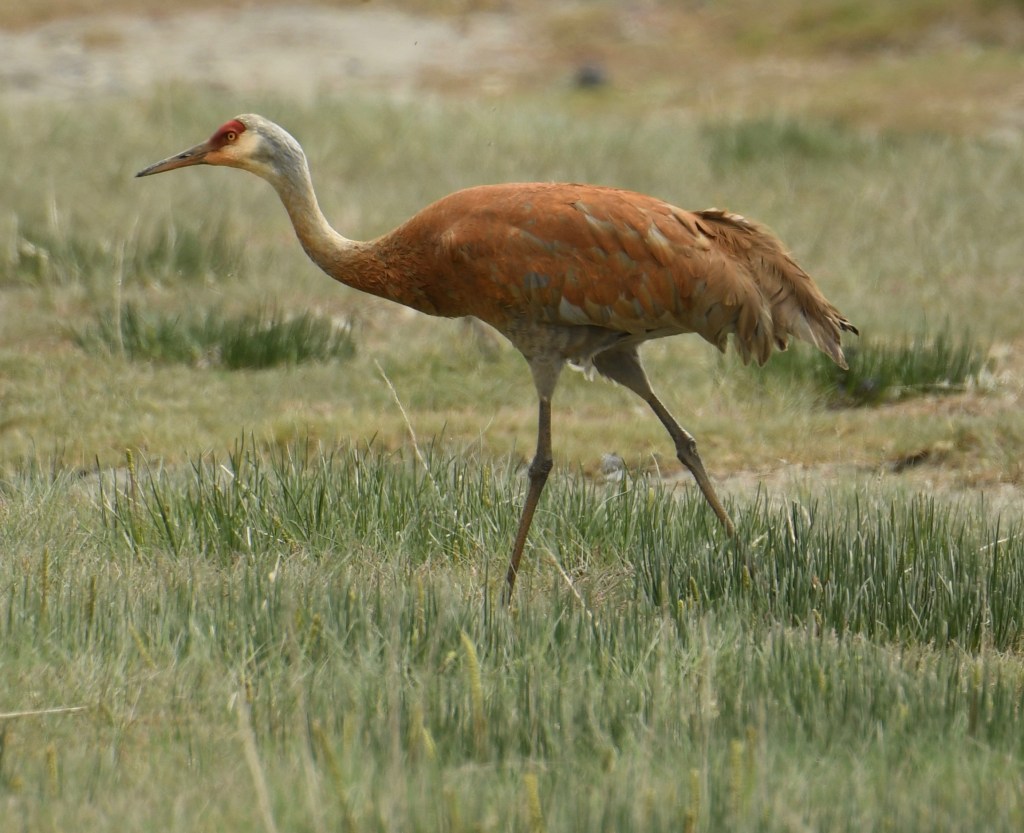
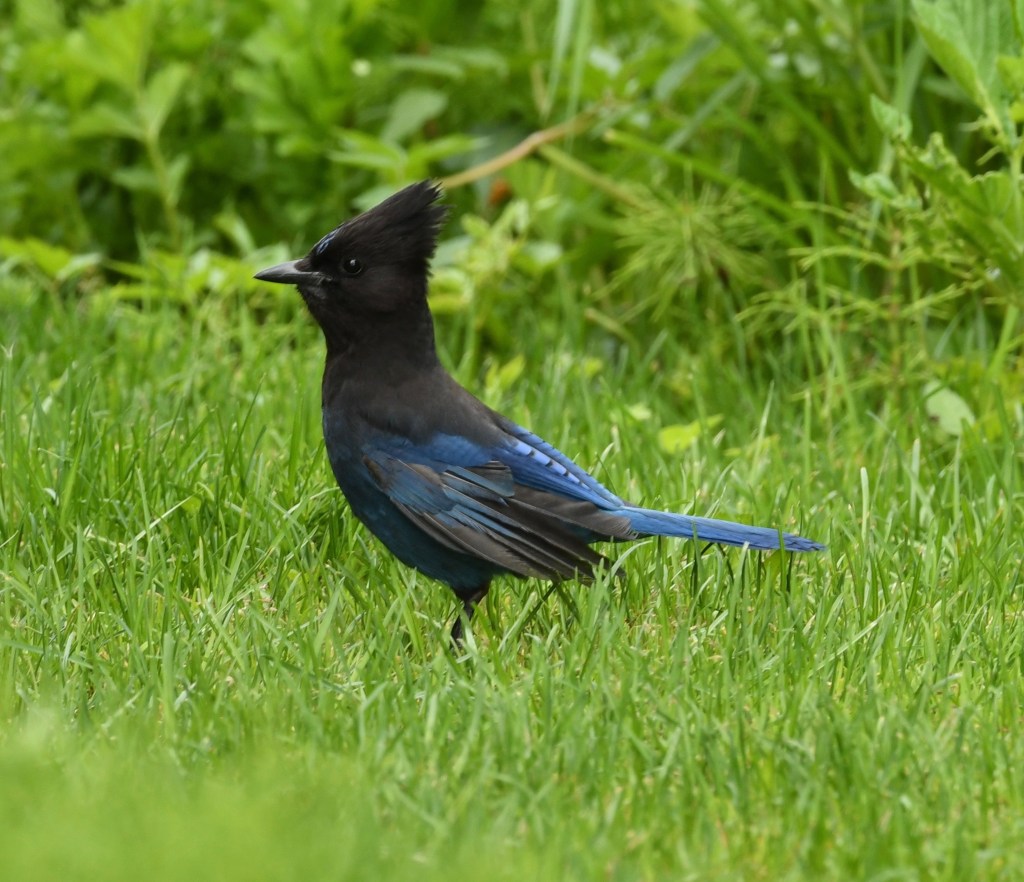
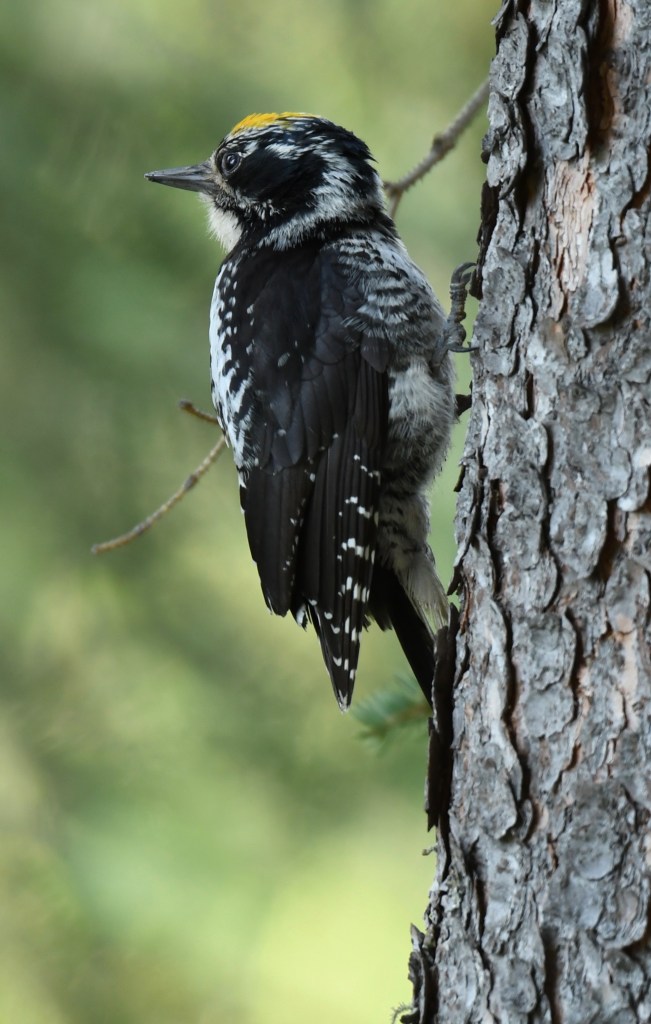
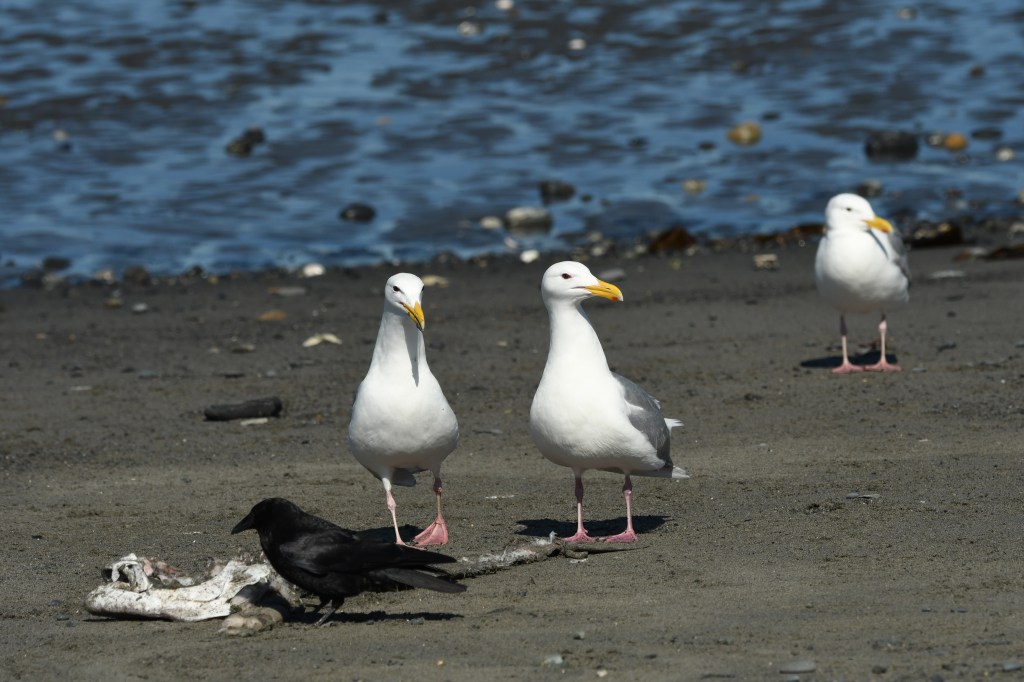
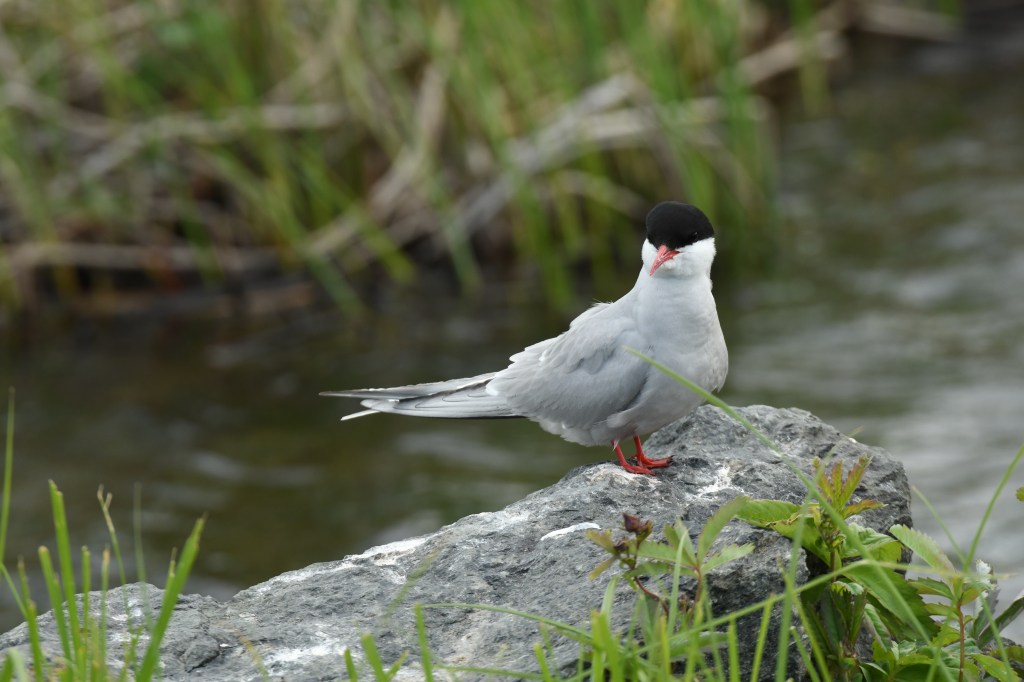
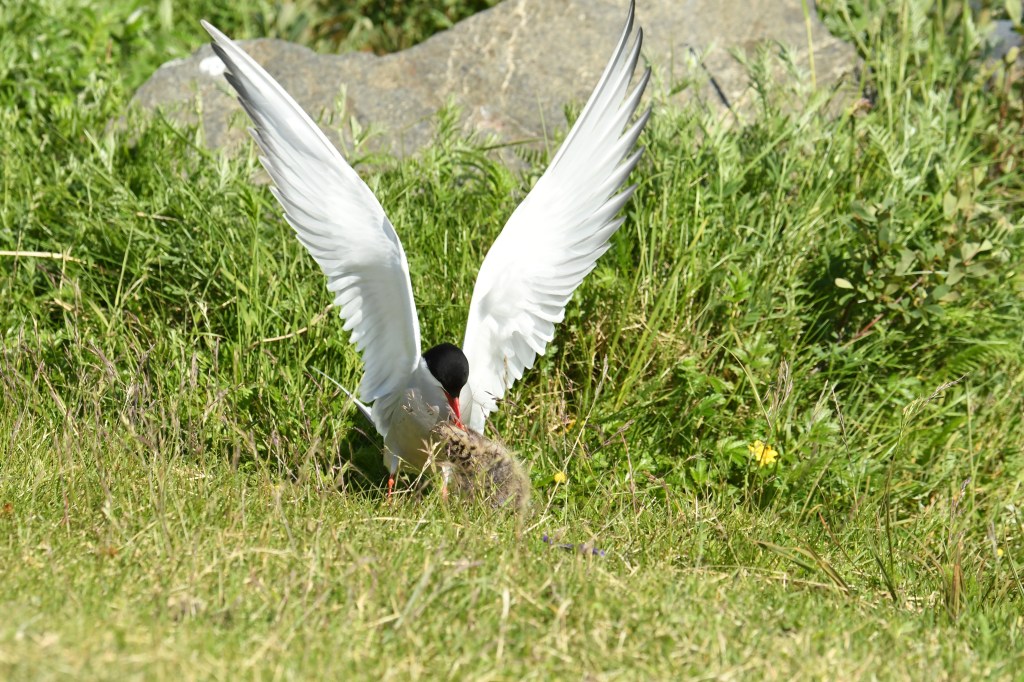
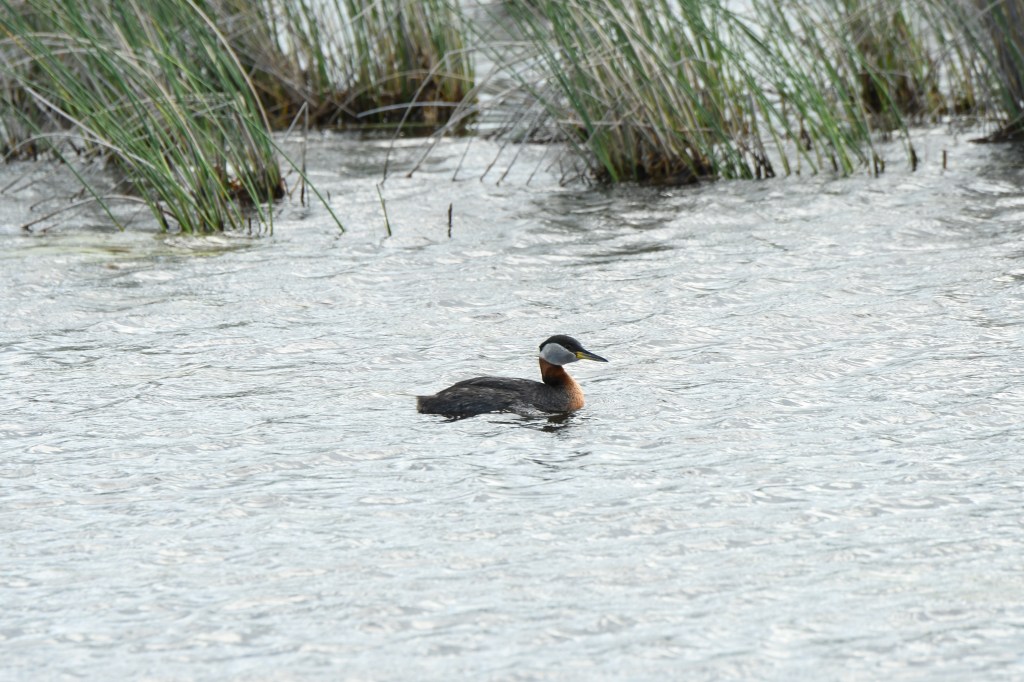
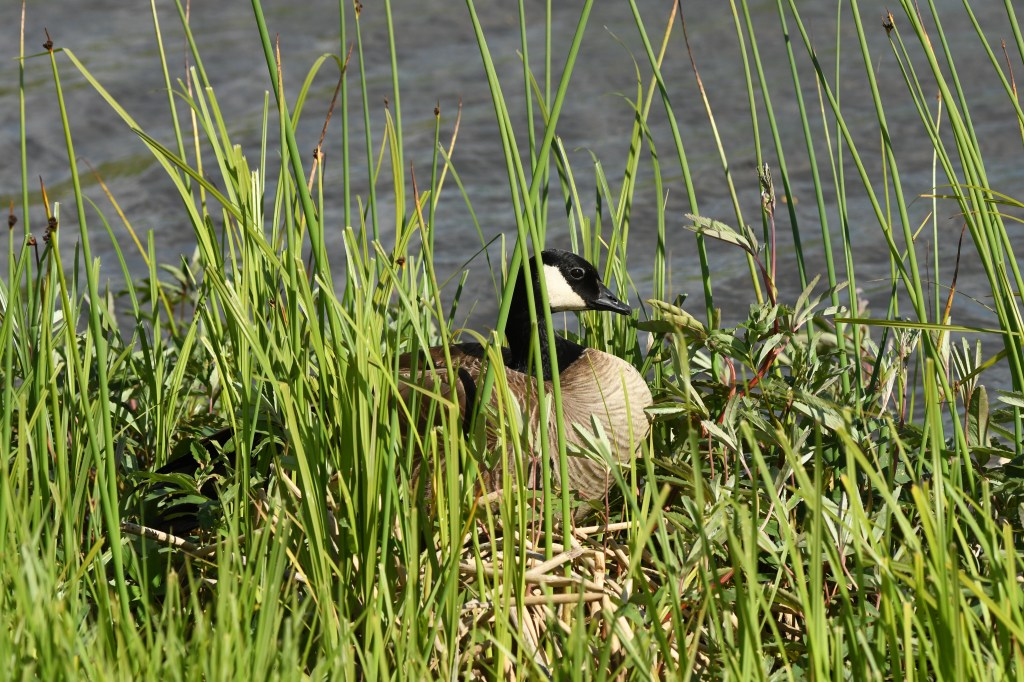
Sandhill Cranes are widespread; with breeding populations in Florida and Alaska, but not everywhere in between, it is a bird that might appear almost anywhere in the continental US; and perhaps better said – anywhere in North America. These birds are the size of Great Blue Herons and perhaps best known for the migratory stop in Nebraska when tens of thousands gather on the Platte River to refuel as they head north. There is also a stunningly large number of Sandhill Cranes that winter in New Mexico at Bosque del Apache.Alaska’s forest are grand. There are large trees of many types; coastal forests are temperate rain forests with Sitka Spruce, Hemlock, and cedar dominating and the inland forests are great swaths of birch and spruce forest. In these forests are specialized finches and chicken-like grouse. But one of the most likable birds is the Stellar’s Jay. Many parts of the USA have Blue Jays or perhaps Scrub or Canadian Jays. The handsome dark Stellar’s Jay is a bird of western high elevations and lower elevations as you head north. In highland areas they extend southward into Nicaragua and north to the Kenai Peninsula along the Alaskan coast.Forest means trees, trees mean woodpeckers. In Alaska the birder looking to flesh out a life list will be searching out Black-backed and Three-toed Woodpeckers and the Red-breasted Sapsucker. The other woodpeckers can be found widely to the south. These three species can be found to the south as well but the search may be more difficult.Gulls of all sorts make it into Alaska. About 15 species are seen annually. The most widespread of the gulls is probably the Glaucous-winged Gull. They are abundant along the shore lines and up major waterways. They do have the ubiquitous Herring Gull as well. But the uncommon gulls like Ross’s, Ivory, and Sabine’s are what bring the birders. The three gulls in the image above, waiting for a Common Raven to finish with a salmon carcass, are Glaucous-winged Gulls.It would be no surprise to find that the Arctic Tern is the common tern of the Alaskan shoreline. The Common Tern, easily seen in the lower 48, is not at all common in Alaska. The all red bull of the Arctic Tern and its rather short legs make the ID easy; but when they are the most frequent tern in the area it isn’t to difficult to make the identification anyway. The lower image shows an adult feeding some sort of aquatic morsel to the brownish puffball which is its youngster. Alaska being where it is and what it is has a great many undeveloped and uninhabited areas. Thus wildlife is still common and widespread. In many areas, Anchorage City for instance, the wildlife persists right in town. This is a Red-necked Grebe; a diving bird that looks a bit like a duck but has followed a very different evolutionary path. This one was nesting in a small backyard pond in the city.Lastly it should be pointed out that some geese and ducks are widespread and well adapted to life in a wetland; any wetland anywhere. The Canada Goose and Mallard show this in a very widespread way. Actually there are many separate populations of Canada Geese scattered around North America. Alaska has big ones and small ones and several types in between. There are the Vancouver, Dusky, Lesser, Taverner’s, Aleutian, and Cackling Canada Geese in Alaska. Each population has a breeding area and a wintering area often separate from other Canada Goose populations.
Please consider these images to be copyrighted and contact me for permission to use them.
Many birders head for Oregon, especially around the town of Sisters, to tick off an array of woodpeckers. I had this opportunity when a friend had already booked a room and rented a car. The woodpecker list is impressive; White-headed, Pileated, Three-toed, Black-backed, Lewis’s, Downy, Hairy, and lots more. The woodpecker search was very successful; mostly because we joined up with a pretty hardcore weekly birding group that was out for the day and we spent the entire day in the hands of local experts. It was the kind of luck that you dream of. Even though we didn’t know we would be in the back woods all day and had no lunch with us – we may have gotten hungry but it was well worth it.
The next day we went downhill from Sisters toward the city/town of Bend and then down into the flat land; Sisters is in the high country and the woodpecker story will have to wait. Having satisified ourselves somewhat with the woodpeckers we were looking for sagebrush birds and others that avoid the tall evergreen forest. We headed east and south dropping in elevation as we went. From Sisters we headed for Brothers (really) but then dropped to the south toward the Fort Rock State Natural Area. Fort Rock is a site worth visiting on its own to hike, bird, photograph, and enjoy. It is a volcanic remnant; a tuff collar just sitting there. I am a bit surprised that I have no images from this area – maybe somewhere. It is a large rock formation shaped like huge a steep-sided dish with an opening where a portion of one side has caved in. You can imagine cattle rustlers or ranchers keeping their stock in there for safety or to keep them out of sight. You can walk into it or around it; really cool.
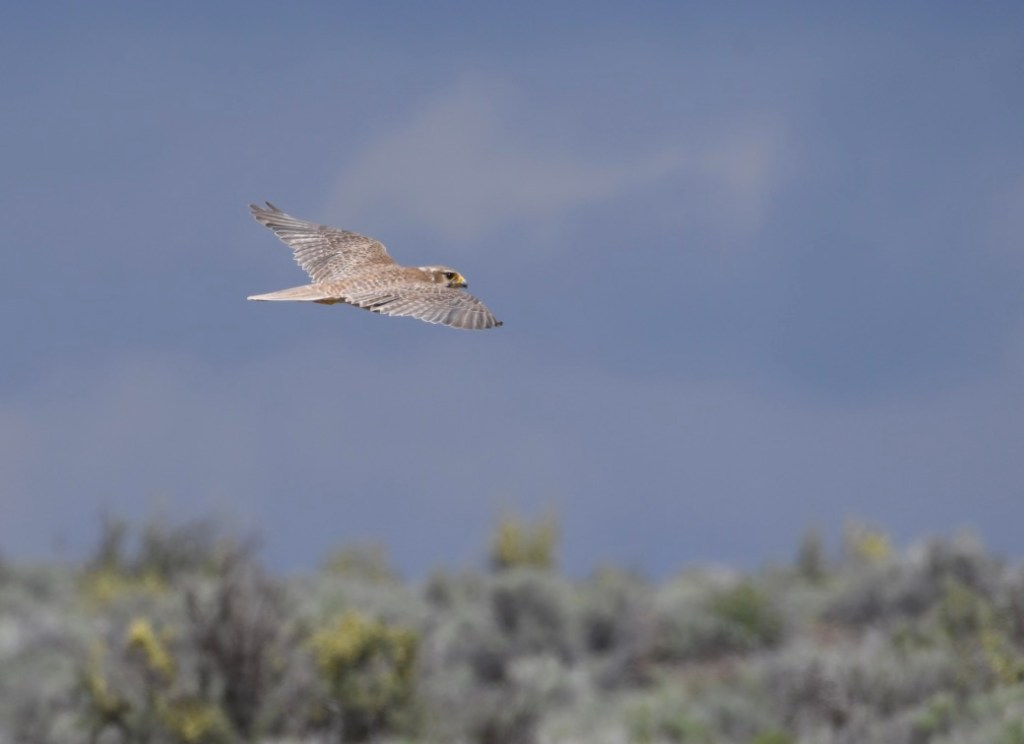
Since I don’t seem to have any decent images of the Fort Rock area I will stick in a photo of a Prairie Falcon skimming over the sage brush; that’s the best I can do for now.
While in the low country we headed west into the foothills and reentered the forest lands and the territory of the Deschutes National Forest (1.8 million acres, lava caves, tall trees, and birds). These woodlands, especially at the higher elevations, are full of tall and very tall trees. The tall ones might be Western White Pine, Western Larch, and Douglas Fir. The very tall tree is the Ponderosa Pine. As we headed away from Fort Rock and back into the fringes of the forest there is a spot called Cabin Lake. It isn’t much really, no lake for instance, but it has two bird blinds with food and water – and that made it just super.
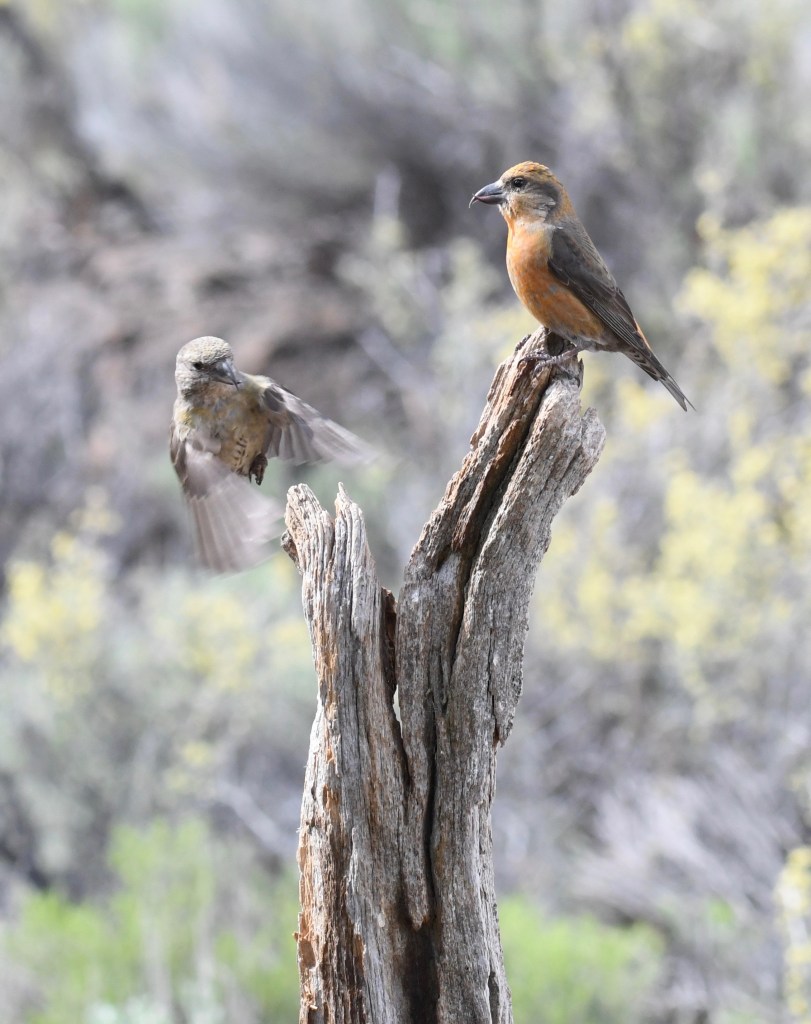
There were White-headed Woodpeckers, Red Crossbills, Clark’s Nutcrackers, Pinyon Jays, Western Tanager, and Cassin’s Finches in good numbers and right outside the blinds. It was enough to get a birder’s heart thumping.
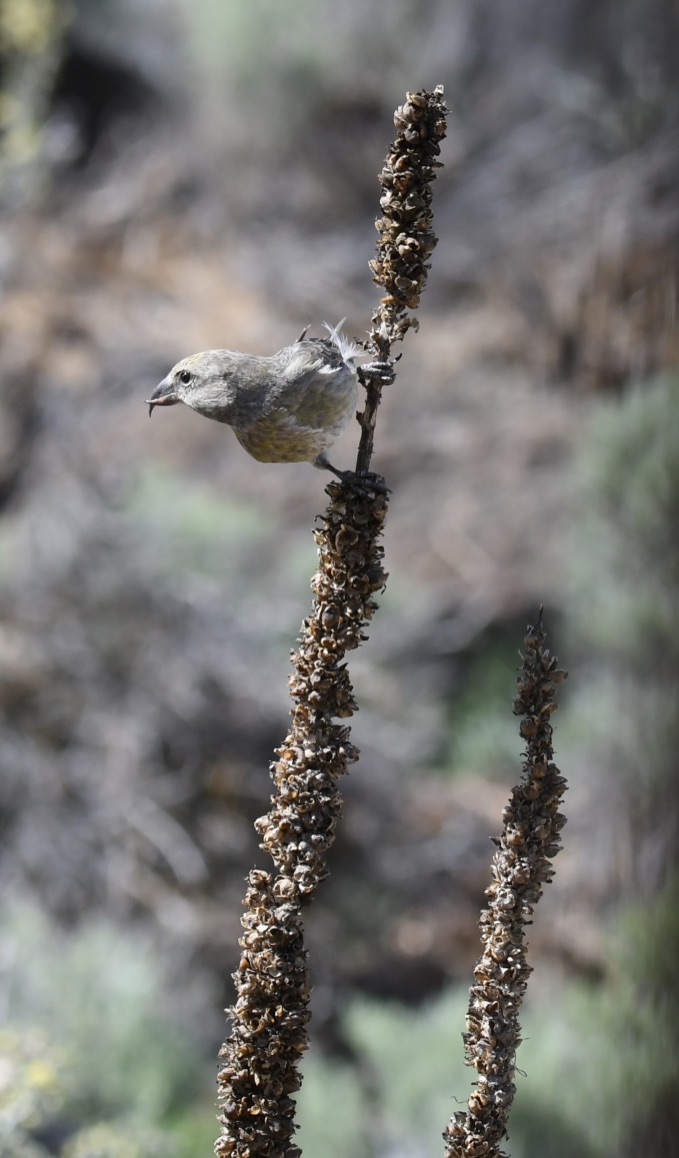
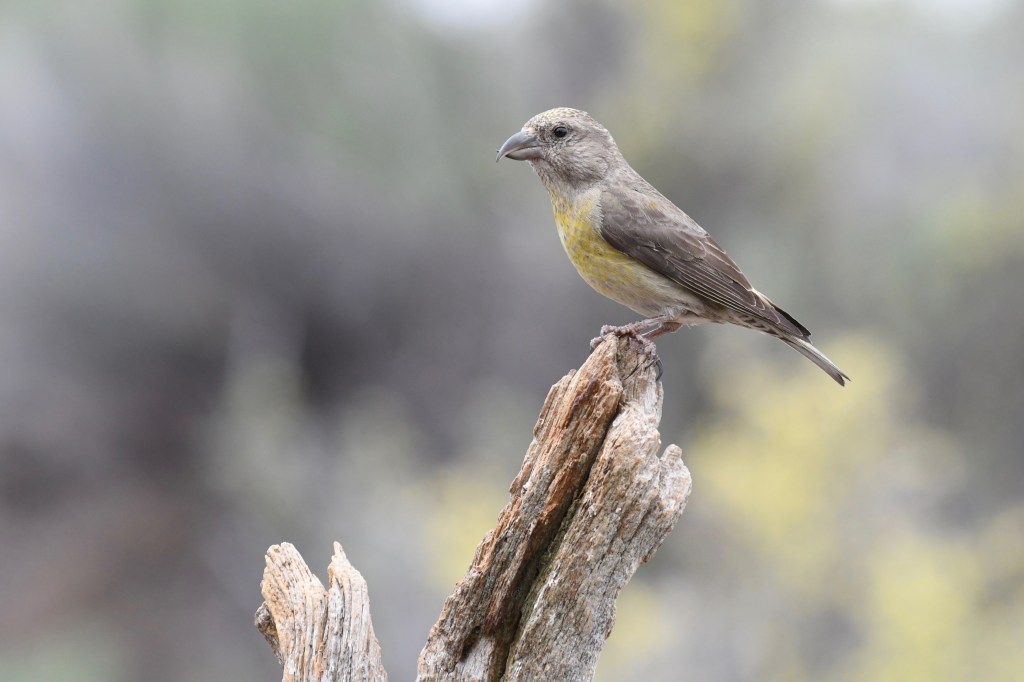
The Red Crossbill is quite a bird; not just for its adaptations (and evolution has been pretty busy in that realm) but also in that there may be ten or more populations that do not interbreed – they might turn out to be separate species from the same origin. Darwin’s finches out in the Pacific (on the Galapagos Islands) will quickly become a second thought once the DNA relationships get sorted out. The bird above is a Red Crossbill, probably an adult female.This bird is very similar to the photo above, but offers a good look at the “crossed” bill. This arrangement is found in all populations but varies significantly in both bulk and length. The bill is specifically adapted to a population of cone-bearing tree. Each population of Red Crossbill favors a certain species of evergreen. They are not totally dependant on the specific tree (they eat black oil sunflower seed for instance) but probably the trees they favor has driven the size and shape of the bill. They “scissor’ off the scales that shingle the outside of a cone and eat the seed that was once covered by the scale.Young Red Crossbills look like the large finch that they really are. The crossed bill develops quite early in the birds’ life and they can feed on cone seeds right after leaving the nest.Here are two sort of yellowish gold birds (both Red Crossbills) in a water feature at Cabin Lake. The Cassin’s Finch on the upper-left is just relaxing. The crossbills vary in color within populations though most populations have a “look” that is pretty common. But identification of all crossbills is best done by listening to their calls. This part of Oregon favors the populations of Types 2 and 5. Pretty boring names for sure. The study of crossbill populations and habitat use is under way right now. A great set of projects for graduate students or birders interested in citizen-science.
Here a bright male watches as a duller female joins him on a perch.
So, a nice opportunity, and some good luck, allowed us to see many of the forest birds, especially the woodpeckers, and also allowed for a day down in the flat land looking at all sorts of things. The fringe of the forest had the crossbills and the sagebrush had Vesper and Brewer’s Sparrows and a Prairie Falcon. A great weekend was had. Thanks Kevin.
I’ll do a page on the woodpeckers soon and another on the mammals of the areas – small mammals that is. And, I’ll look for scenery photos as well.
The Falkland Islands are small and distant from most anywhere else on the planet. They are cold, often dreary, yet they attract about 20 times as many visitors annually as there are residents. Why? Because it is wild, remote, barren, and full of ocean-going birds and marine mammals. The nature people come here; in very large numbers. There are no trees. It is somewhere between tundra and arctic.
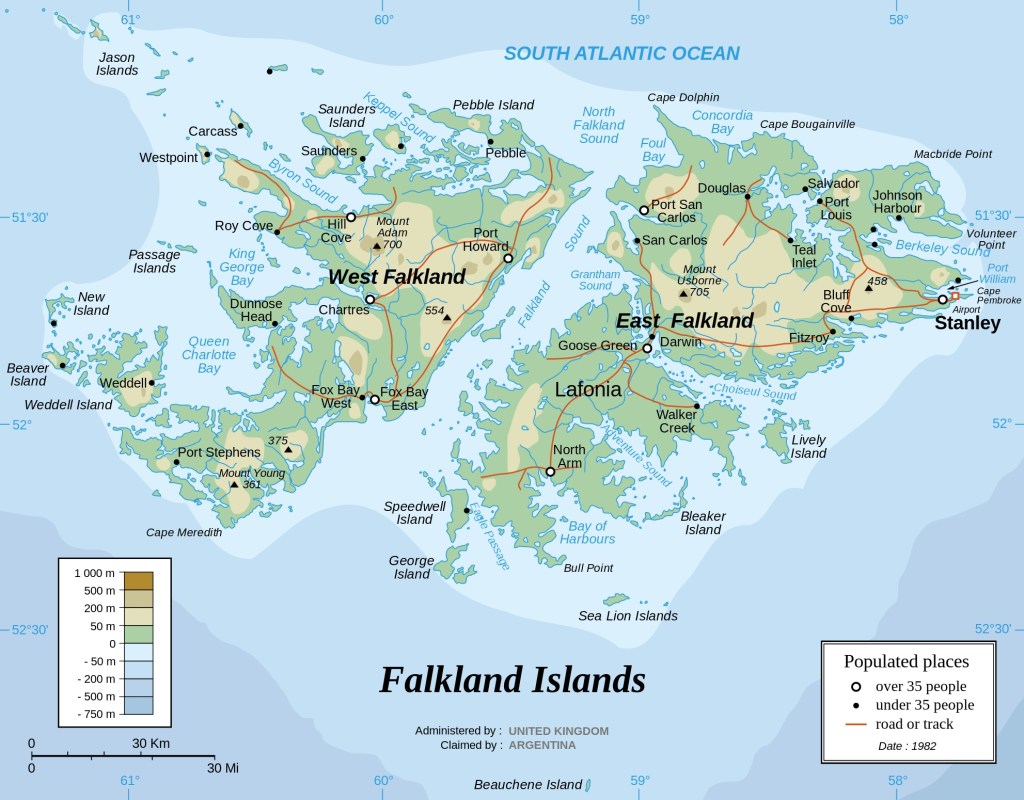
These islands (more than 775 small ones and only two big ones) total about 4,700 square miles which is larger than Delaware but smaller than Connecticut. There are about 3,350 island residents who are mostly British in heritage and loyalty. Two thirds of the residents live in the one town on the islands – Stanley. Stanley is found at the eastern tip of the East Falkland island. It has a protected deep water port.
The map above shows the route of a grand nature outing to the Southern Hemisphere. Starting in Ushuaia, Argentina the ship goes first to the Falklands, then way out to South Georgia, and returns via the Antarctic peninsula. This is one of the trips that nature people salivate over; much like the Galapagos or East Africa. It is the greatest sea bird outing possible and there will be many marine mammals as well; seals, sea lions, elephant seals, whales, and dolphins for sure. And of course, many thousands of penguins of at least six different species.
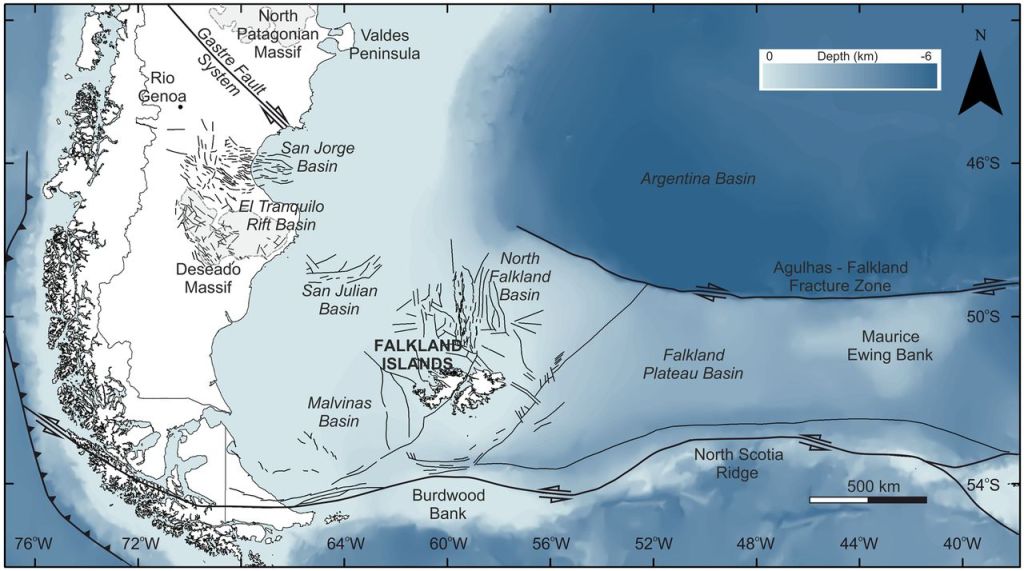
Back in the really olden days the piece of Continental Shelf that has become the Falklands was squeezed between Antarctica, Africa, and South America, mostly a part of Africa. As Africa was separated during that break up of Gondwana, the island fragment got stuck to what was to become Antarctica and was snagged on the Patagonian Ridge, rotated about 180 degrees, and stayed near South America; parting from the African land mass, and Antartica, about 400 million years ago.
Gondwana was a tight hodgepodge of land masses. Most of the Southern Hemisphere land was squeezed in one mass. As it broke up the Falklands and New Zealand were left hanging (in very different locations) as the “parent” lands relocated. In the Falklands case the African continent had a scrape with an underwater plateau and a chunk of Africa was dislocated and remained stuck about 400 miles off the coast of South America. By the way this was the time when India started its long road northward until stopped by the Asian continent. (see image below) This is a close-up of how South America and Africa were about 400 million years ago. The Falklands are those crustal fragments on the shelf east of southern South America.
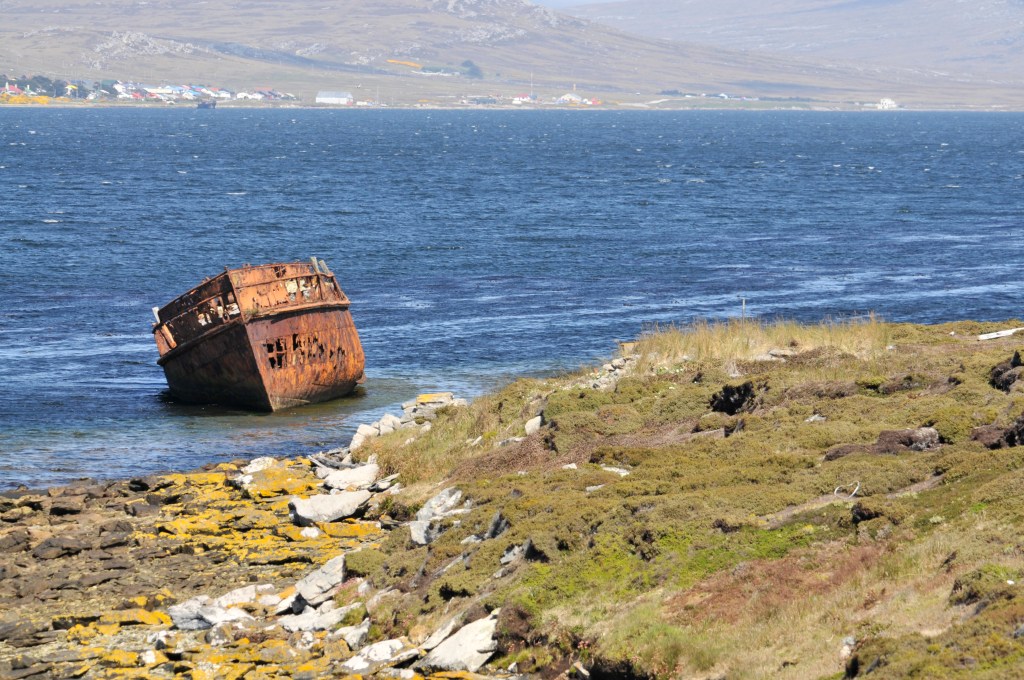
The islands today are not just small they are rather unpopulated. It is a bit lonely out there with no great economy to excite an entrepreneur. The two large islands have a bit of development, especially East Falkland. The tour ships filled with Nikon and Cannon carrying birdwatchers usually stop at New Island, Carcass Island, and maybe Westpoint. This gets the travelers into penguin and albatross colonies and on shore with the one or two people who have sheep out there. If your ship stops in Stanley be sure to go ashore and eat fresh fish and squid – and support these most rural people.
The islands are clustered for the most part. The harbor in Stanley is very encompassing and provides a safe haven, but is not easy to access during high winds and rolling seas. Most of the smallish named places that look like towns are just homes or ranches. Aside from the town/city of Stanley everyone else live in “camp”. This general term encompasses about one-third of the population.
Like most remote places the weather is often rugged, like the landscape. In the Falklands there are lots of foggy, windy, and wet days. In February, the Southern Hemisphere summer, the temperature rarely gets above 60 and rarely below 50. That is as good as it gets. The remainder of the year is less pleasant; though the coldest winter days are rarely below freezing and there is no snow that sticks to the ground. The wind is nearly constant from the west and is usually at 15-25 miles per hour.
So anyway; a long time ago this became a mammal-free zone in the middle of the ocean; a great place for birds that wander to great Southern Ocean to nest. There were/are no native mammalian predators and miles and miles of rocky ledges and grassy swales for nesting. It was, and largely still is, a haven for albatrosses, petrels, cormorants, penguins and a few land birds that have adapted to the stark situation the Falklands provide.
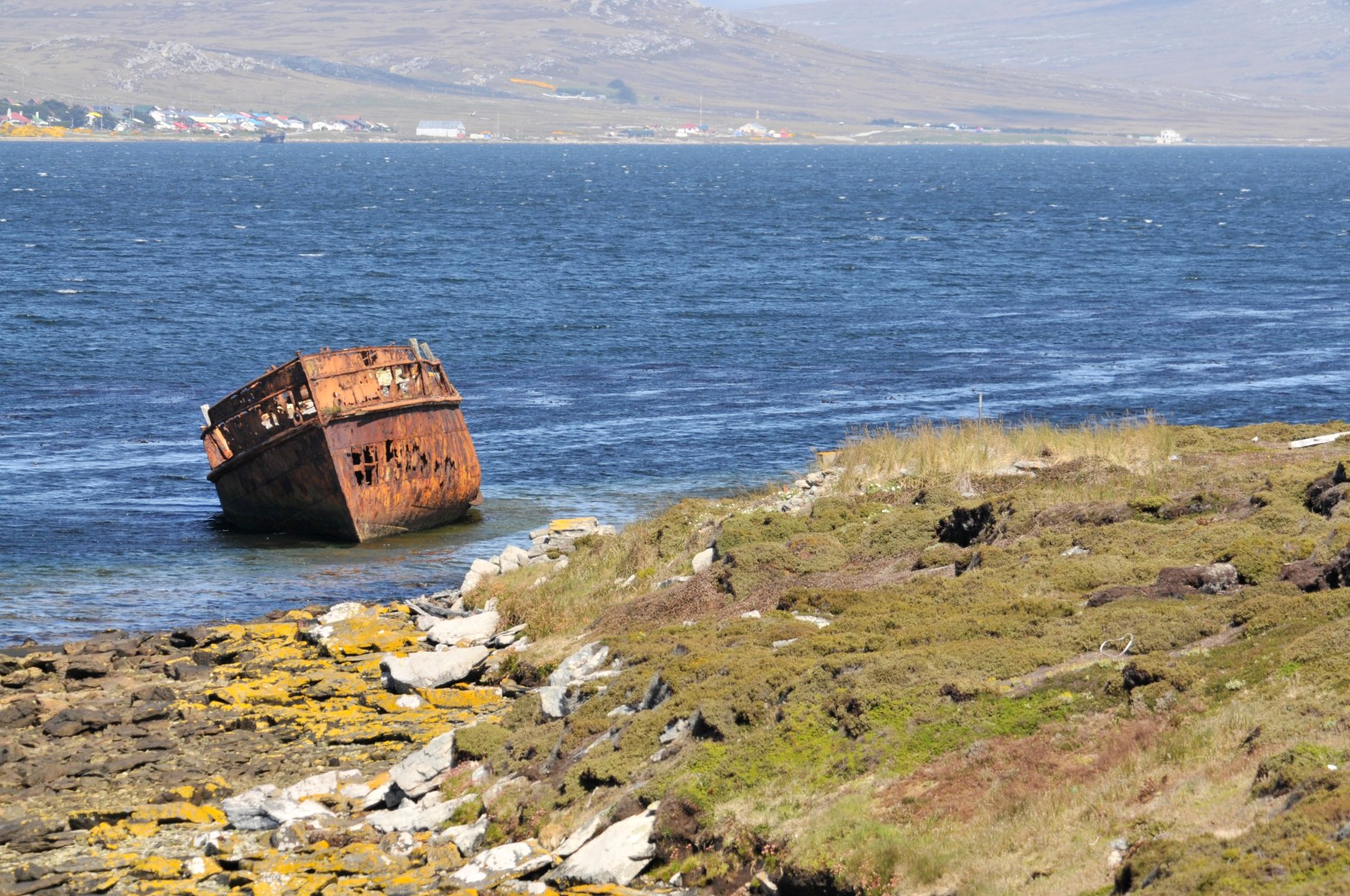
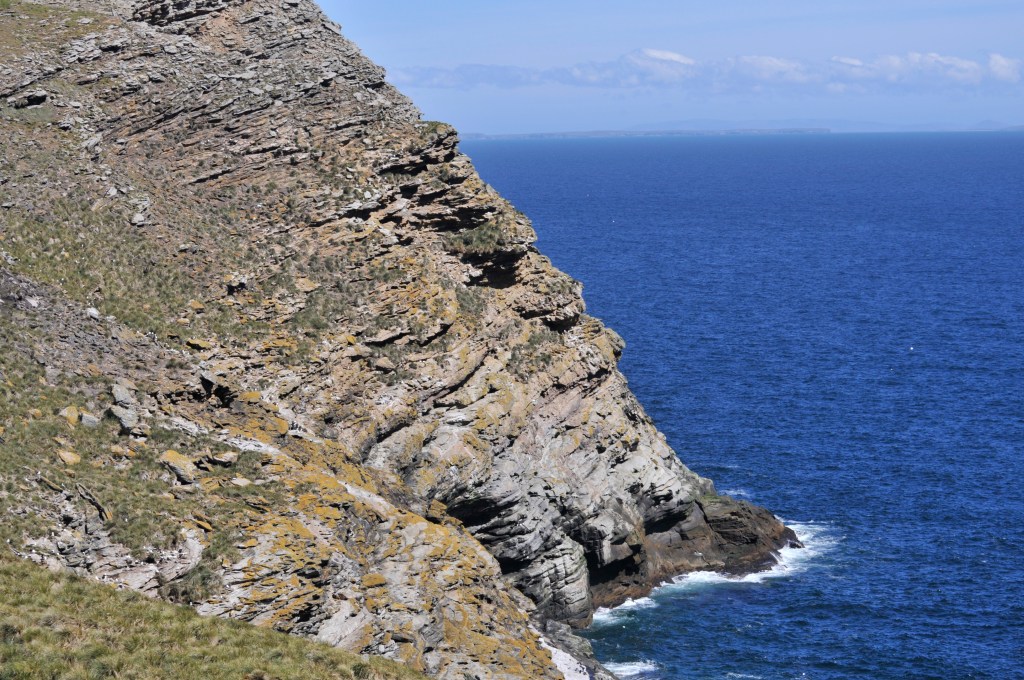
There are scattered ranges and homesteads throughout the islands. Most are remote and stark. Few people live out here and many of the properties are like little three-house villages where everyone works on the property and live with their fellow workers cheek to jowl.But there are hundreds of miles of rocky shore line. These layers provide room for thousands of birds to nest and the areas of grassy swale (like the foreground in the lower left) provide nesting ground for the Black-browed Albatrosses, and land birds.The Falklands War of 1982 saw the nearby Argentine government try to claim (reclaim?) the “Malvinas Islands” which they have long considered to be more Argentinian than British. Much of the shoreline is still off limits due to the many land mines still buried along the beaches.
I realize that this entry has almost no nature stuff – because the Falklands deserve a bit of background I am doing this on purpose. Within the next few days I will post a few more pages on this region that certainly will include birds and mammals of the area.
Stay Tuned.
Sunny days are glorious here; windy perhaps but really nice. Sunny days are not routine however.
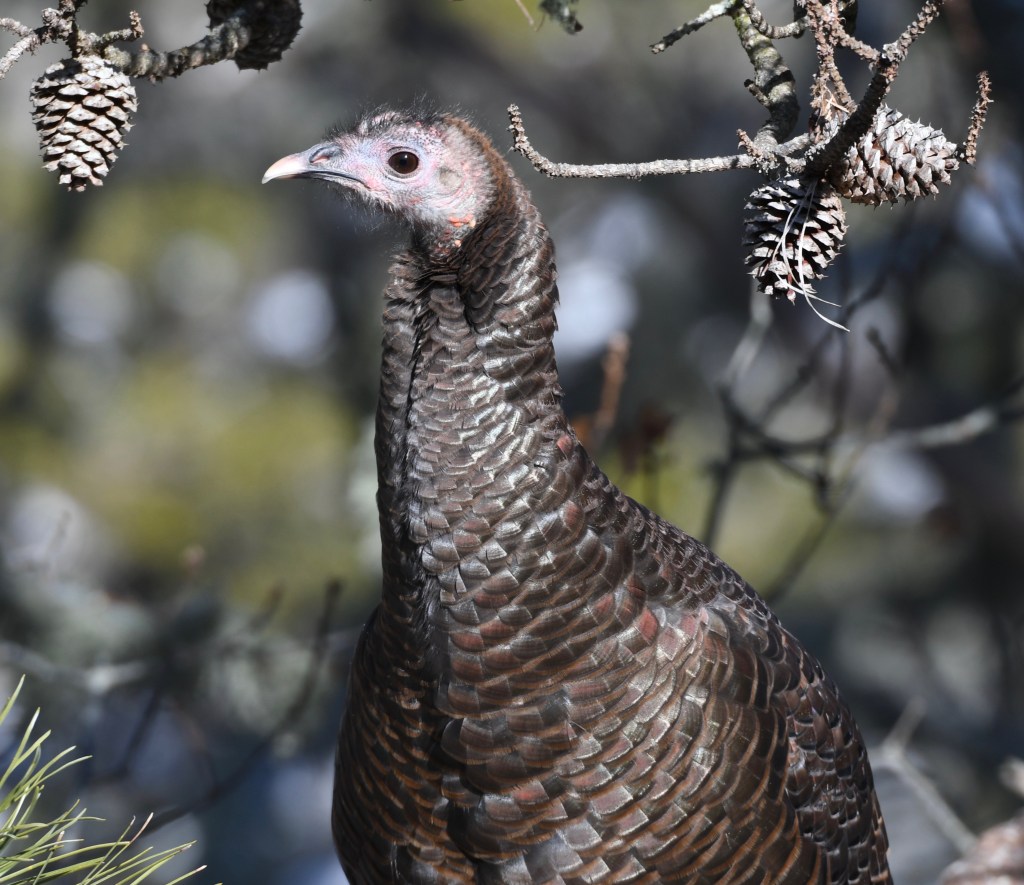
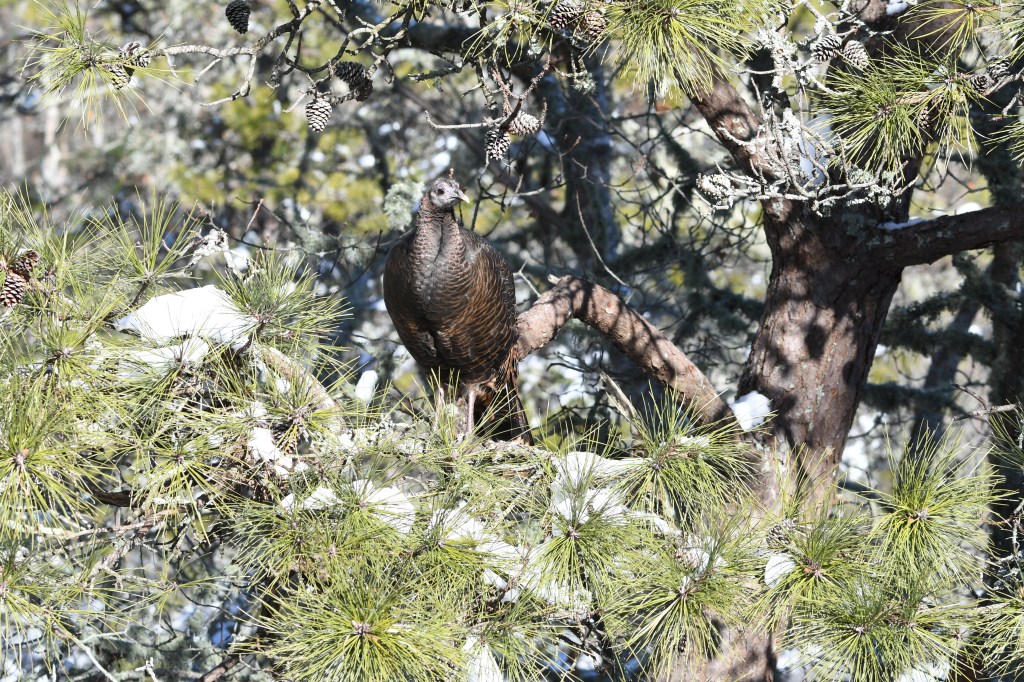
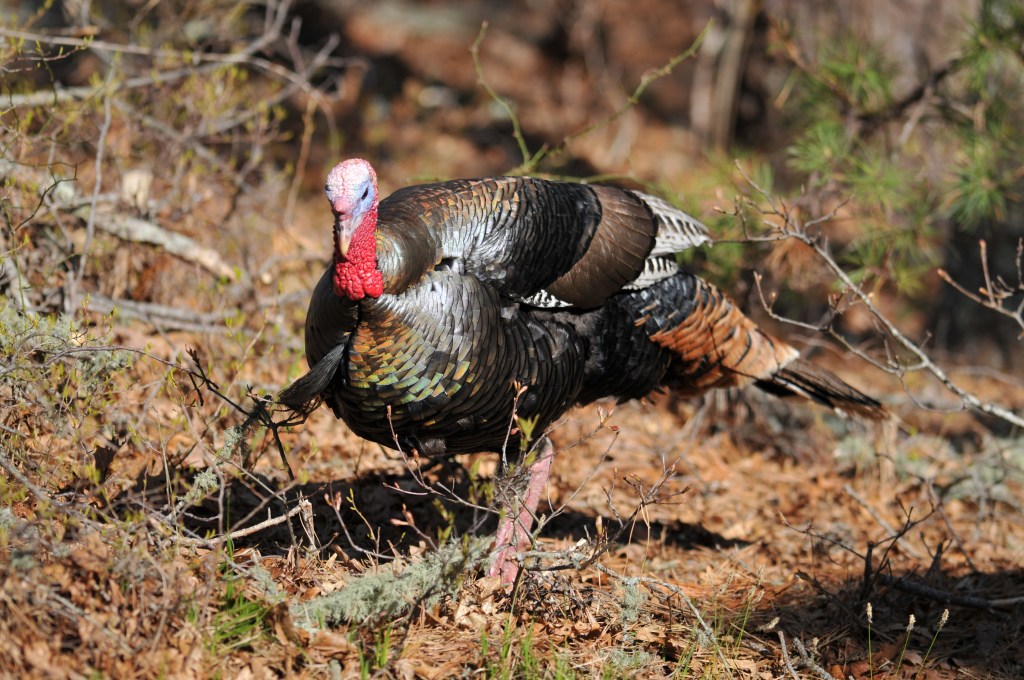
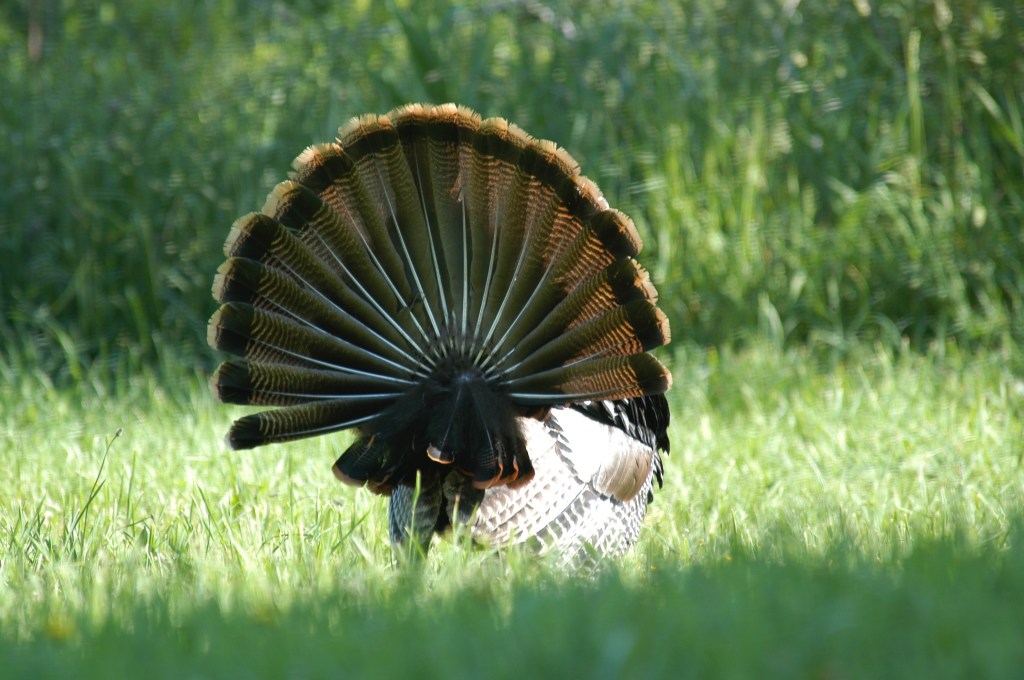
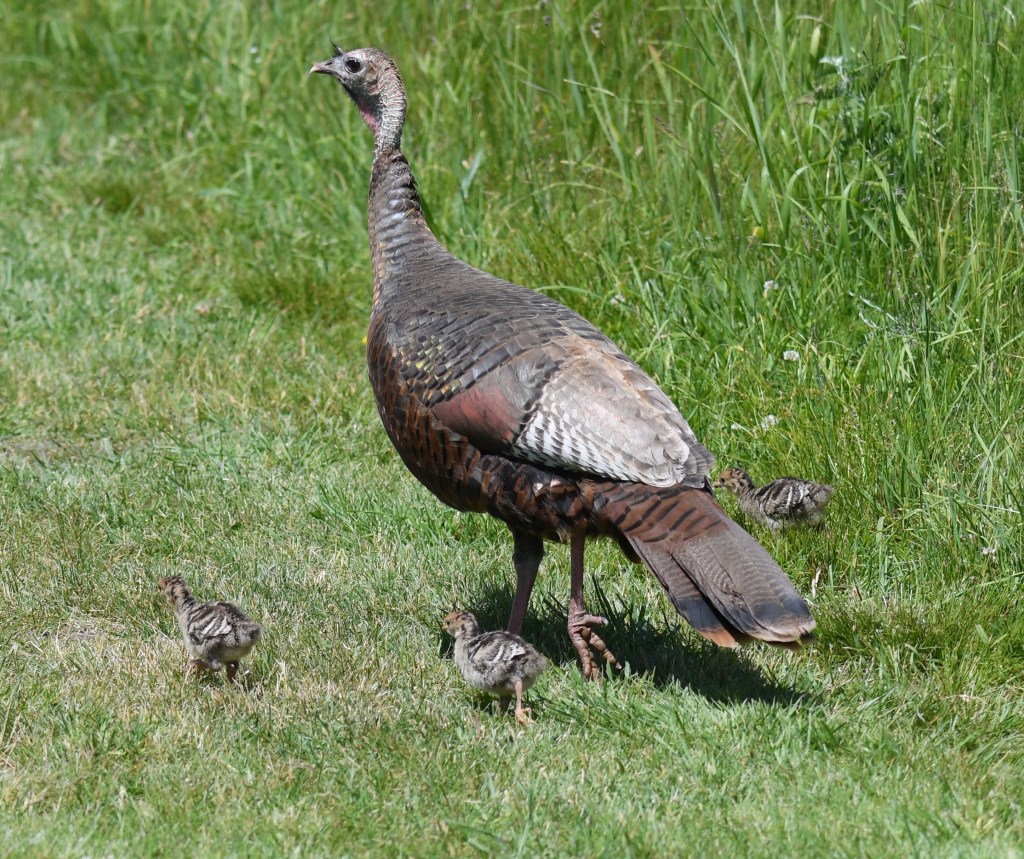
Wild Turkeys have been very successfully reintroduced into Massachusetts – and else where. They are now well established and can be found the full length of the Commonwealth; from Provincetown to the Berkshires. The females (above and below) have no beard and are not as colorful in the face as are the males. Females have a rather passive role in the spring. They observe and then choose (?) from the males who have largely ignored them as they flash, strut, and compete with other males.Males have a beard and the unfeathered facial skin becomes very colorful as breeding season approaches. The feathers are iridescent and the boys make very effort to show them off. Small groups of males stay together seemingly competing among themselves for breeding dominance. This is what they are doing, but it seems a little more time with the ladies might be beneficial. Facial color, shiny feathers, and a large complete tail make for a handsome male. The females will nest on the ground but both sexes will roost in trees – though females will often incubate through the night on the ground.Eventually the hens create clutches of eggs (usually about 12 eggs), incubate for about 4 weeks, and hatch the young. Groups of hens with young will form and the occasional cluster of males may join in with them. But generally it is the females that watch over the youngsters. Predators include (depending on the size of the poults) cats, dogs, foxes, coyotes. and probably some birds of prey. The eggs are consumed by medium sized mammals like raccoons, opossums, and foxes. As they grow in size they become more and more able to take care of themselves.
Please regard all images as copyrighted and ask for permission to use any of them. thanks, DEC
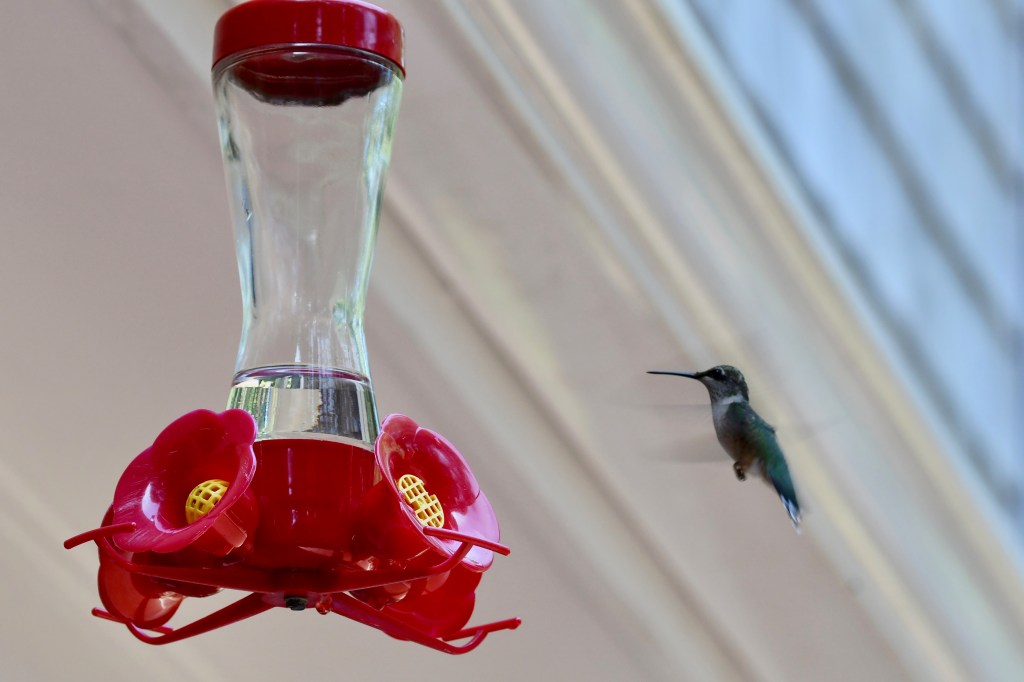
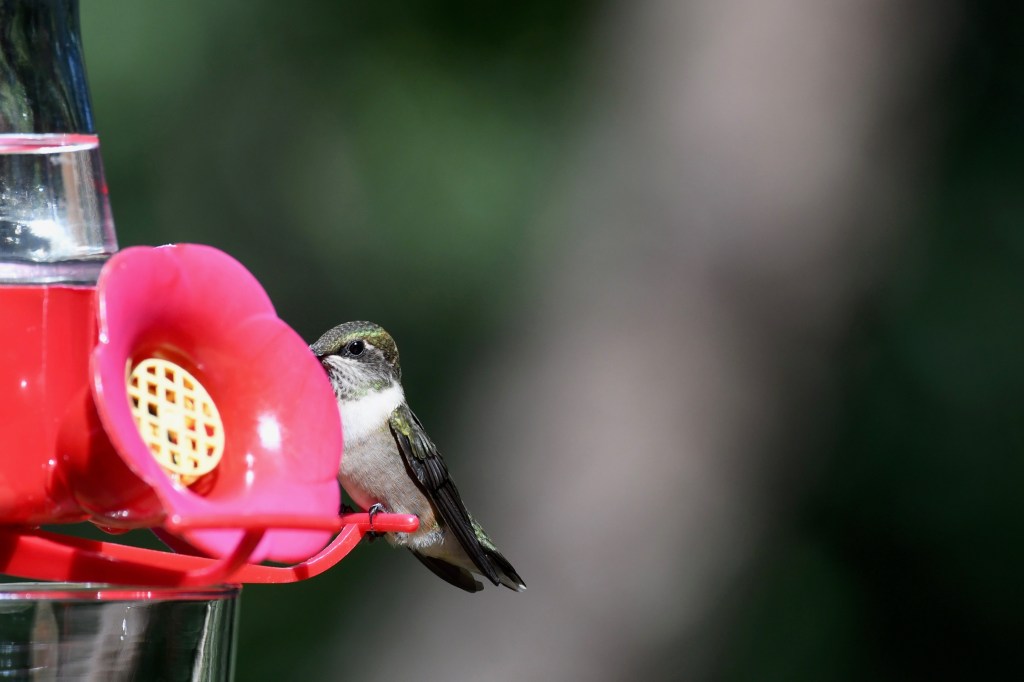
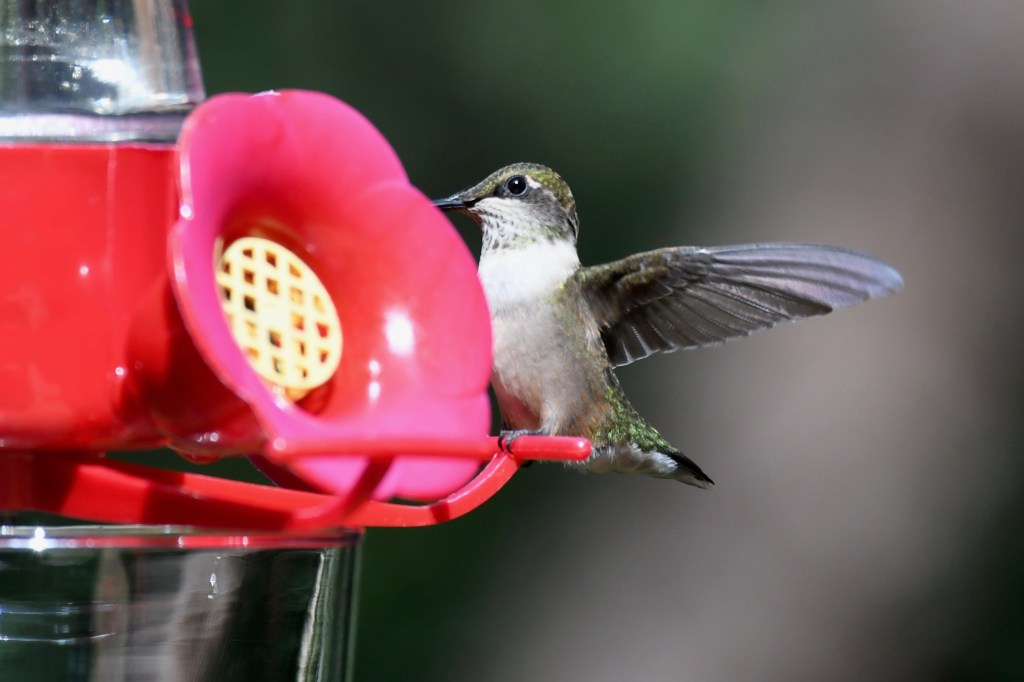
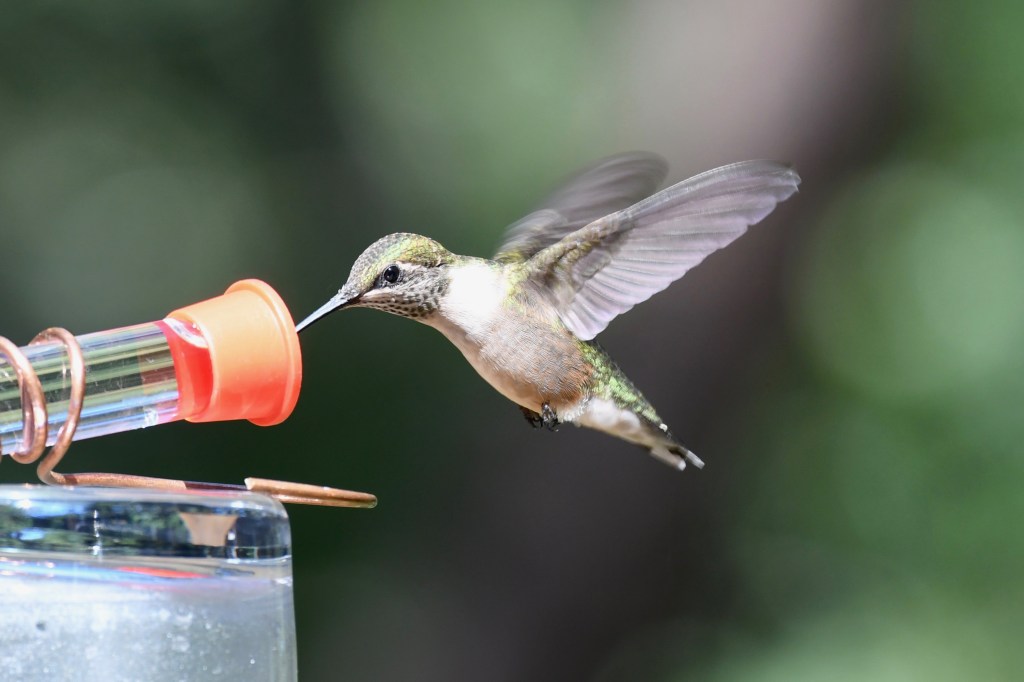
Throughout the summer we have had Ruby-throated Hummingbirds (RTHU)at the sugar-water feeders. They are brazen, confident, belligerent, and mechanically amazing. They chase each other with great vigor as they defend the food supply. They fly in and stop, in mid-air, to look around and then zip (nothing is languid about their movements) to the feeder or to harass another RTHU or simply to go somewhere else.
I have not been doing blog pages for a while and wanted to get back in the saddle – so here are a few hummingbird images from 15 September of this year.
They arrive in a blur. They stop and assess the situation and then either leave or drink. In the later afternoon they seem to be come more often and stay longer.They perch rather casually after their intense arrival. They look around and drink, using the brushy flaps that line the tongue to collect the calorie rich liquid.Tiny feet reach out and hold the feeder’s perch. They regularly sit on the leafless branches of the trees, often sting for several minutes.They are also able to drink on the fly and often do.
Please consider these images to be copyrighted and contact me for permission to use.
It was mid-June and the ocean water had warmed to about 64 degrees in the inner bays, but it was still in the mid-40s when we arrived off Monomoy (Chatham, Massachusetts) near Crab Ledge and there was a real chill in the air. It may have gotten into the high 70s and low 80s on the mainland on Father’s Day but it was damp and chilly out on the ocean. We were about 18 miles east of the sand spits that make up the Monomoy Islands; an ever-changing collection of sandbars and dunes reaching down to the south of the Cape Cod’s elbow.
The boat trip was arranged by Krill Carson of the New England Coastal Wildlife Alliance (NECWA). She does two of these outing each year, June and September, as fundraisers for NECWA. The fundraising may be modest but the educational value isn’t. We have seen and identified many whales over the years and have added a great many pelagic bird sightings as well. Sharing these opportunities with interested folks is a real treat. This year it was Wayne Petersen, Tom Robben, and me on the microphone; though Krill and her interns were very adept at working the great feeding displays of Humpback Whales that we saw. (We saw the old lady of whale-watching out there – Salt is an animal that was first seen back in the 1970s and is known to have at least 14 offspring!)
Krill does a great deal of work with ocean Sunfish (Mola mola) and her website is well worth visiting. The fall trip will be out of Gloucester, Massachusetts this year, a great time for both sea birds and marine mammals.
Most years there are lots of Humpback Whales along the coast of Massachusetts in the summer. Tourism depends on them as they attract people like magnets attract iron filings. In 2019 they share the spot light with Gray Seals and Great White Sharks; but the whales are much more easily seen than are the sharks. Seal tourism is modest but whale-watching is big business.
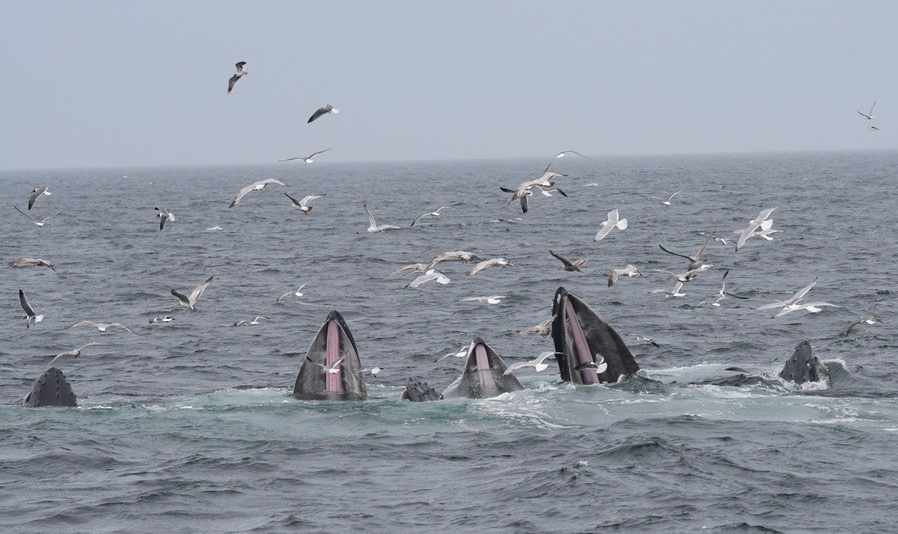
Humpback whales are rorqual whales – meaning they have a pleated throat that expands greatly when they take in sea water – hopefully sea water filled with fish or krill. In the image above the whale has its top jaw open and extending upward (fringed with baleen) as the animal rises through the water taking in a gullet-full of water filled with Sand Lance (Launce). The smooth water to the right of the image is the surface water held in the expanded pleats. The whale will swim forward pushing the water up and out of the pleats while the top jaw closes and a filter of baleen allows the water to leave but constrains the food. The water is expelled and the fish remain in the mouth.
Our boat ride was a bit testing for the first hour or so. No one seemed to be ill and that is always a good thing. There is nothing quite as contagious as sea sickness on a smallish boat. We looked around as we traveled and had very little to talk about. There were a few gulls and terns and a Common Loon as well. But when we found whales there was a great deal of activity. We couldn’t decide on a number for the humpbacks (on the way back in to port) but the most conservative number was forty. There could have been sixty whales in our view! It was very impressive.
The best part was that they were bubble feeding in many small groups. Several whales would get together and dive, shallow dives as they were not down for more than a minute or two in most cases, and when under water they would exhale streams of small bubbles as they swam in a circle. This created a rising tube of bubbles that constrained the fish that were enclosed in the “bubble net”. The whales would then turn and rise through the water inside the bubbles, expanding the rorquals and collecting a throat-full of fishy water. When two or three or four or five whales do this at the same time it is very cool.
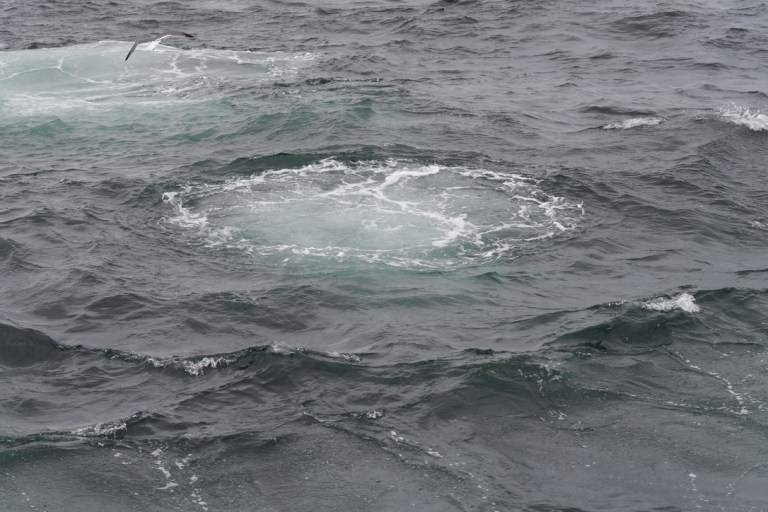
Here six whales emerge from a complex of bubble nets. They are leading the way upward with the open tip of their top jaw. The baleen is arrayed along the outer edge of the top jaw and will close down over the lower jaw to keep the fish inside as the water is expelled. The gulls are hoping to catch fish as they jump out of the mouths of the whales. It may seem an odd life style for the birds (and perhaps the whales as well) but it seems to work very well.The bubbles are often dispersed by the wind and surface action of the ocean and are difficult to see. While other times the ocean and wind, and the way the whale releases the air, allows them to be easily seen. There is a similar patch, only of smooth water, that a diving whale can make by flexing its tail as it dives. The circle pictured above is caused by bubbles; the other type (called a “footprint”) is caused by water rising after the whale exerts upward pressure as it dives.
One of the world’s most abundant birds is the small Wilson’s Storm-Petrel. It is pelagic, oceanic; coming ashore to only nest. They nest in the talus rocks of the Antarctic continent and the young are fed until they nearly burst. When they are twice as heavy as the adults and still without real feathers, the adults stop feeding them and head north starting a long migration up to the Gulf of Maine, then over to the European Coast and finally back down along Africa to Antarctica again. The youngster turns his oily fat into muscle and feather and walks to the edge of the rocks and starts north itself – about two weeks after it parents abandonded it. Some years we see hundreds of them other years just a few – it all depends on where the food is.
There is another group of sea birds called shearwaters. Graceful in the air and unafraid of the stormy ocean these birds travel a great migratory circle also. The bird above is a Great Shearwater one of our more common types. We often see Sooty, Manx, and Cory’s Shearwaters as well as the Great. They all have a hook on the tip of the beak to help snag fish and squid.
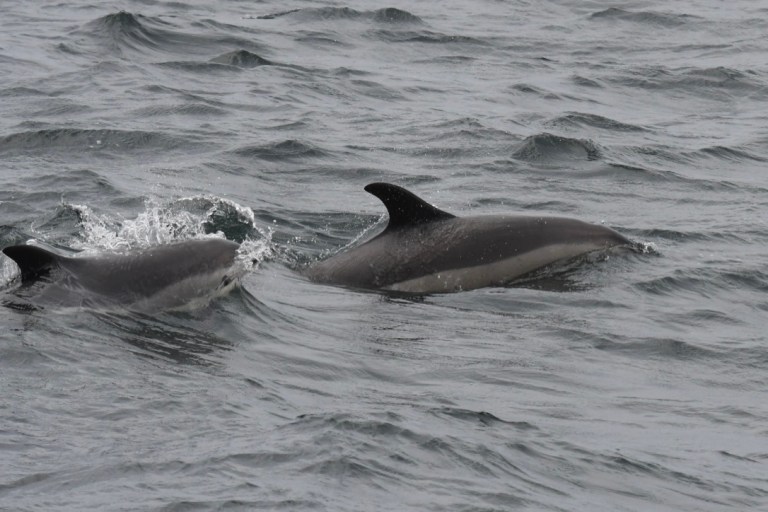
In addition to the Humpback Whales we had several Fin Whales and Minke Whales. The Fin Whale is a long sleek whale of great size where the Minke Whale is a small whale that rarely fully shows itself and mostly just darts about. We came across a group or two of White-sided Dolphins out there as well. The two animals pictured above were part of a group of 20-25 that hung around with us for a while.
Please consider these images to be copyrighted and contact me for permission to use. By the way — I have imported a whole lot of blog pages from my Blogger site and they are now here at WordPress. Please scan back through there years for many many posts that you have never seen. Enjoy them. Thanks DEC
Texas is large as I have said in each of the latest Texas posts. With that in mind I am going to mix birds, mammals, and geology a few more times until I wear out the Lone Star State’s welcome. I’ll make most entries as image captions but a few topics will be expanded.
The geology of Texas is both surprising and yet not unexpected. It was under an ocean that divided North America into three parts: the Rockies, the Appalachians, and a huge sea in between — and it stayed that way for millions of years. Hence the geologic stratification and the abundance of limestone based rock. The mountain building and volcanic activity that followed moved things around. Texas is now a wonderful hodgepodge of geologic memories.There are limestone layers, great swaths of lava and runny pyroclastic mudstone, and occasional towers or inselbergs. Habitats vary according to elevation and compass direction on all mountains. Faces of rock or forest looking south are heated more than those facing north and garner much more sunshine, one side will catch more rain than the “rain shadow” side, and these things when combined with elevation, create many micro habitats which will harbor different plant communities and in turn support slightly different animal communities. For most of us the change in trees is the most obvious of these changes.
The goal for most birders who wander through Big Bend includes the Colima Warbler. This small bird is a Mexican species that just squeaks over the US border into the Big Bend NP. We birders, crazier than fisherman and golfers, seek out this bird for life lists and any other list we may keep. The small rather plain warblers nest in Boot Canyon which is a relatively flat valley (especially welcome after the arduous climb up the Pinnacles Trail). We heard a couple warblers calling on the way up Pinnacles but never saw them so we persevered into Boot Canyon where we found a very cooperative bird or two. By cooperative I mean they could be seen and seen pretty well. As the image below shows they really didn’t pose for us and stayed in the emerging leaves as best they could.
On the way up the mountain we met a birder from Arizona (a lady, experienced, and knowledgeable) and we teamed up. So when we saw this bird it was a nice moment of celebration. I think it was a life bird for Fran but not for Ms Arizona or me. As a matter of fact I had had the bird a few times in years past without ever climbing all the way to Boot Canyon. We were there in April (the 17th) and the birds are most abundant in early May after they return from the south and they will sing into early June. We were a bit early and a bit lucky.We climbed up for almost four miles and it was nice to see a smiley face every now and then. It was certain that I wasn’t smiling as the grueling climb continued; though the descent was much more impactful on my knees and hips. The iPhone said I walked over 23,666 steps and climbed the equivalent of 78 sets of stairs that outing. It felt like more.You are looking up at a hummingbird bird nest. The pointy thing aiming at ten o’clock is a baby Anna’s Hummingbird’s beak. The nest is made largely from lichens and spider webs with some very soft fibers (both plant and animal) in the tiny cup. The baby bird may look a bit “spiney” as the feathers are still in sheaths. The feathers start off wrapped in these scabbards and as the scabbards fall apart the feathers fluff out. This is an adaptation to keep the feathers neat and whole while the bird is in the nest. You probably could cover the bottom of this nest with a nickel. The adult will weigh about 4 grams — that means you could mail 7 of them with a single stamp!!One more Turkey Vulture image and homage. The vultures can fly very well but often choose to glide and soar; sometimes for miles and miles and hours and hours. They are pretty common throughout most of the US and this sort of bird, scavenging vulture, has established worldwide. They are now in significant danger from the rodenticides and other poisons we use to control “varmints” and protect crops. There is a species called Black Vulture in the US as well as the Turkey Vulture. This other vulture ranges north to Massachusetts, but is more common as a southern bird. The Black Vulture is a common Central American bird and the population sweeps north and eastward from Texas through the lower tier of states into Virginia and Maryland before the population thins out.
Texas is large and diverse. It isn’t all grassland and cattle. Much of it is dry and sparse; cattle aren’t happy in those places. In other spots it is rolling hills with evergreens and running water. The eastern side of this large state is either pine woods or coastal, with warm salt water. In still other places, like Big Bend NP in the southwestern corner, it is a mixed bag of rough habitats; rocks of volcanic origins, sedimentary rocks, deep layers of caliche, and great swaths of pyroclastic rock. The Big Bend NP has a wonderful, new and high tech, fossil exhibit displaying some of the large (really really large) creatures that were here about 65 million years ago, and were eliminated out during the great Cretaceous die-off.
In the previous two blog posts on Big Bend we looked at some of the geology both modern (gas and oil) ands ancient (sea floors and lava flows). In the following post we will begin to look at the wildlife of the area, birds to start.
There are migratory paths that cross west Texas, mostly north to south and then back. In the spring birds come up through Mexico and intoand impacted US territory by the millions. One of the (usually) non-migratory, and very common birds, is the Turkey Vulture. This is the “buzzard” to many people and is well known as a scavenger. They clean up our roadways and help molecules from the recently deceased back into circulation to aid in the metabolism of the still living. They perform an important job; as do bacteria, fungi, worms, and other recyclers.
In modern times (the last 250 years) the wildlife populations have been displaced by domestic animals in many instances and yet helped by the creation of water resources needed by the domestic animals. Things always change; but in Texas, adding water always enhances wildlife opportunities.
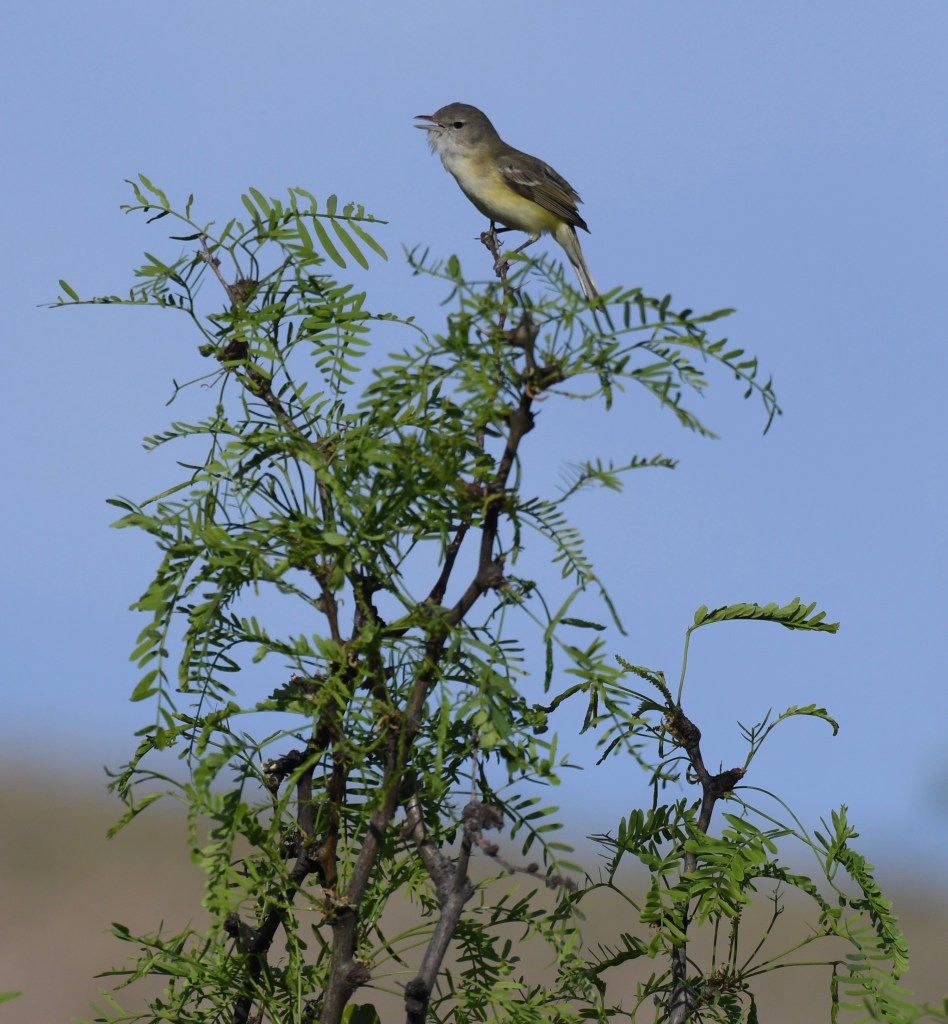
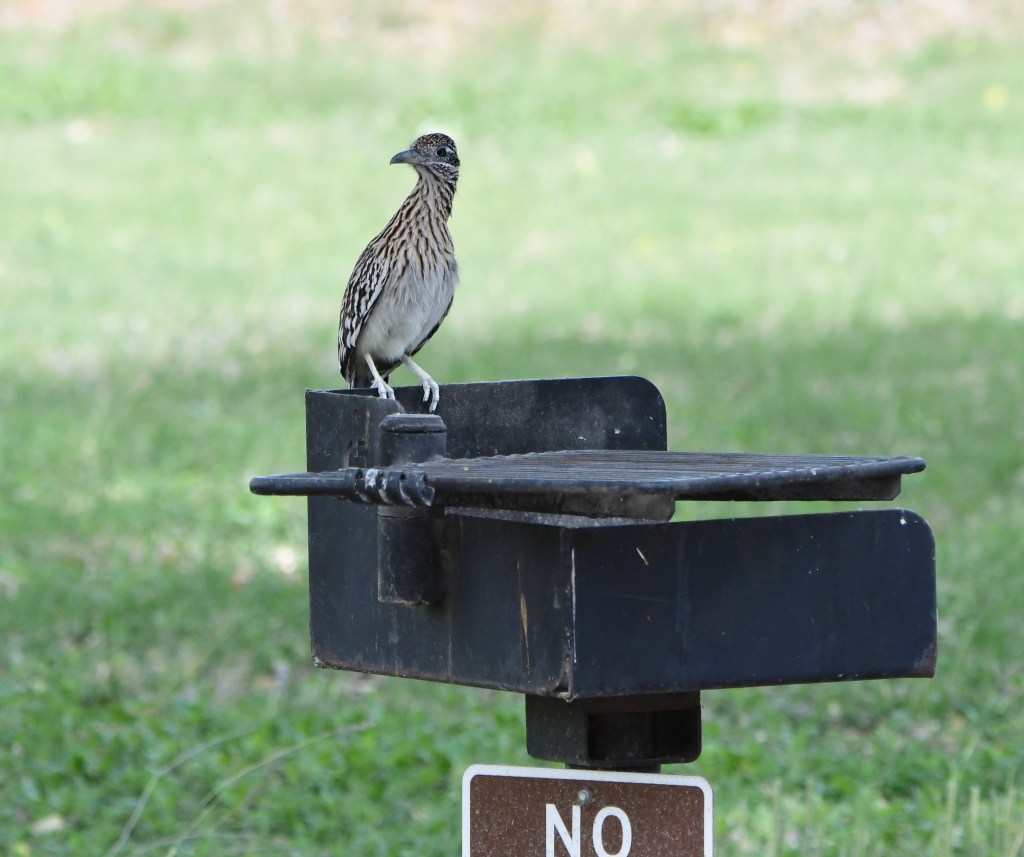
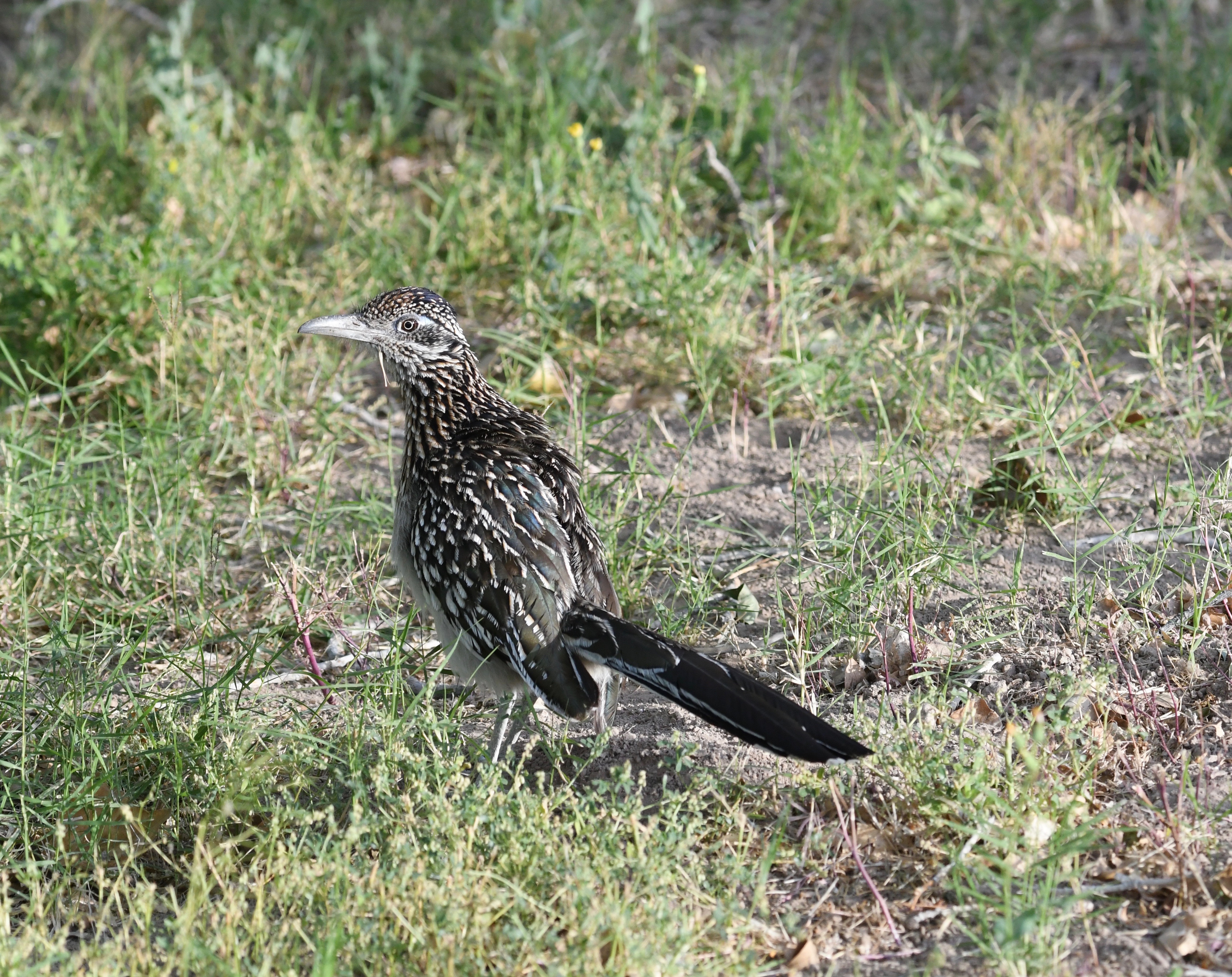
The lovely red bird above is the male Vermilion Flycatcher. The female likes him dressed like this though she prefers to wear a more drab gray hue. This is a rather common species of the west and they are quite common in the open vegetation, especially the low damper areas, at Big Bend.The Bell’s Vireo is a smallish bird that sings all the time in April and May. Vireos have a small hook to the bill and they use that tool to harvest insects from the dense shrubbery that they prefer. The sexes are not dissimilar but it is the male’s song that gets the species into your frame of reference. The female is quieter and less “on top” of things as she nests and forages.It is often presumed that dry land plants are lacking in fruits, seeds, flowers, and the related insects and birds – not true. The cacti, like this ocotillo, do make flowers as do the small hardy shrubs of Big Bend. Hummingbirds and orioles are well know as nectar-eaters and the Ocotillo and Scott’s Orioles are very happy with each other. The oriole feeds on the flowers and pollinates the cactii as it move from plant to plant. The trees in BBNP are often Piñon Pine, various oaks, and junipers of several types. High elevations will have larger trees like aspens, maples, and Ponderosa Pine. The small plants, what we would call shrubs, are Creosote Bush, Cenizos (a sage), Honey Mesquite, and Soapbush. The bird perched on the flowering Ocotillo cactus above is the flashy Scott’s Oriole. This is one of the birds that winters in Mexico and breeds (largely) in the US southwest.Of course no visit to the west or southwest would be complete without a good look at the Greater Roadrunner. This large cuckoo eats whatever it can catch; from snakes to scorpions to lizards, to insects – even other birds. A pair will stay together and hold a specific territory for years if all goes well for them. The male and female incubate the eggs and feed the young and together they patrol and defend their territory. The GRRO is adapted to the dry side of things. Water is not important to their life style. They are slowly expanding their range to the north and east. Now found in California, New Mexico, Arizona, Texas and east to Louisiana; the birds are doing quite well. The northern edge of the range touches Nevada, includes Oklahoma, and a bit of Colorado, Utah, and Kansas as well. Most of northern Mexico has roadrunners as well.
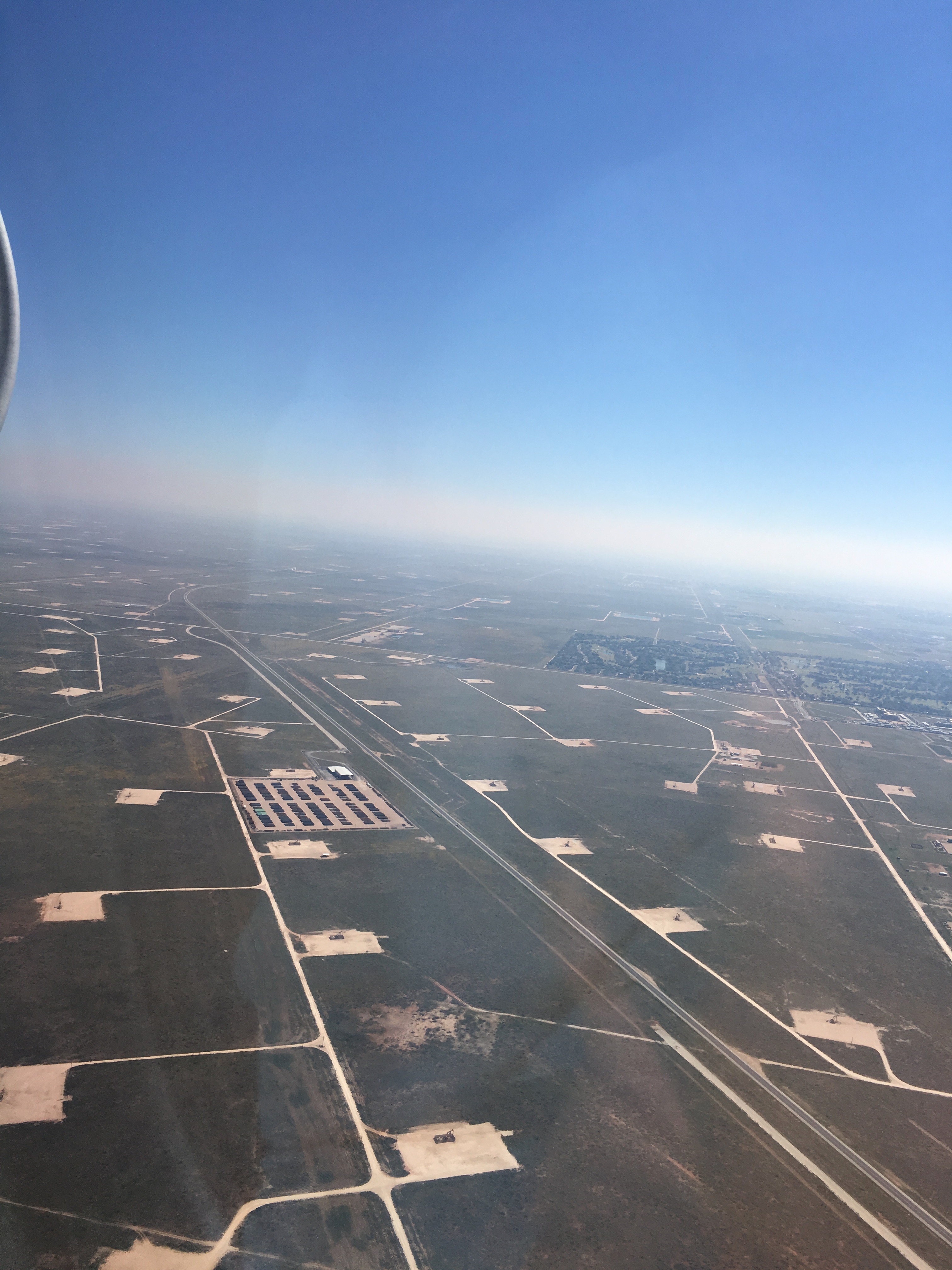
As we flew into Midland-Odessa Texas from Dallas-Fort Worth it was easy to notice that the ground was pocked with extraction stuff. Hundreds and hundreds of pads from which gas and oil was being drawn to the surface; pad after pad from which fracking takes place deep underground and oil pumps hum. The smell of money (gas especially) is in the air. This areas oil resource has been tapped for about 100 years but the new methods (horizontal drilling and hydraulic fracking) started a huge boom about seven years ago; 2012 that is. This is way larger a field than what North Dakota has and it may be the largest in the world – certainly one of the largest. (That probably doesn’t speak well for alternate energy options as this is an American oil/gas resource and it is huge.)
From the air the pads and process seem to be apparent. However, the resource is well below the surface. The shale that is being utilized is a very thick layer (1300 to 1800 feet thick) and represents huge amount of fossil fuel. It has made west Texas and southeastern new Mexico very important in the energy market. Permian Basin drilling now accounts for almost 30% of the US rigs that are active. The weak link here is the need for sand and water that fracking has. There isn’t much water out here in the dryness just north of the Sonoran Desert.
Now we were heading for the counties of Presidio and Brewster – both of which are almost entirely outside the Permian Basin and hence largely out of the money. Once we were inside the airport at Midland it was a wall-to-wall display of resource development. The advertising on the terminal walls was all about water, sand, drilling, shipping, pipe lines, oil and gas and there was a lot of advertising, a whole lot, of adverting. The displays were large and colorful; there was no disguising that this area was wallowing in the hundreds of millions of dollars worth of oil and gas that it sat upon.
As broadly interesting as this was and as important as it is to the US economy….we got out of town as fast as we could. We were a whole day late after being delaying by violent weather the day before in Dallas/Fort Worth and we had places to go; roads to drive and Road Runners to see.
Our first stop was as a Texas wetland, surprise surprise. It was the I-20 Wildlife Preserve & Jenna Welch Nature Study Center just a couple miles from the airport and the car rental. This spot is right on I-20 and for the most part noisy with trucks and traffic. But it was nice to see lots of families walking, some western birds, lots of coot and ducks, and it was really nice to get out of the planes and airports that had held us captive for the previous 24 hours.
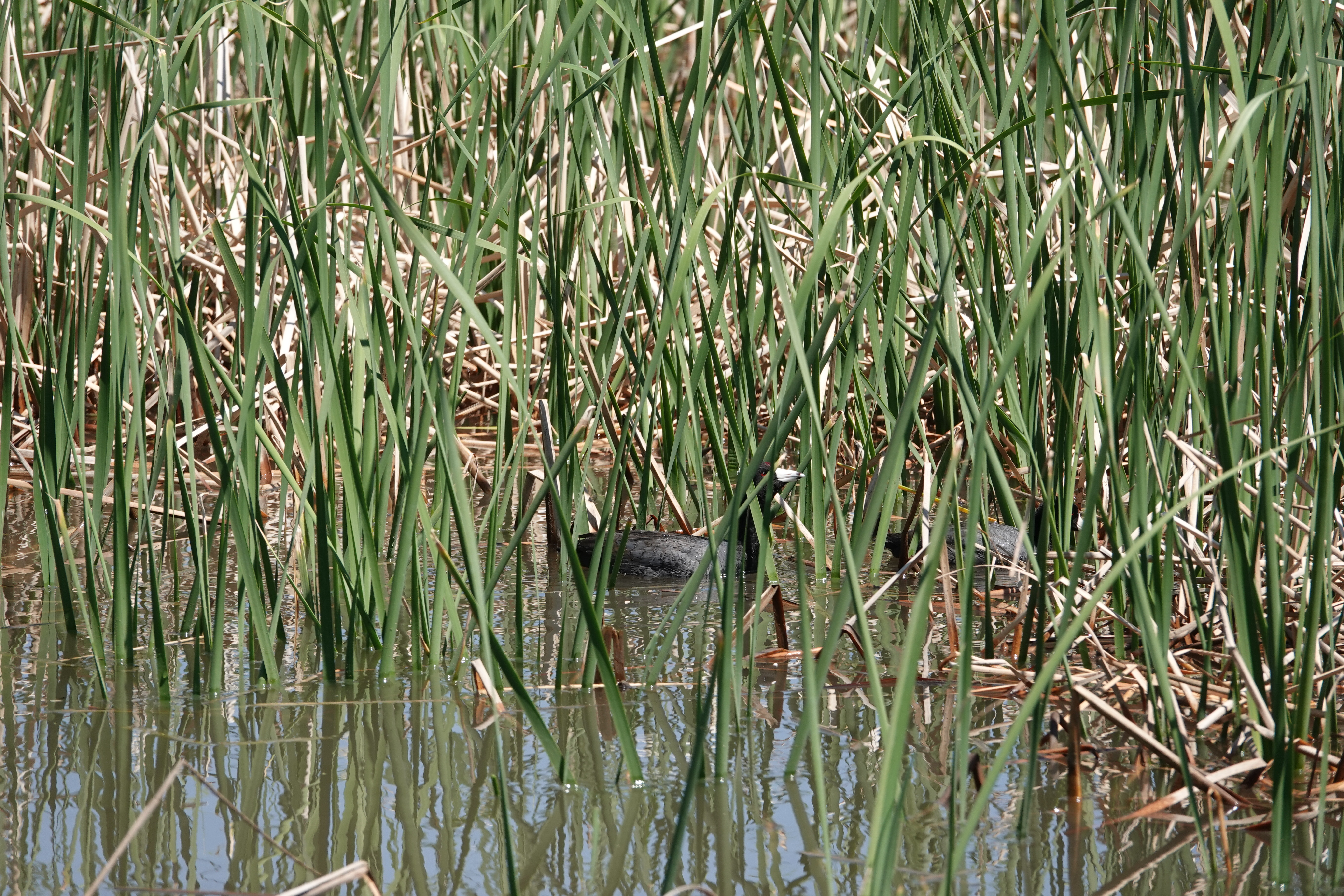
There were some Blue-winged Teal, lots of Northern Shovelers, and a few Ruddy Ducks like the one in this image.Tucked in the cattails this Coot is looking for things too eat – most anything would do.
But our destination for the day was still many miles and a few hours away. We settled in and headed south toward Alpine and then Study Butte and Terlingua; the gateway to the Big Bend National Park. Speed limits along these rural roads are posted between 70 and 80 mph. There was ample warning of a need to slow down for a curve or the arrival of a passing lane; but for all practical purpose people drove the speed limit on these nice wide roads – with great visibility….there are few trees in this part of Texas. The scenery was mostly geologic but nice.
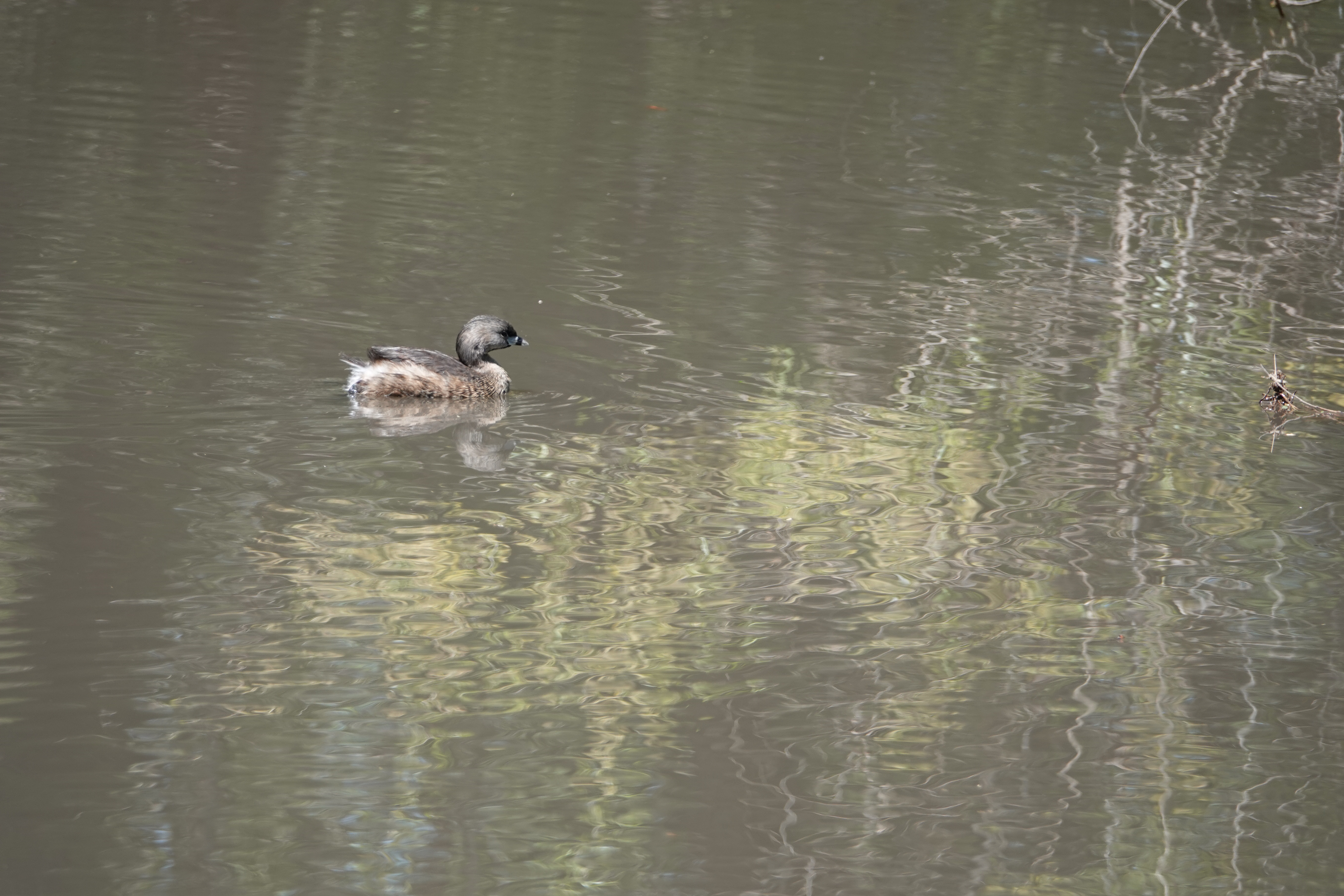
There was also a single Pied-billed Grebe on the pond and Fran got a snap of it in between dives.
















 On The Road With DEC