Please do not reproduce any of these images – treat them as copyrighted and ask permission if you want to use one. Thank you. DEC.
Plovers are not big birds. The largest is about the size of a pigeon but most are smaller than American Robins or European Blackbirds. They are mostly wetland edge birds; both coastal and fresh water. In Africa there are larger plovers now called lapwings – they used to be called plovers. Even in Africa there are still smallish birds that are called plovers; but the larger ones have been reclassified as lapwings. Anyway below are a few plovers from around the world, these are the smaller members of this group, the lapwings will have to wait their turn.
In the USA the plover that most people see is the Killdeer which is not one of the smallest. Killdeer are found coast to coast in the US and are very common in agricultural areas. But the plover that creates the most press coverage is the small pale gray Piping Plover. This little bird is threatened or endangered in most of the US and thus gets preferential treatment on our beaches. This special treatment is good for the nesting birds but is an impediment to wind-surfing, ORV driving, and other beach uses can that threaten the reproductive success of the bird. Walking and fishing are OK but sometimes vehicular access is limited so the babies don’t get run over and the adults don’t get forced off the nests.
Here are a few plovers from around the world and a bit on their life styles – the Piping Plover will be the last one shown and is also the bird that is at the head of this post. Due to their tendency to nest in areas that humans also enjoy they are in danger from our motorized vehicles and our pets. Not all are technically listed as endangered or threatened but they are almost always in the way of something or someone. Please watch out for them and respect their needs.
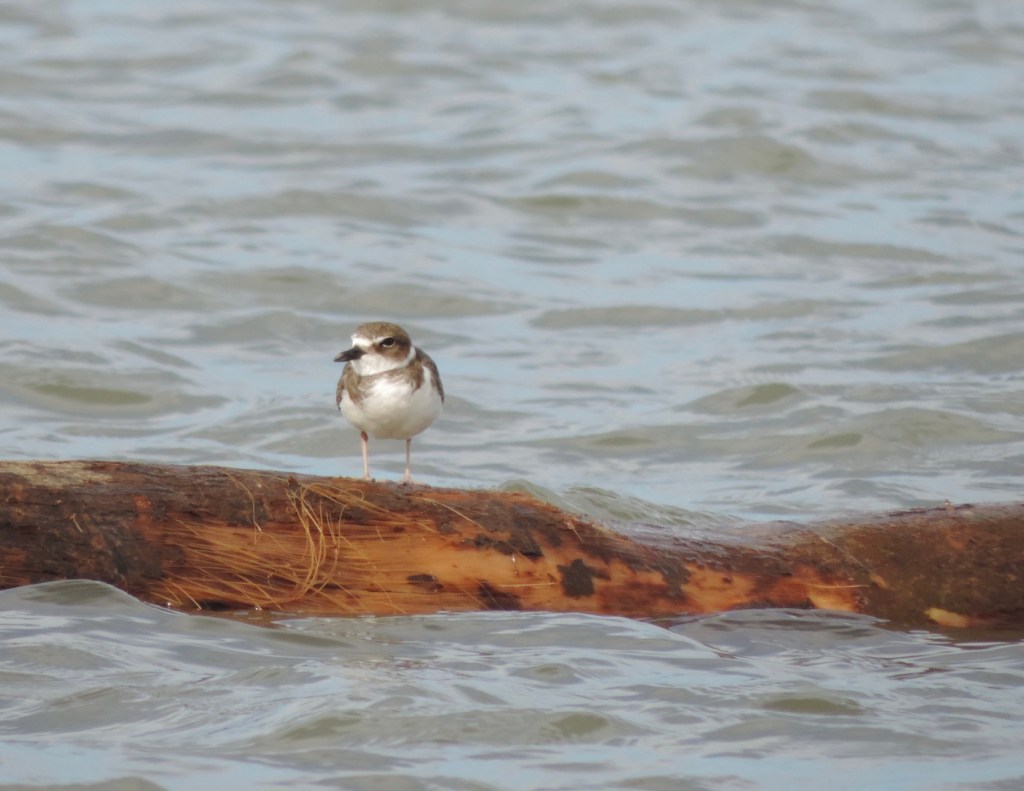
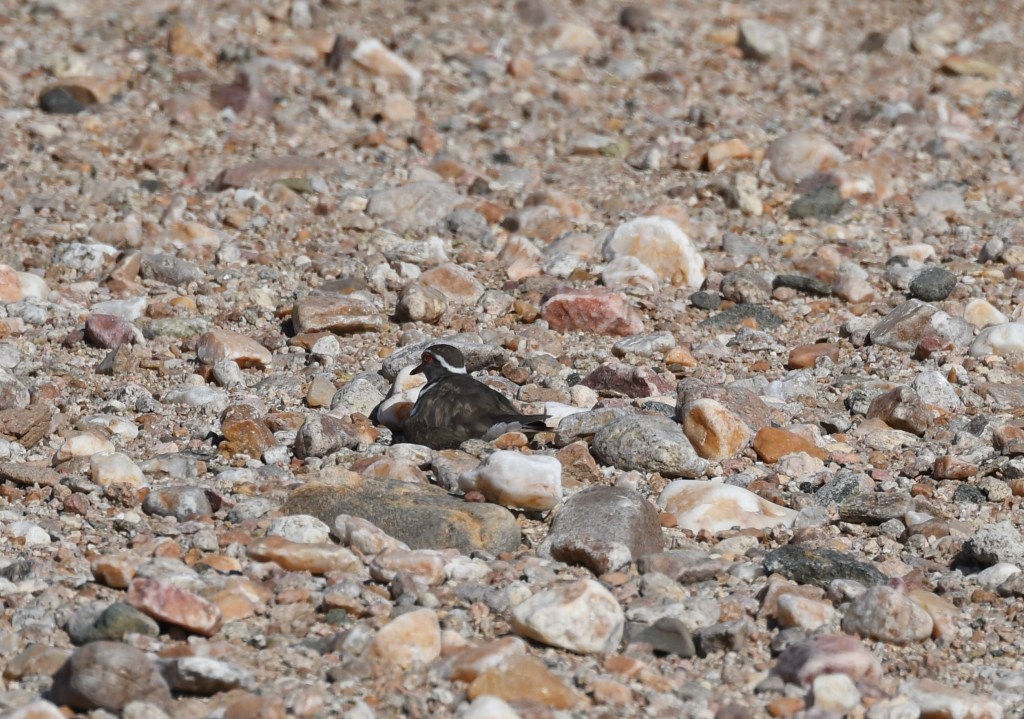
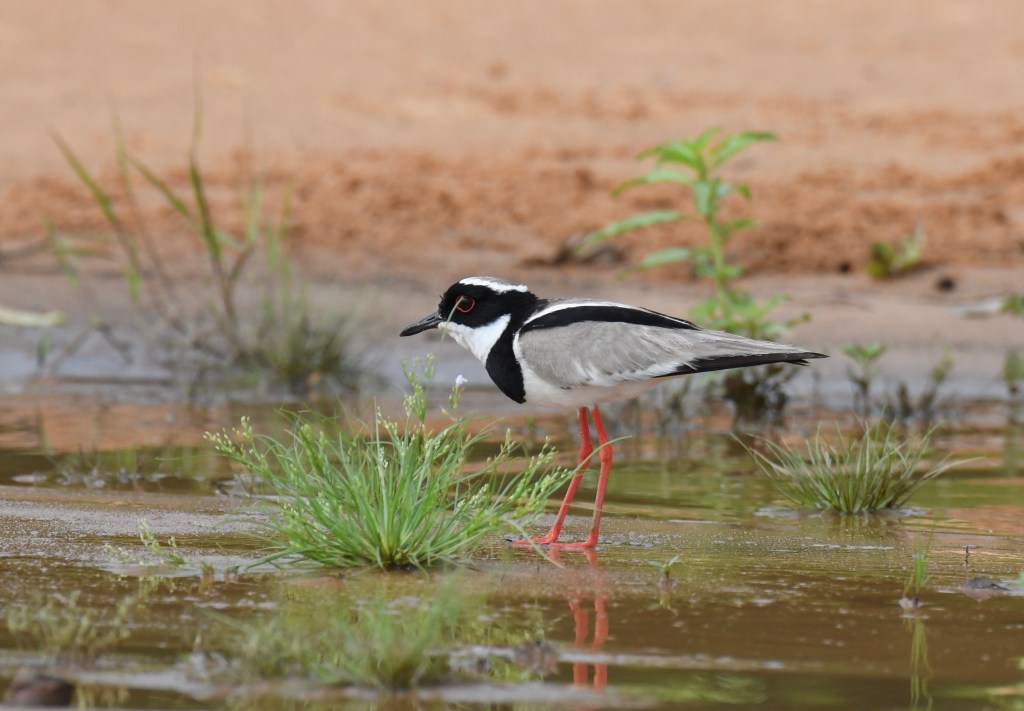
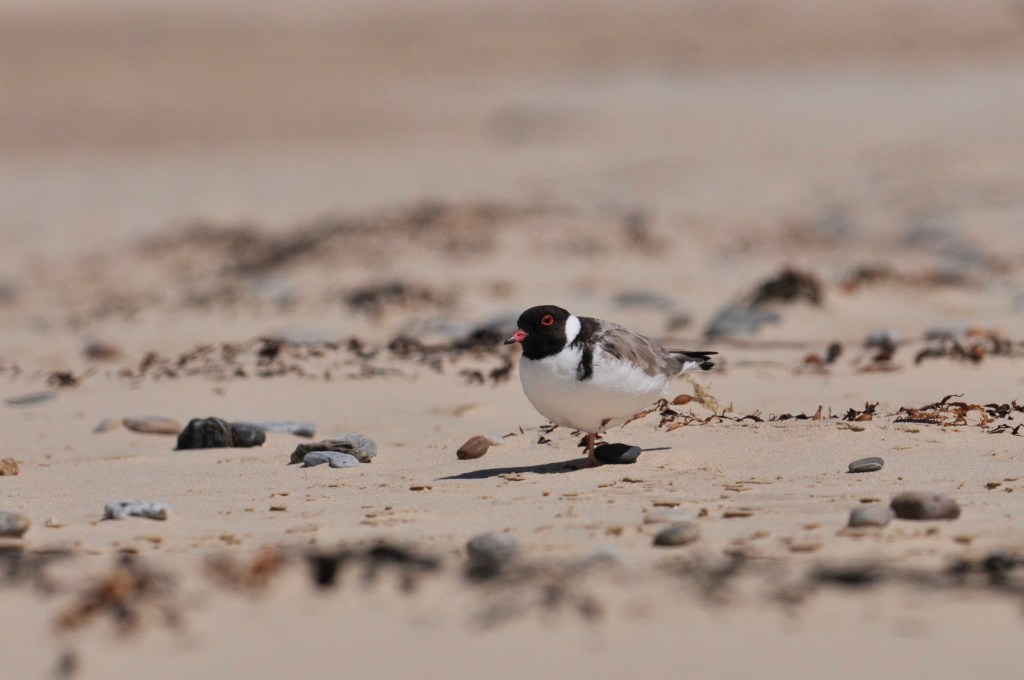
These birds are a common North American plover with lookalike cousins through most of Eurasia. These are Semipalmated Plover. The toes are in fact semi-palmated or partially webbed. This allows them to work the wetter ground along the edge of the shore. In the middle of the five plover is a Semipalmated Sandpiper; named for the same anatomical feature. On the east coast of the U.S. we see this species as both northward and southward migrants. Thus we may see them from early May until the end of September. This image is a bit blurry – sorry – but we were in a rather fast-moving boat off the coast of Panama when we saw this Wilson’s Plover floating on a log. It is similar to the two-banded Killdeer and the previously shown Semipalmated Plover. People think shorebirds (sandpipers and plovers mostly) are a difficult group to identify; that is because most people are just a bit impatient. This bird is larger than a semi-plover and has a much larger bill. These are both noticeable in the field and even from a bouncing boat.The Three-banded Plover (above) is an East African staple. Most wet areas will have these birds. The image below is also a Three-banded Plover. Like so many of the group they are born, medium-small sized, with a white forehead and bands around the neck. Figuring out the group isn’t too difficult, but getting the right species is sometimes more difficult.As I have cropped this image to feature the bird you may not realize how well camouflaged it is when on this nest. From any distance the bird disappears. The sharp lines of white and brown actually provide a kind of camouflage called “ruptive”. Ruptive camouflage breaks something, in this case a bird, into pieces and allows it to blend in. Many camouflages try to mimic the surroundings directly – two ways to achieve the same end.This is a Pied Plover, from Brazil. In this bird (and the next) the browns are now gray and the neck bands black. But they serve the same purpose and allow the birds to disappear into much of the habitat they live in.The Australian Hooded Plover is much like our Piping Plover in that it isn’t common and its habitat is used by people. Australia has lots of beach and relatively few people so the bird isn’t seriously threatened. The bright red eyeing is a nice touch don’t you think?The Piping Plover is often referred to as “that damn bird” by recreational beach goers but in fact is a hardy, though delicate looking, bird that returns in early April when our beaches are still very cold and windy. If all goes well they are done nesting by the Fourth of July and summer life can proceed. But often crows, foxes, coyotes, exceptional high tides, and careless people (and their pets) cause a nest to be destroyed and forces the adults too renest. This pushes beach management and restive regulations deeper into the summer. During the last thirty years or so we have pretty much managed to accept this as a way of life – thank you folks. It would be a shame to eliminate a species for the sake of sunbathing.
We are fortunate to be out of the city and in an area where open space is available. Of course on a nice day these spaces attract lots of people and thus are no longer attractive — this is all a very sad state of affairs isn’t it? What a surprise to find that our traditional escape locations can be so easily tainted and our usual haunts (stores, restaurants, bike paths, and such) rendered downright scary. For some it is oppressive; for a birder and nature person there is always an outlet, even out is just the backyard bird feeders. I am going to stick in a couple pictures that are not mine but show what might happen to any of us. One sister-in-law is working from home and able to look out at her bird feeder on a regular basis. This was a feeder in a small yard in a tightly developed neighborhood that was filled and emptied often without seeing the birds. Off to work early and home late meant little time to enjoy the feathered diners outside the window.
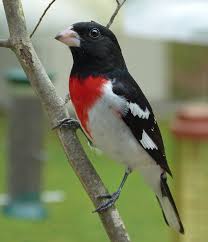
So one day she texts and asks “what is this bird”? Her image showed an Indigo Bunting. The next day another text with a photo and this one is a male Rose-breasted Grosbeak! Can you imagine? Two days, two stunning birds. Just for being home and looking. The great philosopher Yogi Berra since said “you can observe a lot by just watching”. Here are images of her two birds – pretty cool.
A Rose-breasted grosbeak will brighten up your day!
These two birds at your feeder, at your window, in your yard — wow.
Well that is just an example of what can happen. Here are a few things from my wanderings yesterday. Enjoy. Again the captions will contain the information.
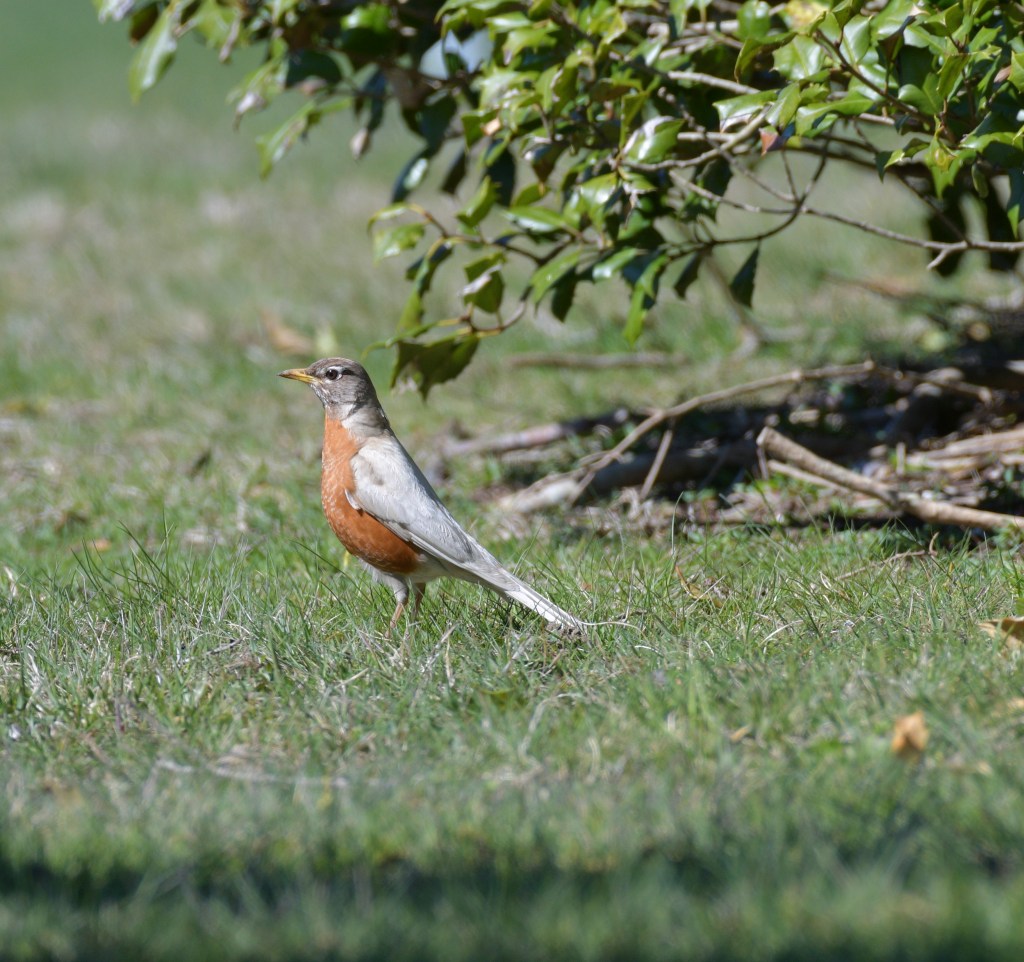
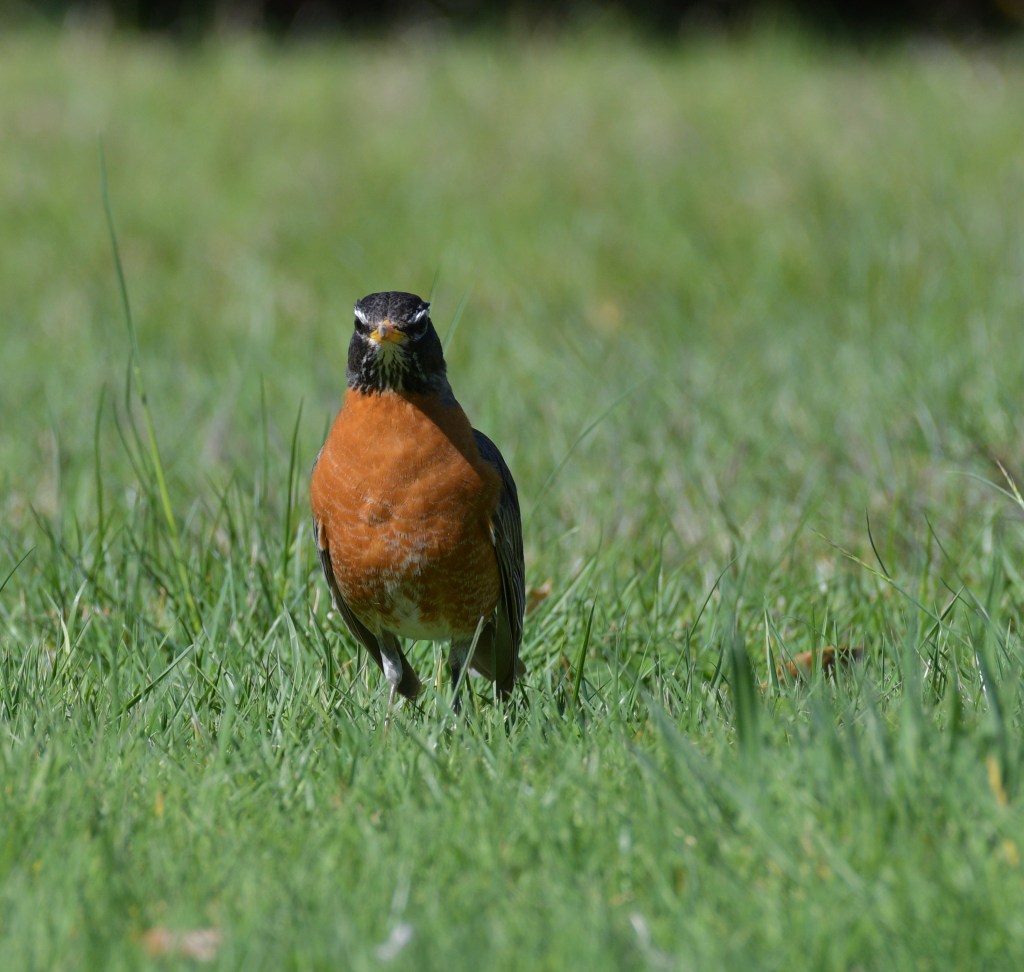
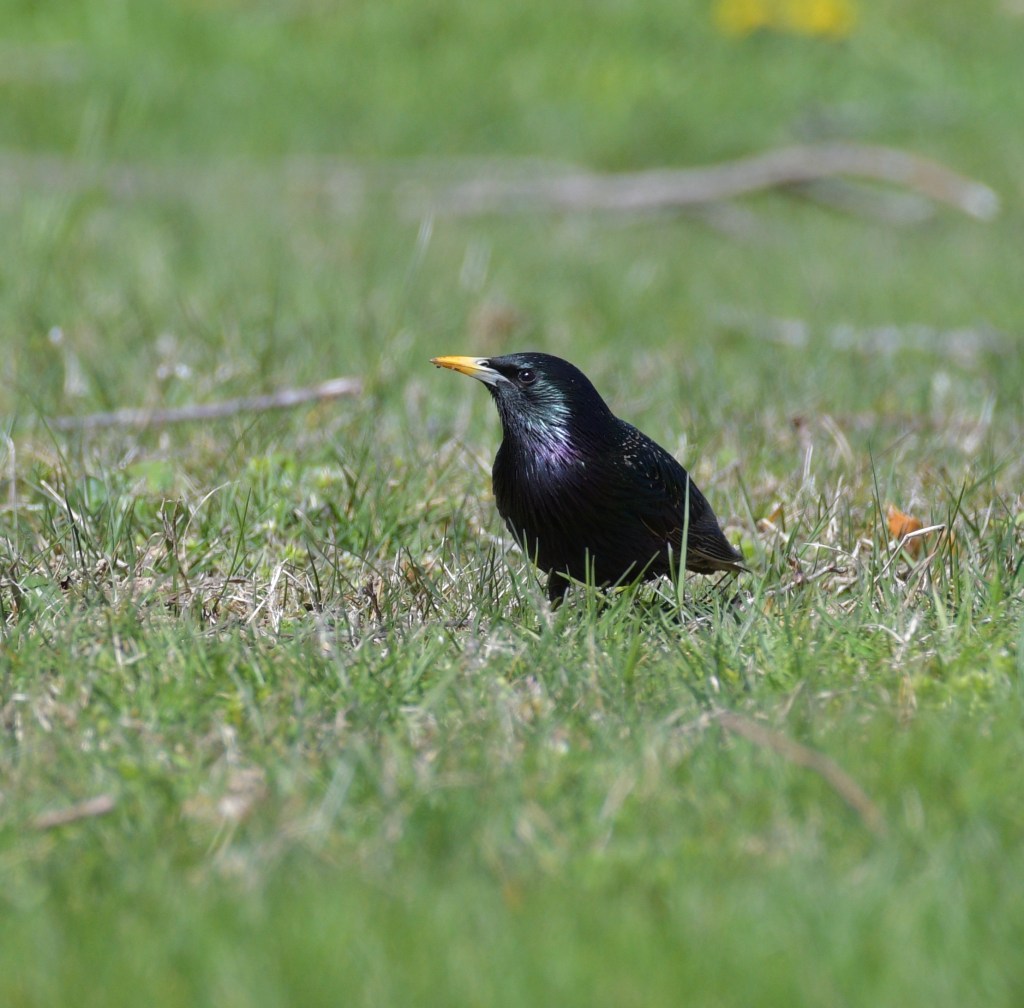
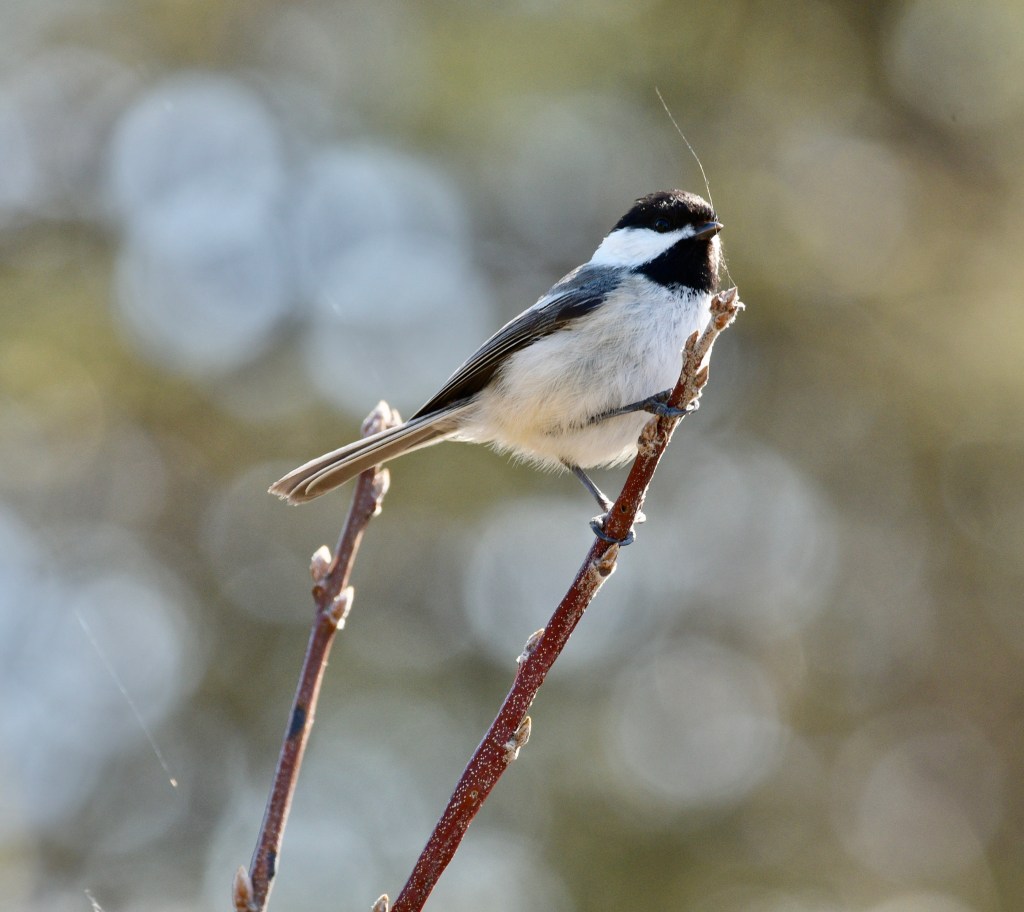
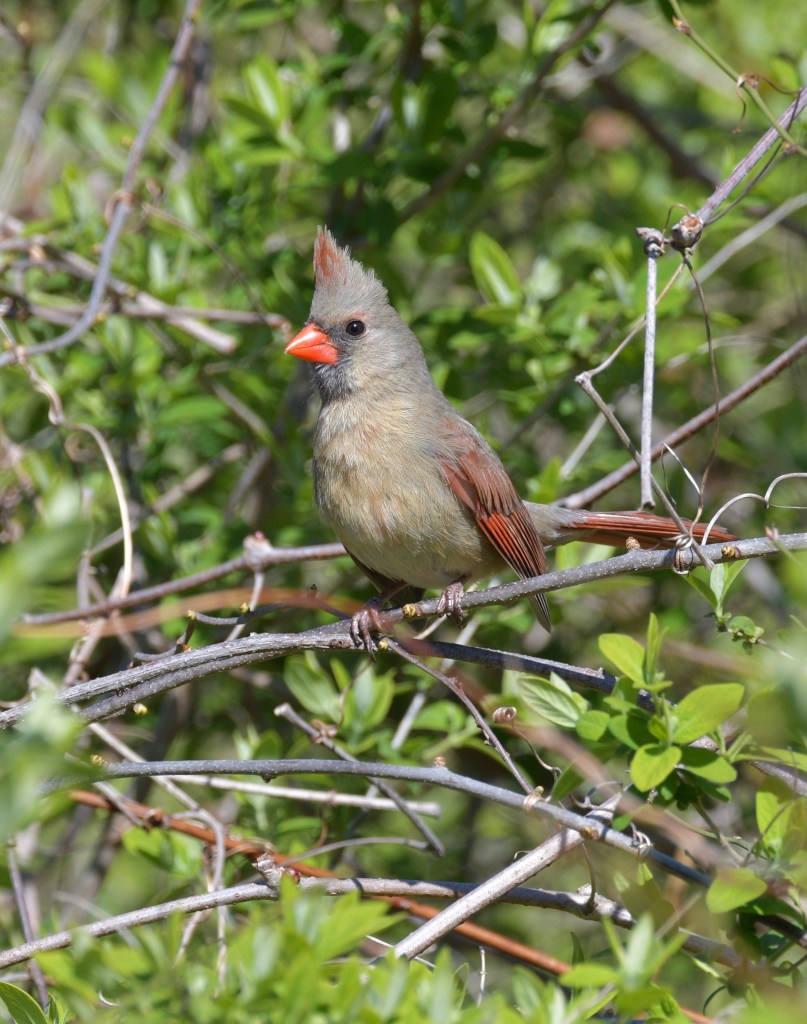
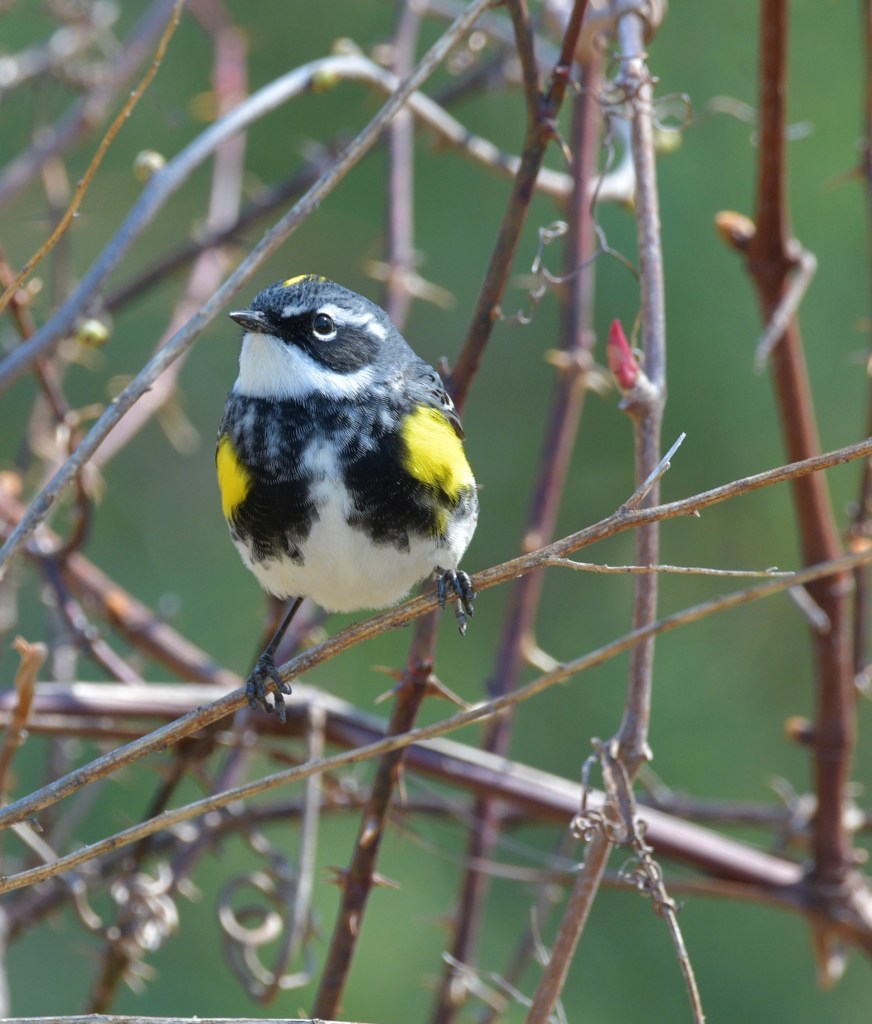
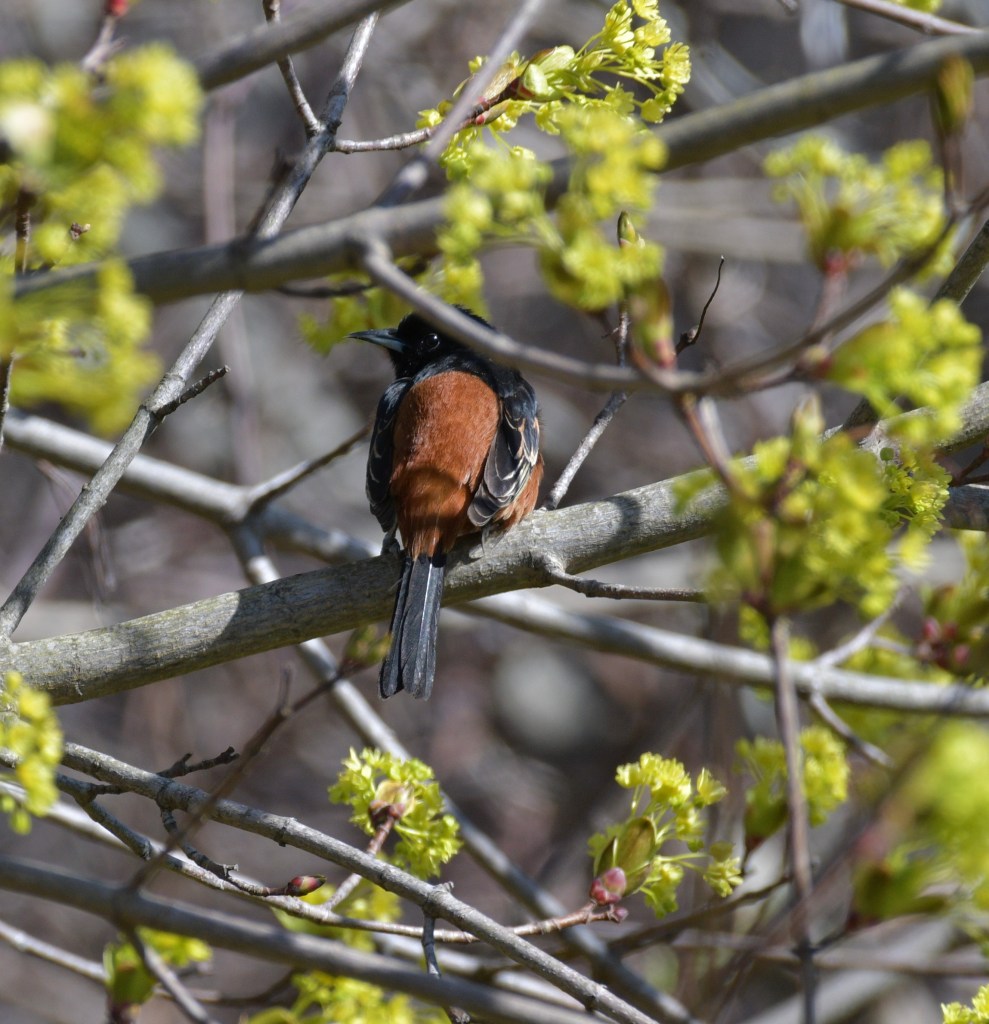
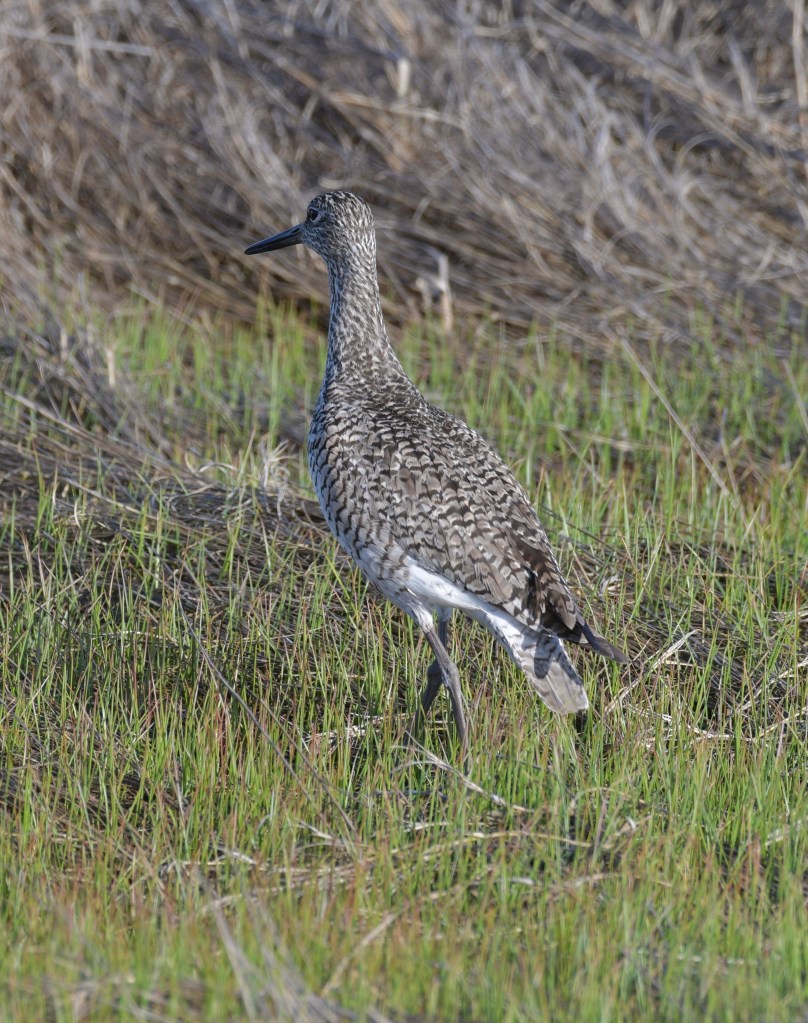
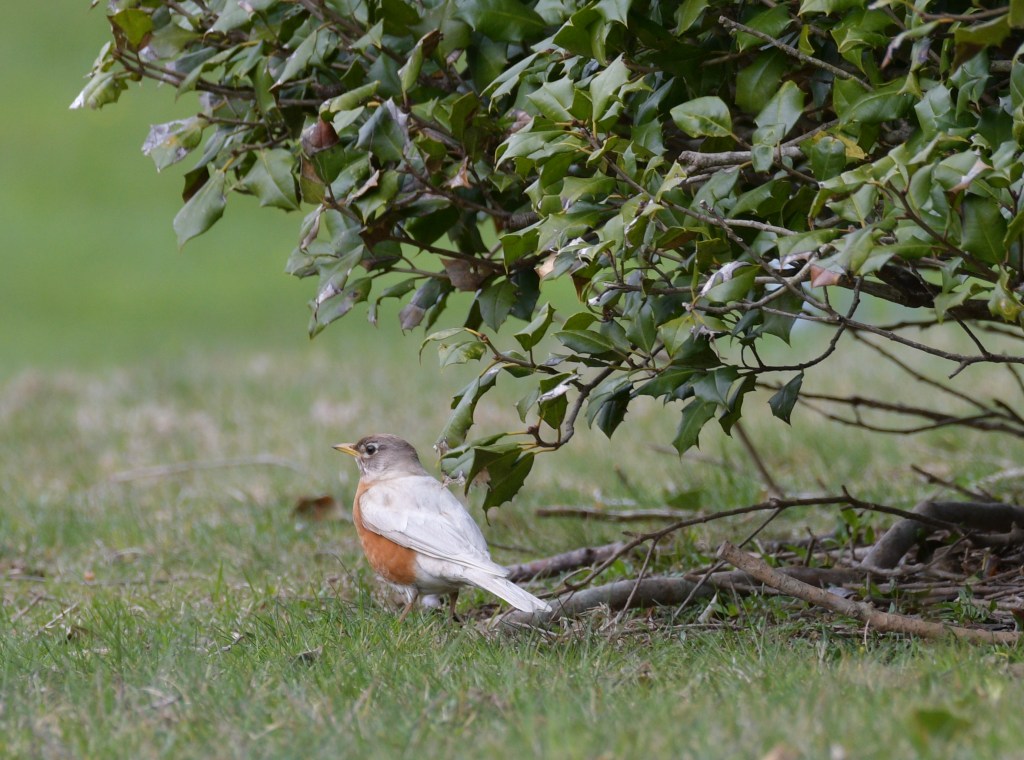
One of the first things I did was drive to the municipal building where that white robin (leucistic) was hanging out to see if it was still around. There is was. Yea. It was hanging around near a full and bushy holly shrub/tree under which it ran whenever anything startled it. The more usually colored American Robin (below) was also there.This American Robin seems to have eyebrows. In fact there are white eyebrows and a narrow yellowish eye ring. It is richly colored underneath and has a very black head – making it a male. The white that shows on the belly continues under the tail and the corners of the tail are also white. For a bird we think of as reddish it has a lot of black, gray, and white on it.The European Starling is not the prettiest of the starlings – a worldwide group with some pretty spectacular representatives in Africa. This is not a native bird to North America. And a matter of fact it was intentionally introduced (several times) by Shakespeare enthusiasts who felt that all species mention in Shakespeare’s work should be world wide. So they released them in several US cities, several times, in the 1890s. Despite being immensely common and often a pest it is respected as a hardy, intelligent bird that has succeeded in most every part of the US.The state bird of Massachusetts is the Black-capped Chickadee. This is a small bird in a group that is widespread throughout the world with representatives all through the Northern Hemisphere and some to the south as well. This image shows an interesting bit of our springtime – there are at least two strands of spider web in the image. Spider eggs hatch and many species will then have the tiny babies exude a single strand of webbing which acts like a kite and floats away carrying the tiny arachnid to its destiny. There are spring days where the sky just glistens with floating webs.We have two nuthatches – the White-breasted and the red-breasted. This little guy is, of course, the latter and is smaller than the chickadee. As a nut hatch it spends a great deal of time hitching up and down trees – always leading with its head. Headfirst up the tree and headfirst down the tree. They take black oil sunflower seed from the feeder and jam it into a crevice in the bark and then attack the immobile seed. Probably pretty wasteful but apparently successful.Many bird species feature a well-dressed male. The male is often a striking array of colors where the females are brownish, grayish, or otherwise subdued. Such is the way with the Northern Cardinal. The bright red male gets on the covers of magazines but the female is pretty cool in her own way. A bit subdued perhaps but a soft gray-brown with reddish touches can make for a pretty nice looking bird. In fact, if the male were toned down a bit we all might think the female is pretty fancy looking. The red bill, perky crest, and the red in the wings and tail are pretty nice.Our warbler migration can be patchy at best out here on Cape Cod. But we can count on the Yellow-rumped Warbler to both be around and to brighten an outing. They winter with us as dull grayish birds foraging on old sumac and poison ivy berries. As spring approaches they start to change. Slate blue-gray, ebony black, and bright whites and yellow begin to appear. Before they head north we are treated to a pretty splashy, if rather common, bird. The other warblers will come through in mid-May but the Yellow-rump is our earliest avian transformation. There is, in fact, a bright yellow patch where the tail and back meet- hence the “yellow-rump” name.We are pretty familiar with the Baltimore Oriole – either as a bright yellow/orange and black bird or a s a pretty mediocre baseball team. It may be a bit of a surprise to learn that we have a second oriole in the area as well; the Orchard Oriole. This bird has a brick red/brown where the Baltimore has bright yellow/orange. It is a bit more somber I guess. The chestnut brown body feathers are expensive to make so it isn’t until the second year that a male will create this look. As a first year bird it will be like a female Baltimore but have a black, feathered, beard under the bill for about an inch. This one is a male in its second year at a minimum (hatched in June of 2018 at the latest).On the Cape we have a lot of sand – that moveable gritty fluid that flows from the land into the sea. Around here it is a fluid. The edges of Cape Cod are worn away and the sand floods all sorts of locations just below the surface. It is always a new springtime learning experience to see what has open or closed the previous winter. Boat traffic is rearranged in many harbors each year as shoals and bars come and go. The dredging business is ongoing. But what I was going to get at is that we have the ideal passage habitat for many of what we call waders or shorebirds or sandpipers. The coastal flats are not replenished every year with little creatures, that will take time. But each year there is some place that is just right. Next year it might be just a bit further north or south. These areas can grow in with beach grass over a few years or they can wash away and be good only for fish. It is along these ever changing strands that plover, sandpiper, oystercatcher, sanderling, and many others feed as they head north in the spring and again during their southward passage in the fall. We have a few birds that nest on our beaches or in our dunes, usually the more remote the better. We have Piping Plover, American Oystercatchers, and Willet – that is about all. Most of our birds we see along the coast are migrants. They are rather speedy nesters once they get into the appropriate habitat and we often see southward migrants in mid-July. So they come and go along our shore but as the timing suggests many are actually residents of lands much to our south.
It seems that I have been moping around – lots of time and almost no blog pages.
Please respect the pictures and do not use them without permission. Please let others know that there are a few nature images available at ontheroadwithdec.com to help pass the time. Thanks.
So here we go!! This is a collection of images from the last couple days. We are confined and restricted like everyone is (or should be) but can still get out in the car or in the yard. The pictures are explained in the associated captions. These are just some of what a naturalist notices from the car window. Enjoy – more to follow.
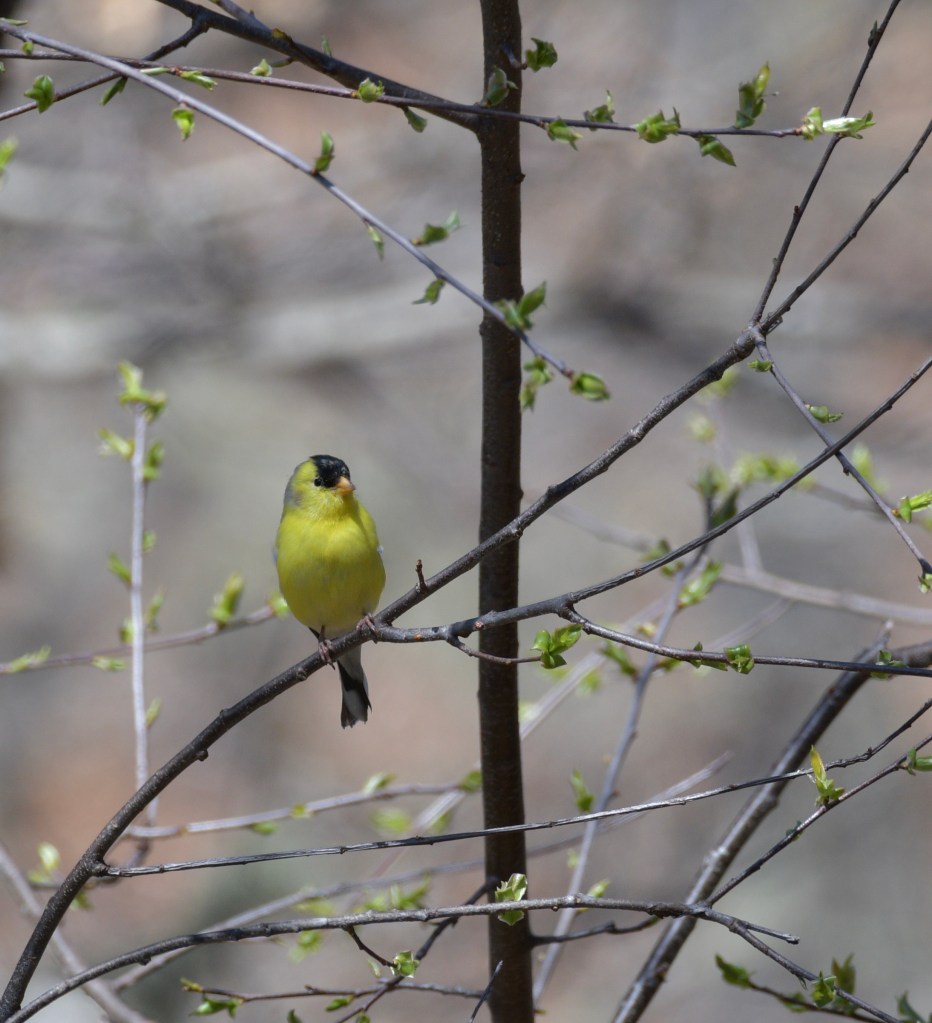
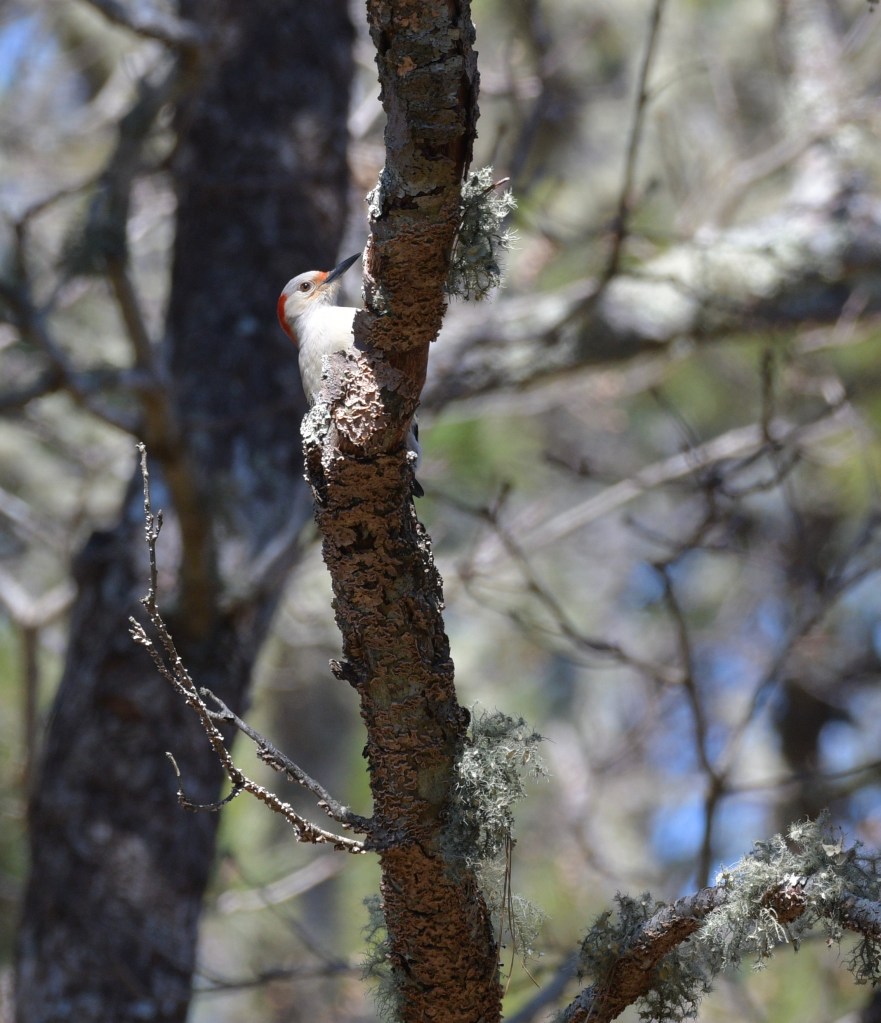
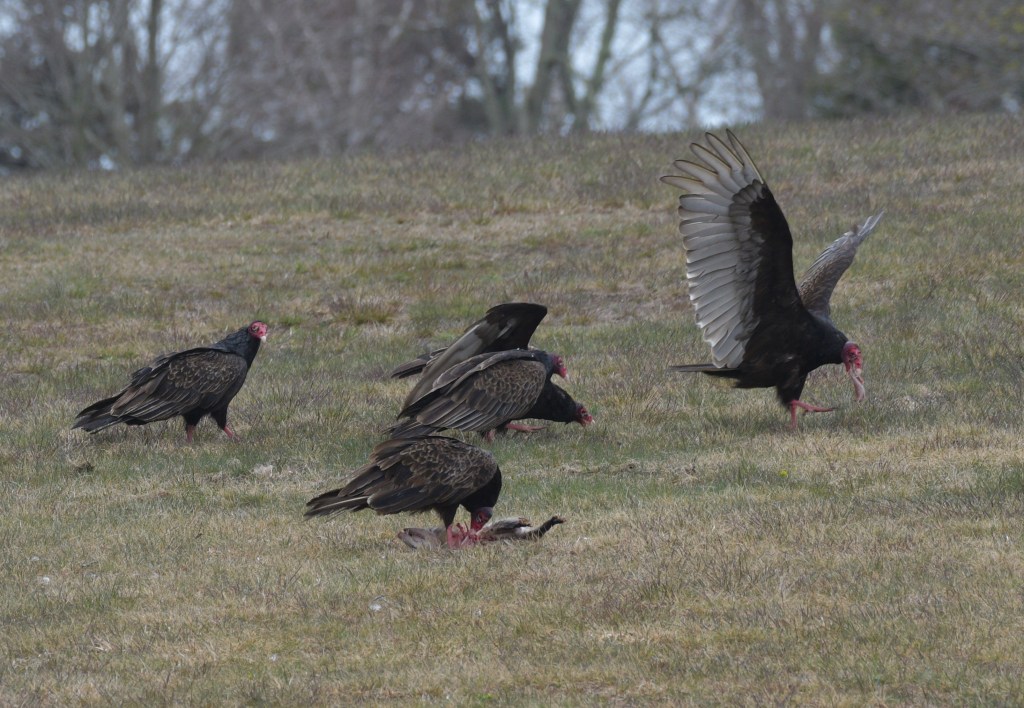
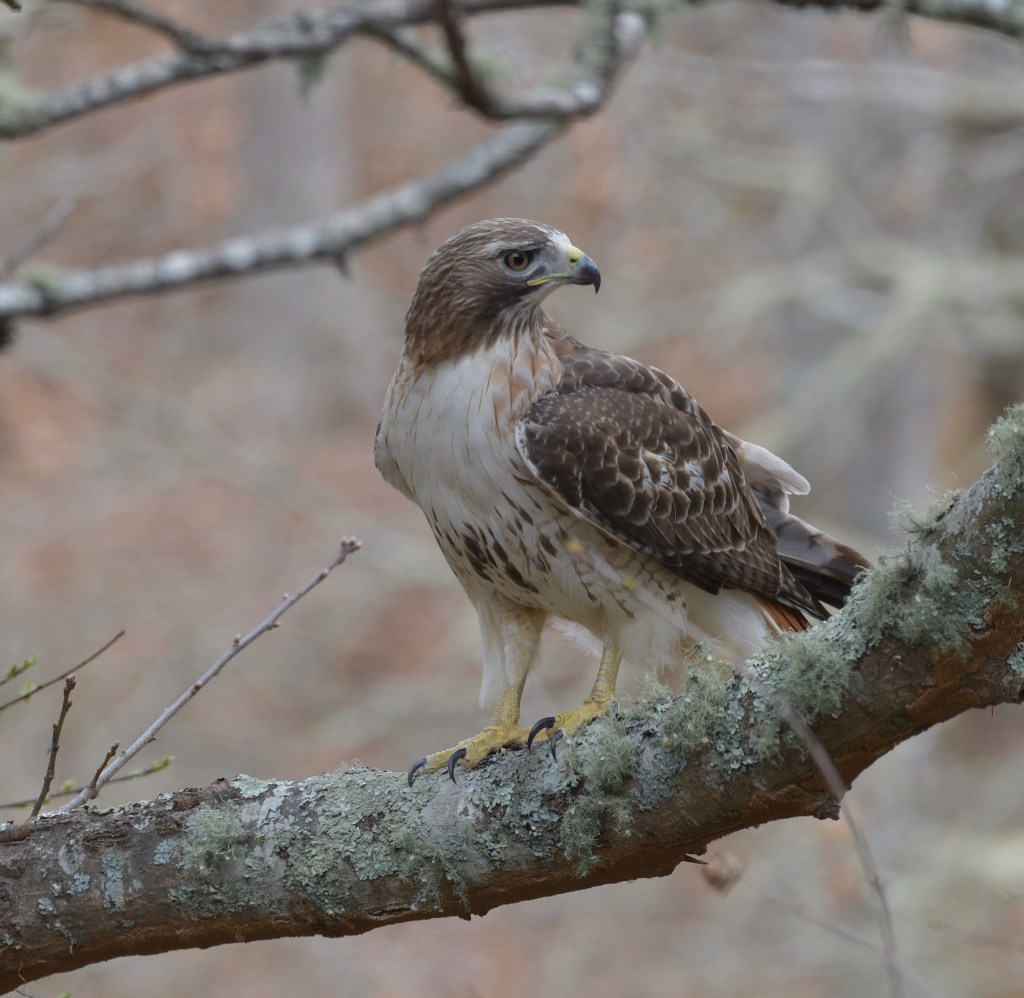
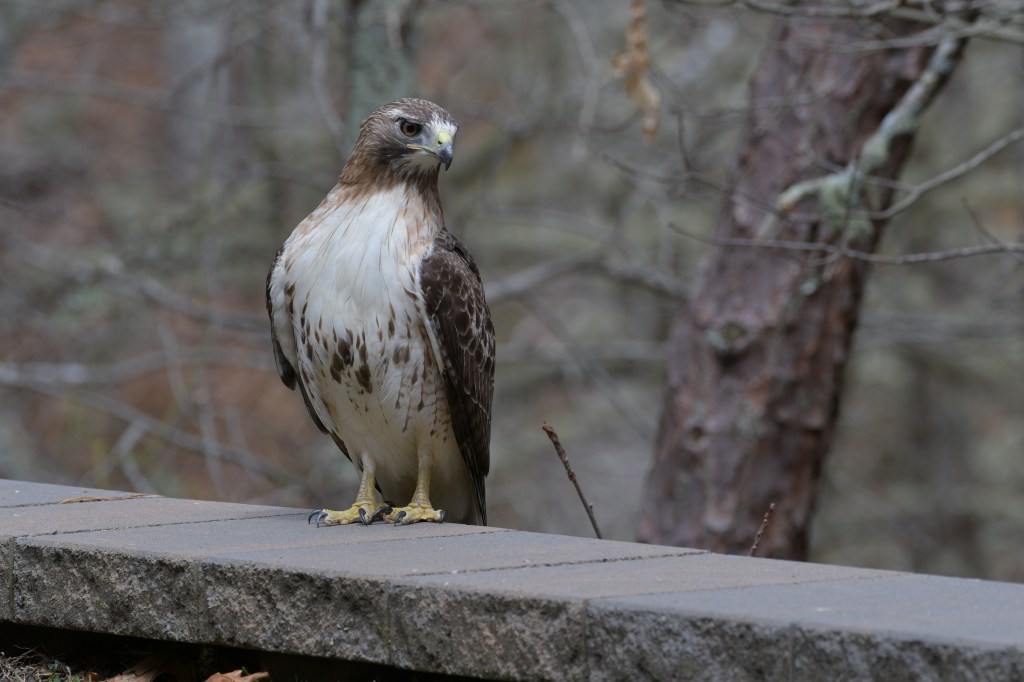
The bright American Goldfinch is a common bird of brush, fields, open spaces of all sorts and a common bird at feeders. They are reputed to be attracted by thistle seed (nijer/niger) but they are also very happy with hulled sunflower seeds. They are common in the early spring and seem to be paired up, but they are rather late nesters in our area – often waiting until June and July. They can be identified easily at some distance by their bounding flight and high pitched calls.This Red-bellied woodpecker is a bit shy. It is a breeding bird widely spread in eastern Massachusetts but the first nest in the Commonwealth was in the mid-1970’s. Richard Forster discovered that nest near the Rhode Island state line in Attleboro. The species has quickly spread throughout the state and well into New Hampshire as well. It must have been named by a museum taxonomist as the red-belly is never really there and even a pale red is quite uncommon. Combined with the fact it is a woodpecker and the belly is usually against a tree trunk the name is pretty poor on many levels. It is a noisy type however and you can usually hear them more often than you would see them.Turkey Vultures are large birds with vast wingspans. They are built to drift around using the movements of the air itself rather than flapping their wings. They are now year-round in Massachusetts and can be seen in decent numbers most every day. A good number is still less than ten but seeing two, three, or four daily isn’t surprising. The nearest bird of the five in the above image is working on the dried carcass of a Virginia opossum. It isn’t very often that we see vultures on the ground – but their numbers have increased in the recent decades so they must be finding enough food too survive and raise young. The Red-tailed Hawk is a very widespread bird of prey. They occur across the country in various forms; some are whiter than others and a couple populations are pretty dark. But they all seem to have the same size and shape and tail color. Many of the Red-tails in Massachusetts are quite white underneath. This makes them easy to spot as they perch in roadside trees. It is surprising to many people that these creatures live amongst us – that speaks to our insulation more than it does to the birds craftiness. This Red-tail is on a wall maybe ten or twelve feet from the house. We have also had Sharp-shinned, Cooper’s, and Broad-winged Hawks in the same proximity in the last two weeks. The Sharpie and Coops are bird eaters and may be strafing the nearby bird feeders – the Red-tail and Broad-wing are generally small mammal eaters and are probably eyeing the Eastern Chipmunks and Gray Squirrels that frequent the yard. This last image of the day is an American Robin – a leucistic American Robin that is. It has many white feathers; it isn’t an albino as that is a very specific term, but it has white feathers and that (in many forms and patterns) is leucitic. This partial loss of pigment is found occasionally in many animals. Siegfried and Roy had all those white tigers and there are squirrels, lions, giraffes, kangaroos, and even crocodiles that are white or nearly white due to a genetic circumstance that inhibited the production of normal color patterns; that is, the lack of melanin. This genetic defect has to be inherited from both parents and in many cases the animal will have other color-related genes which keep the animal from being white even though it coloration is not normal.
The image that opens the page is of a Snapping Turtle. This is a big old turtle (probably over 30 years old) out looking for a mating companion. The males will move around to locate females and the females will eventually lay eggs in a hole that she digs to a depth of about ten inches. The eggs are smaller than ping-pong balls and will all hatch at about the same time ten to twelve weeks later.
In years when there are lots of skunks the nest holes are routinely dug up and the eggs eaten. In years where skunk numbers are low (often due to distemper) the eggs hatch, and survive, in good numbers. Thus many turtle populations (all turtles bury their clutches) level off for a few years as the skunk population remains high only to surge when the skunks are reduced in number.
Throughout the year the oak and pine branches here in the northeast (of the USA) explode with a greenish fuzzy growth in times of rain or extended dampness. This actually happens pretty much all around the world in some form or another. There are epiphytes, mosses, orchids, ferns, and lichens that grow in and on trees. They are not connected to the ground and most of them are not parasitic. They just live in treehouses; gathering moisture and stuff from the air around them.
This fuzzy plant-like growth that I am writing about is a lichen – a Usnea to be exact and probably Usnea strigosa. This is a very common “plant” in most parts of the east and northeast of North America. It attaches to the bark of trees, or sometimes to dead wood, where it simply hangs out month after month and year after year. It belongs to a group of lichens called fruticose lichens and is related to a vast array of similar lichens found world-wide. Many of this group (the Genus Usnea) are called “old mans beard” or “bushy beard” or some other phrasing that would remind you of a shaggy beard. (“Spanish moss” is another common name for a plant that hangs from trees; but Spanish moss is a Tilandsia – a cousin of the pineapple and is a flowering plant not a moss or a lichen.) The group apparently can be used medicinally to control weight, pain relief, wound healing, and as an anti-bacterial agent – though I have no idea how it is prepared, used, or collected.
Lichens are not a real thing! There are at least 14,000 organisms that are called lichens that have been identified worldwide – and they still aren’t a real thing! They look like a moss or like a fungus or maybe just a scaly thing on a rock. What they are, and how they are named, is based on the sort of fungi (usually an Ascomycota – a group of about 30,000 similar fungi) and not so much on its photosynthetic partner. The usual cohort is an algae but there are lichens that use Cyanobacteria (blue-green algae) as well. The relationship has been called symbiotic but the actual relationship is much more complex; growth and reproduction of the photosynthetic part of the lichen has to be somewhat unlimited – so the fungi aspect of the relationship takes the fruits of photosynthesis but allows the green portion to grow and reproduce.
But the more you know about plants the more you realize that fungi are integral to the lives and growth of many many plants – from the lichens through the giants of the forest. Fungi provide the mechanism for transfer of minerals and moisture from the soil to the plant. They seem to be the IV tubes that allow plants to gather goodies from the ground (and maybe from the air).
Perhaps everything is a lichen to one degree or another.
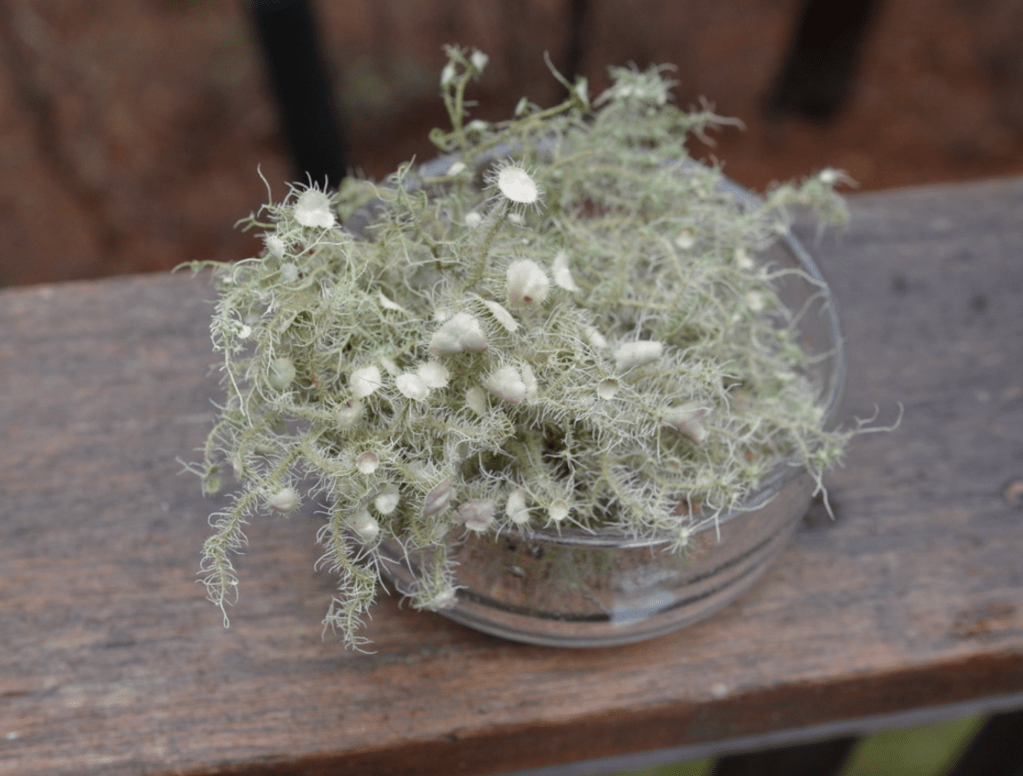
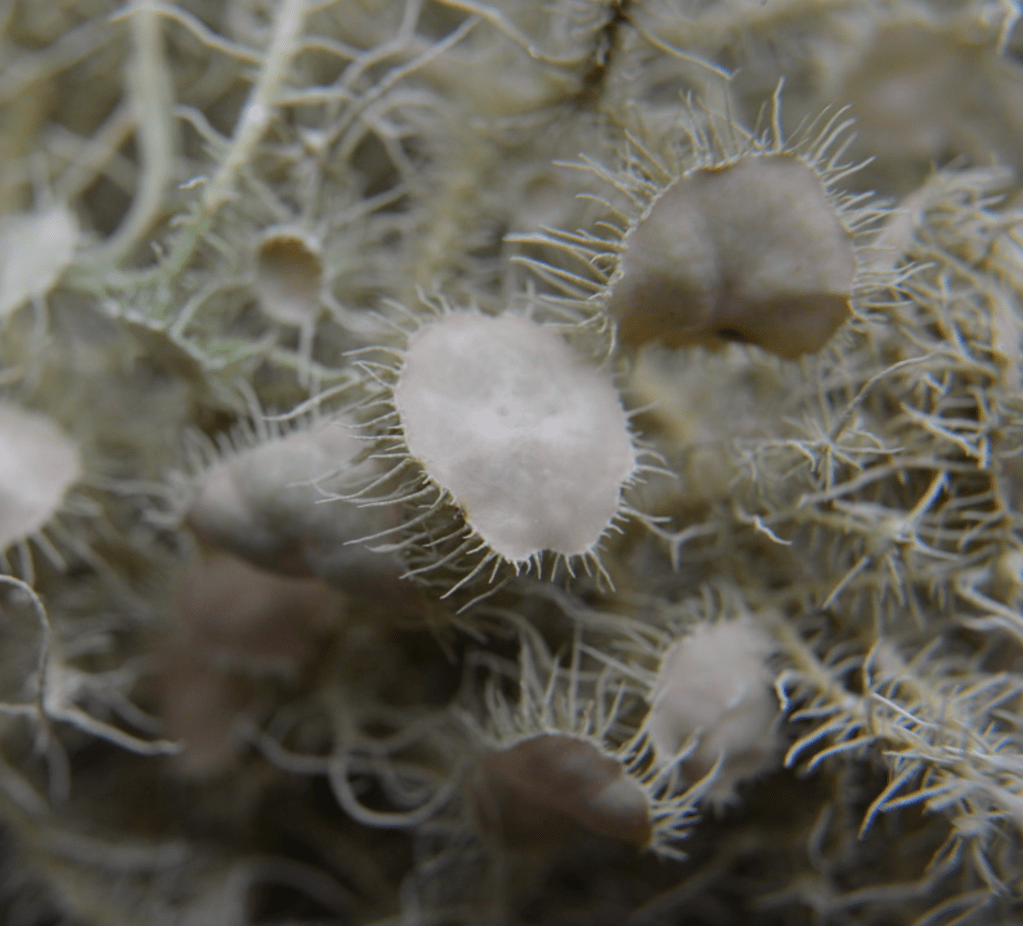
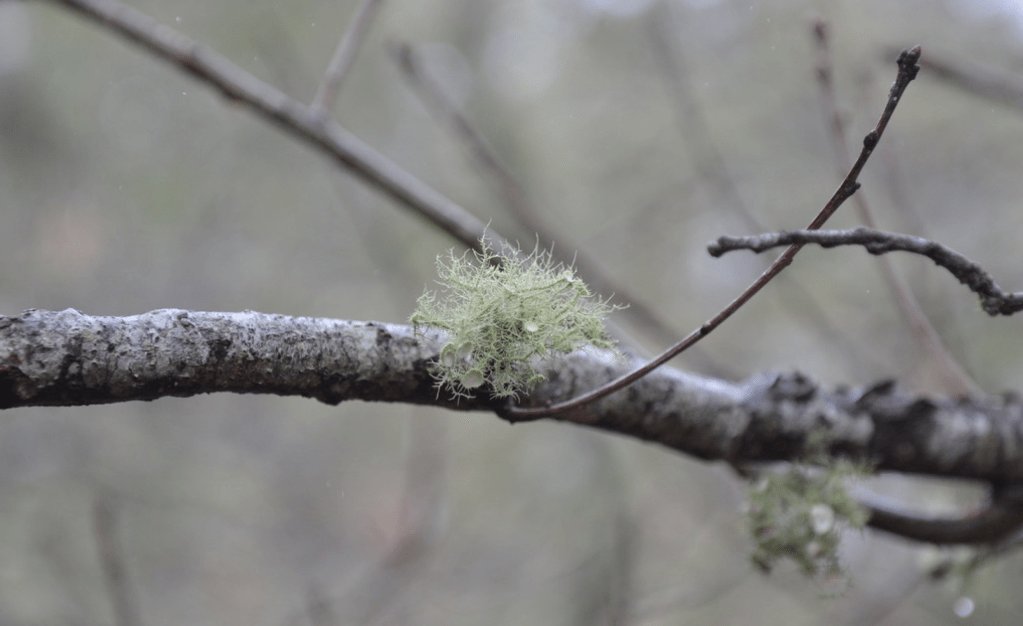
Here is a small dish of Usnea strigosa that fell during some recent wind and rain. As the lichen often grows on dead branches (it isn’t a parasite and can grow on anything) it is common to find small branches and bits of “beard” on the ground.There are few common names for the various parts of mosses, fungi, and lichens. We don’t talk about them enough as a culture to have developed nice little botanical terms like leaf, branch, trunk, or bark. Part of it is that these organisms are different – the thallus is a stem sort of but it also does much of what leaves do and it connects to a “holdfast” as there are no roots in these Usnea growths. The rounded, hairy-edged thing in this picture is a fruiting body called the apothecium and it looks sort of like a leaf (but so does all of the plant); its most important role its to house/hold/display the fruiting bodies of the Usnea called asci. It has no more of a leaf-function than does any other part of the lichen. This group, and most fungi, are in a very special linguistic arena. This is a small clump of Usnea strigosa on a branch in the rain, on a gray and gloomy day. The outside temperature is about 40 degrees Fahrenheit and the woods is a hazy gray-green as almost all the trees are hosting a blush of Usnea. The fungi/lichens will dry out and pretty much disappear in arid times and expand and grow in times of wet weather – even in cold wet weather.
Viruses are very strange – they are not usually classified as a life form – like archaea, eukaryotes, and bacteria. They are usually just some bit of stuff waiting around to attack and kill (eat? – not really, just use the life juices from) bacteria. Viruses are invaders; usually of no matter to us at all. As a matter of fact Carl Zimmer, the renowned virus guy and author, says we have about 14 billion of them on each of our hands – hopefully eating bacteria that we want to have eaten. But when they invade our cells and use the cell juices of our own complex cells to power their reproduction it sometimes happens so quickly that we cannot develop the antibodies needed to kill the viruses – and for a while (at least) the viruses win. In most illnesses the after effect of having a virus is that your body now has knowledgable bits that will recognize and defeat the virus if it appears again. This corona virus we are experiencing is new and we have no defenses yet; either manmade or from a vaccine. So here we sit, waiting, hoping, and trying to stay busy and out of sight.
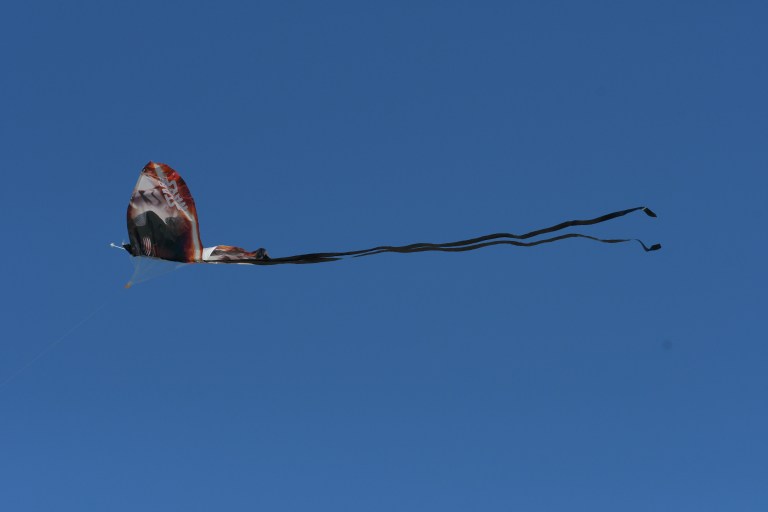
Staying in the car and staying rather remote I went out today for an hour or so. We have been pretty dreary the last few days so the afternoon sunshine was enticing. There were people sitting at oceanside parking lots watching the sea, people flying kites from the beach, and a few souls already preparing their garden plots at the community gardens. I was able to get a few images. There isn’t anything special about these pictures but maybe they will bring a bit of Cape Cod sunshine into your day.
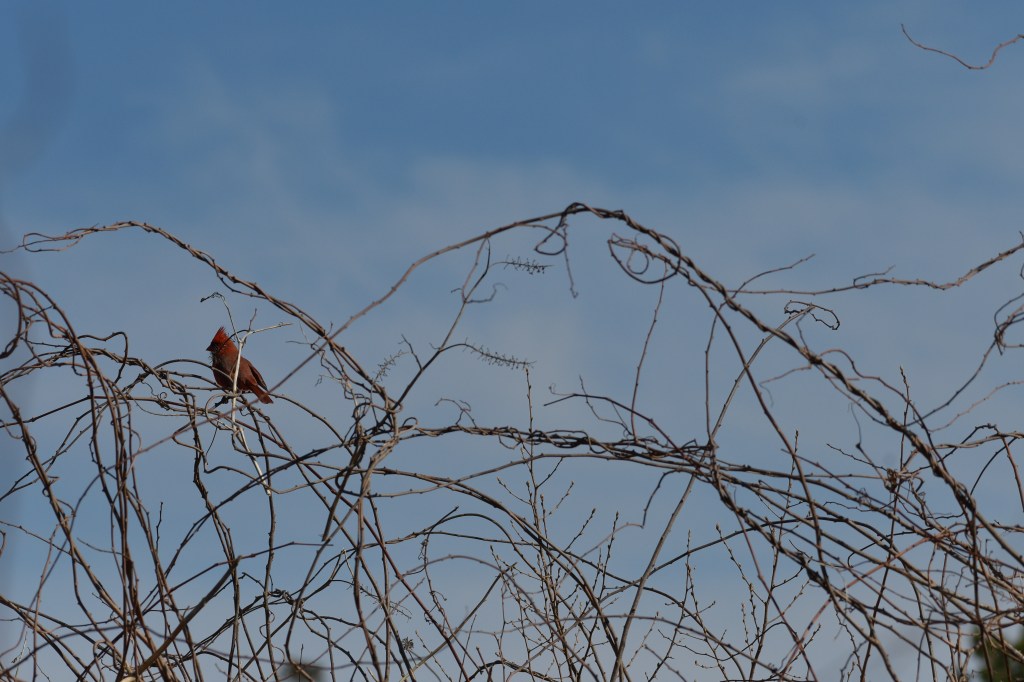
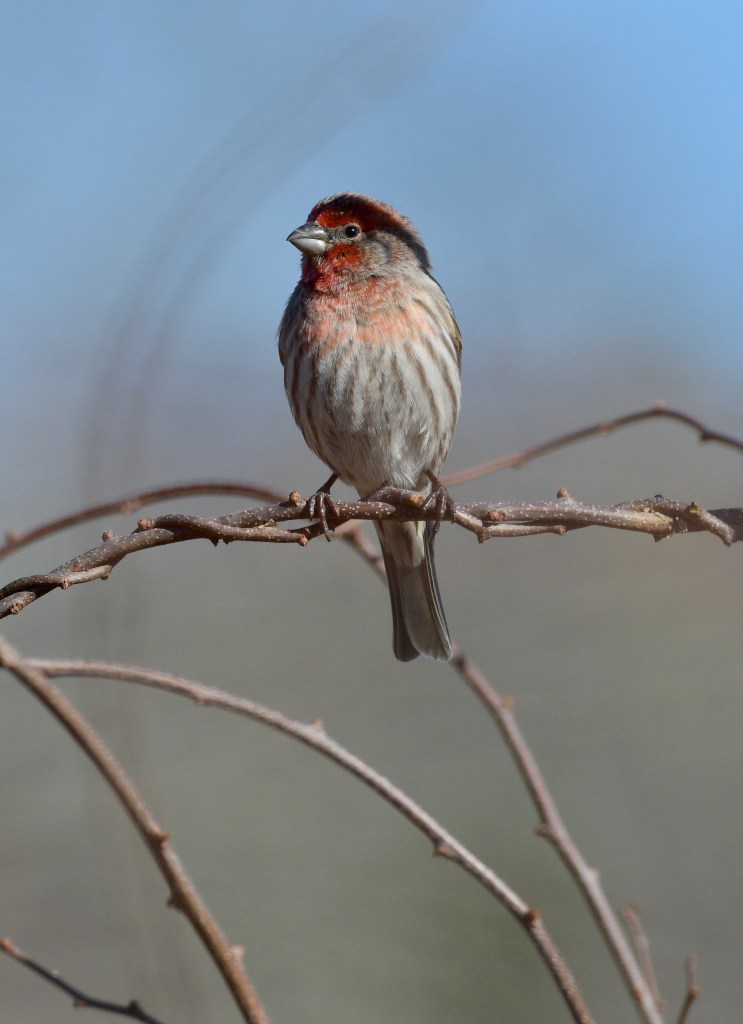
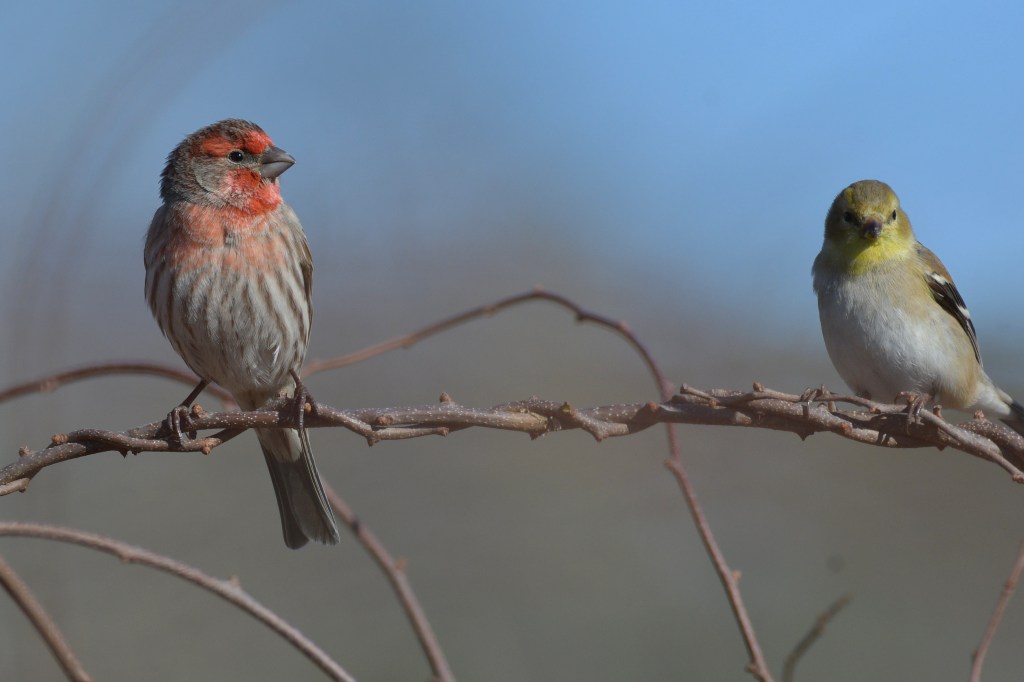
We have American robins (AMRO) all winter here on Cape Cod. They are sometimes seen heading to a roost site in the late afternoon. Our roosts can contain thousands of birds; usually in a red maple swamp. During the day they scatter about looking for old fruit and berries that persist into the winter. This one didn’t pose very well and the picture is pretty average, but it is a reasonable bird to start with.This northern cardinal (NOCA) was cooperative but not close. The males are starting to whistle loudly as the days get longer and warmer. Can nest-building be far away? The cardinals are seed eaters and many can be found at bird feeders where seeds, especially black oilseed sunflower, appear like magic.I was in the car and not able to get where the light and bird combination was best. Hence this very nice eastern bluebird (EABL) is a bit shaded and yet still pretty nice. The males, like this one, are rich in both the reddish color and the blue. Some bluebirds winter here and others migrate – I have no idea what they are thinking.The house finch (HOFI) is a bird that older folks often think is a purple finch (PUFI) – but not so. The house finch wasn’t here when many of us were kids but even then the purple finch wasn’t very common either. Anyway, today we have pretty much only house finches. The males can be quite red and the females and young are rather a dull grayish-brown. Some of you may get purple finches at your feeders as migrants heading north in March and April.This is a house finch male (on the left) sitting with a second cousin – the American goldfinch (AMGO). The AMGO is a bit yellow but has no black on the head; the yellowish eyebrow and the greenish patch below and behind the eye make me think this is a winter-plumaged male; just a bit slow in starting to turn bright yellow.
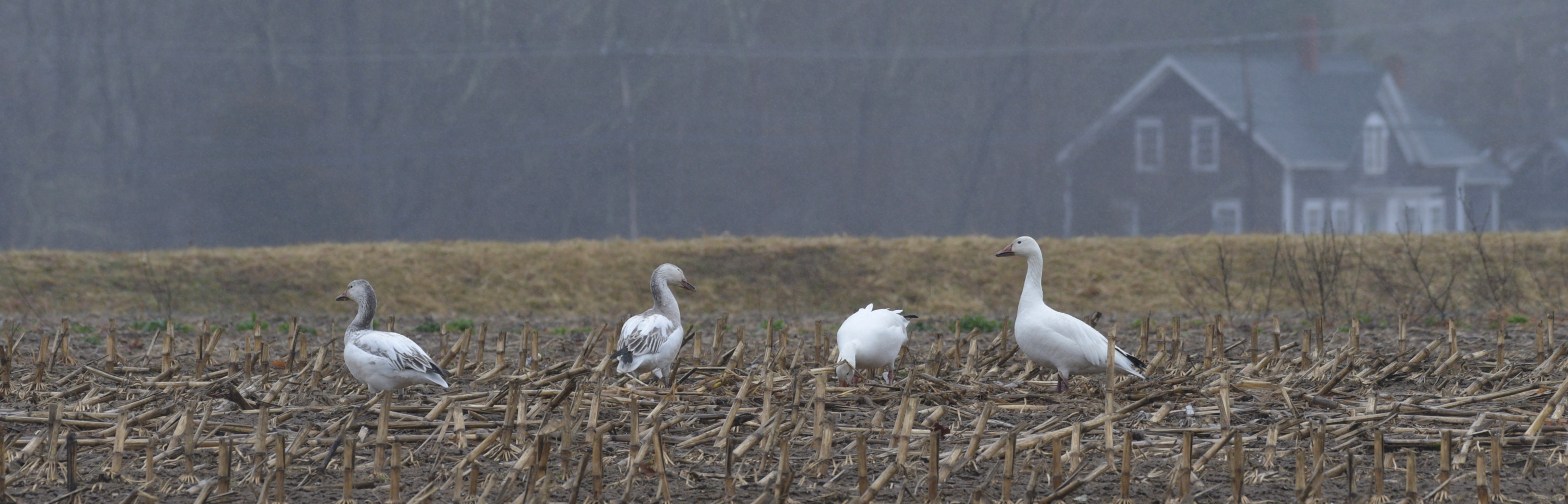
This was an odd sight. I tried not to seem to interested or impressed – as were being flown where birds usually rest – but I have to admit they were eye-catching.As I mentioned there were kites – not the bird kites but the airborne floaty things. In this case a Star Wars flyer with a long tail and in the top images, those pairs of pants or lower body parts.These are snow geese (SNGO); probably a pair and last years two youngsters. These birds were not on the Cape but in a large corn field in southeastern Massachusetts on a rather dreary day.
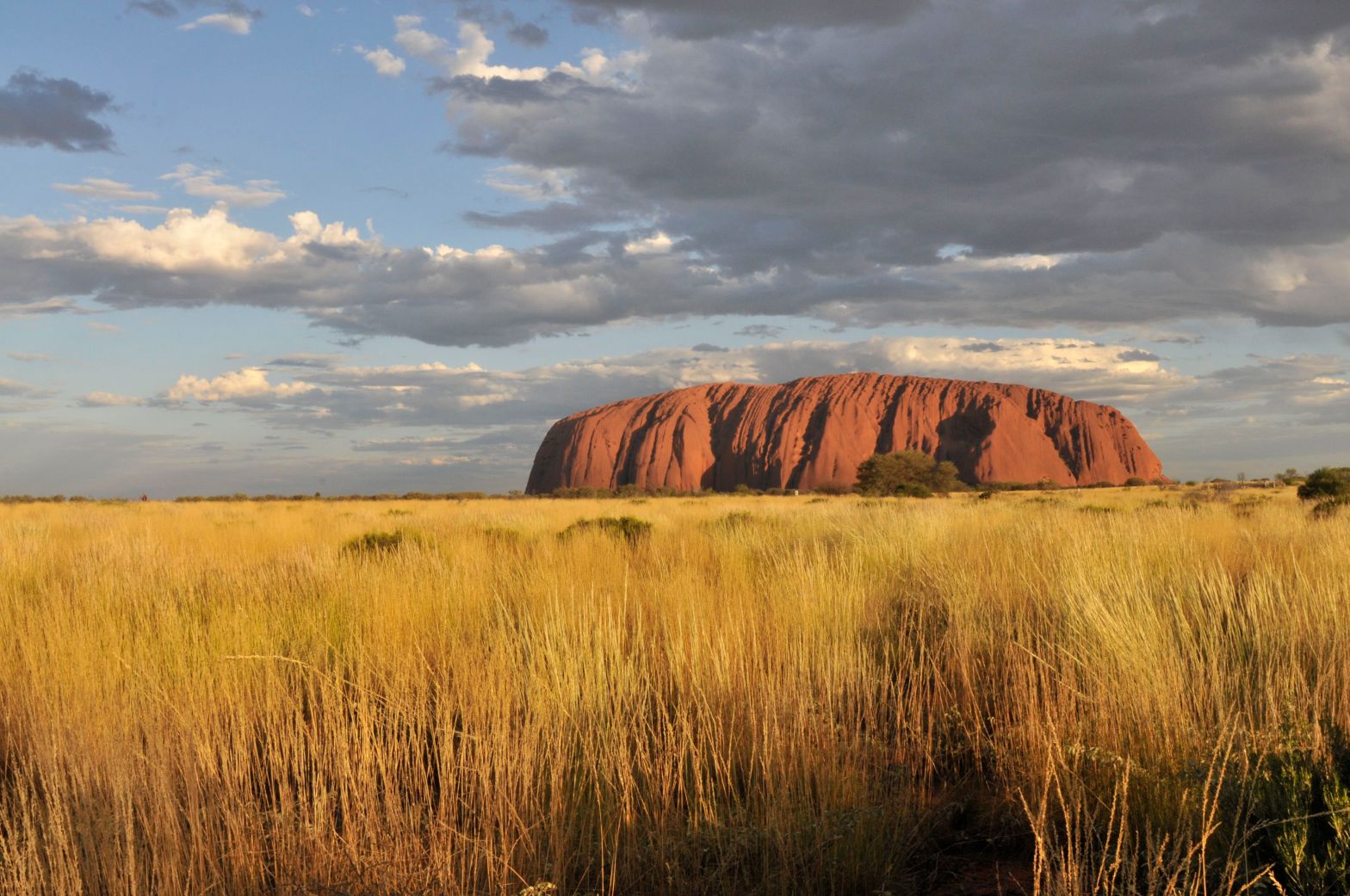
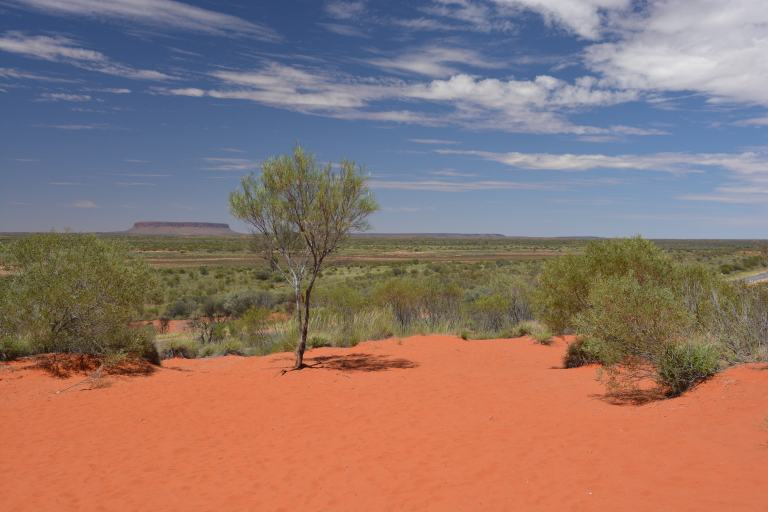
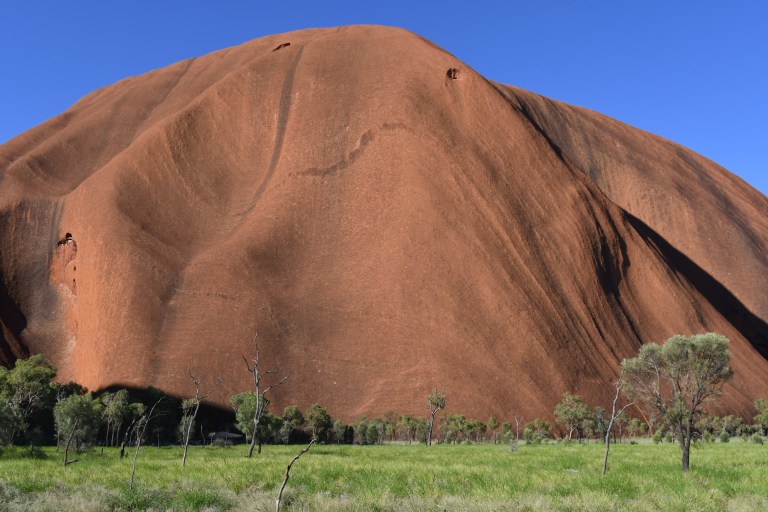
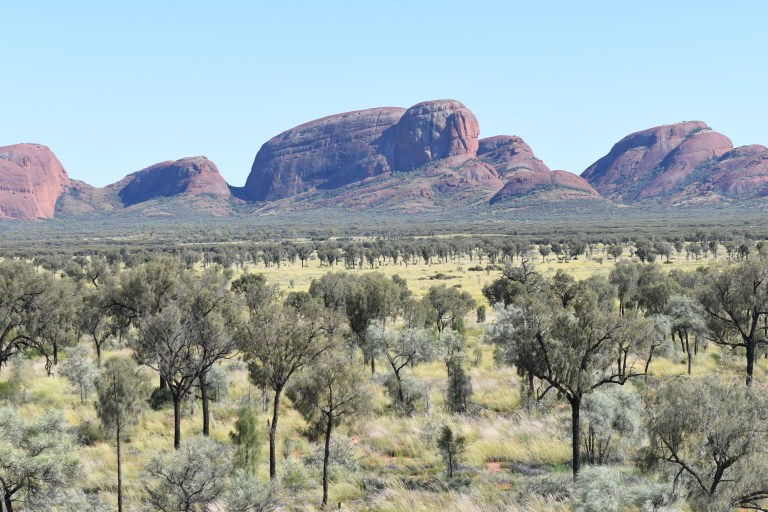
What may look like Uluru out there in the background is the remains of another portion of the ancient and eroded Petermann Mountains; Mount Conner. The flat top is merely a part of a harder more erosion-resistant layer of material that was laid down eons ago. It is simply hardier stuff than what the surrounding layer, or the layers that were once on top of it, were made of. If you look through the tree in the middle you can see a longer lower ridge that extends across the middle of the image just at the earth-sky horizon. I have never been out to this feature as it is on private land, a large station (ranch), called Curtain Springs Station, but it has a great mystique to it. When I say large station I mean really big; the Curtin Springs Station is more than a million acres in size; that is over 1600 square miles!! It is currently a mix of tourism and cattle ranching. As you can see in the picture grazing land is very sparse and water is unlikely. The station makes long range plans based on having a good year of rain every 7-10 years. The management of the ranch is much more aboriginal in outlook than European. They try to protect habitat, utilize native grasses, manage rainfall, and eliminate feral animals and non-native plants. There are no planted pastures on the property everything is native.
The last bit of remarkable information is that within the 1,000,000 plus acres there is no surface water at all. It was Peter Severn and his wife Dawn who first moved out here and established the Curtin Springs Station. It was Peter who laid out and installed the walk up Ayers Rock – a walk that is no longer allowed on Uluru. The walk was closed in November of 2017 at the request of the Anangu people, who hold title to the land. The post and chain guideline was installed in 1966. You can still walk around the base of the rock but climbing it is no longer allowed. The walk around the base is about 7 miles and takes at least 3.5 hours. Guided walks are available.
At the Curtin Springs Station they take in guests and provide a great deal of information on the area. There are hikes and overnight outings that are run by the station. The roadside part of the station is just a few miles from Uluru. It would make a great get-away spot.
The scene in the above image is one of the most enthralling vistas in the world. You can see forever; you look into our deep past from this vantage.Most of Outback Australia is remote, wild, empty, harsh, and unfenced. Most of that is just what we like when we travel. There are a few things related to living here that might interest you. Road signs here are not like this in most places, they are frankly honest. As you drive along you may be warned about death from car and truck accidents or loss of flesh from motorcycle mishaps; often with graphics.
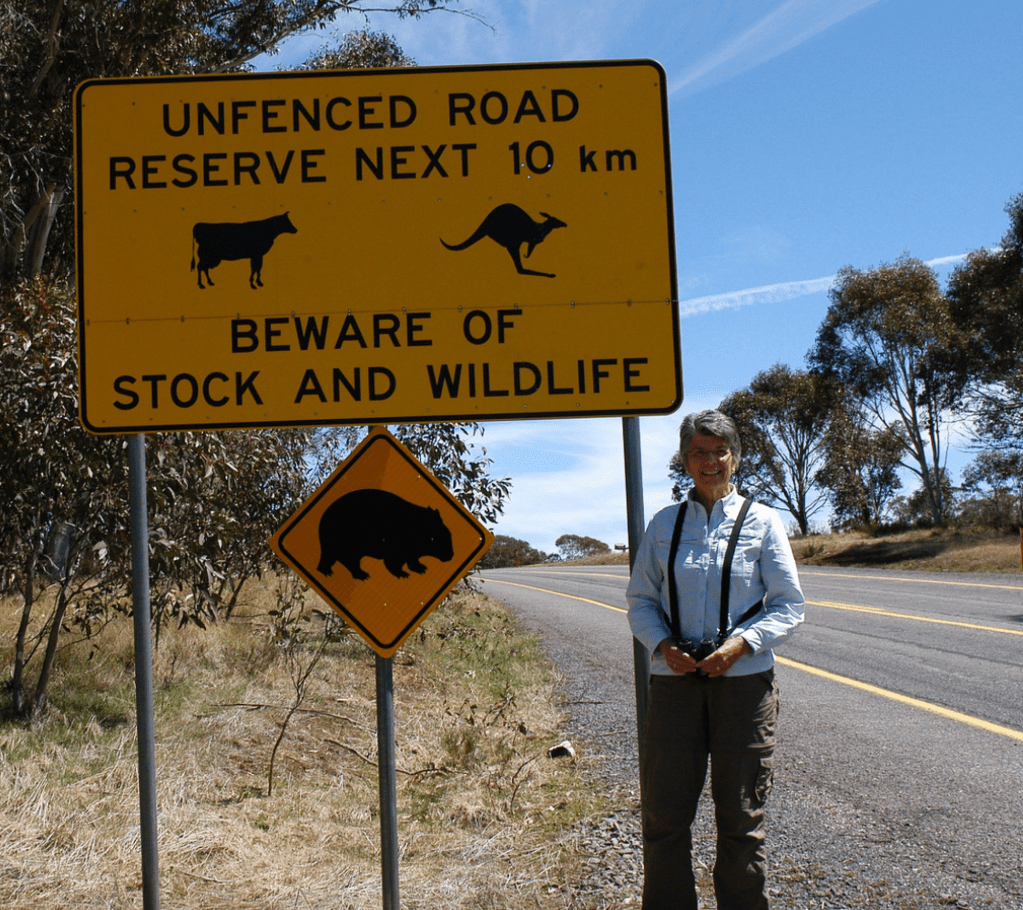
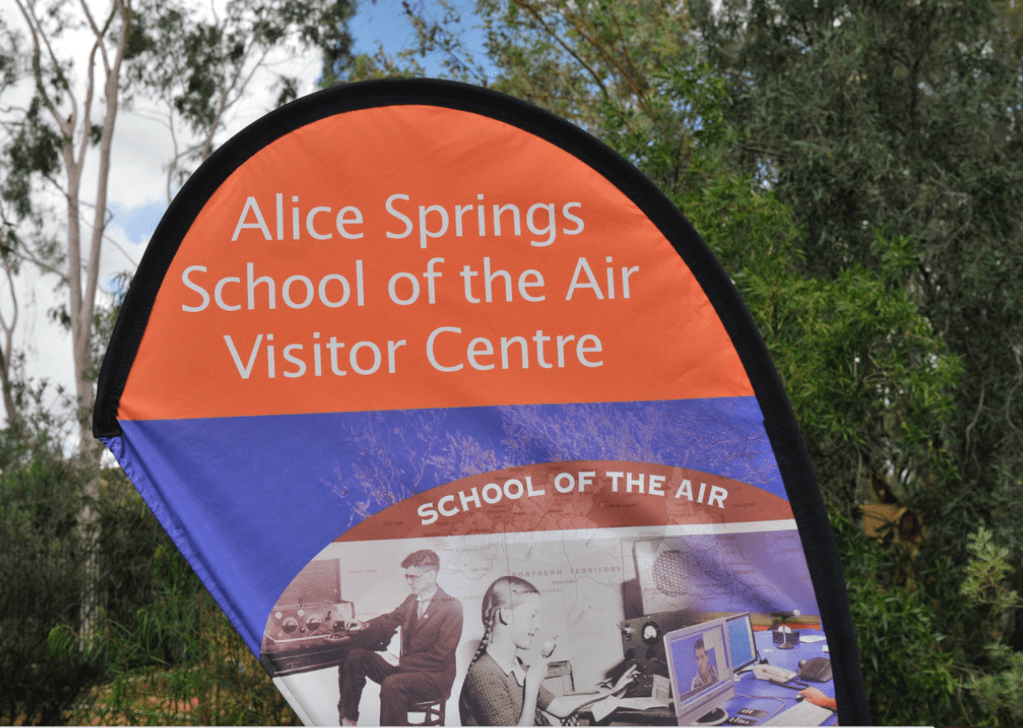
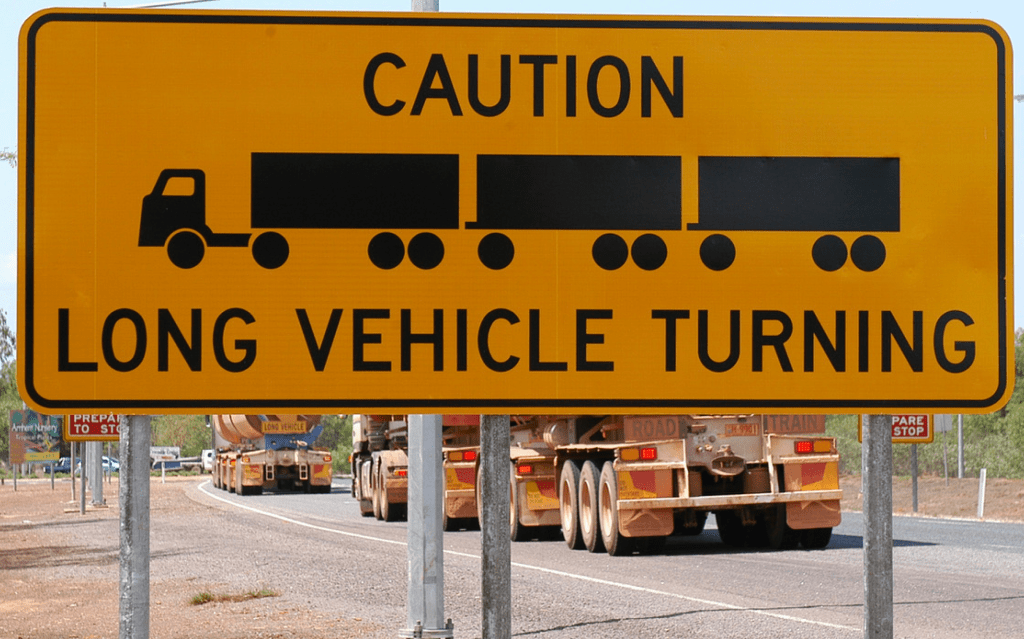
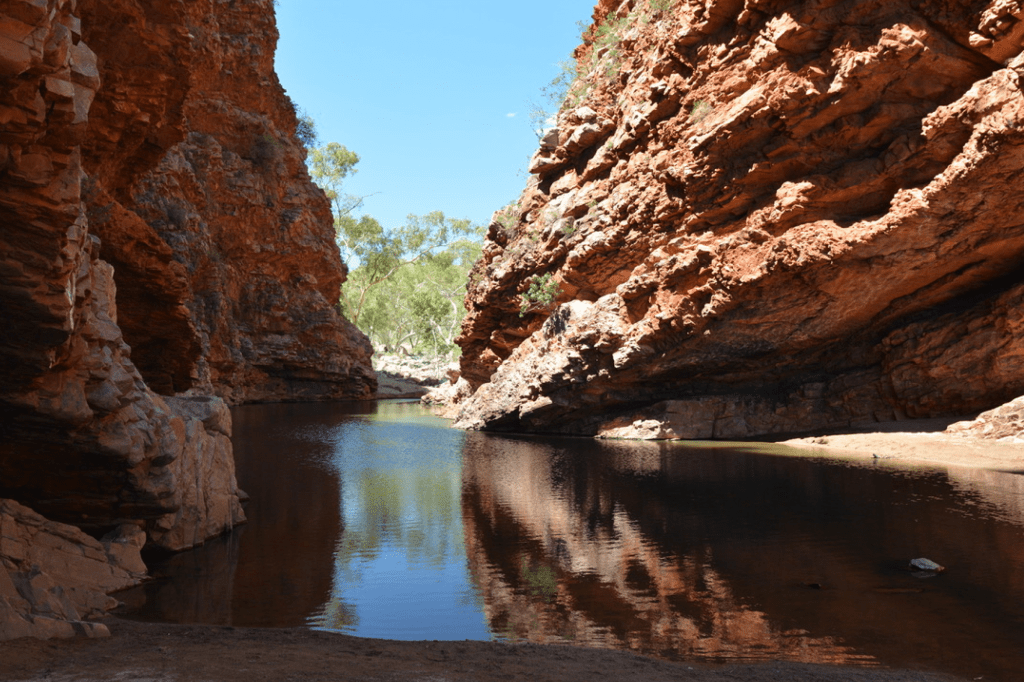
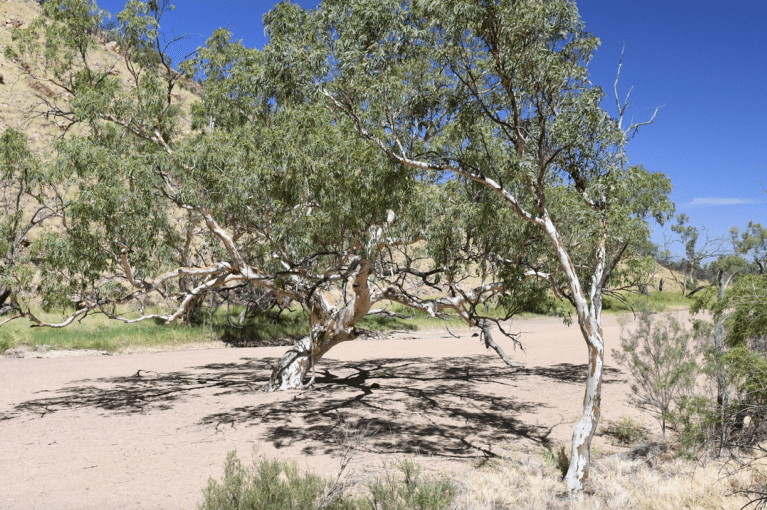
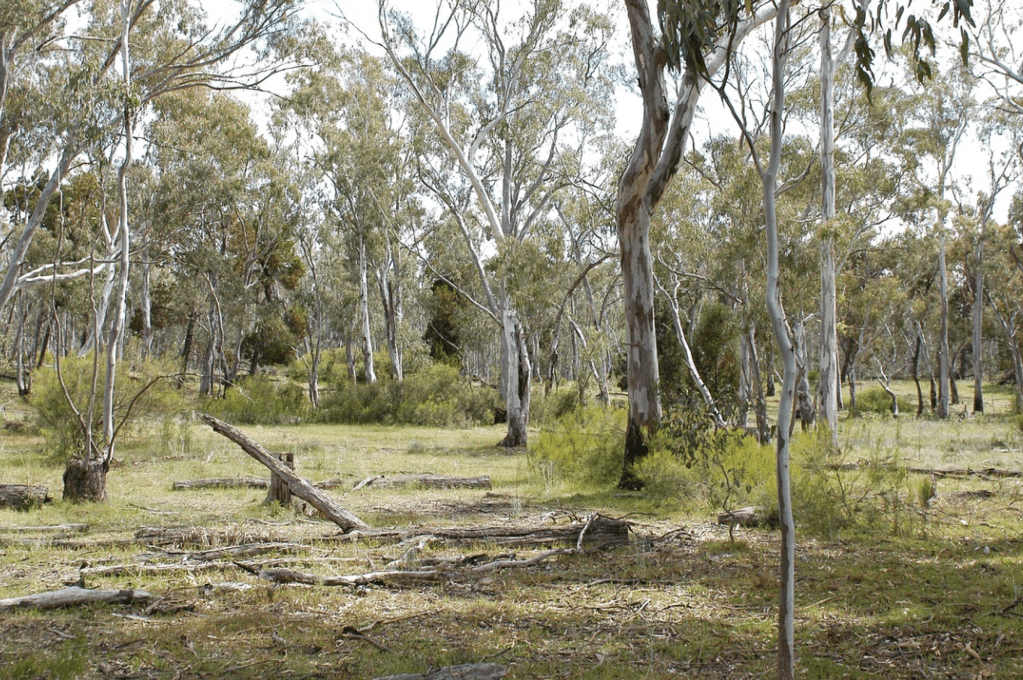
The beware-of-wildlife signs are also unique. There are “watch for kiwis”, “watch for emus”, and “watch for bandicoots” warnings posted throughout their habitats. On the main roads, where speed is likely, the warnings mostly deal with cattle – but kangaroos and wombats can be a problem also. There are signs for snakes, plovers, thick-knees, box jellyfish, sharks, and all sorts of other stuff depending on what part of the country you are in. The shark and jellyfish signs are not along the road — just in case you were wondering. The real fear in most of the country is dehydration and sun burn.You can imagine working at Curtin Springs Station and waiting for the school bus to arrive to take the kids to school — maybe you can’t. Many of the cattle stations are hours and hours drive from the nearest settlement and a days drive from a city. School is boarding school for the older kids and School of the Air for the younger ones. School of the Air provides an educational opportunity in front of a monitor with teachers broadcasting from Alice Springs many many miles away. The school started with foot-pedal radios that sent message and and air service that delivered books and assignments. The 21st century has seen significant upgrades to solar powered computers which allow for instantaneous communication of material. The kids now have an almost face-to-face relationship with the teachers. The schools also teach into the local (aboriginal) townships as well as to the ranches, police and federal stations, and other remote residential locations.When distances are great there are ways to ease the associated burdens. Almost everything everywhere is carried by a truck at some point in its journey to your neighborhood store or to your house. In Australia there is almost no traffic in the Outback but there are thousands of miles of straight asphalt roads. With that in mind “road-trains” are allowed and planned for. Roundabouts are huge. Some of these transport systems haul cattle and others haul minerals and still others move department store goods from point to point. A road train usually consists of three trailers and one tractor – a length of just over 175′ when driven on public roads. They are not always easy to get past and they stir up quite a wind when they pass you. They are also difficult to park and thus truck stops have very large parking and pull-off areas – very large.There are a few spots you should get visit if you are ever in the Great Red Center. Most people are here to see Uluru (the site formerly called Ayers Rock) and often fly into the airport of near the rock; Connellen Airport (AYQ) or the Ayers Rock Airport. A better way might be to fly into Alice Springs Airport (ASP) spend some time in this historic and most interesting town and then, a day or two later, drive a few hours to Uluru. Actually you would drive to the “town” that has been created at the Uluru site called Yulara. In Yulara there are residential offerings that range from campgrounds to basic accommodations and on to very upscale hotels for you to choose from. Probably you should choose your specific destination before arriving, as many of the places are very busy and often filled to capacity. Yulara was laid out to repeat the cultural history of the site. Roads are planned to bypass religious sites and there are no scattered trailer parks, stores, pull offs, or roadside stands. This approach makes it an organized place to visit as well as representing an understanding of the ancient ways. The image above is a small wet spot, it seems to always have some water in it, called Simpson’s Gap. There are is nice flattened trail here, Black-footed Wallaby’s, a dried river bed, and very large Red River Gums (a rather typical eucalyptus).This is view with that water hole shown above at my back – I am looking up the ]dry river at the Red River Gums. After rains, and there are rains here, the river bed will show a few more water hole types of spots, but rarely will water flow through here. The Todd rIver which passes through Alice Springs will have water flowing for a few days once or twice a year.This is a look at a eucalyptus woodland in the outback but in the southeastern part of the country rather than the Northern Territory. This site is what Northern Victoria and southern New South Wales might look like. This is the kind of place that burned earlier in 2020. There is a more woodland jewel here as trees and undergrowth get enough moisture to survive.
Uluru is a national and cultural icon in much the same way that Americans revere Yosemite or Yellowstone or Mount Rushmore or Niagara Falls. It is pretty amazing simply as a rock. It is a massive remnant of the ancient Petermann Mountain Range which has been eroding away in central Australia for the past 550,000,000 years. It is a very hard sandstone (arkose) rich in feldspar that has weathered the years pretty well while the surrounding mountains (once the size and breadth of the Himalayas) have turned to sand and dust. The origins of the actual rock go back about 800,000,000 years though the thrusts and uplifts that formed the Petermanns were merely 550,000,000 years ago (or so). The cultural aspect of Ayers Rock, in the short memory of the white Australians, is built around early explorers and their often ill-fated ventures into central Australia; the Outback. Climbing the rock, camping nearby, and fossicking in the area were what they did with a certain narcissism, callousness, and abandon. The deep cultural history of Uluru and this remote region is essential to Aboriginal life and culture of the Aboriginal people of the central part of the country.
I have never known how to write about the Australian Aboriginal peoples. They are a wonder and a mystery. They are still remote within themselves and distant from the European culture that has spread through this island continent. Firstly, and perhaps most importantly, two things need to be understood or at least recognized; first, these people are ancient and second, they are not really a single “people” or nation. How that works is something like this; they arrived from the Sri Lankan coast some 60,000 years ago – well before Chinese cultures blossomed and more than 55,000 years before Greece and Rome. It is beyond imagination. The second aspect concerns the adaptations the people needed and the land that required adaptation – Australia has an ecological richness along its coast but not so much in the great Red Center; the desert after desert that encompass the interior of the country.
In order to survive in the center the people divided into small groups and eventually created more than 260 languages from the 500 small nations that eventually existed. When the Europeans arrived the aboriginal people were not anything like a unified nation or even a group of tiny nations with alliances. There were hundreds of small groups; twenty-five people or less. Any larger group couldn’t have survived on these barren lands. Each member needed a couple square miles a day to hunt and forage on. They needed space and no competition. They moved constantly. They competed for space and water. It was unlike anything we can imagine today. The coastal peoples were more settled and had resources upon which they could depend.
Uluru offers many aspects as you circumnavigate it. The shapes and lines are all explained in the Dream Time aboriginal cultural stories. These stories are ancient and basic to the earth’s formation and thus are to deep to be shared with the younger European culture. Thus much of what we know is superficial and likely similar to the first stories that children are told about their aboriginal heritage. The songs and odes that speak to the truth of creation and life are kept within the adult aboriginal group. Even within the adults it is unlikely that “men’s business” and “women’s business” overlap. Here at Uluru there are still places scared to each gender’s business and activities. Understanding Uluru from the perspective of the Anangu people is a bit like trying to understand the Wailing Wall, the Shroud of Turin, Mecca, or other deeply held religious beliefs. The Dream Time stories held by the local Australians are both religious and cultural. They explain everything.
I cannot explain the Outback from an Aboriginal point of view. Perhaps no one can – remember much of its history is very ancient and the deep meaning hasn’t been told to us. There are many books written on the subject and some of the newer books are not deeply biased and present a pretty level look at the inner workings of these people. Most of the books written about the exploration of Australia, especially those about the harsh interior, will speak of these resident peoples but most early accounts should be looked at with a bit of skepticism as the lack of understanding was great in the early 20th century. I do recommend looking into the discovery and settlement of Australia both to get a sense of the European culture that sent the “First Fleet” south to this supposed empty land and a sense of those who were already there and watched the ships arrive. The interaction with the native people, the wildlife, the environment provide perplexing and often contradictory studies in bravery, planning, thoughtfulness, sensitivity, along with a heavy dose of stupidity.
Just a few miles away from Uluru is the second great geologic landmark of the area; Kata Tjuta. This is also a remnant of the Petermann Range; but instead of being formed by compressed sandstone it seems to be the remains of a giant mud flow (pool, basin, sea) that formed as the Petermanns eroded. These rocks are deeply conglomerate. As you walk through them you can easily see that you are on a dried hardened mud pudding with millions of smaller rounded “raisins” mixed in. The new road to Kata Tjuta is sinuous and certainly not point-to-point. This new road was laid out with the advice and desires of the Anangu people in mind. It avoids sacred ground and ritual sites. It represents an understanding of the cultural importance of this area in a way that is a recent addition to the thinking of the governmental powers that be. Like Uluru Kata Tjuta is still used and revered by the Aboriginal peoples. This is a dislodged chunk from the wall of a Kata Tjuta canyon. It is obviously conglomerate and is by no means eccentric. The whole of the great “heads” and associated canyons are made of conglomerate rock. This feature was named The Olgas by Ernest Giles one of Australia’s most vigorous early explorers. As was the tradition it was named for a monarch or a benefactor; in this case it was Queen Olga of Württemberg, the daughter of Tsar Nicholas 1.
I can’t resist on more reference to ancient times – – – As we know here in the Northern Hemisphere there was an Ice Age that covered much of Canada and the Northern US with billions of tons of ice; frozen fresh water. This also happened in Russia and Europe. There was some ice that occurred in the southern hemisphere as well. There was a lot of ice; a whole lot.
There was so much ice in the ice sheets up on land or frozen in the sea that the oceans and seas were deprived of runoff from rivers and the ocean surface dropped and dropped as the glaciation grew and grew. The ocean today is about 400′ higher than it was in Ice Age times – that is only 10-40 thousand years ago. Do you see where we are going?
The aboriginal peoples were the only culture in existence at that time that persists into modern times. The stories told by aboriginal people from the coast (not those of Uluru and the arid Great Red Center) speak repeatedly of the times when barriers, reefs, islands, marshes, and rivers were flooded or expanded and the time when land disappeared under the expanding ocean. There are stories of lost seasonal camping sites and flooded fishing areas. A detailed explanation of these stories and the relationship of the stories to a rising ocean as the glaciers melted back is very interesting. These people lived through the ups and downs of an Ice Age effected ocean – how very cool; how interesting, how revealing.
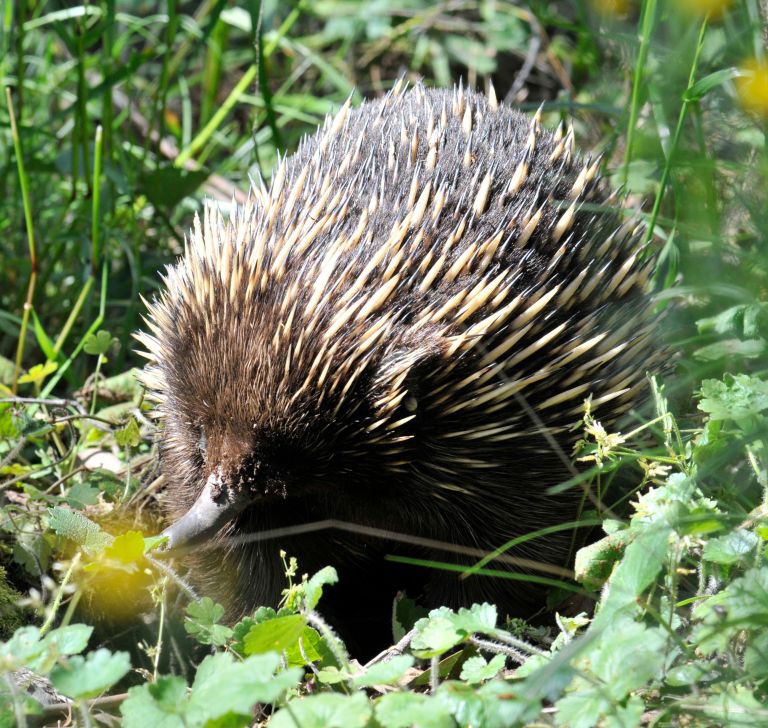
These four post cards from more than 100 years ago depict the countryside being developed by the Europeans. As the two lower cards depict they wanted a countryside with running water, vegetation, and cattle. The upper left card shows a group of aboriginal people watching a camel train passing by. Camels were widely used in Australia and still roam wild through the outback.The Red Kangaroo is the largest of the many types of forward-hopping big foots (genus Macropodia) found in Australia. There are kangaroos, wallabys, wallaroos, pademelons, betongs, and potoroos. The three or four largest are called kangaroo from the word “gangurru” taken from the Guuga Yimithirr people. The Red Kangaroo can weigh as much as 200 pounds and cover about 20-25 feet with each hop, once it gets rolling.The Echidna is one of the two egg-laying mammals found in Australia. These spiny creatures are also found in New Guinea and on many of the islands around Australia. They reached these islands during those periods of low ocean level and have since been kind of marooned out there as sea level rose and these lands became islands. the other egg-layer is the Duck-billed Platypus, an even more astoundingly odd mammals. Claws, poison glands, a flattened bill, and the egg laying confounded early European taxonomists who couldn’t decide what kind of animal the platypus was.This last image shows a common bird of Australia – the Galah. A pink and gray cockatoo that occurs widely and is quite a pleasant part of the country’s wildlife. This is a bird who’s population seems to be increasing as suburbs and settlements expand. Like many Australian names (more and more each year as cultures blend and aboriginal names are invoked) the name Galah comes from an aboriginal name. In this case the heritage name is “gilaa” a word from the Yuwaalaraay language. Galah is not pronounced like gala as we say it. It has a softer pronunciation more like “ha – lah” with the emphasis on the last syllable. Ga – lah. Australia is rich in parrots cockatoos, rosellas, corellas, lorikeets, and budgies. There are 40 true parrots and 14 cockatoos species in Australia.
Migration is still mostly a mystery. We know that things move around the planet; sharks, whales, striped bass, lots of birds, caribou, butterflies and dragonflies, and wildebeest. We know why they do it; to find a seasonal food source, to reach a likely breeding area, or to avoid bad stuff like seasonal fires or cold (cold kills off food sources as well as presenting metabolic challenges). We expect creatures to appear or disappear within a season or at a certain time of year. Migratory birds arrive and depart, nests are made and used, flowers bloom and fruits appear – all somewhat predictably.
On the other side of the coin is the total lack of understanding about some important features; what starts the movement, do creatures travel together, is it weather or food dependent, is there a simple answer or is it a suite of circumstances that work together to create a general result, how do they navigate and what do they remember.
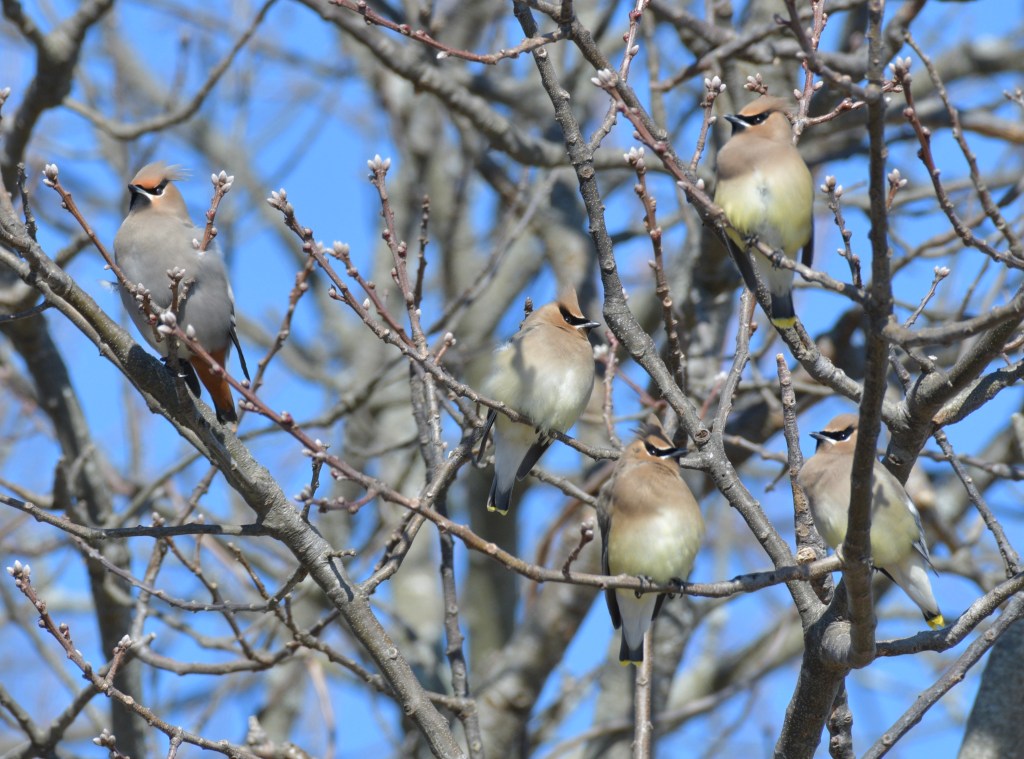
In the image above there are five Cedar Waxwings (CEWA) and one Bohemian Waxwing (BOWA). The cedars are smaller and much more common in the Northeast US. As a matter of fact the Bohemian Waxwing is an irregular winter bird in New England. It shows up each winter in small numbers for certain and very rarely in larger numbers. Both waxwings eat fruit and seeds in the winter and thus are looking for hollies, privet, cedars, and bittersweet. Sadly two of these are invasive plants in our region.
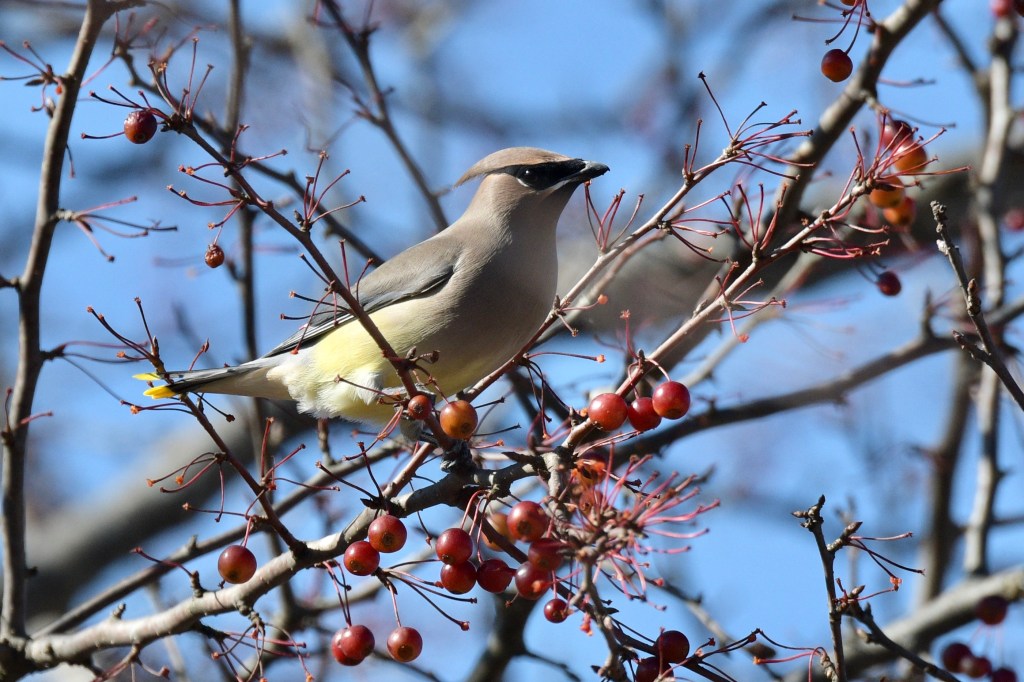
In this photo, also with both the Bohemian and several cedars, the birds are stuffed to the gills with privet berries. They had just spent a few minutes gorging on the cold fruit of this hedge plant. Birds have a storage area called a crop where food can be gathered, stored and saved for swallowing and digestion later when the bird is in a safer place. The majority of the birds above have swollen crops, full of privet berries. The Bohemian waxwing is on the left again.This Cedar Waxwing happens to be a resident of West Virginia where it, and a hundred of its cousins, were feasting on a cluster of crabapple trees. Plantings for wildlife are always a good option when thinking about your yard or a nearby park.
The Bohemian Waxwing, and even the more common Cedar Waxwing, is a nice winter bird to happen on; fun to see, a bit of a surprise, and providing some brightness in a rather drab environment. There are many birds that are much easier to see in our winter. 2019-2020 has been a very mild winter but still there are few insects, not much fruit, and almost no seeds from our annual plants. So here are a few more common birds …. that can always find something to eat and a place to hang out.
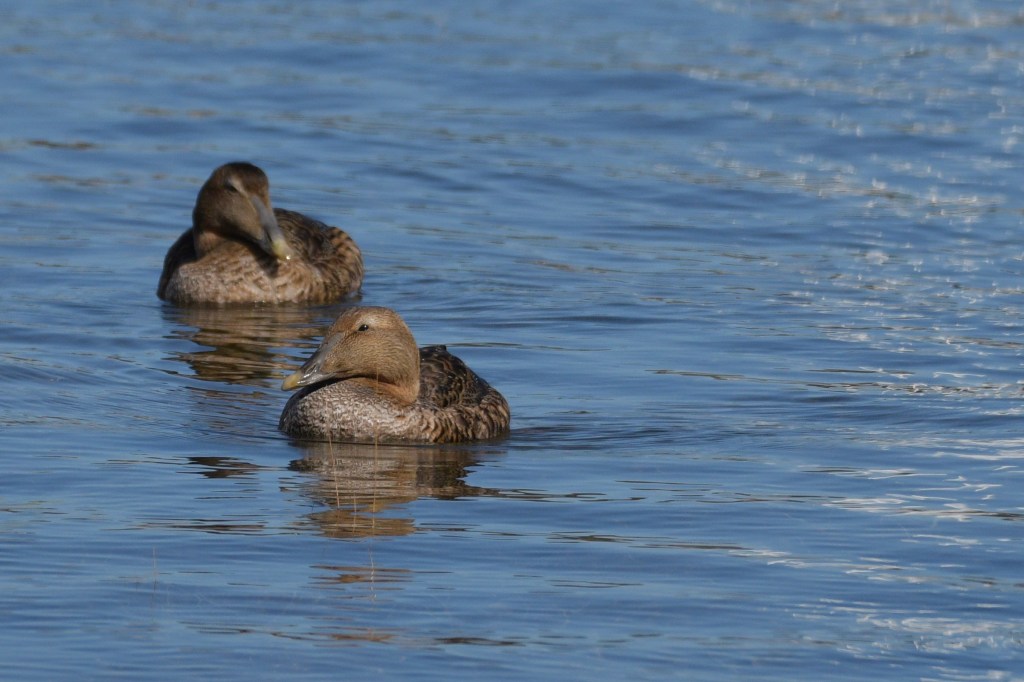
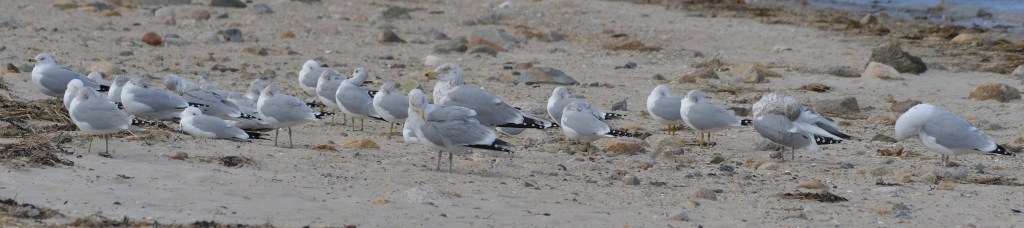
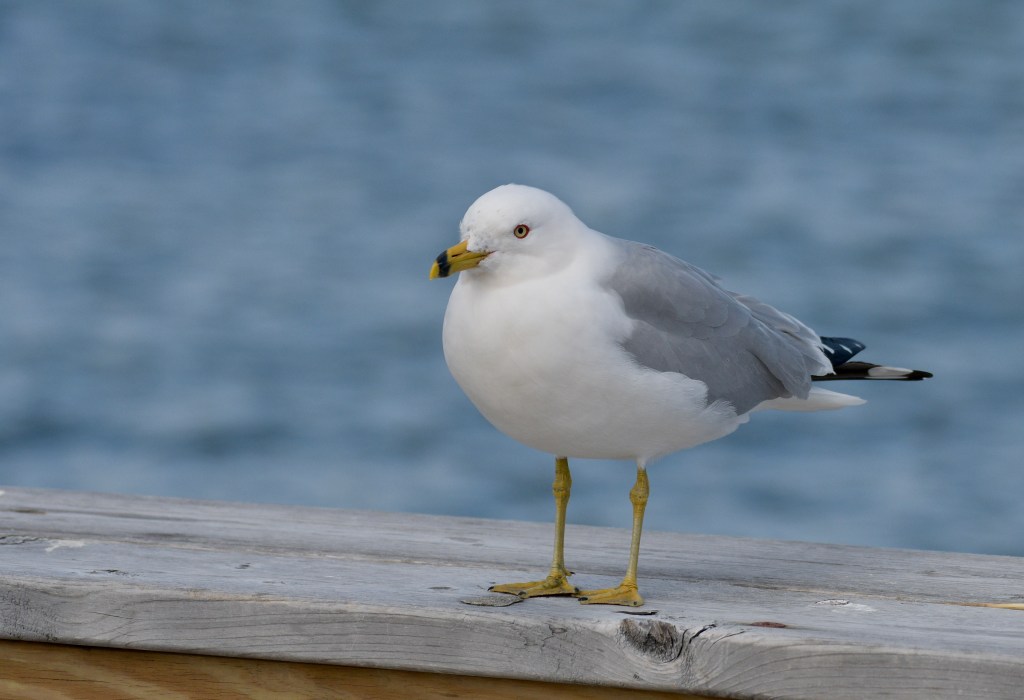
Our most abundant winter duck is the Common Eider (COEI). The black and white males are easily visible even when well off shore. The darker females are more difficult to see in the distance but eider of both genders come close to shore often. These two females show the nice browns of the females and the aquiline bill that is a distinctive characteristic of the species. At the moment there is one spot (Chatham, Massachusetts) where about 10,000 COEI are on the water at any given moment. It is quite a sight.Of course gulls are a coastal feature in the northern hemisphere. The inland breeding Ring-billed Gull (RBGU) winters with us after raising young in central southern Canada and around the Great Lakes. It is not a SEA gull – as a matter of fact the term Sea Gull doesn’t apply to any bird at all. They are gulls, some of them can be found along the shore. In the image above the smaller grayish gulls are Ring-billed Gulls and the larger ones (center and right) are Herring Gulls (HEGU). In April and May the Herring Gulls will hang around the Herring runs (a migratory fish returning to fresh water to lay eggs) and grab the fish out of the riffles and shallow water.This is a portrait of a Ring-billed Gull. It is smaller and sleeker looking when compared to \the larger rugged-looking Herring Gull. The neat ring around the bill is seen in birds over two years old and is diagnostic. The gray mantle feathers of the back are developed in gulls in their third or fourth year after a time of grayish of brownish transformation.
Yes, yes this is another Falklands page. I’ll be done with these rough and wonderful islands soon enough. Perhaps we’ll go back to the Galapagos or Australia or Africa – or maybe the winter-beating Brazil. But this page will tie into pages from New Zealand (see March 2014 post) where the kings of the great Southern Ocean, the albatrosses, reign.
These birds range in size, when measured by wingspan, from 6.5 to 11.5 feet tip to tip. The bird’s weight is not exceptional for that large size which allows each square inch of expanded wing surface to “float” only a modest amount of weight. This allows the bird to sail and sail almost effortlessly over and around the great ocean, often for weeks at a time.
The Falkland Islands harbor one species of albatross (or Mollymawk as many books and people call it) the Black-browed Albatross. This species is found world wide in a very southern sense. As a resident of the northern hemisphere I tend to think of worldwide as the US, Europe, Asia, and thing north of the equator; or in expansive moment I’ll include equatorial regions as well. But in the south there is Australia, South America and southern Africa and each of these is pretty much surrounded by water. A circumpolar (hol-antarctic) bird or mammal is a creature who has a range that touches the southern tips of South American and Africa and maybe the underside of Australia. In order to qualify you pretty much have to be a fish, marine mammal, or sea bird.
That said, our “Falklandian” albatross is the most widespread of all albatross. They even wander north on occasion – there are rare records north of the tropics in both the Atlantic and Pacific. Fishing boats and trawlers may accumulate hundreds, even thousands, of Black-brows as they stir up the seas and discard undesired species of fish.
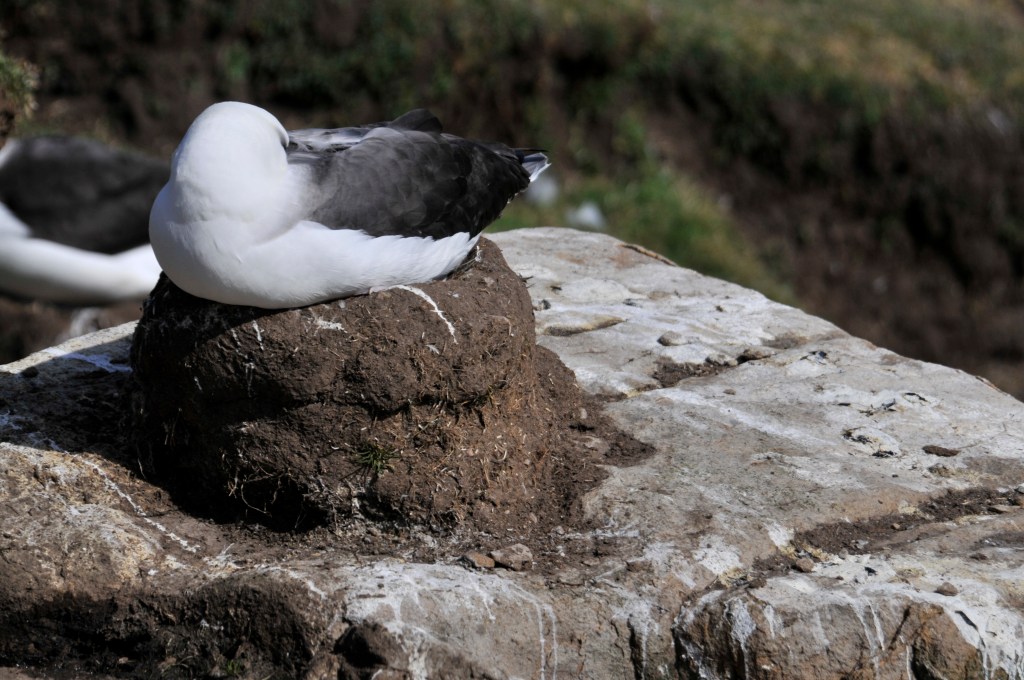
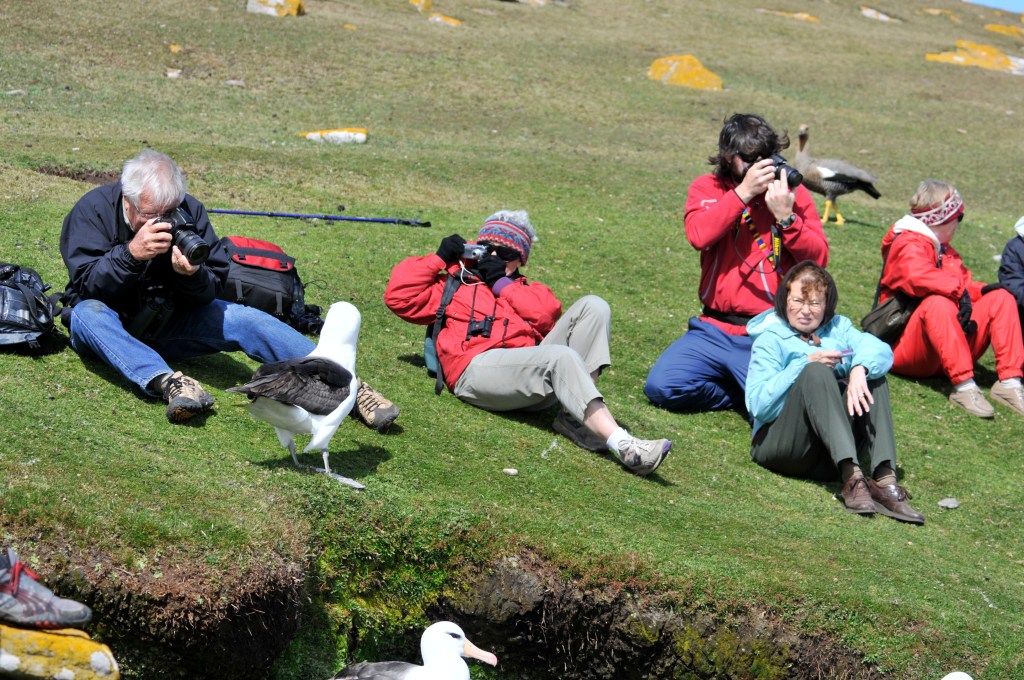
The black brow is usually visible in adults. The bird itself is considered a medium-sized albatross with a white head and underside and a black back. However if you see one standing around like this; then you know both where you are and what you are looking at. It is birds in flight that are difficult to identify for sure. The underwing leads and trails with black and the middle is white – in adults at least. The bill is yellowish-orange. Geography helps a bit though this is a widespread and common sea bird. But look-a-likes in the northern hemisphere are usually Laysan and those off Australia and New Zealand may be Campbell Albatross.Just for a more local sense; this is a Black-footed Albatross off the coast of California. As mentioned above the Laysan is quite white and this one is kind of a scraggy dusky bird. Those two are the only ones that regularly fly along the coast of the USA and Canada. The Laysan and Black-footed have almost identical ranges that encompass the whole Pacific Ocean north of the Tropic of Cancer; from Japan and Southeast Asia to California and southern Alaska.The Black-brows are annual nesters. This is a rather significant time commitment as it takes about 10 weeks of incubation to hatch an egg and another 14-18 weeks too fledge the youngster. Thus, half the year is spent with getting the next generation started. In most places they nest on steep slopes but on the Falklands they usually nest on flat grassy areas. The nest is a tall cup of mud, grass, seaweed, and guano. The youngsters will return to the colony at 2-3 years old but won’t successfully breed until they are about 10 years old.As you can see the birds in a nesting colony are quite placid. Most island creatures have evolved with only minimal predation so they nest on the ground and seem fearless. Really it is that they have had nothing to fear and just don’t understand predation and hunting.The black brow is a reasonable characteristic but at sea many of the smaller albatrosses look similar. As mentioned the black brow, white head and yellow bill are reasonably diagnostic if you are within Black-browed Albatross range.In many instances getting there is really all you need to take a good photo. As shown here the subject will often wander to close to focus. The bird in the foreground-left is an albatross checking out the optics used by visiting eco-tourists. The goose in the upper right is likely a female Upland Goose.























 On The Road With DEC