Please consider the images to be copyrighted and ask permission to use or reproduce. Thank you. DEClapp
In the last post I mentioned the annual Christmas Count; a bird count within a circle. This is an annual occurrence in over 2500 locations today. In 1900 the tradition of a Christmas “side shoot” was first confronted by a noire passive activity; the Christmas Bird Count (CBC). During the past 120 years the CBC has pretty much replaced the side-shoot. Much of the USA is covered by these 15 mile diameter circles and birders of all stripes patrol the lakes, ponds, woods, fields, streets, seas, and developments within the scribed area. National Audubon Society oversees this massive citizen-science project and the data is largely available just by Googling.
That is all well and good; good for nature, good for birds, good for planning; it is even fun and social. The weather varies year to year but the enthusiasm and repetition prevail. But counting is easy only when you use your fingers and maybe toes. A quick flight of Razorbills or sandpipers happens in a flash and the most experienced people will have wildly different counts (estimates) of the number of birds that just passed by. Even a slow moving flock of Canada Geese can be hard to count. Rarely do birds pass by slowly and with space between them. And even if they do, it can be hard to count them.
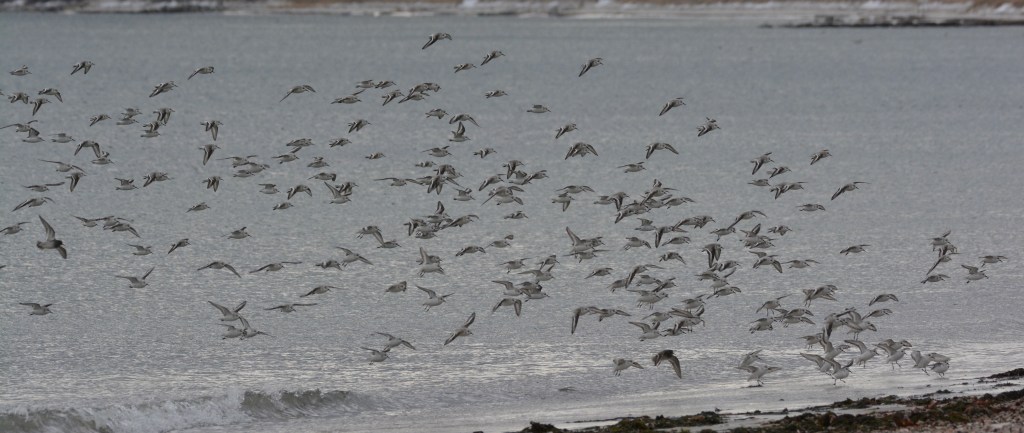
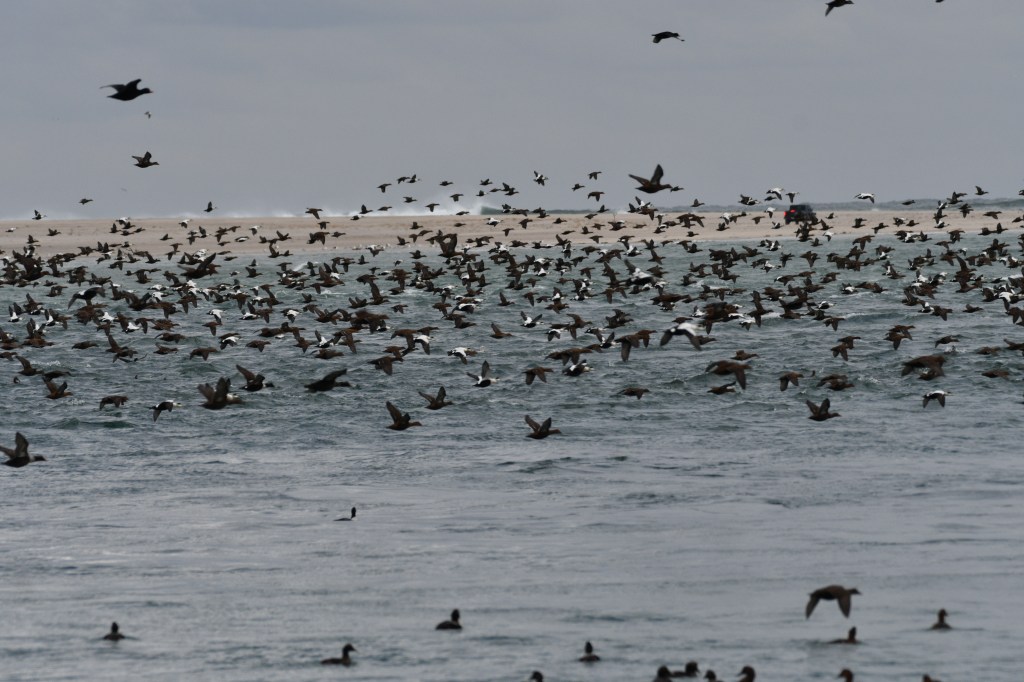
Ducks on a pond or eider on the sea will bounce, dive, and paddle to a frustrating degree. Learning to estimate and extrapolate is a skill born of practice. Let’s take a look at some flocks, flights, and floats. Try to estimate the number in a few seconds, then count a representative section and multiply and try a second number – for the most obsessive of you, take the time to actually count the birds. This is best done by printing out the image and then ticking off the birds as you count them on paper. I will give the answers at the end of the post – so get ready….
This image shows 2 Purple Sandpipers (PUSA) flying into a beach with a group of Sanderling (SAND). The PUSAs are at the left edge in the middle and on the lower edge just to the right hand side of center; they are the two darkest birds in the image. When they flew in I thought there were maybe 40-60 Sanderling. I printed the picture and counted them….how many do you think I got?Some groups of birds are beyond accuracy. This flight of Common Eider (COEI) went past for at least twenty minutes. There were hundreds in view at any moment and in the next minute there was another whole population in front of me. I have never bothered to count from this image but I imagine there are more than 700 birds here and I think that they were replaced by another 700 birds in just a minute or two. It is hard to imagine that I had tens of thousands of birds pass by…but maybe. I’d like to get one of those counters they use for fish-counting and adapt it to bird counting.
Looking at large groups of birds requires some planning and quick counting. If there are three people in a group everyone should try to develop a number and then discuss estimates and arrive at a best guess. Exact numbers are not possible in many cases while in the field.
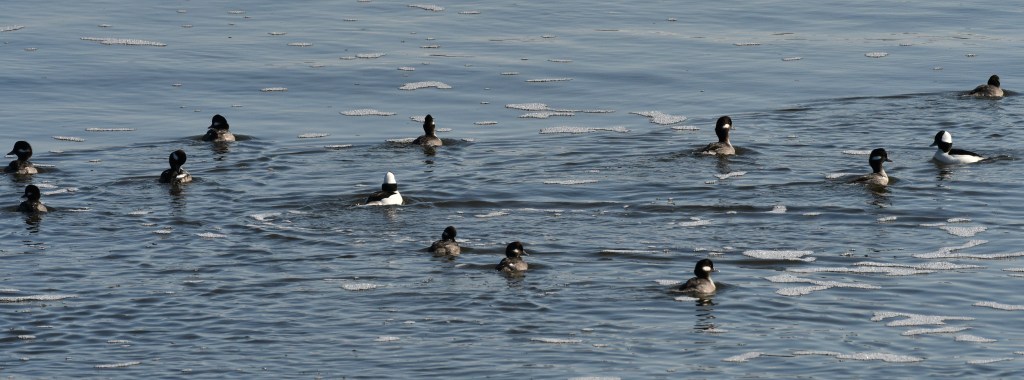
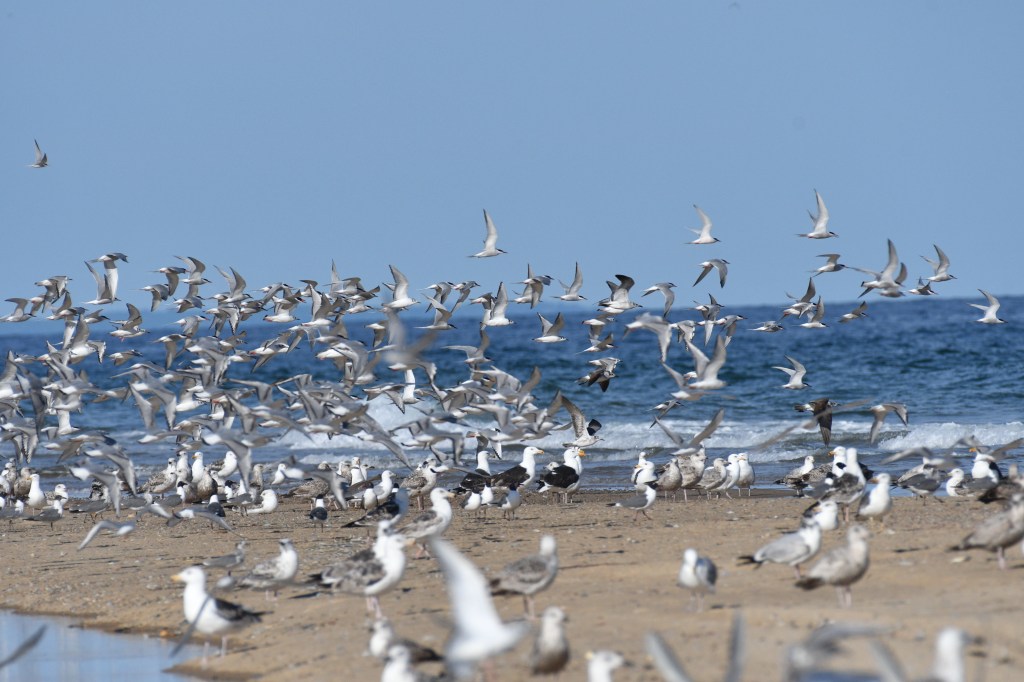
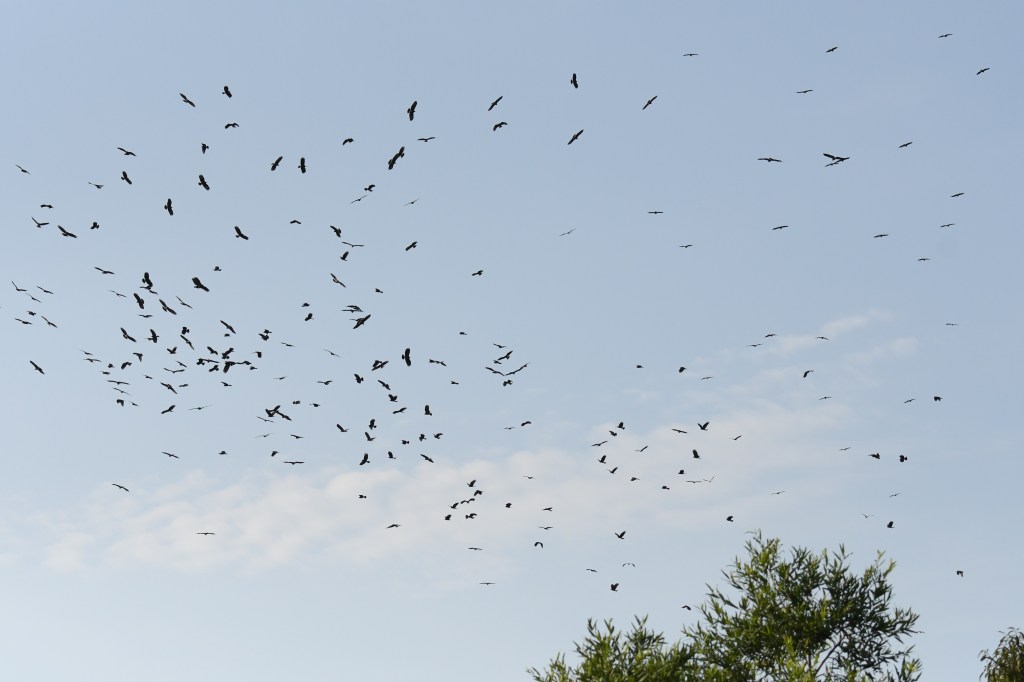
Some groups and some species are kind of easy. These are a cute little duck called Bufflehead. There are 13 in the picture; but these are diving ducks and at any given moment you might see only 5 and a few seconds later there will be 15. Some species deserve a bit of time in order to make the best count or get the best possible estimate. In this image there are only two males (white bodies) so if you later see five males you know to add three.While walking a beach you might come on an aggregation of gulls that consists of several species; and with gulls, several ages. This is not an easy circumstance as you need to know how many were Herring or Great Black-backed or perhaps how many were Ring-billed or Laughing. In the image above there are a lot Bonaparte’s Gull to further confuse the situation. The best way to count this sort of group is to use “notes” on a ‘phone or jot down numbers on a pad with a pencil to keep track of each species. Count one species at a time – and hope they don’t fly or drastically change position before you are done. This requires that you stop and stay quiet as you count and recount. The tide will rise (or fall) and the birds will fidget and move. An eagle may fly over and they will all lift off, or a dog will happen by (all too often) and the birds will turn into a mass of white and gray and black feathers that are simply unable to be counted. Plan ahead and be patient.One warm day in Brazil’s Pantanal we had the surprise that this picture represents. It is a group of hawks lifting into the warm mid-morning air. In the US we occasionally see a Snail Kite in the Florida wetlands where Pomacea snails live. But the kites are usually quite solitary. Here in Brazil, all of a sudden this group of Snail Kites lifted in front of our boat. The nearby Jaguar may have been more breathtaking but these birds were more unexpected. It is another chance for you to make a quick estimate, then a more exact guess and to count them all if you want. Again, the answer is below.This last image shows how you might lose concentration. When counting birds a flash of yellow in a thicket will certainly distract you. In the ocean a pod of Humpback Whales feeding on Sand Lance can do the same thing. This half-dozen whales are surrounded by Herring and Laughing Gulls and on some days will have Great, Cory’s, and Sooty Shearwaters around them as well. It is hard to do bird numbers when these great and iconic marine mammals are just off the rails. There are just about 65 gulls in the image; how many are Laughing Gulls (with a black head and dark gray mantle)?
So that’s what we do; only a lot of it is counting birds at feeders and in bushes and walking through snow or slush. But getting good numbers of Black-capped Chickadees, Downy Woodpeckers and Northern Cardinals isn’t that easy either. How many can you list when you have already seen two woodpeckers with red feathering on their heads? Some birds, like Northern Cardinals, are pretty easy as they often just sit out as if waiting to be counted, others flit or hide and make accurate numbers difficult.
Here are the numbers from the images: there are 202 Sanderling in the first picture with the 2 Purple Sandpipers; there are 204 Snail Kites in the air in Brazil; and there are 37 Laughing Gulls in the 65 birds in the last image. By the way the top three birds in that last picture are actually Common Terns, not gulls at all. My counts are certainly close but I cannot guarantee them to be exact… close for sure though. There are 31 Great Black-backed Gulls and two Herring Gulls in the image used as a heading, or lead, at the top of the post…..Cheers.
Please consider all images to be copyrighted and ask for permission to use them in any way. Thank you. DEClapp
In one of the last posts I sort of apologized for doing so many bird posts and mentioned that I did see mammals as well as birds at this time of year. This time of year is winter here in the northern hemisphere and though it is nothing like when I was a boy, winter is still colder, snowier, and more blustery than spring, summer or fall. A great percentage of our birds migrate south as winter approaches and there are many fewer birds from the far north that arrive to replace them. It is a bit more stark that usual. There are no leaves on the deciduous trees and there is no insect fluttering or bird song to catch your eye or to entertain your ear. But nonetheless, there are birds that didn’t migrate and mammals that didn’t hibernate.
The North American Gray Squirrel is now an “invasive alien” problem animal in Great Britain and elsewhere. It is a smart and self-sufficient animal and adapts and reproduces in many habitats. In the USA it is seen as vermin by many and a smart opponent to outwit at bird feeders. It was a food staple for early American country folks and was found in great abundance until the early 1900s when the American Chestnut died off and a great percentage of the forest mast crop disappeared. Squirrels may have suffered some but they were happy to continue on eating acorns, beech nuts, walnuts, and many other nut crops. They are still very common. As you might tell from their dietary choices they are largely creatures of deciduous forests.The cone forests; those of pine, fir, spruce, hemlock, and other evergreens have the Red Squirrel as their primary mammal. This guy is smaller than the Gray Squirrel and is known to be a bit feistier. They are also seed eaters but typically will eat the seeds from cones rather than from nuts. In many forests the presence of Red Squirrels is marked by mounds of dismembered cones that have been left in a midden heap where an animal eats day after day.There is another whole category of squirrel type and most of these hibernate, or at least sleep, through the winter months. These are the ground-squirrels or chipmunks. In the eastern part of North American we have only one form but the western states have many types that have adapted and evolved to survive at different elevations and in some pretty harsh mountainous habitats. The one pictured here is from Oregon and is the Golden-mantled Ground-Squirrel.
On the land, and in the trees, we may see Gray Squirrels regularly and Red Squirrels less so. There are not many diurnal mammals, so most of them might be best seen at night – if we could see at night that is. (our night-time squirrel is the small grayish Flying Squirrel). The smaller mammals are hiding under snow or dead grasses and the larger mammals are bedding down throughout the day and saving energy. Thus we see fewer mammals at this time of year.
The small Flying Squirrel is a cavity dweller. Usually the old hole of a woodpecker will do, but a nice bird house, unused in the winter, works just fine. This bird box is on a tree just off the back of the house and I am sure that the resident Flyers partake of sunflower every night from the bird feeders nearby.
But here is this posts real story. — This is mid-winter and it is the time for an annual bird census program called the Christmas Bird Count. The CBC has been in place now for well over 100 years. It consists of birders, feeder watchers, and others out looking at birds within a specific circle. The circle is created by establishing a spot and then scribing a circle around that has a 7.5 mile radius (15 mile diameter). The circle is then assigned to as many birders as you can gather and the birds are counted – as many as possible for the 24 hours of the count day. I will post a few blogs on the activities and sightings from this year but there is a mammalian story that starts off the season.
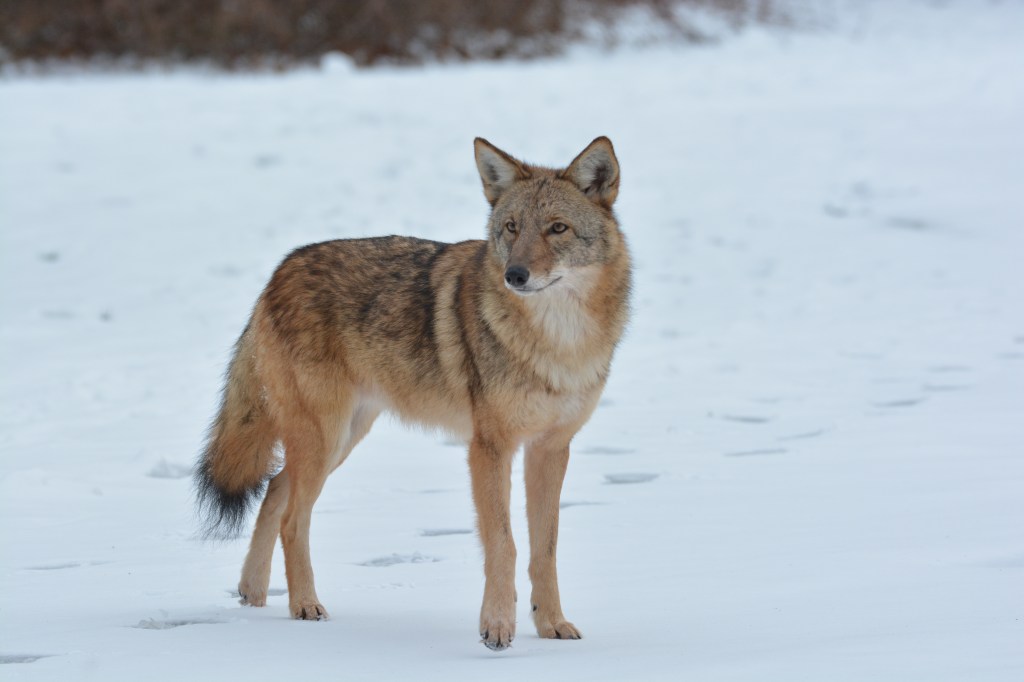
The first of several all-day, tiring, counts that I do is one that connects Cape Cod to the main land. My section is on Cape Cod but I am looking west toward the continent. This year we had a bit of a snow cover that fell just before counting day. So this was to be a bit of a slog but no where near as bad as it would have been a couple days earlier. One of the places we go when there is no snow, and as we are creatures of Christmas Count habit, a place that we go each year whether it is cold, warm, snowy, or sun dappled. This place is a small field, maybe four acres. This year we pulled in and we were about to make a plan for the next hour or so as we were preparing to count in this locale. It was a bit of a surprise to all of sudden see that we had parked, in the snow, about thirty feet (10 meters) from a large Eastern Coyote in rich winter pelage. It was just laying belly-down in the snow looking past us the way that animals do when they are in their worlds not ours. The next few images will tell the story.
Many coyotes look their weight; maybe 10-15 kilograms; 22-35 pounds. In the winter they have a thick and luxurious fur coat and they often look quite a bit larger and bulkier. This individual was regal. The Eastern Coyote has the DNA signature of wolf in it and it is quite a bit larger that the western coyote. I have watched them hunt over the years and generally they just sort of walk or slow-jog along and try to catch whatever catches their eye; very opportunistic and not much of a planner. They will try for a duck moving off a nest or the eggs or ducklings if the timing is right or they may pounce on Microtus as they encounter them in a field. Because they move a lot and don’t tire easily they will almost always bump into something to eat. Picking up road kill in the very early morning seems to be a new procedure, but one that produces regular meals. But they can think and plan.Well, our fellow seemed a bit bothered that we interrupted him but not upset in any real way. He stood, stretched, yawned and moved past us toward a White-tailed Deer that he had been watching, and an animal that we had not noticed. A single coyote and a deer are not really predator-prey as the deer would be pretty large for a single coyote to take down; but maybe he was dreaming, or waiting, or hoping. Incidentally that lead image where the coyote looks to be snarling is simply one of the photos snapped as he was stretching and yawning. Did you ever switch the TV channel and catch an odd facial expression on the person who was speaking as you changed channels? That’s sort of what happened here – he is not really snarling.We sat in the car as he gathered himself to move off and it was a great two or three minutes. We were not any trouble and the animal was not scared or aggressive at all. Animals that live in urban or suburban areas see people and the trappings of our lives every day and learn to move among us keeping a low profile. The Eastern Coyote is very widespread now (the past 30-40 years) and it is well established throughout the northeast in all sorts of habitats and situations. When I first began to notice coyotes in eastern Massachusetts I would seek out the night-shift policemen as they were the only people out all night who might see nocturnal and secretive animals.On its way into the rest of its day the coyote passed just a few feet from the vehicle and we exchanged glances. I have no idea what he was thinking, but we were thinking how lucky we were to share that quiet moment with one of nature’s most successful animals. it was our pleasure for sure.
Please consider the images to be copyrighted and ask permission to use them in any way. Thank you. DEClapp
I feel a bit apologetic for doing birds birds and more birds. But that pandemic has me/us pretty limited in travel opportunities and so it is local birding and more local birding. I have to finish the Falkland Island blogs and do a few from the Galapagos Islands and Namibia but it is easy to do the local and current birds of the northeastern USA. They are what I see day in and day out. So this post will show some creatures that are not limited by a virus and can travel the globe on their own wing-power. Some are just the usual sort of winter wanderer, a vagrant perhaps but no real surprise, others are migrants that are expected winter visitors, and a couple are surprises.
As I look at these birds you should keep in mind that there are other natural events and organisms in the area. I see Red and Gray Squirrels and until this last cold spell, the occasional Eastern Chipmunk. Yesterday, despite the cold weather, I found several tunnels of Star-nosed Moles. In the unfrozen wetlands, getting to be fewer and fewer, there are still Muskrats and the occasional Otter family. White-tailed Deer are not easily seen at this time of year but they are out there and the widespread browsed shrubbery attests to that. Today I saw a Fisher atop the Pitch Pine trees and it was being verbally abused by a congregation of American Crows (AMCR). Also we see Gray Seals about every day and Harbor Seals in the winter when the young ones visit from the Canadian waters to the north.
One of the unlikely creatures that really show at this time of year are the sea turtles; specifically the Kemp’s Ridley turtle. These are warm water creatures and they swim further and further north in the Gulf Stream each summer as our changing climate warms the ocean waters. This northward movement, and our northeasterly winds, will push the animals toward the continent, and as they swim south they swim into the open arm of Cape Cod. Most of the turtles that get stuck inside Cape Cod are younger animals and they have no sense that they have to swim north again and then east and around the sandy arm. They simply hit the beach. If the water were warm still they might swim out through perseverance, but this beaching syndrome only happens when the cold air from the north chills the ocean water and stuns the turtles. Many die. Many are found by beach walking volunteers and are rehabilitated and eventually flown south to be released. Though most are Kemp’s Ridleys there was a 350 pound Leatherback beached this year as well. So far, mid-December, there have been about 450 beached turtles found.
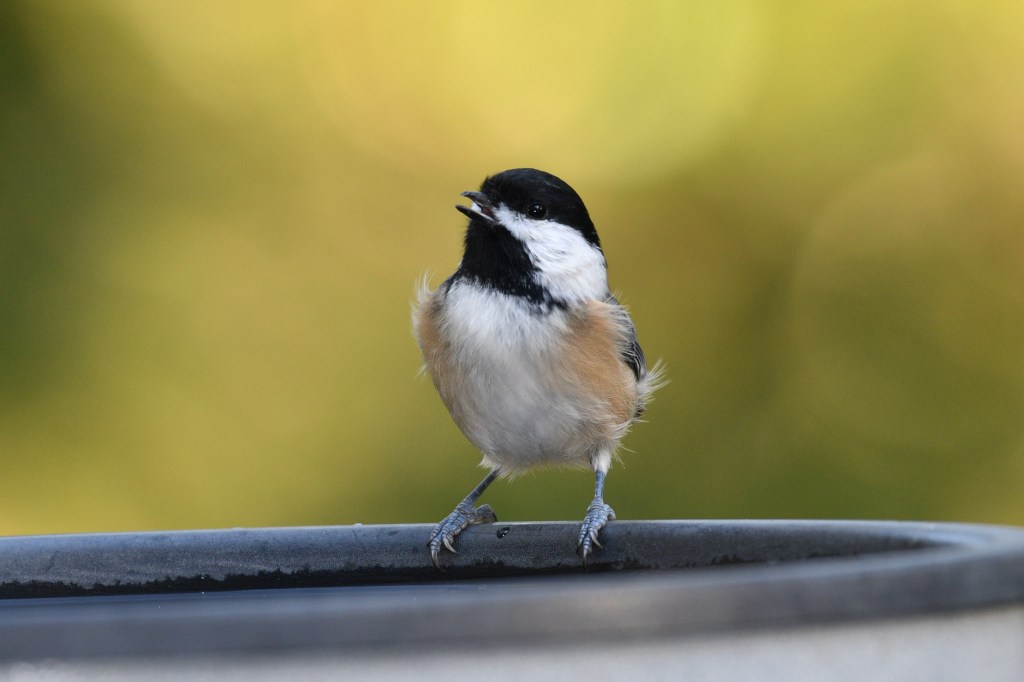
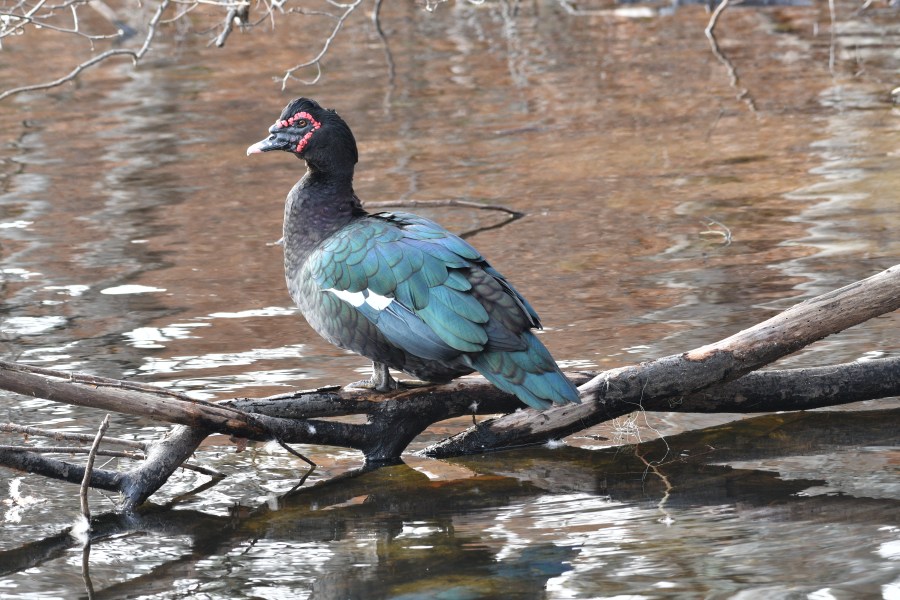
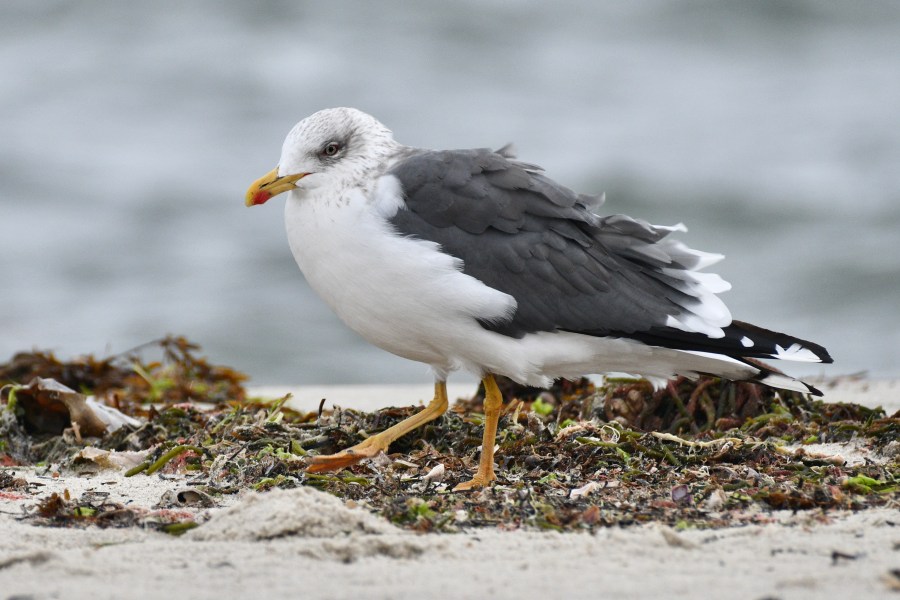
Let’s start off with a common nesting bird of the US and Canada. The American Robin (AMRO) is a thrush and very widespread in North America, nesting in any area with forest or trees. It is a member of the Genus Turdus, one of 66 species in that large group. Here in the northeastern part of the US we have always thought the robin to be a harbinger of spring; one of our first nesting birds to return from a southward migration. But things are rarely as simple as we first think. Many of our robins do head south but some stay all winter eating soft seeds and berries. Other robins from further north migrate down to our latitude and winter here as well. So even on snowy days when you’d think they would be basking in warm southern sunshine we have American Robins in the crabapples and hollies.The Black-capped Chickadee (BCCH) is tiny and very light. You’d think it could never stay warm through a 14-hour winter night. But they do and they are common. Insulation and metabolism are the keys to the adaptations found in Chickadees, Kinglets, Creepers, Wren, and many other birds with a lot of surface area and not a lot of body mass. But this little guy is pictured here to contrast with the next bird, a rather uncommon winter visitor. Out here on Cape Cod the Boreal Chickadee is a once in a decade birds. This Black-capped Chickadee is a once every five minute visitor to any bird feeder with sunflower seed.The Boreal Chickadee (BOCH) is a bird of the boreal forest of Canada. It is found in northern USA and at elevation on some mountains, but it is not a common bird in the US. It has a brown cap and is browner and duskier over-all than the Black-capped Chickadee. There are 55 members of the Genus Parus. We are familiar with the chickadees (six members of the Genus) and the Titmouses (four members of the Genus) and the rest of the Northern Hemisphere knows the remaining 45 members of the groups as Tits. In Europe and Asia it is a group that has many species and a large number of subspecies. The members of the Genus are common and cute; hence they have been studied a great deal. Geographic populations have been identified and ranges delineated. But recent population separations do not inhibit interbreeding along shared boundaries – thus they are a well studied but still confusing group. These four Families are closely related, in the Order Aves (birds). These four are the Nuthatches, the Treecreepers, the Penduline and True Tits, and the Long-tailed Tits. Our North American chickadees of all stripes belong too the “True Tit” group. In the US we have the widespread Black-capped and the more restricted range birds like then Carolina, Mountain, Chestnut-backed, and Mexican Chickadees. In addition we have the Brown Creeper (BRCR), Bridled, Plain, Black-crested, and Tufted Titmouses and five nuthatches (Pygmy, Brown-headed, Red-breasted, and White-breasted. This greenish bird may look a bit like female, or young, oriole at first glance but it is a Western Tanager (WETA) a rather common bird in the forests in western North America and an annual oddity here in the northeast. We usually see them in the late fall when they are pausing in a wrong-way migration. They should be heading south from the woodland nesting sites into Mexico and central America but every year a few fly east or allow themselves to travel on an eastern wind. I’ve always wondered what happens to these wrong-way travelers; do they continue east into the Atlantic, do they head south along the coast and then swing back to the west and eventually make it to Mexico, or do they expire here in New England. When we see them it is usually because they have established at a feeding station and are eating hulled sunflower seeds. During nesting season they eat all stages of bugs and insects.Here on Cape Cod we enjoy a college-age baseball program every summer. The Cape Cod League consists of ten teams using accomplished college players; it has developed great stars like Aaron Judge, Jason Varitek, Mo Vaughn, Ron Darling and the Hall of Famer Pie Trainer (1919!!). There are well kept playing fields in all ten communities that sport a team. The bird above, standing on the pitcher’s mound, just to the right of the pitching rubber, is a Pink-footed Goose (PFGO); not an official member of any baseball team although it does seem to enjoy the pitcher’s mound. This species of goose, small and kind of brown all over, nests in Spitzbergen, Iceland, and Greenland and is a rare but not totally unexpected visitor to northeast North America each year. On its more usual wintering grounds in Europe you may see them in flocks of hundreds and thousands.The bulky Muscovy Duck (MUDU) is always considered to be an escaped bird or at least a feral bird when seen anywhere in the USA excepting maybe along the Rio Grande on occasion. This bird is up here in Massachusetts, out on Cape Cod, and a long way from any native Muscovy population. Hence it is considered to be a bird with captivity and domestication in its background. They are non-migratory and most unlikely as a vagrant. That is true – – however – this particular bird is essentially all black excepting for the expected white in the wings. All depictions of domestic birds show varying amounts of white feathering. This bird looks like the image of a real Muscovy in Birds of Costa Rica; no extra white. I like to think that this might be the Marco Polo or Vasco da Gama or Christopher Columbus of the Muscovy world. But, even the Birds of Costa Rica says that wariness of humans is a good trait to determine domestic birds from wild birds. This bird is pretty docile….but maybe it just wanted its picture taken and a conversation started,I have displayed a Lesser Black-backed Gull (LBBG) previously, maybe this same bird. It is a gull of Europe though it is now suspected that there are small numbers of breeding birds in the Canadian Maritimes. In the northeast we see them off and on throughout the year but mostly in non-breeding months and generally along the coast, though certainly not exclusively. They drift into the US and have been found in the eastern half of the continental states. They are smaller than our Great Black-back Gull (GBBG) and also smaller than the common and widespread, Herring Gull (HEGU). The smudge around the eye is one of the characteristics that is expected in a wintering bird.We don’t have penguins in the Northern Hemisphere but we have alcids. There are puffins, murres, murrelets, auklets, and razorbills. The bird above is a Razorbill (RAZO). All the alcids are oceanic birds and are happiest (seemingly) when they are on or in the water. The razorbills dive for fish and other schooling creatures of the sea. They are cold water birds of the Atlantic but they do not extend much further north than the Canadian Maritime shores where they nest on ledges and rocky islands. After heavy storms blowing from the northeast we often see thousands of razorbills looping inside Cape Cod Bay and heading back out to sea. From ocean view points like the Race Point Beach at the tip of Cape Cod they are a regular winter bird.
So, it is getting to be winter here; it is cold and we are expecting more than a foot of snow: that’s 30 cm or 300 mm for those of you using the metric system. Hopefully, I will be able to shovel snow and do another blog page over the next few days.
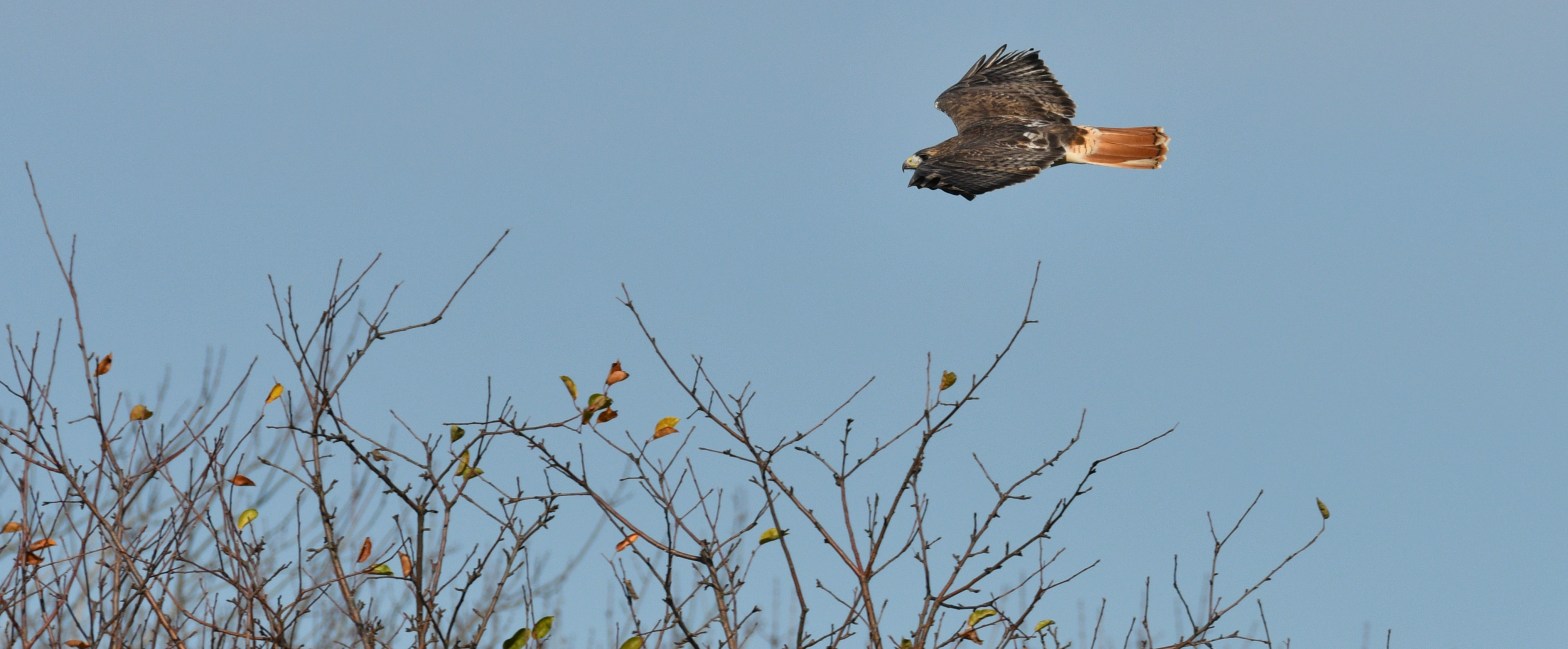
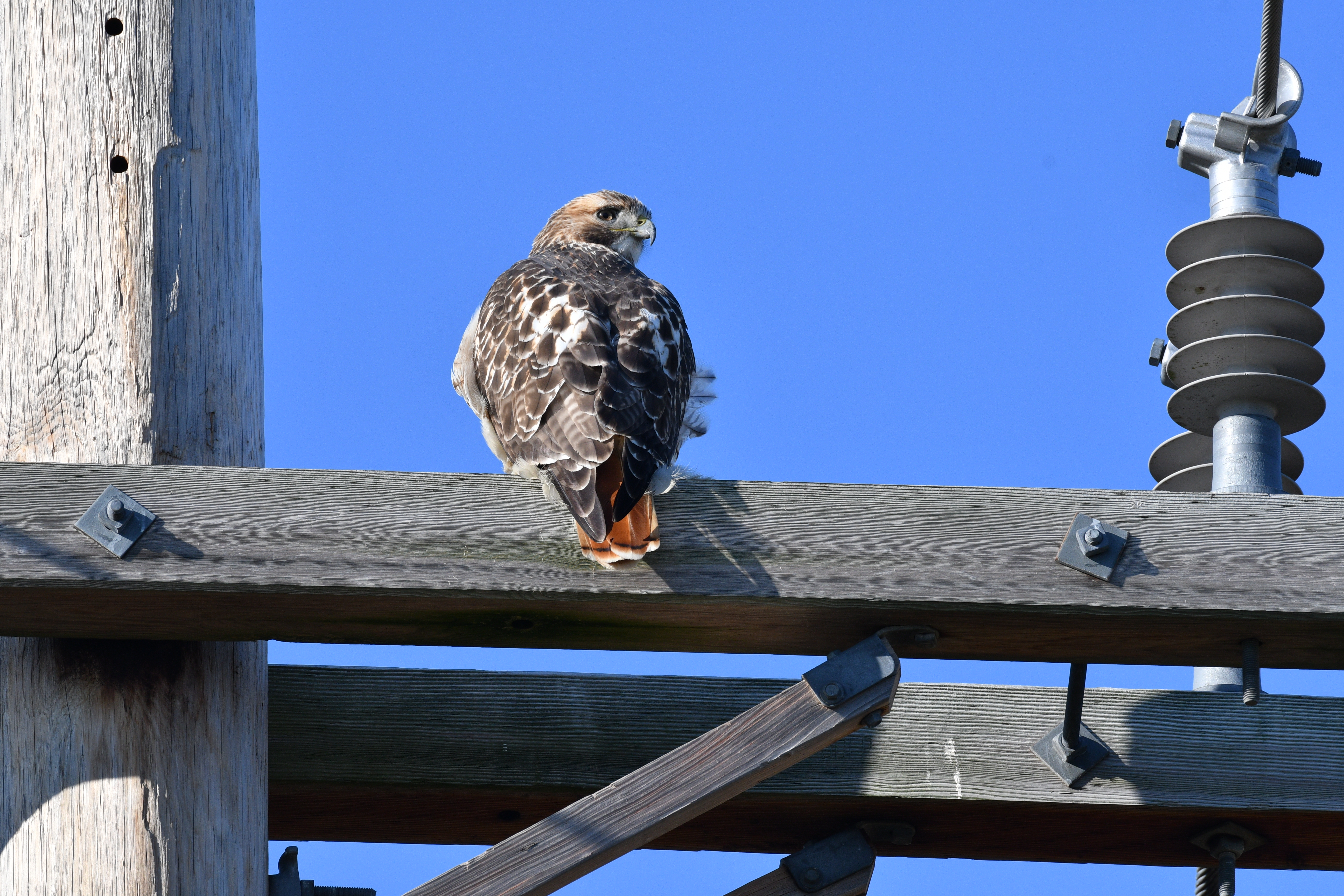
By the way, the header-image is a Red-tailed Hawk, one of our common birds of prey. It has nothing to do with unusual winter visitors, I just thought is was a nice image to include
Please consider the photos to be copyrighted and ask permission to use them in any way. Thanks, David Clapp
The other day we headed back to a favored haunt; the Daniel Webster Wildlife Sanctuary in Marshfield, Massachusetts. This 500+ acre site is well known to local naturalists for many reasons, primarily birds; but its topography is also very interesting. This was a salt marsh area in the early 1800s and was diked off from the sea to make into a salt marsh grazing area. The enclosed marsh then “composted” down in elevation about eight feet making the whole area a polder; land below sea level. Over the next century the land freshened and became both pasture and farm land. In the 1980s it was purchased by the Massachusetts Audubon Society and began a new life as a wildlife sanctuary.
There are a couple miles of trails and a viewing platform on the only hill. The fresh water marsh is a cattail haven and the tidal waters flow again into the creeks and make for a nice variety of fresh and brackish habitats. There are two observation blinds (hides) from which a man-made pond can be observed and photography undertaken. Well, we were here because the fields had been plowed, harrowed, smoothed, and planted in grasses. Actually that work was done twice this year. The first planting died off as we had an extremely dry summer. The second planting seems to be doing well and here in mid-November it looks a bit like a turf farm or even a shaggy golf course.
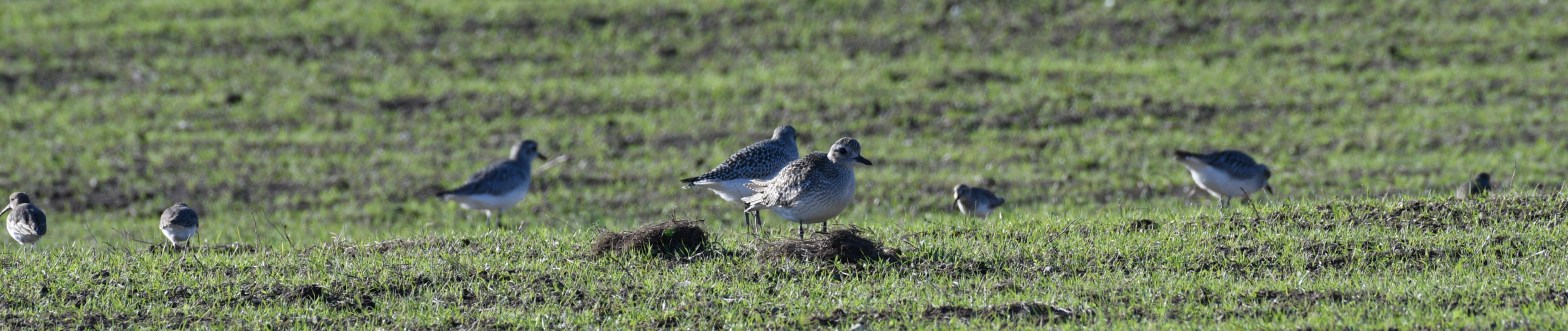
The grasses have attracted sandpipers and plovers, so in addition to the usual array of birds of prey there are now Dunlin, Black-bellied Plover, and a single Hudsonian Godwit; with a scattering of Horned Larks and American Pipits.
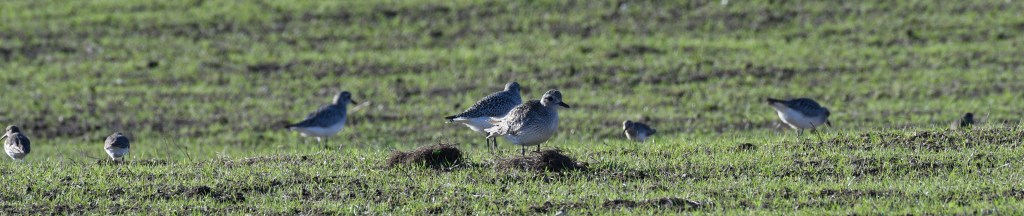
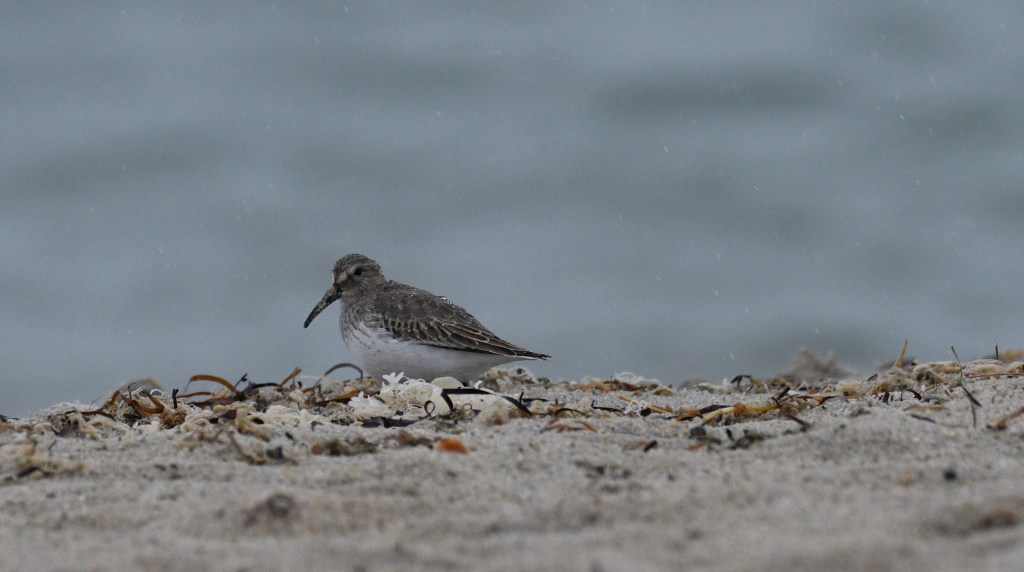
This site is quite well known for its birds of prey. Over the years the rough grasses produced a small mammal called a Meadow Vole by the thousands and they fed an array of hawks, harriers, and falcons. Now that the rough grasses have been plowed under on about 20% of the sanctuary things might change a bit but the birds of prey are still a feature. While we were there we saw four different Red-tailed Hawks (RTHA). This Red-tail was rather blasé as he sat on a cross bar and watched us walk past.The adult birds develop the red tail and it is an obvious characteristic. It takes about three years for the tail to change from a striped brown pattern to a nearly totally red pattern. Both of the birds shown are adults with red tails.In addition to the Red-tails we had two Peregrine Falcons (PEFA) zipping around the fields. They were intent on catching one of the shore birds that were on the fields and this one eventually caught a Dunlin and ate it on top of one of the poles. Most of our locally nesting Peregrines do not really migrate. They may move a couple hundred miles in total but not really changing habitat and behavior. Thus when we see what appears to be a migrant falcon it is likely a bird from Canada or Greenland as these populations migrate long distances, leap-frogging over our more sedentary birds.The sanctuary has always been too heavily vegetated for ground-feeding shorebirds to linger. But with this years plowing and planting it is attractive to many migrant shorebirds. This image shows a Black-bellied Plover (BBPL) (four actually) and a few Dunlin (DUNL) using the exposed ground to locate edible creatures. They are most likely eating beetles and caterpillars. Black-bellies are often found in and on grasslands but Dunlin, though widespread, are not as common.As Dunlin may be a bit of a new name for some of you, here is a closer picture of one. This is from a nearby beach where they examine the wrack line and sandy edges. It is a medium sized bird with a decurved bill. As I mentioned, they are not uncommon and here in Massachusetts will often stay in large flocks right on into and through our winter. Hardy little guys for sure.This was the rarity that drew birders. It is a godwit; the Hudsonian Godwit (HUGO). Most of the Hudsonian Godwits migrate through central USA and they are seen in small numbers along the Massachusetts coast if you can get to the remote areas they frequent. . Hudsonian Godwits belong to a group (Godwits) that are remarkable for their long distance, non-stop migrations. The eastern population of this species, the Hudsonian, usually flies from the Canadian Maritimes out over the Atlantic, and likely for 5,000 miles non-stop, well into South America. There are other godwits that undertake similar flight; such as the Bar-tailed Godwit which flies from Alaska or Kamchatka to New Zealand and Australia in 8-11-day non-stop flights. The Hudsonian Godwit has not been found staging in South America prior to its northward migration and many of the Canadian nesting sites are still unknown. Many members of this species migrate through a very narrow track in the central part of the USA’s mid-west but as you can tell there is a lot left to learn about this species.
Now that telemetry is light and dependable recorders are easily put onto birds; emitter so light and small that the birds are not hindered. One of the Bar-tailed Godwits in Alaska was outfitted with a nano tag and then followed as it flew non-stop from Alaska to New Zealand. (Take a minute to look at a map.) That is really non-stop; no food, no sleeping, no floating on the ocean . This last migration one of the birds flew about 7500 miles (12,000 kilometers). The most staggering part of this may not be the distance but that the bird flew at about 35 mph for 11 days!! Eleven days non-stop, no food, and hit the target; landing in New Zealand. The speed averages out at just under 30 mph, (11 days = 264 hours; 7500 miles divided by 264 hours equals 28.4 miles an hour) but given that the bird flew through and around storms the distance and speed are hard to figure exactly. The bottom line is that it is remarkable, nearly unbelievable, and simply fascinating. How to they steer? How do that metabolize? How much weight do they lose? How do they navigate in the day, the night, in a storm? Part of it is that most migratory birds allow unneeded organs to shrivel up and organs that they depend on to enlarge. Thus reproductive organs are essentially non-existent during the non-breeding season making the birds lighter and aiding a bit with flying. Specialized high density fats are created to power the birds. As it is they still lose about half their body weight during the flight.
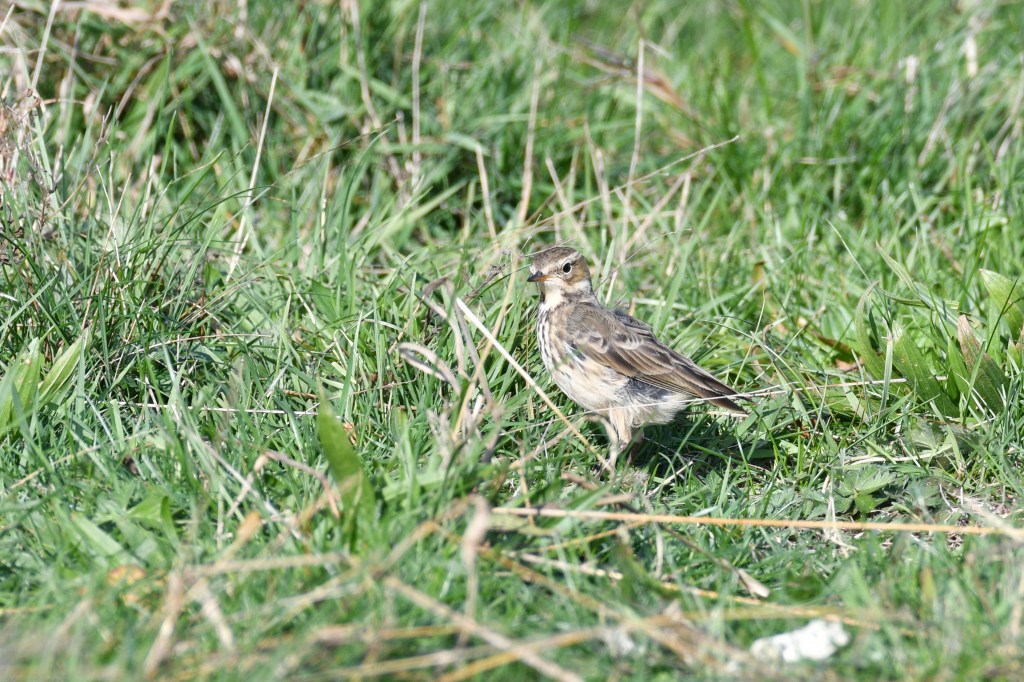
The last bird is much less remarkable in many ways; it is the American Pipit (AMPI). Another tundra nester, like the Hudsonian Godwit, with a reasonable migration south each fall. They nest in the tundra to the north and on mountain tops which simulates the tundra. In the winter they migrate to the south and are found from Southern California all the way east to Florida and south through Mexico. They walk, bobbing their tails, and blend into grass land and course fields quite completely. You can be walking a field and never know they are there until they lift up and call their name in flight; “pi pit”. They are quite common in southern agricultural fields in the winter and then less easy to see as they return to their remote and high elevation breeding areas. They are a variable bird in plumage. Some American Pipits are pretty light and plain underneath and others are a dull reddish and striped — and everything in between. At 6.5″ in length they are a good bit smaller that the 10 inch American Robin. Cryptic, quiet, smallish and not easy to find; hard to believe it’s not rare.
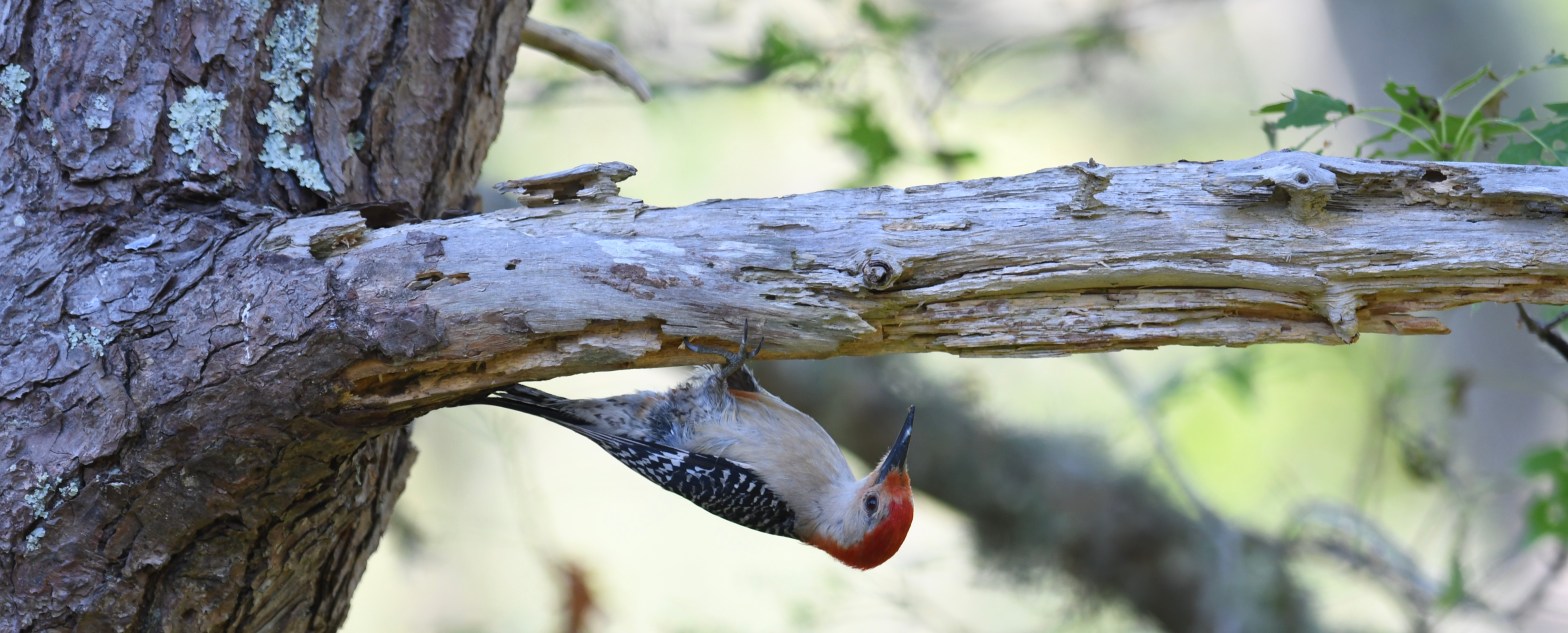
Let’s start with the big picture – there are 214 species of woodpeckers. There are none in Australasia and none in the Sahara or the very northern treeless tundra. They have found a way to live most everywhere else; savannah, boreal forests, montane forests, and so on. In much of the world they are a common yard bird – here in our yard we have the Hairy, Downy, and Red-bellied Woodpeckers as well as the Northern Flicker (yellow-shafted type) and the very occasional Yellow-bellied Sapsucker. The first four are really quite common and seen daily for the most part.
Woodpeckers are almost always called “woodpeckers”. But there are close relatives in the group that go by these names; flicker, piculet, sapsucker, and wryneck. Piculets are tiny little tropical forest birds and wrynecks are birds that are smallish less rugged woodpeckers that feed mostly on ants and use other woodpeckers holes. But generally this whole group has the same skull and foot configuration – a configuration that allows for easily navigating vertical surfaces and opening wood to find insects and insect larvae.
There are also birds with similar adaptations that are not woodpeckers. The nuthatches and creepers may come to mind first but the new world and old world barbets, honeyguides, and even toucans have often been cited as near-woodpecker relatives.
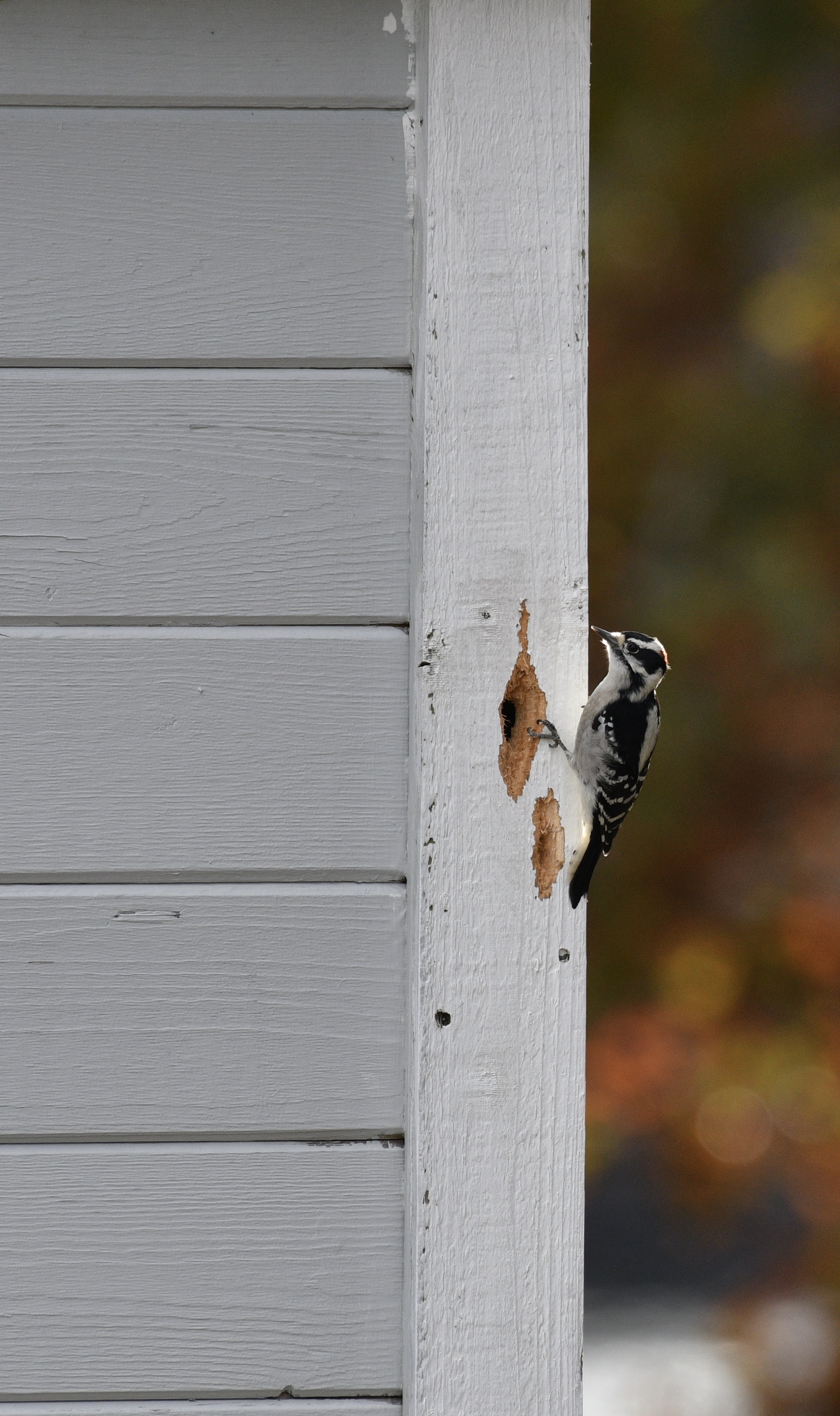
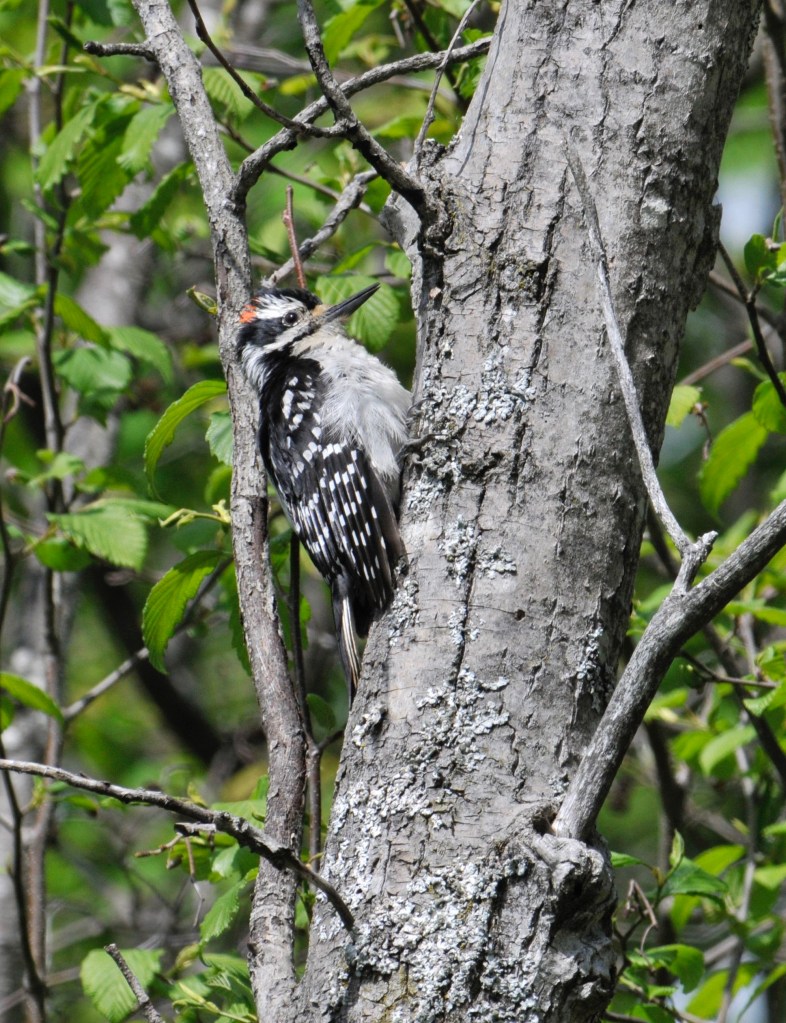
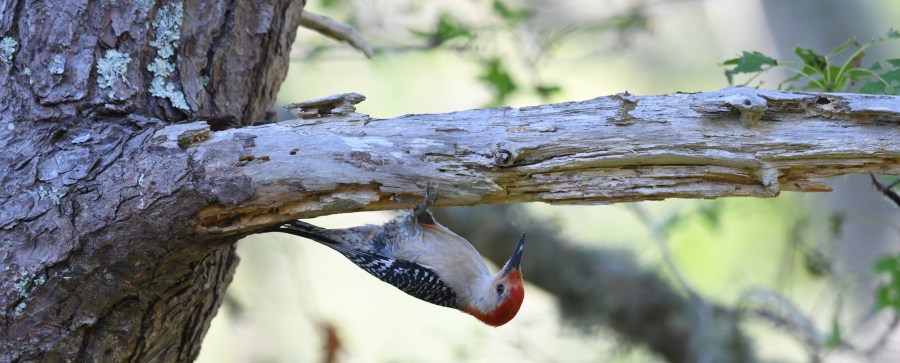
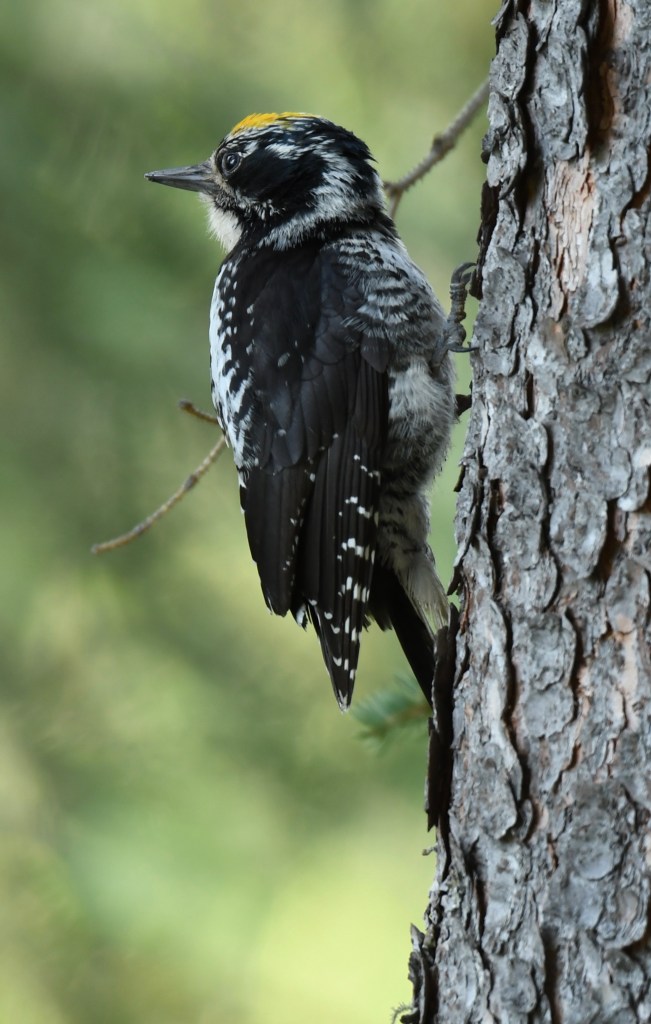
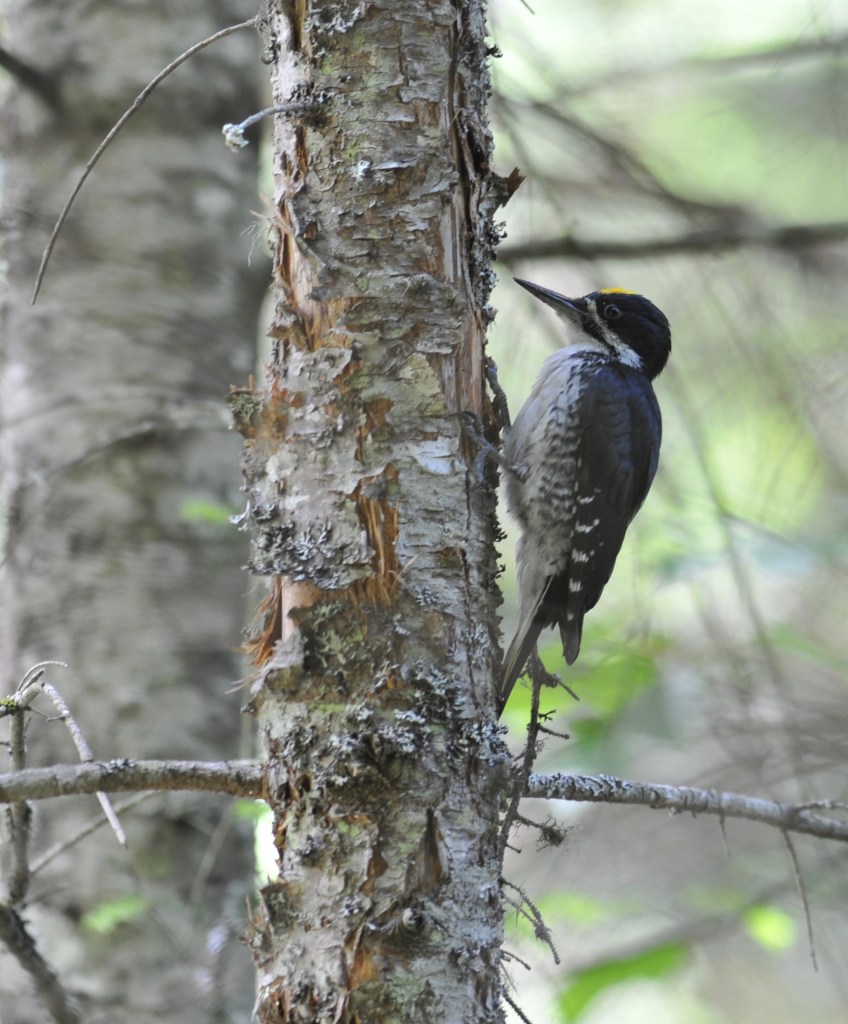
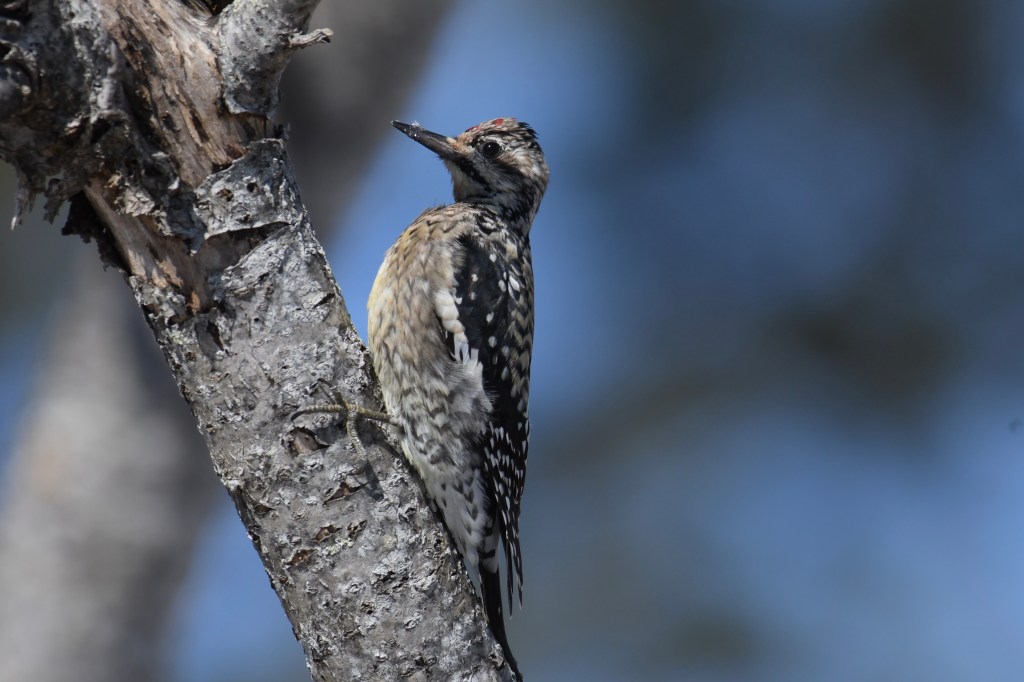
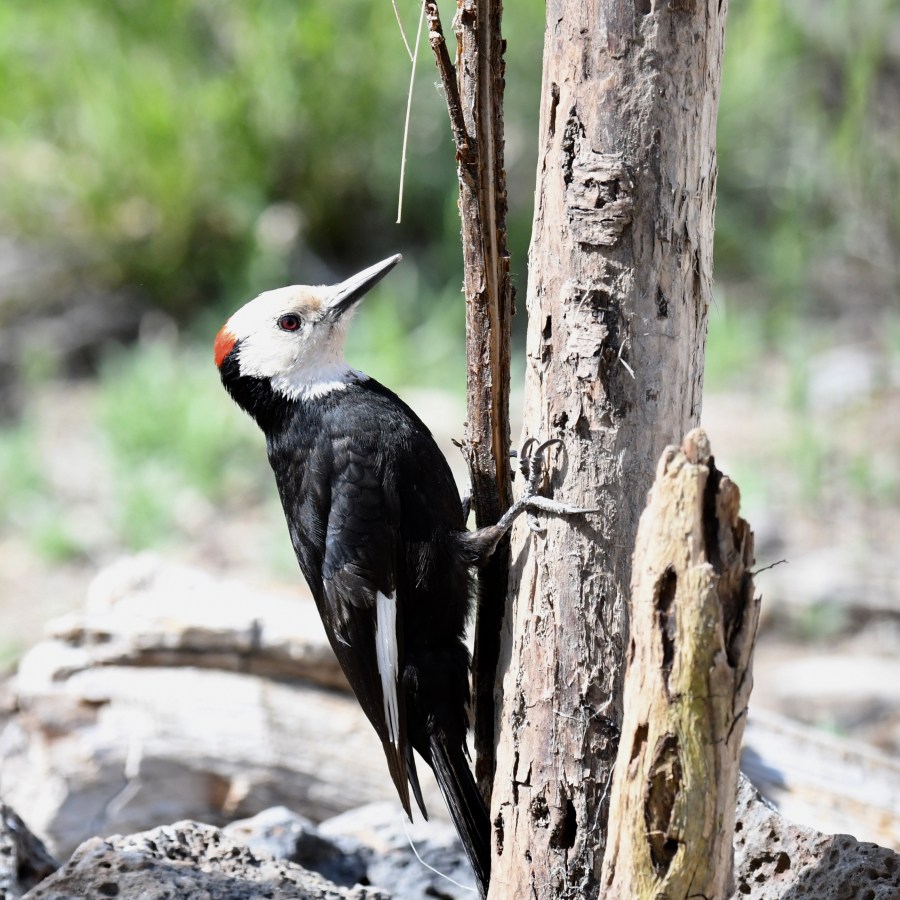
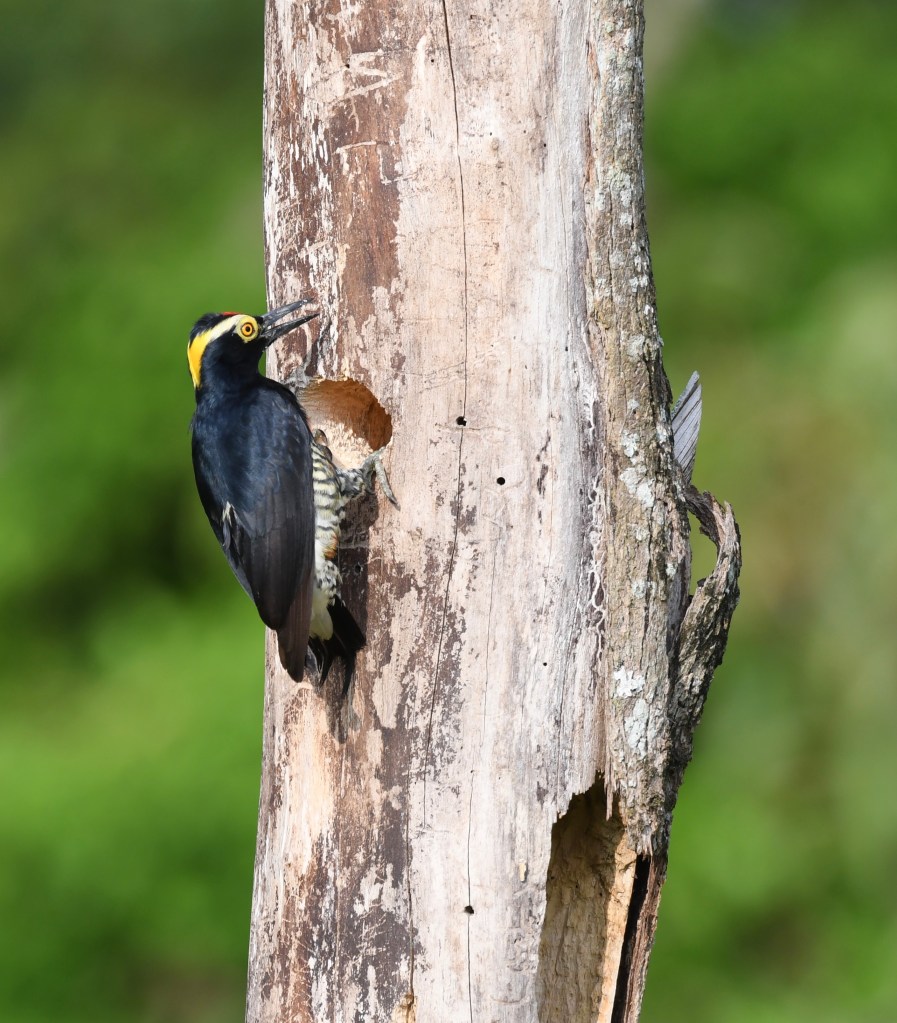
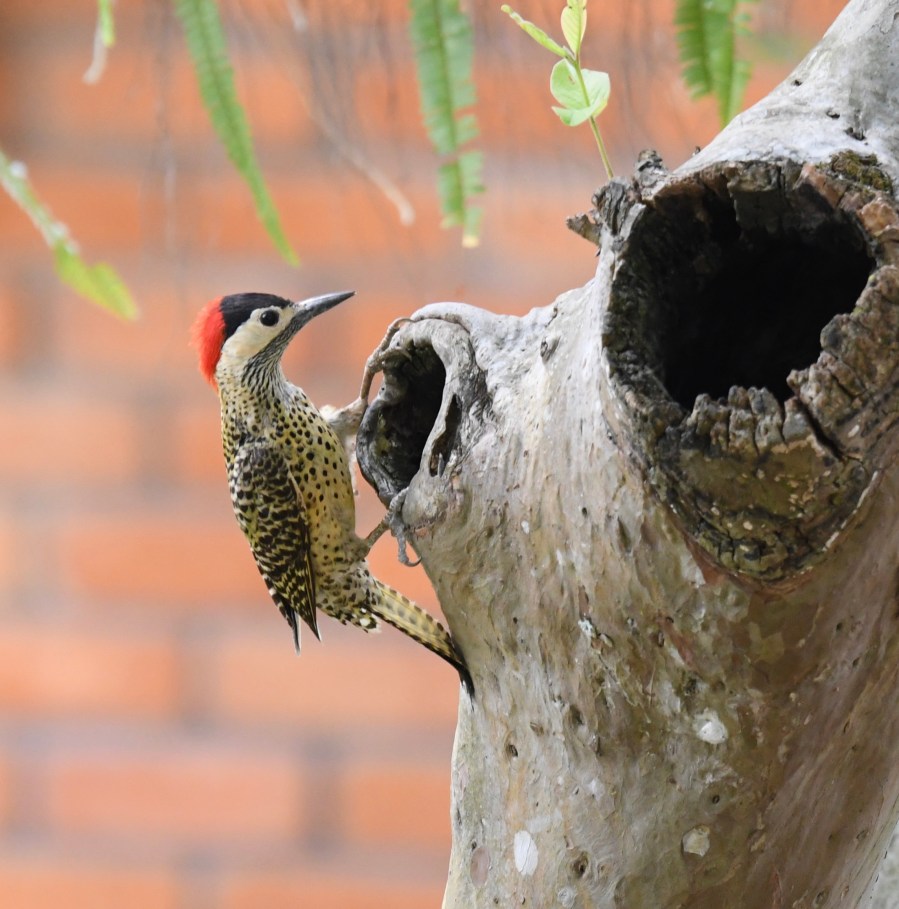
These first two images are of the common black-and-white woodpeckers of the USA. This one is the smaller of the two; the Downy Woodpecker. They are easily attracted to residential yards with a suet-feeder. Merely having trees is enough to have them around but a suet feeder will guarantee that they are regular visitors. This one is chipping a hole in the siding of an outbuilding probably to gain access for a winter roosting spot. In many cases they will enter a building in this manner and then not find their way out. Many woodpeckers attract attention by drumming on metal gutters, the side of buildings, or dead branches and that is the only purpose of rapping. But in the fall many will look for winter accommodations and dig into barns, garages, and sheds.This woodpecker is the very similar, though much larger, Hairy Woodpecker. It is widespread and common but not as common as the Downy. Both the Downy and Hairy are widespread in North American forests though the Hairy seems to have stronger ties to coniferous forests than does the Downy. There are six populations of the Downy and 14 populations of the Hairy in North America. These races are tied to elevations (temperature and moisture) and are determined by the extent of white in the pattern – in other words they are pretty similar across the continent.Here is a pretty good look at the belly of a Red-bellied Woodpecker. Don’t feel badly if you are not seeing the red, it isn’t a big feature. In the eastern USA this bird has expanded its range northward by hundreds of miles in the past three or four decades. They seem to know about global climate change.The western forests of North America also have two similar woodpeckers; the Three-toed and the Black-backed. The Three-toed has a huge range that encompasses the boreal forests of Canada, Europe, and Russia. It is found wherever there are spruce trees. Like any creature that has such a widespread range there are localized populations. In the case of the Three-toed there are usually seven races listed.As this image shows, the Black-backed Woodpeckers is similar to the Three-toed with the main difference being that the back is black; as advertised in the name. This is an adult male with the yellow patch on the head and the black and white cheek lines. Both of these birds are widespread and not rare, but they are quiet and exhibit a subdued behavior that makes them blend into the forest. They are not always easy to locate unless they are breeding and the males are calling and drumming or the youngsters in the nest have reached their “teens” and are constantly begging (noisily) for food. There are four US sapsuckers (maybe five). Like all woodpeckers they will eat grubs and insects but sapsuckers derive a large percentage of their nutrition from the living parts of the forest. They lap up sap and cambium from holes they drill in certain trees. Hummingbirds will also visit the sapsucker wells.The Acorn Woodpecker is a bit of a goofy looking bird. They are communal with as many as four males and females all staying together in a territory. The likely reason for this is that they collect and store thousands of acorns each year in “granaries”; holes drilled in telephone poles or dead trees serve as their bank account. It is probable that a large group, each with “skin in the game” can protect these valuable resources better than if they were in pairs or alone. In the western USA as long as there are oak trees there will be Acorn Woodpeckers.The White-headed Woodpecker is a bird of the USA’s western pine forests. It will flake off bark and locate insects and such but will also spend time eating seeds from pine cones. They are found in Washington, Oregon, and California in the mountains with coniferous woodlands.The Yellow-tufted Woodpecker is found in the Amazon Basin and down into the Pantanal. It is a striking bird and included here for the “gee whiz” factor. It is also a communal bird with up to five adults helping at a nest. They interact all day and often sleep in the same hole at night. They are quite widespread in central South America and seem to require little beyond a few trees, although tall dead trees seem to be a nesting requirement.The Green-barred Woodpecker is another woodpecker of South America though not widespread into the Amazon Basin. Its range is extensive but not inland through the Pantanal below the Basin. A very versatile woodpecker it eats fruits, saps, bugs, and feeds on the ground like a flicker, eating ants. They are not communal and are usually seen one at a time. They have adapted to forests of all sorts and desert scrub lands as well. There are two populations and in both populations the male and female can be separated by the red in the mustache; males have it, females don’t.
Please treat all images as copyrighted and ask permission before using for any purpose. Thanks, DEClapp
Many birds are glorious; bright, colorful, showy, resplendent, overdone, vibrant, exotic and so on. Some adorn themselves only in the breeding season; usually males to impress the ladies. Other are superb athletes; diving, swimming, rolling, zipping, or building great bowers. But not all of them stand out in a way that we might adulate or appreciate. Some are rather plain looking and carry on a very comfortable middle-level life. They are assuredly not boring to each other I would imagine, but to the average human observer they seem to be more couch-potato than rock star. In previous posts I have shown the Indigo Bunting (in the fall) and House Wren, and a few other birds that are nice enough on their own, but not showy – here are a few more.
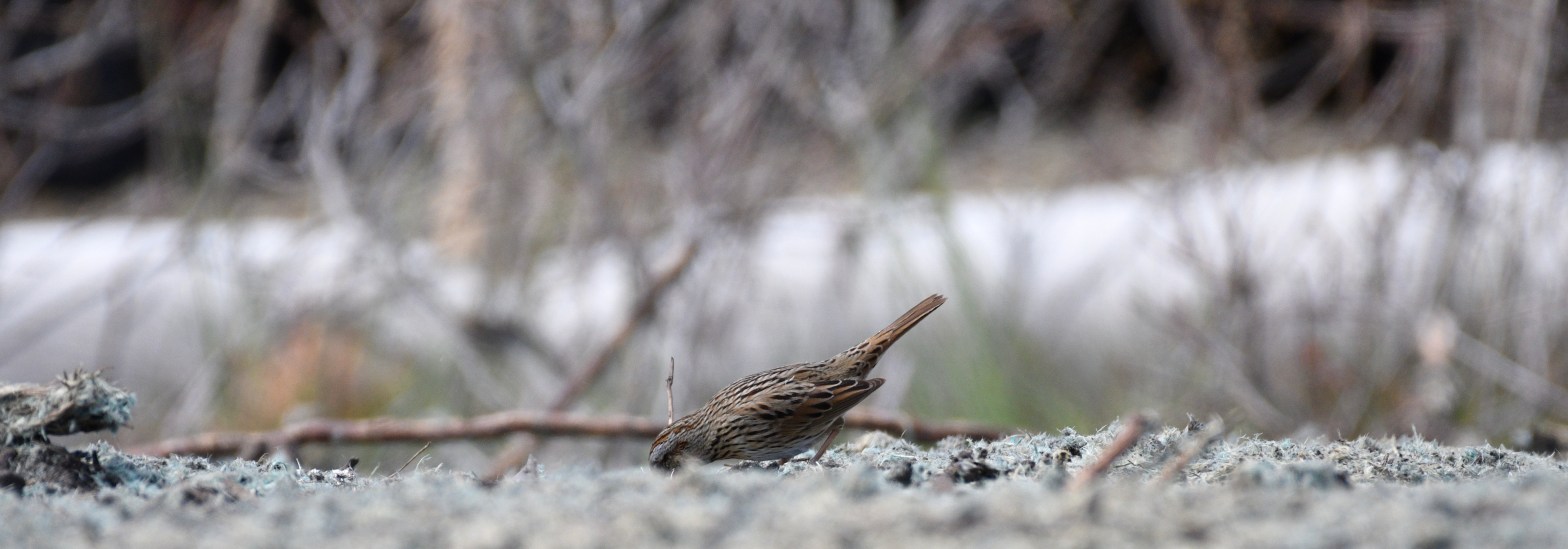
The bird in the lead image (up above) is a sparrow – perhaps you guessed that. It is a tightly marked Lincoln’s Sparrow with it head tucked into a hydro-seeded patch of earth. It is noticeably different from the Song Sparrow shown in an image below. Lincoln’s Sparrows nest in the Boreal Forest of Canada but in clearings with leafy patches in the forest usually adjacent to bogs or ponds. Learning and appreciating the dull and inconspicuous birds is both challenging and tedious – but worth it in so many areas. A comparison of Lincoln’s and Song Sparrow might be done with a fabric reference; the Song has a burlap sort of weave and the Lincoln’s is more like a tightly woven bed sheet sort of fabric.
Let’s start with these birds and then later maybe we can apply what we have grown to appreciate to our fellow humans; we are not all showy, flashy, tightly-woven, or memorable (at least at first glance). Here are few of those sorts of birds with a bit of a narration as to why despite their average looks and life style, they may exceed our first impressions.
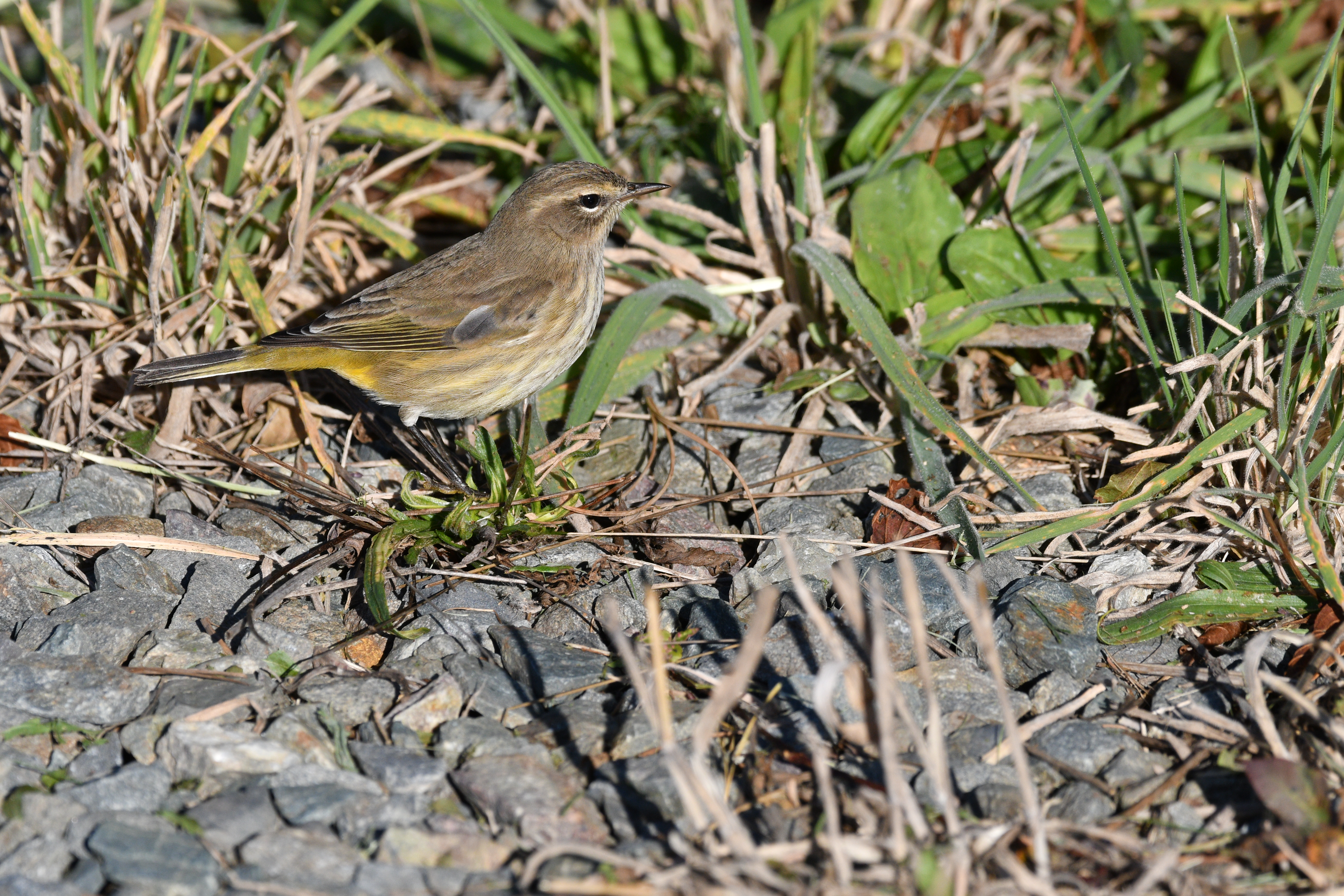
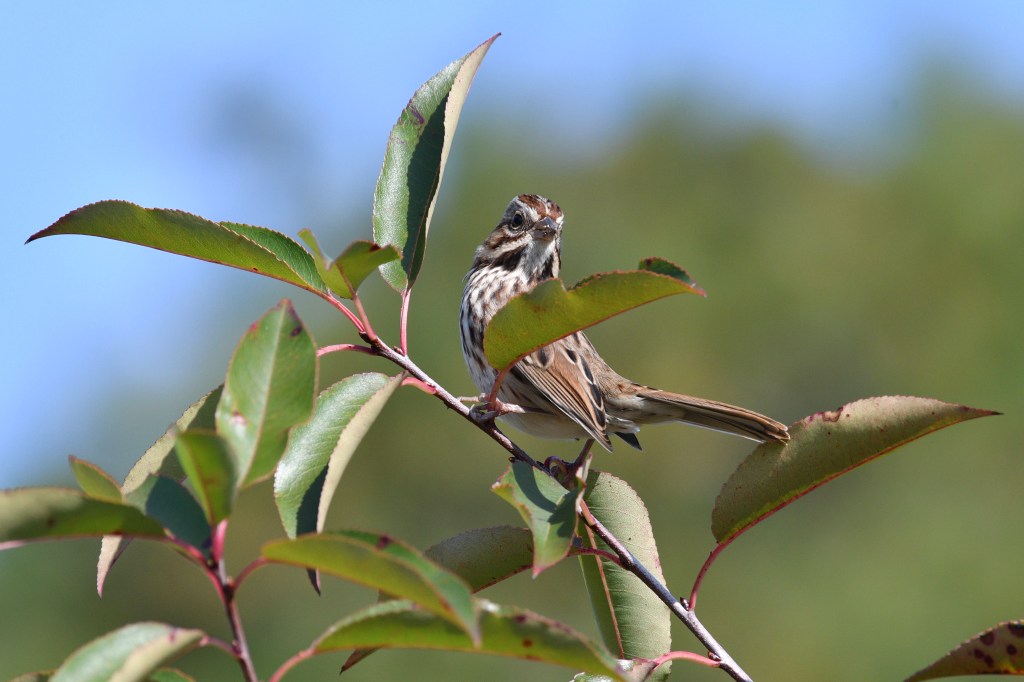
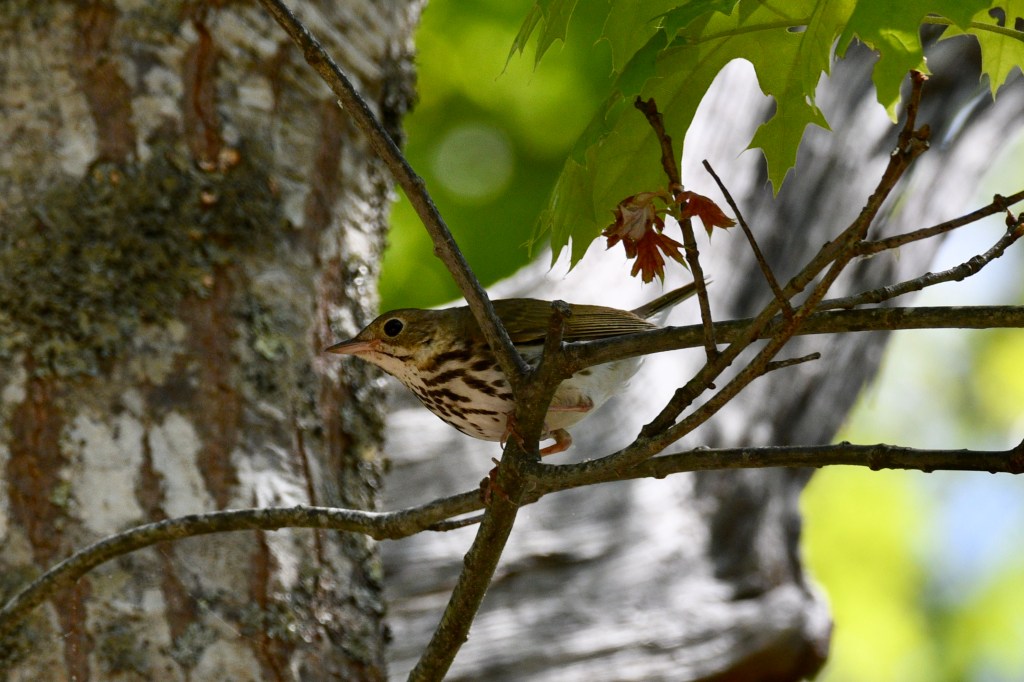
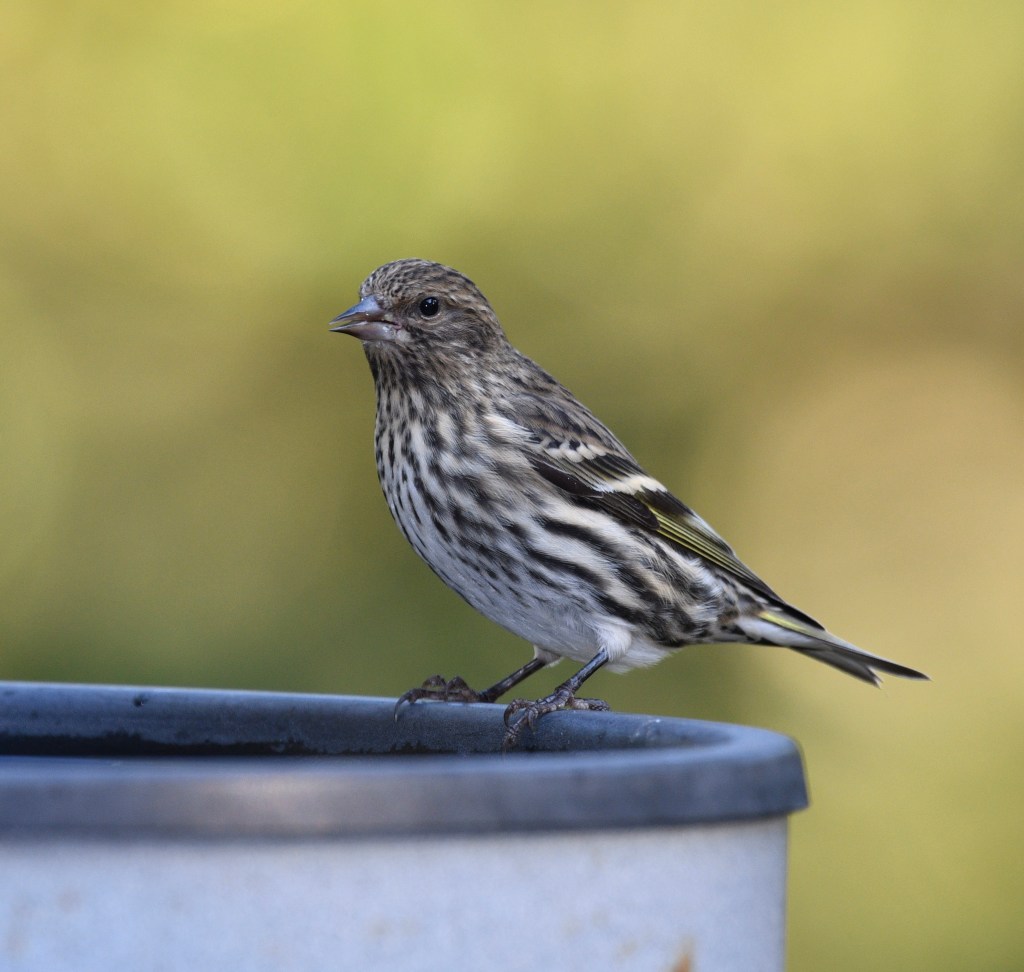
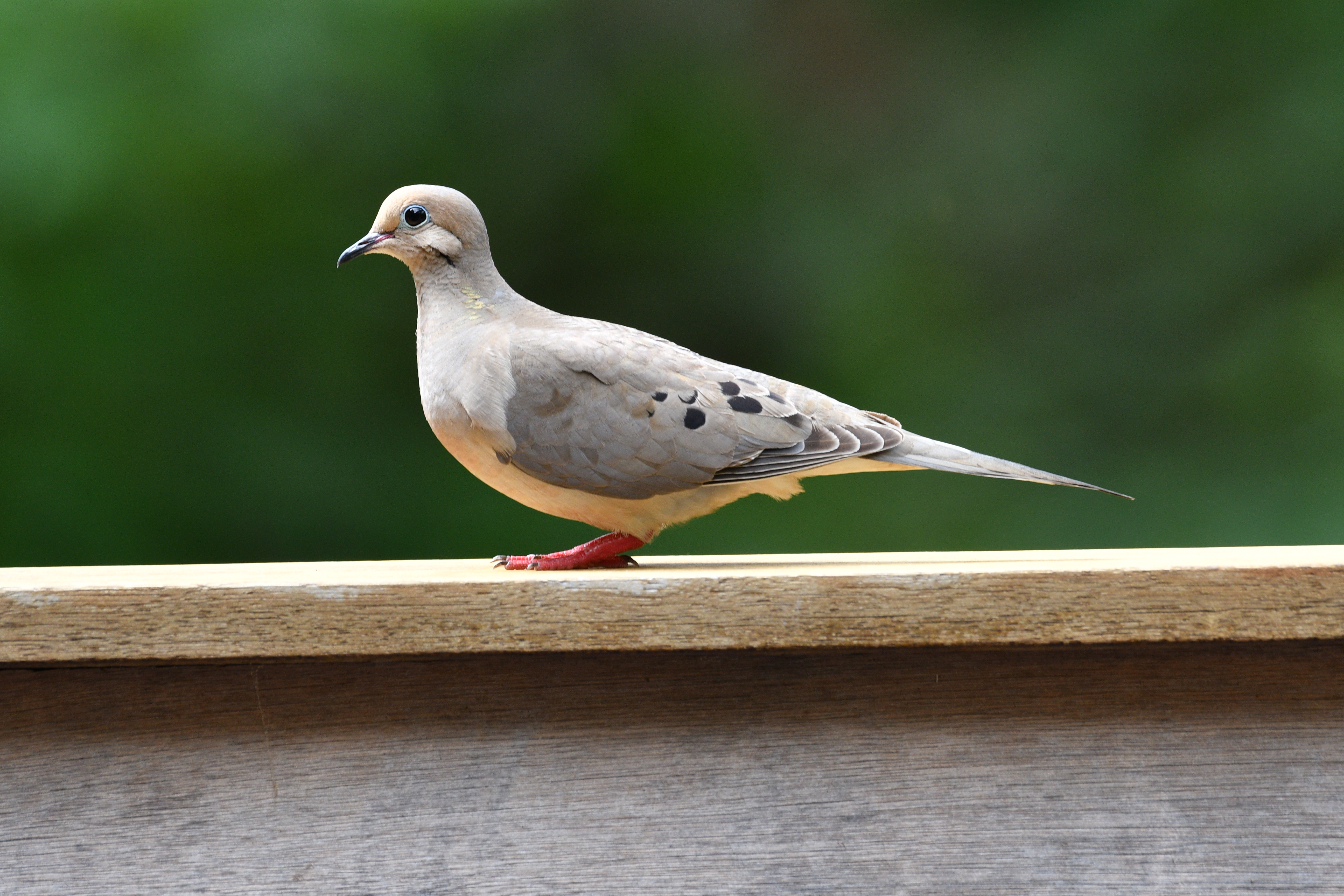
Our impression of warblers, here in the eastern part of North America, is of bright birds flitting in the nascent foliage of a mid-May morning. A bit of buzzing and trilling perhaps but more reminiscent of a butterfly invasion than an avian incursion. But all warblers are not up in the trees and all are not yellow and showy. There are many, like this Palm Warbler, that are a bit drab and perhaps even blah. Palm Warbler is a bad name as the bird is rarely in palms and spends all of its breeding life in southern Canada and only a fraction in the southeast corner of the US. Even in winter it really isn’t a “palm” sort of bird. As a migrant is passes through the eastern two-thirds of the USA both heading north and returning south. The bird above and the bird below are both Palms.There are two very distinct populations of Palm Warblers’ The “western palm” is shown in these two images and breeds from Hudson Bay west and up through northern Canada. The “yellow” palm (maybe it should be called eastern palm) is very yellow underneath and breeds east of Hudson Bay. The western group migrates east and then south in many cases and here in New England (east) we get mostly western Palm Warbler. The plainer looking western palm still has bright yellow under-tail covert feathers which can be seen in both pictures. The easiest place to see these birds in migration is alongside agricultural fields where weeds have grown up. The seeds from annual weeds feed many millions of birds and almost all of the Palm Warblers as they migrate. They spend their winters in southern Louisiana, Mississippi, Alabama, Georgia as well as Florida and the eastern parts of the Carolinas and Virginia. As they are pretty plain looking the easiest characteristic to notice when checking out a Palm Warbler is that it wags its tail both vigorously and continually.Sparrows are often mostly brown and sport lots of stripes. This is the most common of our sparrows, the Song Sparrow. All the USA and all of the lower half of Canada have Song Sparrows from coast to coast. There are several populations with modest specific characteristics but generally they are boldly striped above and below with an irregular spot on the chest. Hedgerows, weedy patches, yards, and all sorts of bushy and brushy areas are used by the Song Sparrow. It is widespread and common. If you learn this sparrow you will have a central landmark in the sparrow terrain from which to describe and compare other cryptic brownish and striped birds. Oops, this may look like a sparrow but it goes back to the not-all-warblers-are-colorful comment. This is a weird little warbler; common (in the oak forests of the NE) and noisy – the Ovenbird. It looks like a small thrush perhaps. There are bold stripes, an eye ring, and the habit of walking on the forest floor or on a horizontal tree branch. The older bird books depict the call as “teacher, teacher”. But that never sat well with me as I thought that was backwards and placed the emphasis on the wrong syllable. Now I am vindicated, as David Sibley says in his field guide, the “song is an explosive two-syllable phrase increasing in volume “chertee, chertee, cherTEE, CHERTEE” and so on. Ah, the sweet feeling of vindication. Ovenbirds build a smallish inconspicuous domed nest on the forest floor and raise the clutch close to the earth. When seen well, and that’s easy especially in the spring, this rather plain brown bird has some colorful attributes and a nice contrasting pattern. It’s worth taking the time to track one down.The great Boreal Forest of the northern hemisphere sweeps around the globe encompassing most of Canada, Scandinavia, and Russia. It consists of more than 6.5 million square miles of trees; the cone trees like fir, spruce, larch, and pine, and the leafy trees like the poplar, birch, and alder. Boreal forests are a very recent habitat; they are all post-glaciation, perhaps 10-15,000 years old. As much of this habitat is in Russia it is often called taiga, the Russian name for this snow forest. Very similar habitat occurs at high elevations through mountain chains well to the south. These elevation-restricted areas are often referred to as “alpine” zones or “alpine” habitat. We have them in the Appalachian Mountains and throughout the Rockies and Sierra Nevada in the west. The bird life of the forest is made up of ravens, finches, grosbeaks, warblers (breeding) and jays. North of the forest, more toward the North Pole, is the tundra where there are lots of “sparrow and finch” types of birds. Here in Massachusetts we wonder each fall if the Canadian birds will sweep south and spend part of the winter with us. Many of these birds, perhaps most, are capable of surviving through the winter by gleaning nutrition from the needles and cones of the forest. But some years, for a variety of reason, they will head south. Well this year, 2020 in early October we have had a huge invasion of the tiny, but hardy, Pine Siskin. They are here in busy flighty flocks. There can be 50 or more at our feeders each day – I figure they are eating about $6 worth of seed per day. Now we are wondering whether the Common Redpolls and Evening Grosbeaks – will they appear as well? Maybe the great predator of the north, the huge and impressive, Gyrfalcon might stop in somewhere nearby. This could be a winter of northern species for us – but maybe not…..we won’t know for a few months.As far as plain and pedestrian goes can anything beat the dove/pigeon group? We dismiss the Mourning Dove as common and unimpressive and the urban Rock Pigeon as little more than a rat with feathers that seems to like bridges and buildings. But this group is worldwide and very well adapted. The bird above is a Mourning Dove. It is at best a subtle bird with a long tail and small rounded head. It is a bird of yards, grasslands, gardens and farm lands, and spends a good deal of time sitting on wires. They nest from late winter into early fall on very flimsy nests made of an unlikely small number of criss-crossed sticks. The “cooing” noise can be confused with the hooting of an owl – but it is a day time noise and the bird is often quite visible.
Please consider the images to be copyrighted and ask permission for any use – but please share this blog page. Thank you. DEClapp
Over the years Jack Clyne and Rosie Stewart have shown me a great deal of their island country. It has been my pleasure to work with them and learn from them. I was prompted to do this post because Jack sent me the Kea book that he always brought on tour with us. It arrived the same day that Rosie informed me that her kōwhaitree was in flower and attracting a gang of tui that were wildly slurping the nectar – those two are a couple things to Google (I mean the plant and the bird not Rosie and Jack).
Rosie lives outside Auckland and Jack just north of Christchurch on the east coast of the South Island. Auckland is a city with a grand harbor located on the northern part of the North Island. There is one other largish island, Stewart, and many many small bits and pieces. The country of New Zealand has respected the Māori heritage and has used many Māori names for towns, plants, festivals, and animals. Thus the two names that you will now Google –right?
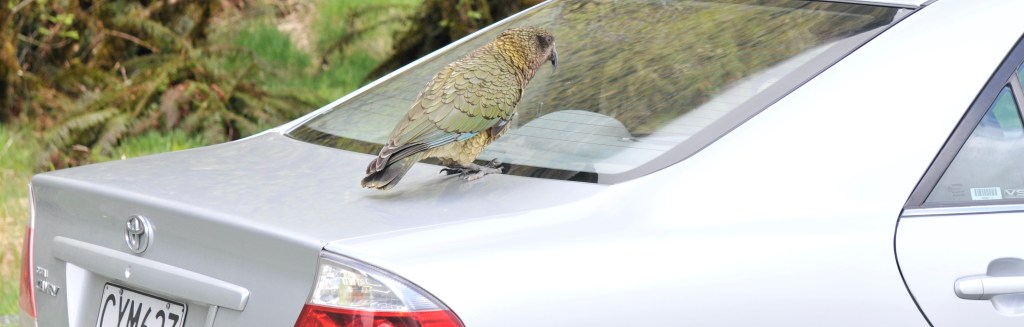
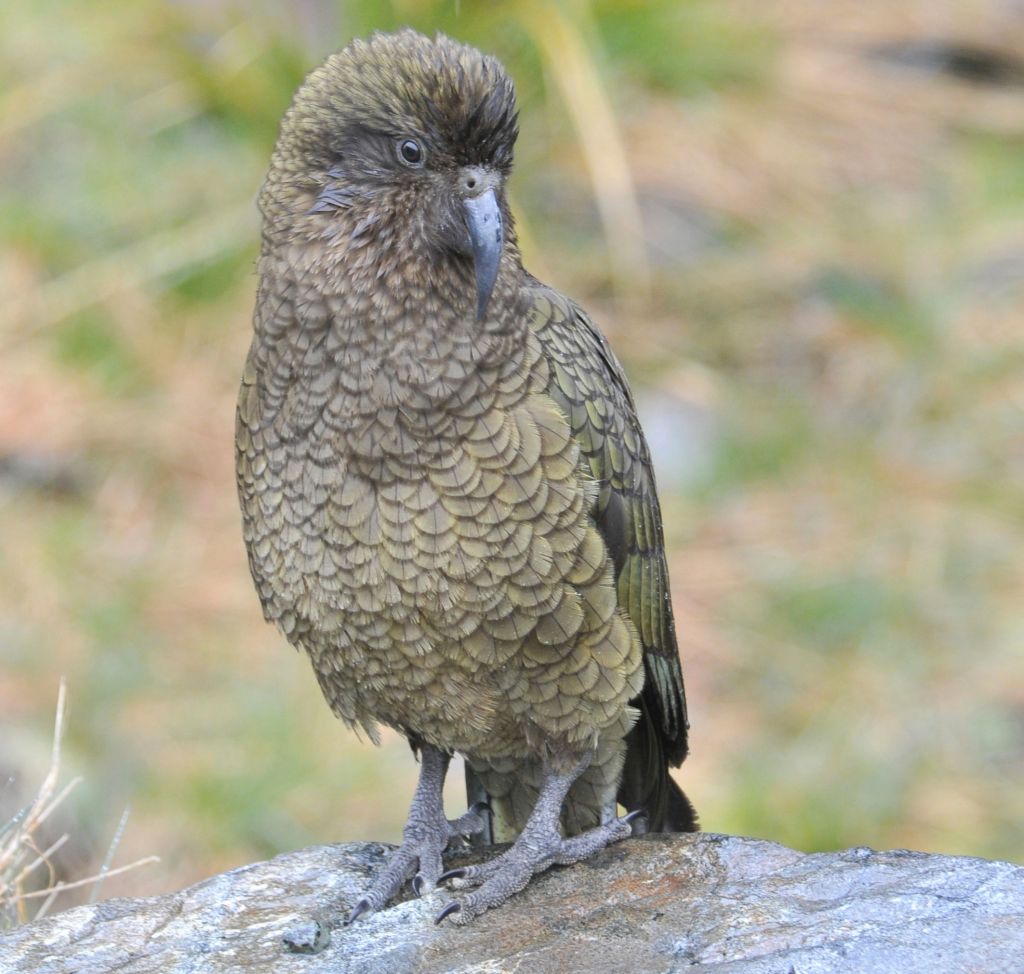
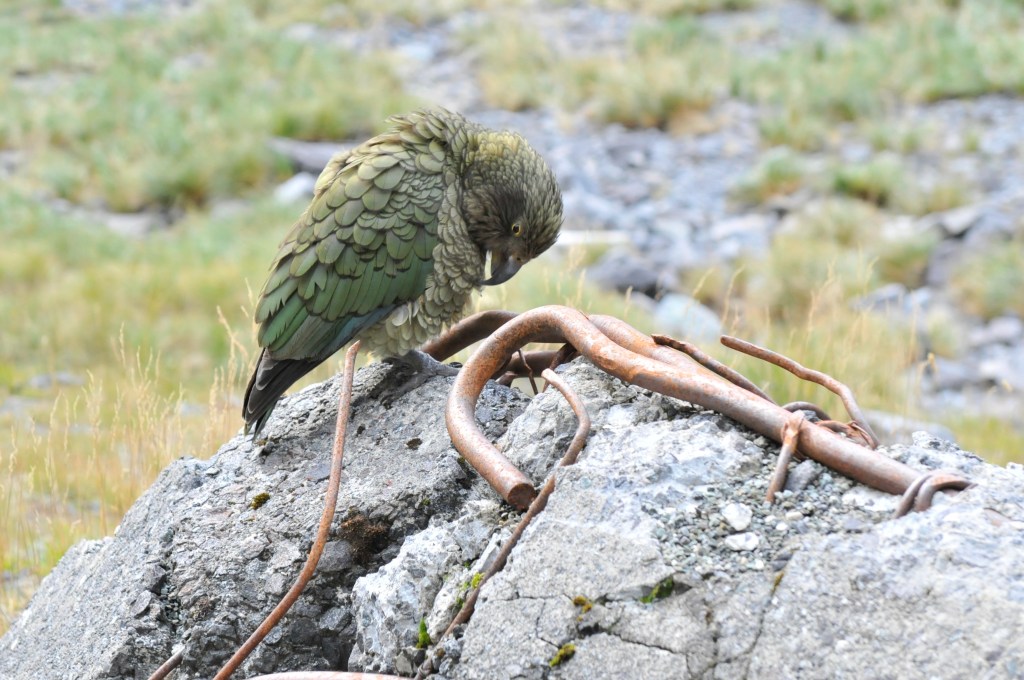
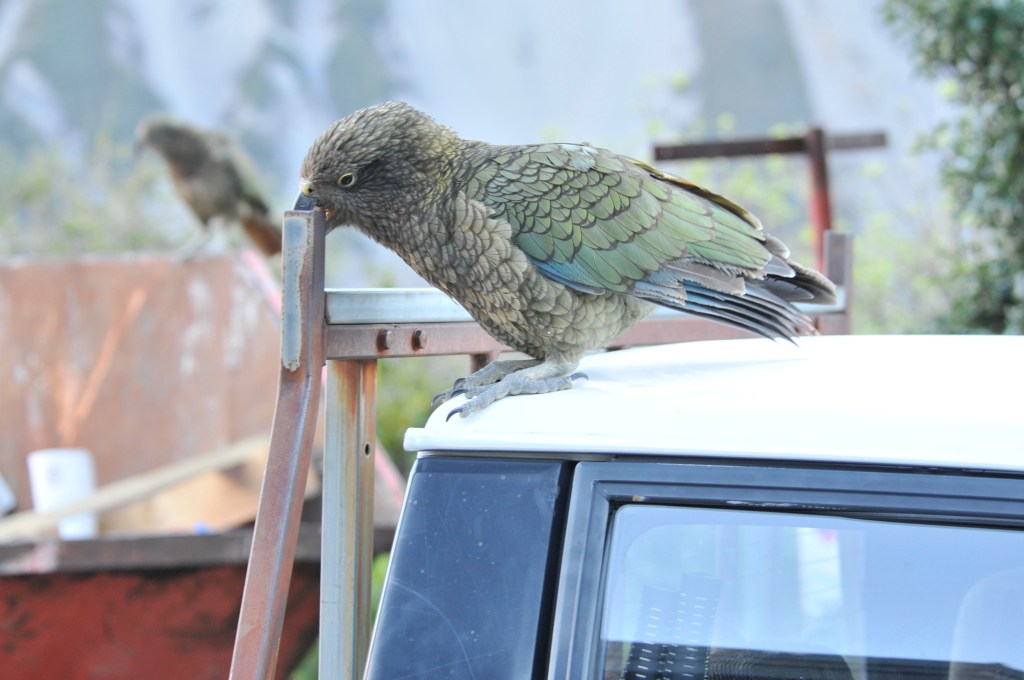
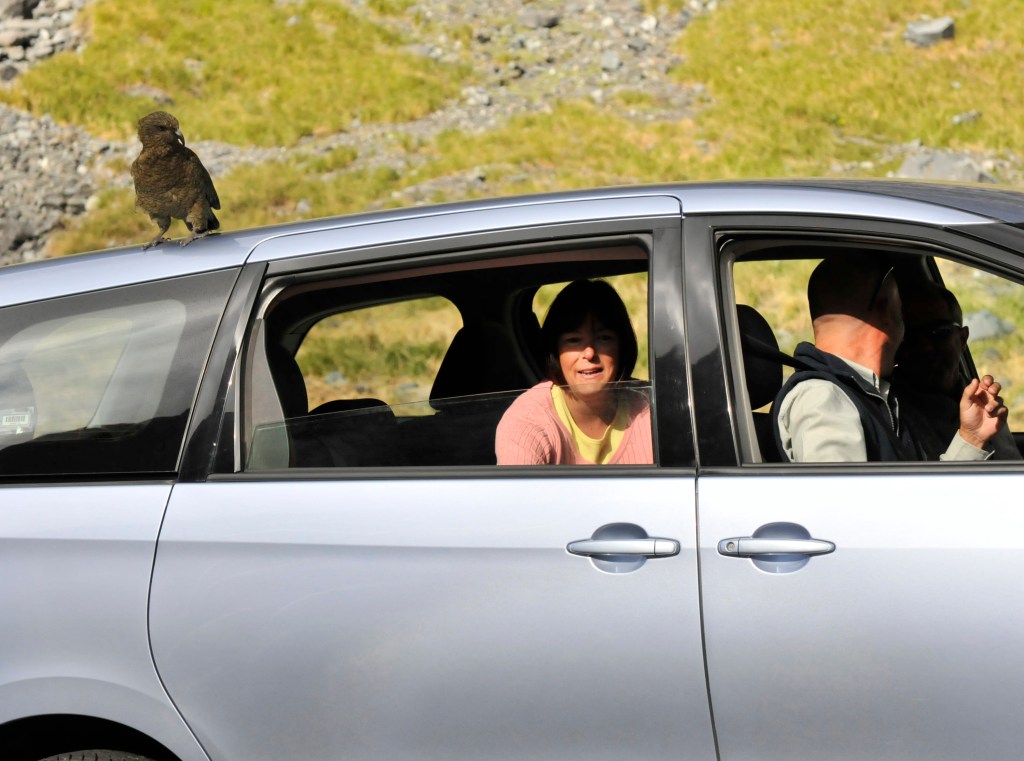
This bad boy parrot is sometimes called the clown of the mountains. It may surprise you that a post on a parrot doesn’t include either the hot humid tropics of South America or the vast dry wonders of Australia. This is a parrot like few others; and those few others are also from the land of the Long White Cloud. Aotearoa, or New Zealand to the late comers, has been a land alone for a long time. This fact, and the total (excepts for a bat or two) lack of mammals allowed the birds to develop all sorts of exceptional behaviors and looks. From a naturalists point of view, it wasn’t “spoiled” by humans until after Captain Cook and Joseph Banks arrived in 1769. It may have been visited by the Chinese very early on and the Māori and Dutch later – but it was the expanding empires of France, Spain, and Great Britain that really consumed the great oceans. It was Great Britain that controlled and developed both Australia and New Zealand. Cook arrived well before English annexation (1840) and his travels opened the area to many other adventurers. Sealing, whaling, and nutmeg collecting (more valuable than gold for a while) drew explorers and entrepreneurs from all over the world. When I say “spoiled” I mean that the native environment was altered, invaded, and changed. Plants and animals that had adapted to a particular and successful way of life were exposed to, and wiped out by, creatures with another way of life. Captain Cook’s ships probably brought rats and mice and maybe mosquitoes. He released chickens in anticipation of a free-range buffet in anticipation of his next visit (Cook made three trips to New Zealand). On his last two trips he carried ducks, chickens, cattle, sheep, and goats (perhaps their genes persist in the Arapawa Island goats). It was recorded that he presented a breeding pair of goats to a Māori chief and released several pair on the island called Arapawa.This is the Kea. Its call is KEEEAAA, loud and shrill. The noise carries up and down the mountain valleys. The lead image of this post are the Mountains in the Southern Alps near Mount Cook I lead with this post not merely because it is a nice scene but because those high, cold, windy, snow-covered reaches are the home of the Kea; it is a parrot of the mountains. They roll in the snow and slide down the slopes on feathered sleds. They are able to survive here because they are smart and they are problem solvers. They are hardy and have good memories.Here is a Kea looking to disassemble a concrete brick with reenforcing rod imbedded in it. Given the time they probably could make this into a pile of gravel and another pile of paper clips. They tinker, they explore, they experiment, and they figure things out.This one wishes he had invented the screw driver or socket wrench as taking apart this truck rack would be so much easier. Tinkering with metal is no where near as successful as removing rubber gaskets from automobile wind shields (windscreens to some of you).Driving the mountain road, NZ State Highway 94, from Te Anau to Milford Sound requires passing through the one-way Homer Tunnel deep in the Fiordland mountains. As you sit and wait for your turn to enter the three-quarters of a mile long hole in the rock, the vehicle is often inspected by a curious Kea or two. Dropping down to the front hood (bonnet) they will look over the wind shield and examine the rubber gaskets and windshield wipers – perhaps taking a nip or pulling a strand or two before the light changes and the car drives deep into the mountain. The tunnel is narrow and seemingly unfinished though now paved; the walls are as the sledge hammers left them; rough and rugged and as permanent as any mountain on earth. It was a depression era project and almost all the digging and chipping done by the gnarled hands of five men with picks and shovels. The Darran Mountain area where the tunnel is located is plain and simply gorgeous; especially if you get there on one of the few dry and sunny days, The workers at the site eighty years ago recorded that there is direct sunlight only half the year; due both to rainy weather and the mountains that allow a very late morning sun and an earlty afternoon sunset. Having been there several times in the rain I can say that the rainy days are also spectacular as hundreds of waterfalls and cascasdes develop to drain water for the near vertical mountain walls.Another roadside Kea; actually that is pretty much the only way to see them. The mountains need to be flown over and hiking to find Kea is a challenge. Yes, they are best seen at the tunnel or at rest areas where they have learned that people will offer them a cracker just for being there. It shouldn’t happen and DOC (the Department of Conservation) posts against it but people are not alway aware of the impact they might be making. Because the birds are so rare and so important many, perhaps most, have been caught and ringed (banded). This bird shows a silver band on the right leg and there are probably one or two color bands on the left leg. This research allows DOC to follow families and individuals as well as habitat preference and territorial range.One of the DOC signs implies that you should keep your eyes on your shoes. My favorite time at the Hermitage Hotel at the base of Mount Cook is just around sunrise when the Kea will arrive at the maintenance area and putter around the leavings from the day before. It is as if they are looking for bits and pieces to finish a project.
One of the DOC signs implies that you should keep your eyes on your shoes as the Kea will “toy” with them. My favorite time at the Hermitage Hotel at the base of Mount Cook is just around sunrise when the Kea will arrive at the maintenance area and putter around the leavings from the day before. It is as if they are looking for bits and pieces to finish a project.I mentioned that there are several New Zealand parrots and a few parakeets as well. The Māori names for the parrots all seem to have the same base sound; Kea, Kakapo, and Kaka. The Kakapo is a large, nocturnal, flightless parrot that is now very rare and restricted to a few predator free islands.
This parrot is one of the creatures impacted by the European predators that arrived on the islands; cats, stoats, possums, and dogs became predators of the many flightless birds; goats, deer, sheep, and now cattle have in turn greatly altered the native vegetation. New Zealand has an active program to remove these alien creatures (and plants) and try to return to the avian rich wildlife it had before humans arrived.
Please consider all the images to be copyrighted and ask permission before using them in any way. Thank you. DEClapp
Migration occurs pretty much everywhere in the world. Wildebeest and zebra move to find fresh grass as they follow the East African rains. As the glaciers receded from the northern hemisphere a few thousand years ago, birds began to fly north to breed and then south to their lands of origin. Fish used the newly open rivers and streams for spawning; and bear, mink, and a dozen other mammals followed them. Forests appeared and birds flooded them; eating the insects that were part of the developing system. Everything changes, nature is not static. There is no balance of nature.
Migrations can be stunningly long like the thousands of miles traveled by the Arctic Tern or the Sooty Shearwater – or the similar distances undertaken by many other sea birds. Tuna, Blue fish, Striped Bass, sea turtles, whales, and even jellyfish all migrate. Migration can be seemingly inappropriate as with the tiny Ruby-throated Hummingbird flying hundreds of miles non-stop across the Caribbean. This bird is so small, and so light, that you could mail 7, 8 or 9 of them with a single one ounce stamp. Now I think the United States Postal Service does a great job – but still they choose to fly. The birds I am going to show below all have different stories and all have unique behaviors and patterns. They are barely representative as each creature has its own story.
The late summer and early fall is migration bonanza time. The sandpipers and plovers and other waders have headed south already; with the adults dropping southward in July and August with the breeding season over and their homeland calling. The shorebirds that hatched this year are undertaking their first migration now – August and September and into October. Land birds stay around and feed their young and as the young learn to fly and feed themselves the adults put on weight and the whole gang migrates pretty much at the same time. They are not together really, families drift apart in the nighttime air or on the expansive feeding grounds. Age groups seem to develop loose partnerships. Adults keep out of trouble following rivers and mountains chains, perhaps remembering the wrong turns of their earlier trip. The youngsters wander a bit more and often end up too far east or west or north or south of the intended target. That is what makes fall birding so much fun.
Here in New England we look for central US nesting birds that come our way or birds that migrate quickly north in the spring and are rarely seen, but seem to dawdle on the southward journey. We look for Blue Grosbeaks, Yellow-breasted Chats, Indigo Buntings, Lincoln’s Sparrows, and Dickcissels. There may be Green-winged and Blue-winged Teal and those sea birds that get blown ashore (or near shore at least) by the tropical storms that Africa feeds into the Atlantic this time of year. Then later we will see the signs of winter as the sea ducks begin to arrive.
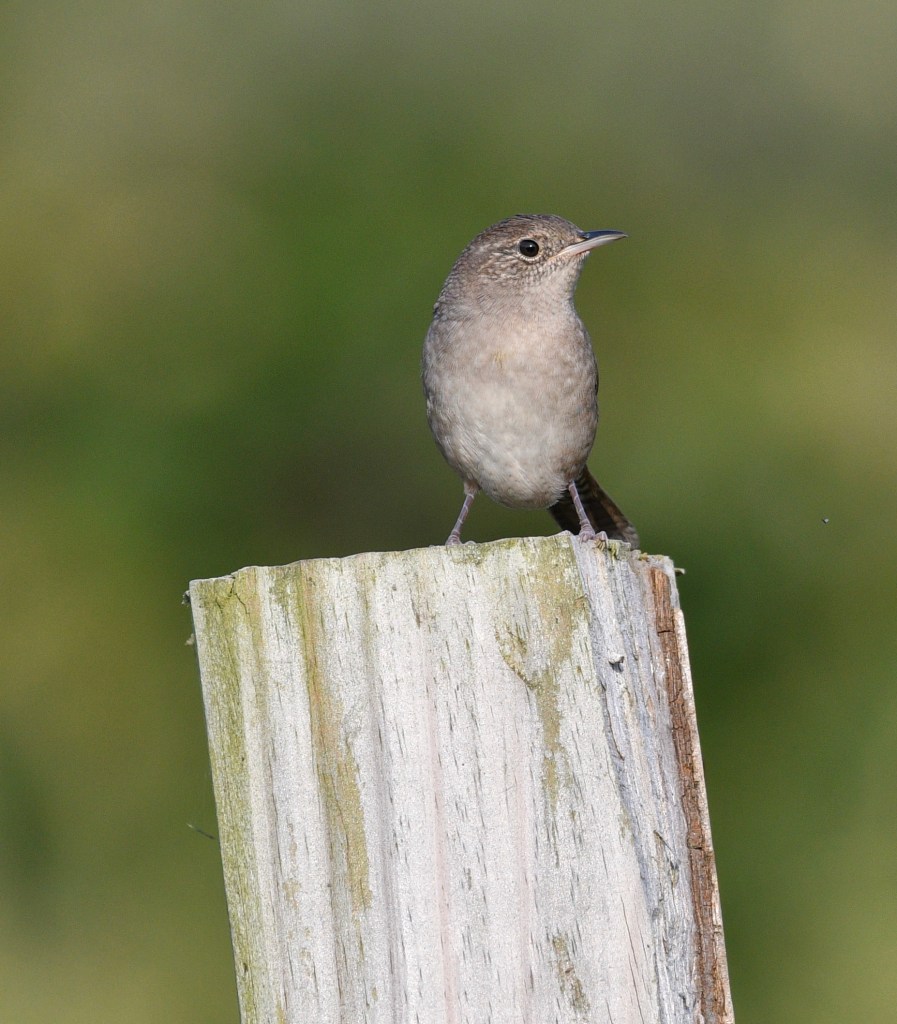
The featured bird at the top of this blog page is a House Wren; common in much of our region but not so common out here on Cape Cod. It will build a nest of twigs and will maraud nesting boxes and take them over (and evict) Eastern Bluebirds and Tree Swallows. We also have the Carolina Wren around here and there are maybe seven other wrens widely represented throughout the US. (Just a test for me as I write: the other wrens are….Pacific , Cactus, Canyon, Rock, Marsh, Bewick’s, Sedge, and Winter – oops that’s eight more).
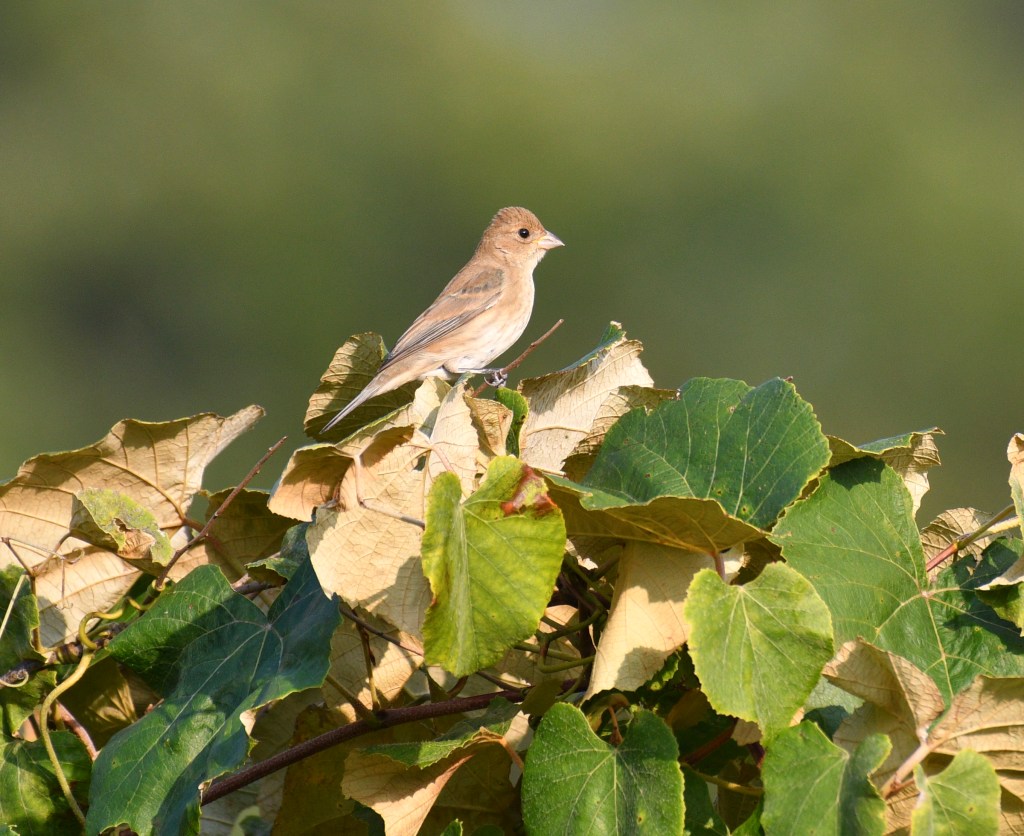
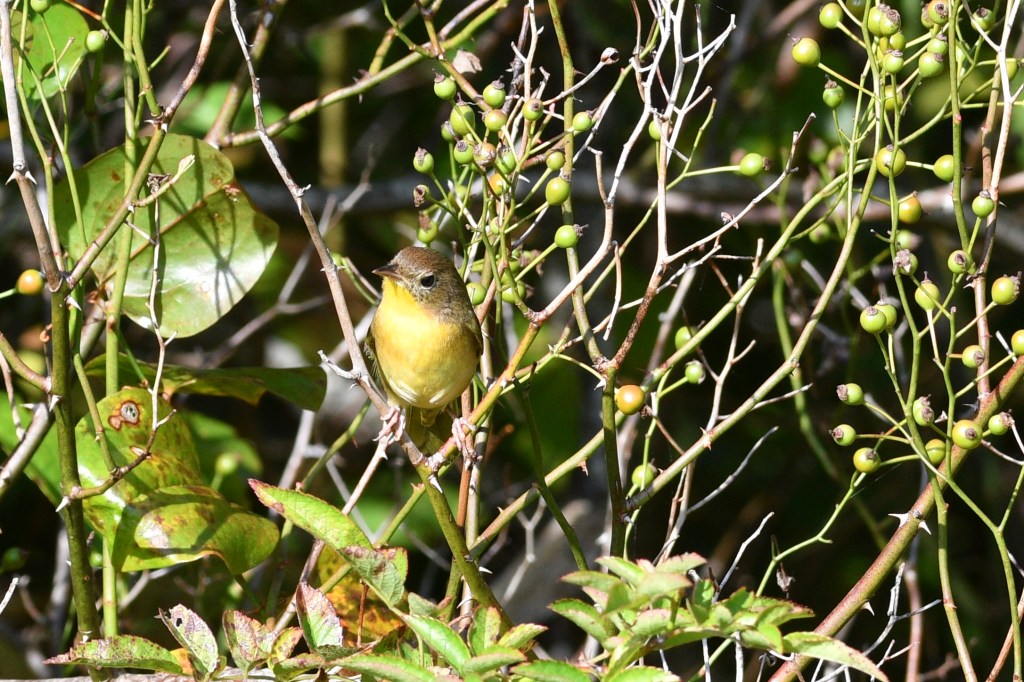
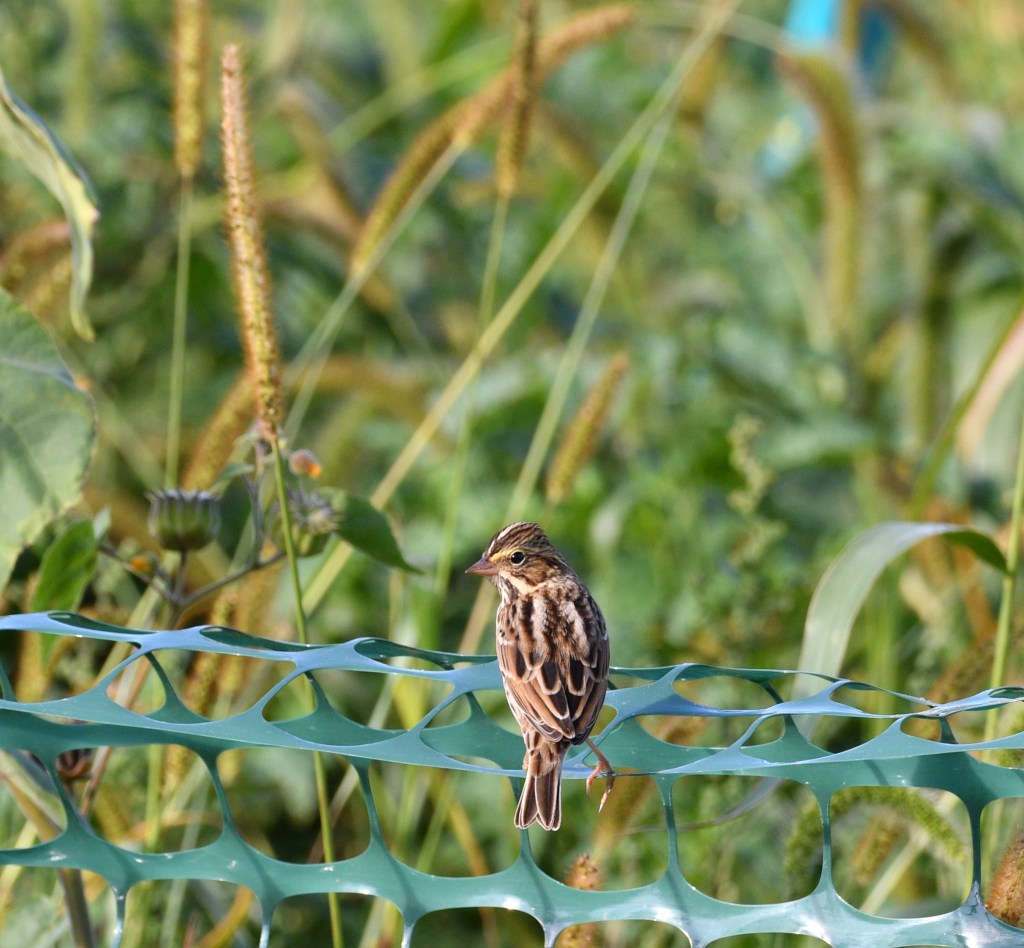
As I said, House Wrens will use nest boxes no matter who they are intended for. Many people who put up boxes want Eastern Bluebirds or Tree Swallows to nest in them. In much of the country it will be the House Wren who becomes the ultimate resident; often after chasing out and destroying the eggs of the original homeowner. In most species, including the House Wren, the nest is kept clean by removing fecal sacs. The (altricial) youngsters eliminate waste in a package, this allows the nest to be kept clean and keeps the presence of parasites at a minimum. This wren is taking the “diaper bag” out to be discarded. Wrens as a group are rather small. The Cactus Wren of the south and west is the exception. Most are brownish and some are gray; tropical wrens use white, reddish brown, stripes, speckles, and patterns to create quite attractive birds with this limited palette. They are busy, noisy, and widespread. Our wrens don’t really haul off and migrate but they do move in the fall to better places to winter. Generally they need dense cover and food. Wrens, like almost all birds, feed their young on protein-rich bugs and worms. But in the winter it is a carbohydrate diet of seeds that gets them through. There are 83 (+ or -) species of wrens and all but one are residents of the Americas; with the greatest number of species in Central America and South America as far south as the southern end of Peru. But the House Wren is very widespread and is found from Alaska to Tierra del Fuego. The House Wren is a taxonomic puzzle; some taxonomists have named ten species where others have one species with ten populations/races/forms. The bird nests as far north as northern Canada and as far south as Tierra del Fuego in Chile and Argentina.This drab little guy may have been raised around around here but the parents are shy and keep the nest out of the public domain. This is an Indigo Bunting; yup it’s clay-colored and not really blueish. The male is strikingly indigo blue and is often seen up on a wire singing its doublets over and over. But the female and the young look like this; clay-colored or brownish. The males will breed their first year with about 80% brown feathers but will molt into the blue plumage by the time they are about16 months old. But they are common in the fall in weedy spots like old field and community gardens. If you look for the Indigo Bunting in with the sparrows or finches based on its bill and general look you will not find it – it is much more closely related to the cardinals.Another widespread nesting species is the Common Yellowthroat. This is a female and the yellow throat is glaringly obvious. The male sports a black mask over the eyes and face edged with a soft powder blue (gray to some) fringe. These are a pleasant fall find as they brighten up a weedy patch and get a birders heart racing – there are lots of “good” birds that one might see in the fall that are yellow.This bird is not a Common Yellowthroat though it has a yellow throat and is quite small. It is a vireo – a Philadelphia Vireo. They nest in the eastern two-thirds of North America, mostly along the Canadian border and north. They migrate through most of eastern USA in the fall and are one of the birds that you look for when migrants are around. Like all vireos (I think this is right) they make a small basket-like nest that hangs from a forked branch, a thin forked branch that is. Vireos used to appear on the check-list next to warblers but DNA comparison has them more closely related to the flycatchers, shrikes, and crows and they now precede the warblers greatly on the modern taxonomic check-list.Some day I’ll do sparrows. They are brownish as a rule but have nice patterns and surprising color (on occasion). This one with yellow lores (find them?) is the very widespread Savannah Sparrow. This species nest throughout Canada and much of the USA. Most of them will winter in the southern US and Mexico with a few going further south. Sparrows are often described by characteristics; neat, water-colory, with a breast spot, clear belly, striped, buffy, crowned and so on. But for the most part they are brown and streaked. Yet, after a while they take on a personality and have bit of style. Some are bold looking others are tightly patterned. Some skulk others are easy to find. The Savannah is small-headed, streaked, with the yellow feathering between the bill and the eye (the lores). Some of our fall migrants are birds of the year. Just a few months old and on their own. They are exploring the world whether they mean to or not. This is a picture of a young Dickcissel. They breed commonly in Kansas, Oklahoma, Missouri, Iowa, and western Nebraska. They breed sparsely pretty much all over the eastern half of the US excepting New England, most of New York state, and the very southeastern corner. We get them there on Cape Cod as off-course fall migrants annually and they are a treat to locate. The young are plain and lightly striped in front, the females are often pale yellowish and the males often have some black in the throat and a brighter yellow breast. We look for them in thickets and weedy patches.This is another Dickcissel, likely a female, sitting on Mugwort in a weedy place in the local community gardens. Gardens will produce annual plants (weeds). Perennials are selfish and feed their roots; annuals are looking to the future and make lots of seeds for their next year. Birds and small mammals like the annual plants’ way of life. Managing a patch for migrant buntings, Bobolink, sparrows, and Dickcissel is as easy as tilling soil in early May and waiting.
So, there is a quick review of the past week or so. I know I have a couple more posts from the Falklands to do and a whole bunch of African herbivores – but I am sure that there will be a few interruptions and some good stuff to pass along. For instance I had several Garter Snakes this week and the last summer days still draw out the Painted Turtles. We still have lots of dragonflies around though many have already migrated away – yes many dragonflies migrate .
Thanks – enjoy our natural world (and work to protect it) …. it is under great pressure!
Please consider the images (excepting the one that I note in the caption) as being copyrighted and ask permission before using in any way. Thank you. DEC
The largest land mammal wears a baggy gray suit and has more wrinkles than a botox doctor’s waiting room. They are not colorful. They eat all the time. They are family-oriented. They are not very vocal. They are actually a bit boring in many of our hyper-human ways of assessing things. But they are for many safari-goers (maybe) the coolest of the African animals. They are so human in so many ways – or perhaps we are so elephant in so many ways.
They are family oriented. They are gentle and slow-moving. They seem thoughtful (usually). The youngsters are often noisy and playful. The males wander a bit and the females are not unhappy about that. Adolescents are asked to move out and find their own homes. They are huge and daunting without seeming to be huge and daunting. They drink water by the gallon and eat hundreds of pounds of vegetation daily. Their droppings are huge and still rich in seeds and grass fiber that passed through the animal undigested. (Any Dung Beetle will tell you that there is still plenty of good food in there. In fires it creates a smoke that kills mosquitoes. The fibers can make a very nice paper. And so on…)
Research on African elephants has a long and wonderful (modern) history. Cynthia Moss at Amboseli in Kenya, near the Tanzanian border and Iain Douglas-Hamilton who studied elephants and elephant movement in the Lake Manyara area of Tanzania, were two of the earlier researchers. Cynthia’s work, and that of her crew, spanned decades as they looked at elephant families and impacts on the environment in a smallish national park. Iain and Oria Douglas-Hamiton studied elephants and their movements in Tanzania. Oria started Elephant Watch Camp in Samburu (northern Kenya). Saba, their daughter, ran the camp for many years . Another daughter Mara, has also remained in touch with the elephant research and family heritage. Saba continued with elephants and education. Iain and Oria worked together on books about elephants and the need for conservation: Among the Elephants and Battle for the Elephants.
Quite honestly Iain and Oria and the girls are a whole book on their own. Saba (7 in Swahili) is still raising money and appearing on BBC educational programs and Mara (Dudu -insect in Swahili) is doing the same. I knew the parents through many safari visits to the family home near Lake Naivasha in Kenya and enjoyed many meals and chats during those visits. Iain was a guy who probably enjoyed being outdoors, flying, and watching elephants more than he liked hanging out with visiting groups – but Oria was different. I always described her as a mix of Lady Di and Madonna; a bright captivating spirit and a wonderful hostess. And, one that also loved elephants and Africa. Over the years I got to know a few of Iain’s Samburu elephants, where he had a permanent elephant study camp. I rather enjoyed sitting up on the “roof” of the house talking with Iain; but that is not to diminish my time with Oria but rather a chance to both learn from Iain and get a break from the group setting. The story of the Naivasha house and Oria’s family is a book in itself. Her cousin wrote the Babar books for instance and much of their childhood has running with the local Maasai kids. Very very interesting.
I am beginning to realize that there are elephant people and elephant stories that will take more than one blog post – so let me get on with this one and continue with other elephant-topics in the future. Again I will use the captioning of the photos for the narrative .
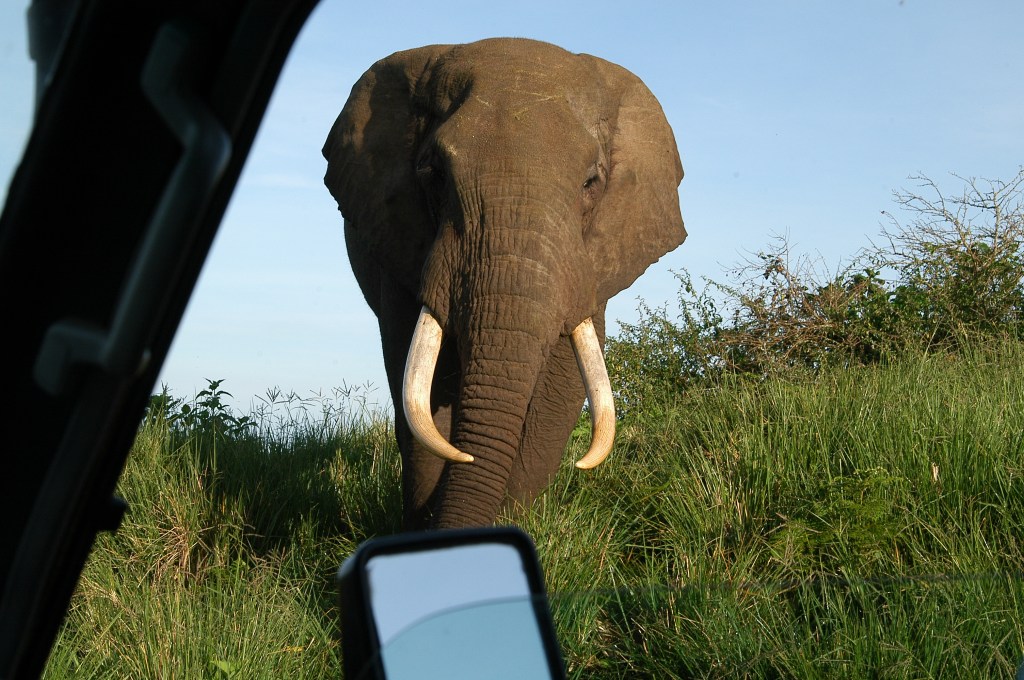
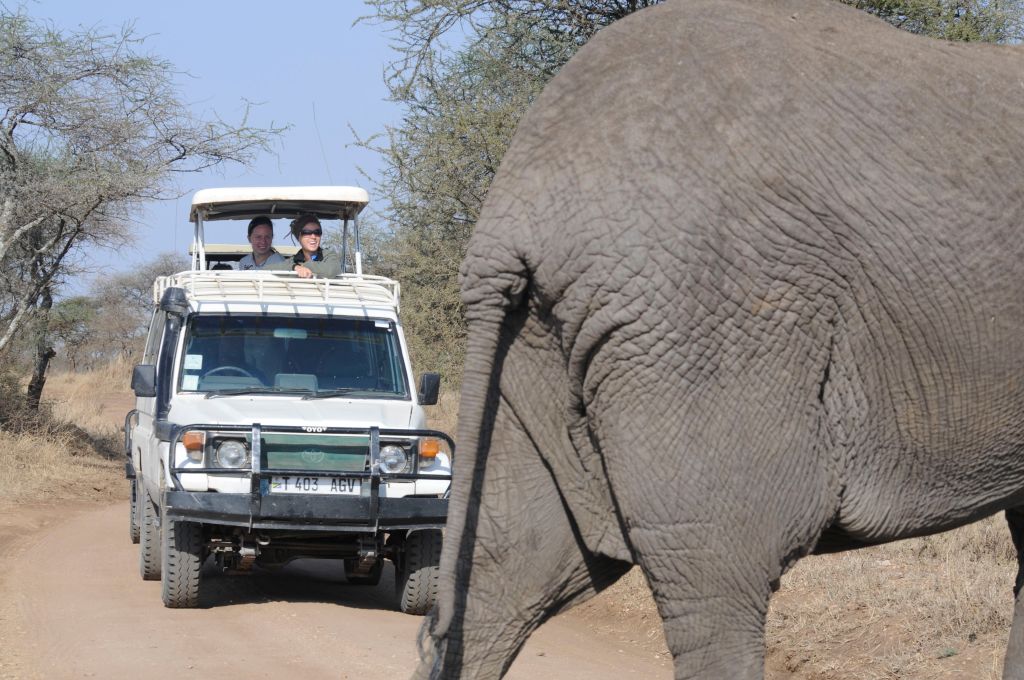
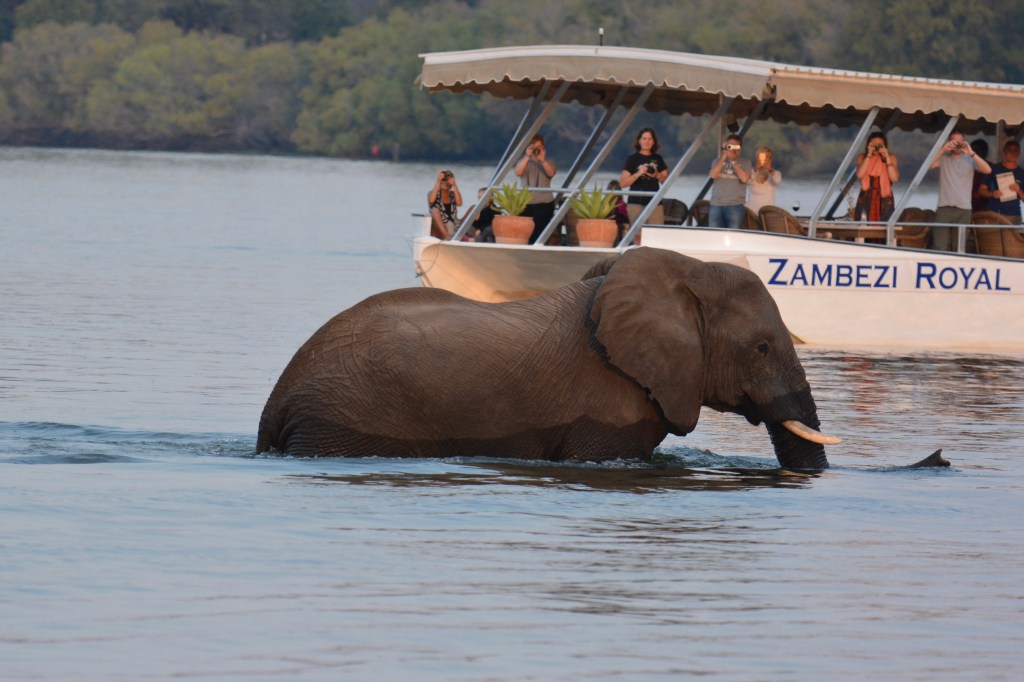
Seeing your first elephant is a memorable moment. Seeing a family group is even better. But bumping into an elephant in an unexpected place and at an unexpected moment surely spikes the adrenaline. They are large animals; 13,000 pounds, six and a half tons, for a big male and up to 10,000 pounds for a full grown female. The females; mothers and youngsters and their youngsters, for many generations, stay together. The young males are asked to leave the group when they are ten to twelve years old and have become a nuisance to the ladies. These fellows will form small groups and occasionally hang with older males and learn the ways of the wild. A thirty to forty year old male is dominant and will usurp breeding rights with great vigor – but the younger males contend as best they can and soon find they might mate with the younger females. A matriarch may come into oestrus and attract an older male from some distance. For this post I thought I’d include a few images that show that elephants and motorized tourists are simply independent big things on the African scene. The elephants will use roads, cross roads, and hang out on roads and thus meet and greet many vehicles. They will step aside and let traffic pass as if it were some small unimportant beast that they barely countenance. Individual males are often oblivious. In some cases they may be a bit territorial, usually when near a female in heat. At those times they may chase things including vehicles. They can be nervous and a bit aggressive if there has been poaching in the area. They don’ trust anyone then. In most cases they just stand off from you and the roadway and go on about their life – which, like many herbivores, means eating. The sight of an elephant in the road is captivating. What a surprise, what a reward – just what you had hoped for. The cameras click at the first elephants no matter how far away they are. Cameras are soon used only when the light is right and the animal is in a nice setting. These big gray beasts become part of the scenery – a both wonderful and surprising aspect of the human condition. Oh yes, the same sense of deja vu happens with lions as well.When a herd/group/family passes by we always count them. They can number five or fifty. There are some places, and some seasons, where a hundred for more may be seen in the same grassland. These groups are headed by females; a matriarch, her sisters, her daughters their daughters, and so on. There are males as well; until they are deep in puberty and need to “get their own place”. The groups are very intimate. They walk together, feed together, stay together, touch each other, and look out for all the youngsters. When the males get to be about ten years old they are interested in themselves and competing with others of their age group and thus are often rough and tumble. This , and their developing interest in females, causes the older females to drive them off. In the few cases where a vehicle I was in was banged by an elephant it was almost always a couple of teenage boys chasing and goofing that hit us – with no intent of hurting us. After a while – what’s over here? The elephant passes by unveiled. Perhaps a Lilac-breasted Roller or Magpie Shrike has caught the tourists’ attention. There is a lot to see out there.They happen by boats as well. Elephants are very used to water. They drink prodigious amounts of water and swim well. They can be found in rivers, like here in the Zambezi in Zambia, and in lakes and swamps like the images below from Zambia and Chobe in Botswana.If you build a lodge along a river’s edge you will get passersby. They may be anything from kingfishers (birds) to elephants. In most cases everyone simply gets on with life but occasionally things happen. Behind, and above, this elephant there is a fence. It has a gap in it. During one stay here I was walking with a guest along the path from my habitation to the lodge when a screaming young (but really big) female elephant came up from the river, between the sections of fence, and headed right for us. It was numbing. We actually bolted downhill a bit on a diagonal to avoid her charge and dived under a solar panel and the rickety fence. She bellowed and swatted with her trunk – leaving a long dirt mark on the other guy’s back. The staff came out banging on pots and pans and yelling and she went running down the walkway – never to be seen again. There were six other elephants with her and they all streamed off into the bush. We had no idea what prompted her or if she ever acted out again – we supposed that perhaps her group was from upstream and had been shot at or poached and they were moving territory and very easily aggravated. It could have been that she wasn’t the oldest female and was not used to making decisions – sadly it was likely the older and larger animal was killed in the poaching instance. They are smart and do have a great memory. They remember trees that provide fruit for seeds and return seasonally to those places to enjoy the food stuffs. This elephant returns to this lodge to reach up for the legume seeds on the low roof. It is quiet and tame – but you should never assume that means they are passive and domesticated. They are wild animals and capable to inflicting great damage if irritated. Though scenes like this are memorable and seem almost romantic; they aren’t.This elephant is walking by my deck. This particular wetland had hippos, elephants, crocodiles, and lots of birds. A most entertaining place to sip a cold beverage and enjoy the view.This is not my image – but I am also happy it is not my rental car. This is the largest elephant that I ever saw. There were large “ellies” in Samburu (northern Kenya) and in the Ngorongoro Crater (northern Tanzania), but this guy, from dry and dusty Namibia, was a looming presence. It was stunning to see. As with many males he was alone and seemed to appear out of no where – easily a seven ton apparition. This is the kind of big old bull who might appear when the matriarch comes into heat. A woman of his own age so to speak. For the most part elephants of this size and gender are alone.
The old “elephant graveyard” story is both true and false. The early Europeans who appeared on the African scene were simply killing animals, lots and lots of animals. Occasionally they would keep skins or tusks or bones, but mostly they just reveled in the killing. Before the Europeans the animals were modestly used for food by tribal peoples but rarely slaughtered. As a matter of fact elephants used to grow old and wear out their teeth. Once the teeth were pretty much gone they would head for wetlands and eat the moist succulent vegetation, eventually dying of old age. Thus there was an accumulation of tusks around these wetlands and thus rose the myth of an elephant graveyard. It was where many died but not where they headed intentionally to die. They headed there to live as long as they could. The flesh was eaten by scavengers and microbes and the bones chewed crushed and scattered by porcupines and hyenas; leaving the hard and tough tusks to accumulate.























 On The Road With DEC