Please consider all images to be copyrighted and ask permission for any use. Thank you. David E Clapp.
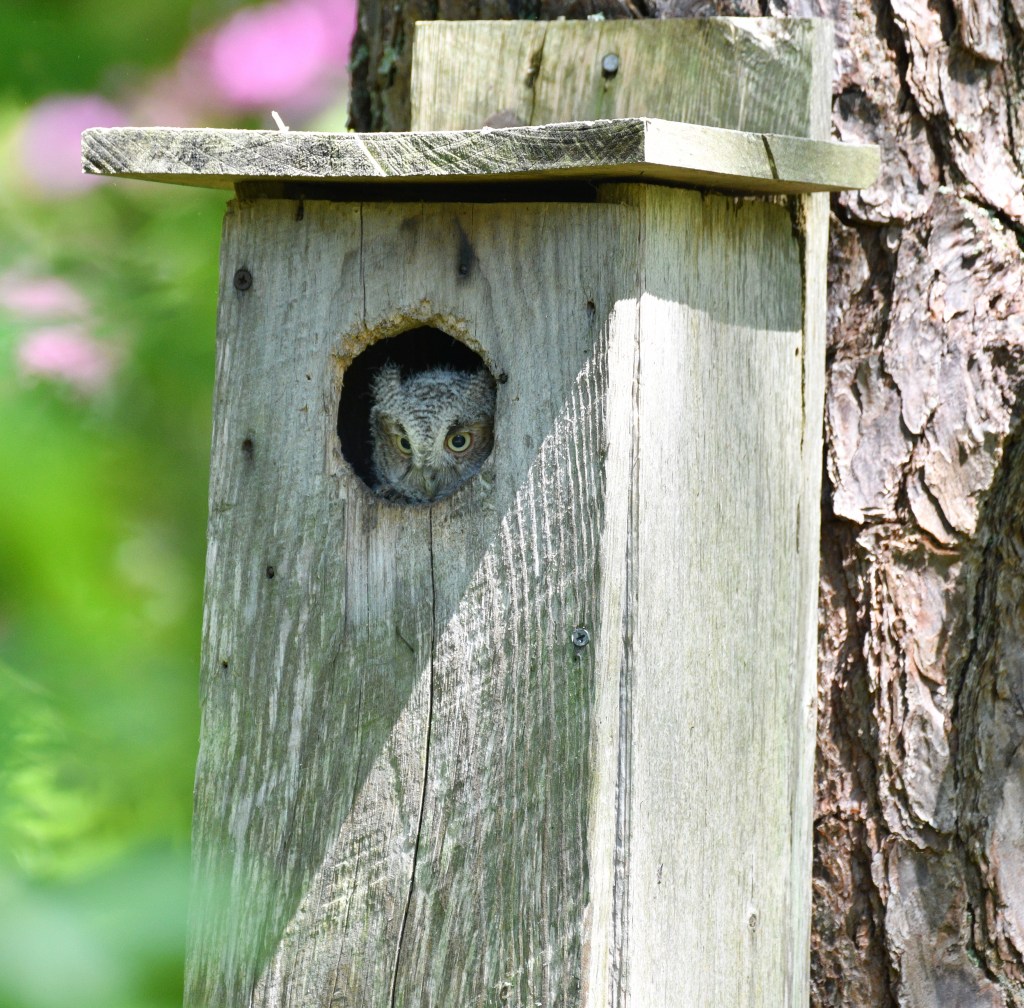
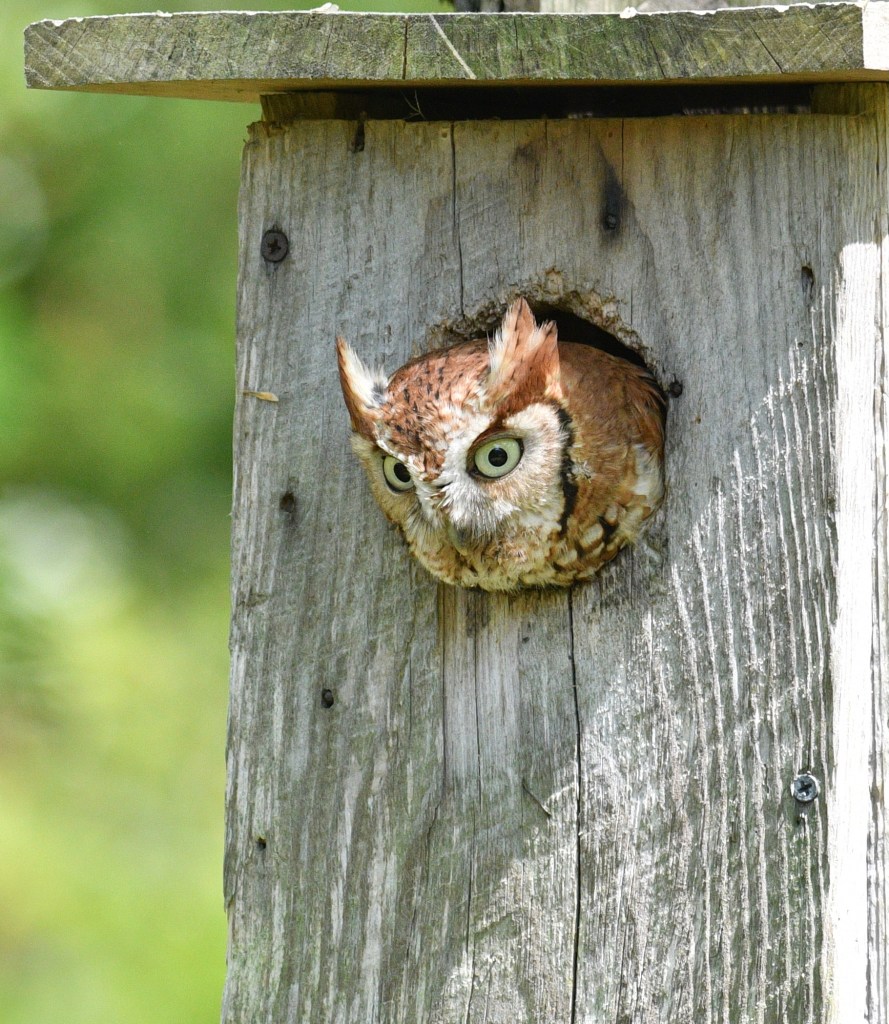
We have had an owl nesting box nailed to a Pitch Pine at the edge of the side yard for years. It is quite similar to the more common Wood Duck nesting box. As a matter of fact there is really little difference and I suppose if a Wood Duck ever started to nest in this box we would be thrilled and there would likely be no trespass or squatter rights contested. So, we have this big old nest box (probably the same one that KR gave me twenty plus years ago) hung where owls, squirrels, and Great-crested Flycatchers all have a shot it it. The small Sreech-Owls usually gain control each spring.
Over the past decade we have been the landlords to a pair of Eastern Screech-Owls on about 4 out of every 5 years. Screech owls are a smallish predator of the night and very common in eastern half of the US. It seems a bit odd to me but they rarely are found north of the Canadian border or in the western states. There are other small and smallish owls in these places but this very successful type has never swept north or west. Before you stop and marvel at that tidbit let me be clear – there is also a Western Screech-Owl and a Whiskered Screech-Owl. These are both western species and are very similar in appearance to the eastern but the voice/song is quite different amongst the three types. The Whiskered barely reached the USA in southern Arizona and is primarily a bird of the Mexican highlands. The Western Screech-Owl ranges from Alaska well into Mexico and is found in all of the western mountain ranges.
In bird nomenclature there are often usages that are a bit baffling. In the case of the screech owls it is seen that they are called “XXXX Screech-Owls”. They have their first name and then they then have both Screech and Owl capitalized and separated by a hyphen or dash. The mid-sized heron group that we call Night-Herons have the same naming structure.
Anyway, back to our nest box and owls. The Eastern Screech-Owl is a bit of a genetic oddball in that there are gray morphs and reddish morphs but no blended form or mixed color form or any forms that show a blending of gray and red. Two gray adults can have reddish young or gray young or one of each. They are “eared” in that feather tufts can be seen on all birds starting just before they fledge and then on throughout their lifetime. They are rather intricately patterned with the ventral side marked with vertical lines and almost fernlike delicate horizontal lines which allow them to stand on a branch next to a tree trunk and blend in with the bark. Let’s take a look at some of the recent birds of prey seen in and over the yard and then then look at our most recent owl family.
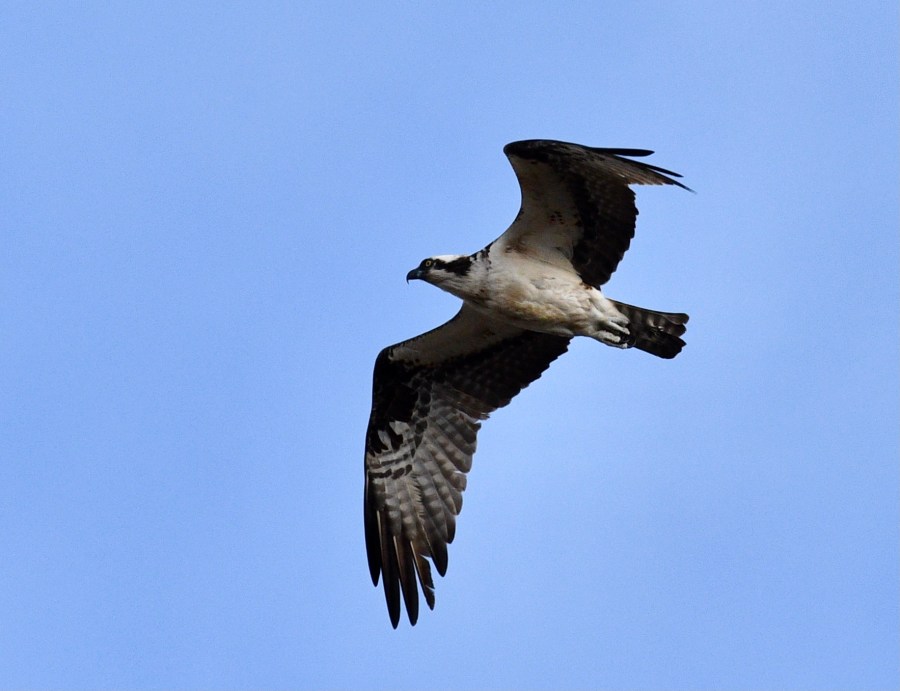
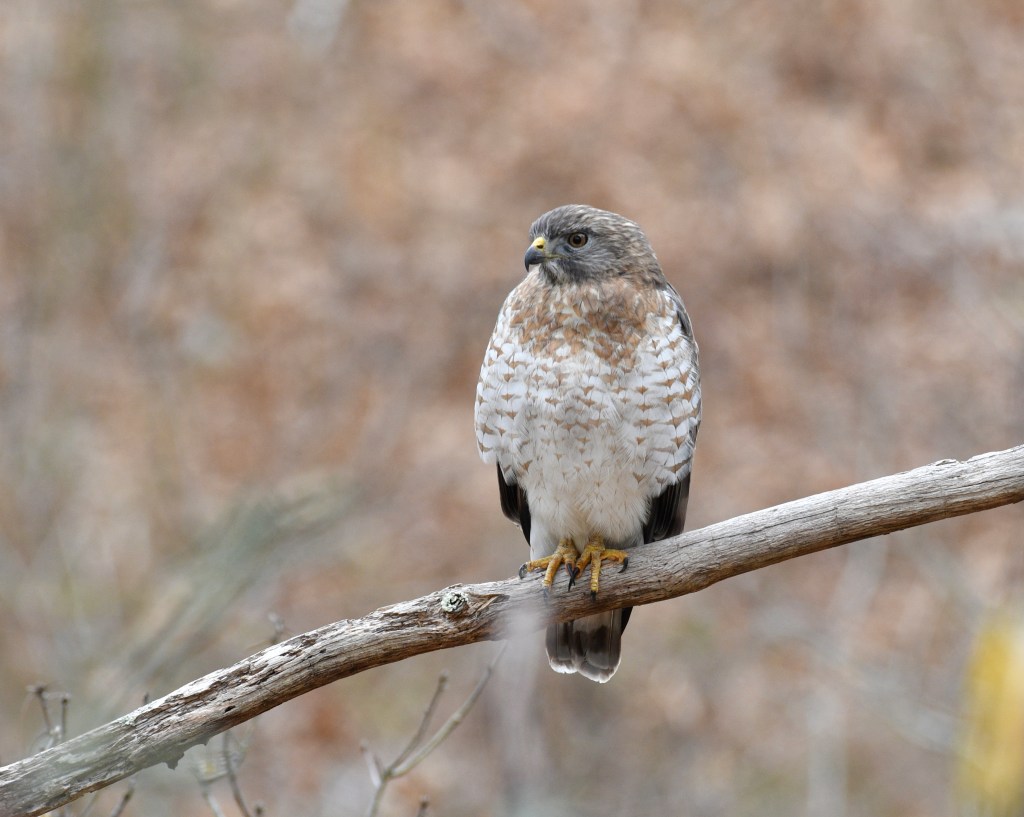
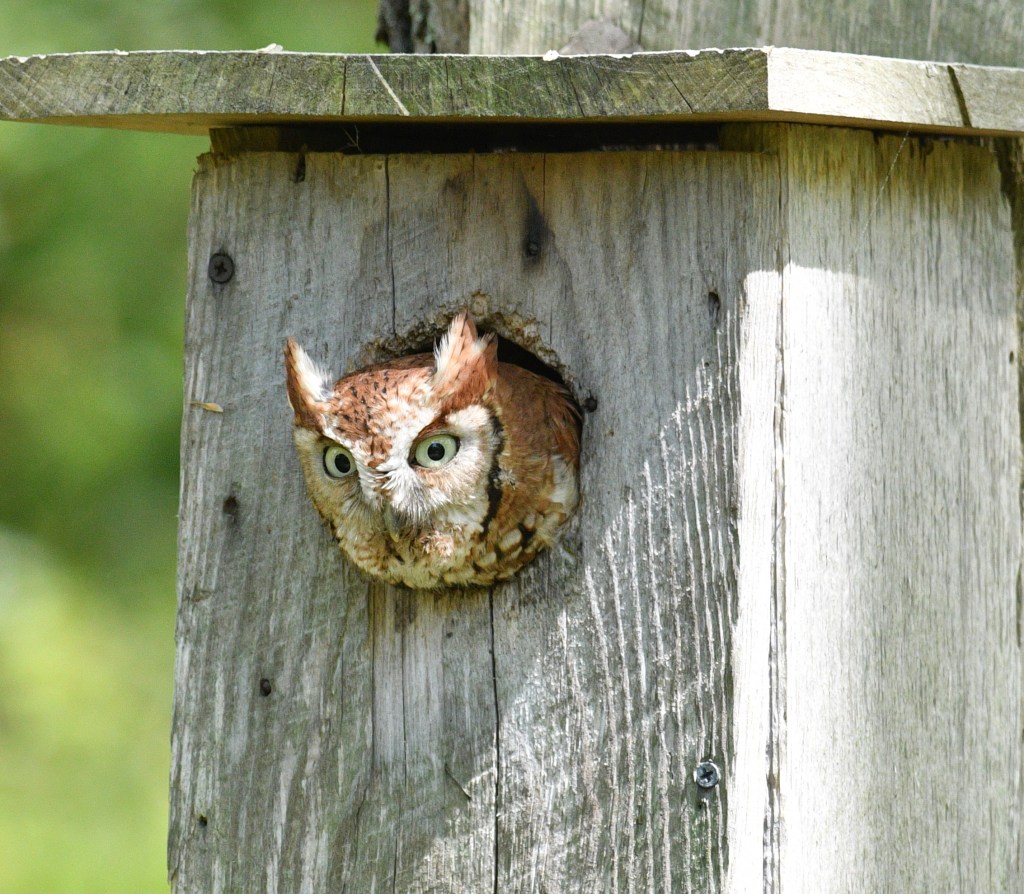
When the herring return from the ocean and enter the fresh-water streams along the east coast we see a large influx of Double-crested Cormorants and the fish-eating Osprey. For about a month there can be hundreds of cormorants and a dozen osprey looking for a fresh fish meal. Osprey were in dramatic decline until we stopped using DDT and in the past thirty plus years they have rebounded quite nicely.The Broad-winged Hawk is smaller than the common and wide-spread Red-tailed Hawk. The Broad-wing is much less conspicuous as well. They almost never sit out along a roadway usually staying in the shelter and shade of a woodland. Our birds all migrate south and into Mexico and then many continue on southward to southern Brazil. In mid-April huge waves of them will return across the Texas/Mexico border back into the US. I can remember thousands at a time suspended in the sky outlining the winds and looking like the the Northern Lights painted with birds. It was a great sight.The Broad-wings and the Red-tails are Buteo hawks; bulky and broad winged. The falcons (Peregrine, Merlin, and Kestrel) are sleeker and faster. They were always classified with the hawks and accipiters but recent genetic research shows that two groups (falcons and parrots) are much more closely aligned with the song birds. The accipiters (Sharp-shinned, Cooper’s, and Goshawk) chase birds through the woods and the falcons chase birds over open spaces. They will migrate with shorebirds and often live on tundra or grasslands and feed primarily on birds. This little dark falcon is a Merlin; a bird we see mostly during migration but is a rare breeder in Massachusetts as shown by the most recent Mass Audubon Breeding Bird Atlas..The Red-tailed Hawk is common and obvious. It is America’s most common roadside hawk, or at least the most easily seen roadside hawk. There are Red-tails from coast to coast and north to south throughout North America. There are several color forms (morphs) as you move across the continent. They can be very dark in some places and lighter in others. The Harlan’s and Krider’s are the two most distinct populations. But in the west they range from almost all dark dark brown to quite light. The tail seems short as a flying bird passes overhead and the wings are quite rounded.From underneath the light birds here in the east show a distinct belly-band The lack of any red in the tail of this bird mark it as a young bird. The banded tail is characteristic of young birds and the red tail isn’t fully red until the bird is three years old or so; and even then the underside isn’t as red as the top surface. But here are the Screech-Owls. This is a gray adult looking out from the nest box.Both sexes and all birds (after fledging) have ear tufts – with are not really ears at all.The female for the last several years has been a red owl. In most cases the adults are unseen until well after the young hatch and grow. The adults poke their heads out beginning on sunny days (mostly afternoons) around the third week of May. We look forward to this and are both a bit surprised and pleased when we finally get confirmation that they are using the box again.We almost never see the young of the year until they are less than a week from fledging. When first seen they look a bit fuzzy and the ear tufts have not yet popped up. This image was taken with a very high ISO and pretty much in the dark. Fortunately the youngsters don’t/can’t move very much.In better light they can look to be a lighter gray. The young birds will extend their heads out of the box and look around for more than an hour. It is hard to tell what they are doing or thinking. They must get some sense of their new world but they also must be looking for an adult returning to the nest box with food. When there are two youngsters in the box the oldest is also the largest and dominates the scene. The eggs will hatch a few days apart and that can make a big difference. It is not common for both young to stick their heads out at the same time so we really can’t be sure of how many young there are until quite late in the process. Some years there can be only one survivor in years where the prey is scarce and the first born dominates the entry hole.When they first appear at the hole the youngsters are a bit shy and wary. Our window is about 35 feet from the box so they must get used to our movements. On one occasion the adults returned about every minute with a food item. We figured that must be from a beetle cluster around a night light – what else could it be? On one other occasion the adults returned with a small snake which was slurped down in a flash by the older of the two young.
Please consider all images as copyrighted and ask permission to use or reproduce them in any way. Thank you; David Clapp.
Well it is spring here in the northeast and I/we have been out birding most every day – hence a big gap in blog posts and I’m a bit sorry for that. In a way of apologizing and trying to make up for it I’m going to share a cluster of local images and observations; hopefully a post every few days for a while. Nothing exciting in the works mind you but at least an attempt to stay current and share a bit of our New England spring time.
Our New England spring time has been pretty nice much of the time. Out here on the Cape we had week after week of coldish winds from some aspect of north to them all through March and April. It was cool and bird migration was pretty slow. I saw red foxes, eastern coyotes, and river otter along with both red and gray squirrels but few birds. Finally in May we had less troublesome (for the migrating birds that is) winds and we started to get some neotropical migrants. Our herring and elvers returned to our tidal creeks and streams from the Sargasso Sea and Atlantic Ocean and the striped bass were on time as well. It seemed that the birds were kind of late and we never had a huge big push of arriving birds.
But soon there were orioles, tanagers, warblers, grosbeaks, vireos, and flycatchers in the trees. Here is a collection of images from the deck and a bit about each bird. The next post, “Around the Yard – #2”, will continue this theme with both more yard birds and a few from the shore. I’ll try not to depend on images or creatures that you have seen in previous posts; nuthatches, cardinals, chickadees, song sparrows, and eastern bluebird and so on, but there may be a few repeats.
Almost every year we have a pair of Eastern Screech Owls (EASO) in a nest box at the edge of the yard. This year again – as summer heats up and the young develop the box becomes warm and crowded. It is now that the female sticks her head out the opening and gets a break from the kid(s) inside. Within a week they young will leave the box and start the next phase of their journey.
One of the larger birds that has a fierce look and gluttonous reputation at the bird feeders is the Common Grackle (COGR). This bird associates with wetlands and the associated shrubbery. They are big and noisy and gather in large flocks in the fall prior to migration.
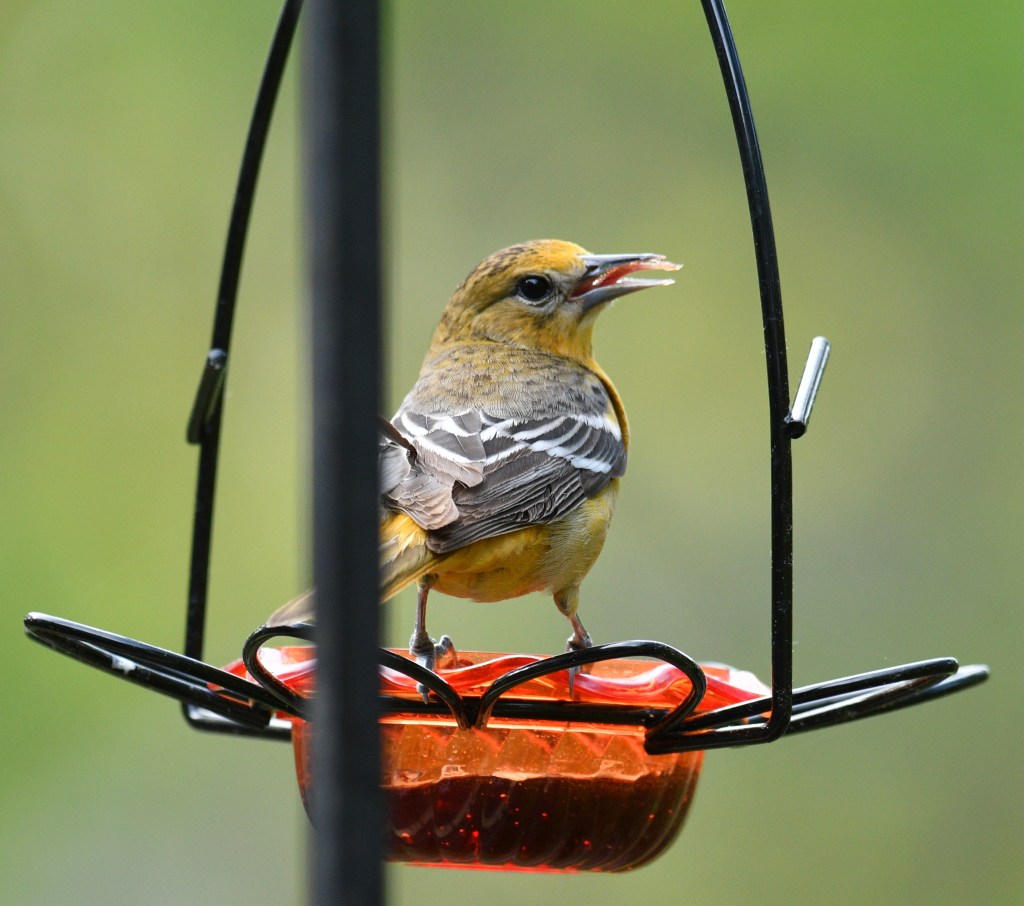
The male Baltimore Oriole (BAOR) is striking; the female less so. The orioles are closely related to grackles, blackbirds, cowbirds, and meadowlarks. This adult female is taking a bit of grape jam from a feeding dish.
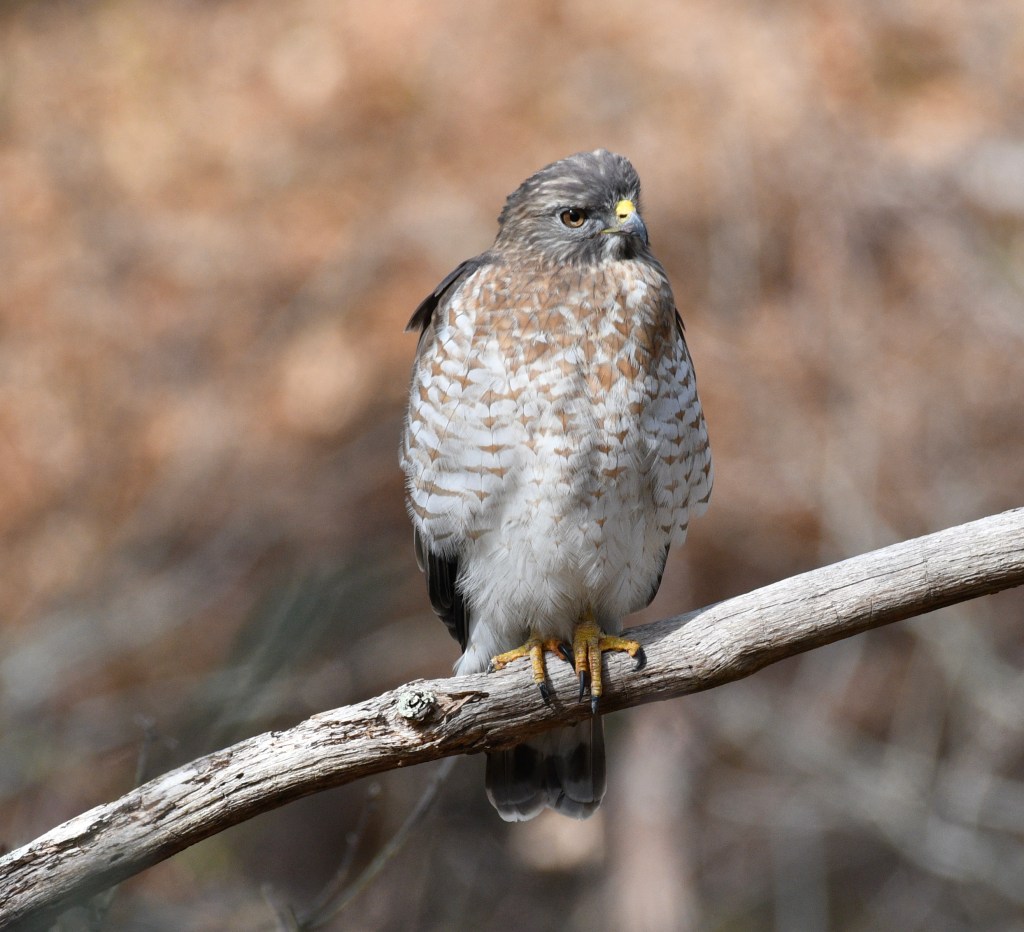
The birds of prey in eastern Massachusetts are Osprey (the fish-eater), Red-tailed Hawk (small mammals), the occasional Red-shouldered Hawk (small mammals and reptiles), and this bird, the Broad-winged Hawk (BWHA). The Broad-wing is an opportunistic feeder but is largely a small small mammal eater. They have nested in the neighborhood for several years but never in our yard – though the male returns to the same tree out back each year and suggests it to the female. But she decides on another yard and another tree — we try not to take it personally. At least they fly over at least once a day as if to say hello — or perhaps to amplify the fact they have chosen another yard to nest in.
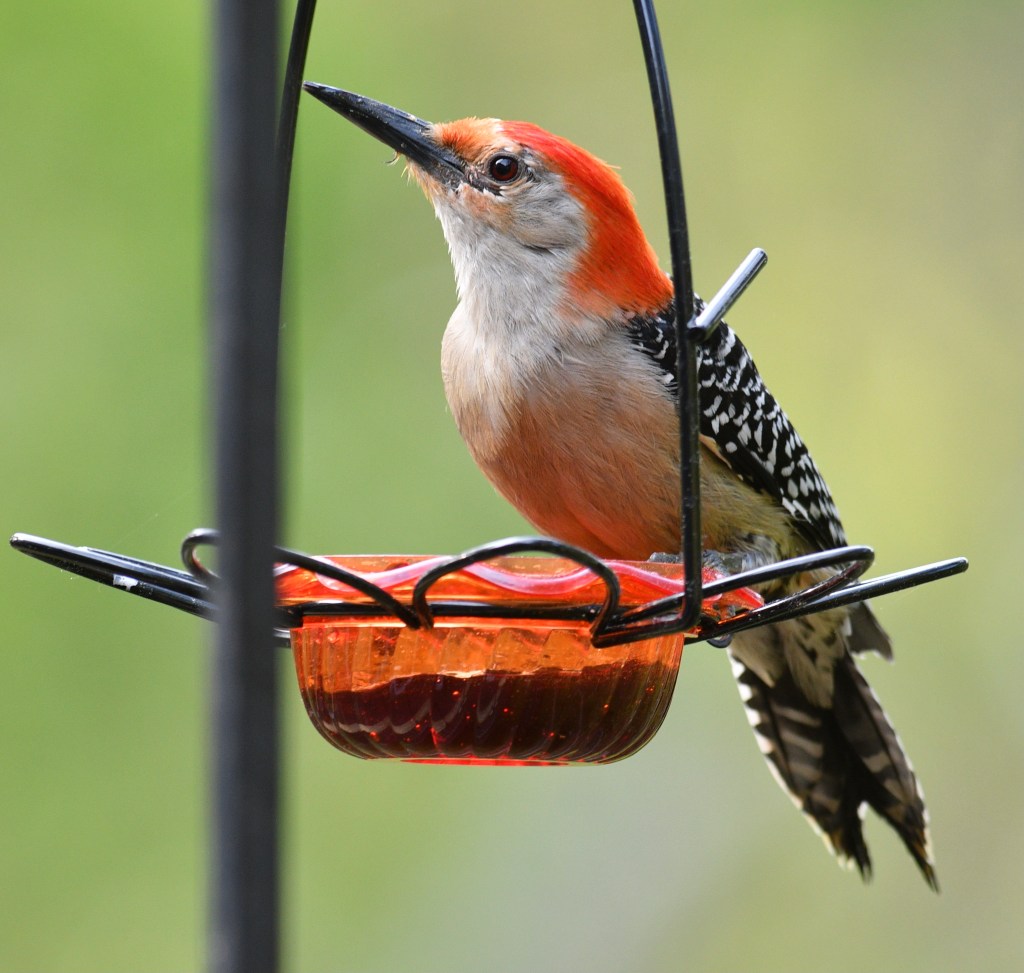
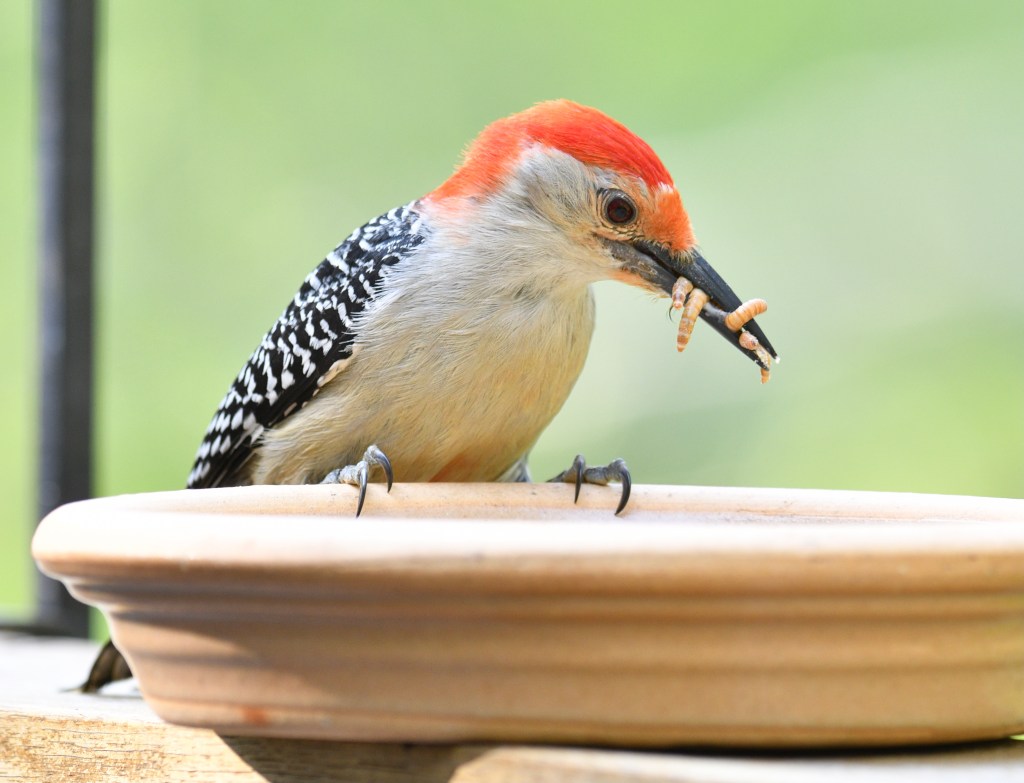
Many woodpeckers are insect larvae eaters and the Red-bellied Woodpecker (RBWO) fits that mold pretty well. But when it has youngsters to feed it will stop for some jelly as a personal treat and then take a beak-full of meal worms home to the kids.
Young birds grow fast and need a lot of protein. Thus even birds that will eat seeds and fruits as adults will feed the youngsters insects and other protein rich foodstuffs.
These next two pictures are just sort of regal images. The Blue Jay (BLJA) is a striking bird with a tawdry reputation. It will take babies and eggs from nests as food for their own young and they are known as raucous and brazen creatures. But they sure are stunning. They are around all year but many migrate south from here. They are likely tied to the acorn crops and will leave when the oaks don’t provide. They will return in loose flocks up thorough mid-May. These flocks can be seen as diurnal migrants, but usually early in the morning.
The Mourning Dove (MODO) can “coo” all day. Many people think it is an owl hooting. But the doves and pigeons are not a bit owl-like. They are quite vegetarian and even feed their young on a partially digested milky mush rather than the usual array of insects. They breed from March on into November though they don’t make an issue of it. The nest is a casual platform of twigs and has no mud or weaving to it at all.
The header image that leads this post is of another Mourning Dove. They are, as you can see, just a kind of pigeon or a pigeon is a large stocky dove. In the US we separate pigeons and doves in our language and that semantic use implies a biological difference where there really is none. The study of genomics has opened the door to some really odd (possible) relationships. It seems, at least by early studies, that pigeons are related most closely to Tropicbirds and then in another step to ducks and geese and grouse and quail. That may seem unlikely but adaptation and the demands of survival have often caused twists and turns as plants and animals do what is necessary to reproduce and survive.
Look up (Google) tropicbirds and compare the three species to pigeons and doves. Tropicbirds are oceanic and rarely seen from land but they do actually fly with strong pigeon-like wing strokes. Most bird guides have placed the tropicbirds near the cormorants and boobies. Who would have thought that they might be salt water adapted pigeons……
Please consider the images to be copyrighted and ask permission to use or reproduce any of them. Thank you, DEClapp
Gulls of all sorts, about 50 “species”, if laid out next to each other on a very long table, species after species, would pretty much grade from very white to nearly a complete dusky brown. In addition there are a few that have lots of really ebony black feathers. These black feathers are in a very similar pattern to the gray feathers we see on another swath of gulls. In other words they are an evolutionary work in progress; similar, different, overlapping, developing, adapting. They can be seen to have similar relatives and many share similar feather patterns from group to group, but vary in size, geography, and specific features (like the size and coloration of the bill, legs, or eyes). They are all gulls and there is no mistaking that – but they are all different in a kaleidoscope of ways.
Avian taxonomists work to combine and/or separate the, often similar looking populations. The recent ice ages created geographic populations separated from their relatives by many thousands of years of intrusive ice. Tongues of glacial ice separated populations as tundra and mountain were inundated and icy fissures created. When the ice melted back they didn’t share the same looks or language – they had adapted to their new home and its requirements. They are a hardy group with a greater number of species (or types) north of the equator than are found south of it. But they are found all over the world including the South Pacific, Australasia, New Zealand, South America, and Antarctica. There are more types north of the equator; most likely because the Northern Hemisphere has more land and the glacial epochs divided it into more separate parcels than were seen in the Southern Hemisphere.
I am going to insert a whole gaggle of images that are mostly North American in origin. However, the birds are not so neatly arranged in real life. The birds of northern Canada can overlap with and often breed with populations in Kamchatka and Siberia to the west and Iceland and Scotland to the east. In general, gull populations have a breeding fidelity to specific sites and geography; but they can fly and are strong flyers. Hence there can be unexpected gulls found here and there at any given moment. I will try to arrange them by size, coloration, and closest relatives but that may not be a perfect approach or even doable. Enjoy them, appreciate them and marvel at the skills and adaptations they have developed during the last several hundreds of thousand years. They are pretty cool despite the cultural denigration we assign them, mostly because they are opportunistic feeders and we find them in landfills, trash tips, and dumps as well as fast-food parking lots. For the most part they are hardy and hard working. Oh, by the way the term “sea gull” is meaningless. Many of the gull types are ocean going and live along the edge of salty water, but there are many fresh water gulls and some that are much happier in the prairie-lands than they are at the beach. They are mostly tied to the water but it isn’t a requirement nor is it universal. Also, like many animals, the breeding and wintering habitats are not always similar.
When you go out looking at gulls note the feather color and pattern, compare the size to other common birds, look at the bill and its size, pattern and color, note the time of year as things change in breeding season, look at the eye color, and especially the leg color. Now let’s take a look at a few of our gulls.
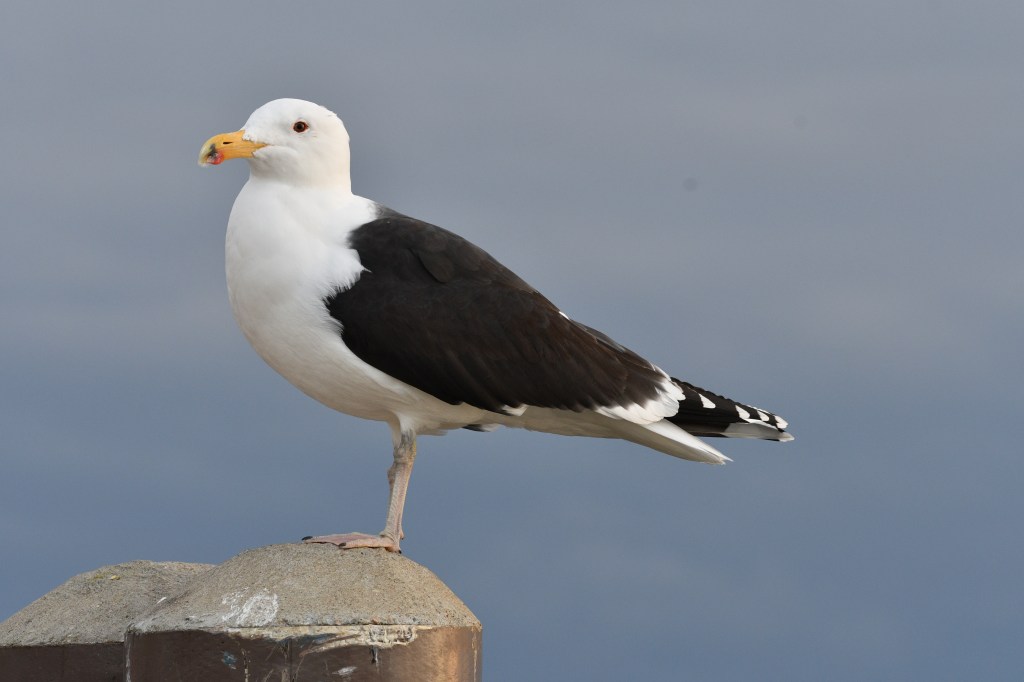
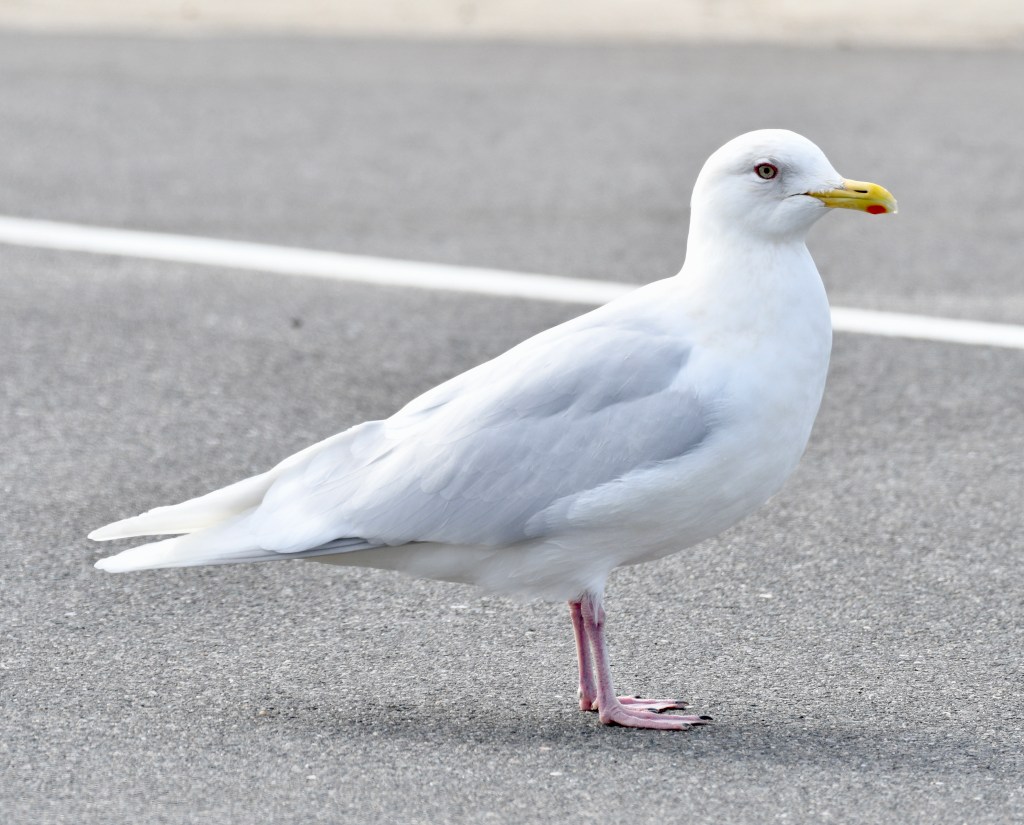
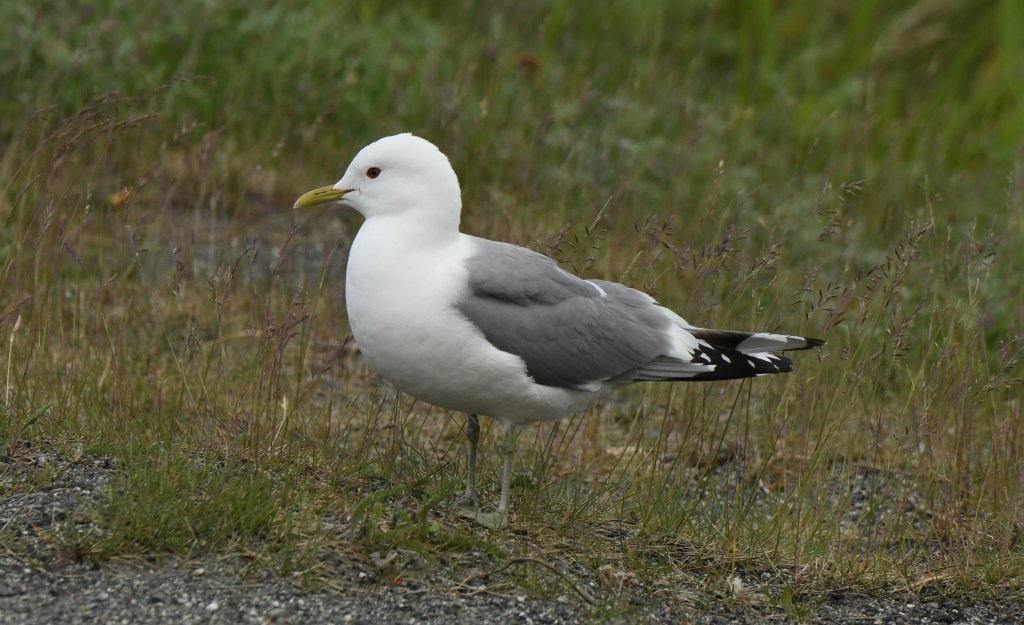
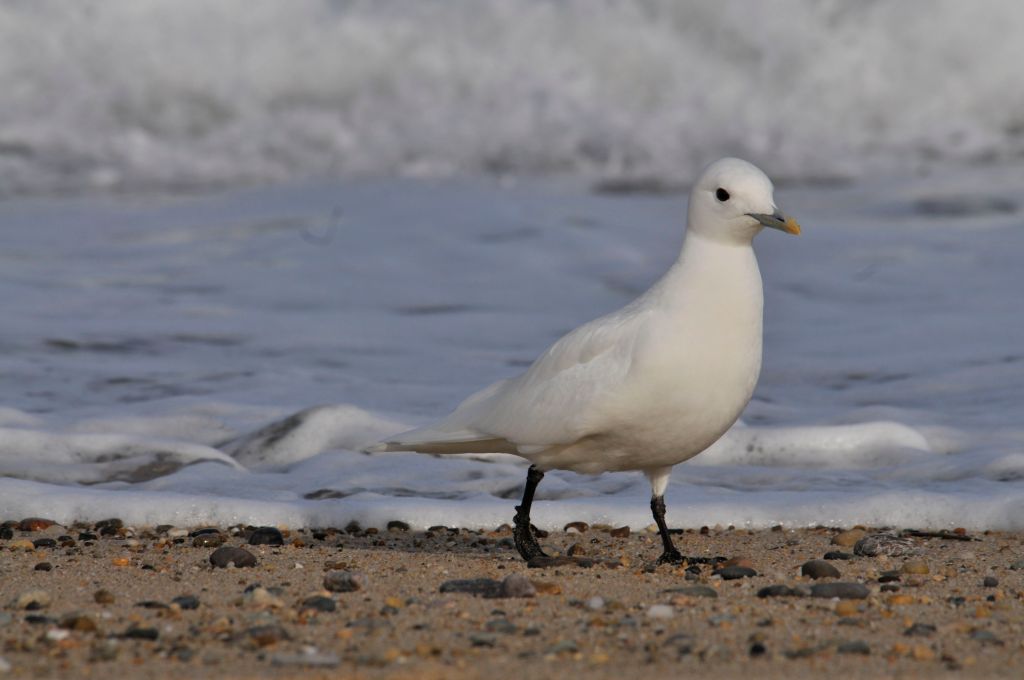
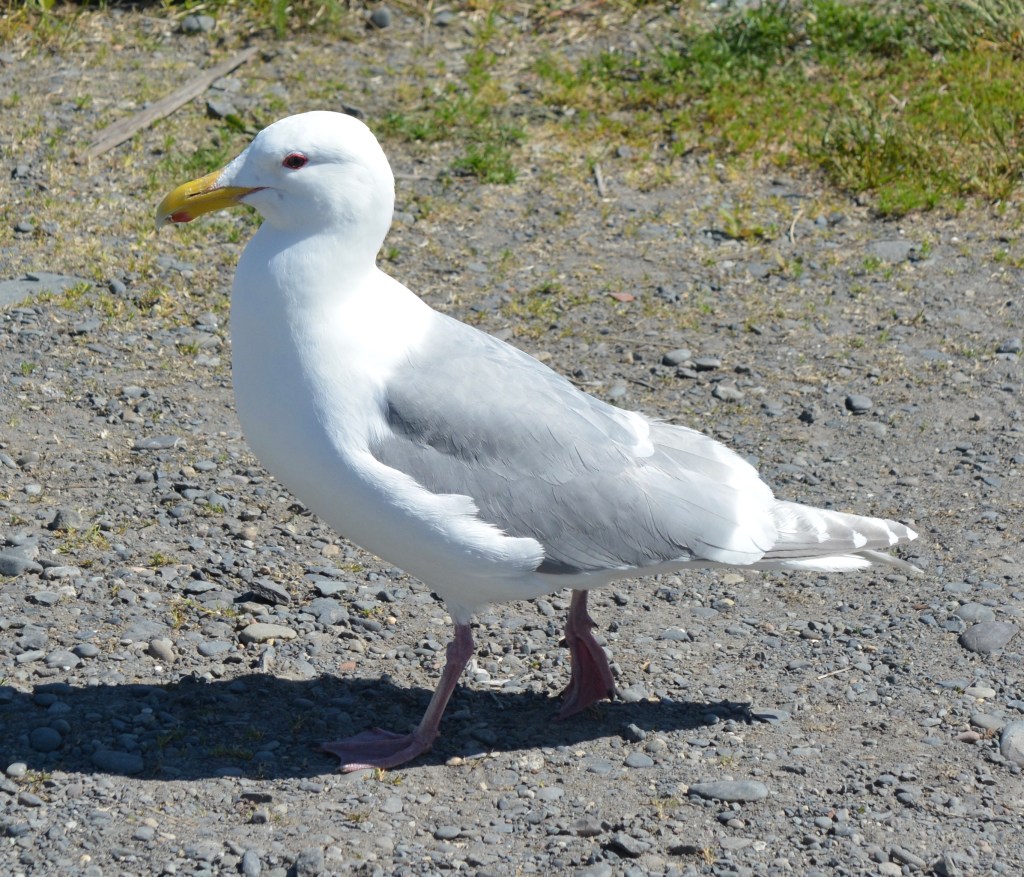
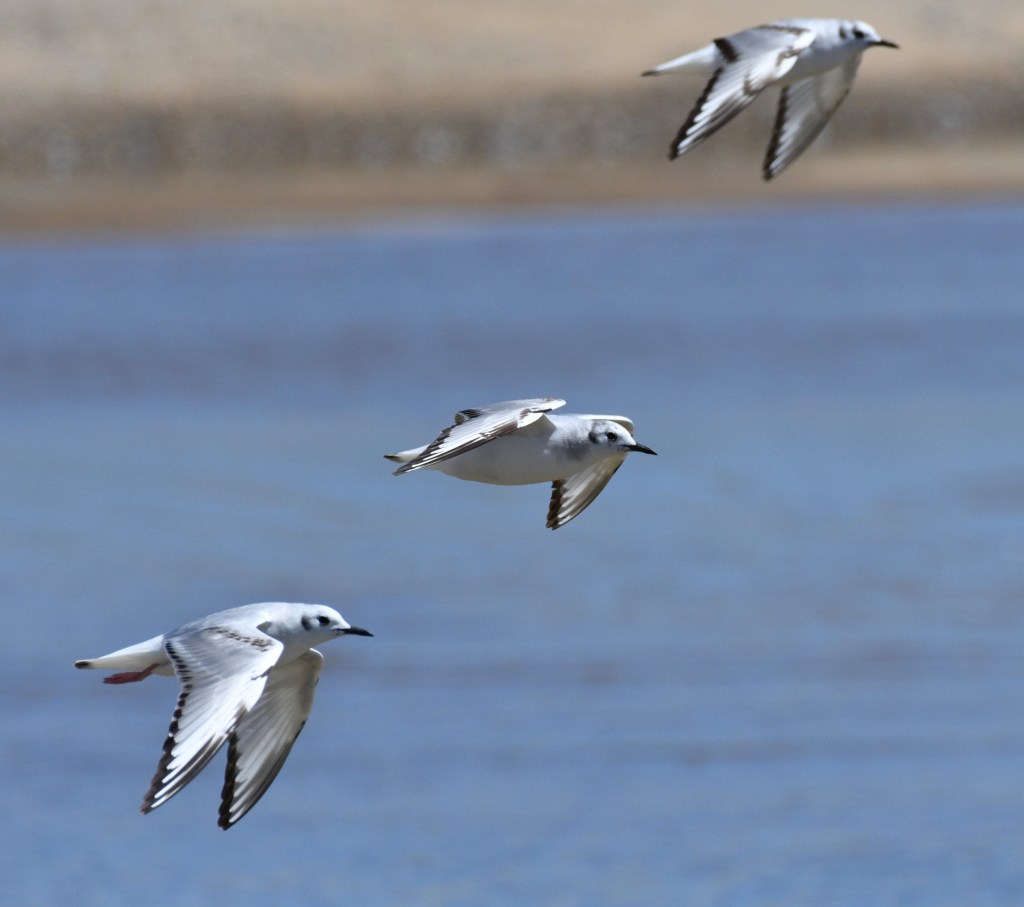
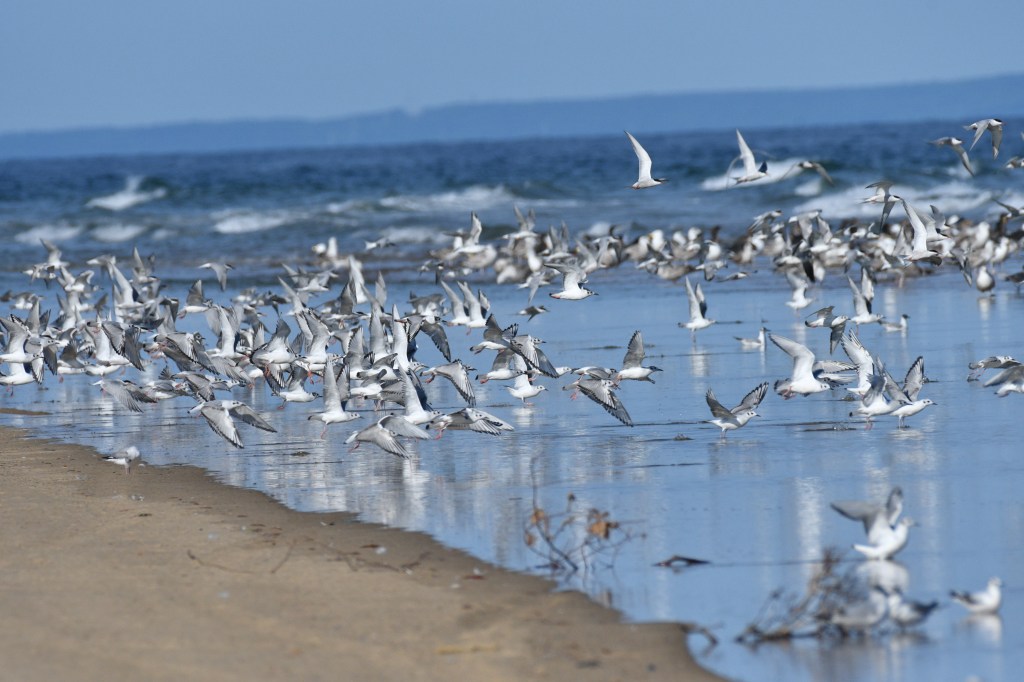
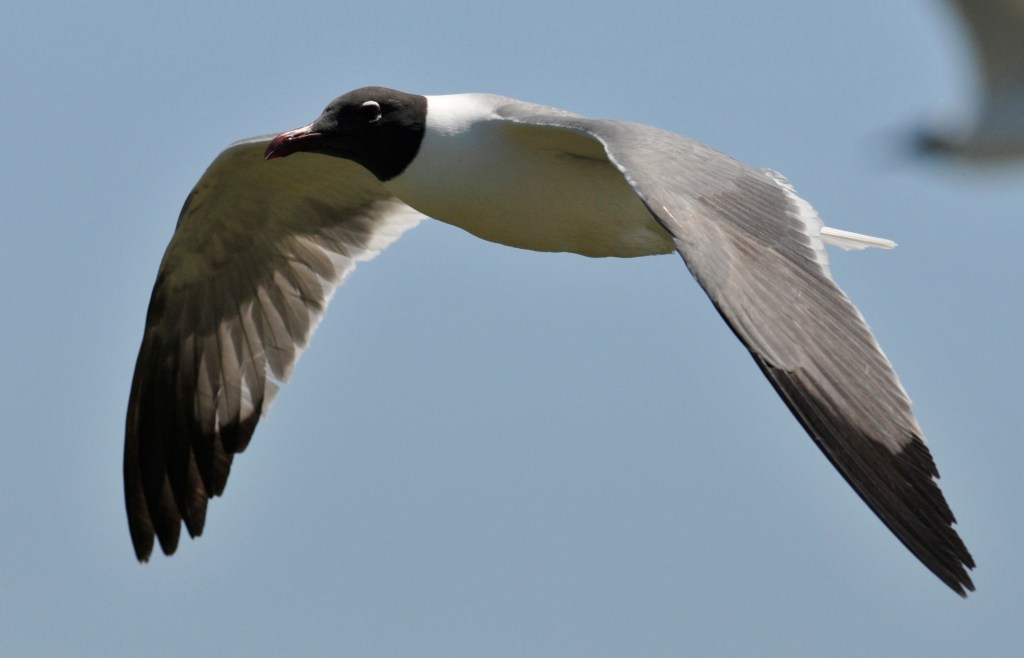
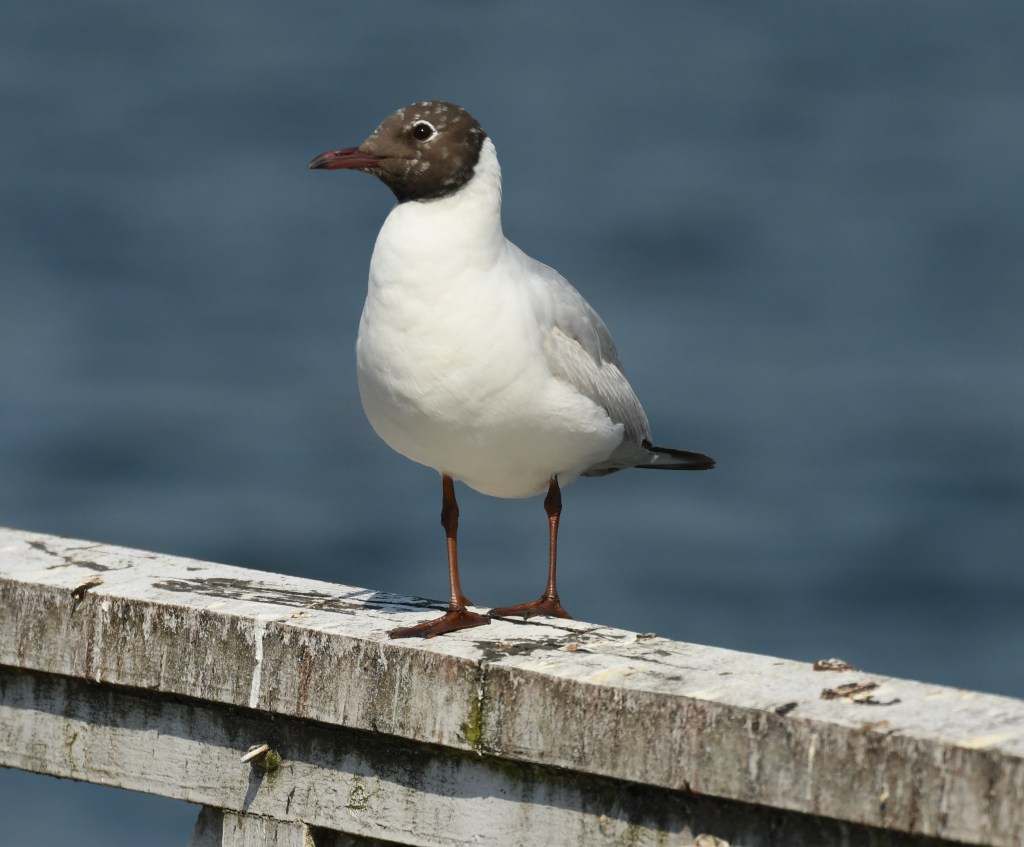
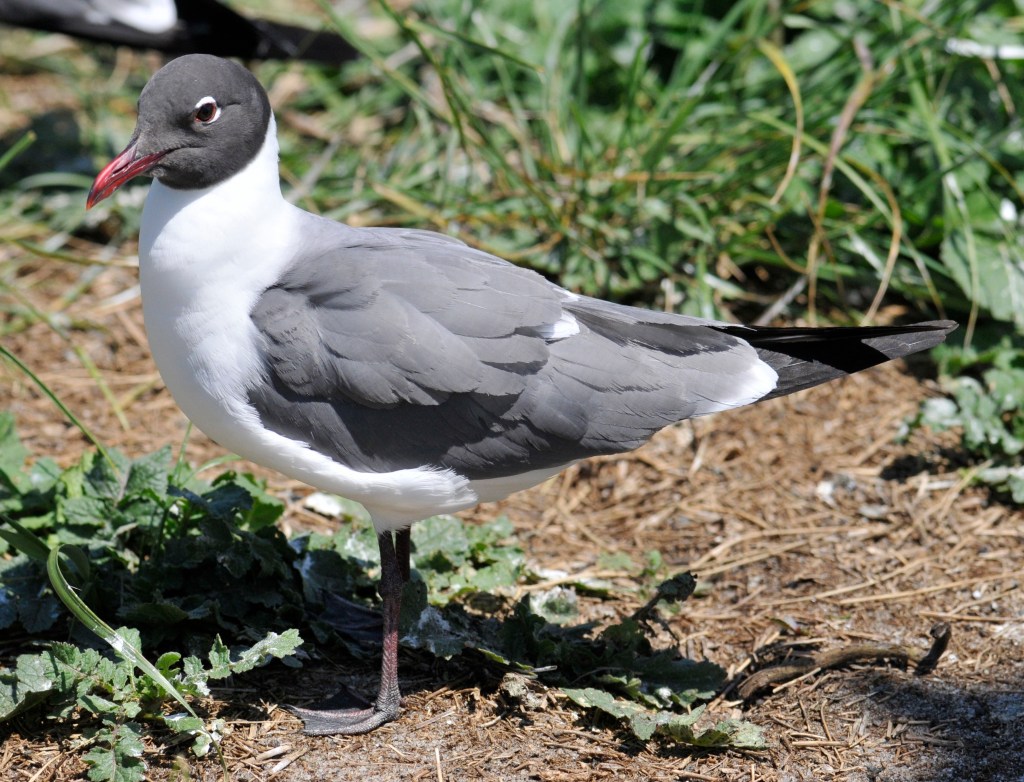
The sort of typical gull for most people in the USA is the Herring Gull (HEGU). In the spring the adults (about four years old and older) lose the grayish head feathers and become rather aristocratic in appearance. They often have a mark on the lower mandible and grayish pink legs. Thisis a pretty large bird and among the larger gulls. In most places and in most cases they nest in loose colonies and raise a very dark young or two. They are opportunistic feeder like many gulls and they have been well studied at landfills and garbage tips. In the US we began to cover our trash only within the last 25 years or so and this closed off usual and productive foraging sites for gulls. On our Christmas Bird Counts we will now get 2-300 gulls in places where we once would count 2500 or more. The gull in this image is still flecked with the winter’s gray feathers on the head and nape. Determining the age of gulls is not always easy as it takes the larger gulls four years to reach maturity and the smaller ones average about three years. Each year they will alter their appearance from dark as a juvenile to splotchy grayish as an adolescent and then two years becoming more and more adult-like. There are many, many birders who never bother to sort out all the gulls.The Great Black-backed Gull is really quite a big creature, with a body about the size of a Canada Goose. They have become quite common along the North Atlantic coast line and are expanding their range southward each year. As with most gulls they are opportunistic feeders and will scavenge, catch fish, and can swallow most alcids (Dovekie, Murres, Puffins) whole if the opportunity arises. In Europe the Herring Gull has taken another form and the Great Black-backed Gull doesn’t occur, but there is a gull about the size of a smallish Herring Gull and patterned somewhat like a Great Black-backed Gull – the Lesser Black-backed Gull. This widespread European species has more of a charcoal colored mantle (not deep black) and yellowish legs. They are probably nesting in the Canadian Maritimes and will soon be a bit more common down here in New England. It is presumed that the Canadian birds were Icelandic birds that moved west.The same shape and appearance is also found in a northerly gull with no dark feathers at all; the Iceland Gull. This is an adult with a very pale gray mantle. As youngsters Iceland Gulls are often quite light overall. The pattern of feathering, the shape of the gulls, and the feeling one gets looking at them all point to birds with a common heritage. These populations (or species or types or race or genomic types) probably share common relatives going back into the last Ice Age. We have been melting that ice for 10-15,000 years but the Ice Age began over 2.5 million years ago. That is plenty of time for populations to be isolated and then adapt to their “new” environmental circumstances. That is evolution – a matter of surviving in the way the environment demands, fosters, and allows.Oh yes, there is a bigger gull that is similar in size to the Great Black-backed Gull but is also white – the Glaucous Gull. This is most likely a first year bird; about 4-5 months old that I photographed along the Connecticut coast. It was hundreds of miles from where it was raised and hundreds of miles from where it would breed, if it ever got home. Generally speaking gulls are widespread and strong fliers and their penchant for eating whatever and wherever allows them to travel in all directions for great distances.Another gull that we see throughout central and Eastern North America is built along the same pattern as the Herring Gull. It is smaller, more delicate looking, and has a distinct ring around the beak. It is aptly named the Ring-billed Gull. This is not a salt water gull but a gull of the prairies and lakes of the central US and southern Canada. However we do see them in large numbers in the winter after they migrate out of the mid-west via the St. Lawrence River to the Atlantic and then spill southward along our sandy saltwater shoreline. There is of course a European or Eurasian gull of some sort as it probably isn’t familiar – in reality this picture is of a Mew Gull taken in Alaska. Step out of yourself for a moment and become an observer well above the north pole. Now, looking down at earth from what we think of as the top, we can see that the continents of North America and Asia almost touch; and there are plenty of large islands and icy patches that do (in fact) connect the land masses. So gulls and other northern species have the opportunity to mingle and hybridize. Some hybrids may be better suited than either of their parents and eventually form a “true-breeding” species.Another of the very northern gull forms can be seen in this delicate looking Ivory Gull. There are many smallish populations of gulls in the Arctic (Ivory, Kumlien, Ross’s, two Kittiwakes, Sabine’s and Little among them) and we rarely see these species in the southern parts of North America, but they do occasionally wander through. This individual Ivory Gull was walking the beaches at Race Point and was not at all concerned about what or whom. was on the beach with him. I guess if one is to live with seals, walruses, and polar bears a few people on the beach are not a big deal.This rather typical looking gull is an adult with grayish wing tips and mantle. It is a rather common gull in the far Northwest. The Glaucous-winged Gull is a common resident of Alaska.There are smaller gulls as well – these are pigeon-sized gulls called Bonaparte’s Gulls. They nest in the Canadian tundra and taiga and we see them along shore in spring and fall. This is an action shot of Bonaparte’s Gulls resting and loafing along shore during migration. In breeding plumage the ‘Boney’ has a black head like the two species shown below. In the fall they lose the head coloration, retaining but a smudgy spot on the cheek.These black-headed gull are Laughing Gulls; a very common bird south of New England along the Atlantic. It is now expanding its range northward and we see it regularly in the summer now. They are medium-sized, about the same as a Ring-billed Gull.Laughing Gulls migrate south to the warm coast of the Carolinas and Florida in the winter. They also (like the Bonaparte’s Gull) lose their black heads and retain a smudge. As you might now expect there is a similar (but different) species called the Franklin’s Gull which can overlap with Laughing Gulls in most of eastern USA.This is a winter patterned black-headed gull that is actually named Black-headed Gull. This is a regular annual straggler to the American Northeast but is really a European species. This one was hanging out in a parking lot near the Sagamore Bridge and Cape Cod canal.In breeding plumage, which this individual is approaching, the head is becoming black with a brownish hue. A nice looking gull.The reddish bill is another characteristic of the Black-headed Gull.
These are representative gulls of the northern hemisphere. In the south there are fewer species, but they also range in size from smallish (like Australia’s Silver Gull and New Zealand’s Red- and Black-billed gulls). They are hardy, bright, and opportunistic. they have been marvelously successful over the past few million years and they offer us a look at speciation/evolution in action. All in all they are much cooler than we usually credit them.
Please consider the images to be copyrighted and ask permission to use or reproduce any of them. Thank you. David Clapp
As I have mentioned previously Cape Cod is a long sandy arm that sticks into the North Atlantic and then bends northward. The town at the elbow, the southeast corner that is, is called Chatham. Prior to the 1900s it was a hardscrabble fishing town populated by rugged individuals who had essentially no roads to Boston. The glacials left Chatham little but sand; there are sand dunes, sandy barrier beaches, sand cliffs, and sandy beaches. But there is also a great deal of moving water and exposure to those rather unfriendly North Atlantic storms. Sand is much like a liquid. It flows when the wind blows and it flows in the moving water around Chatham.
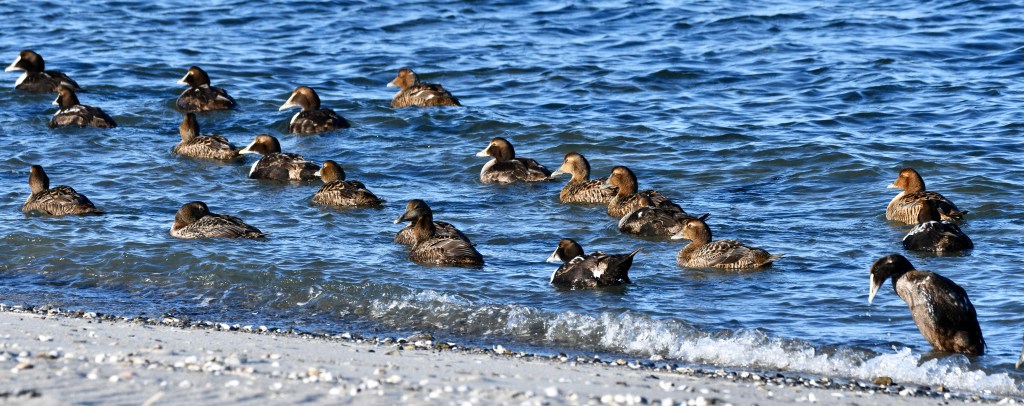
This image was taken at a Chatham town landing where the tidal flow tears around a sandy point and between a barrier beach and an island. There are spots where the water steams along and other spots where it eddies and is quite placid.The birds in flight are headed back into the lower harbor where they will catch a tidal-ride on the incoming water back to this starting point. They are transported over their buffet table of mollusks and crabs. These are almost all Common Eider (COEI). The birds with white are adult males and the all dark ones (actually a chestnut brown) are the females. There can be more than 10,000 eider in this rip alone. It is where the rest of the images were taken today.
There have been long sandy extensions running like dreadlocks south from Chatham off and on for thousands of years. During those many years the sandy shoals have also disappeared at times. At the moment the lower corner of Chatham is wasting away very rapidly. I volunteer a bit for the US Fish & Wildlife at their refuge in Chatham called Monomoy. The office sits on a bluff that has lost about 40′ of frontage just this winter. Stairs to the beach go first, then the bluff-top paths and walkways, and the woodlands that (used to) carpet the sandy ground. It has been quite a winter.
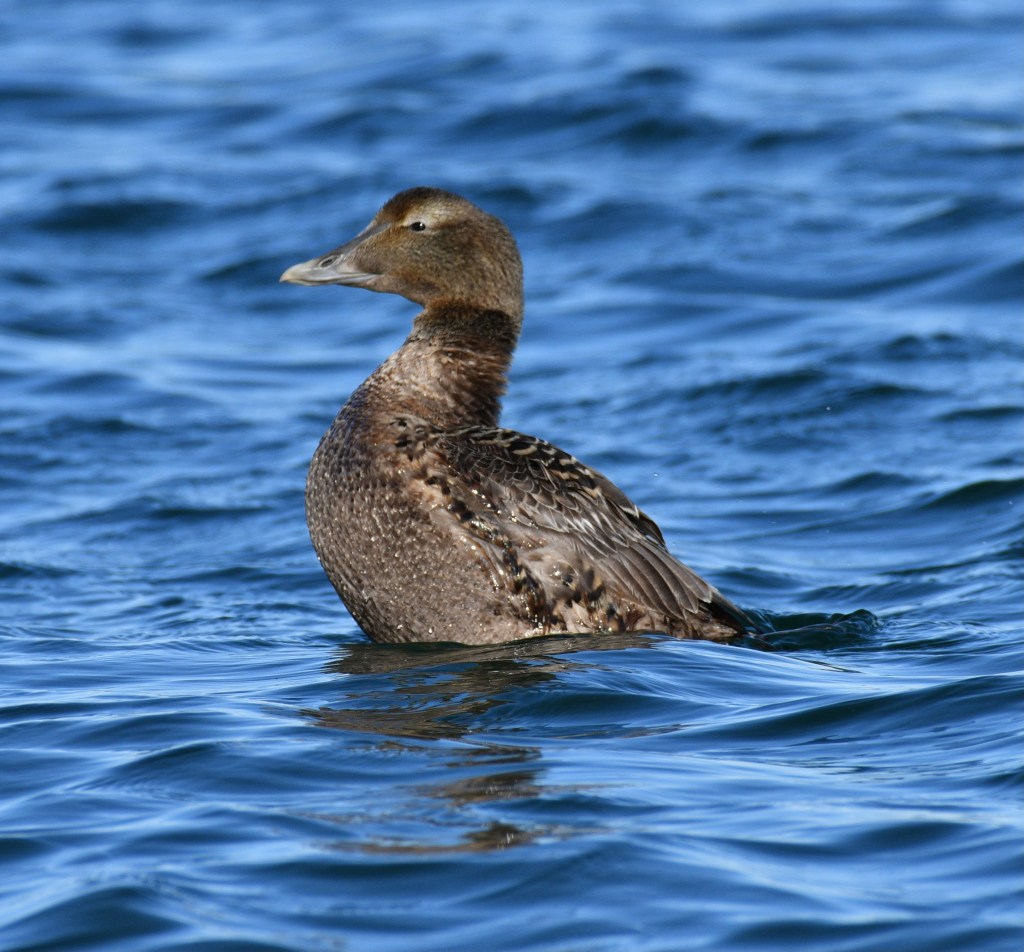
This is one of the eddy areas. Here there are lots of female Common Eider and a few young males. The males are black and white in their second year. The adults males are striking; the females are brown, some sort of dark or reddish brown. They often will come out of the water and sit on the beach, usually an exposed sand bar but that isn’t always the case. These guys wanted to come onto the beach where I was standing in the sun in the wind in the freezing cold winter air.
Looking through the floating birds just offshore I saw many female eider, a couple Red-breasted Mergansers, and a single Surf and another single Black Scoter. Interesting but not earth-shaking (sorry New Zealand).
The Red-breasted Mergansers have a wild tuft of feathers that serve as a wind sock. The merganser group is, as you can see, a water bird. But the mergansers (Red-breasted, Common, and Hooded) have a very narrow beak with tooth-like serrations on both upper and lower parts of the bill. This helps with slippery fish, elvers, tadpoles and other squirmy things they chase down, catch, and eat.Eider have a rather large aquiline beak and feathers that repel water and insulate the bird. Well I guess that is requisite duty of all waterbird feathering. The females of most ducks are brownish to limit their observability while incubating eggs during nesting. The female do have delicate patterns and vermiculations developed by the interaction of the feather edges and the variations within each feather.
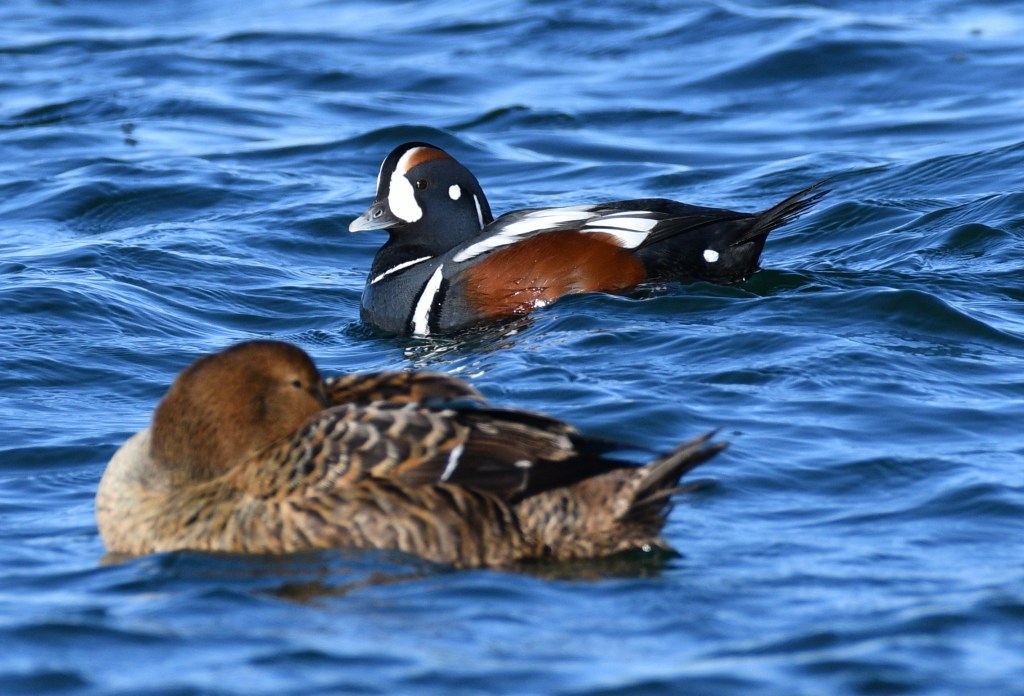
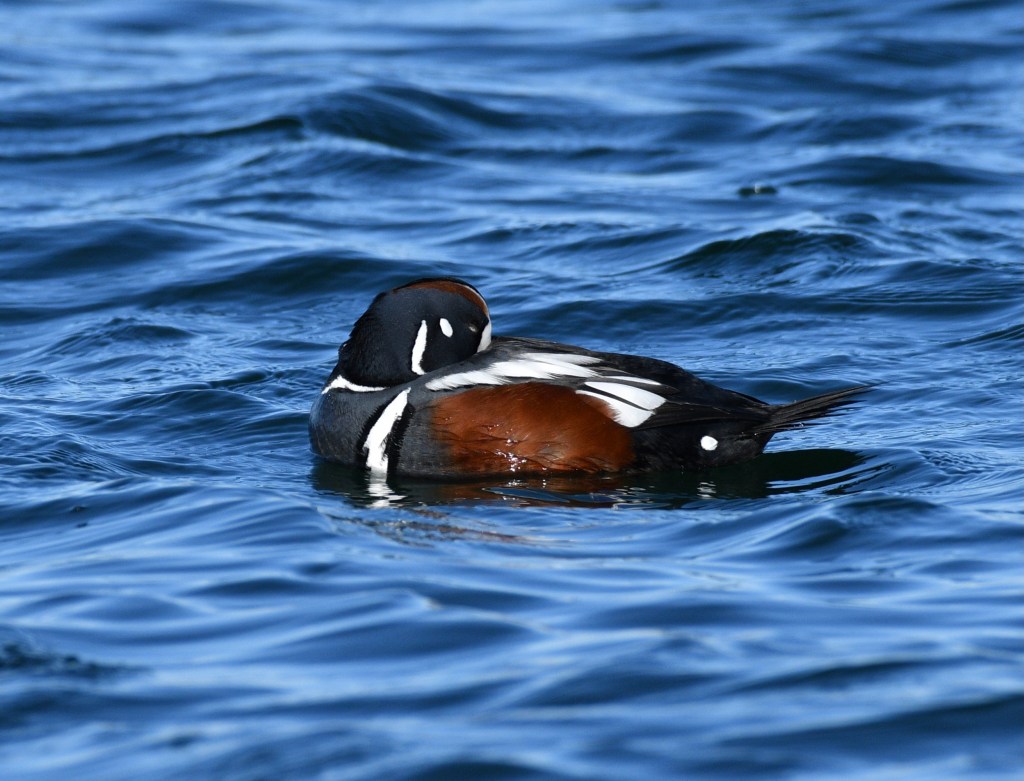
There were only a few hundred eider near shore today and I tried to stay in the car as I looked them over. That was soon impossible as I discovered a really cool duck in among the eider – it was a male Harlequin Duck. Soon after I found another, much less gaudy duck but still not an eider, it was a female Harlequin Duck. The three images below show them at rest. The harlequin comics (or jesters) of old Italian theatre were often depicted with masks and fancy headgear. The Harlequin Duck is named after those affectations.
The male is really quite spectacular. The chest color is a green/turquoise/almost purple color that defies labelling. The bill is small and the white contrasts sharply throughout. The Harlequin Ducks are not ducks of sandy Cape Cod; they are rugged coastal ducks that dive in the surf as it crashes over rocks. They pluck sea life from this turbulent water. They are not usually seen floating and napping with eider, rather they can be seen hauled out on a rock exposed at mid or low tide. They are not uncommon but are probably declining in overall population. There is an east coast population that runs from the Canadian Maritimes to Greenland and Iceland and into northern Europe. The Alaskan and western Canadian population connects to more Harlequins breeding well into Siberia. They winter on salt water.The female is rather plain. She does have a couple face marks that allow for a bit of flash; but mostly she is a flat gray-brown. But remember it is the female that chooses the male based on how vibrant his plumage is – she may not be flashy but she is responsible for him being flashy. She has to sit on eggs adjacent to a far northern river. These birds nest inland and well up into the boreal forests and tundra alongside gravel bottomed rivers rather near the coast. It is much less common inland from the coast – say more than 100 miles or so. Here, near their river breeding habitat, they dive for small creatures that live on the rocks at the bottom of their river home.
Please consider all images to be copyrighted and ask permission to use any of them. Thank you. DEClapp
Winter is a difficult time for all sorts of creatures. Insects lay eggs and the adults die, some will over winter but usually just an egg-rich female. Many birds migrate south to locations where the winter weather doesn’t kill their food supply. Some mammals hibernate and most really slow down. There are many birds that stay here in the north and these birds need to burn food to stay warm, find food to burn, find water, find shelter, and avoid predators. Winter isn’t easy.
Many of the wintering birds here can lose up to 10% of their body weight overnight. It is being discovered that many species can droop the body temperature significantly in an effort to lower demands on the metabolism. Hummingbirds can do this on chilly nights in the summer. The birds that come to feeders in the winter are adults. Most of our smallish and medium sized baby birds are pretty much grown and on their own within a couple weeks of leaving the nest. So the need for protein lessens. That is why most bird food is fatty or oily. Bird seed is thistle, sunflower, millet, or corn. There are either carbohydrates or oils or a mixture. Birds need this sort of food for metabolic control; growth has been accomplished and winter is a time for maintenance.
Feeders and thickets are where we find our small birds in the winter. The thickets often hold seeds and fruits well into the winter. Non-native plants like privet and oriental bittersweet are fed on by birds as are the native hollies and dogwoods. Poison ivy and bayberry are usually eaten earlier in the season but may persist into each new year. The thickets also provide cover from predators and a dense swath of vegetation to shed the wind. There is a rather pacific microclimate deep in a thicket.
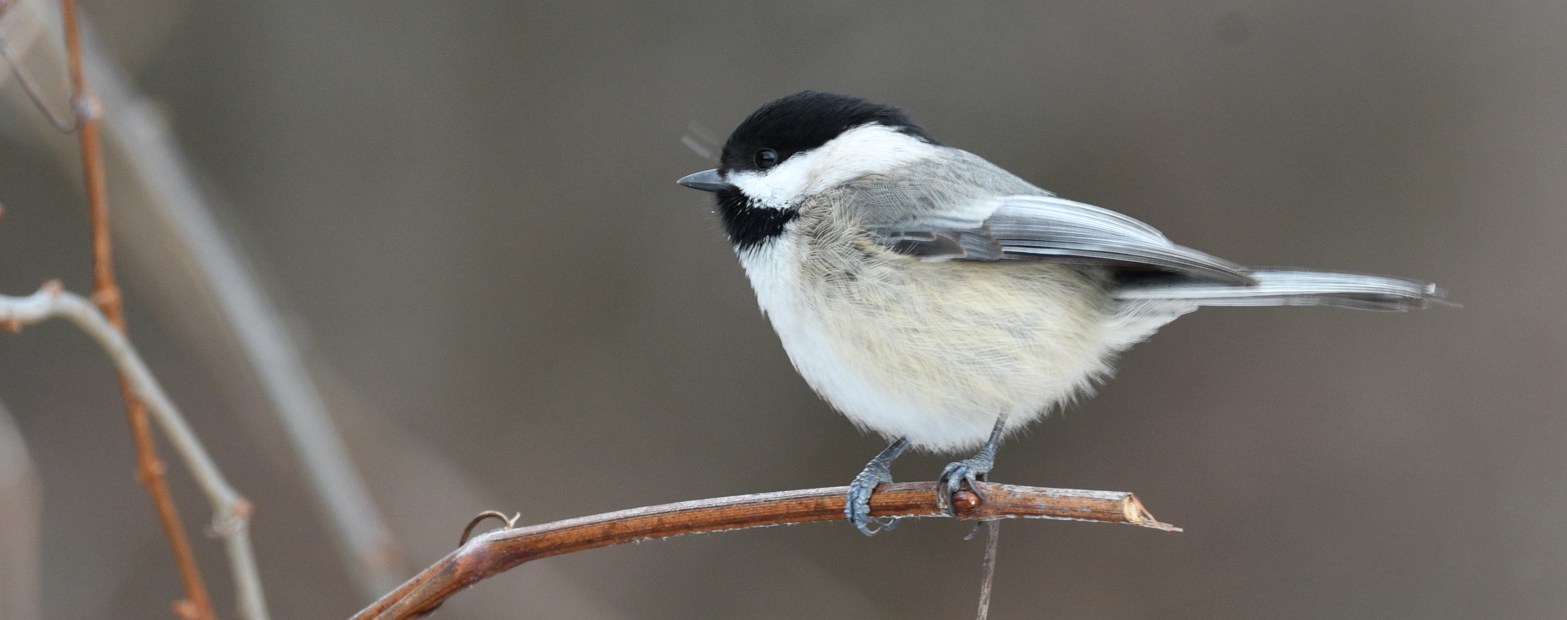
The bird in the header image is a Black-capped Chickadee. This is a world-wide group of birds with many types in North America and even more in Europe and Asia. They seem tame and bold. A rather remarkable combination for a small bird. They are a very common bird of our woodlands and utilize thickets in the winter for cover and a place to glean overwintering insects and insect eggs.
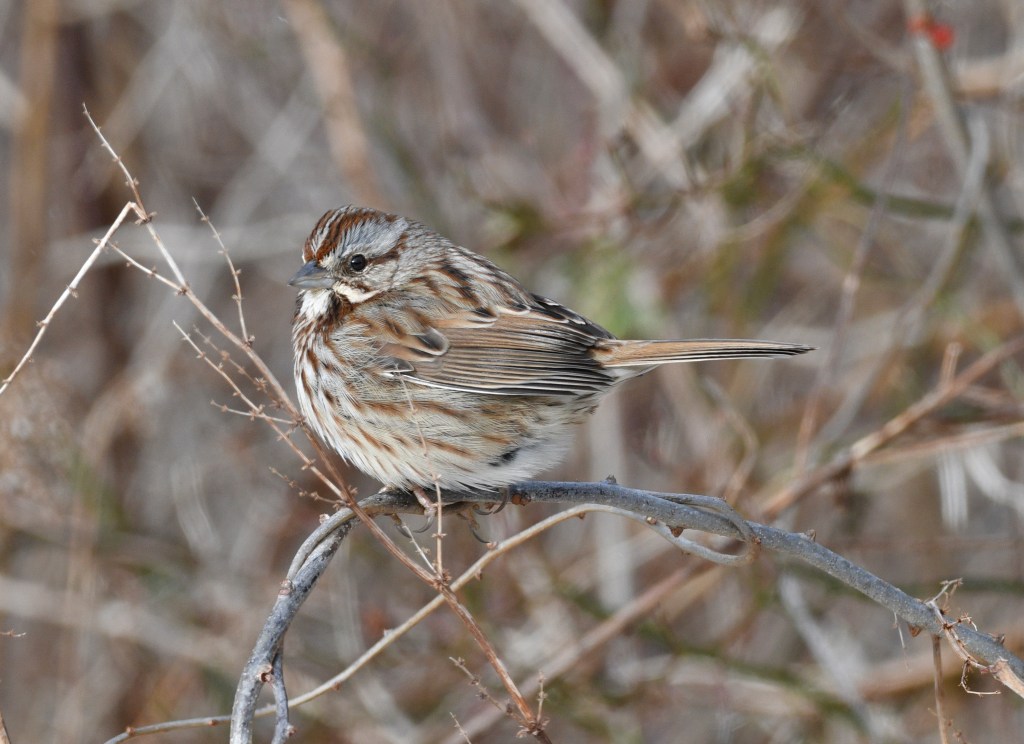
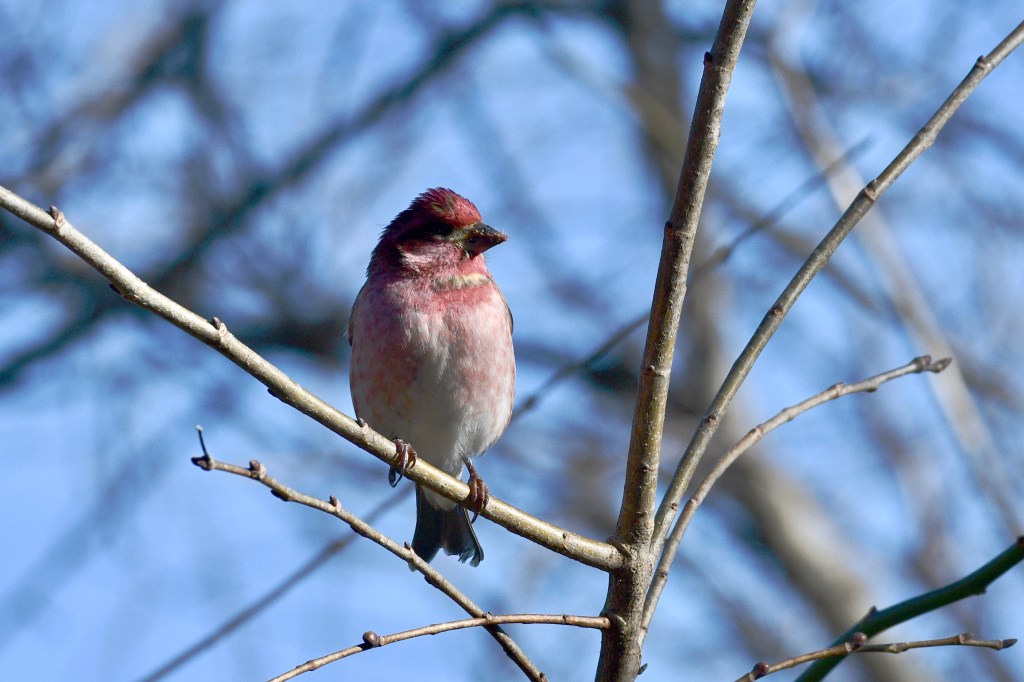
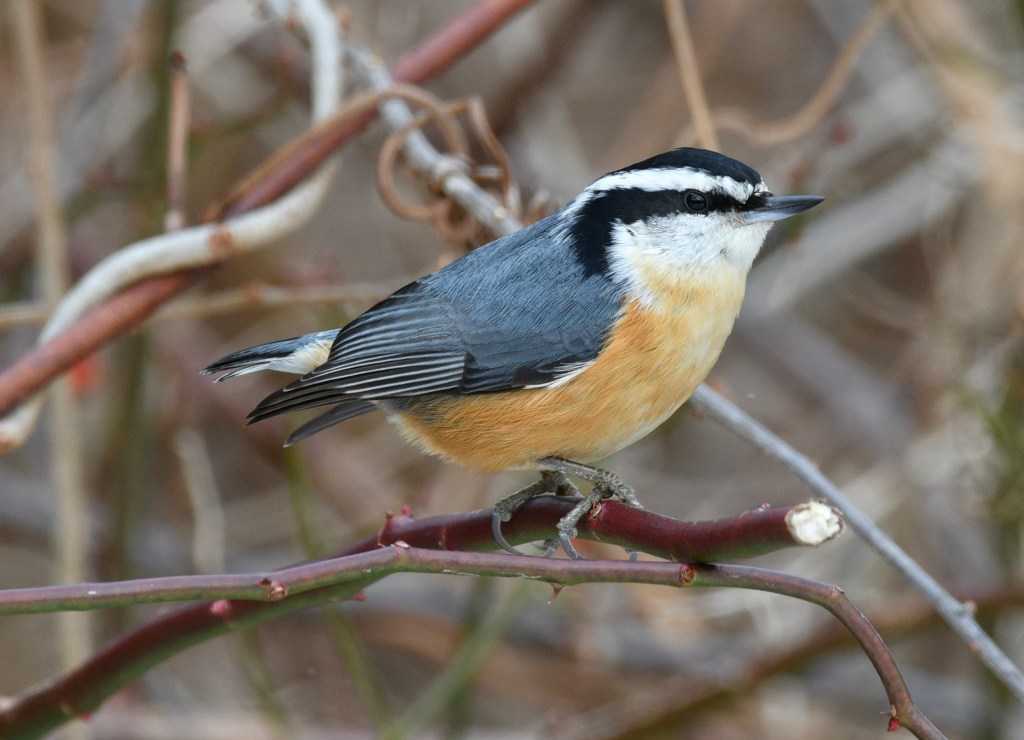
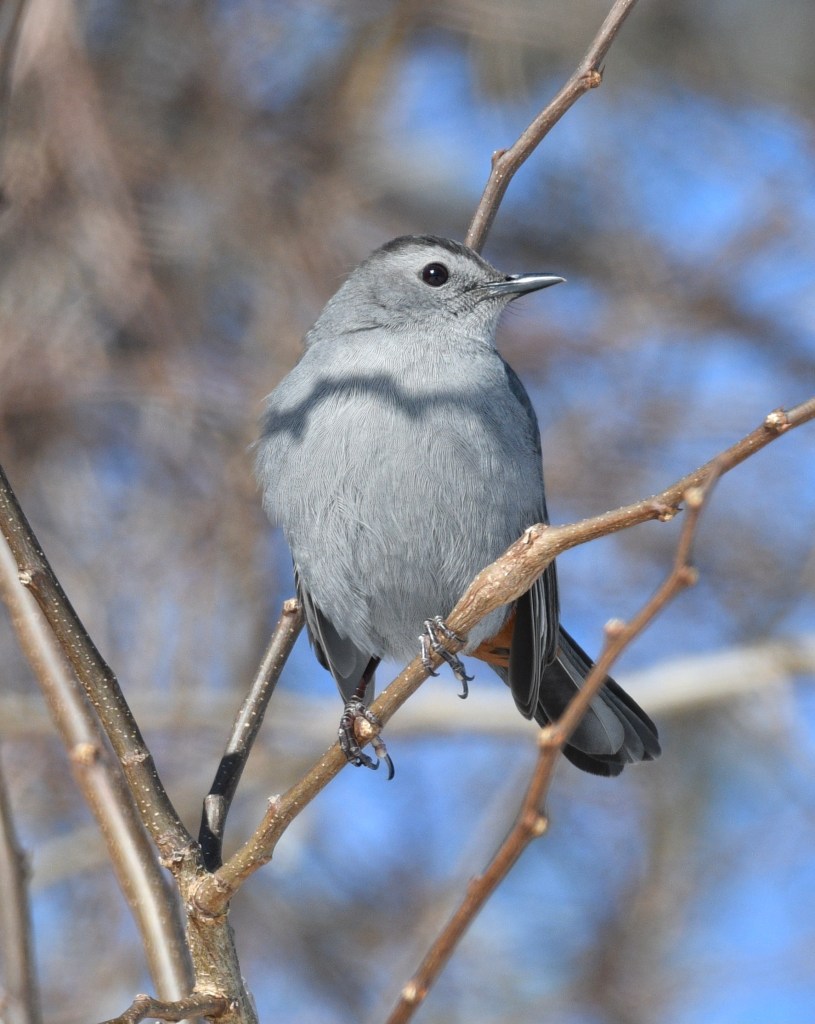
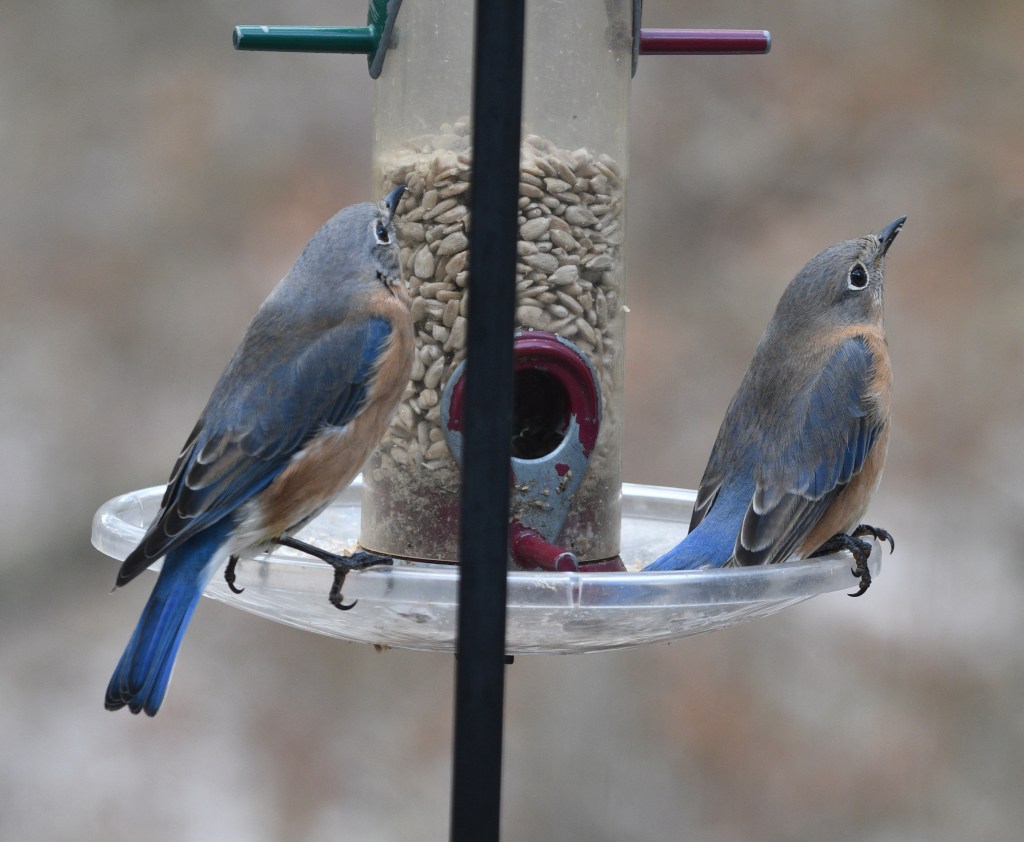
We have a lot of Song Sparrows out here. Every thicket or brushy area has a few. In fall migration there can be a dozen or two in a one acre garden. As winter sets in and the days pass there are fewer and fewer, but still many can be seen in a days outing. The numbers drop (we like to think) because the birds head south as the food supply diminishes. Snow and ice storms probably kill a good number of these small birds each year.If you own an eider down jacket you understand this picture. A fluffed up layer of feathers is very warm. Many birds develop a thicker layer of feathers in the winter. Polarloft and other manmade insulating materials that we insert in our hats, gloves, jackets, and boots is based on the shape and function of filoplume feathers. Incidentally eider down is taken from the nests of the Common Eider. Because the nest material is from the breast and belly feathers of a female eider, the down material (if real) should be a rather dingy brown color.We have a rather surprising number of small birds that winter here in the cold of New England. The sparrows, the titmouses, the chickadees, wrens, and goldfinches are all small and light. The Song Sparrow weighs just over half an ounce and the others are all two-to-the-ounce at a minimum. This bright fellow above is a winter plumaged Yellow-rumped Warbler, a bird that nests well to our north in the Canadian boreal forest. In breeding plumage it has rich yellow and ebony black and is quite striking. The yellow rump is present year round. This is a Purple Finch; in many places the more common House Finch is the most likely bird to pop out of a thicket. But this is a winter visitor here and maybe deserves a bit of air time. The red head and thick neck and bill make this bird distinguishable by silhouette. You probably could mail three Red-breasted Nuthatches with a single one-ounce stamp. There are White-breasted and Red-breasted Nuthatches and the white-breasted may be the most common overall. But Cape Cod is rich in pine forests (Pitch Pine mostly) and the Red-breasted Nuthatch seems to really enjoy these woodlands. Most of the Cape has been managed at some point in the last century and the pines and thickets are often adjacent. And, the Red-breasted Nuthatch is a regular bird in the thickets as well as the pines.When birding winter thickets we hope to see maybe a Dickcissel or an Eastern Towhee, or a Gray Catbird. These are not common winter birds but we are always looking. The Gray Catbird is a very common nesting bird in our summer but not so usual in the cold weather. The male Northern Cardinal is really striking. They are thicket birds year round and do very well here in the winter even though the species is a relatively new bird this far north. It may be rather new here in the northeast but it has been common in the central part of the country for quite a while. It is the State Bird of Indiana, Illinois, and Ohio; none of them are particularly southern states. It is also the State Bird of the more southerly states of West Virginia, Virginia, North Carolina and Kentucky.Lastly I wanted to put in an image that demonstrates a bit of interesting behavior. These Eastern Bluebirds are wintering in the area and are big fans of meal worms as winter food but will also eat hulled sunflower. So, here are two Eastern Bluebirds sitting on a hulled sunflower feeder tray with the beaks pointing skyward. They sat like this for several minutes after a Cooper’s Hawk passed by. Lots of animals stay motionless in order to remain unseen and thus unchased or uneaten. This behavior is quite common in birds but is also seen in rabbits and other mammals. As a birder and naturalist I can attest that it is motion that draws the eye.
Please consider the images to be copyrighted and ask permission before copying or using. Thank you. DEClapp
Here in New England the coast varies from a southerly sandy beach to a rocky northern beach. The state of Rhode Island is quite rocky along its coast and north of Boston it is pretty much all exposed rock. South of Boston there is a great deal of glacial sand that forms both the substrate of the ground and the soft, sandy, and malleable, stuff of the beaches, all the way past the Carolinas to Florida – excepting the Rhode Island shoreline. This sand moves easily with storm-driven waves, the pummeling by rain drops, and the twice daily energy of the rising and ebbing tides. The olden days glaciers came down from the north and ended for the most part somewhere near a line from Boston to Albany, an east-west boundary that marks the lower edge of the icy invasion. Out on the eastern end of that line is now Cape Cod; a seventy mile long arm of glacial deposited and sifted sand reaching east and then north and finishing with a curled hand out at Provincetown. Just to the south of the Cape are the Islands of Martha’s Vineyard and Nantucket.
The very shape of this sand bar presents a protective barrier to the populated coast line and also serves as a trap for marine creatures that don’t carry Google-Earth maps. We get a lot of wind from the northeast; much of our weather driven catastrophes are northeasters. These winds drive water into the bended arm of the Cape and deposit all sorts of birds, reptiles and mammals for us to be amazed by. A northeaster will have bird watchers out in the storm looking for sea birds driven to land and into Cape Cod Bay; birds that fly in a big loop looking to exit this constraining land. This is when murres, guillemots, razorbills, jaegers, puffins, and a few others are likely to be seen from shore. At the same time sea turtles that have been feeding along the Gulf Stream and following warm patches of water in all directions can be driven in along the beaches. In late fall we see dozens and dozens of Kemps Ridley, Green and an occasional Leatherback forced up onto the cold beach.
The marine mammals we see in this area (Harbor and Gray Seals; Atlantic White-sided and Short-beaked Dolphins; Fin, Humpback, Minke, Atlantic Right, and the occasional Sei Whales) are all good swimmers and not directly impacted by the movements of the ocean’s surface water. However, the water does move, the prey often travels with the water, many of these mammals are migratory and arrive here coincidentally with a burgeoning food supply. It is the migratory ones that get trapped inside the reach of Cape Cod. They might be headed down the coast, past Boston Harbor and Minot Light and then unknowingly into Cape Cod Bay. They hit the southerly end and I suppose many turn around and swim out, but many follow shallow water and get isolated on sand bars as the tide drops, especially within another hook that reaches westward from the eastern edge of Cape Cod Bay in Wellfleet kind of a fish-hook like barb within Cape Cod Bay. In much of this area you can be standing on quartz sand at low tide and have about eight feet of water at high tide. Maybe the term migratory isn’t quite appropriate for some marine mammals – the dolphins move a lot following food. The whales we see are really migratory as they head south in the fall and return in the spring. They are predictable where the dolphins are not.
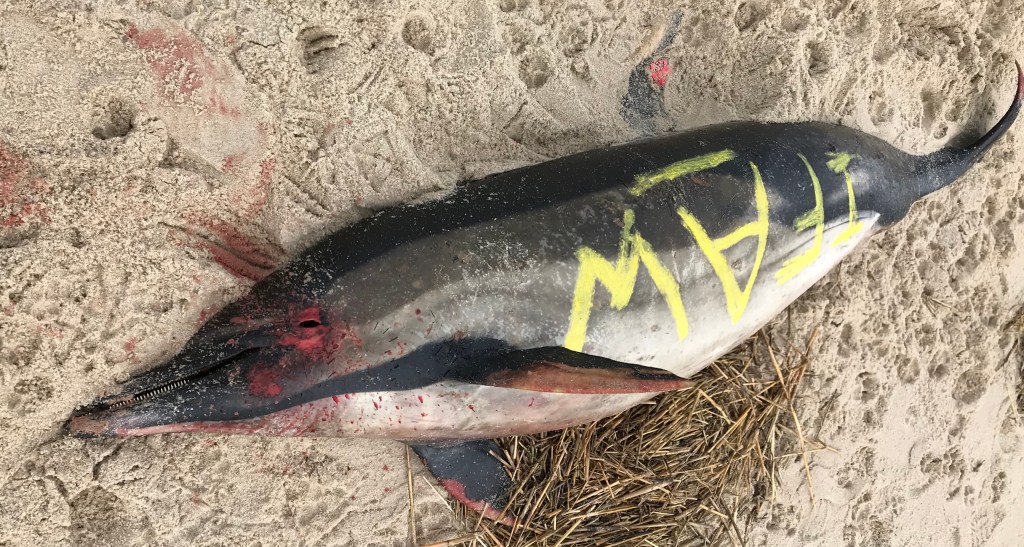
Below are a few of the dolphin types that I have encountered and a story or two about Cape Cod dolphins – maybe whales and sea turtles will follow. The image at the head of this post shows a Short-beaked Common Dolphin with the letters IFAW painted on its side. IFAW stands for the International Fund for Animal Welfare. It is a truly international organization with a string of wonderful successes in the conservation/wildlife arena. It may be marine mammals in Cape Cod but it is also elephants in Uganda, and habitat in Kenya, and tigers, penguins, seals, and more and more elephants. Here on the Cape where we may have 400 strandings in a year IFAW is ever alert to get the animals safely back into the water away from sand bars and shallows.
The eastern edge of Massachusetts ends in the curled arm of Cape Cod. If you are a marine mammal swimming south along the coast you may swim into the northern gape of the Cape. If you are a bird caught up in a storm with northeast winds you can be blown into the Bay and then have to fly south and east and then north to get out. This Wikipedia map shows the sandy hook on the north/south part (eastern edge) of the Cape that further confuses and stymies swimming marine mammals. In 2019 there were over 400 strandings inside Cape Cod Bay.
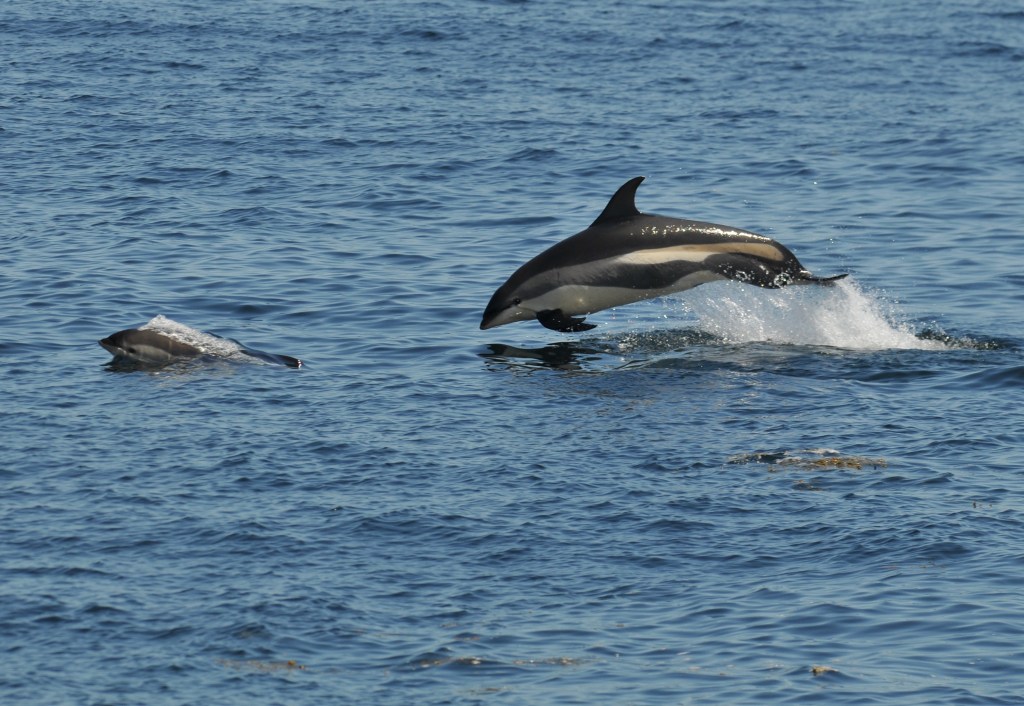
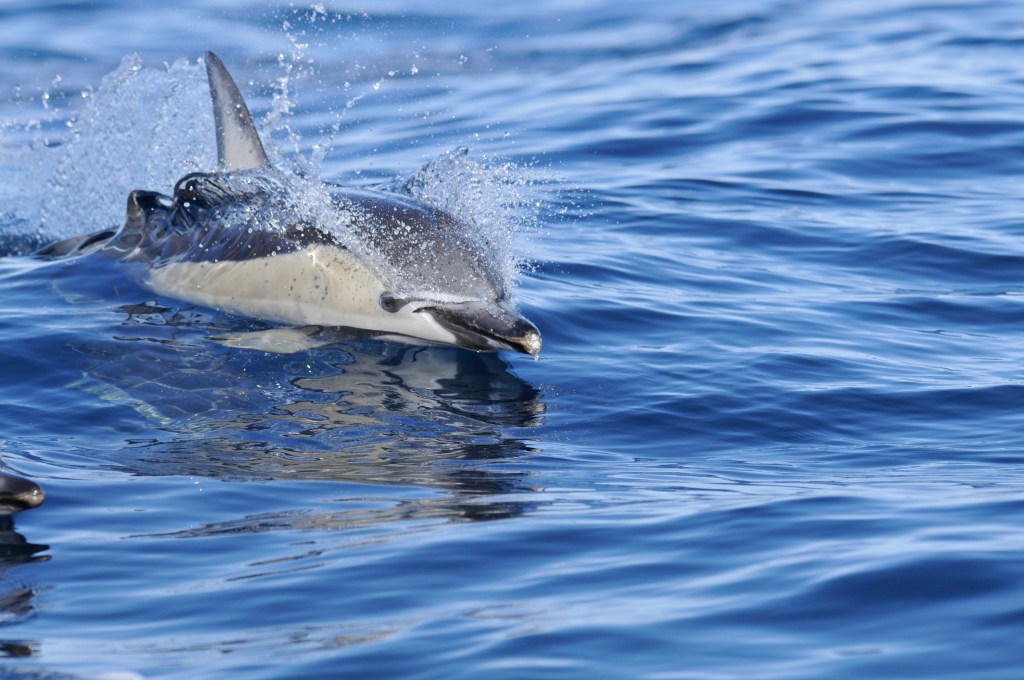
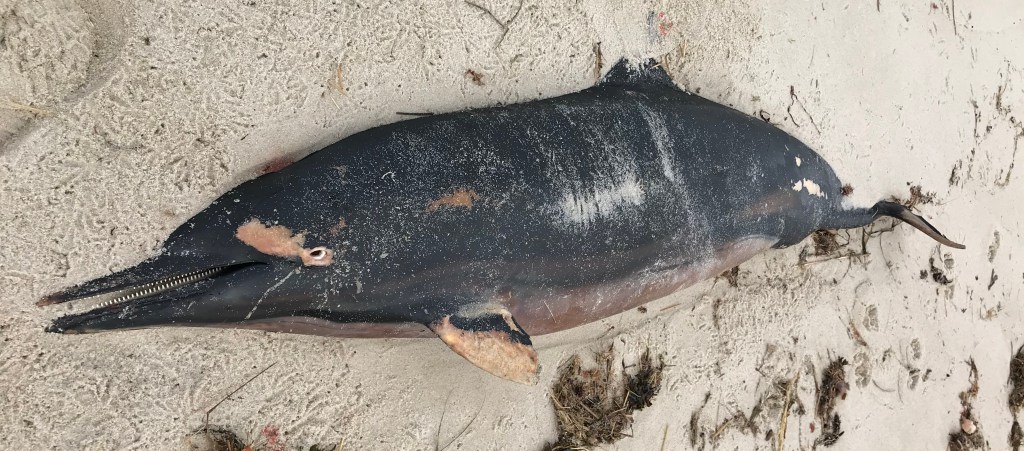
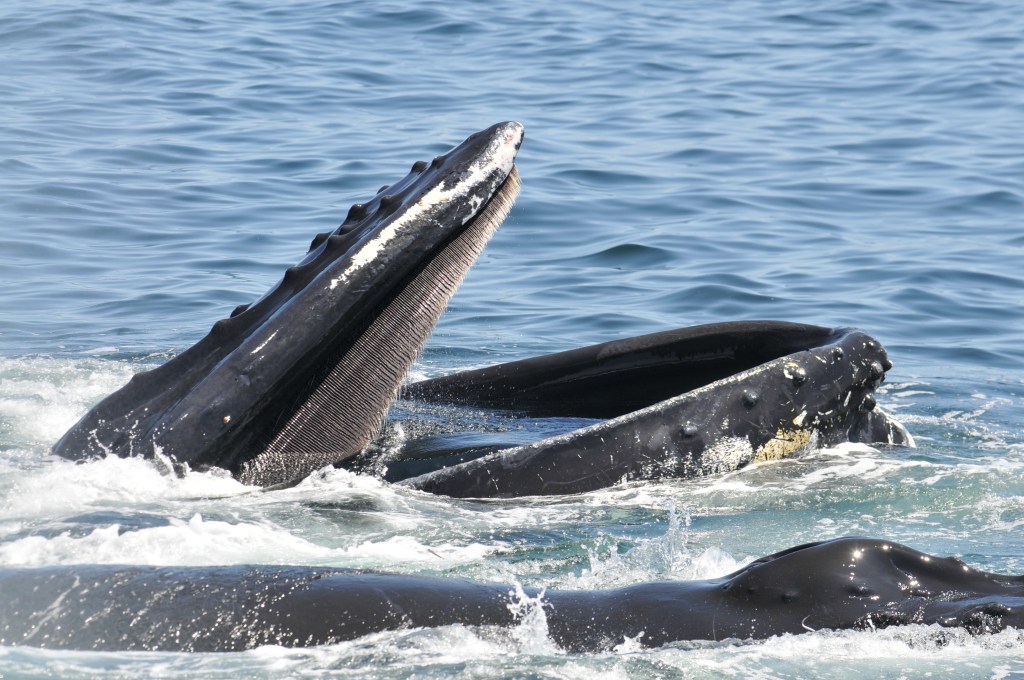
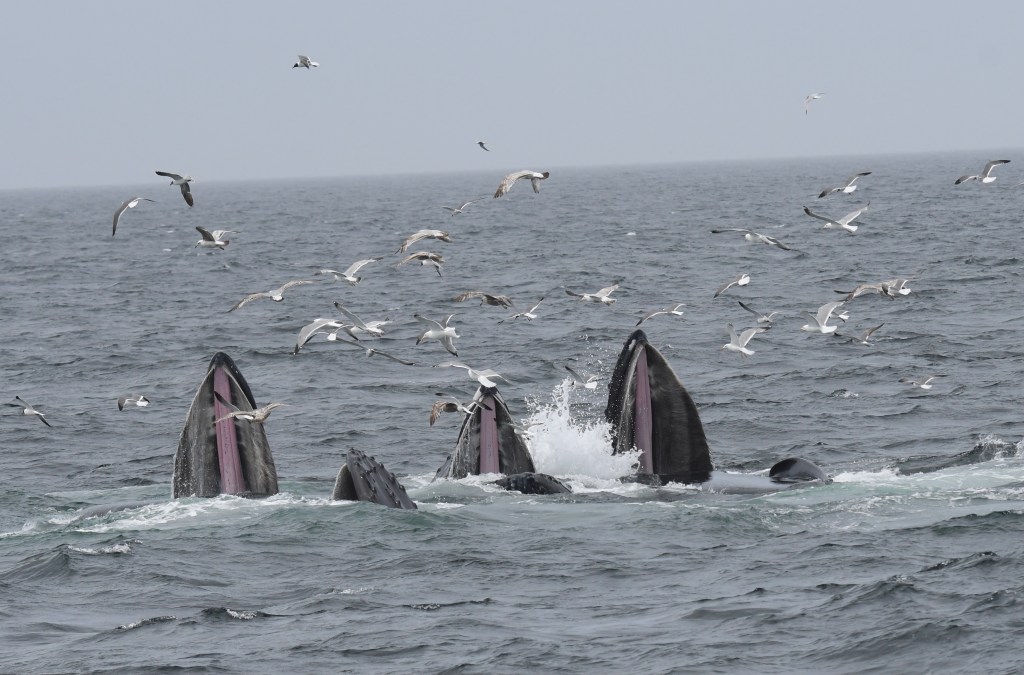
Dolphins are usually longer-snouted than the similar porpoises. This cute little marine mammal (perhaps just a very small whale) is a Commerson’s Dolphin. This is an animal with two very separate populations, one around Tierra del Fuego and the Falklands and the other half a world away in the Indian Ocean. Porpoises are small, with almost no beak and a small rounded dorsal fin. Though this dolphin is also small it qualifies as a dolphin.The White-sided Dolphins are widespread in the North Atlantic. It is the common dolphin from the Carolinas to the Canadian Maritimes and then eastward to the Scandinavian shores. It is also a rather large dolphin as it can grow to over nine feet in length (2.8m) and weigh up to 500 pounds (227kg). Though these dolphins don’t migrate in any predictable way they do move significantly as large social groups so that they stay near the food sources they require. They eat fish (herring and hake mostly) and lots of squid as well. These animals are often seen from whale-watching boats off Cape Cod.The Common Dolphin is in fact the most common dolphin on the planet. They are seen all around New Zealand and Australia and throughout the warm and temperate waters of both the Pacific and Atlantic Oceans. Here in the northeastern part of the US we see them associated with the great flow of the Gulf Stream. It may be the most abundant dolphin but the most common one in aquaria displays is the Bottle-nosed Dolphin; the next image down.Bottlenose Dolphins are also common and widespread. They are also found in most warm or temperate waters. Molecular studies are seeing that there are three types of Bottlenose Dolphins and these may soon be categorized as separate species. They are gregarious, as are many dolphins, and are often seen in groups of hundreds and sometimes thousands. We have seen these mammals in water shows and on television. Flipper was a Bottlenose Dolphin. They are chunky and most weigh well over 600 pounds. They can live for more than 40 years and are constantly on the move. Tuna nets (commercial fishing) are a threat to pods of dolphins but at the moment there are lots of these creatures around.The next three images are of a Short-beaked Common Dolphin that was at the top of the wrack line on a local beach. It was one of three that succumbed on sandy flats exposed at low tide. In this case the low tide flats extend almost half-a-mile from the high tide wrack line. The animals got in to far when there was water and were left high and dry when the tide ebbed. Over the past few years this has happened locally to Minke Whales, Harbor Porpoise, Atlantic White-sided Dolphins, Grampus (Rizzo) Dolphins, as well as The Short-beaked Common Dolphins. And sea turtles as well. It is quite common and always heart-wrenching. The bird next to the dolphin is an immature great Black-backed Gull. Gulls, coyotes, and vultures will help dispose of a carcass, but many marine mammal carcasses are towed back into the water and then well away from shore.The teeth of dolphins are conical and one of the taxonomical characteristics that tell you that they are really dolphins. They can swing their head and jaws as they swim through schools of fish sometimes catching them outright and other times damaging and wounding the prey. They are strong swimmers and have little trouble catching food. This one has the letters IFAW painted on it. This is the mark of the International Fund for Animal Welfare. On a worldwide basis they work to protect and secure threatened and endangered species and habitats of all sorts. Here on Cape Cod they are the marine mammal EMTs. They can respond, triage, then elevate, and wheel off the beach, and then drive to the ocean side of the Cape to release stranded animals. It is heavy hard work and due to the numbers and difficulty in gathering information it is an effort that isn’t always rewarded by watching the mammals swim away.I thought I’d stick in a couple images of the larger marine mammals (Humpback Whales) at work. Around the world the marine mammals either chase and catch fish (toothed whales) or gulp in huge quantities of water and strain the smaller stuff as they “exhale” the water back through their baleen sieve (baleen whales). That is the baleen reaching down from the lid-like top jaw of the whale. In most waters there are creatures of great abundance; here in the western Atlantic it is Sand Lance our whales seek out, but there are sardines in some places and capelin in other waters. These are fish that swarm in schools of thousands or hundreds of thousands. Krill, squid, mackerel, menhaden and a few others are schooling creatures and are also sought out.Though many of the whales eat fish, as we see here, there are other whales (and a seal or two as well) that strain plankton bits from the water. Imagine the largest animals on earth living on food items smaller than popcorn. The whales in the picture above are feeding on Sand Lance, a fish about the size of a small pencil. The whales will circle around underwater exhaling air as they swim. The bubbles rise and the fish are confused and stay inside the “bubble net” or ring. The whales then swim up through the net taking in lots of water and fish. As you saw in the image above, the top jaw is a rather flat lid where the bottom jaw has the world’s largest double chin. The throat is pleated and expands greatly as the whale takes in the food-rich water. Once at the surface the whale will swim slowly forward allowing the pressure of the motion to force the rorquals (pleats) to close, the water to pass out through the mostly closed mouth. A baleen whale with a mostly closed mouth presents a baleen, sieve-like, barrier to any fish that were brought in by the big gulp.
Please consider the images to be copyrighted and ask permission to use any of them. Thank you, DEClapp
Today was well below freezing and for much of the morning the wind made it feel well below zero. On days like this the birds seem to arrive later than I would have predicted and it is eight in the morning before they really begin to arrive. Then they seem to arrive in a flurry; especially if there are meal worms on the deck rail. They might dribble in if they are only offered cold bird seed. But at about 8:30 it is quite busy with Pine Warblers, Eastern Bluebirds, Black-capped chickadees, Tufted Titmouses, American Goldfinches and a scattering of American Robins and nuthatches, mostly Red-breasted but an occasional White-breasted.
This post is a quick burst of images taken a bit earlier today through a heavy glass, double-paned slider out onto the deck; my excuse for images that many be a bit off. The Eastern Bluebirds are big fans of meal worms as are the Pine Warblers. The Carolina Wrens, chickadees, and titmouse also favor these larval bits. Ordering and providing meal worms is a bit of a task as the birds will eat and eat and you need to order and store these beetle larva and then provide and provide. I can store about 10-20,000 (yup, really) in a plastic box that is about the size needed to store a pair of boots, pretty small really. They don’t need much room and they cannot climb the walls of any plastic container. They are living in, and on, non-medicated chick starter (a chick food crumble) and about five pounds of chick starter (less than $5) will take care of thousands of larva for weeks. I keep them in an unheated garage (maybe getting into the low 40s) and put them on the deck rail on a dinner plate; no napkins or silverware needed. They will not pupate at this temperature for 5-6-7 weeks; and by then they will have become bird food.
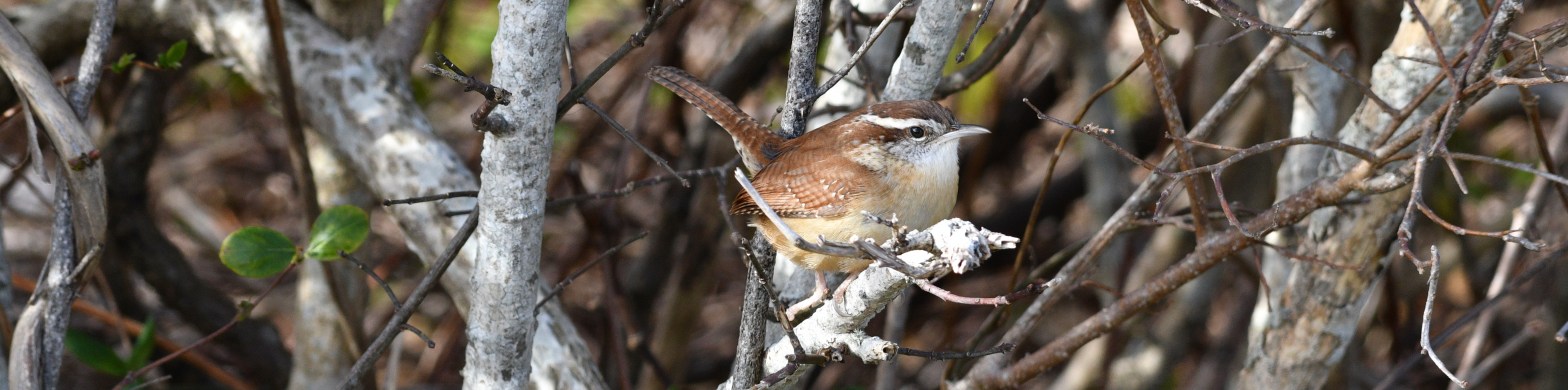
The image at the head of this post is a Carolina Wren. A small, hardy, noisy, perky wren that is at the northern edge of its range (especially wintering range) here in New England. The CAWR almost always stay in pairs and are often seen in pairs and is the bird that sneaks into your outbuildings, tool sheds and garages to look for those spiders and other insects that cohabitate with us. They are similar to the Northern Mockingbird, Northern Cardinal, Tufted Titmouse, and Red-bellied Woodpecker in their recent transition into our more northern environment from their origin locations to the south. We are seeing many more birds and mammals and insects as well as plants moving north as our winters become less challenging. The CAWR is one of the “new” arrivals.
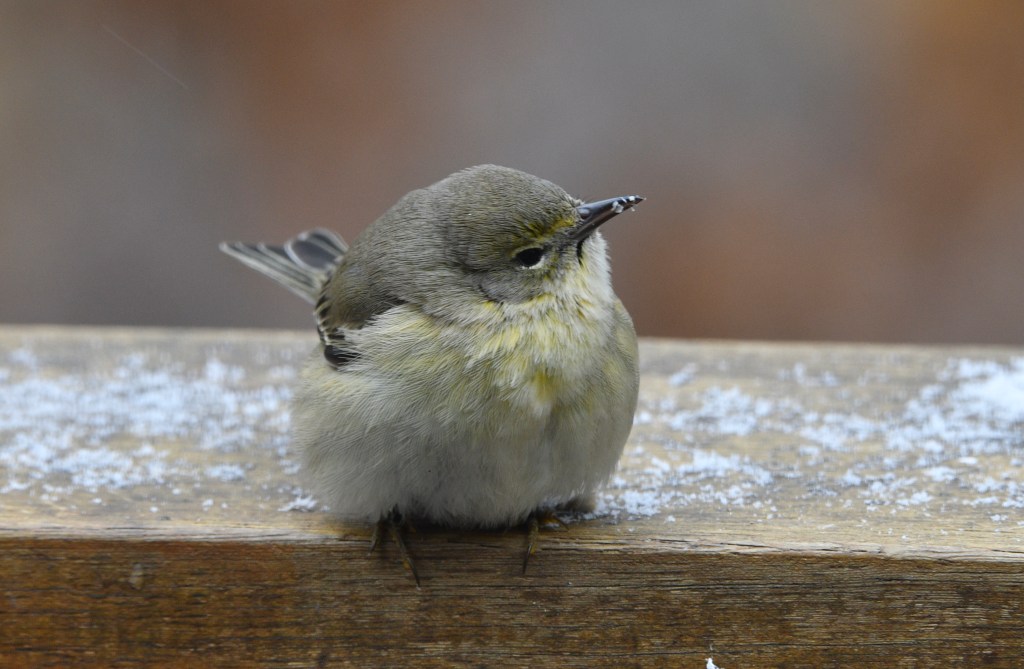
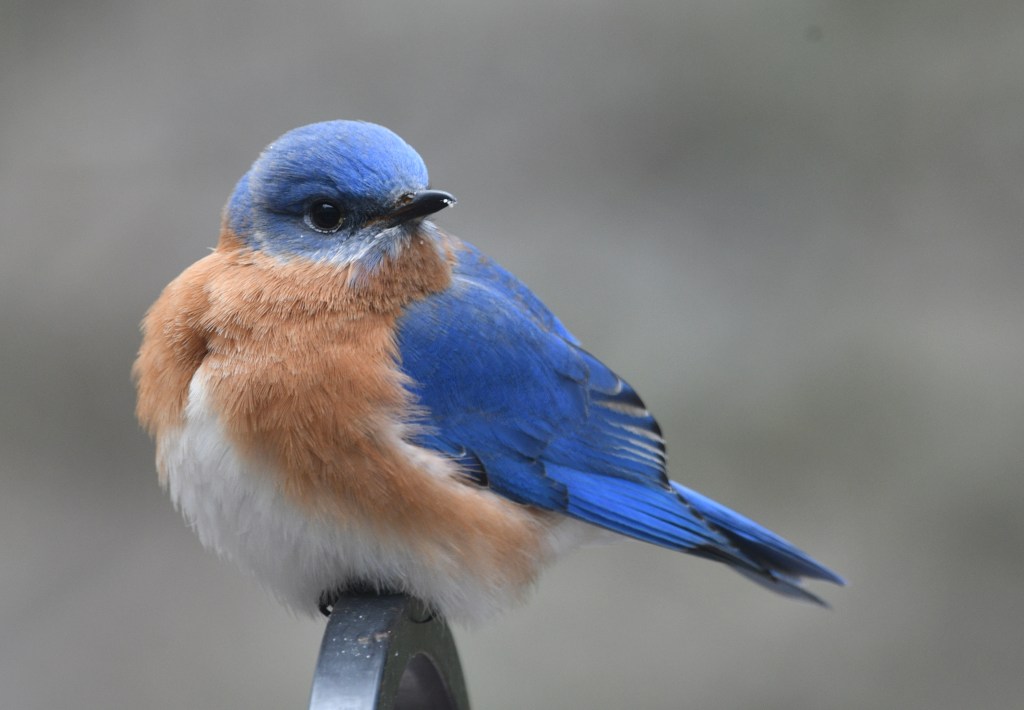
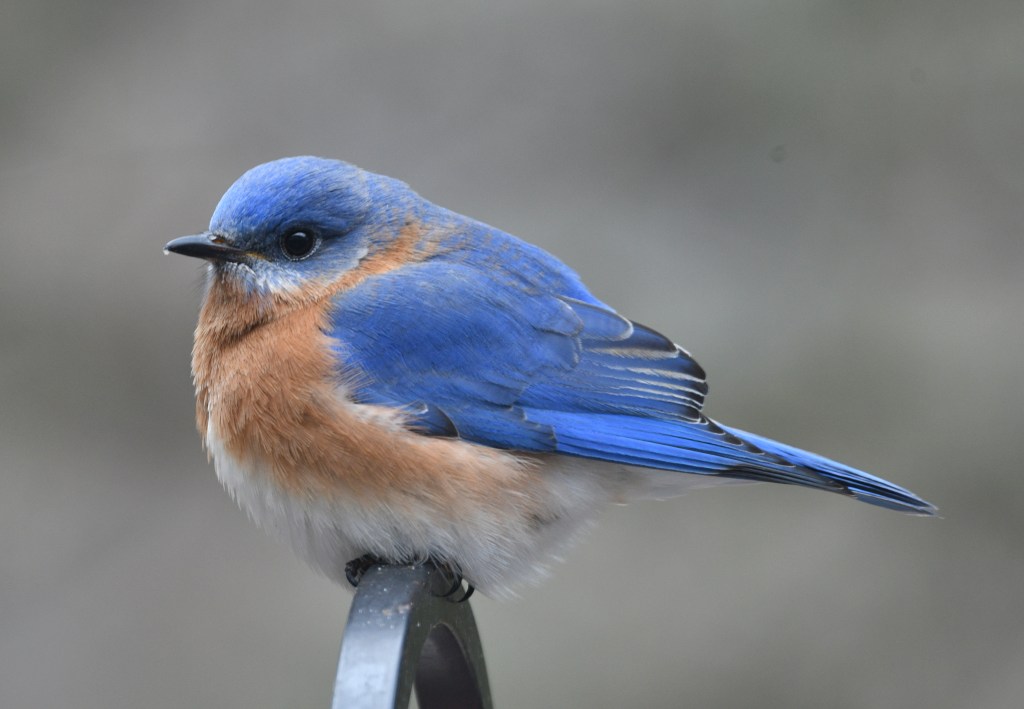
I certainly will add better images of the American Goldfinch as spring replaces winter. The bird on the right is beginning to become more of a “gold” finch and is likely to be an adult male starting to develop the bright yellow breeding plumage that makes this little seed-eater so easy to recognize. The bird on the left has warm spots on the face and may be a young male (last summer’s youngster) but more likely is an adult female in winter plumage. The yellowish-brown nape is more like a female’s nonbreeding plumage; but not all birds can be sexed or aged at all times.The Pine Warbler is a small bird of pine woodlands. Here on Cape Cod that usually means Pitch Pine but could include White Pine woods as well. This particular bird is probably a first year female as she is lacking any distinct yellow feathering, though she is warmer in color just below the throat. They arrive at the feeders when meal worms are offered. At the moment we have about 5 or 6 of these grayish birds and 2 or 3 of the yellower birds; see below. They seem to be spending the winter with a group of Eastern Bluebirds and are rarely seen outside the company of these small blue thrushes.Adult female Pine Warblers have a good bit of yellow on them but they usually have streaked sides and a small stripe above the eye. I simply call the winter birds “yellow” or “gray” and it probably doesn’t mean much at all. This bird is quite yellow but doesn’t show the dark streaks of a male nor the muted streaks of a female. The eye stripe is more pronounced in males but likely fades in winter plumage. The bird pictured can be called an adult in winter, but maybe that’s all.The Eastern Bluebird is an up and comer here in New England. It was widespread and common into the 20th century and then its numbers slumped during that hundred-year period. However, there are now more Eastern Bluebirds wintering in the USA and in the northern parts of the country than there have been in decades. We are still at the northern edge of the wintering range but we are seeing more and more EABB each year. Perhaps the warmer winters provide more insect (primarily hardy beetles) food for them or perhaps the plantings that we use in suburbia provide fruit and berries and seeds throughout the winter. Likely it is a combination of both environmental changes. Young birds and wintering birds are often in plumages that are not what we are familiar with, or expect. The bright colors of springtime males get all the publicity. With the Eastern Bluebirds there are a few distinctions between the sexes; the males are a brighter blue, the females are a grayer blue, the males have no eye ring and the females have half an eye ring. Both male and female have a white belly and some orange-red on the throat sides and breast though the male is much redder. So, this bird is a female; based on the white eye ring and grayish forehead. As I said, males are blue; really blue. Many of the Eastern Bluebirds that breed in the US will winter in Mexico and on down in Central America as far as Guatemala. As this is an EASTERN Bluebird it might be remembered that they breed and reside pretty much east of our great river systems. (There is a Western Bluebird and a Mountain Bluebird that fills other geographic and environment niches.) This means that in order to get to Mexico, or further south, they have to fly over the Caribbean Sea or around Texas and then southward. It is likely that our (eastern population) Eastern Bluebirds move straight south and winter along the southern tier of states in the US and those that breed in Minnesota, Iowa, Missouri, Arkansas, and Louisiana are the ones that work their way southward to Mexico and Latin America. There are a few records of fall and winter birds in Cuba but it doesn’t seem that the islands are an important winter destination. Just one last image of an eastern Bluebird. They certainly are a bright spot on a cold, gray, winter ‘s day. Snow storms can hide food from both Carolina Wrens and Eastern Bluebirds. It always causes me to wonder when I think about short cold days and long colder nights, and the rapid metabolism of birds. Can they all lower their body temps to make it through the night? How do they restart/reboot/kickstart their metabolism each morning? How many days can they survive if snow or ice covers their food? Can they just up and migrate in mid-winter if things suddenly take a turn for the worse? Did you ever contemplate the chill factor on the open eye of a flying bird in 10 degree air? Or what is required to warm and digest foods that are eaten at air temperature? Still lots to learn….
Please consider all images to be copyrighted and ask permission to use or reproduce any photos. Thank you. DEClapp
The salt water in this part of the world doesn’t freeze like it used to – as a matter of fact it rarely freezes any more at all. The days of icy blocks lifted and pushed ashore by the flood tides are pretty much over. If the sea water freezes it isn’t for a long period – I sort of miss the look and primal feel of those days, but I don’t really miss the weather. The larger fresh water ponds out here on Cape Cod, Massachusetts, often stay unfrozen through the winter as well. That means that many of the sea, bay, and puddle ducks, geese, and swans can winter here rather easily. Cape Cod has about 365 fresh water ponds, many of which are shallow and have vegetation which dabblers can reach through the winter; some of these may freeze off and on during the winter. Other ponds and lakes are a bit deeper but have copious numbers of fresh water mussels and small fishes in place of the vegetation of the shallow lakes. The shallow salt waters inside Cape Cod Bay and the shallows of Nantucket Sound also provide mussels, clams, crabs, and other food items that the sea and bay ducks favor. We will look at the sea and bay ducks in another post, here we will see some of the freshwater ducks, as well as a goose or two and our only swan.
Ducks and geese feed in a variety of ways and in a variety of habitats. Geese tend to graze; they like large lawns, golf courses, and planted roadside verges. Some ducks will dabble near the surface for vegetation and easy to catch critters by tipping tail-up and head down. Other ducks will dive and chase down aquatic life forms underwater like feathered otters. The Mergansers are all divers and chasers and the Swans are all long-necked dabblers. Here are a few of our waterfowl.
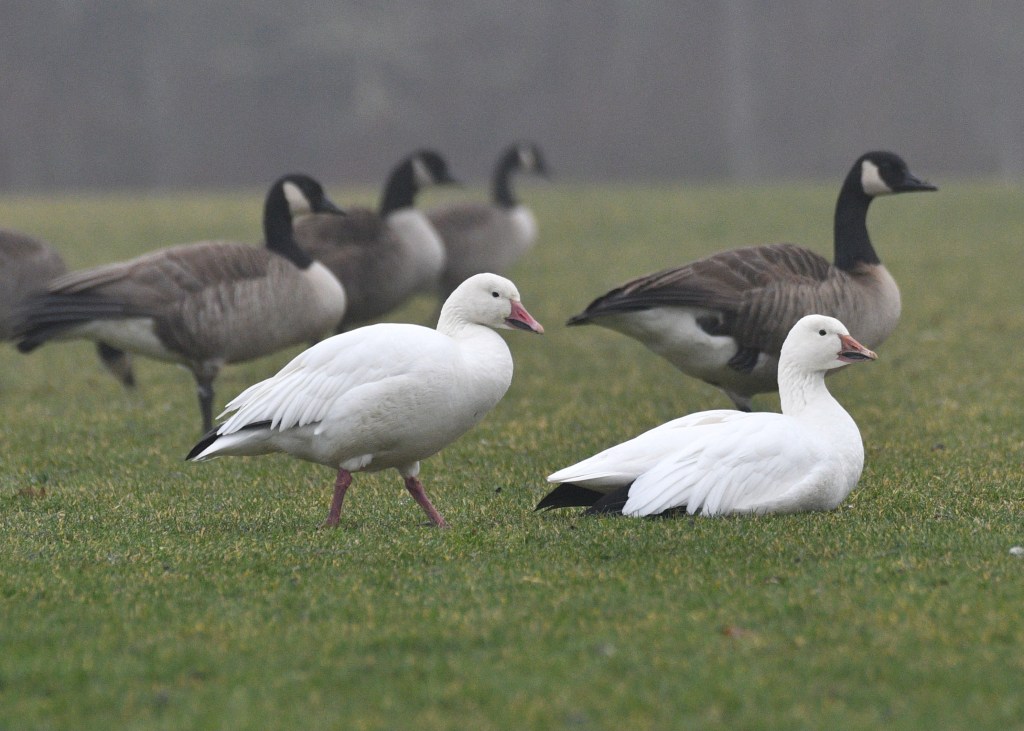
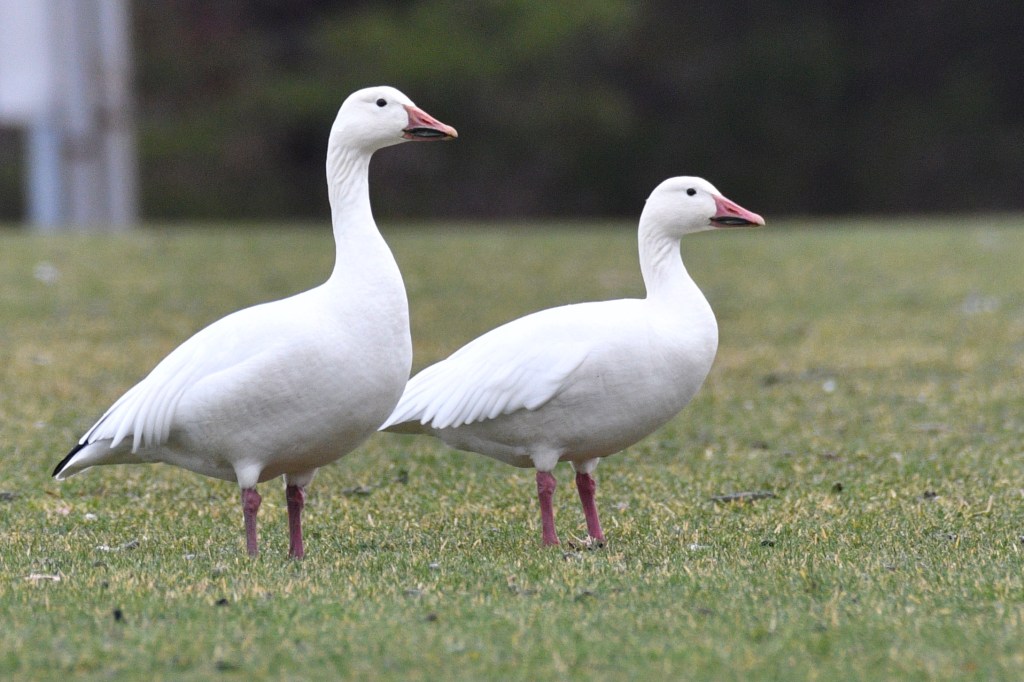
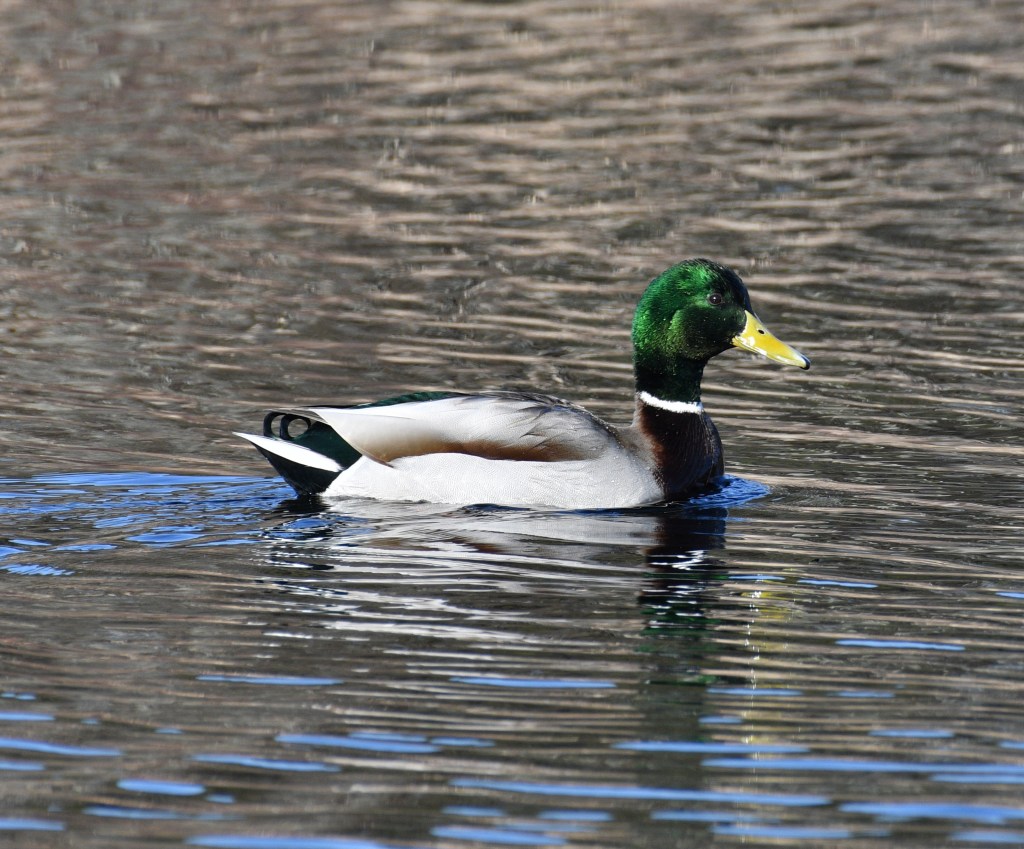
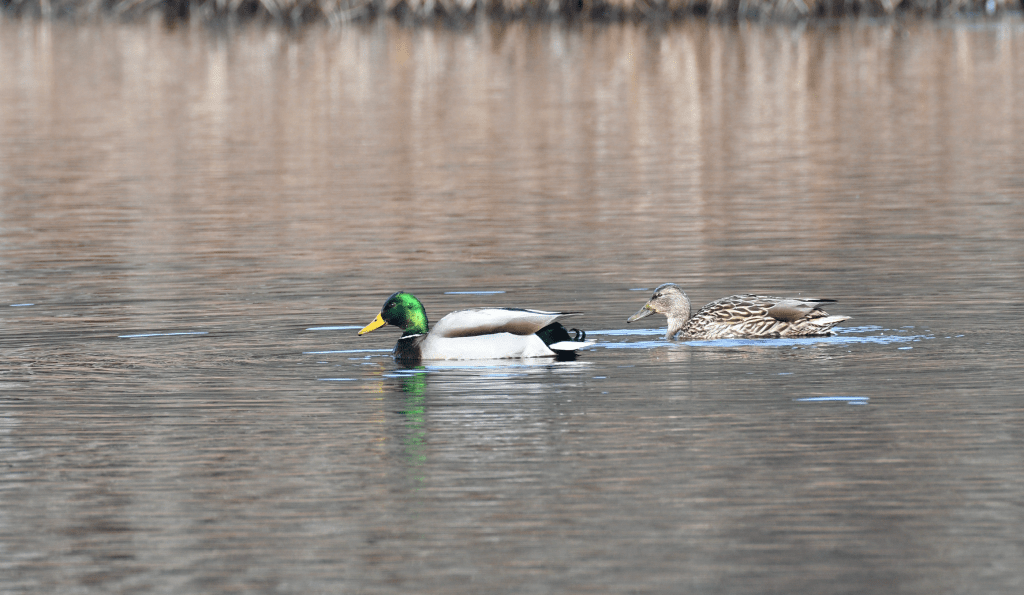
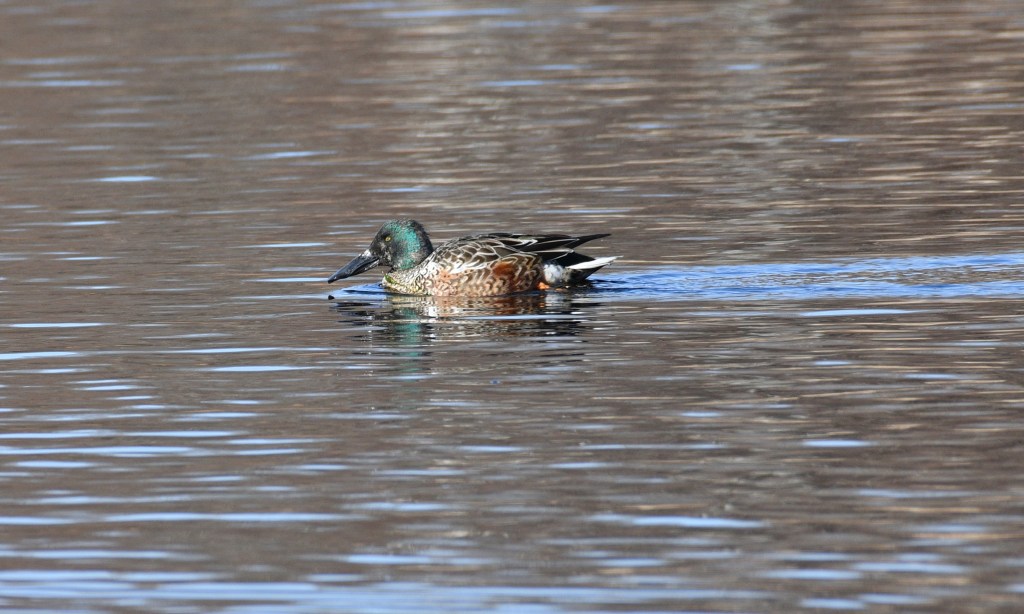
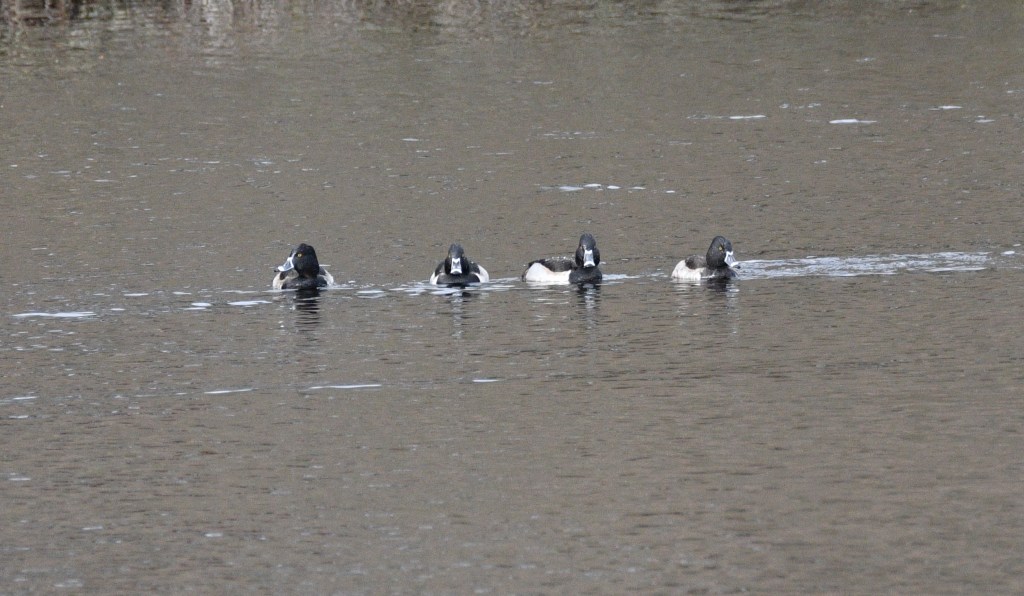
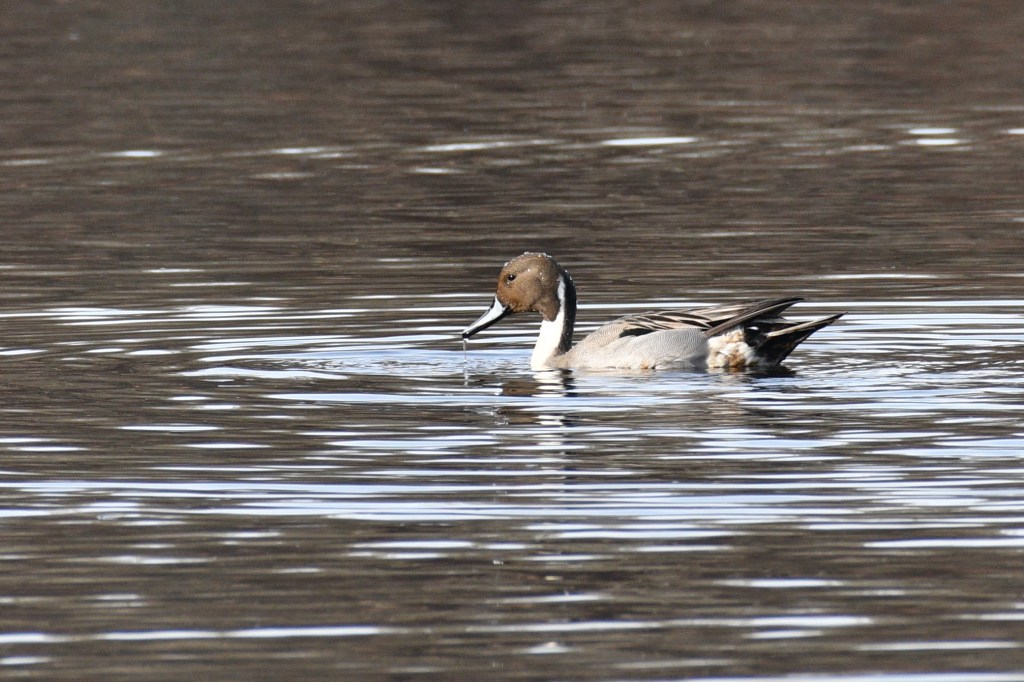
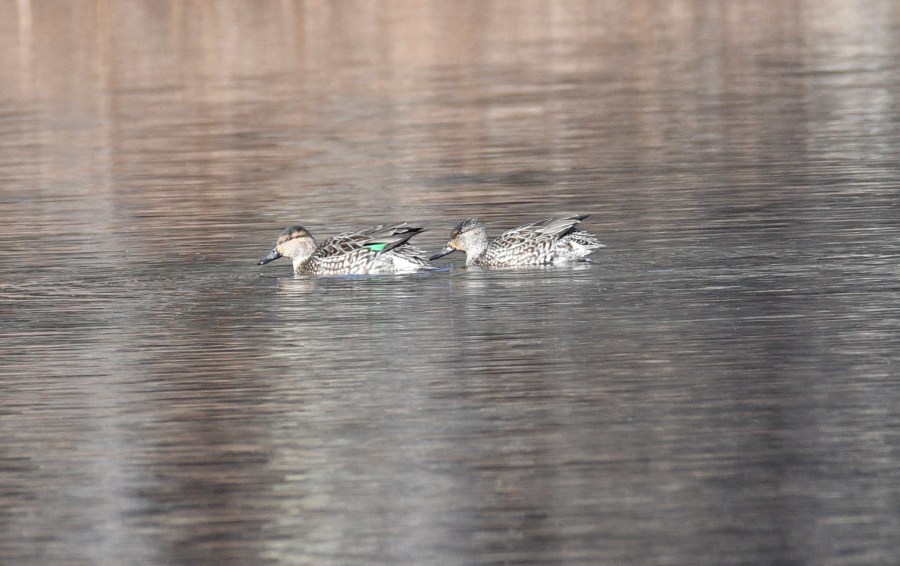
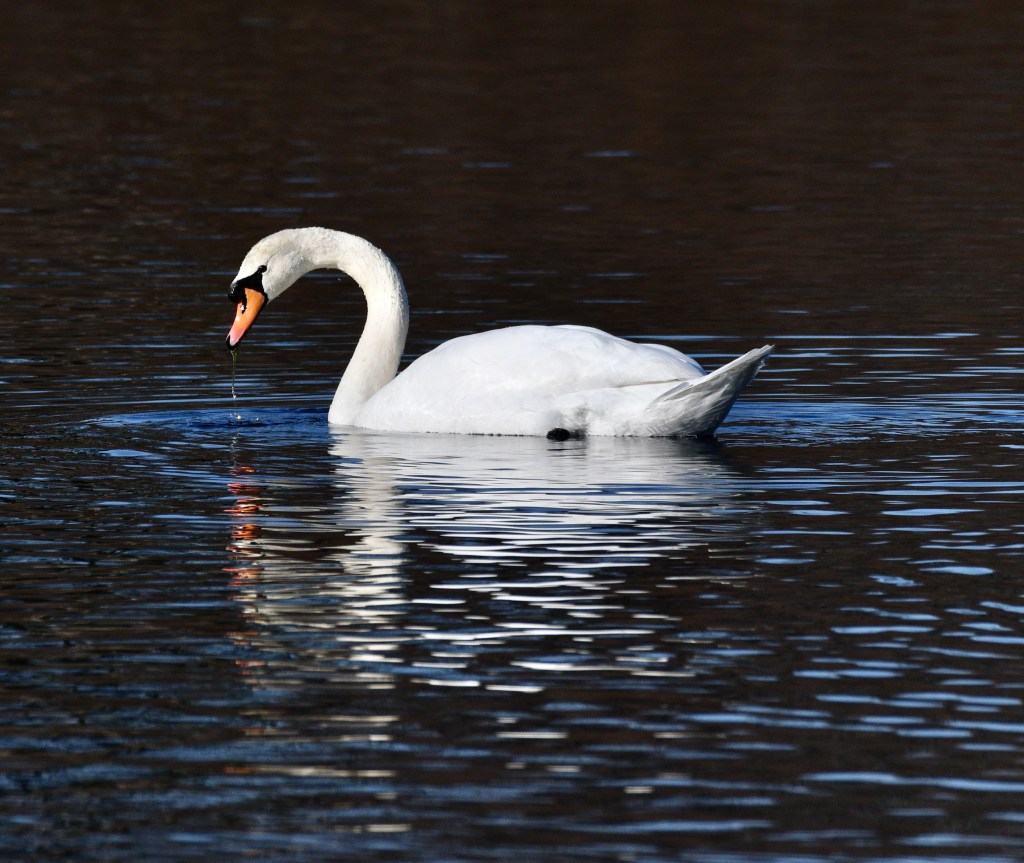
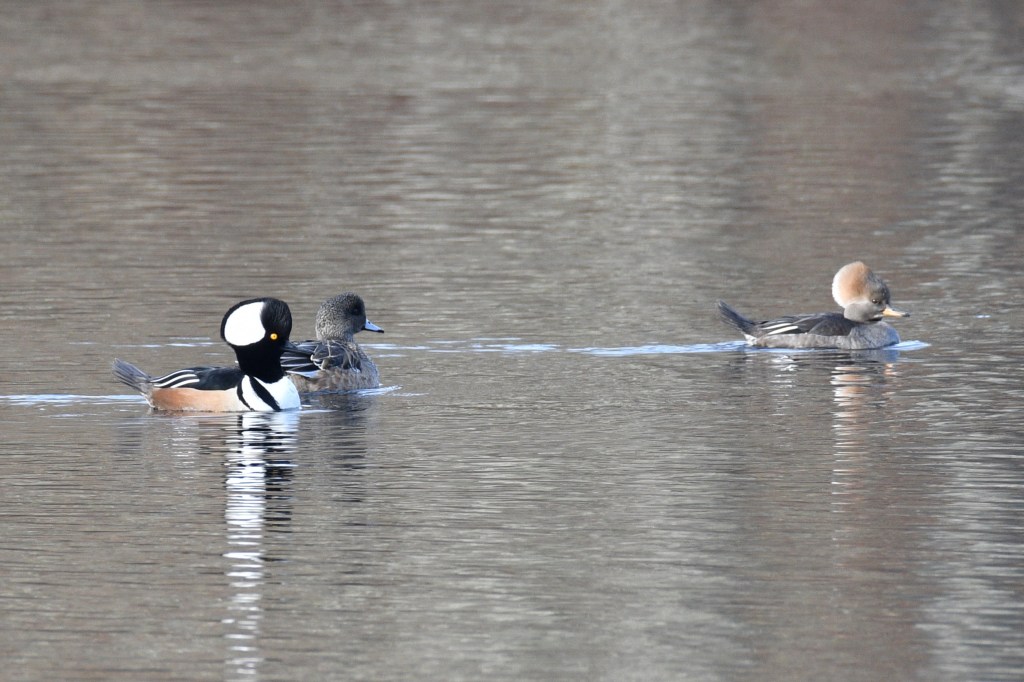
The ubiquitous and now non-migratory Canada geese are often joined by an interloper. We get the very occasional Pink-footed Goose and the more usual Snow Goose (SNGO). These two are Snow Geese as you may have guessed. These are not uncommon in the US and Canada but here on the northeastern shore we don’t see them very often as they tend to migrate inland a bit and fly over us, usually well to the west, as they head to their southern wintering grounds.Like many, perhaps most, white birds, they have black-tipped feathers in the wing. The dark pigment (melanin) helps keep the wing tips from wearing and fraying. It is a characteristic seen in pelicans, ibis, and some other long-distance migrants that are white. Like our Screech Owl which has a red and a gray phase; the Snow Goose has a “blue” and a white morph. The white type is by far the most common.The Mallard is perhaps the most common duck of North America. Many, perhaps most, have domestic DNA somewhere in their lineage and rarely are they thought to be much more than very successful and capable domestic escapees. They have been “farmed” for hundreds of years. The males are characterized by the iridescent green head and the curling feather above the tail. Many of the Mallard group are migrants and they are well represented in the prairies and farms of the central USA.The female is quite cryptic and blends in to her surroundings as she incubates the clutch of eggs in a nest which is located on the ground. In ducks many of the females are rather plain and designed for camouflage and partner with a more gaudy, flashy, and colorful male.The Northern Shoveler is named for its broad spatulate bill. They tip up and eat vegetation and whatever is attached to it. This is a young male and it will become more flashy as the whites and blues become stronger,. This is another central US duck that we look forward to seeing annually in small numbers here in the northeast. The Ring-necked Duck must have been named in a museum. The neck does have a ring if you hold it just right in a canted light stream. It looks like it should be called the Ring-billed Duck as the pattern on the bill can be seen at great distances. It is a diving duck that gets most of its food from seeds and green growth but about a quarter of the diet is animal matter taken during shallow dives. A flock of RNDU will stay tightly together on the water and will dive so often that they are quite hard to count accurately. This is a very attractive and common winter duck here in New England on the freshwater ponds.An elegantly constructed duck is the Pintail. The long neck and sleek body with a “pin” tail makes it more like a piece of art than a duck. This is another duck that tips up and dabbles in shallow water. When central America was great prairies there were thousands of prairie potholes where water stood and countless millions of ducks bred. Those days, and those places, are pretty much gone – turned to Soy Bean and Corn fields – but enough habitat exists and is managed for waterfowl so that the Shovelers, Pintails, teal, and mallards are still quite common.The Green-winged Teal is a small duck with a rather brown camouflaged female. These two are both females or perhaps young males, but the white undertail feathers make me lean toward female. The males are flashy in breeding plumage but here in the northeast they are not very common and rather skittish. I looked for a good image of the males but find that the best teal photos I have are from far far away – maybe I’ll get a male Green-winged Teal to pose some day and I’ll share it immediately. Teal are in the same Genus as many other ducks (Anas) but the name “teal” usually refers to a small enclave of smaller ducks (here in the US = Green-winged, Blue-winged, and Cinnamon). The Gadwall (GADW) seems to be rather dull at any significant distance but up close the feathering is a tapestry. The vermiculations and soft patterns are exquisite. The Gadwall population is stable right now and management of wetlands in the central parts of the country has helped. The population seen in the eastern part of the country has been increasing for the past couple decades. Incidentally the word “vermiculation” sounds like a rather regal descriptor but really refers to something that looks like the track a worm makes.Geese, duck, swans, and mergansers are the major groups of waterfowl. In the American northeast we really don’t have a native swan. We now have the very large Mute Swan (MUSW). It was brought in to the US a couple centuries ago to lend a regal British air to private estates and ponds on the town common land. They are well established in the northeast and around much of the land around the Great Lakes. It can dominate a pond and alter the breeding opportunities for native species. Over the years many states have tried to remove the Mute Swan or at least control it breeding. At the moment the population is widespread but not spreading rapidly. As of 2021 I know of no states that are controlling the swan population.There are three species of merganser in the USA; mergansers are diving predators of both fresh and salt water. The Hooded Merganser shown here is a small attractive duck that we see in the winter; often in rather large numbers. They dive and chase aquatic life forms of all sizes and shapes. In the spring they head north to breed in tree cavities in the Canadian woodlands and ponds. They also breed in the US in woodlands and often in forests at some elevation. They are one of the duck that doesn’t use the prairies of the country but is tied to forests and trees. Mergansers have a narrow bill with serrations along its length; the better to hold a squirming fish or elver or tadpole.
Please consider the images to be copyrighted and ask permission before using. Thank you. DEClapp
There are common birds here that are very usual to us but in the eyes of a visitor we can see that each and every one is in some way special. So as I take a few images of birds I saw yesterday I try to see them not as old and usual friends but as new and interesting creatures. So here are a few old friends and new arrivals. As a matter of fact the next few posts will be birds and more birds. This is a good time to see and photograph ducks and some wintering species so they are on tap for the next couple weeks. Not all of the birds will be old friends as we have had an influx of uncommon birds recently and I’ll post some of those as well. And lastly the pictures will tell the story in that they represent what is being seen – they may not be the best images possible, but they fit the sequence; enjoy.
The bird at the heading of this post is the widespread and ubiquitous Mourning Dove (MODO). Its cooing is often thought to be owl-like. They can be found throughout the USA and are considered a game bird in some locations. They will nest throughout the year depending on their latitude and will sometimes nest and renest and perhaps renest again. The nest is a casual accumulation of sticks that you can often look up at and see the eggs resting in what seems to be a dangerous position. Pigeons and doves drink an exceptional quantity of water each day compared to other birds This group can suction water up and into the throat – all other birds have to grab a beak-full of water and tilt the head back to allow the water to run down into the body. There are ten species of Dove, Pigeon, and Ground-Dove in the US; but here in the northeast we see only two; the Rock Pigeon (a feral bird pretty much world wide and often urban) and the slimmer, and also widespread, Mourning Dove.
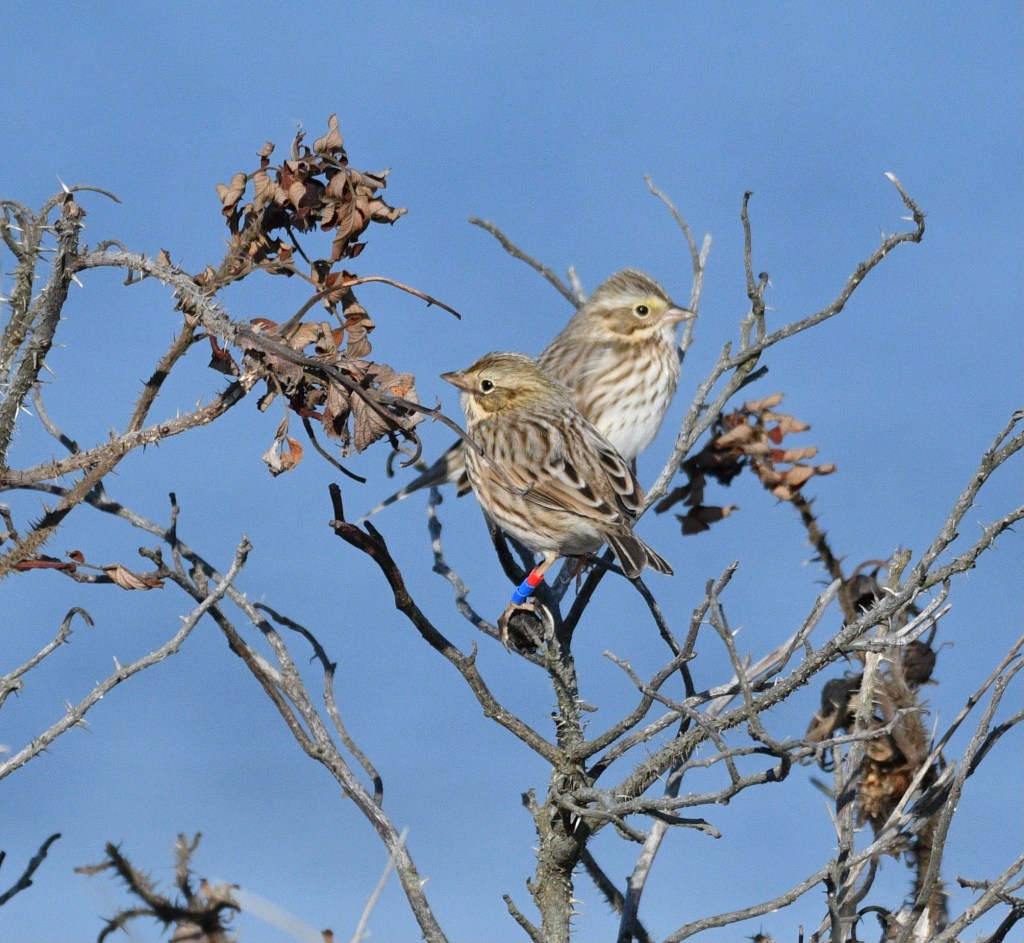
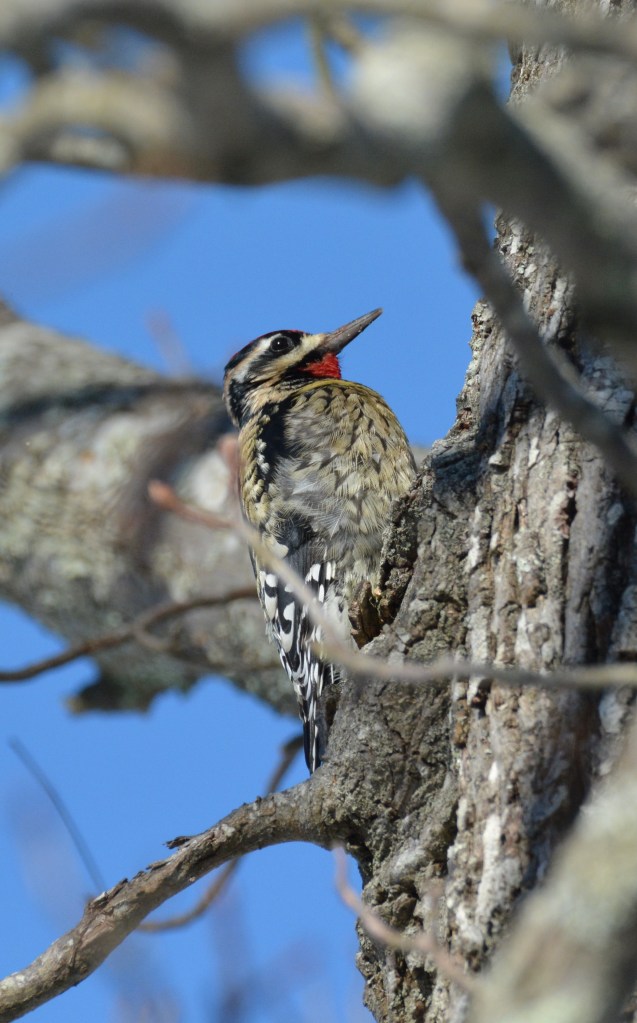
The Savannah Sparrow (SAVS) is a very widespread little brown bird that breeds at some higher elevations in the US and throughout Canada and Alaska. It is a rather heavily striped bird with (usually) a bit of yellow between the eye and the beak. It is finely striped (more so than many of the other sparrows) and found mostly in low vegetation like weedy and grassy areas. It winters widely in the southern third of the US from coast to coast, but is often overlooked as it isn’t conspicuous, colorful, noisy, or always moving. It is, however, very common.There is a small population of Savannah Sparrows that breed on Sable Island Nova Scotia that is larger, paler, and rather uncommon. This is the Ipswich Savannah Sparrow and can be found in the dunes of Cape Cod (and other coastal dune habitat) during the winter. They are usually grayer overall than the more common type of SAVS and often do not show any yellow on the face. The Savannah Sparrow might well be divided in as many as three species in the future as there are at least three different looks and geographically separated populations; although these grade into one another and there are 12 sub-species identified. The Ipswich type birds nest in dunes out on the island and winter in dunes along the eastern shore of North America. Another sparrow, though a different genus, is the American Tree Sparrow (ATSP); a plain fronted bird with a spot on its chest. It winters widely across the northern part of continental US and breeds in the low vegetation of the Canadian and Alaskan tundra. We never hear it sing down here in the US. In the winter we see it in short coarse vegetation in small flocks. It is quite common where it occurs but its presence is quite spotty; here in eastern Massachusetts we often see it near coastal dunes where bayberry and poison ivy dominate.Once a bird of the south, we are seeing the Northern Mocking (NOMO) bird as a resident and wintering bird throughout the northeast. It its much less common in the northern half of the central and western part off the country. In the southern US it is found from coast to coast. Where it is present it is often common as its does well in suburban circumstances. It is a member of the mimic group and readily imitates other birds. It usually repeats the phrases several times; and often sings in the night. We see fewer in the winter but they are not really (yet) known as a regular migrant.The Yellow-bellied Sapsucker (YBSA) is a woodpecker that uses tree sap as a food source; eating fewer insects and grubs than any of its relatives. It will eat fruit, seeds, buds, and bugs – but the sap from the tree is the prime food item, especially in the spring. It is a bird that breeds over most of Canada, but is found only (pretty much only) in the eastern part of the US. There are several other sapsuckers that are found in western states and in many cases these species are able to interbreed and hybridize. Defining a species remains difficult.Another of our woodpeckers is the Northern Flicker (NOFL). Ours is the yellow-shafted form and the western states have a red-shafted form. These feather shafts are often very bright, and easy to see. The yellow-shafted birds nest well into western Canada and one form or the other is found widely throughout the USA. This bird is known for capturing and eating ants and is often seen on the ground looking for creeping and crawling creatures.I think the Carolina Wren (CAWR) falls into the same category as the Northern Mockingbird shown above. It has been a southern bird which has expanded northward over the past few decades. It is bright and noisy. About five winters ago we had huge amounts of snow and the CAWR population was decimated. This year the Christmas Bird Count tallies show the birds have rebounded from that calamity and the numbers are high again.The Black-capped Chickadee (BCCH) is a small member of a worldwide family that its represented in the US by seven species (Black-capped, Mountain, Chestnut-backed, Mexican, Boreal, Gray-headed (northern Alaska only), and Carolina). there are forty or more species in Europe, Asia, and Africa. They are related to the nuthatches and creepers; but the chickadee group is seemingly cut from the same black-capped and black-chinned pattern. They are small and non-migratory, for the most part. They winter in areas of extreme cold and suffer through very short days and very long nights. They cache food and find it later – most of the time. They can drop their internal temperature during the night and enter a period of hypothermia that they can rebound from each morning. They are common birds at feeding stations and favor black oilseed sunflower as well as hulled sunflower. They will readily join Tufted Titmouses, Carolina Wrens, and Pine Warblers at a bowl of meal worms as well.The Northern Cardinal (NOCA) is another relatively new arrival from the south and is now a rather common resident in eastern United States right up to the Canadian border – with some now breeding in southern Canada. This is another non-migratory species that now winters in the northern states. It utilizes feeding stations and stays in thickets with berries and seeds. It is often the first bird at a feeding station as day breaks and the last to visit in the evening.





































 On The Road With DEC