Back in Southern Africa

Please consider all images as copyrighted – thank you. Contact me for use… DEClapp

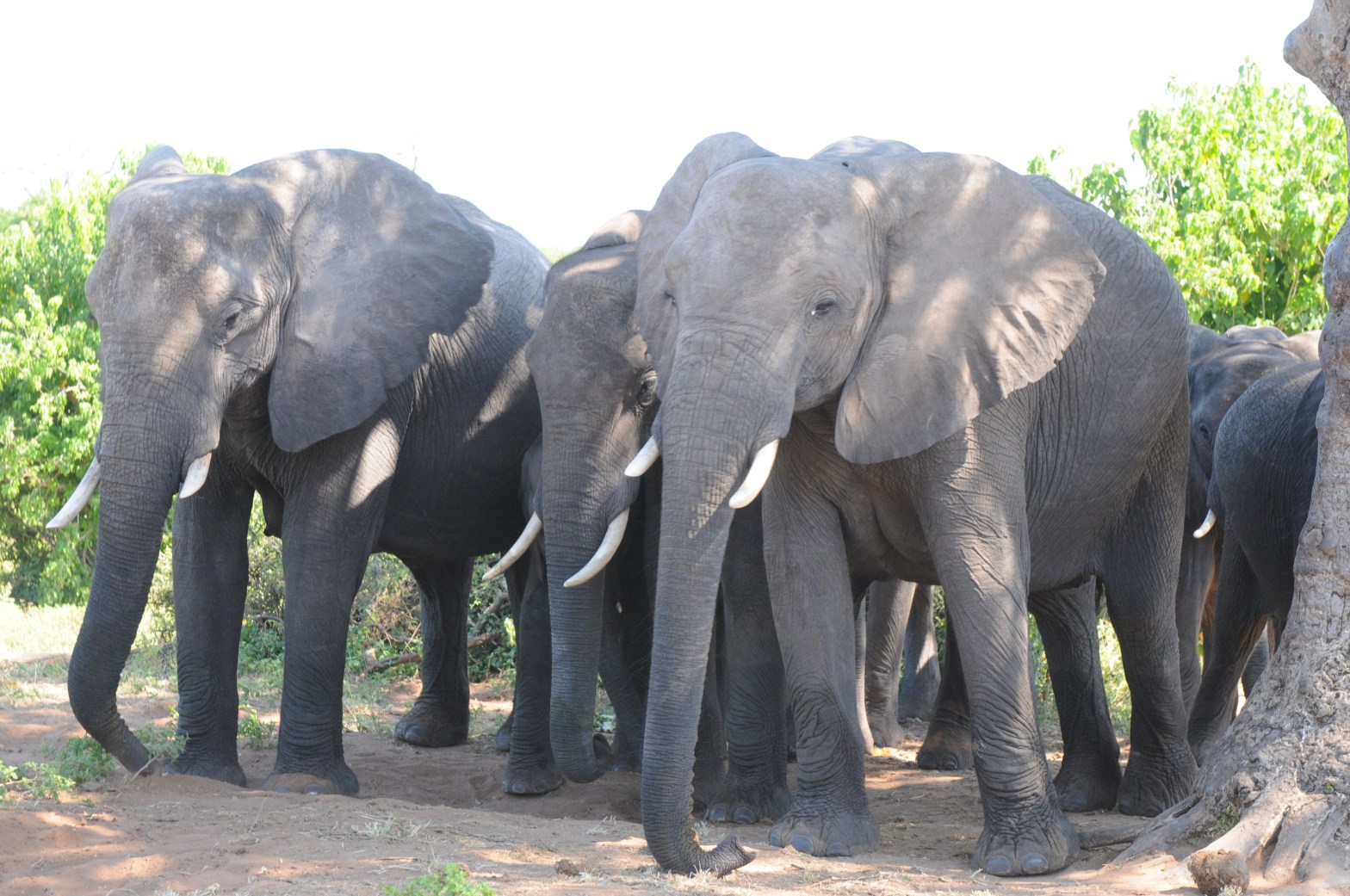
Elephants are social. The members of a group are related. The older female, her sisters perhaps, their daughters, and so on. Young males are part of the group until they become rambunctious, usually between the ages of 8-11  males then lead a semi-solitary life for their next fifty years or so.

dsc_2799
The big animals are alway sought out -well, I guess that really is the big and scary animals; we can’t forget the cats, dogs, snakes and other that give us a chill.  Certainly elephants are high on everyone’s list. They are stunning to look at, social, and groups can be identified and studied over time.
hippo
Hippos and Rhinos, though not closely related, are both big and blocky in appearance. The Hippo is easy to see during the day as they remain rather stationary in some wTer hole, pond, lake, or river. They come onto land in the late afternoon to feed on grasses. Southern Africa has had little rain for two years now and many animals have suffered. As hippos need wTer to nurture their grasses as well as for daytime lounging they can be impacted by drought conditions.
img_0477
Birds, birders, and birding could make Africa a prime destination without big mammals. The bird above is one of the rollers; the Purple Roller. The gaudy Lilacbreasted Roller is more easily seen and remembered as it shows it’s metallic blue wing patches.
dsc_2863
Then there are the hornbills; a bizarre, busy, attractive, odd-looking feature of almost every game drive. The Red-billed Hornbill is one of the more common species. There are hornbills both larger and smaller than this one.
dsc_6292
Birds of prey are very common in Africa. There are grassland, savanna land, acacia forest, and montane forest raptors of all sizes, filling all niches. The African Fish Eagle shown here is very common near water. It and the American Bald Eagle re in the same Genus, that is they are closely related (derived from a common ancestor).

Tiritiri Matangi – New Zealand’s Native Birds

Please consider all images as copyrighted – thank you. Contact me for use… DEClapp

New Zealand has not been spared the impact of human settlement. Most islands and archipelagos have been altered greatly by humans, agriculture, domestic animals, pets, and loss of habitat. Many island birds were ground-nesters and easy prey for people, dogs, cats, stoats,  mongooses, and changing vegetation. New Zealand has had a huge commitment to regaining some of the original nature of the islands. This work has been underway for many years and there is a new energy (and new money) in these sorts of projects right now.

Tiritiri is one of the earliest islands to have invaders removed and natural plants and animals returned; it has taken decades. The animals on NZ are basically birds; there were essentially no mammals before humans arrived. The small bats that were on the islands were very specialized to a predator-free island life and they suffered also. Here are a few of the original birds of New Zealand as they now appear on Tiritiri.

dsc_1254
To reach Tiritiri you catch a dedicated ferry in Auckland Harbor and start an hour plus journey to the island. There are likely to be lots of Fluttering and a few Buller’s Shearwaters along the way.
tui-jan15
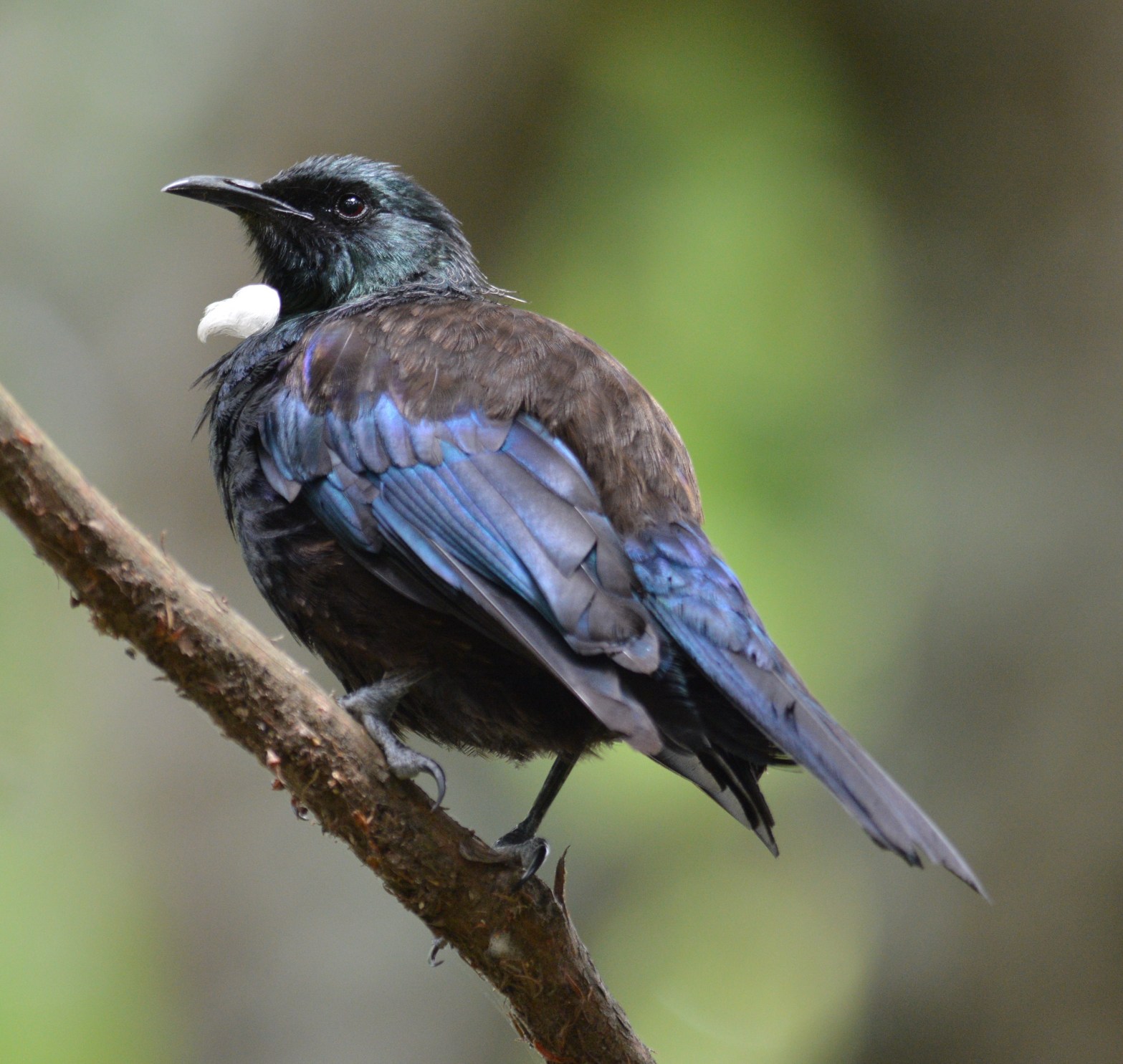
The Tui is a bird that persisted through New Zealand’s development though it’s populations are highest on predator-free islands. The two white puffs of feathers on the threat have been mimicked by the Maori in some of their dances.
oystercatcher-tiri-jan15
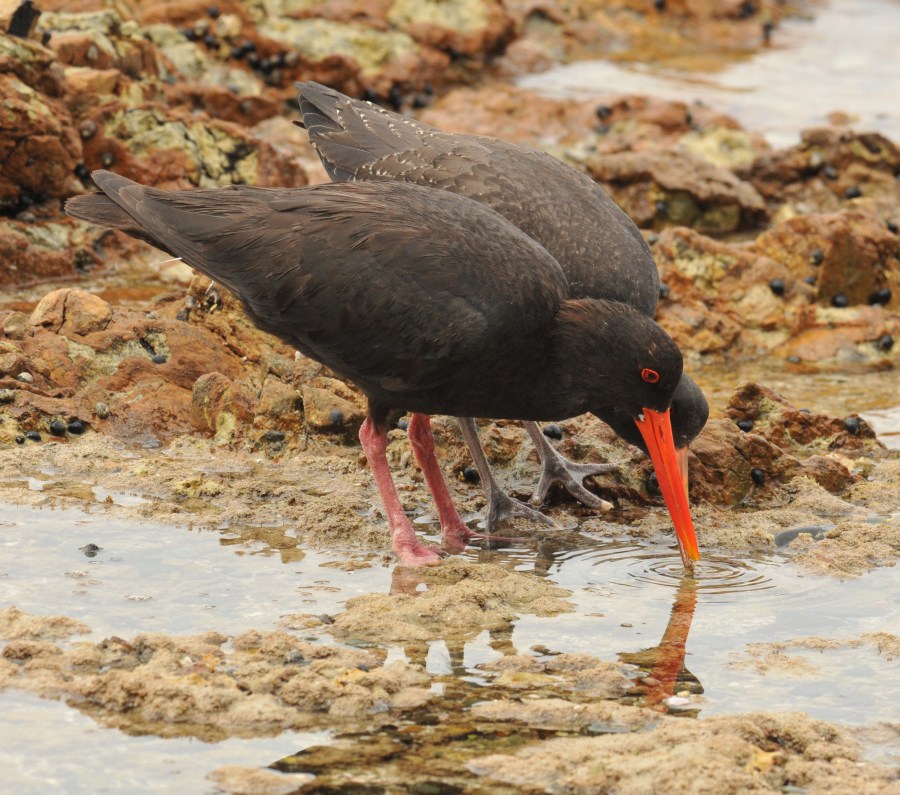
The Variable Oystercatcher is a common shoreline bird.
stitchbird-tiri-jan15-version-2
The Stitchbird is another bird that has taken refuge on the predator-free islands. All the birds on these islands are studied and monitored, hence the bands on the legs.
bellbird-tiri-jan15-version-2
THough the Bellbird wasn’t wiped out during the settlement era it does best on the few safe havens: islands like Stewart, and predator-free islands like Tiritiri and Ulva.
robin-nz-tiri-jan15
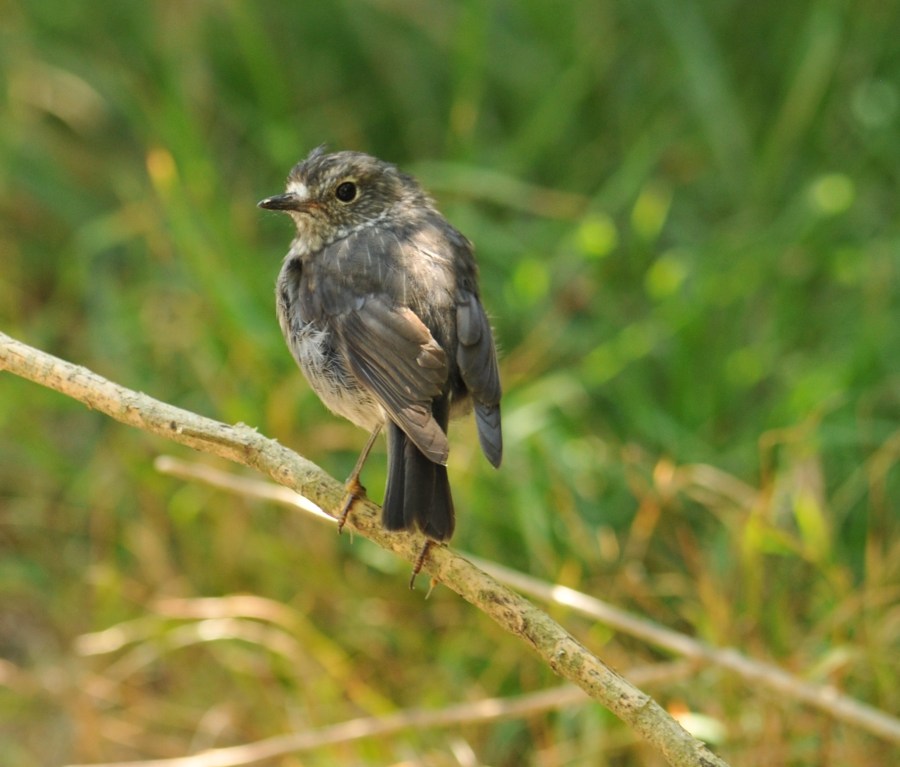
the tiny little New Zealand Robin is a perching bird (a small percentage of NZ birds versus 50% in the US) of the forest. Though not widely common it is often seen in area where there are few predators.
parrot-red-frntd-jan15
The Red-fronted Parakeet is one of a few parrot on the New Zealand archipelago
whitehead-jan15-version-2
the tiny Whitehead reminds me of a chickadee or verdin or bushtit. They travel in busy, oust flocks and are pretty common on the protected islands.
teal-brown-tiri-jan15-version-2
The Brown Teal is a very rare duck. It can be found in small numbers in specific habitats on both islands. It is most easily seen on Tiritiri especially if there has been rain to fill the freshwater island pools.
takahe-tiri-jan15-version-2
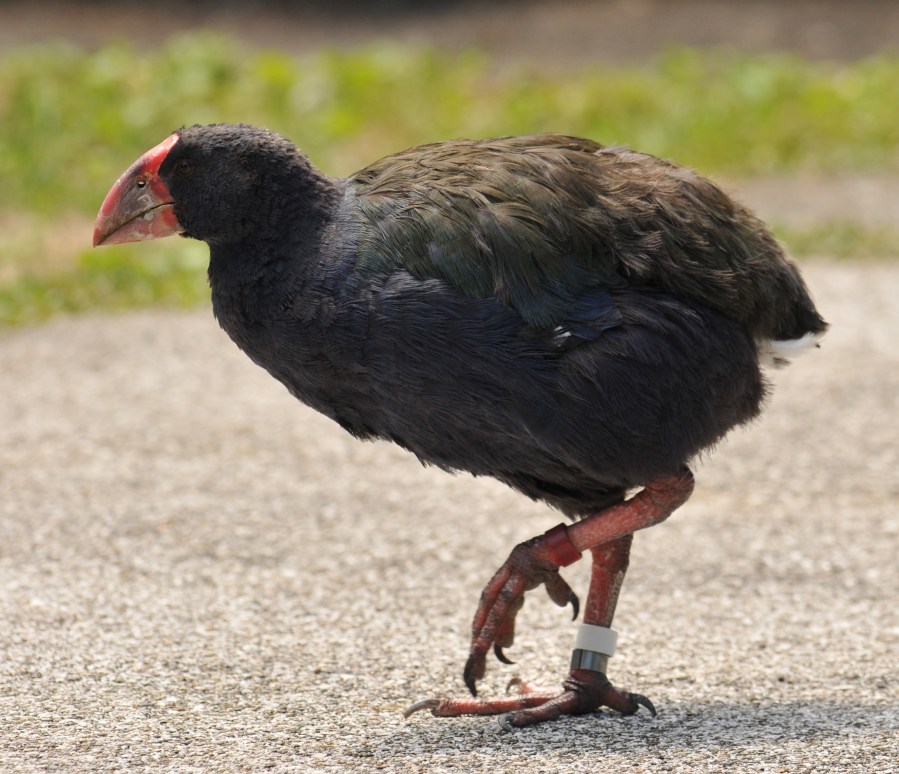
The Takahe is a story!! It was unseen and thought extinct for more than forty years. It was discovered in high tussock grasslands in the mountains of the very southwest corner of the South Island. Breeding programs have been successful and the Takahe is now well established on predator-free islands.
dsc_1599
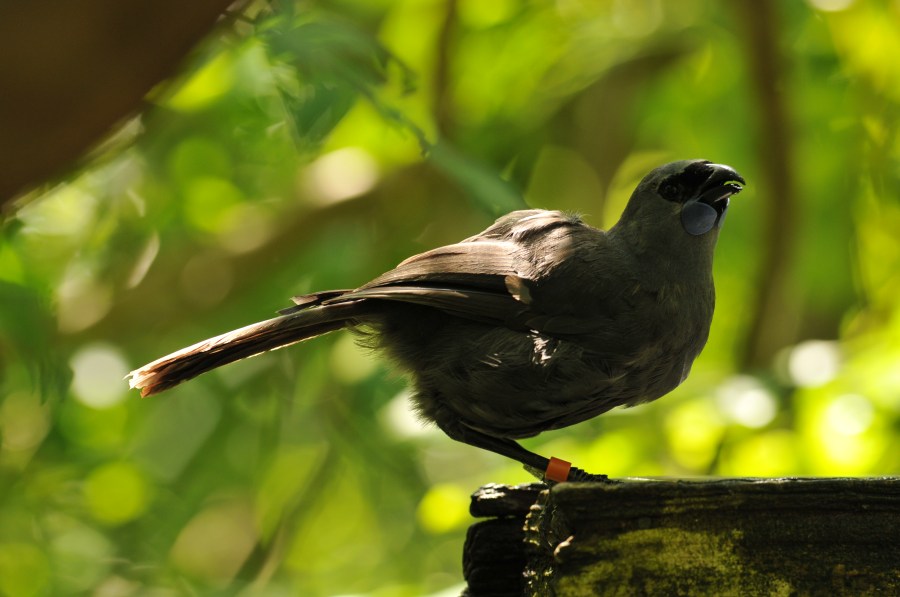
The Kokako is an odd, wattled-bird of the North Island. It has been saved in large part due to the safety oil predator-free islands and can be seen on Tiritiri on about half the visits. It is about the size of a Blue Jay and is resident in podocarp forests. (Podocarps are somewhere in the ontheroadwithdec blog future.)

Louisiana Birds

Please consider all images as copyrighted – thank you. Contact me for use… DEClapp

While at the Yellow Rails and Rice Festival we saw lots of birds, many familiar and some, less familiar, and in numbers we simply never see up here in Massachusetts.

I am posting this, second blog page, from my iPad hoping that it works easily. Here are a few bird images from Louisiana.

dsc_3869
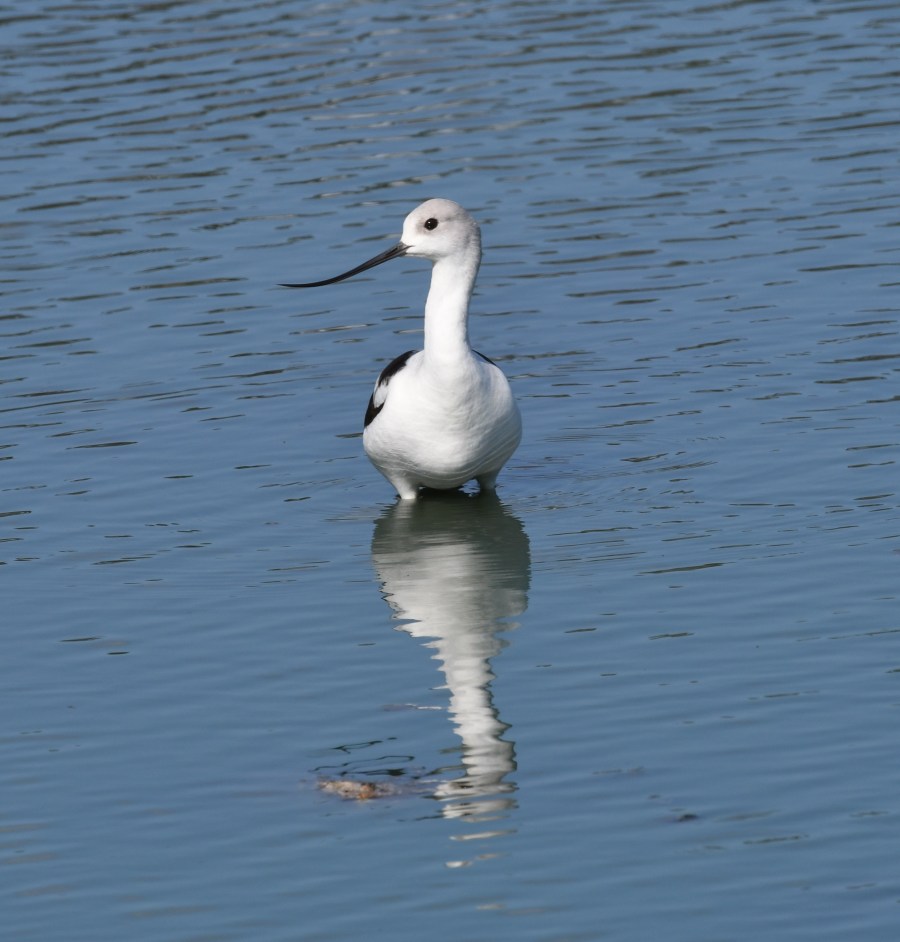
The Avocet has a recurred bill that is swept back and forth through the water snaring little critters. They are alway elegant; even when standing in a sewage lagoon.
dsc_3921
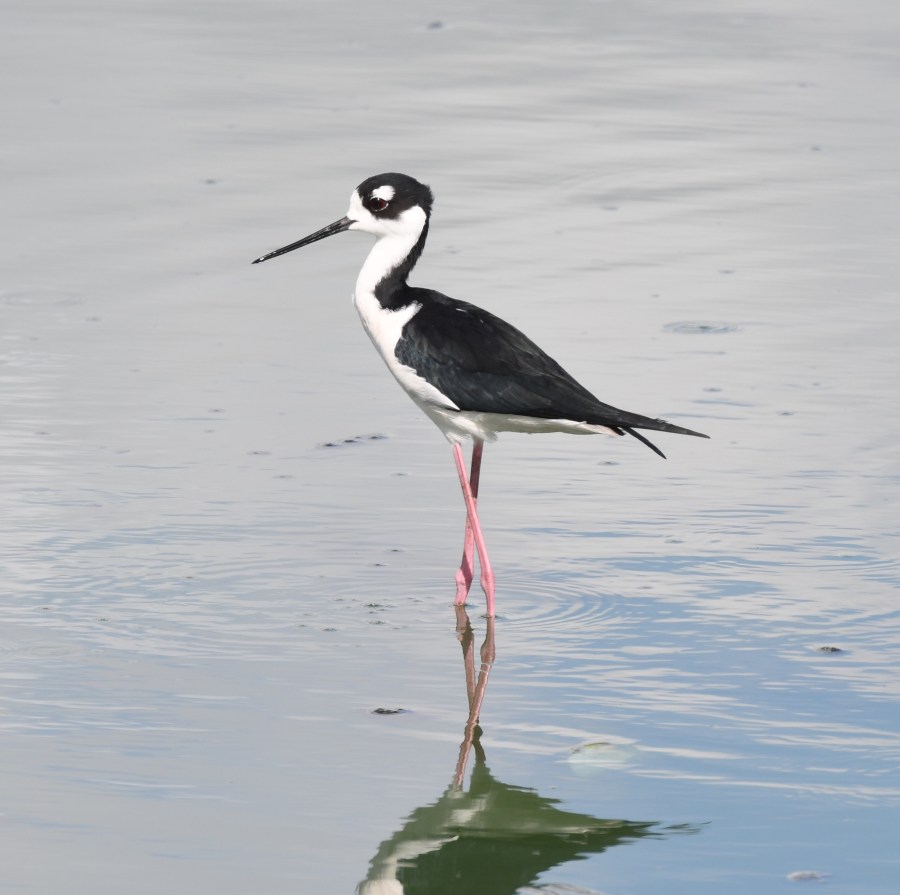
The Black-necked Stilt is another of the elegant shorebirds. The pink legs and stately walk make it a treat whenever seen.

W

dsc_4097
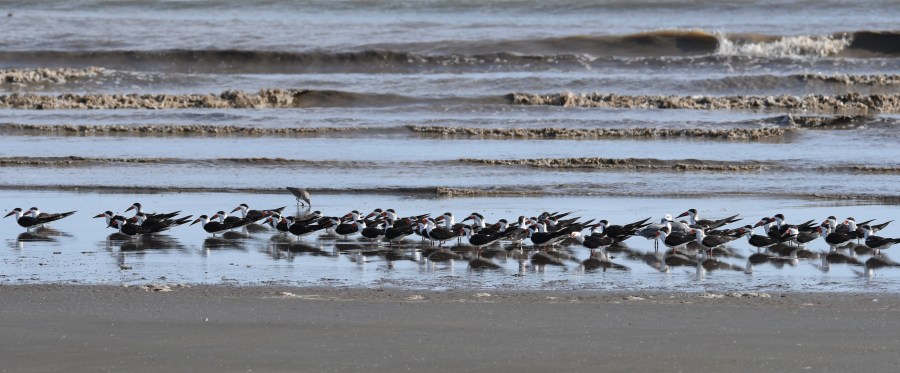
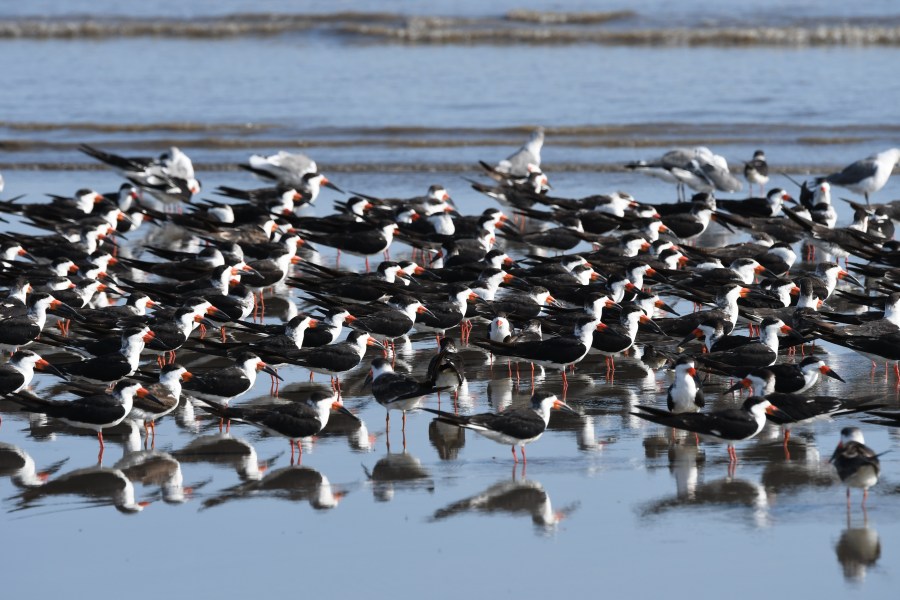
Black Skimmers are another southern treat that are always fun to see. The extra long lower mandible cuts the surface of the water feeling for small aquatic creatures. The mandibles snap shut when contact is made.

dsc_4120

dsc_4134
The Crested Caracara is a rather uncommon bird of prey. They are often seen walking through fields looking for smallish prey items or things killed or damaged by agricultural equipment.
dsc_4160
Perhaps the most common of the wetland birds was the Common Moorhen or Common Gallinule. They are duck-like in habits and more closely related to other gallinules and the (American) coot.

Elephants along the Zambezi River in Zambia

Elephants can reproduce easily and the death of young elephants is not to common. they are familial and protect the youngsters from the day they are born. Females will have a 250 pound youngster every 3-10 years after the previous youngster. The condition of the female (age & health) probably determine when she will ovulate. Females are in heat for a very short time and then they have an almost two year gestation period. The youngsters can eat at two year but most females lactate for four years. The females begin breeding at about 15 years and the young males are persuaded to leave the matriarchal group at about ten years – when they become a teenage nuisance and start to chase the girls.

This page is on the elephants at the Royal Zambezi lodge on the Zambezi River in Zambia. This is one of Africa’s most picturesque locations and the elephants and hippos are always in sight.

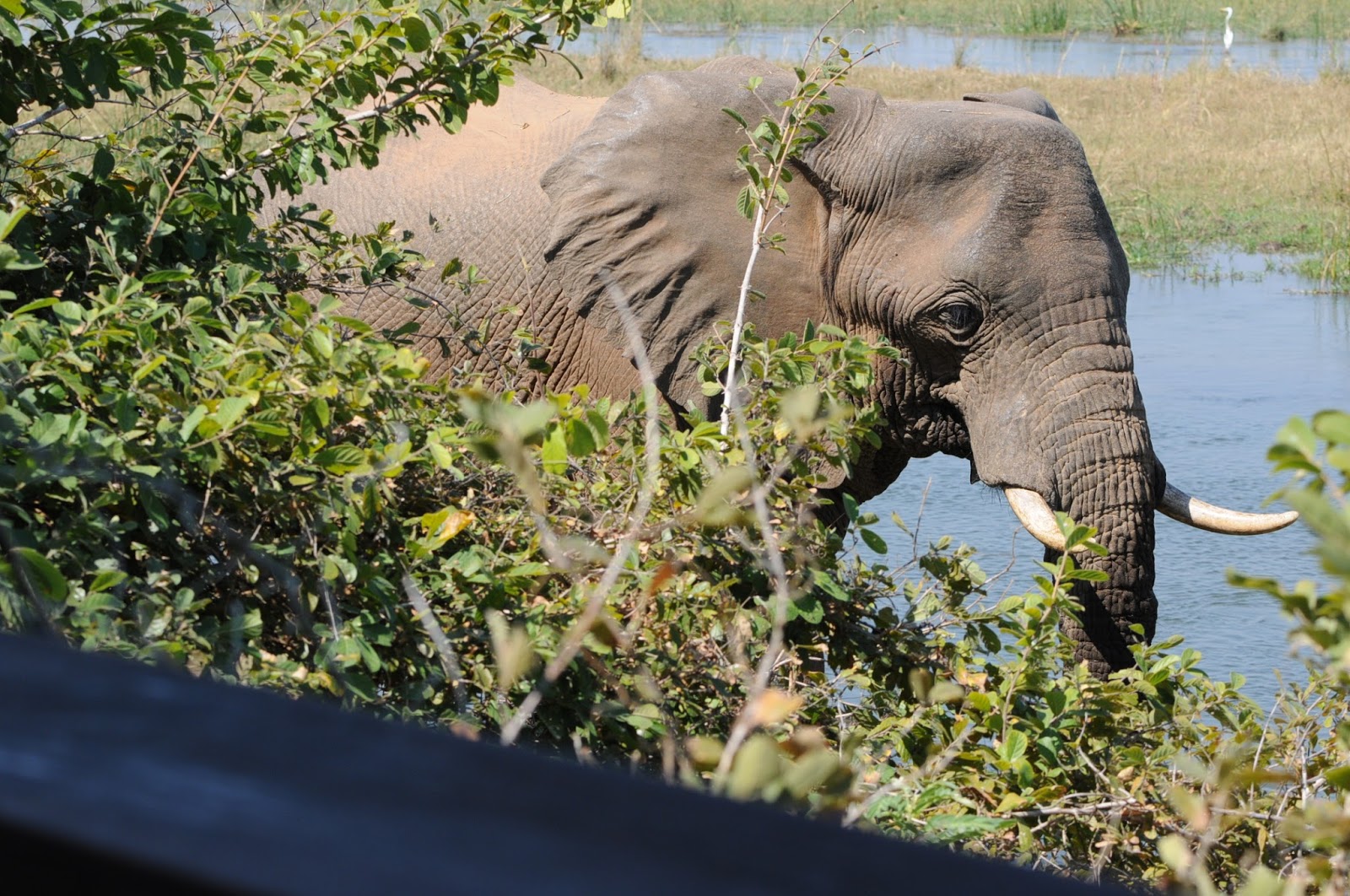
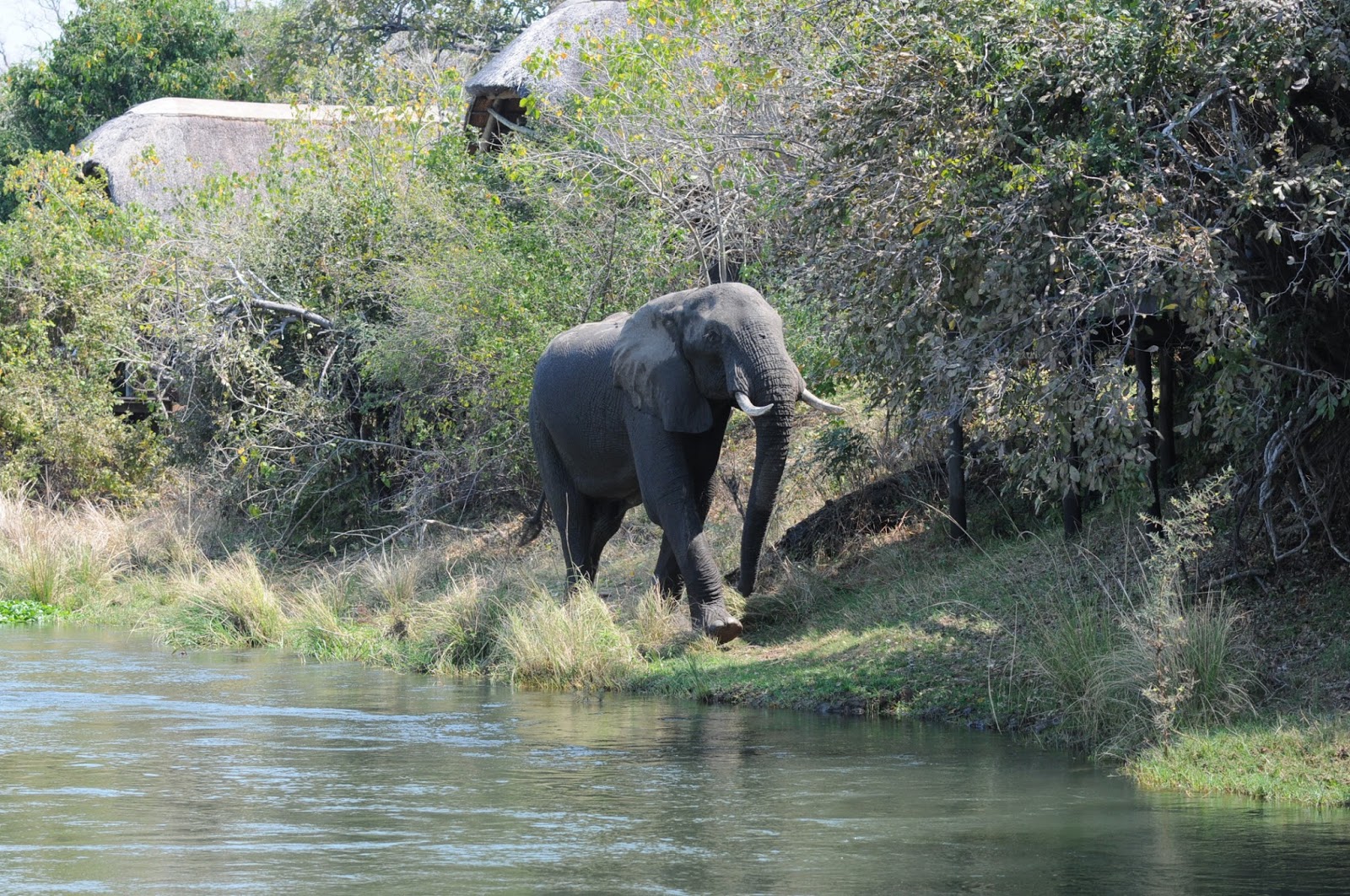
Outside the tent/chalets is the river and in the river are elephants. they are around pretty much all the time and generally provide photo opportunities rather than consternation. This one is sloshing in the wet grasses just outside my room. The area outside the river channel is quite dry and elephants enjoy the water and the wet plants. 
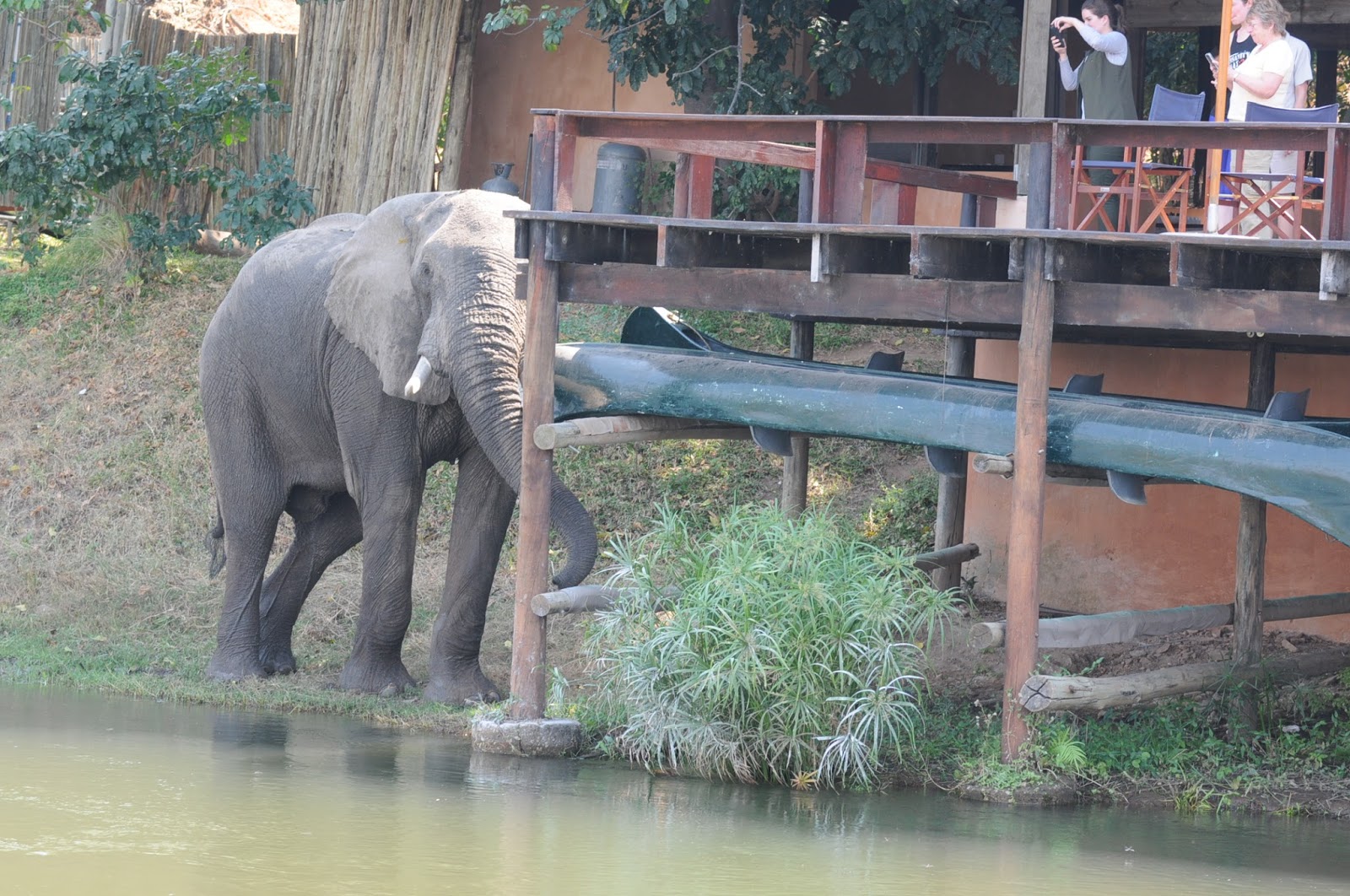
My deck rail is in the foreground as this girls wanders past. In most cases the animals here are parts of small family groups although there are a few single males around as well. Elephants will eat hundreds of pounds of vegetation each day so they are either in the dry woodlands breaking up trees or along the river drinking and eating the softer wetter vegetation. There are elephants in good numbers here in both habitats.
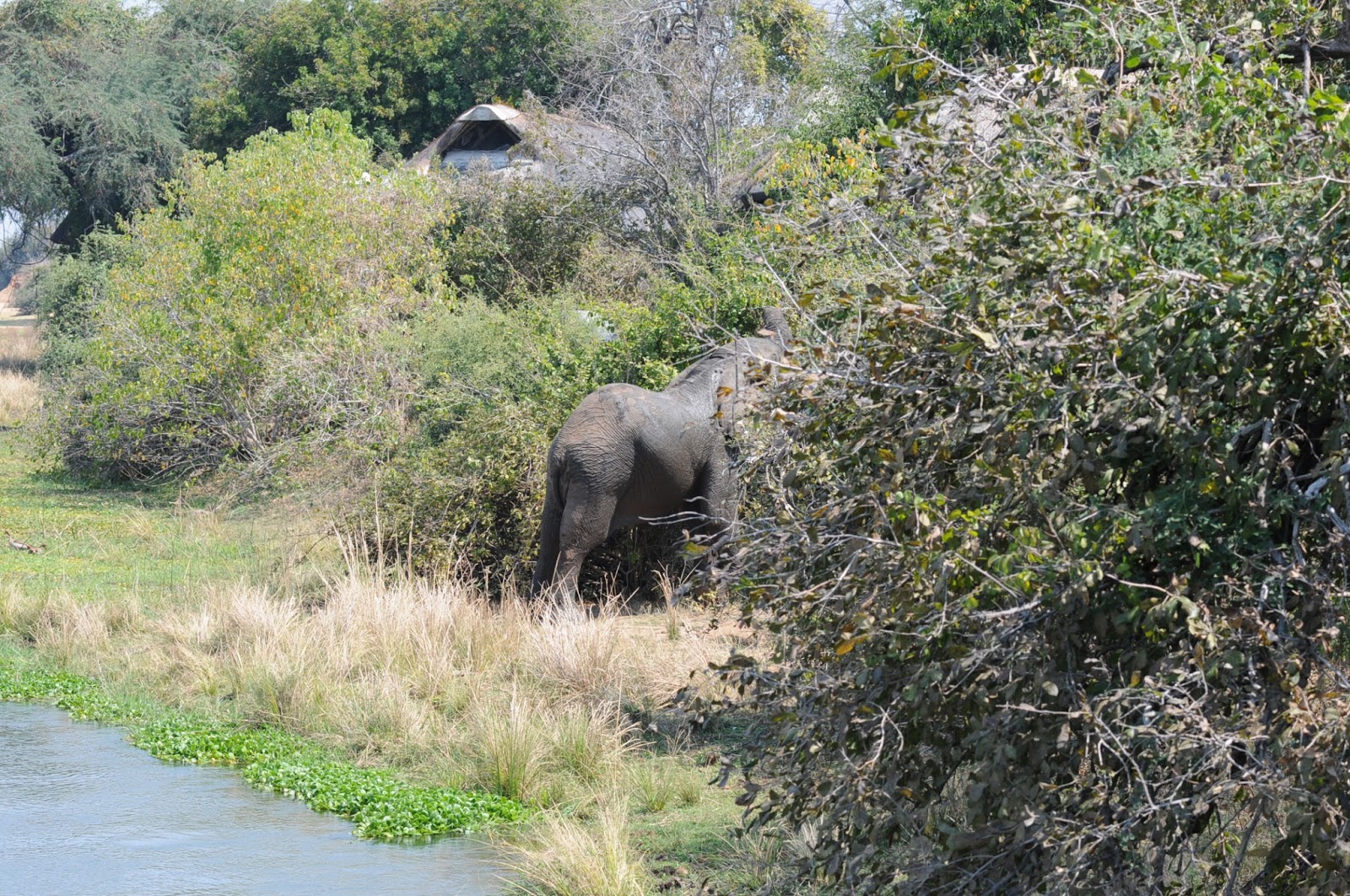
Because the lodge is right up against the river (the better to go tiger fishing from) animals that utilize the river edge are often in or near camp. The image above and the one below show an elephant working along the river edge. the tent/chalets can be seen just set back a bit from the water.
As far as I know they just wander the edges and cause almost no trouble (usually). But there are occasions where a new group may arrive and not understand the protocols associated with suburban life. It is always wise to have an escort in the dark and to be careful in the daylight.
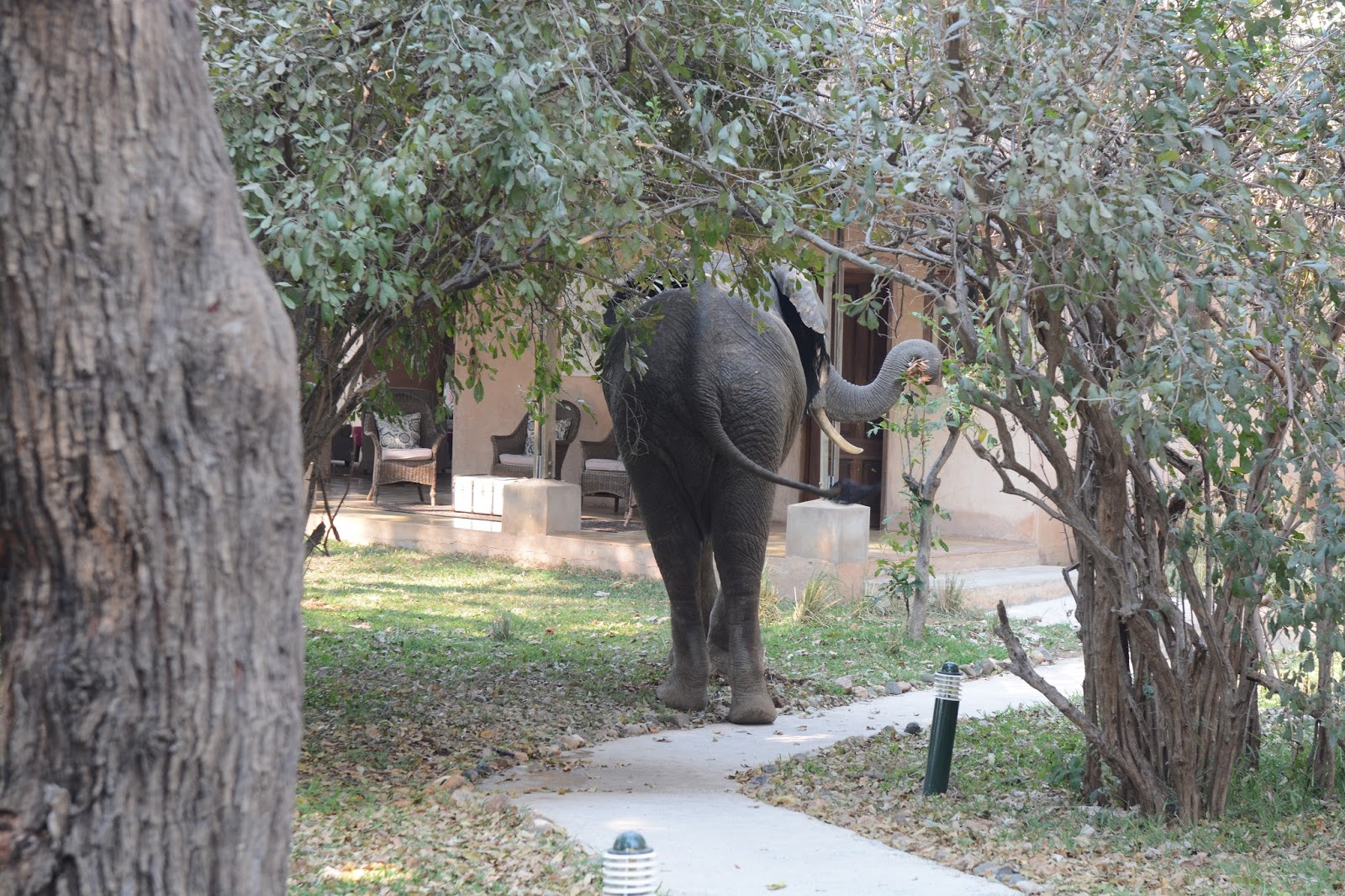
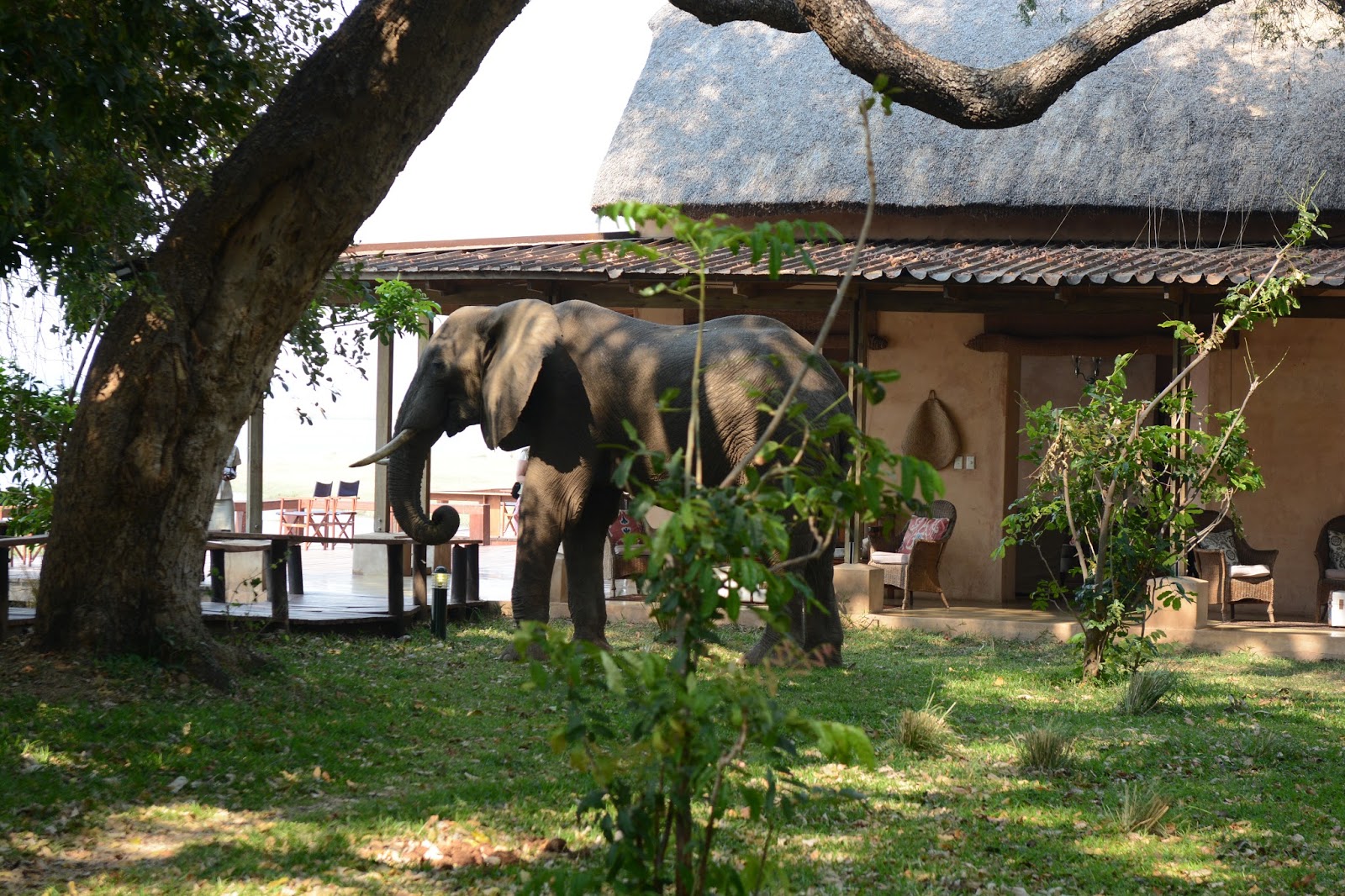
The image above and below here show an elephant that uses the path and then gathers seed pods that have fallen onto the roof at the reception/dining/gathering building.
The last image, below, is an elephant from Namibia. but he was just to grand not to add in to this page… He was just magnificent.

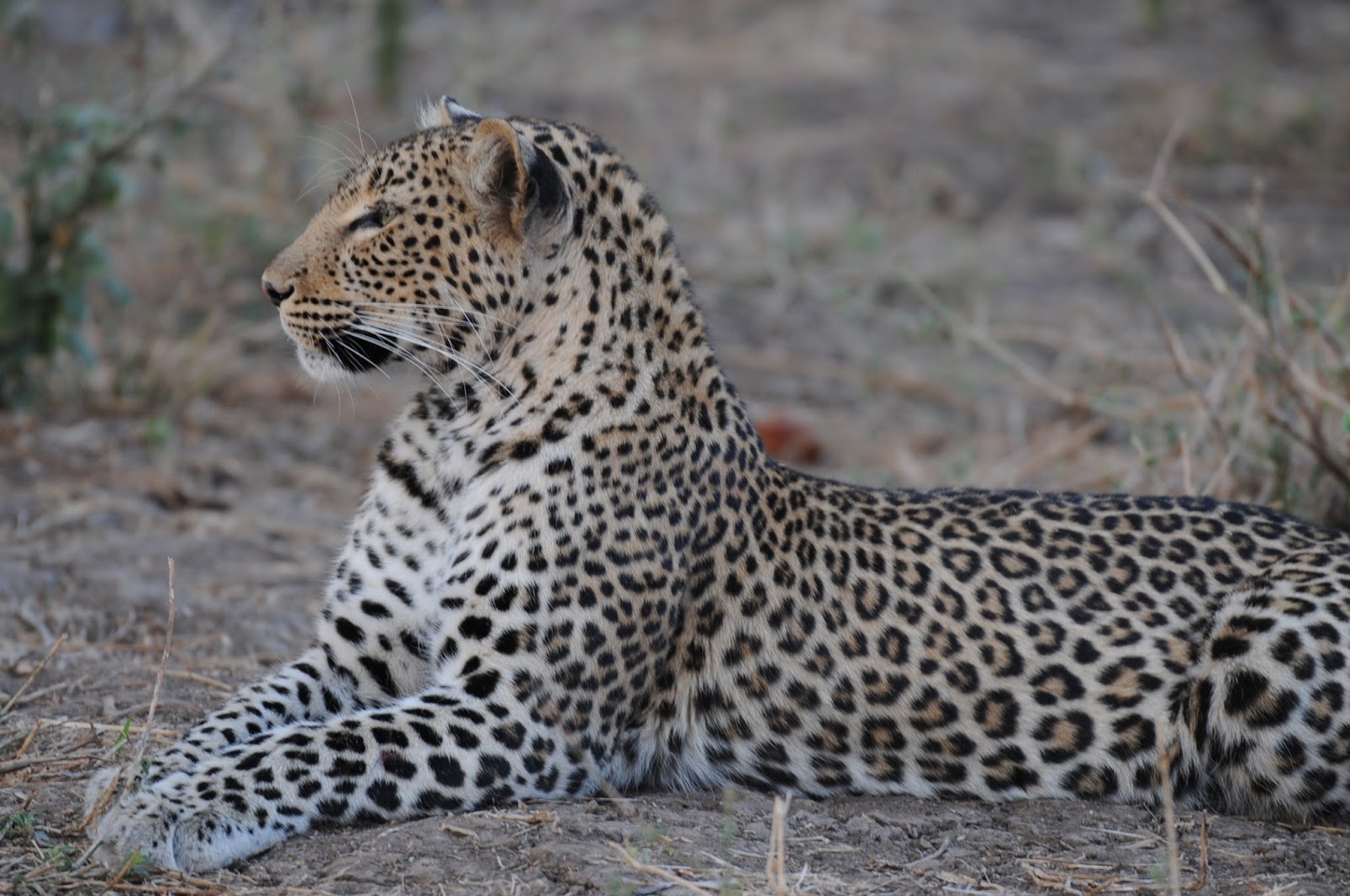
A Cooperative Leopard in Zambia

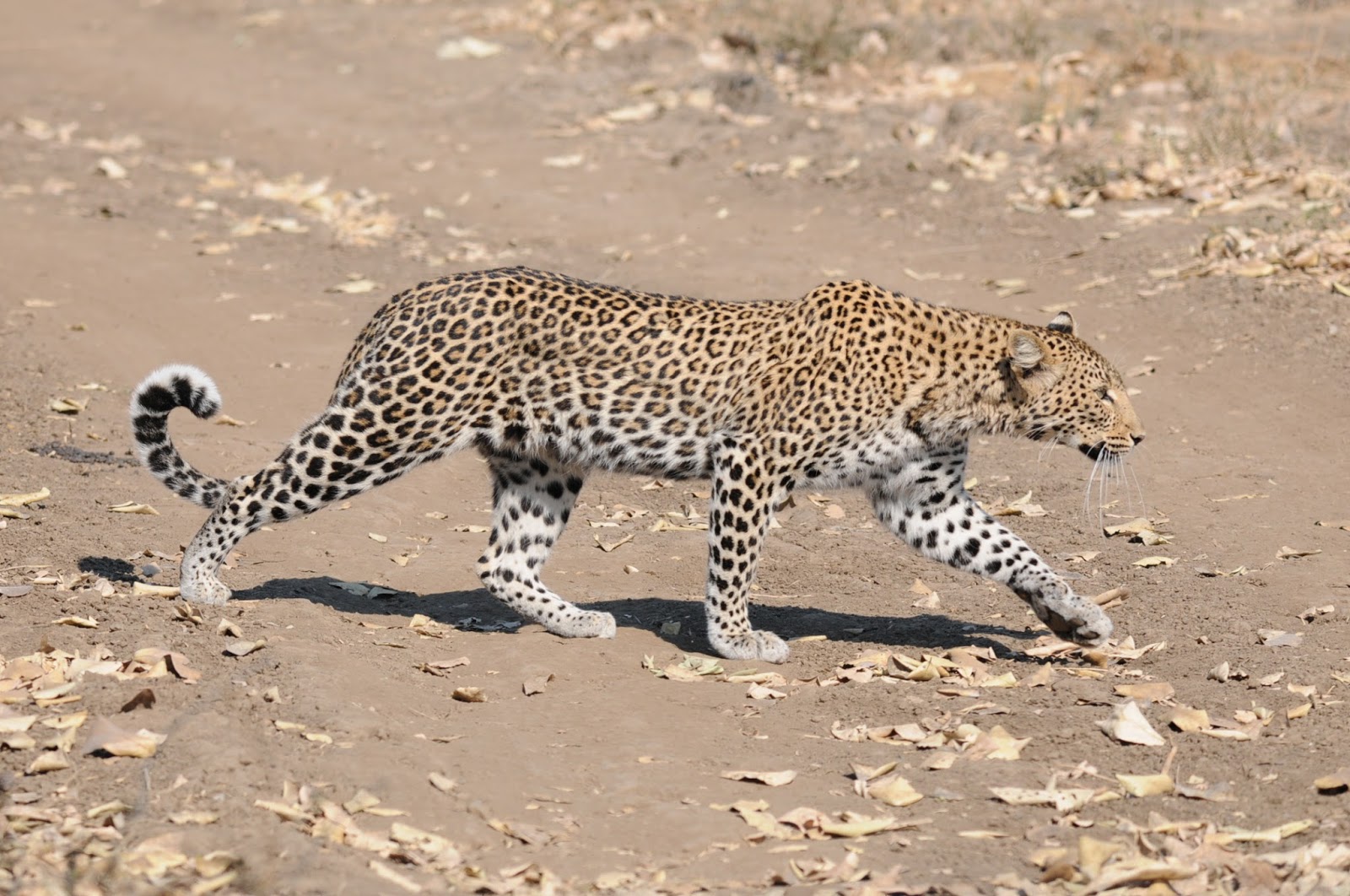
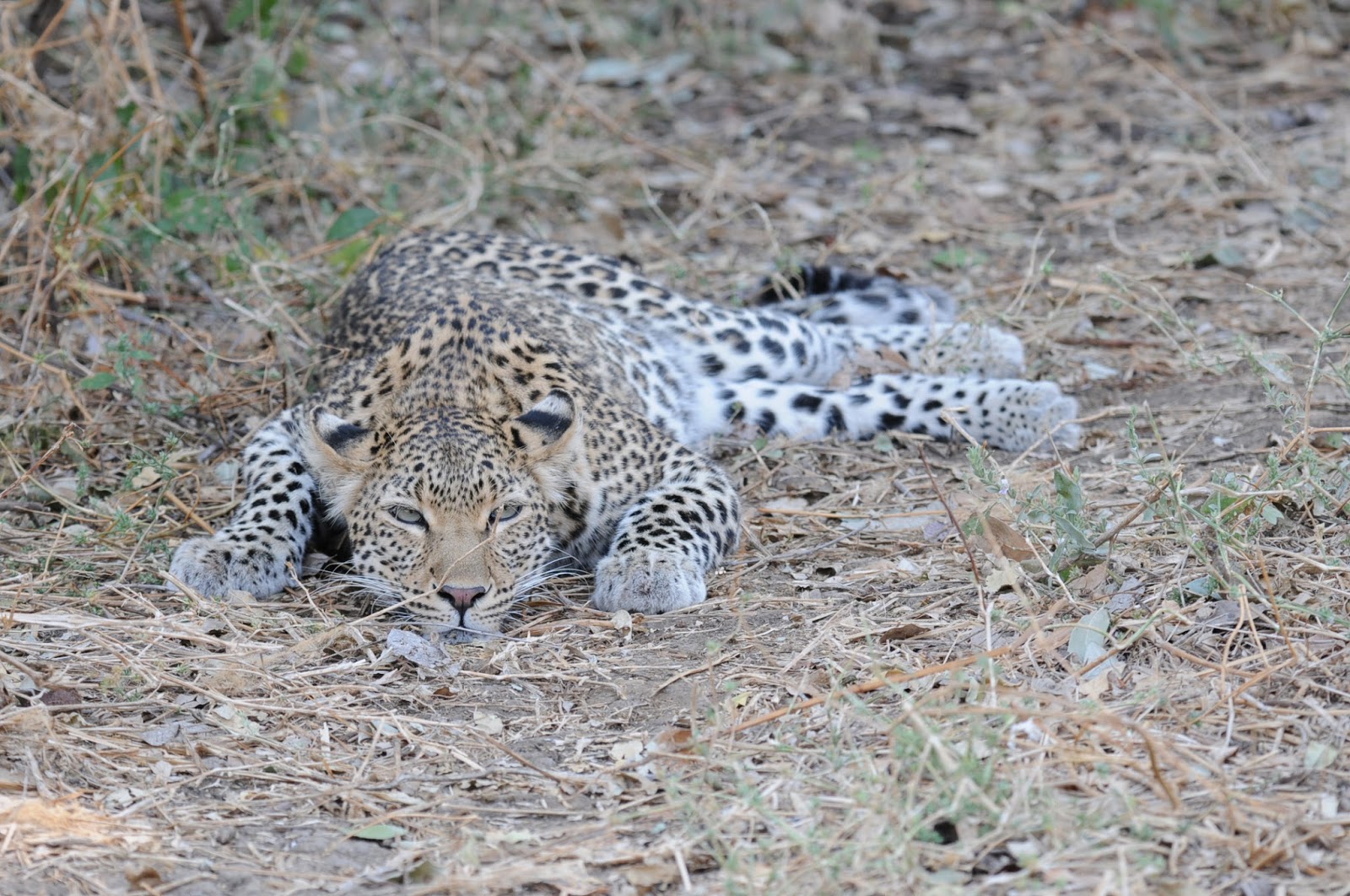
Leopards are better than lions; well maybe not better but they are more interesting in many ways. Lions are rather common on the African savannas where as leopards may also be common* and widespread but no where are they as easy to locate or watch. In both cases the animals, lions and leopards, are likely to be dozing during the day. Cheetahs are the only truly diurnal cat. To see a leopard up close is memorable and to see one go through a variety of leopard behaviors is quite special.

In Zambia, along the Zambezi River, inside the Lower Zambezi NP we came upon a most cooperative young female leopard. this was great for us but may not play out as great for her. Leopards should be shy and retiring, spending the day in a tree or thicket, and living as a creature of the crepuscular times. She was seen several days in a row out in the open and on the ground near her food/kills. This will soon invite lions and hyenas to the area and she may not only loose her lunch but her life.

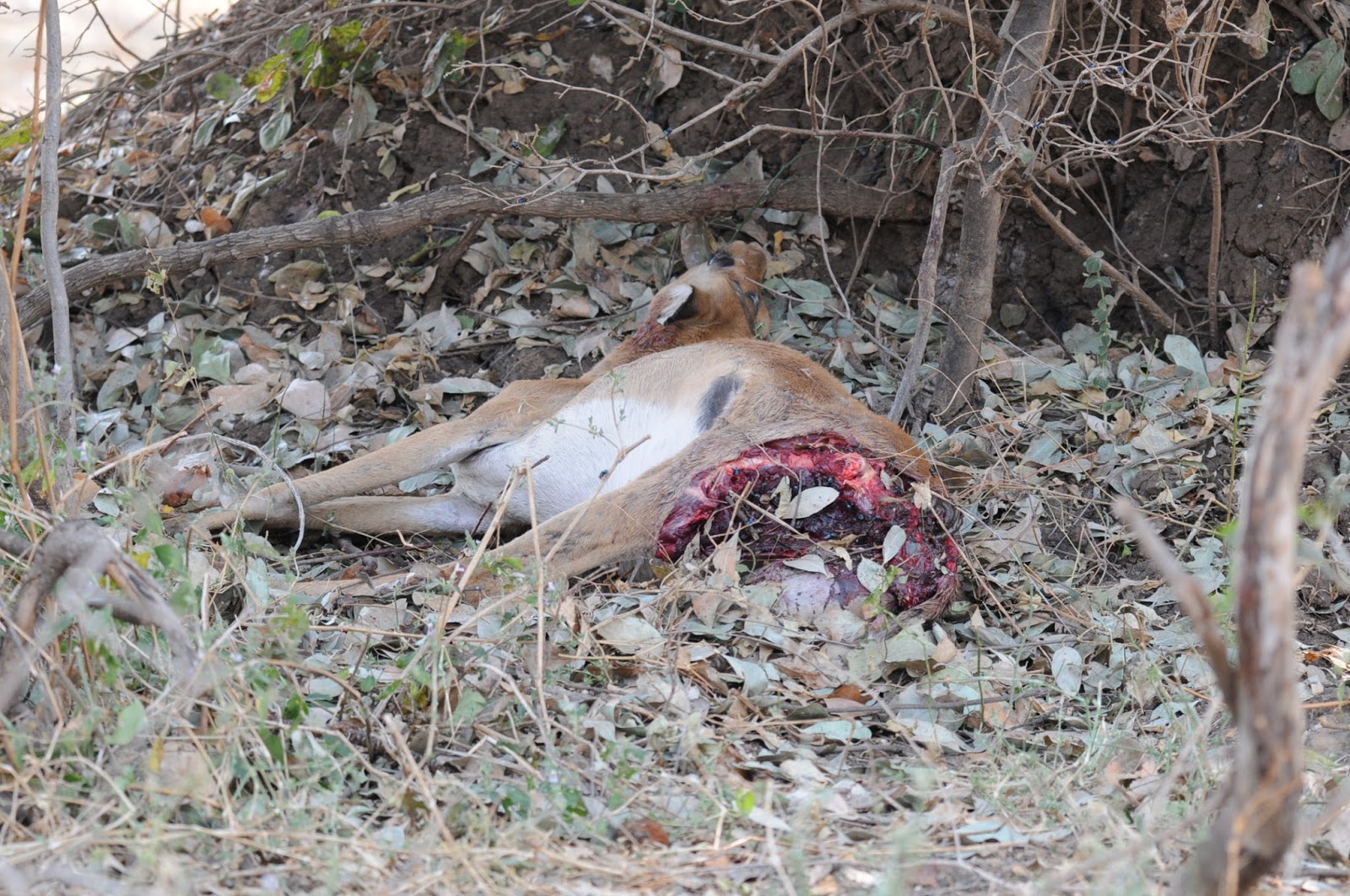
But anyway, this was about a two year old female who is out on her own after spending her first two years with her mother. She may have had litter mates as leopards commonly have multiple births. She successfully hunted a baboon just  before dusk as the baboons were headed to a roost tree for the night. And the next morning she had killed a young impala. In neither case did she take the remains to a tree. She probably left the baboon remains, there wasn’t much left over, for the night scavengers and made the kill early the next morning.

This animal was clean and shiny. Her like so far has been easy and she is pretty much untouched by her surroundings. Now that she is away from her mother and on her own things will likely become more demanding.
We found her one morning with a dead impala but she was still interested in the remaining impala and spent some time looking at the group browsing nearby. They were accompanied by baboons and the baboons were on guard. If she had started to stalk the impala the baboons would have barked and blown her cover.

So, she slinked away, low and pretty much out of sight. Once she had moved so the impalas and baboons couldn’t see her she relaxed again.  
She had most of this impala remaining so her desire to hunt was not based on food but on a cats instinct and desire to hunt.
When she relaxed she lay out on the ground usually right out in the open. Most leopards learn to climb trees to avoid encountering troublesome competition. It is probable that when lions or hyenas arrive to steal her dinner she will learn to (both) hide her food and herself in the local trees during the stay and during siesta time. If she doesn’t learn this lesson the lions and hyenas are likely to kill her or at least make her regret learning slowly.
She is a nice looking animal. I will be back there in a few weeks and hope that she is still around. As I said she is about two years old and will likely breed at two and a half. The male is not part of the scene after mating. Lions are the only social and group cat. The female will secret the baby away for a few weeks and then keep it/them with her for about two years.
A female leopard will weigh only one hundred pounds, max at about 130. A male will be about 20% heavier and sometimes even more. 
* Leopards are thought to be common and widespread in all habitats excepting extremely arid ones. But, as they are secretive, nocturnal, and quite heavily poached it is difficult to get a real sense of how many there are in any given area. Their main predators are man and lions; two rather common animals in most leopard habitat.

New Zealand’s Fox Glacier

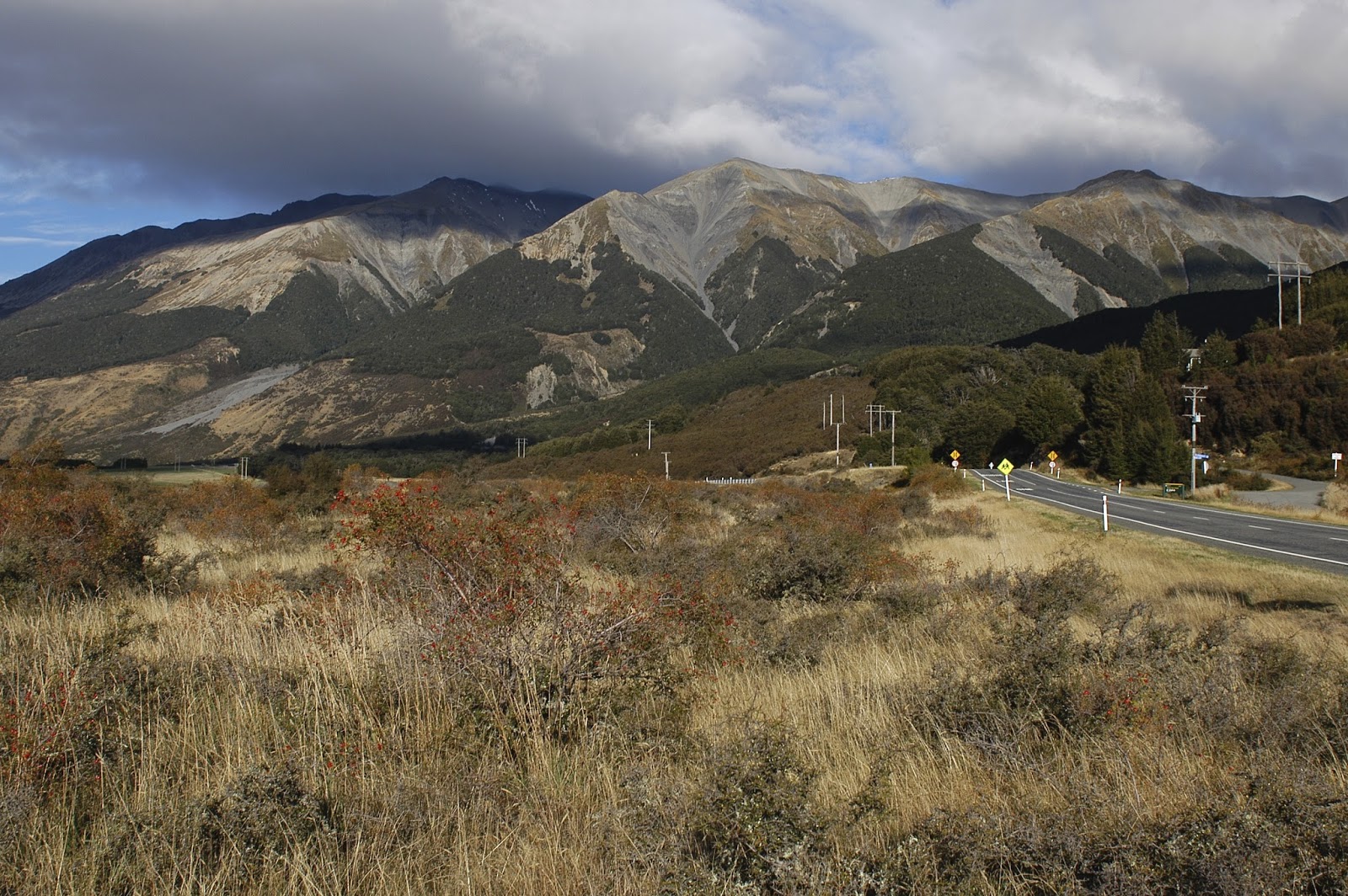
New Zealand’s Fox Glacier is in the Southern Alps on the western side against the Tasman Sea. The entire west and shatter into smaller pieces, often very much like shale.side of the South Island is rugged and there are few roads that go east/west and really only two roads on the entire island that go north/south.
By road the Fox Glacier is between Haast and Greymouth on the #6 road. There are two glaciers that one can get to visit in this area; the Fox and the Franz Josef Glacier. In actuality (as the kiwi walks) these two spots are not to far from Mount Cook* but you have to drive a big loop to get to the glaciers as there are no roads through the mountains except heading for (1) Milford Sound (and that is a dead end road with no north or south options at its terminus, (2) the road from Wanaka to Haast, (3) the road over Arthur’s Pass that heads east back to Christchurch, and (4) the northern road up near Westport.
*Mount Cook is where the famous mountaineer Edmund Hillary trained. Mount Cook is a great destination but the road in to the site is a bit remote. the actual road to the hotels and camping areas is a road that does dead end into the eastern side of the Southern Alps. The two glaciers are on the western side and there is no road that even comes close to connecting these two spots. The educational films at the Mount Cook interpretive center are simply magnificent. The mountain and its story are both grand and the biography film about Hillary is touching, explanatory, and so real you feel as if you are climbing and trudging along with him. And you feel just as sad and emotionally drained as he did when the plane crash ki…….. oh no!, go see it for yourself. It is worth the trip.

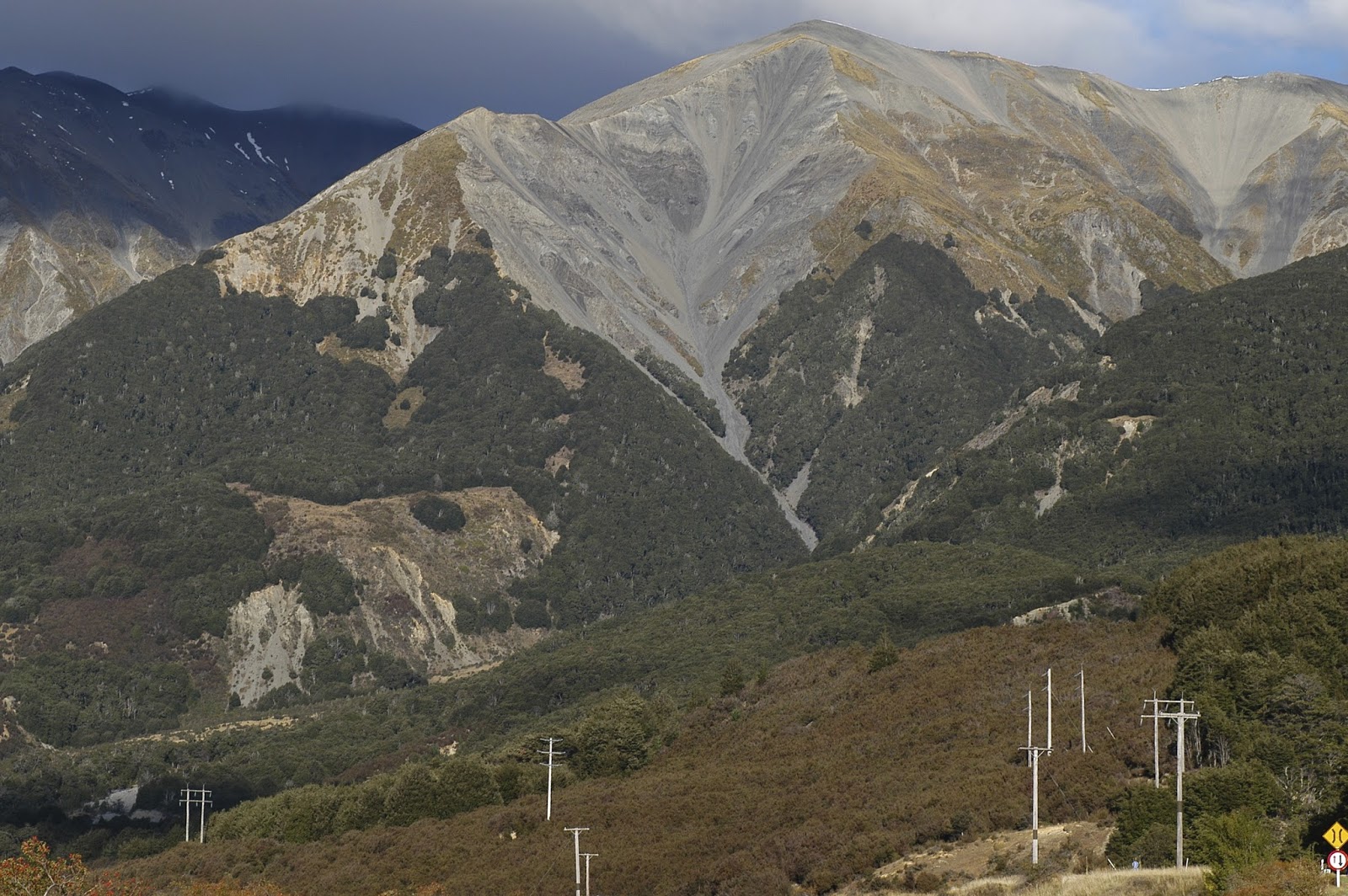
The mountains that make up the Southern Alps are often made of layers of compressed mud stones. These sort of rocks erode way in layers creating loose pieces of shake which eventually slide down the mountainsides and accumulate at the bottom of the slope.
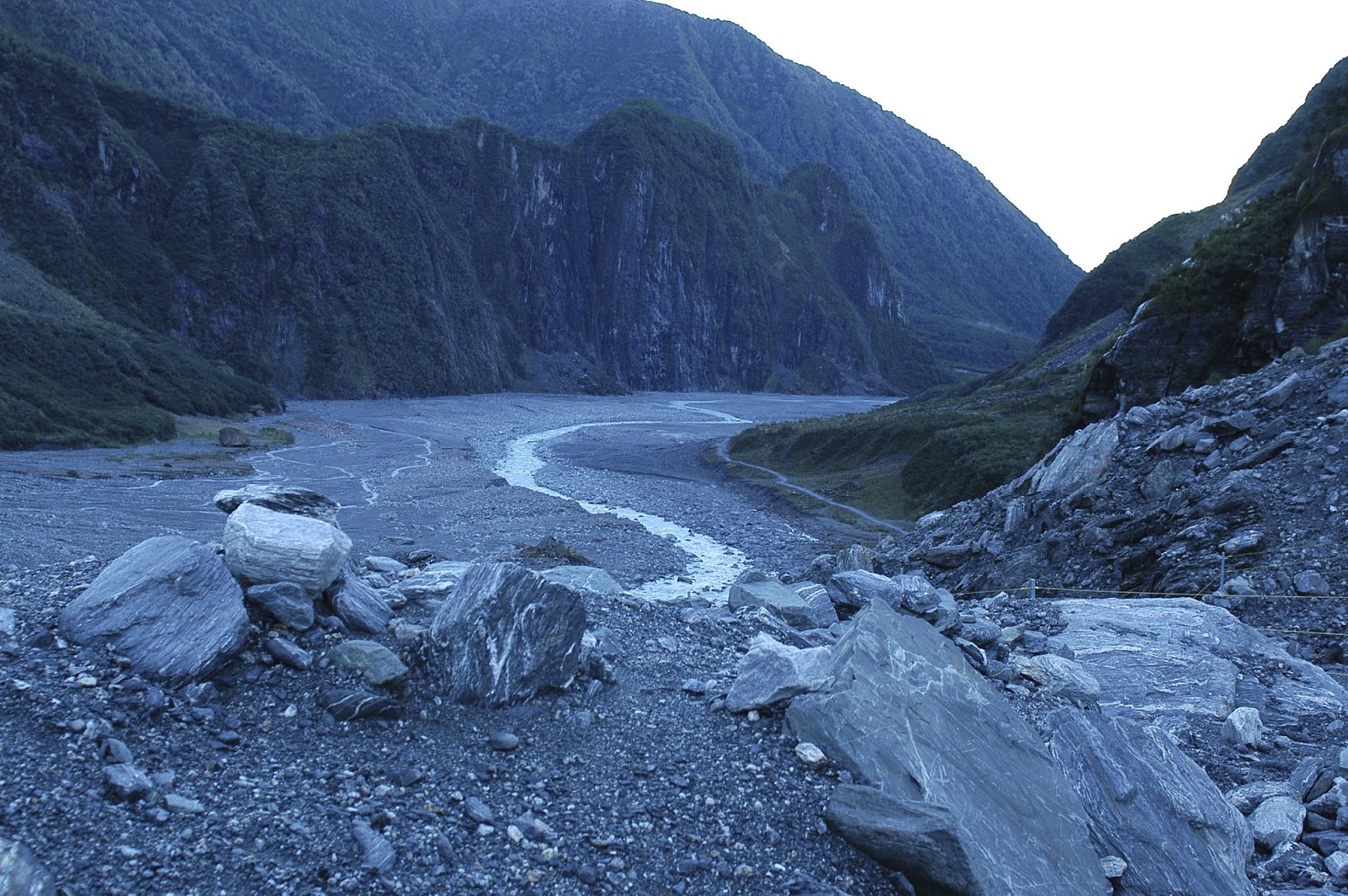
There are often gray valleys that are simply a mountain in the process of falling apart. tThe vegetation does its best but the slopes are poor in nutrients and don’t hold water, so life is difficult.
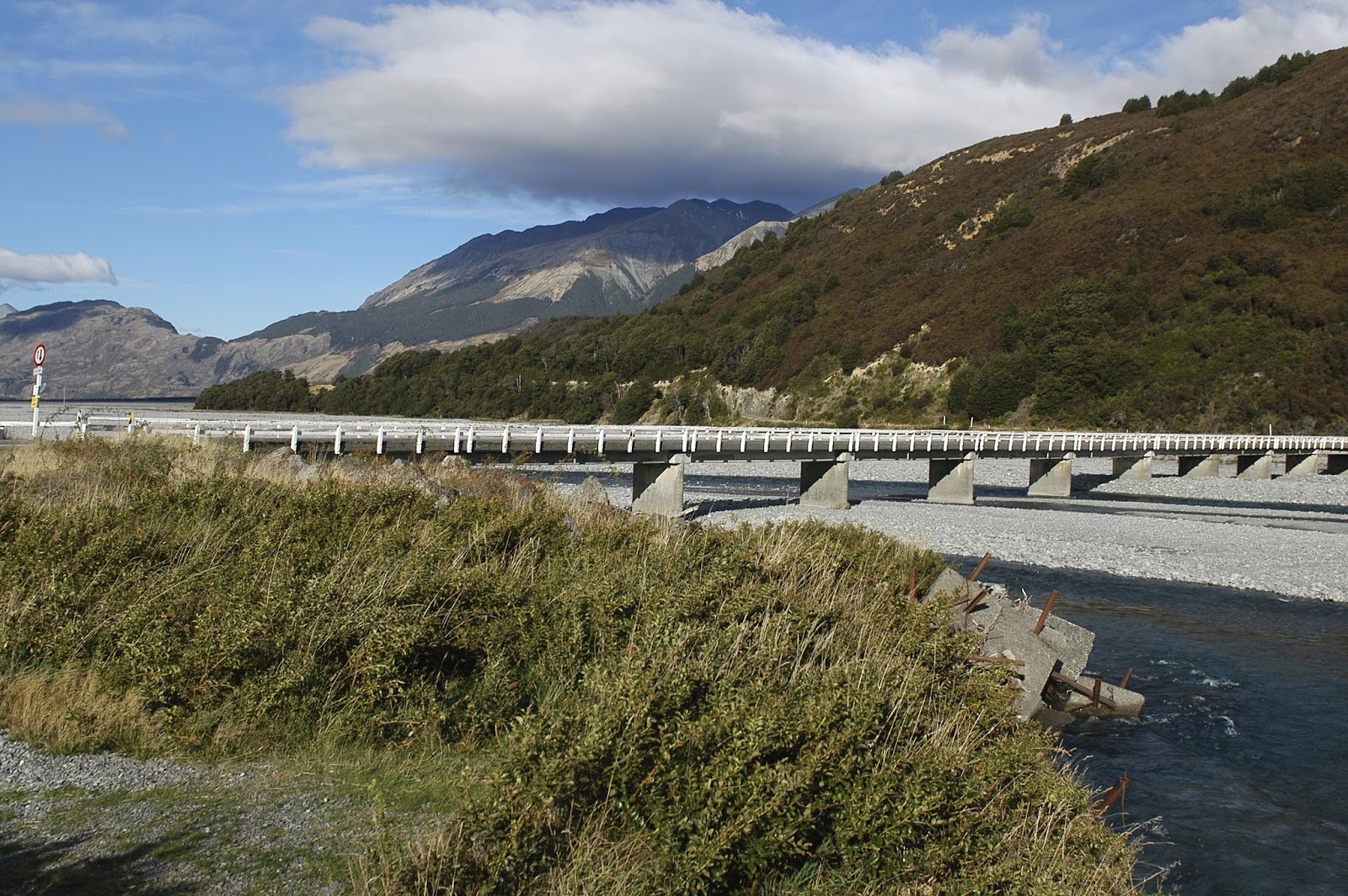
Where there are roads they often follow a valley or switchback up to the easiest pass and then switchback down the other side. Here a bridge passes over a wide gravel expanse that demarcates the boundaries of a glacial river as it drops down from the mountains. In time of flood these rivers will have many stream beds and as the water diminishes there will be a main channel of perhaps no visible water at all, only the stones that have washed down from the decaying mountain upstream.
Fran was excited to see the glacier as she had never seen a river of ice before. I’m not sure what she expected but this was not a huge groaning ice floe. It was a glacier being covered by silt, stone, and debris as it slowed its progress and the moraine material it was dragging or pushing along was able to cover the surface.
But it was a river of ice and it would have to do. It is so easy to see these glaciers as living entities straining through rocky passages, breaking mountains, and transporting the mountain-fragments toward the sea. The accumulated dirt and ground stone was visible everywhere. When a glacier is large and active it is often part of a series of glaciers that descend for several mountain valleys and connect at a lower level level. Some ice fields will have glaciers descend and combine so that one large glacier reaches the sea but the tributaries can be found in the dirt-lines that form when two glaciers join. The lateral moraines of the glaciers are imbued with grit and that grit joins with the grit of the neighboring glacier leaving a stripe dow the middle of the new and larger glacier.
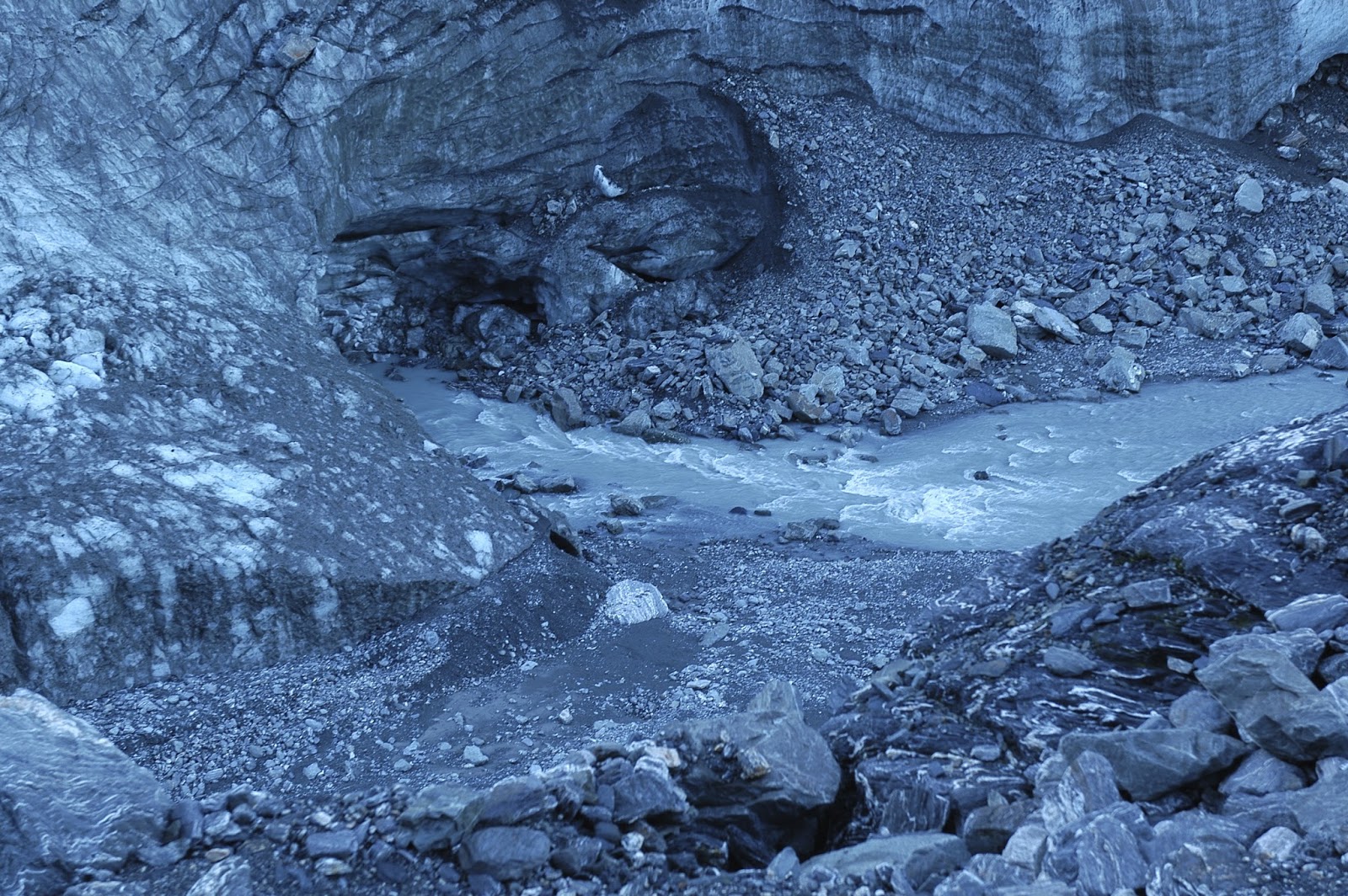
Here the melt water from the glacier runs out from under the ice. Stones hold heat and melt into the galciuer and the ice cracks and crazes as it moves. there are myriad options for water to invade the glacial ice. It then drops to the ground and flows downhill. 
The glaciers are heavy and powerful and they crush rock to dust. this dust is in the water and makes the water milky in color.  All glaciers that have rivers emanating from the will have this color water.

Eventually the river valley fills with pics of the mountain and the river drains through the glacial spoil.
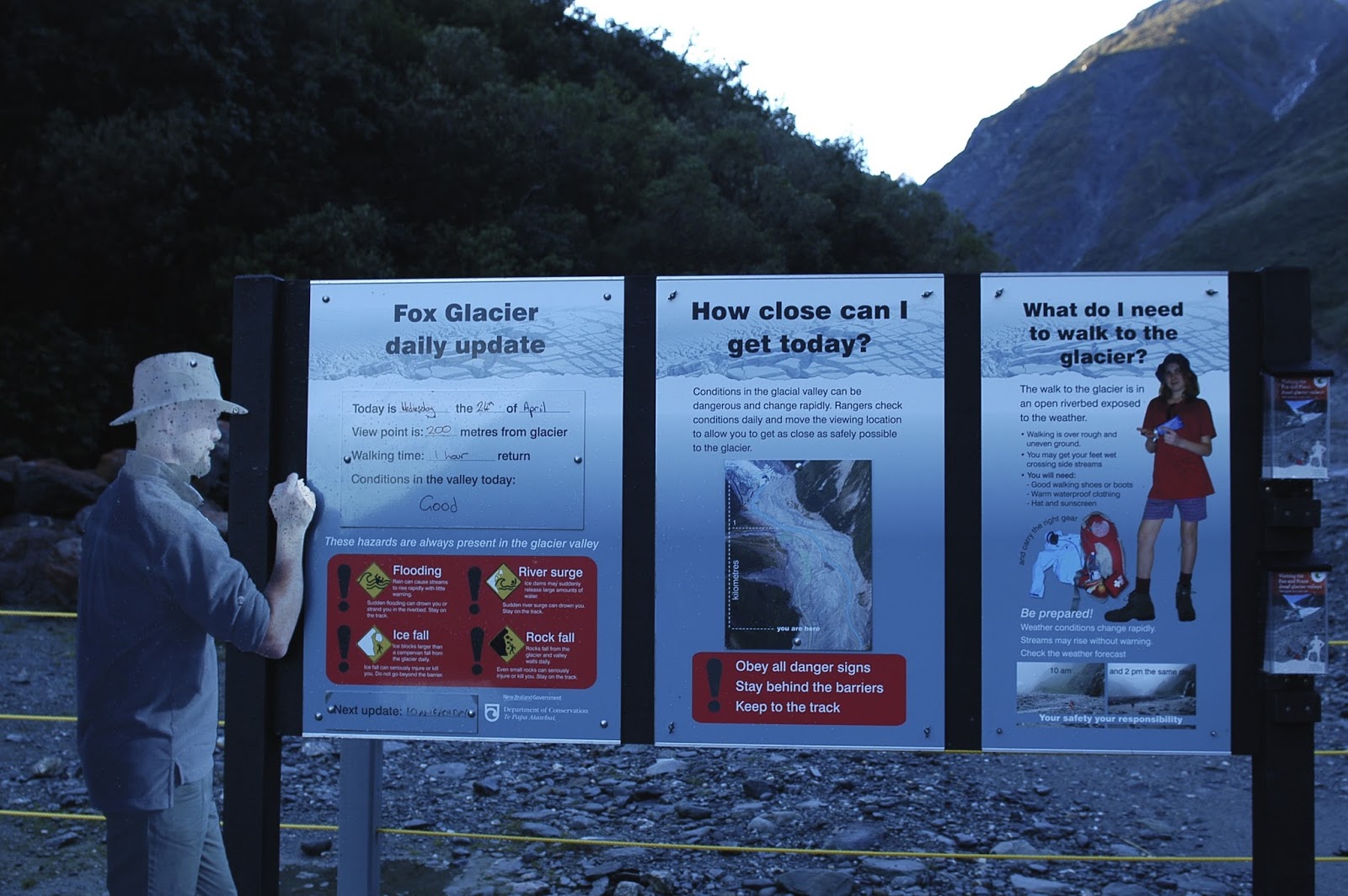
New Zealand does a pretty nice job with wildlife properties and interpretation. The national parks are well managed and public access is quite comfortable. They have almost no vandalism is these areas, which makes life much easier for those responsible for the sites.
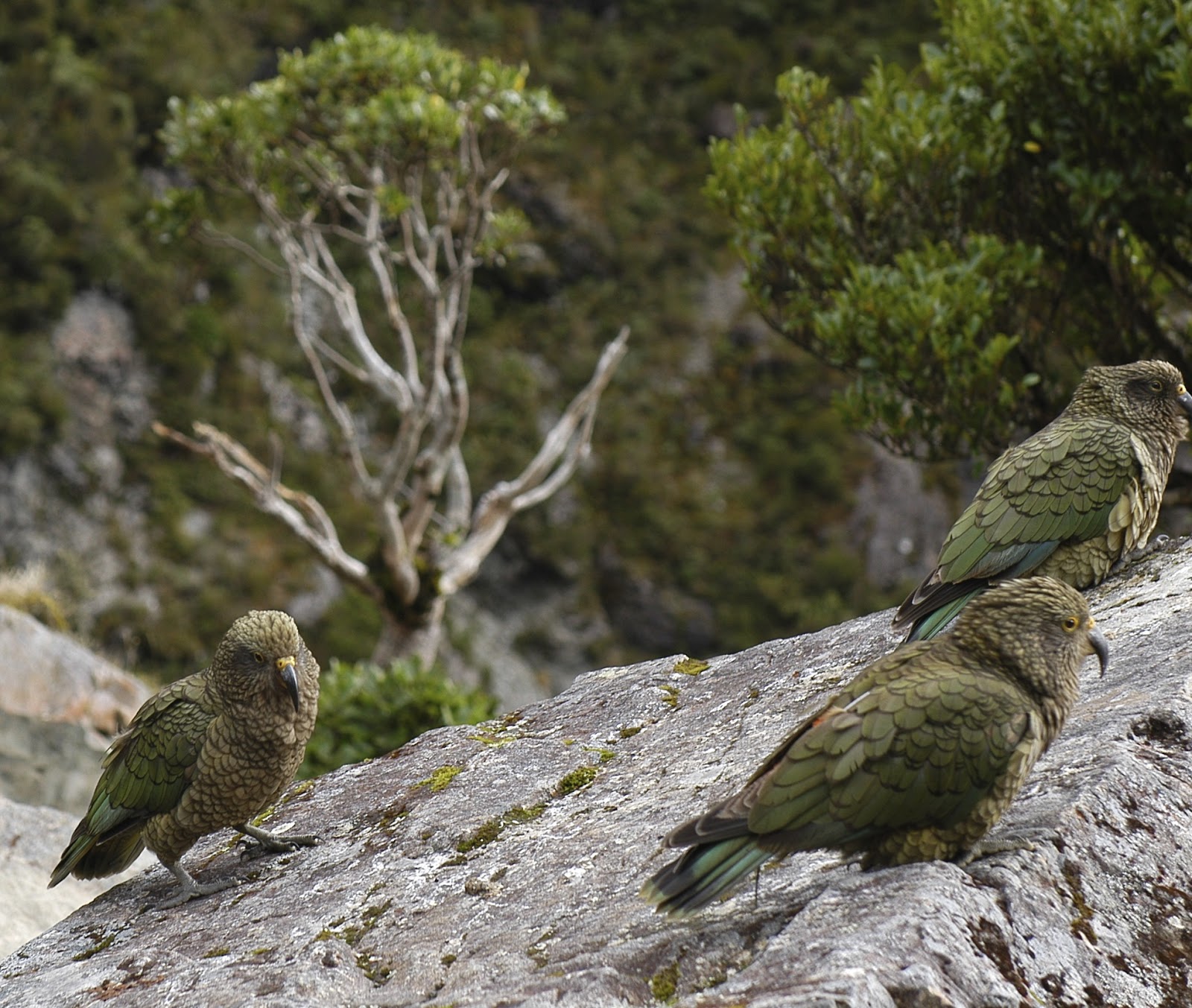
On the way back through Arthur’s Pass toward Christchurch we happened on a group of the “bad boy” parrots called Kea. They are birds of the mountains and are often in the snow fields. they will also tear the rubber gaskets or windshield wipers of vehicles. They are great birds for a visitor to see, but can be a nuisance.

Galapagos’ Flamingos

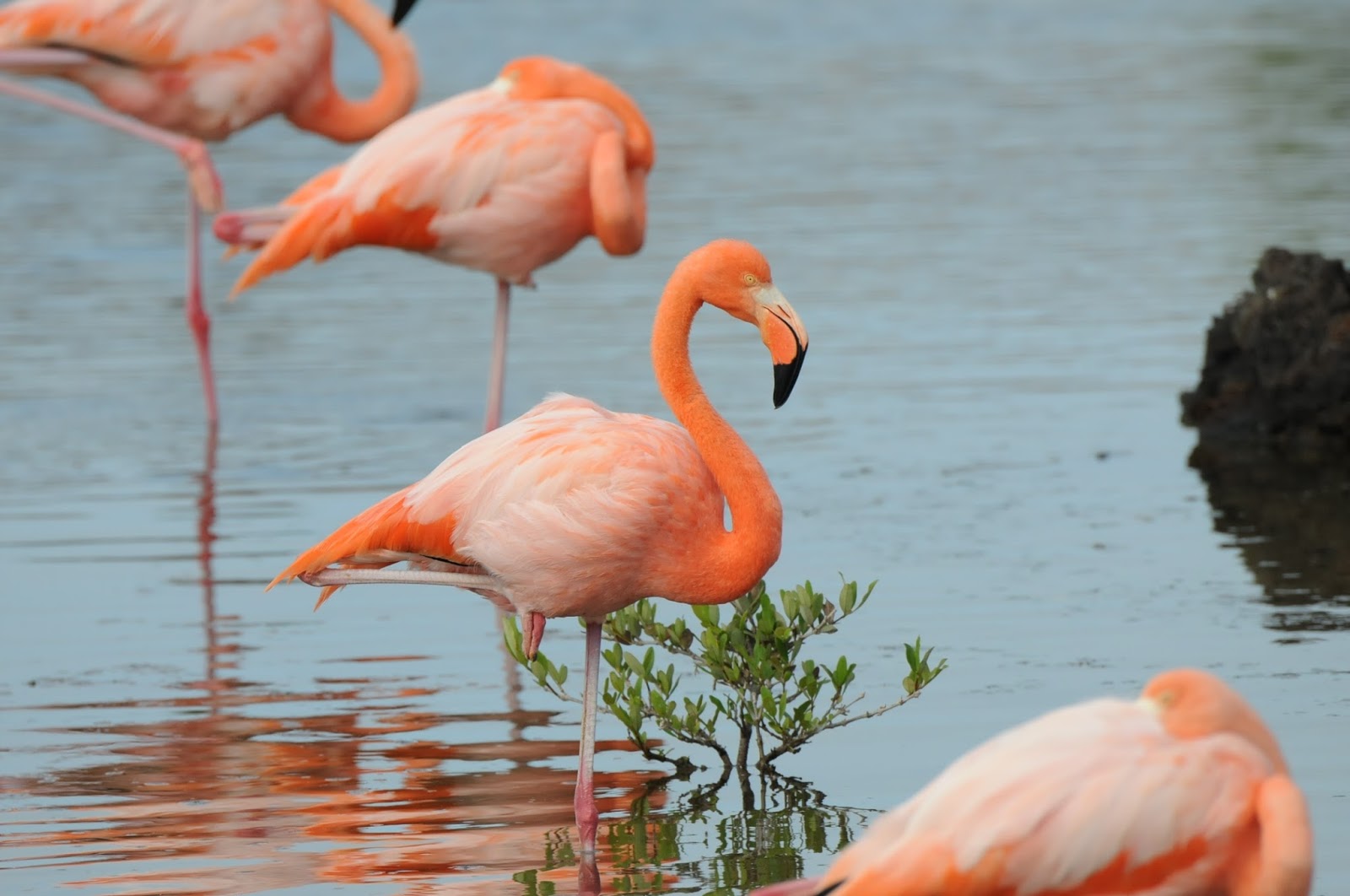
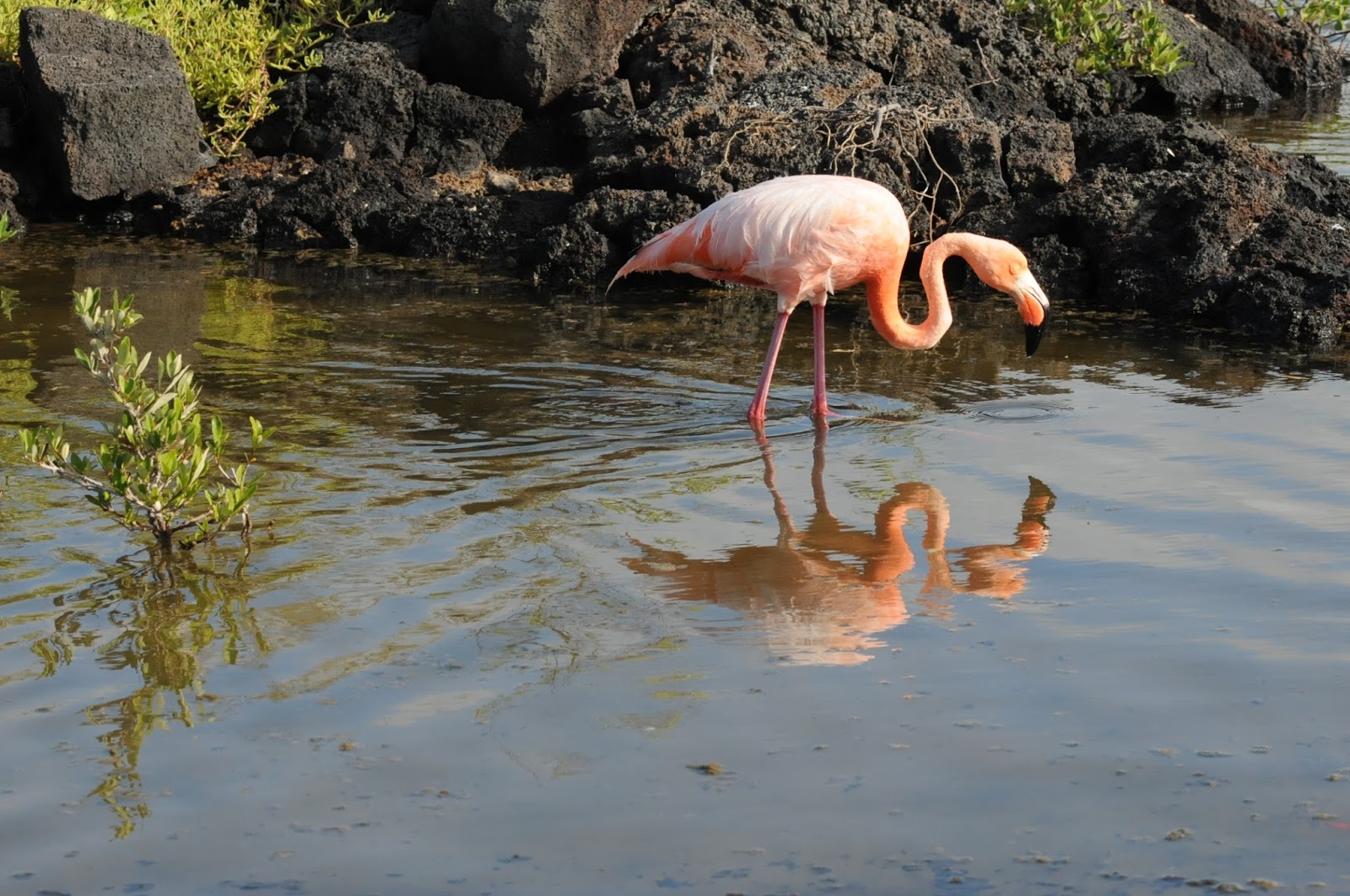
If you’ve been to East Africa you may have seen tens of thousands of flamingos; Lesser Flamingos mostly. Perhaps you’ve seen flamingos in Africa or in India; mostly Greater Flamingos. If you are a hard core birder you may have seen the other three types of flamingos in South America (James’, Andean, and Chilean). The flamingo of the Caribbean is now called the American Flamingo and is found in the islands of the Caribbean and Central America. This is the flamingo that has a modest population in the Galapagos Islands.
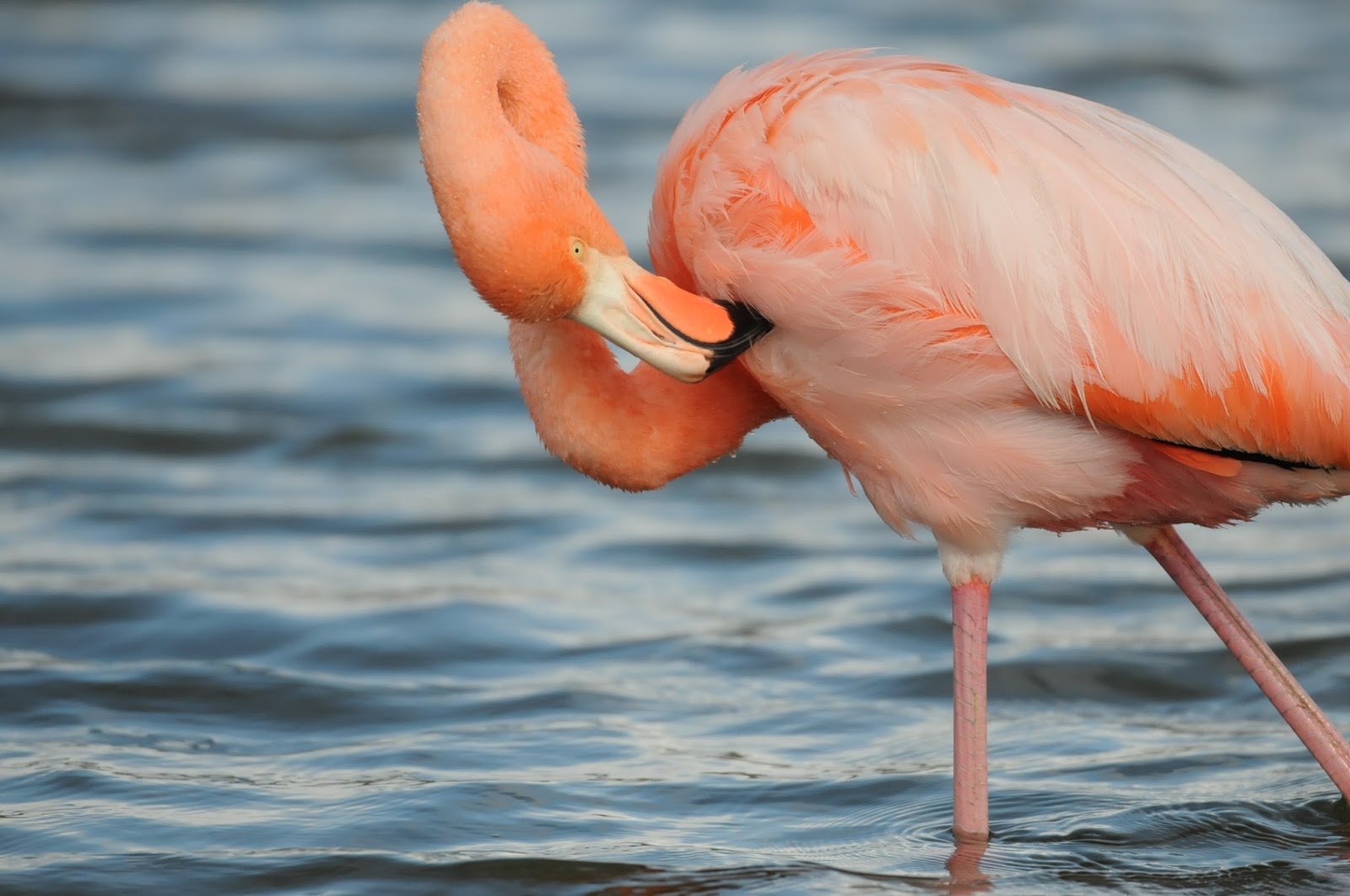
They are often quite colorful and looking beyond the color you may have seen the long legs, long crooked neck, funny-sharped bill or beak, and their rather stately way of walking. 
On this last trip to the galapagos we were fortunate to come across ten very nice looking flamingos in a shallow lagoon behind the front barrier beach on the island of Santa Cruz. This access is from Bachas Beach which is on the undeveloped side of the island.

The birds were scattered but the lagoon is rather small and they were all in sight pretty much all the time from whatever vantage we used. Like the other animals of the Galapagos the flamingos are quite tame although less so that the populations that have been out there longer.

Modern taxonomy is moving toward a cladistic way of grouping (or separating) animals. There are still categories much as there have been since Linnaeus in the mid-1700s: Domain, Kingdom, Phylum, Class, Order, Family, Genus, and species. Actually Linnaeus didn’t use the category now called Domain as the life forms included in one Domain and part of the others, weren’t known during his life time. In a cladistic format those organisms that share a common ancestor are grouped with this organisms that share a characteristic from an ancestor form but that disappears in future forms.

The reason cladistics in mentioned is that is is always a surprise to learn that via a genetic study the flamingos are most closely related to grebes and are closer to the birds of prey than they are to the herons, egrets, and storks. The older taxonomy has the flamingos more closely aligned with spoonbills and ibises. The current tendency is toward waterfowl and grebes. One of the unifying characteristics with waterfowl is the Genus of feather lice that infect the birds. Flamingos have waterfowl lice so they are likely to share certain developmental characteristics with duck, geese, and swans. Stay tuned as taxonomist like nothing more than dissecting the family tree by refining their observations and discovering new relationships.

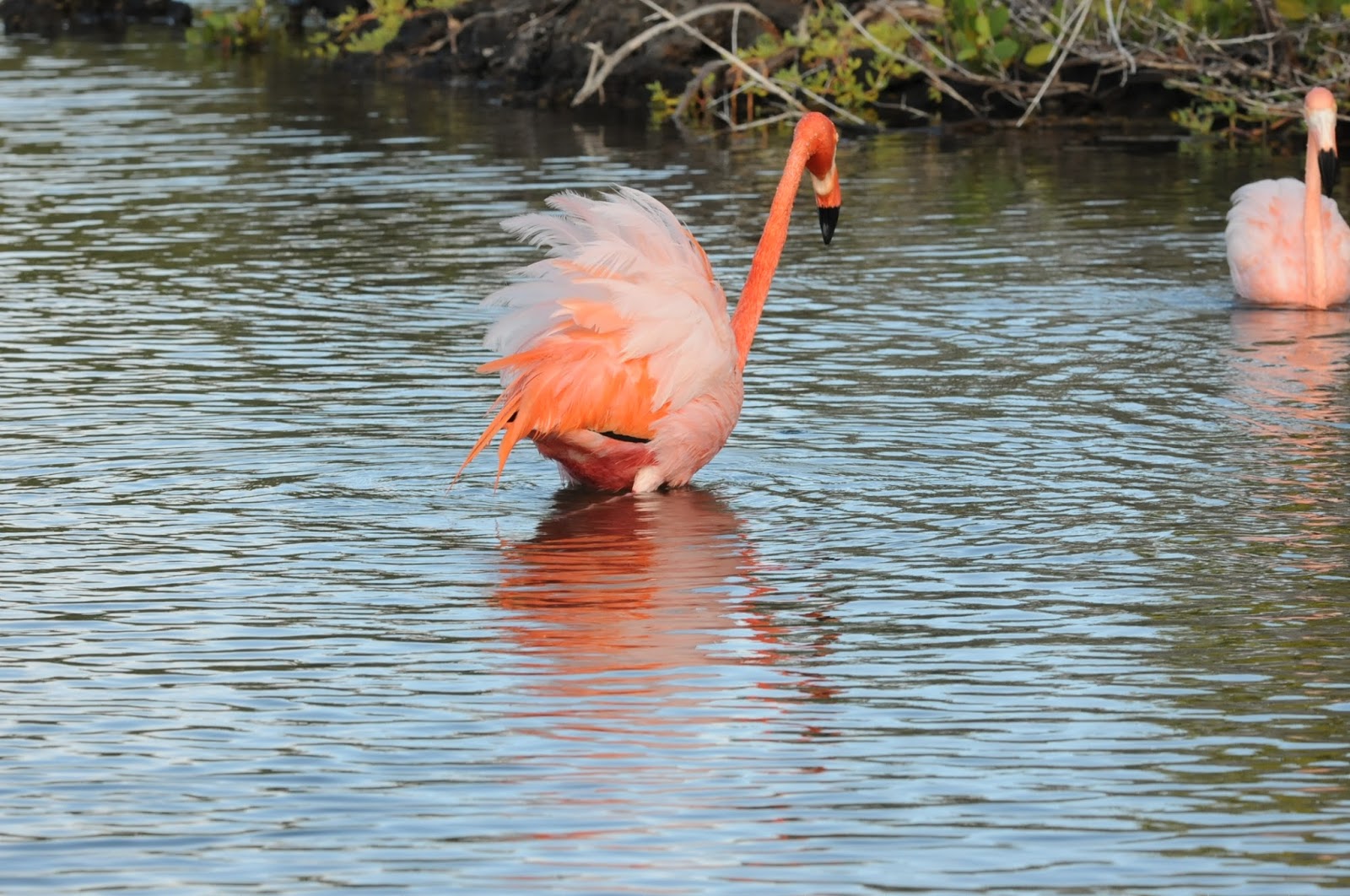
There is no sense in being this large and colorful if your not going to flaunt it. The flamingos walk slowly and with great attention to avoid splashing. They will ruff up the feathers to display their beauty and stature. This is, of course, what most birds do but a flamingo is so much better it than is a displaying male Red-winged Blackbird or  or even a Bobolink. 

The color is derived from their food. It is often mentioned that their diet is selective and that may be true to some extent, but they do feed with their heads upside down and under water – so I doubt they are to selective. The selective part is to put themselves in shallow water with the right kinds (and density) of shrimp and algae that they need to survive; color is an afterthought. The carotenes that they ingest while eating are from the algae in the water. But the molluscs, shrimp and other crustaceans, and insect larvae all live in the same water and ingest the algae and thus have carotene in their bodies. You are what you eat. 
The base feathers are a soft gray, readily seen in young birds, that are then colored by the carotenes in the diet. Flamingos can survive without being pink; it just means that feeding options are not quite right. color will return when the algae forms and the beta-carotene returns to the smaller life forms that everything feeds on. 
I almost said lower life forms – that would (or should) open a door to important discussions of the various roles and rights of all living things on the planet.
Flamingos nest in a small tower built up in a shallow muddy pan. The eggs are laid (each pair lays one egg but the group all nests at the same time) in the conical top and is incubated for about four weeks. there are (maybe) 400-500 flamingos in the Galapagos.  They move about as they need rather specific feeding and breeding habitat and they cannot always find what they need on a single island.

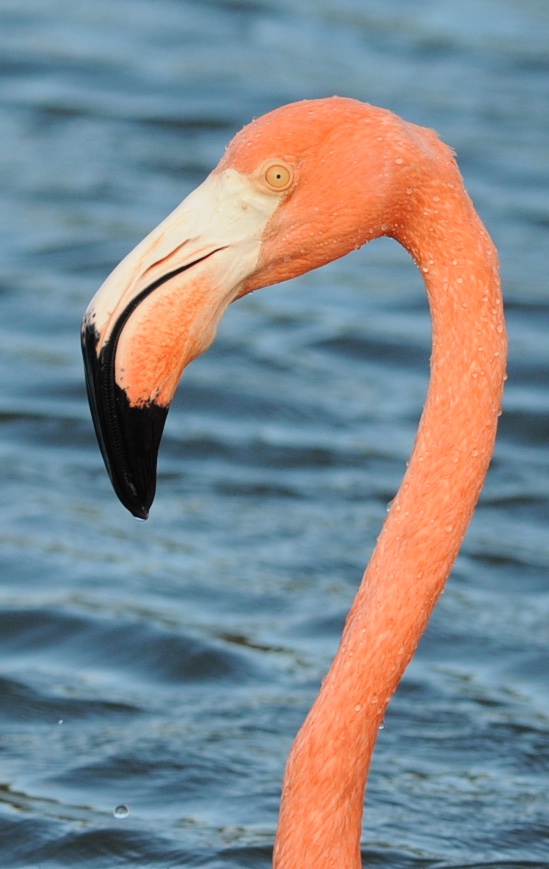
These birds were on Santa Cruz but most of the flamingos are further west on the horseshoe-shaped island (the largest island) of Isabela. Sadly, the flamingos were a dietary delight for Roman emperors and they were killed in order to make a delicacy of flamingo tongue. The tongue is a large and strong organ in this group – see below.

The hooked beak is used like a bilge pump. The head is turned into the water with the forehead closest to the bottom. The beak and tongue then take in and squeeze out water. The small items that the flamingo desires as food stuff are caught in lamellae along the edge of the gaped mouth. Though not in the same scale it always reminds me of a baleen whale taking in water and fish or krill and then squeezing out the water keeping the fish. Or on a smaller scale the filter-feeding of sedentary oysters.
Flamingos can swing their heads back and forth as well a doing the tongue-pumping thing. Some of the penguins and auks are also strainer-feeders as is the duck known as the Northern Shoveler.

Namibia’s Wildlife

You’d think that a sparsely vegetated dry countryside would be devoid of life. Well, nature doesn’t work that way – in fact there are many creatures adapted to this harsh environment and then there are creatures that are adapted to eating those things that are adapted to the harsh environment. All it takes is time, lots of time.
There are fewer animals and plants over all and the diversity doesn’t compare to places like Peru, Ecuador, Colombia, or Borneo or other wet and crumpled countrysides. But there is quite a variety of life in the Namibian desert.

Because this is a sparsely populated country the roads are not always sealed. But there isn’t much traffic so the roads are pretty much yours to drive as you wish. We happened on this other mode of transport and stopped to say hello and hand out a few bottles of water. 
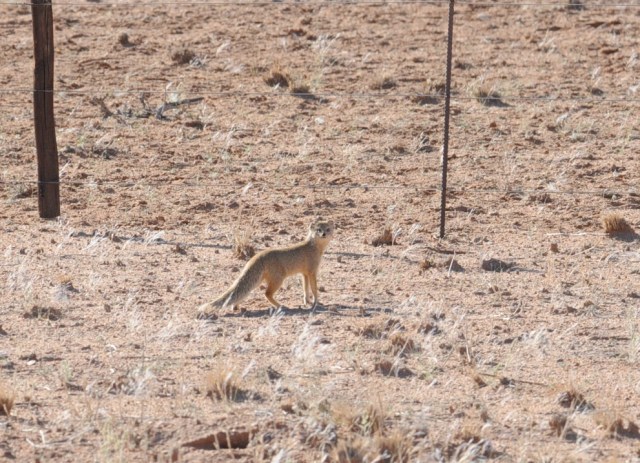
Many of the animals of the desert are small and depend on insects to underwrite their food supply. The Yellow Mongoose is widespread in southern Africa. It is usually seen as a single animal but they live in family groups of about half a dozen. Each morning they go off individually to forage for food. they often live in burrows dug by Ground Squirrels or Suricates (Meercats). Often the three animals live in the same burrows at the same time.
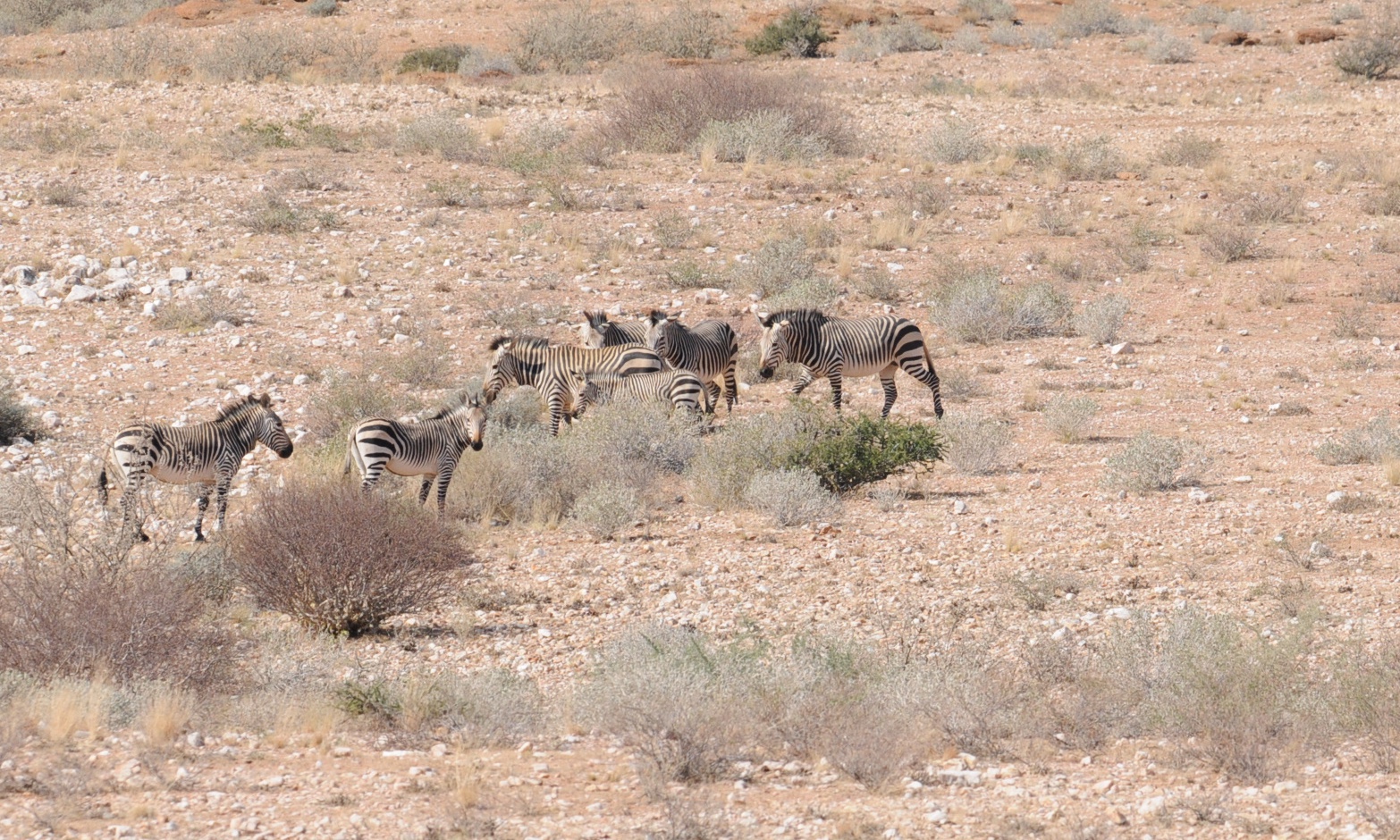
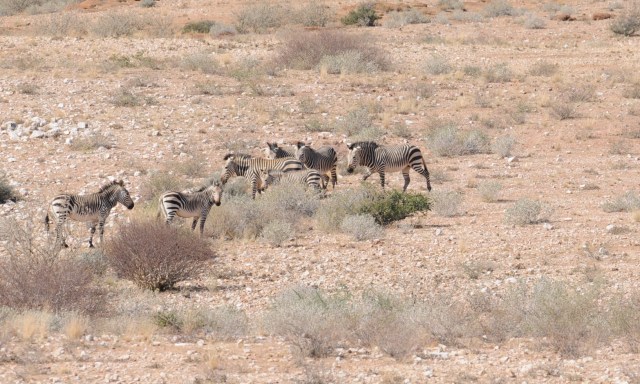
One of the (many) animals that has developed into several species over time is the zebra. As climate change has occurred over the past several million years the extent of savanna land has changed dramatically and more than once. Sometimes much of Africa is savanna and other times there is extensive forest; it is all weather related and changes over the thousands of years. Zebra have become Common (Plains or Burchell’s), Mountain (Cape and Hartmann’s), and the north-of-the-equator Grevy’s. We were very lucky to see Hartmann’s Mountain Zebra in very good numbers over an extended period of time. We were kind of stuck on the coach but had plenty of good looks. Notice that the stripe go all the way down the legs to the hoof. The belly is white.
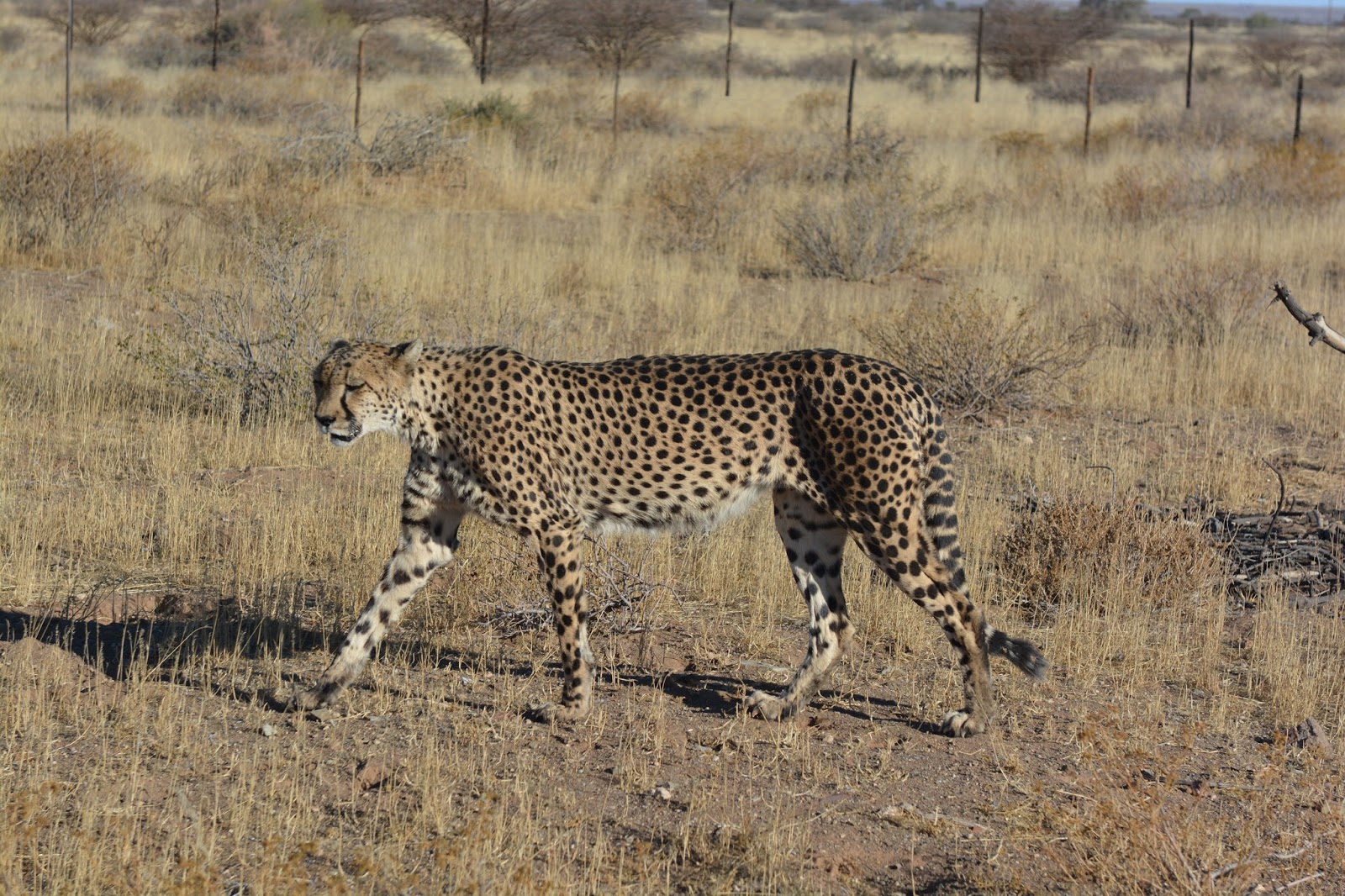
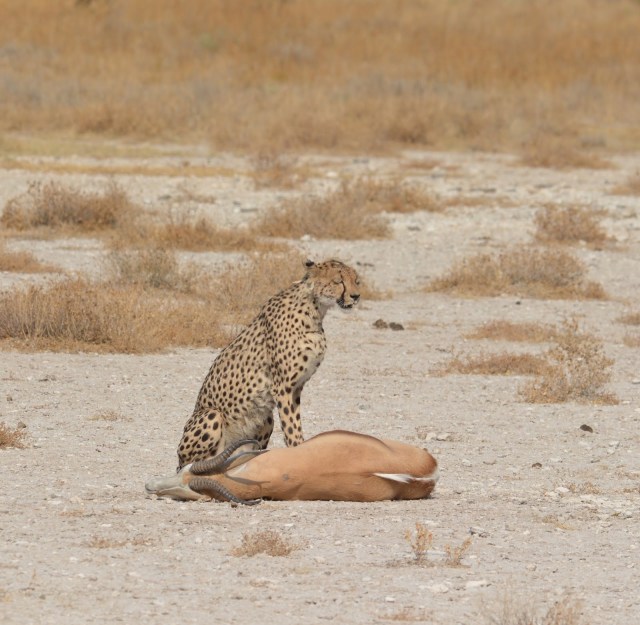
Cheetah have a spotty record in Namibia. Over the past one hundred years they have been treated like vermin and eradicated at every opportunity. Today things are changing and the farmers are more accepting of having this modest-sized predator on their land (it’s never that the farmer is on the cheetah’s land is it). The government has instituted a compensation program for lost livestock and population numbers no longer seem to be declining.

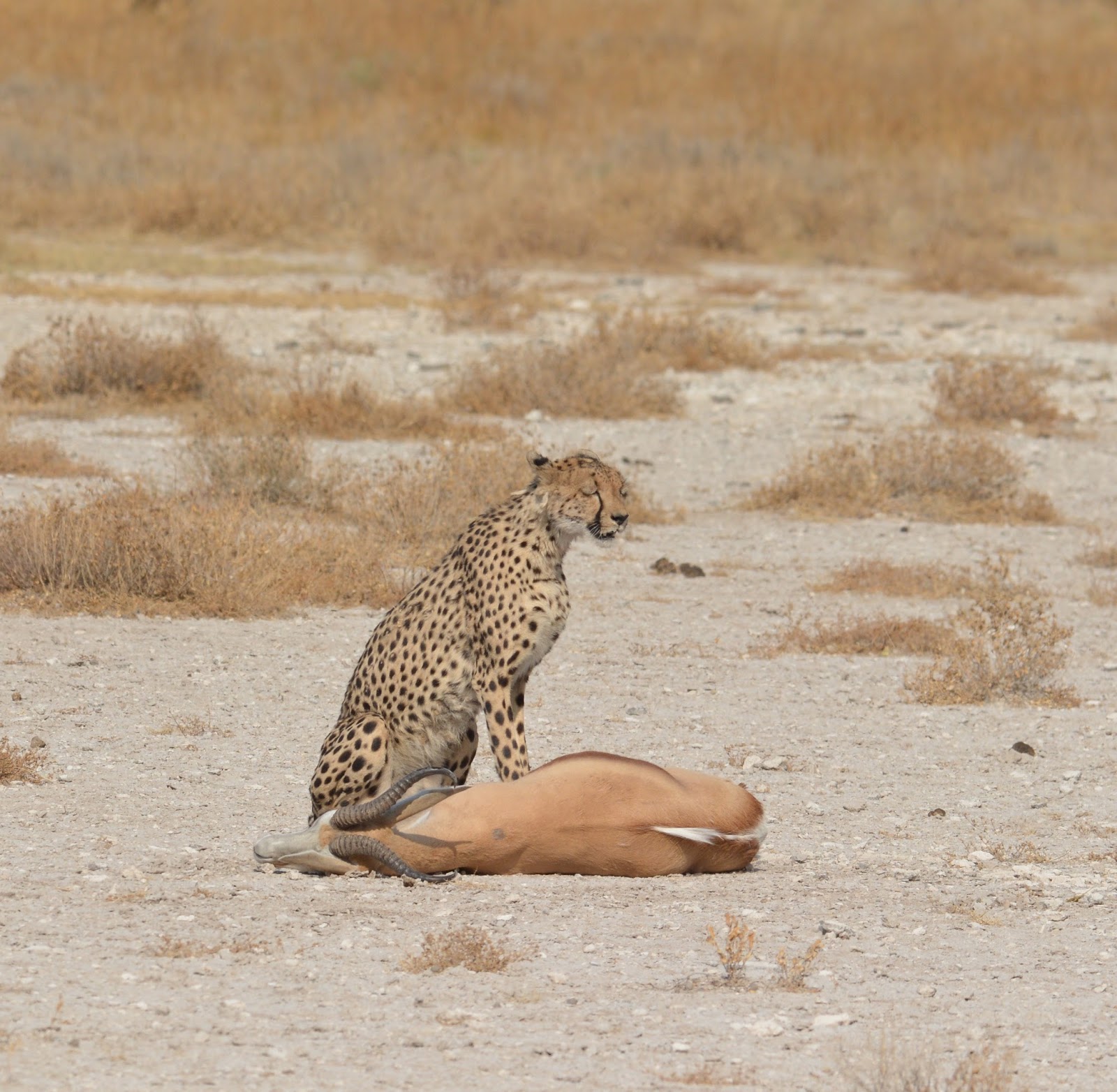
The cheetah below has just killed an adult male Springbok and is pausing to allow for the cellular wastes that build up during a chase to leave the body. Cheetah will often lie down and pant for ten minutes after making a kill. In areas where there is a likelihood that a hyena or lion might steal the prey item cheetah will drag the prey to cover before resting. A male Springbok will weigh 40 kilograms (88 pounds) and a female cheetah is about the same weight. This male cheetah probably weighs about 110 pounds.
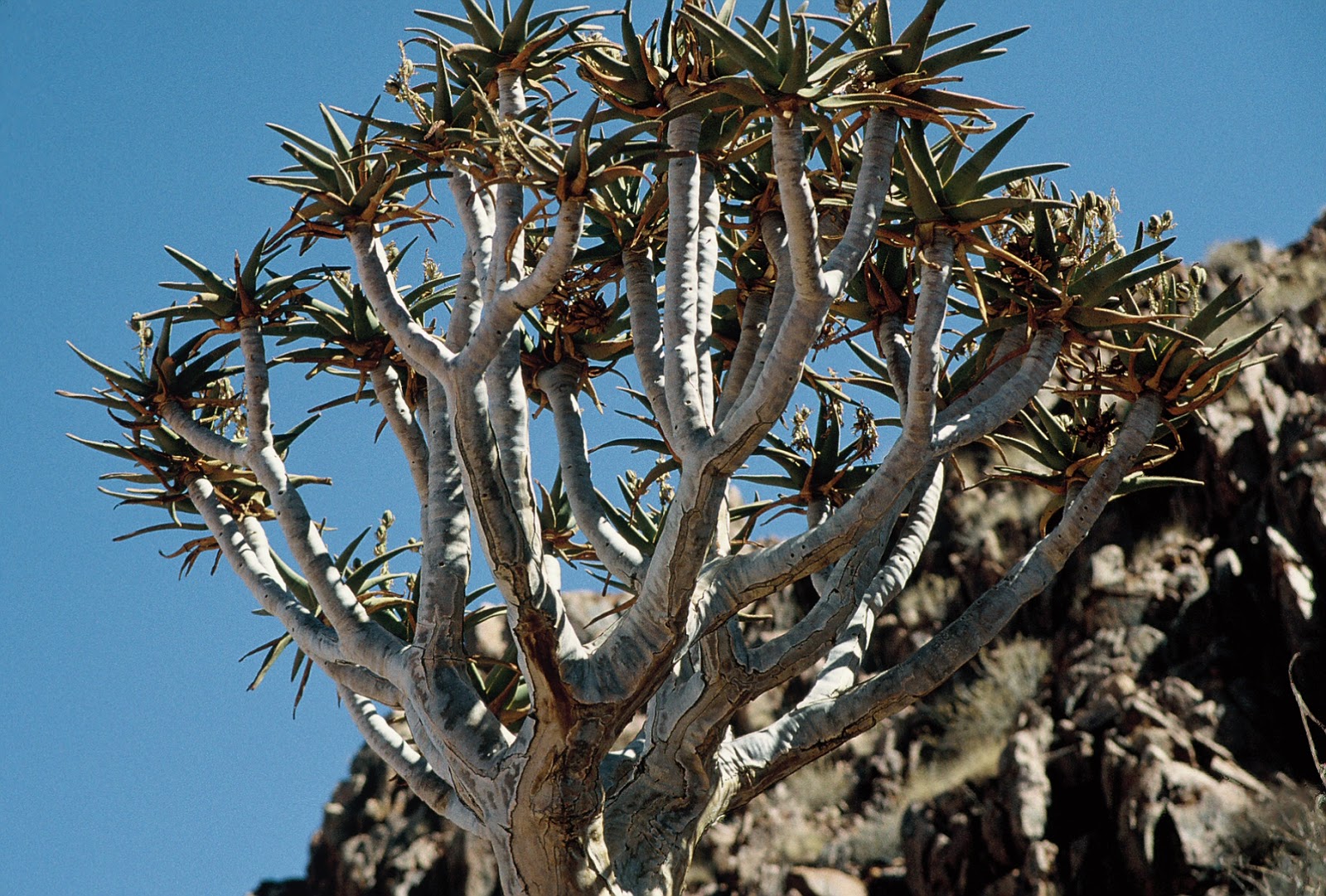
The Quiver Tree (Aloe dichotoma) shown below is about 25 feet tall. The straw in the front of the tree’s canopy is equal to about 15 bales of hay. That straw is the communal nest of a small bird called the Sociable Weaver.  Nests will persist for decades if they don’t get wet, heavy, and break the tree. There may be 100 or more pairs of birds nesting in one nest. There are internal rooms that hold heat during the cold desert nights where the birds roost and then there are rooms on the edge that are simply shaded areas to get out of the daytime heat and sun. Nesting sites are a third sort of space within the apartment house. 

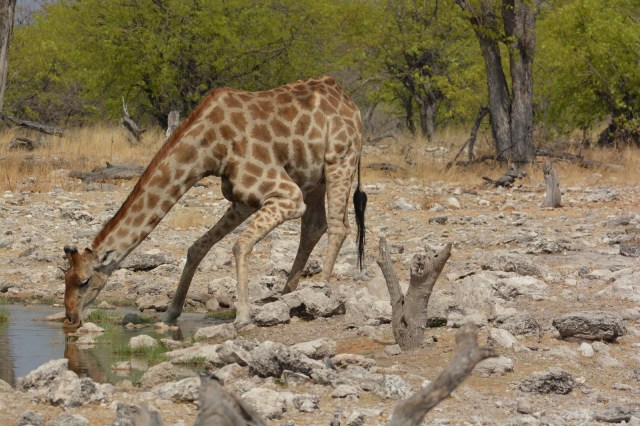
Giraffes are part of Namibia’s landscape despite there being only sparse vegetation. In the northern part of the country they are easily seen in Etoshia where there is some woodland savanna habitat. In the central and southern parts of the country they are less common. Water is the key to the survival of the larger animals. Most large (vegetarian) animals need water several times a week, most need it daily. The smaller antelope can survive on moisture from plant but that is not the case with most of the larger ungulates. (See below regarding the Gemsbok or Oryx)

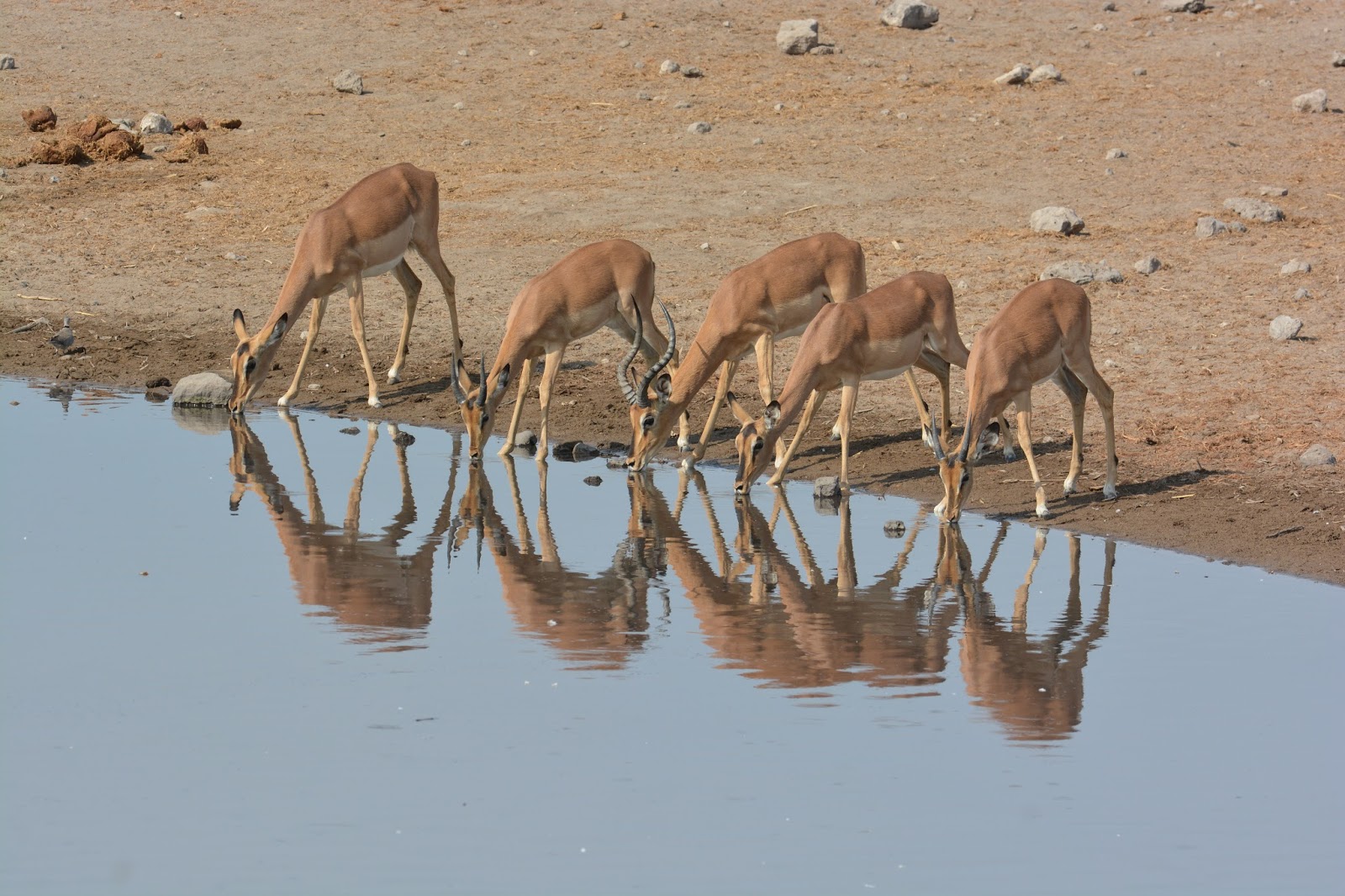
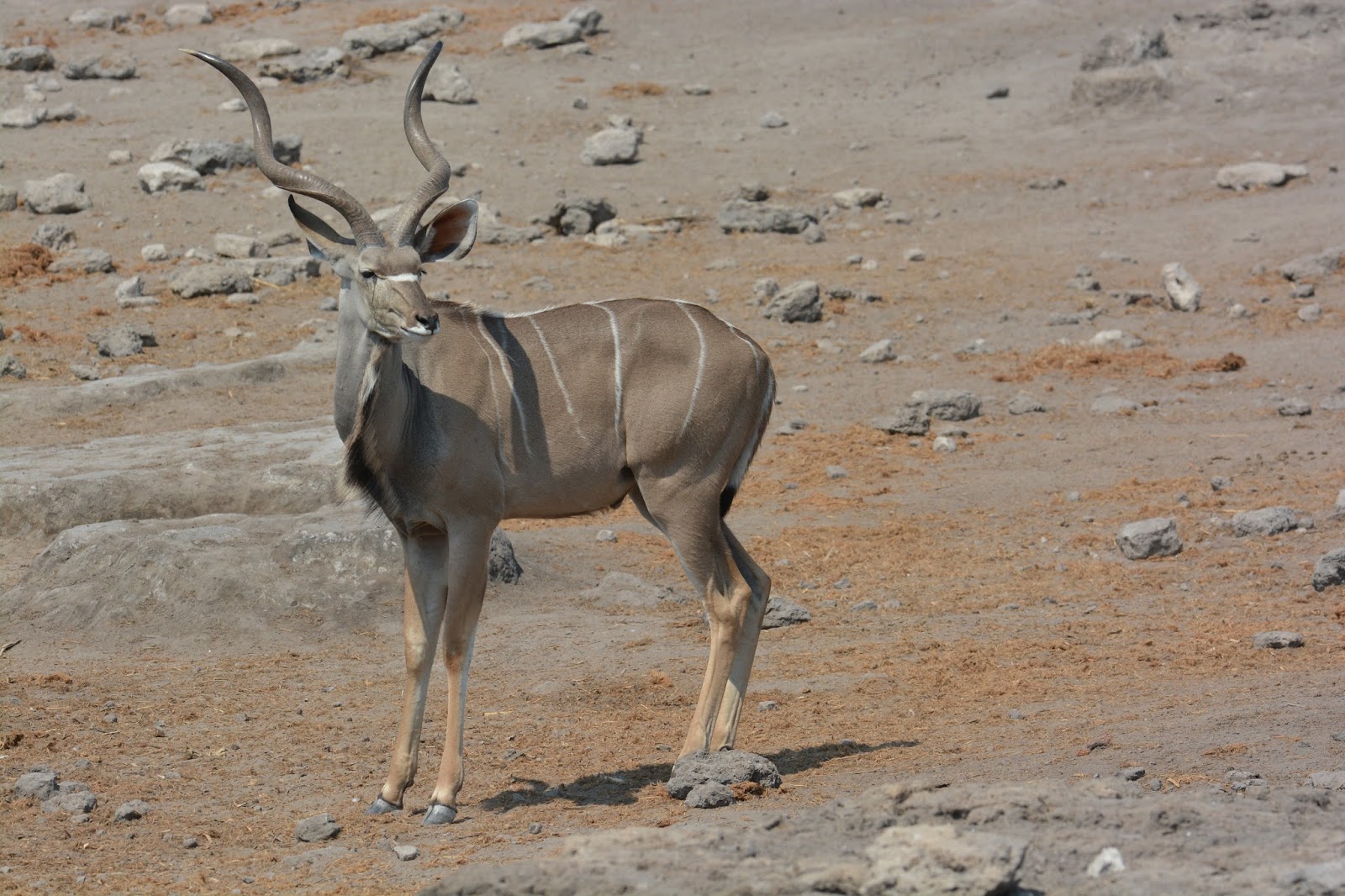
Where there is water there will be Impala and Oryx (Gemsbok) and Greater Kudu (below).

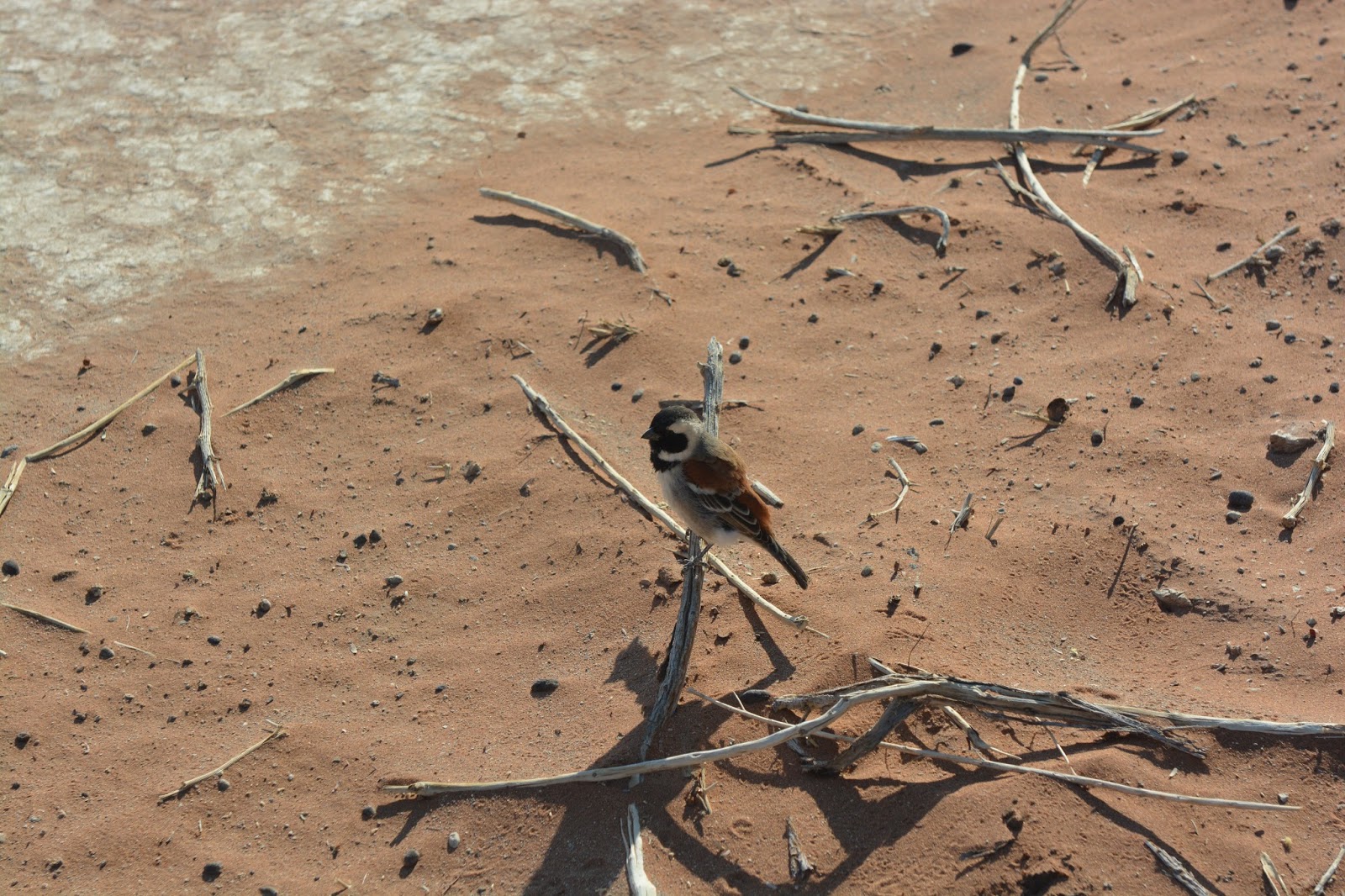
Birds of the desert are often insect or seed eaters. The Cape Sparrow is a common and widespread southern African bird. The workers out at Sossusvlei put out water in a saucer and attract dozens of this attractive sparrow.
The Giant Eagle-Owl below is not uncommon in the trees of the desert; but how often they eat is a good question. There are mice and rats and meercats and mongooses out there but many are diurnal and others not common. Yet there are often owls in thew area so there must be a solid web of life – top predators are exciting killers perhaps, but they are totally dependent of the weather, the plants, and the small mammals of their home turf.

The Pied Crow is a common and widespread bird. Like many of the corgis family they are not terribly picky about what they eat. they can survive in all sorts of habitats and find food just about anywhere.

 
The rather small Shovel-snouted Lizard feeds on insects in the dry shifting dunes.
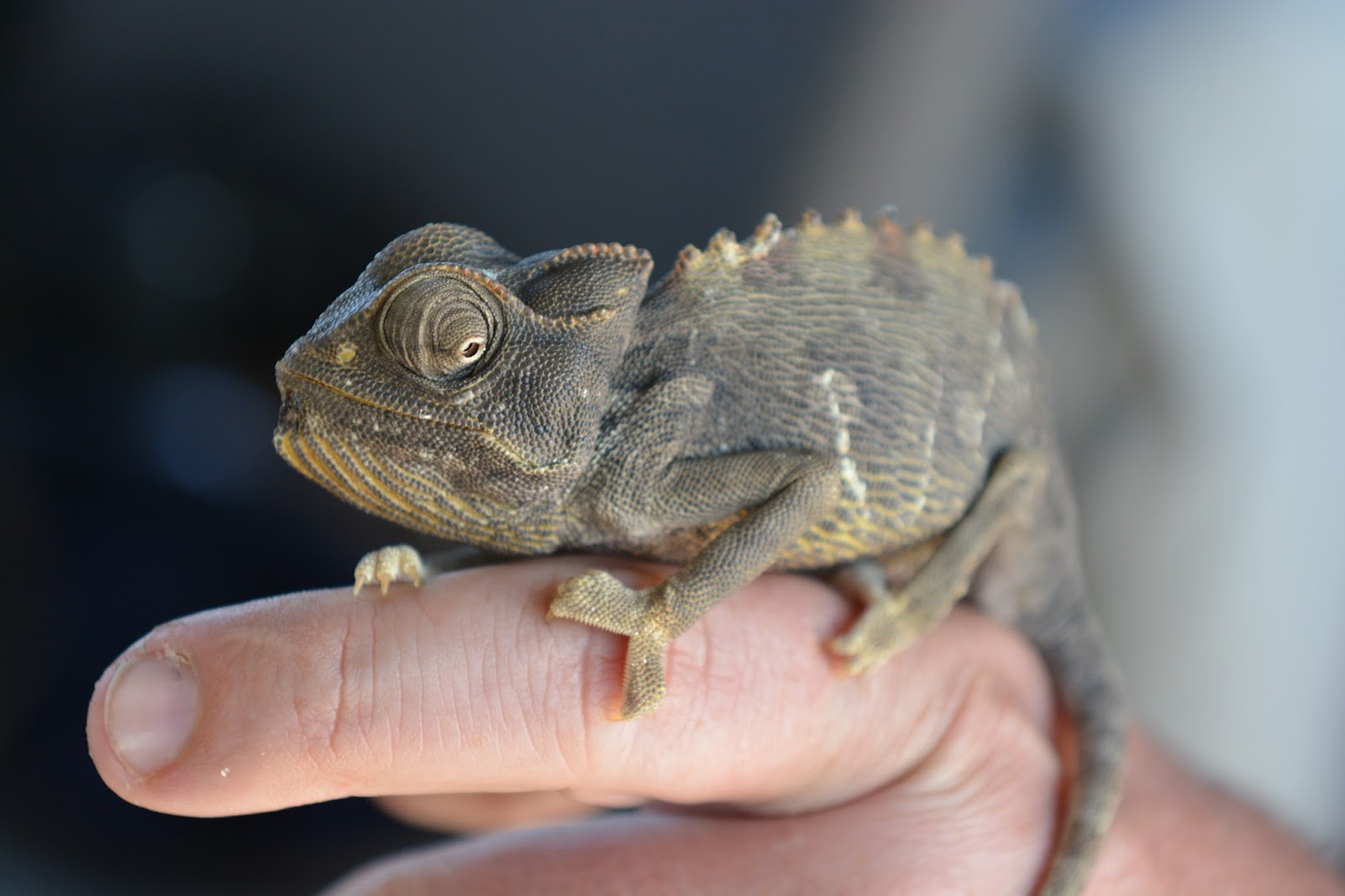
The Namaqua Chameleon is an odd ball, but all true chameleons are a bit odd. The eye is in a turret and each eye can be moved separately from the other eye. The feet/toes are like something from Star Wars – as Sheldon Cooper says (hold up your hand like a chameleon) “may the force be with you”. But, whatever they look like, they are very successful and have been around the planet for a very long time. Like all chameleons they “shoot” out their tongue, slapping the prey with a gooy terminal end that gloms onto the poor food item and when the tongue is drawn back into the mouth along come the insect as well.

Mammals are in need of more energy in order to function in a hot-blooded way. Many of the desert mammals are small and the large ones (oryx etc) have adaptations to survive in the desert. The Southern african Ground Squirrel (the rodent above) comes in many habitat-adapted styles. They vary in color and a bit in size throughout their range.
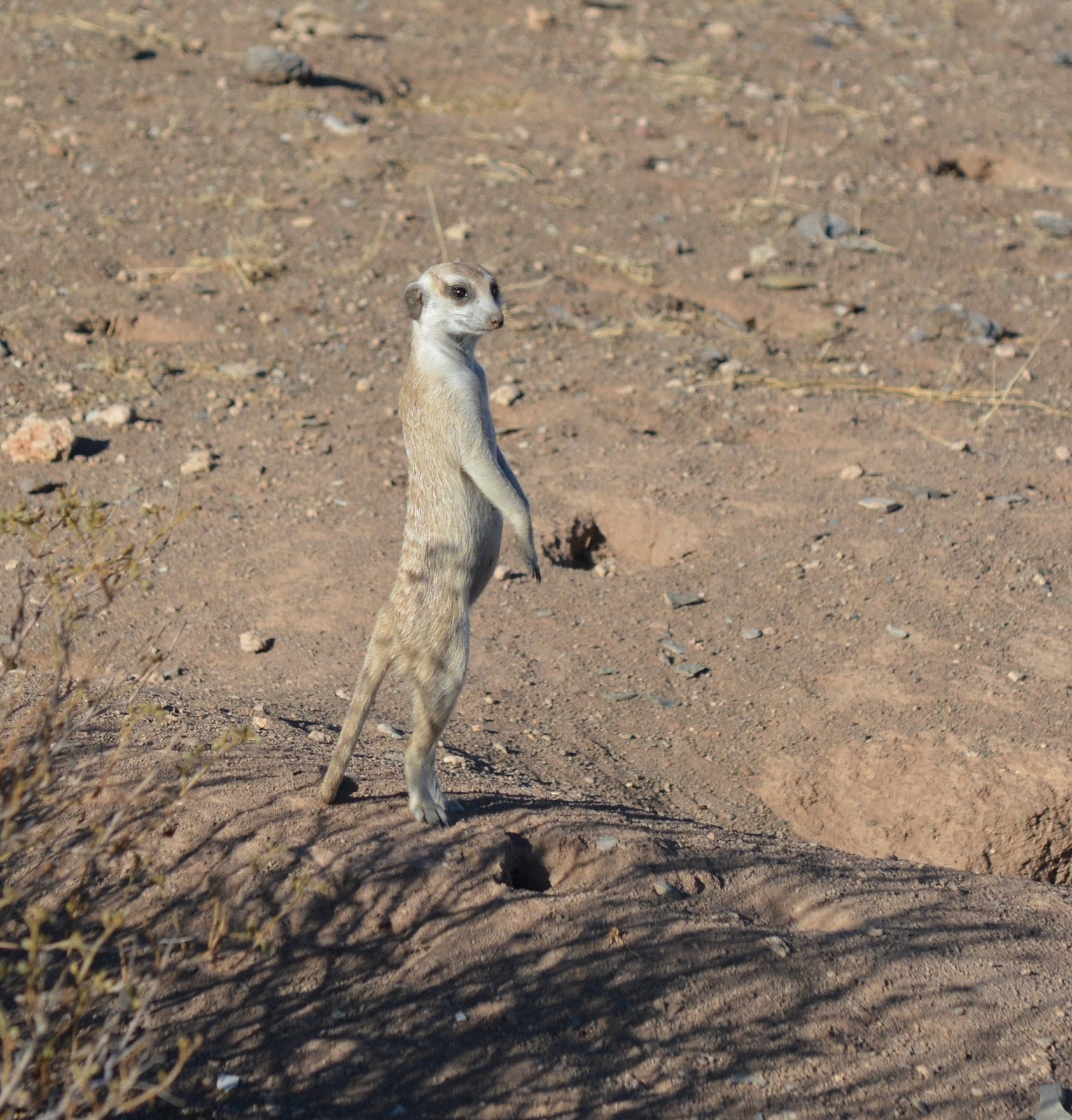
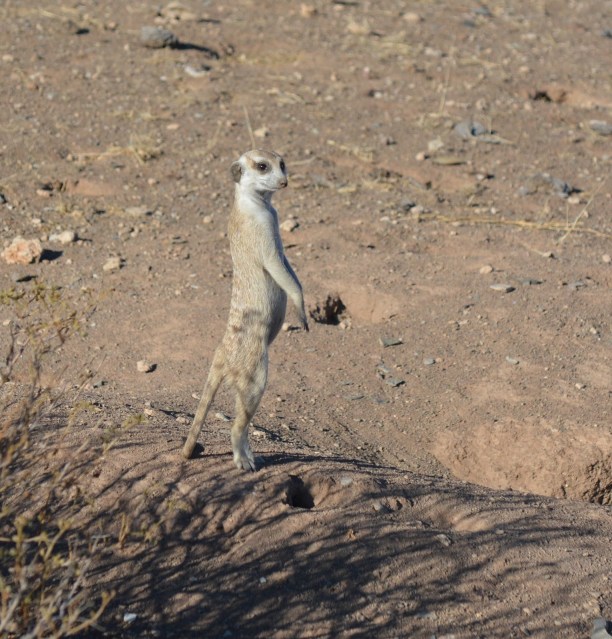
The Meercat or Suricate is a member of the mongoose group and lived in groups of 5-40 animals. They dig tunnels and create a complex of rooms and passageways. They often stand straight and lean back on the tail as it were an extra leg.
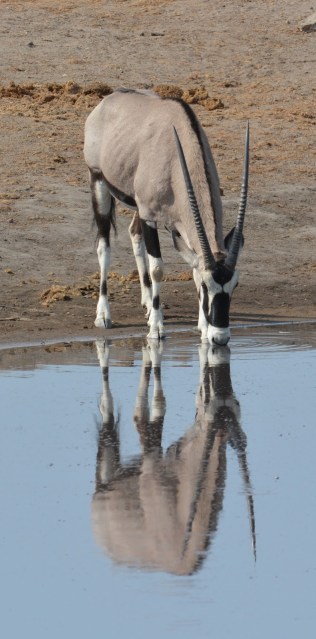
Just one last picture of an elegant antelope. The oryx is a mammal that can survive its body temperature going as much as eight degrees during the day. During times when this happens they pant through their nose, this keeps the brain cool while the body is allowed to heat up. Our exhaled breath is very damp – it is said that an oryx exhales nearly dry air. The back is peaked from front to rear and this helps shed sunlight. They utilize all the moisture in their food and their droppings are very dry. The white belly reflects the reflected heat and sun from the sand on which they live. As the evening comes and the breezes build they often stand on top of ridges and dunes. It is thought that the location allows the animal to cool back down to it normal temperature. 
Namibian Dunes

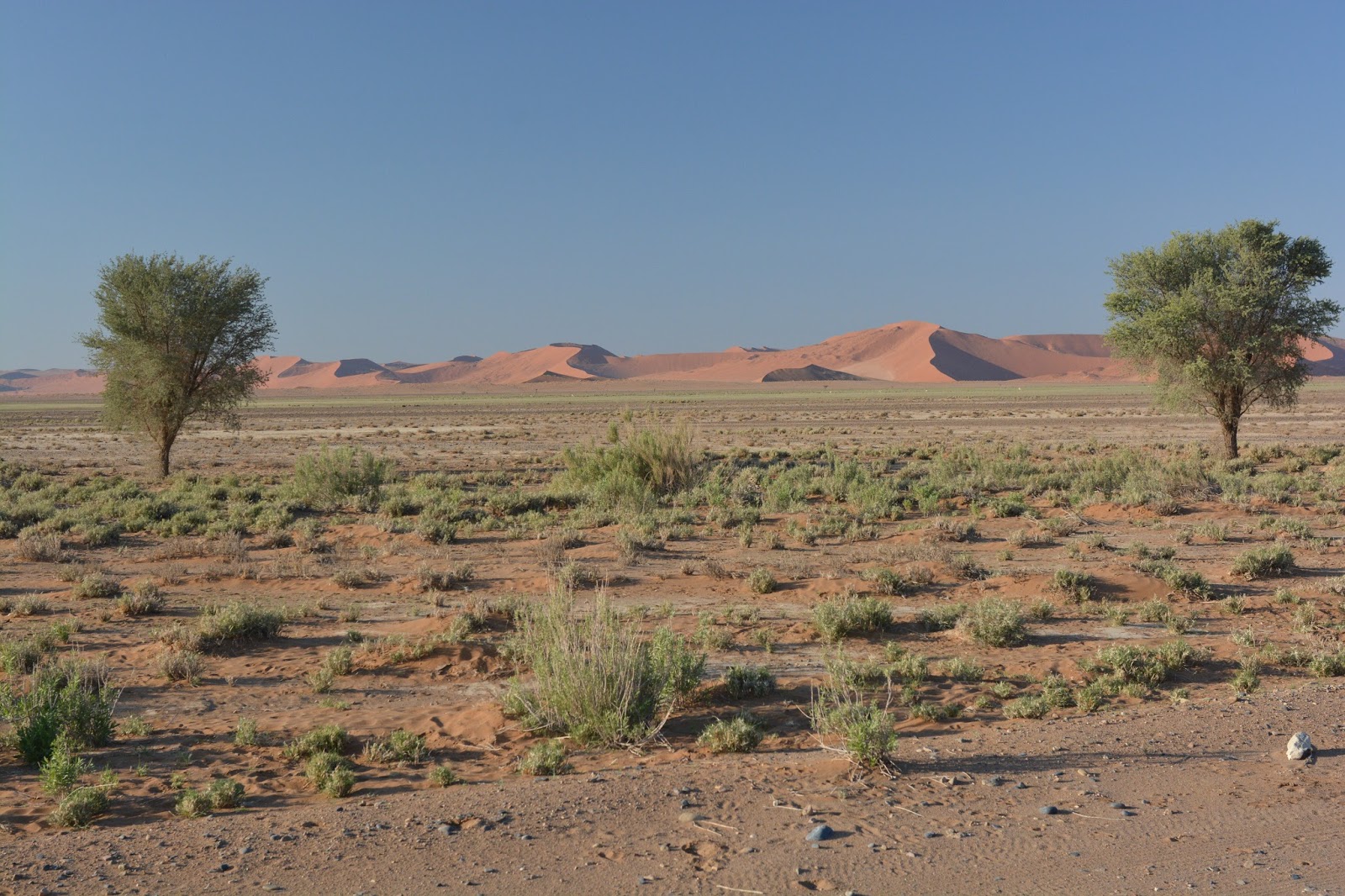
Much of the charm and interest in Namibia is based on the great dunes just inland from the coast. The names Deadvlei and Sossusvlei are but two of the many majestic and unlikely mounds of sand in this huge complex. The whole of the country is dry and seemingly barren. In the north the great Etosha pans are chalk. The Namib is largely sand. There are high erg (rocky desert plateaus) plains and exposed rock mountains. It is a geologist’s paradise. The vista swing from dry and hard to soft and sweeping. Many areas are layer upon layer of ocean-floor sediments and other areas are mountains of windswept sand. The roads also change from germanic straight to mountainous switchbacks with each curve opening a view onto another plain or dune ridge or sandstone cliff.
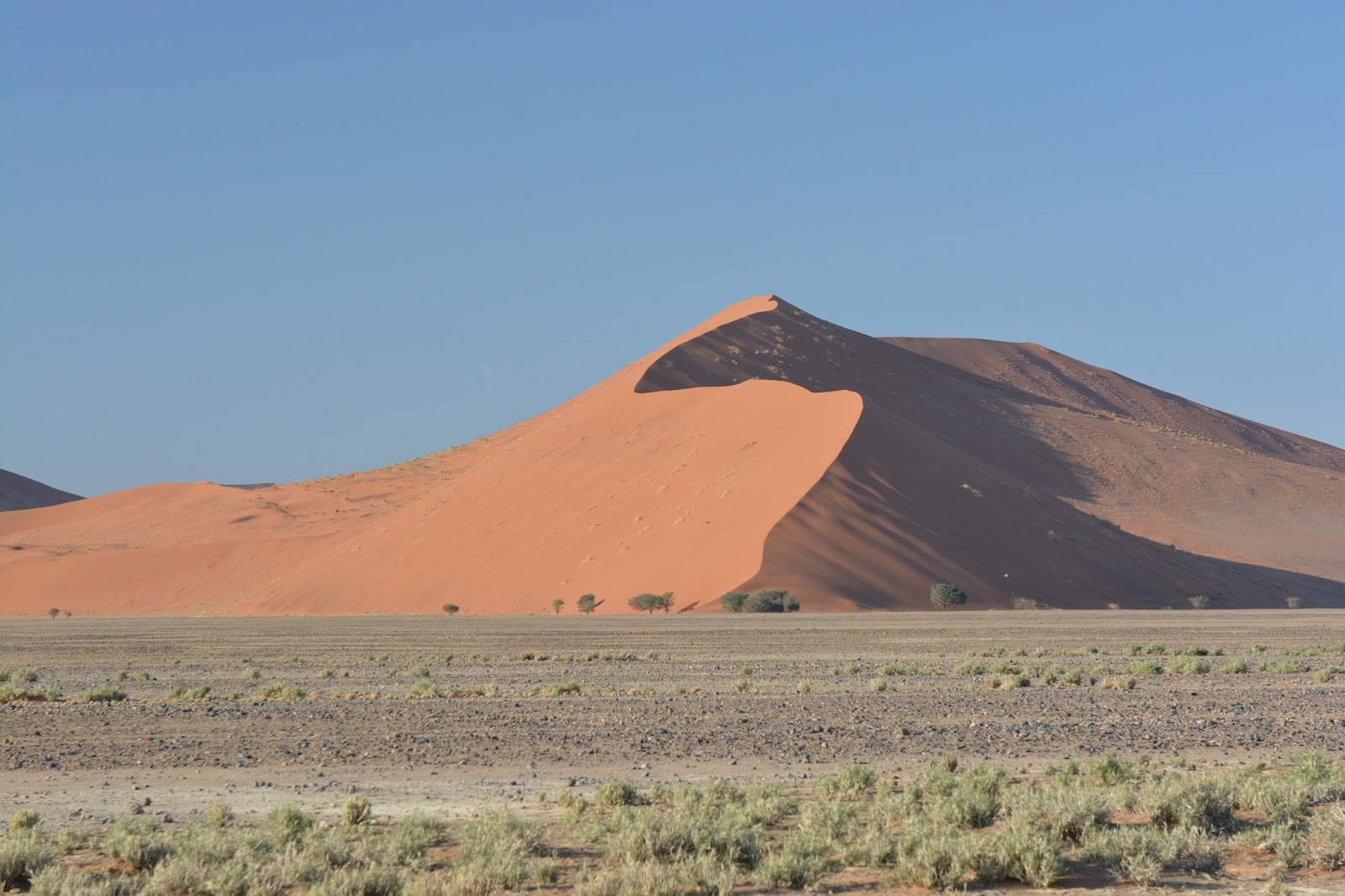
Some of the dunes stand just under 1000′ in height.
Many deserts are obviously formed by the occasional torrent, most have a surface that is smoothed by wind but few are actually formed by wind. The sand mountains of Namibia are a little of everything. If there are strong prevailing winds the sand is moved by wind. In other places dunes have been stationary for hundreds of years. In one area the dunes have become stonelike after thousands of years of immobility.

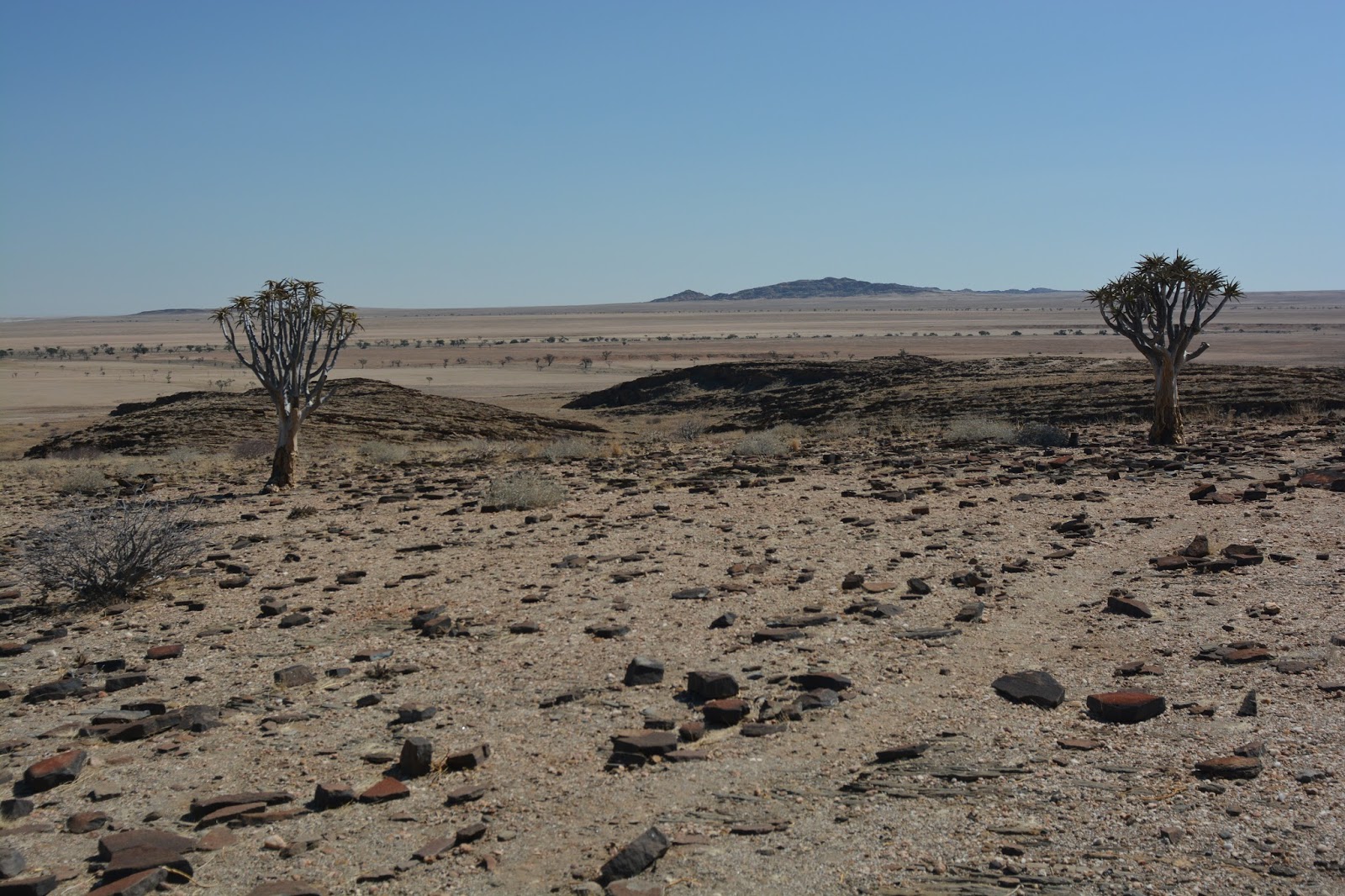
 There isn’t much vegetation, but there is some pretty cool vegetation. There are grasses (shown three images above) and trees where there is soil and permanent (or regular) water. There are also many representatives of the plant group Euphorbia, a cactus-like group found in Africa and Asia.

The tree shown in the above two images are Quiver Trees; an aloe. The San (Bushmen) would hollow out a branch to use as a quiver. Near the town of Keetmanshoop there is a Quiver Tree Forest NP. Strangely, this is a nationally protected property but is on a private land holding. One of the trees there has a huge Social Weaver nest in it.

In North America and South America we have leafless, spiny, barrel-shaped plants with spines and photosynthetic skin called cactus (cacti). In this part of the world there is a group of leafless, spiny, barrel-shaped plants with photosynthetic skin and poison called Euphorbia. Parallel (sometimes convergent) evolution is the term for things that adapted to widely spread habitats and have evolved the same sorts of characteristics; like cactus and euphorbia.

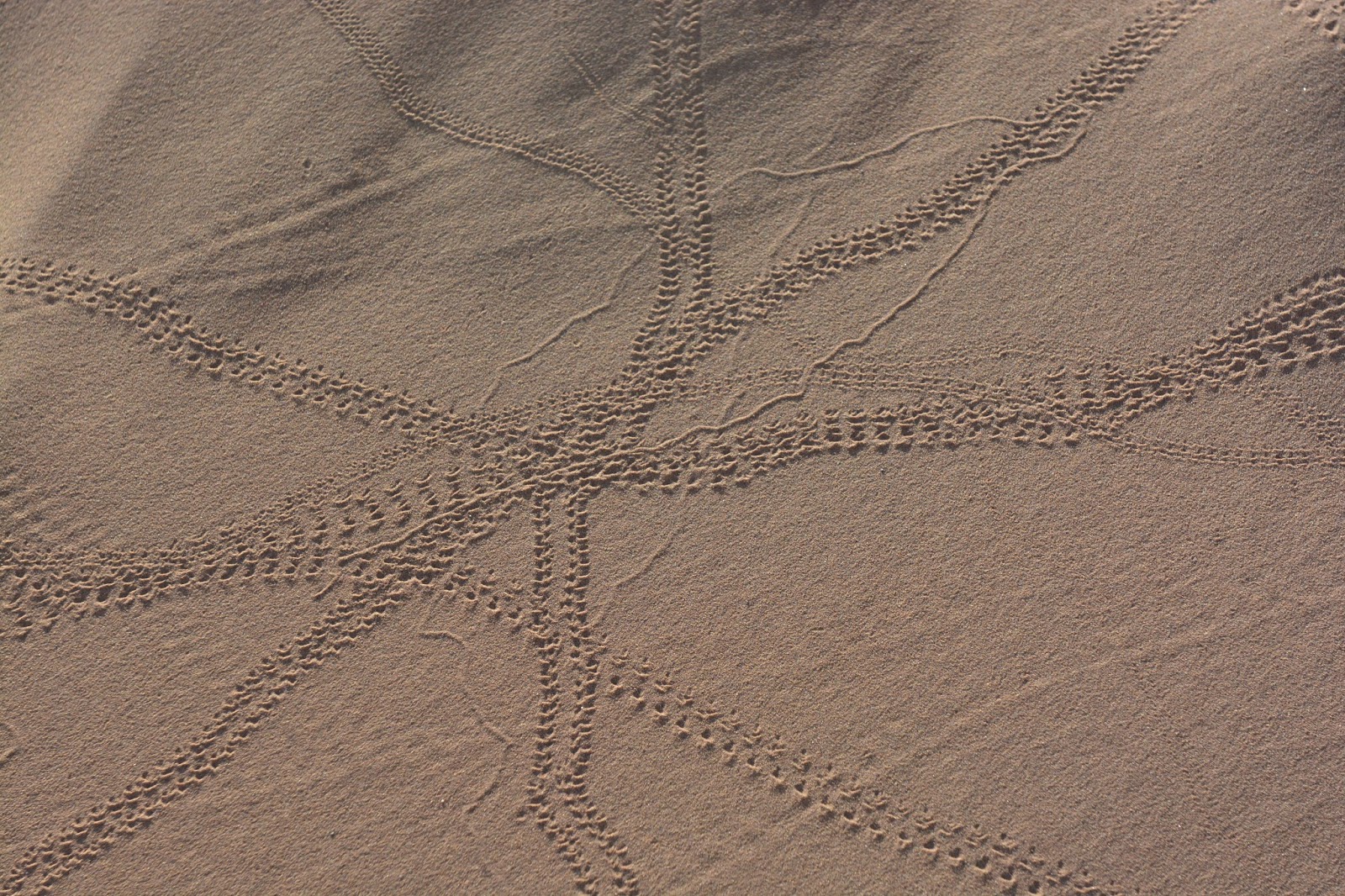
The next blog or two will deal with animals of Namibia but the dunes have a cohort of creatures living within the seemingly lifeless terrain. There are many beetles (as there are everywhere) and the tracks provide a sense of travel and activity that is rarely witnessed. there are a few birds and reptiles as well. Surprisingly there are (very widespread of course) elephants, gemsbok (oryx), and lions in this demanding landscape.

 The two landscapes above show that sand isn’t all the same. Some has iron in it and oxidizes red. Other has had tiny particles brought by the occasional rain over the centuries that now forms a clay-like layer in a hollow or swale. These depressions become shallow lakes when it does rain and some years the puddles will persist for many months.

The sand was formed from an eroding mountain range and washed into the Atlantic over the past several million years. Much of the sand now seen on the ground and in the dunes has been brought northward and then spewed onto the shore as the ever-active ocean, powered by the Benguela Current, moves sand all the time. In many ways the sand goes round and round: from land to ocean, northward to land again, southward by wind and back into the ocean.

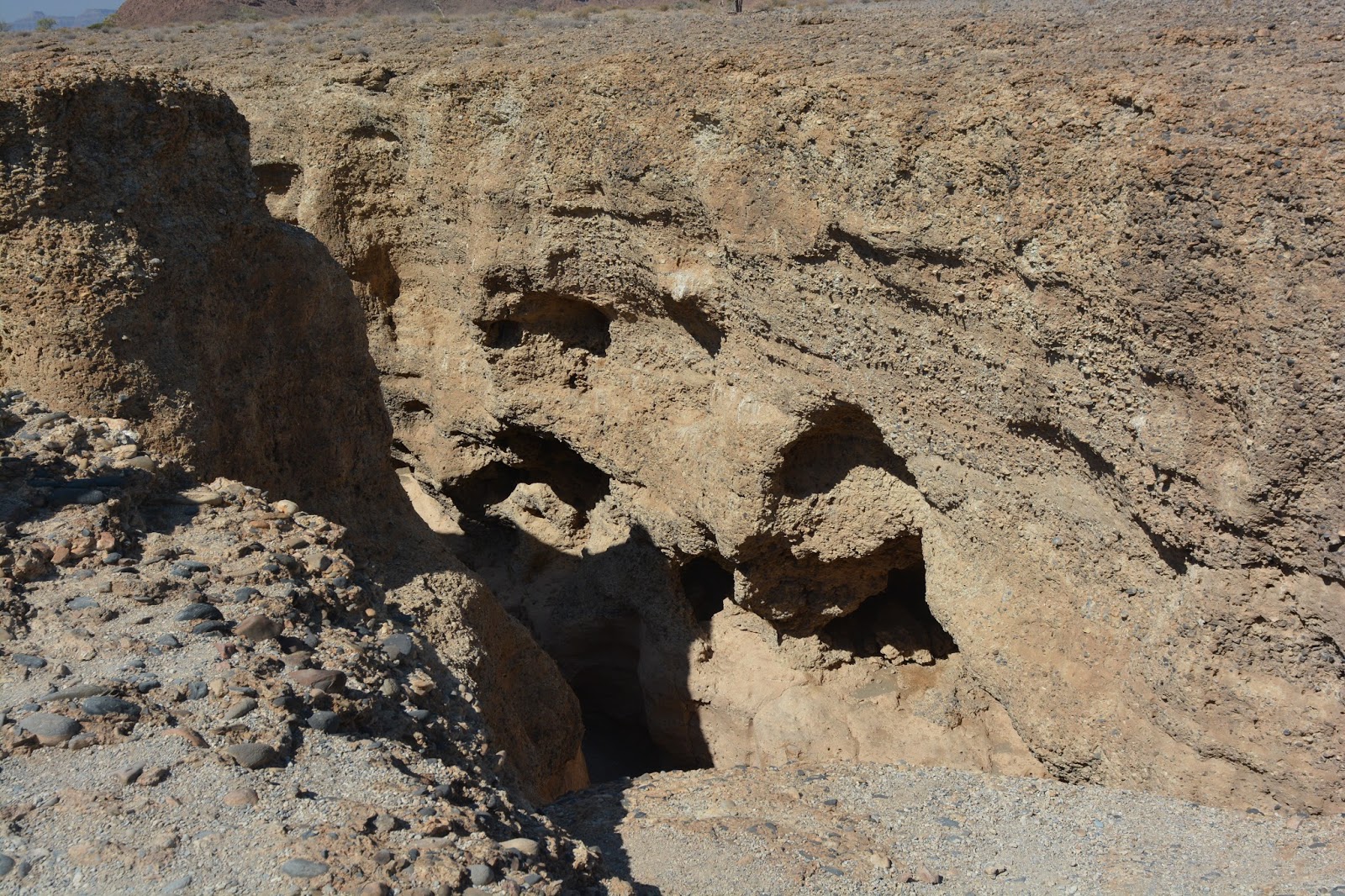
The eroded canyon below is the Sesreim Gorge. It is a washed out area that shows river worn stones and many layers of conglomerate rock. This 100′ deep canyon was eroded by a flooding about two million years ago. It is an area of unlikely configuration but may give some indication of what lies under the Namib-Naukluft National Park.

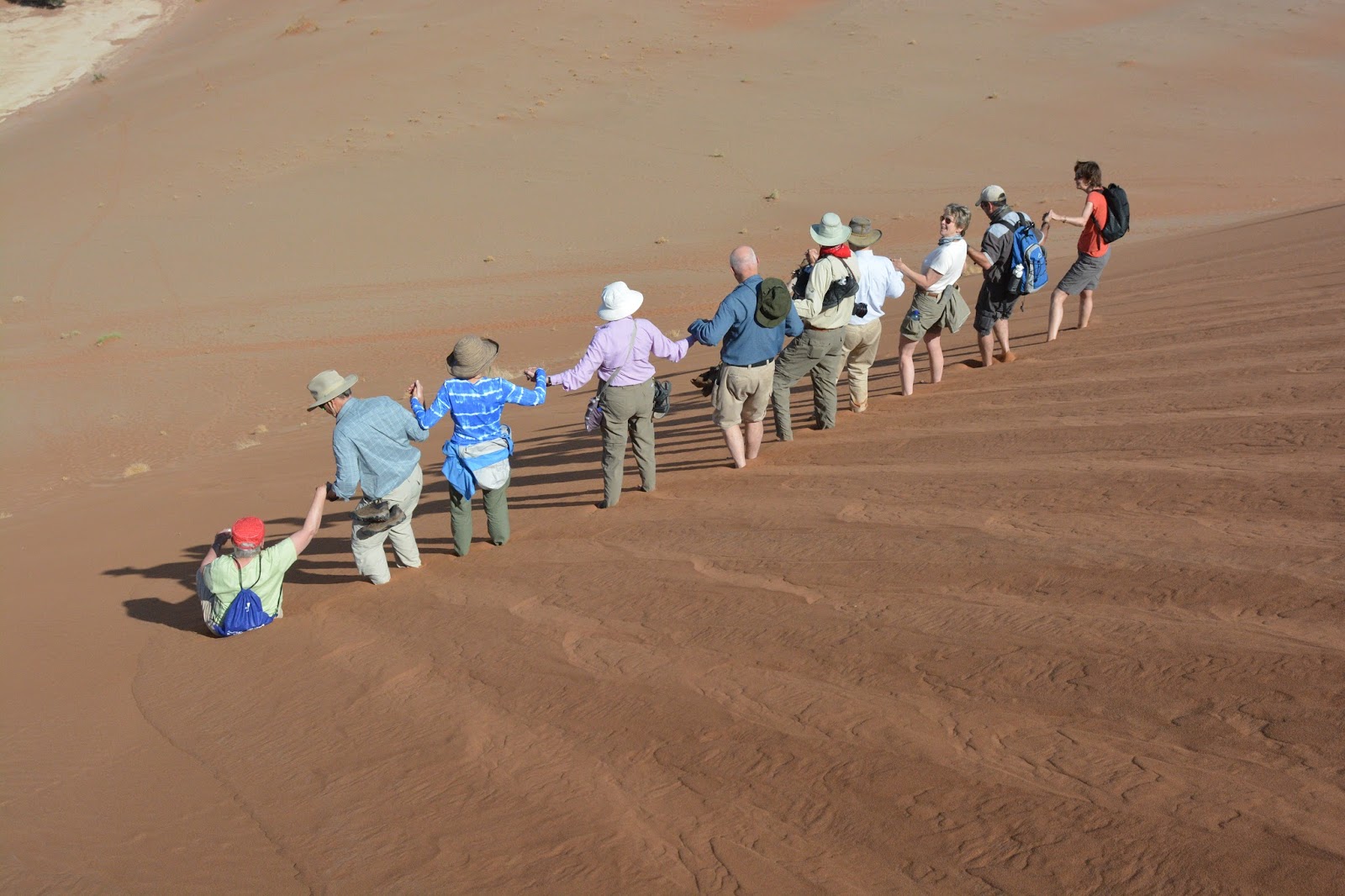
The countryside is mostly ranch land, with very poor grazing; but a great deal is national park land. The visitors are allowed to walk through much of the area and experience the sand and wind on a very personal basis. There is a tractor and wagon that gets people out through the soft sand to the larger dunes. Even when going downhill there is no sense of a forward gravitational pull as the friction of each step is isolated from any larger movement. It is very pleasant and a bit surprising.