Africa, Tanzania, Lions; lion sex, #3

Please consider all images as copyrighted and contact me for permission to use them, Thank you, DEC.

Female lions have a gestation period of about three and a half months. They can hunt right up until they deliver their kittens. The young are like house cats, small and sightless at birth. They are in a shallow burrow, thick cover, or a depression and don’t appear outside this den until they are several weeks old. The female will leave the pride during this period and stay quite solitary. The youngsters are out with the pride at about eight weeks and are weaned, or at least nursed less, at about 5-6 months. they can eat some meat at about three months. As mentioned the males and females both interact with the cubs but the males are pretty aloof parents. Feeding and teaching both are female roles. The males do protect young from all sorts of hazards. Young stay with the females for about two years and then go their own way; males to a consortium and females to form their own pride.

TZ 2017 lion sex
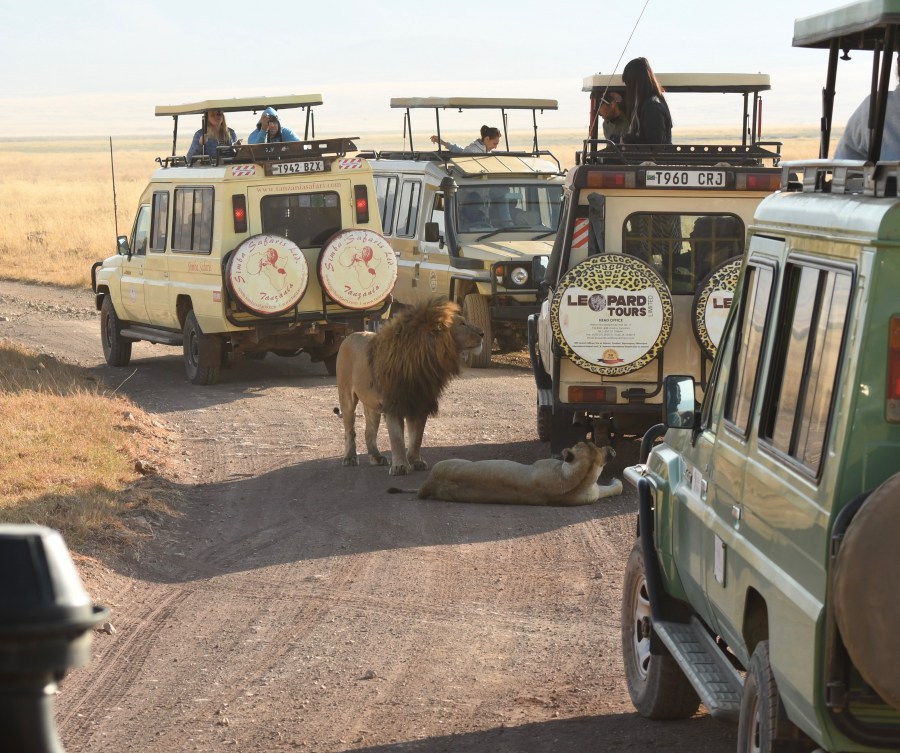
Lions don’t really care where they are and who might be around. They eat and sleep and mate in the road – much as the Beatles suggested on the White Album. Wherever there are tourists and lions there can soon be a gaggle of Land Cruisers and cameras.
DSC_5386
Females come into heat (in the wild) just about every two years. They are not coy or shy in letting the males know they are ready and the breeding/dominant male spends the next week or so at her side. Mating occurs several times an hour for several days. Females need repeated coitus in order to ovulate. The other males in the group may be nearby but the other females might not be evident.
TZ 2017 lion
The male stays close. It is the leader of the pack that gets to breed so the female has what are presumably the best chromosomes heading her way. The young will begin hunting at about two years of age and will be full-grown at four years. Male young are chased off by both females and males sometime after two years of age.
DSC_5396
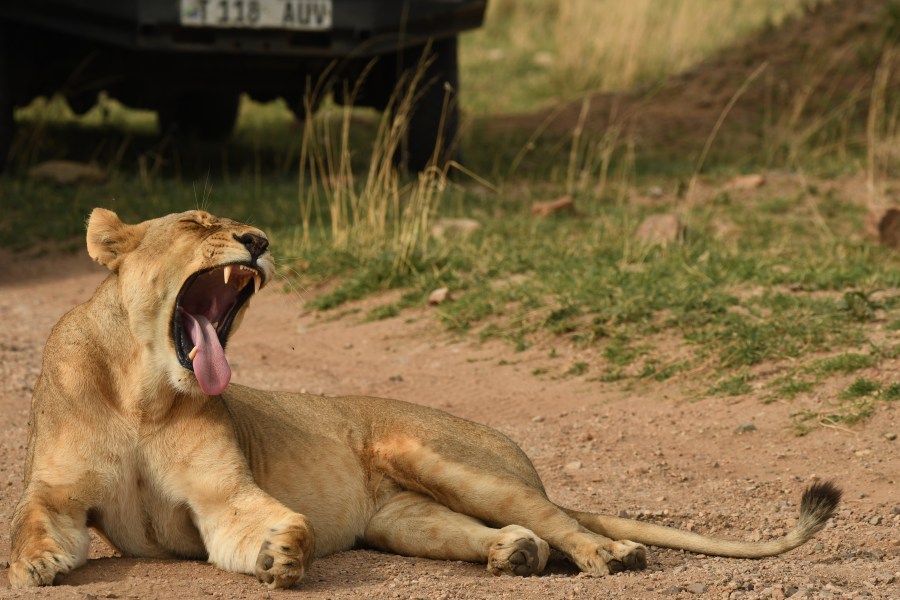
Wherever the female goes the male follows. She will initiate contact by walking around the male or by brushing up against him. They will both cat nap in between sexual bouts.
TZ 2017 lion
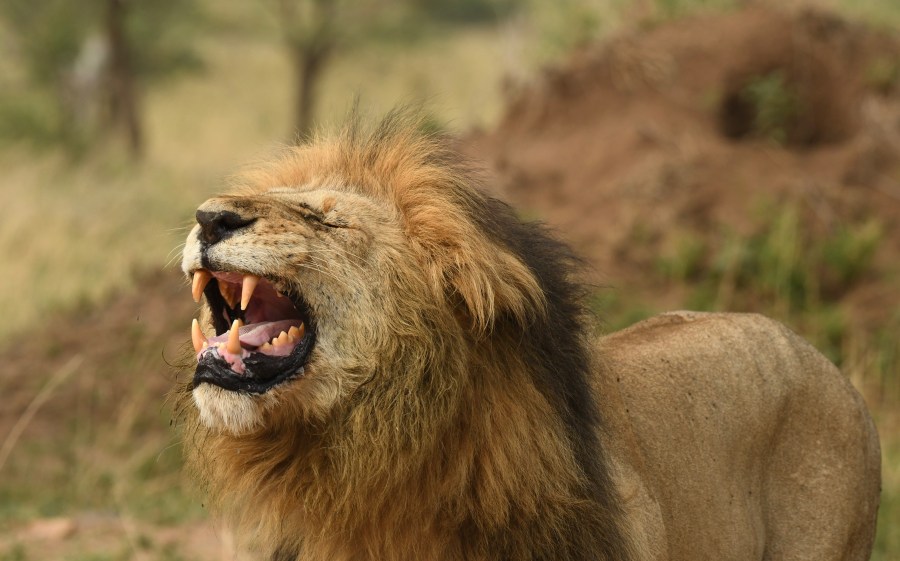
Horses, giraffes, goats, zebras and lions use the Flehmen response to determine the pheromone makeup of the urine left by a female. There are scent molecules in the urine that let the males know if the female if ready for mating. There is an organ (the Jacobson’s organ or vomeronasal organ) at the base of the nasal cavity that makes the assessment. The grimace is needed to get the air with the pheromones to reach the organ – it is not an aggressive face at all.
TZ 2017 lion sex
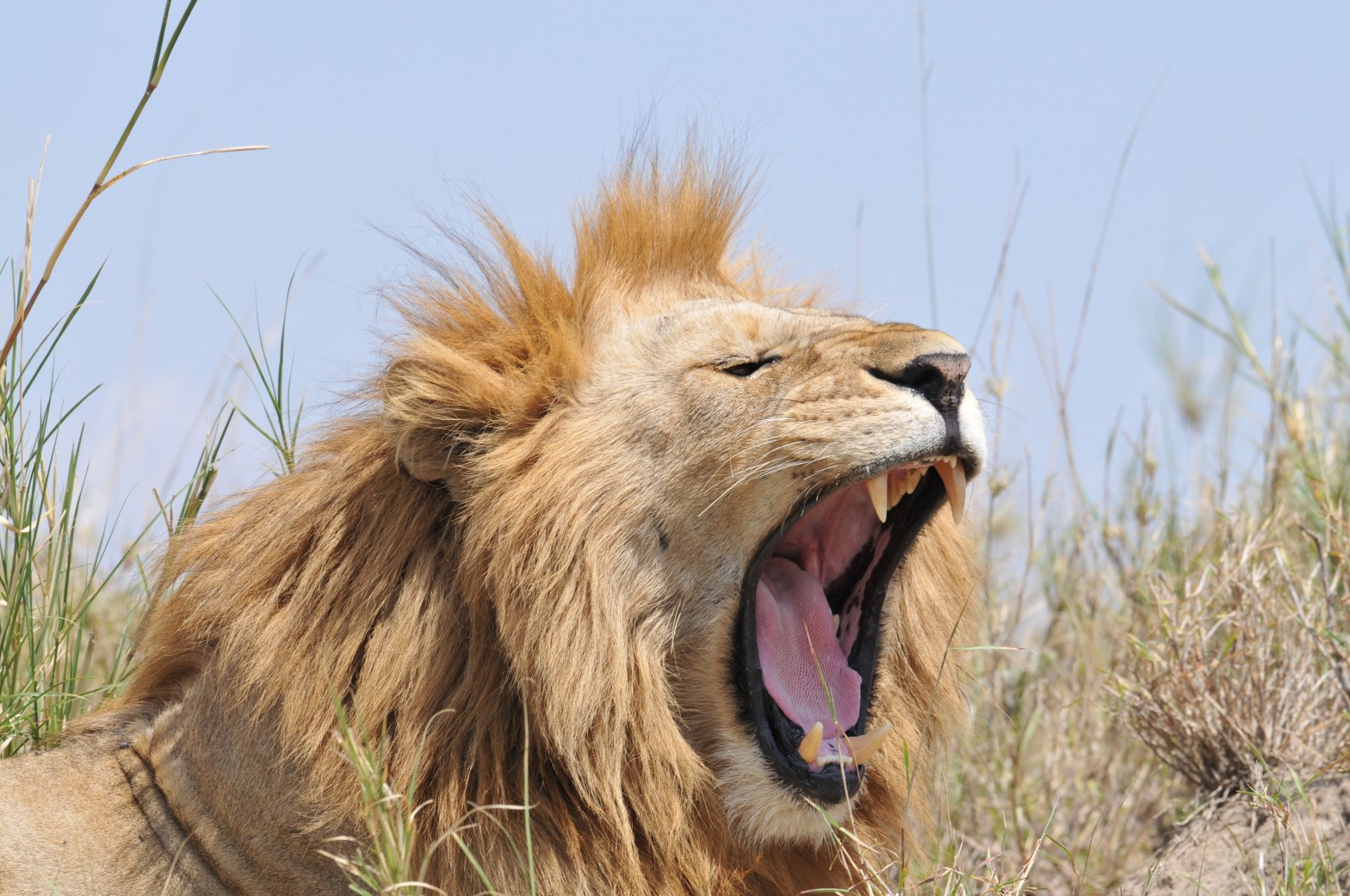
Once the condition of the female is ascertained and the males had determined who is dominant the mating gets going – over and over again. The repeated coitus prompts the female to release eggs and the 4-5-6 day breeding episode, with 25-75 sex acts a day insures that those eggs are fertilized. In the first day or two there may be 4 to 8 matings each hour. The frequency drops off a bit during the last day or two.
DSC_5399
Females tend to favor a territory with a large consortium of males. This arrangement allows for a more stable environment overall and increases the competition among males for breeding rights. the best of four or five males is often better than the best of two or three. Whatever the arrangements and the numbers about 11-12 weeks after the mating sessions the kittens will be born and a new group of lions will start on a hazardous trail toward their future and perhaps success as a member of a pride or a consortium of males.

Africa, Tanzania, Serengeti; Lions #2

PLEASE CONSIDER ALL IMAGES AS COPYRIGHTED. CONTACT ME FOR PERMISSION TO USE THESE IMAGES. THANK YOU. DEC

This is a short bit about males, it will be similar to the post from July 13. The previous post is about females and the pride this one will emphasize males but the overlapping roles and territories of the sexes make real separation difficult. The sexes are often together, many times they will hunt together and males and females both seem to enjoy family time with the kids. But the males have a job to do – guard the property. They keep other lions away and harass pesky animals like hyenas. The males, in most cases, have a heavy mane. This gives then a larger appearance and probably protects them from bites in territorial scrapes with other males. The grassland male lions have fuller manes that the lions of the wooded savannas.

DSC_4345
Males are always around a female in heat. One of the males dominates the breeding activities. But both sexes can be hanging around relaxing while romance is taking place. One reason that large groups of males are rare is that they all “desire” to breed and only the most dominant male gets that privilege. The next post will deal with lion sex more specifically.
DSC_5279
Males can be rather solitary. In many cases a consortium of two or three males (usually brothers or cousins from the same litter) will learn to hunt together and become specialists on a specific animal like African buffalo or Common Zebra. In some cases they will join the pride for a hunt on a regular basis. None of these behaviors is set in stone. As a group they are very malleable and no two prides behave or hunt exactly the same way.
DSC_5311
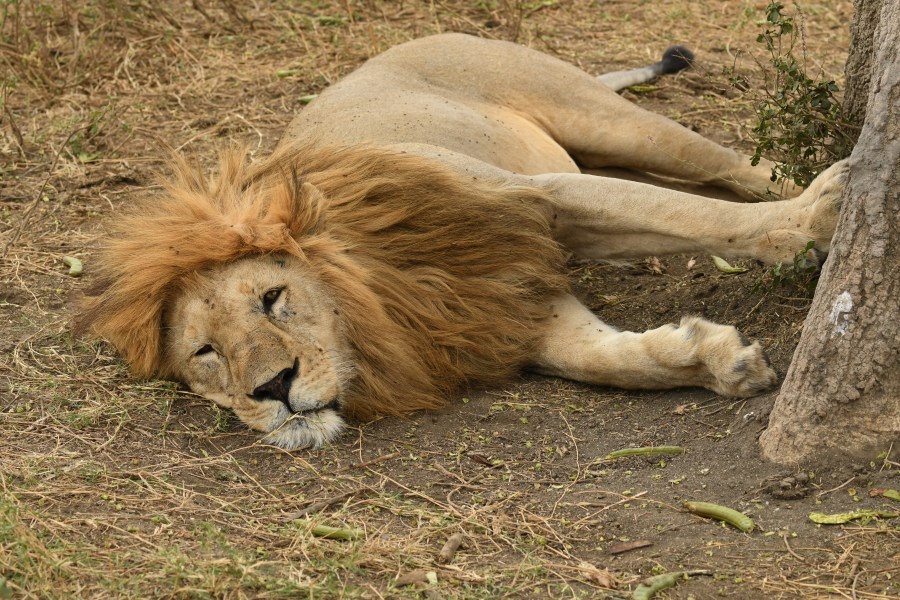
Big and lazy might suffice for male lions. They are also a less fastidious cat than many. They will clean up after a gory meal but are almost always adorned with flies, ticks, and other little creepy things.
DSC_5402
The males are fierce when they study something. The eyes take on a laser-like focus, seemingly disassociated from the rest of the animal, studying as they assess whatever it is that has drawn their attention. They react quickly and decisively. It isn’t easy to be on guard all the time.
KEMALION01
This lion has been chased from his territory by new males. He is pretty much doomed to wander from already claimed-land to already claimed-land until he is eventually killed or starves to death. A single male is at a disadvantage where ever he goes. The power and strength of a healthy male diminishes quickly as the defeated male slinks across the countryside.

Africa, Tanzania, Serengeti; Lions #1

Please consider all images as copyrighted. Contact me for permission to use these images. Thank you. DEC

I did a lion page (Africa; Lions The Big Cat) back in mid-July but think that three (four actually but one page will be on the serval, cheetah, and leopard) more are needed. Everyone who goes on safari wants to see lions. The image of the King of The Beasts or The Lord of the Jungle permeate western cultures. The greatest of the hunters, the strongest of the African cats, and the most social feline in the world all work together to create this image and feed this desire. It matter little that they mostly just lie around with their entourage of flies and ticks. They sleep many many hours a day. After eating it is about all they do for 24-48 hours. Even when hungry they seem to rest a great deal. But the cats (lions, leopard, cheetah) draw the safari-goer onward and the thought of seeing them gets people out of bed at five a.m. to get a jump on daylight and to hopefully find a handsome pride of lions at a recent kill. Sometimes it works sometimes it doesn’t.

This page will be on females; the pride. The next on the males (again), the third on lion sex, and the fourth on serval, cheetah, and leopard. The pride is the cluster of animals that harbors most of the lion group. It is a female group with youngsters and teenage kittens as well. The younger female may grow into the pride the post-puberty males will be sent packing; usually with a snarl and a bite on the rump. There are no fond, lingering, teary good-byes. The pride has a territory that is pretty stable. As long as there is a contingent of females that can hunt together successfully they will stay pretty much in the same area. The males will wander the perimeter of their territory which may or may not be coincidental with the pride. Sometimes there are several males working together and they can hold a large territory with more that one pride inside; other times it is one or two males with a single pride group. It varies and it changes.

DSC_5450
Lions are very social; the only cat to be social actually. Most of the time cats, of all types, are solitary or females with young. There are rarely groups of any sort of cat. Males and females get together to mate – usually without much of a personal touch. There can be small groups of male lions that work together to “own” a territory. But as only one of these chaps will breed, the group often diminishes down to two or perhaps three males as they split up looking to reproduce. The image above is pretty typical of lions – lyin’ around, so close as to be touching each other, in the grass, or under a tree in the shade, or in the road.

Lions are large and solid. Males can weigh as much as 500 pounds and females maybe 100 pounds less. Including the tail they can be eight feet in length and stand almost 4′ at the shoulder. They are big. I mentioned “King of the Jungle” earlier and just want to mention that the term “jungle” is not ecological of biological. It just means a really thickly vegetated area. It is best used along tropical rivers where the riparian edges are nearly impenetrable. In Africa, especially East Africa, the term is pretty much meaningless. The lion is certainly the King of the Savanna and perhaps even the Monarch of the Wooded Savanna but where there is no jungle…well s/he can still be King/Queen of the Beasts.

TZ 2017 lion
Lions seem to know their status. When they want to lie down, they lie down. Surprisingly it is often near the dirt tracks that safari vehicles follow and many times it will be right in the road itself. Perhaps there is a better breeze in the open space of the roadway or perhaps there are fewer bothersome insects out of the grasses; insects bother lions as they didn’t seem to get the King of the Beasts memo. The shadows around the left edge and bottom of this images are parts of our vehicle – we were very close.
TZ 2017 lion
The females are often related. A group of sisters and female cousins raised in a pride will often become the pride of the future. This trip we saw two males and two females, all in different groups, with severe limps. Damaged legs can be the first sign of a significant changing of the guard. If the consortiums of males or members of the pride can no longer hunt then perhaps the end is near. There is competition for space and for females. If males are unable to feed themselves and stay healthy new males will enter the territory and take it over – after a lot of roaring, peeing, and fighting. Once they are taken over, the youngsters of the pride will be killed by the new males and soon the females will mate with the new guys and they will then have a vested interest in protecting the territory and the pride within. There is a lot of research on lions as they are threatened by poaching. The female on the right is wearing a collar that transmits information to the researchers.
TZ 2017 lion
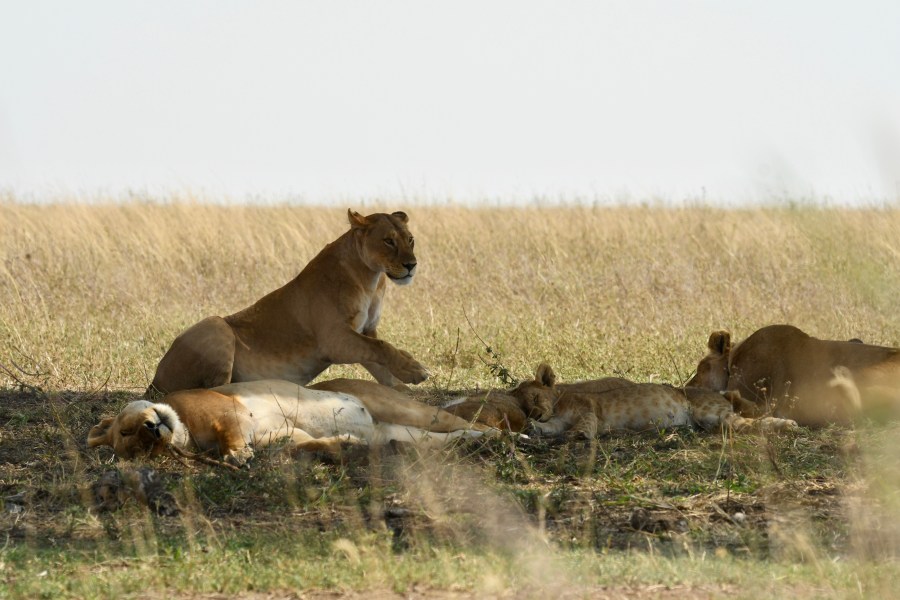
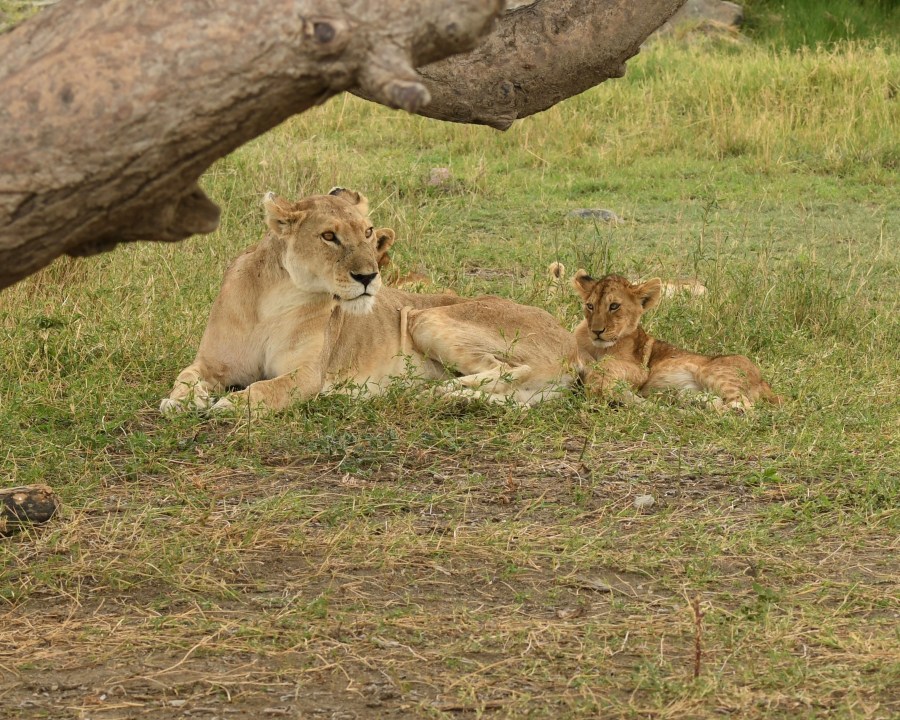
A rather usual family scene has a few females and several youngsters of rather similar ages. The synchrony in birthing is often related to the arrival of a new male consortium. The cycle works best when youngish healthy females form a pride with strong, youngish, healthy males as guardians. This arrangement might allow for two or even three litters to be born within a stable group of adults. But, so much can go wrong. Many adults never raise young to adulthood.
TZ 2017 lion
Though three or four young are the norm they all don’t survive. A female with one or two youngsters is not unusual. Mortality can come from many places; hyenas kill youngsters, thorns, infection, disease, diet, and all sorts of environmental impacts can affect the success of a group of kittens.
TZ 2017 lion
As many of the females in a pride will likely give birth at about the same time they will cross-suckle the youngsters. In many cases the young are frisky when the adults want to sleep. Generally they all get along but occasionally a female will tire of the young and snarl a bit before wandering off a few meters to get some peace and quiet.
DSC_5285
This female was quite happy sleeping is a wet and muddy area while five kittens nursed. This particular cat had a sister and a male or two around as well. The area was a drying mud hole in which a hippo had gotten bogged down and died (or was killed). It was food for the group even though the smell was terrible. (A picture of the hippo is in a future post. Ugh.)


Africa, Tanzania, Serengeti; The Secretary Bird

Please consider all photographs as copyrighted and contact me for permission to use them. Thank you, DEC.

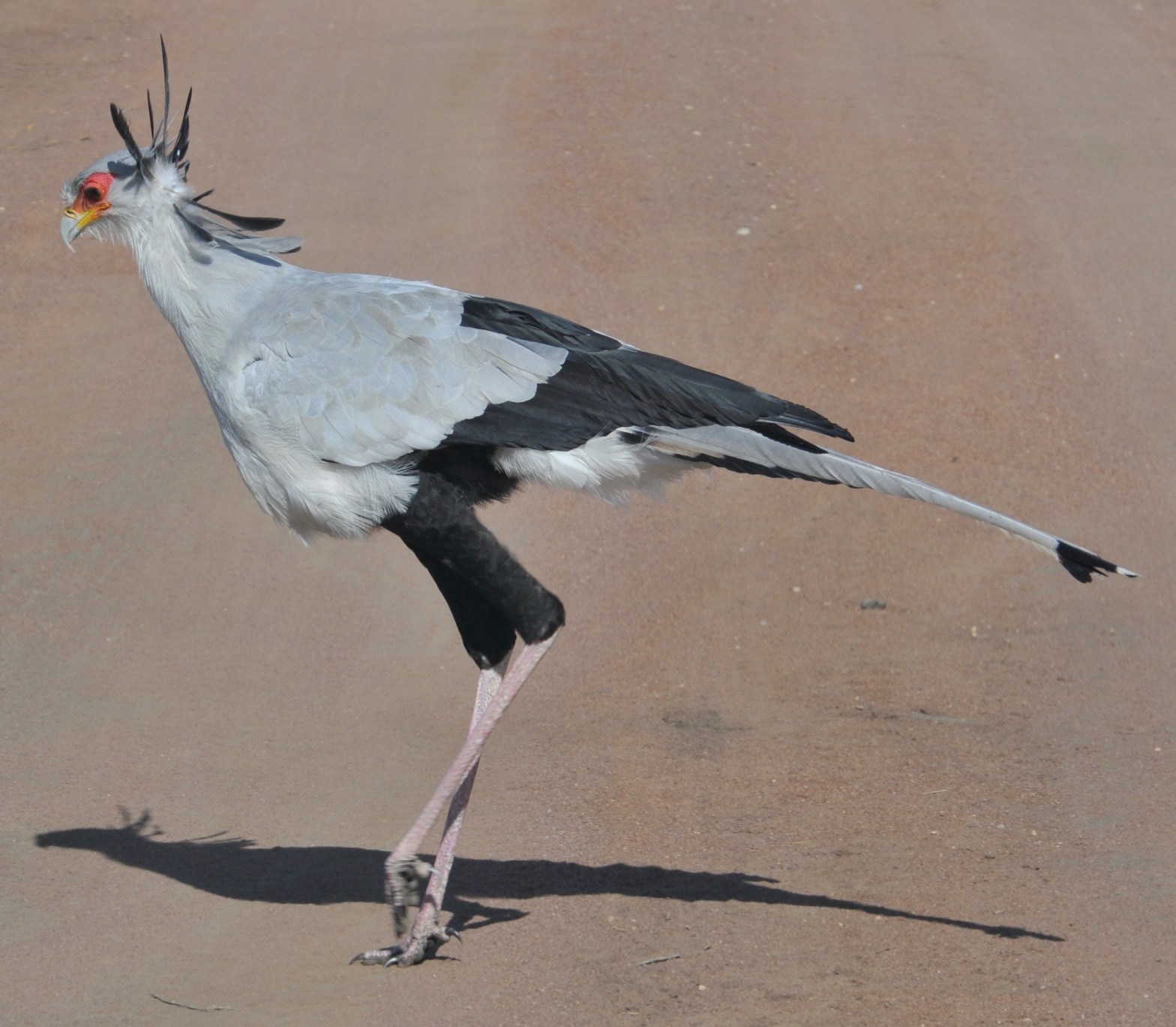
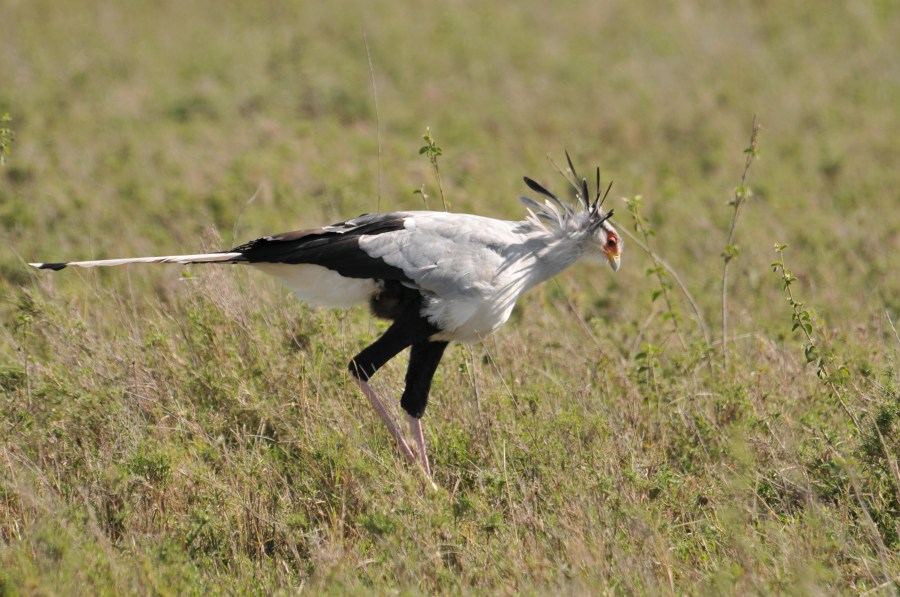
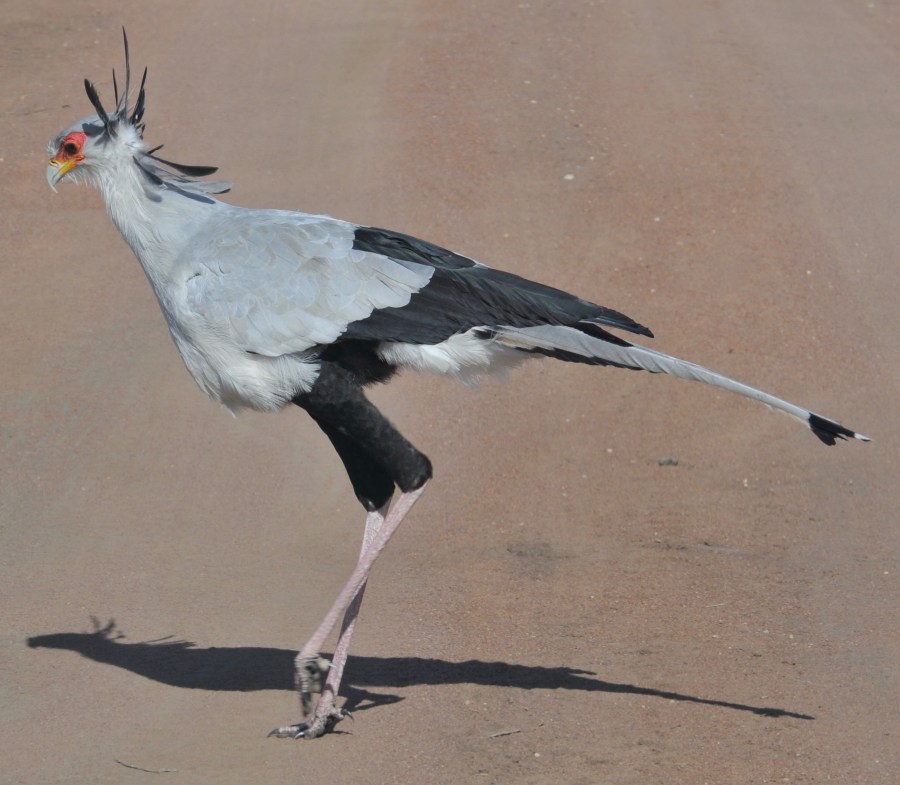
Walking with measured pace over the short grass plains of the Serengeti (and Maasai Mara) the Secretary Bird simply exudes elegance and style. It is large, softly gray, with long legs, long tail, and an array of disheveled feather erupting from its ferociously beaked head. The long legs are half pale pinkish-red skin drawn tightly over bone and half intensely black pantaloons. The Secretary Bird is an icon bird of East Africa and one that is quite unexpectedly carnivorous when watched closely.

But before looking at the Secretary Bird more closely I will point out two other large birds of the grasslands; the Common Ostrich and the Kori Bustard. 

ostrich
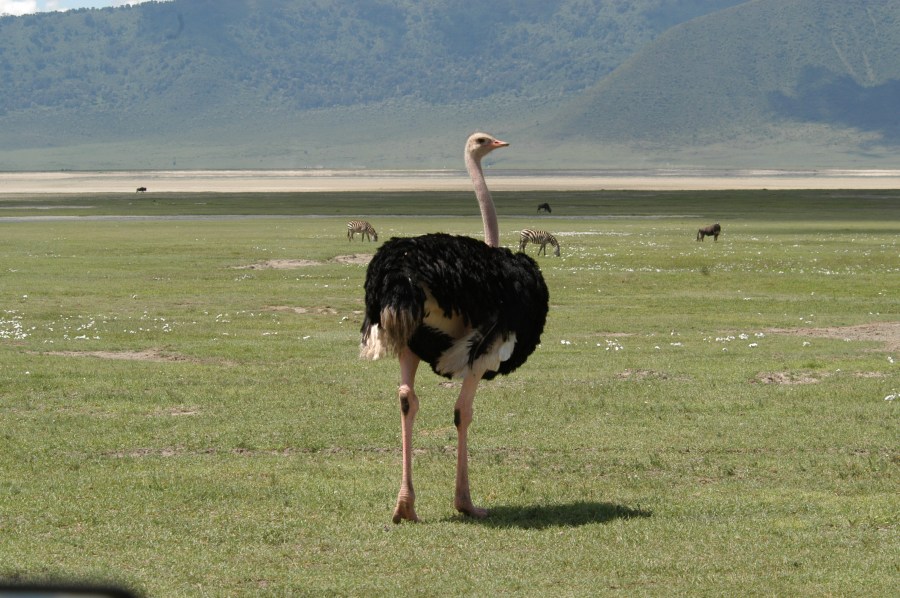
The ostrich comes in two forms, often but not always, referred to as two species. There is the Somali Ostrich found in East Africa north of the equator (Kenya) and the Common Ostrich found through most of Kenya and Tanzania south of the equator. The equator is no real barrier but there are a few species that are found only north of the equator (gerenuk, reticulated giraffe, and Somali Ostrich) for some undefined reason. The Common Ostrich can be eight feet tall at the head and has a sexual dimorphism with gray-brown females and black males. They are very mobile yet have the unbirdlike presence of only two toes on each foot. The more northern Somali Ostrich has neck skin that is quite blue; compare this to the pinkie red neck skin of the Common Ostrich.
DSC_4517
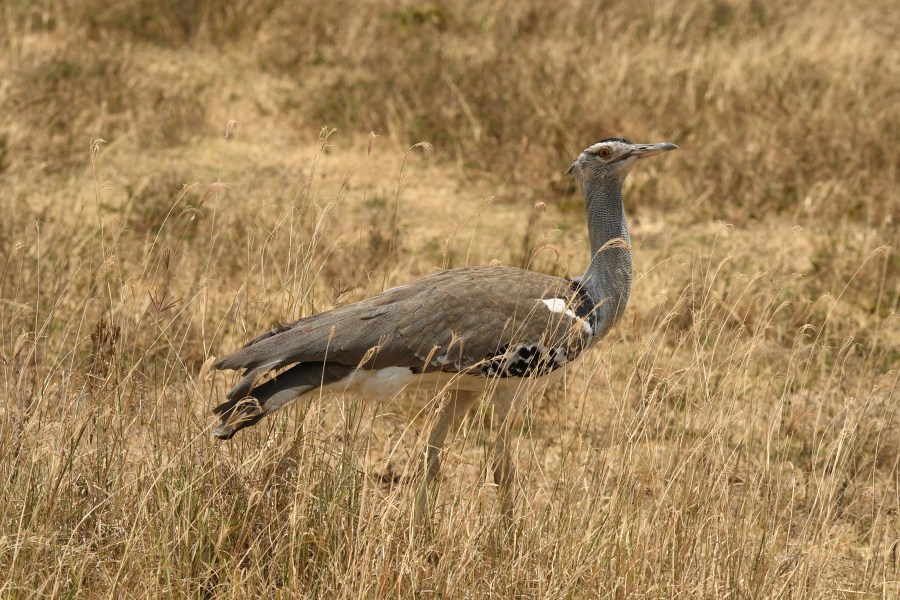
Another large grassland bird of East Africa is the Kori Bustard. Bustards are represented in East Africa by six species but the one most restricted to grasslands, and the largest and most often seen, is the Kori Bustard. From head to tail they can measure about 4′ and they are quite heavy. They can and do fly, showing a banded tail and light wing patches when soaring. Turkeys, swans, condors and pelicans are the other “heaviest” birds to fly. The Kori Bustard male can create a large whitish “muff” of neck feathers and great white patch/plume of undertail feathers to display his interest and availability to mating. On the short grass savannas this display can be seen a mile away.

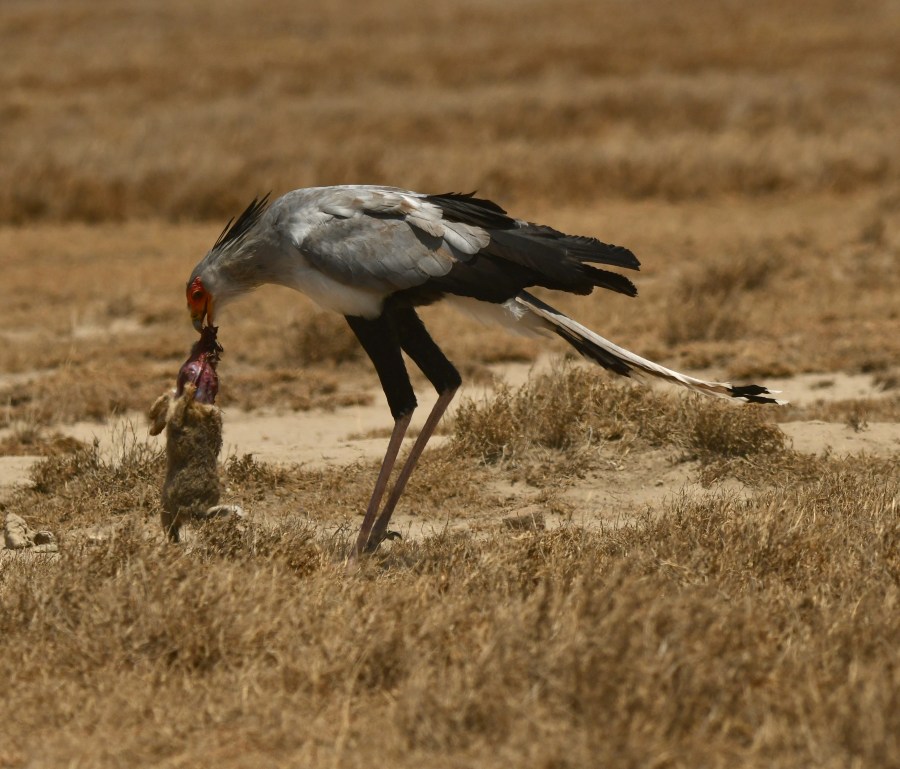
There are also many herons, cranes, spoonbills, and storks scattered over the great grasslands of this region. But the Secretary Bird is really at home here – many of the others are seasonal and often weather dependent. The Secretary Bird has often been classified as a “raptor” and is sometimes called the “eagle of the savannas”. Its current taxonomy has it as the only member of a taxonomical family called Sagittariidae. Aside from its confident carriage and royal demeanor on the grasslands it is best known for a loose array of head feathers that look like the quill pens that clerks and secretaries stuck in their hair and wigs in the 19th century. It was named in an era when those writing quills were used, well before ballpoint pens and graphite pencils. But, they are hunters and the following images will confirm that. They are known for finding snakes and pummeling them with a “fisted” foot. However I have never seen them eat anything except large insects and occasionally (twice really) kill and devour a Savanna Hare – a rather large rabbit.

DSC_6914
Walking, striding, pacing, and looking for prey is what they do most of the day. They can fly with the long tail and legs very evident. When they nest they build a large nest on the top of a substantial shrub of bush or small tree. 
secretary bird – Version 2
The Secretary Bird is not chunky like a turkey or the bustards. It has a smallish head, long thin legs, lots of tail, and a rather small body. The face color is yellow, reddish, or orange and the bill is usually gray or even pinkish gray.
TZ 2017 secrtarybird
In this instance one of the two Secretary Birds found and pummeled (the best word for certain) a Savanna Hare. The second bird, shown above with dinner, took the hare from the paler bird and proceeded to tear it apart eating large pieces one after the other. Most African bird books say that the younger birds are duller (which I read as darker) than the adults. As the original bird was pale and this bird is darker I can only surmise that this bird is a very hungry teenager who took the food from the parent bird. If this is true it is quite likely that this younger bird is just about full grown and hanging around the parents for free food. That sort of behavior, in all sorts of animals from lions to birds to elephants, gets the youngster kicked out of the territory and sent off to fend for itself.

Australian Icons: Cook & Banks

The Australian state governments run libraries. These are wonderful facilities rich with valuable and historic materials dating back to the first ships. I have been to three of them and have been enthralled by the exhibits and artifacts. They also have study and reading areas and great wi-fi connectivity. In addition, and by no means least, they have very nice book shops. The Northern Territory library is in Darwin and the New South Wales Library is on Macquarie Street in Sydney; and easy walk from just about anywhere in the Central Business District. The street, and many other features in New South Wales, was named for Lachlan Macquarie a governor from 1810-1821.
The Smithsonian Journeys groups have had the great good fortune to visit the library and to see some of the historic documents that are housed there. There is always an exhibit of some sort on display and a visit is always a rewarding passage of time.

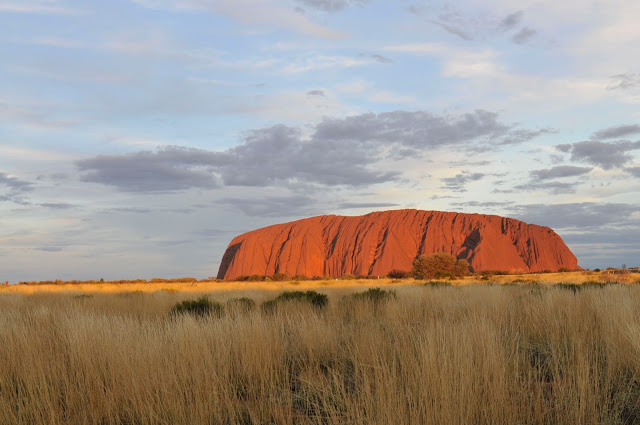
In reality James Cook and Joseph Banks are as much Australian icons as are Uluru (Ayers Rock), The Olgas, The Opera House, and the Sydney Harbour Bridge. Without Cook (and Cook without Banks) a great deal of the history below the equator could be very very different.

Australian Icons: Cook & Banks

The Australian state governments run libraries. These are wonderful facilities rich with valuable and historic materials dating back to the first ships. I have been to three of them and have been enthralled by the exhibits and artifacts. They also have study and reading areas and great wi-fi connectivity. In addition, and by no means least, they have very nice book shops. The Northern Territory library is in Darwin and the New South Wales Library is on Macquarie Street in Sydney; and easy walk from just about anywhere in the Central Business District. The street, and many other features in New South Wales, was named for Lachlan Macquarie a governor from 1810-1821.

The Smithsonian Journeys groups have had the great good fortune to visit the library and to see some of the historic documents that are housed there. There is always an exhibit of some sort on display and a visit is always a rewarding passage of time.

In reality James Cook and Joseph Banks are as much Australian icons as are Uluru (Ayers Rock), The Olgas, The Opera House, and the Sydney Harbour Bridge. Without Cook (and Cook without Banks) a great deal of the history below the equator could be very very different.
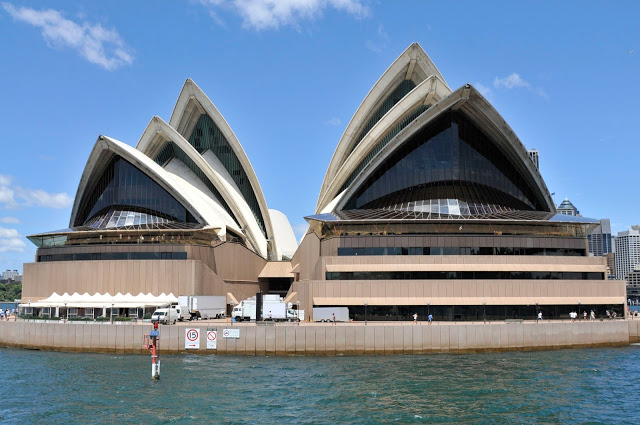
The first four images are of three of Australia’s true icons. There is Uluru (Ayers Rock), the Sydney Opera House (outside and inside), and a Kookaburra. This is the blue-winged kookaburra rather than the more common laughing kookaburra but it is still a kookaburra.

The view of the Opera House from a boat on the Sydney Harbor reminds me of a group of feeding humpback whales. I think that it is supposed to feel more like a ship on the harbor whether you are inside or outside. Certainly the view shown below gives the feeling of being on the bridge of a large and magnificent ship.

Africa; Tanzania, Ngorongoro Crater

Please consider all photographs as copyrighted and contact me for any use. Thank you.

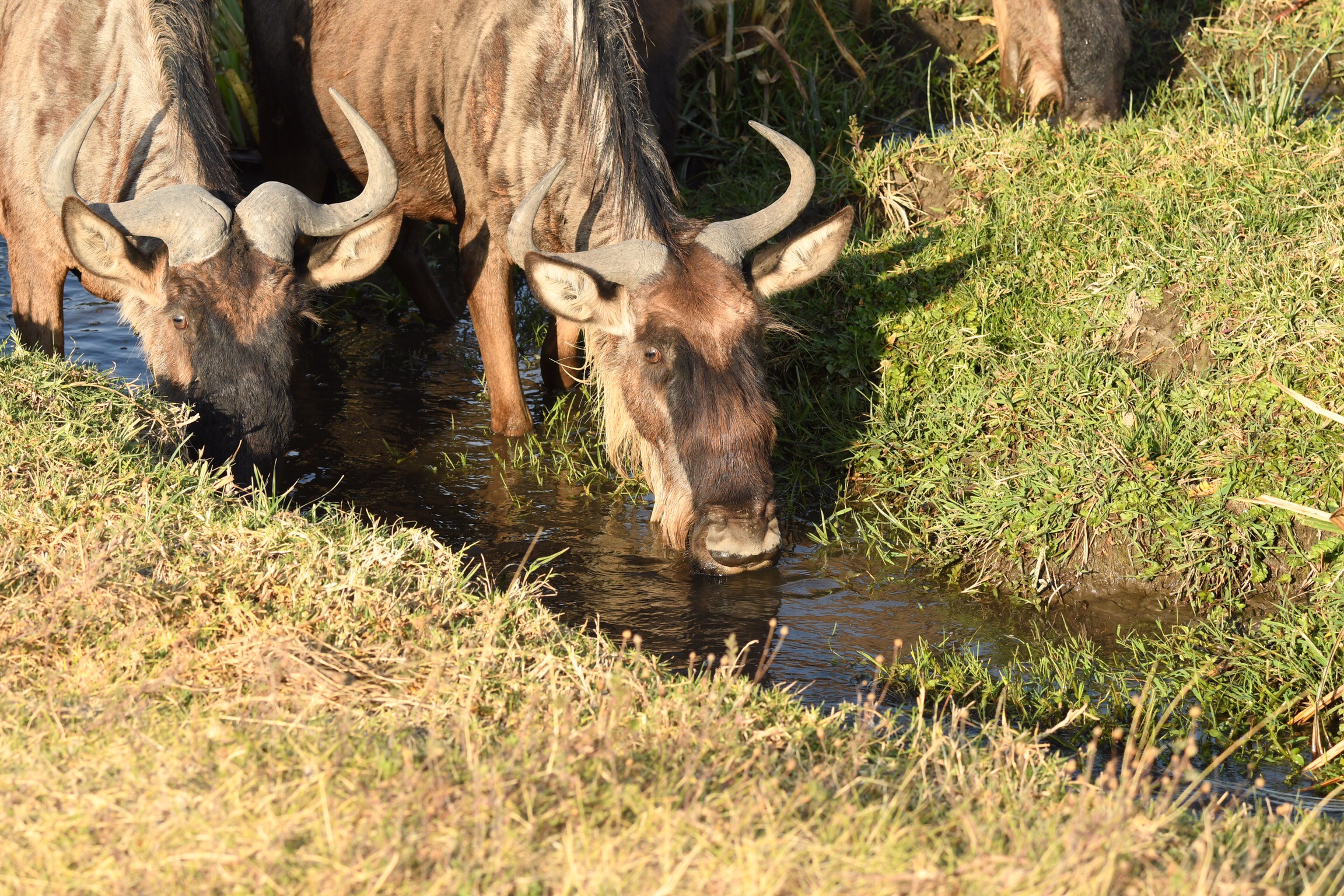
There are thousands of animals in this 120 square mile caldera. It always has water and thus green plants and grazing animals. This is just right for predators as well. The lions and spotted hyenas are always plentiful. But I think I’ll start with an unlikely look – let’s look at a few of the horns seen on the grazing animals. There are Thomson’s gazelles, eland, and a few others that won’t be pictured but the four offer a look at the variety.

Here two wildebeest drink from a fresh water stream. The animal on the right is a yearling while the other is at least a year older. The “boss” of the horns is larger on the older animal. They drink from the freshwater stream as the lake it flows into gets more and more alkaline as water evaporates.
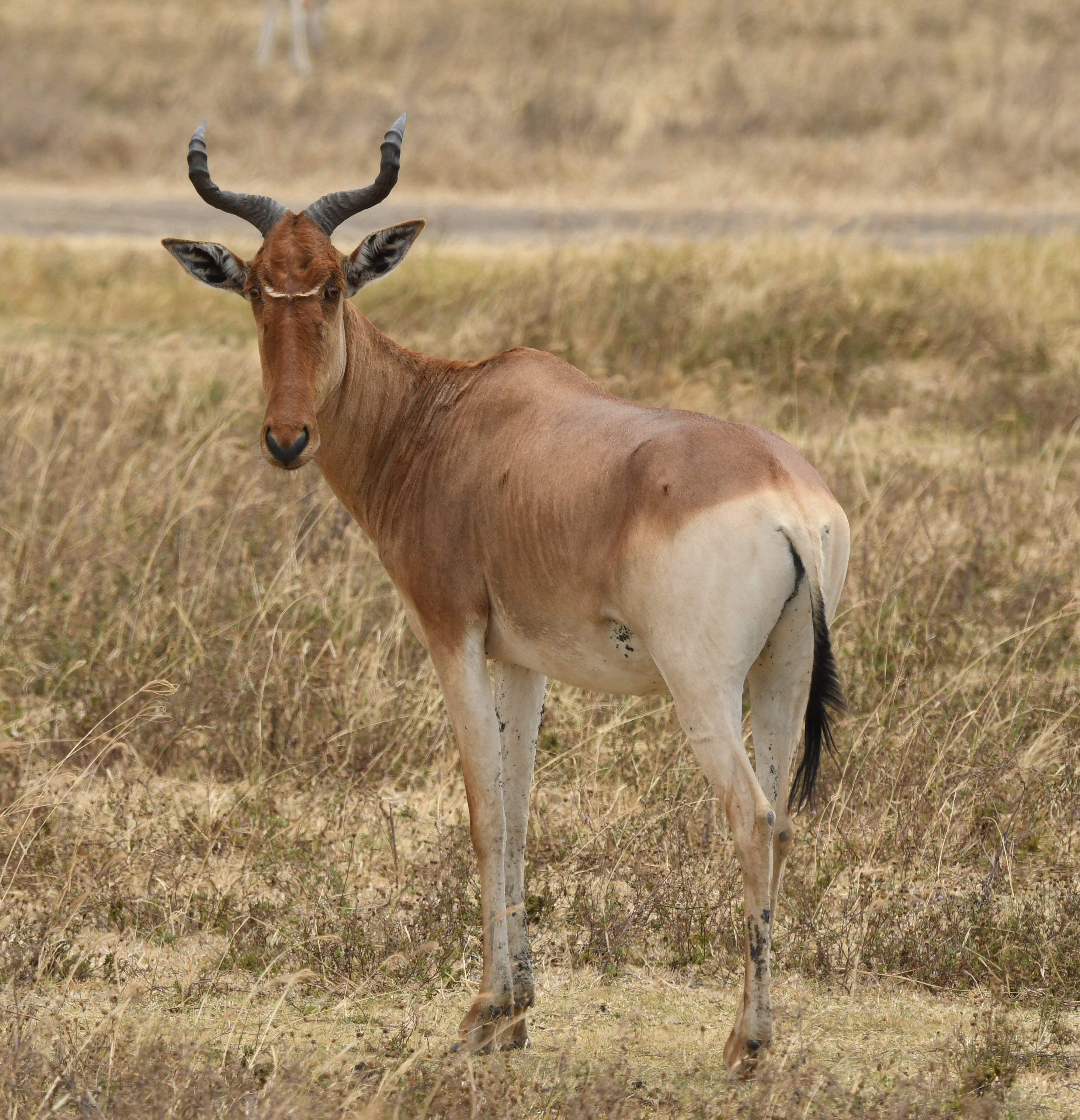
The hartebeest are members of the horse-antelope group. These long-faced animals have horns mounted on a pedestal. The ears and horn protrude in a paired ladder sort of way. Notice the flies on the underside, there are several creatures that make a living on the bodies of the warm-blooded grazers.
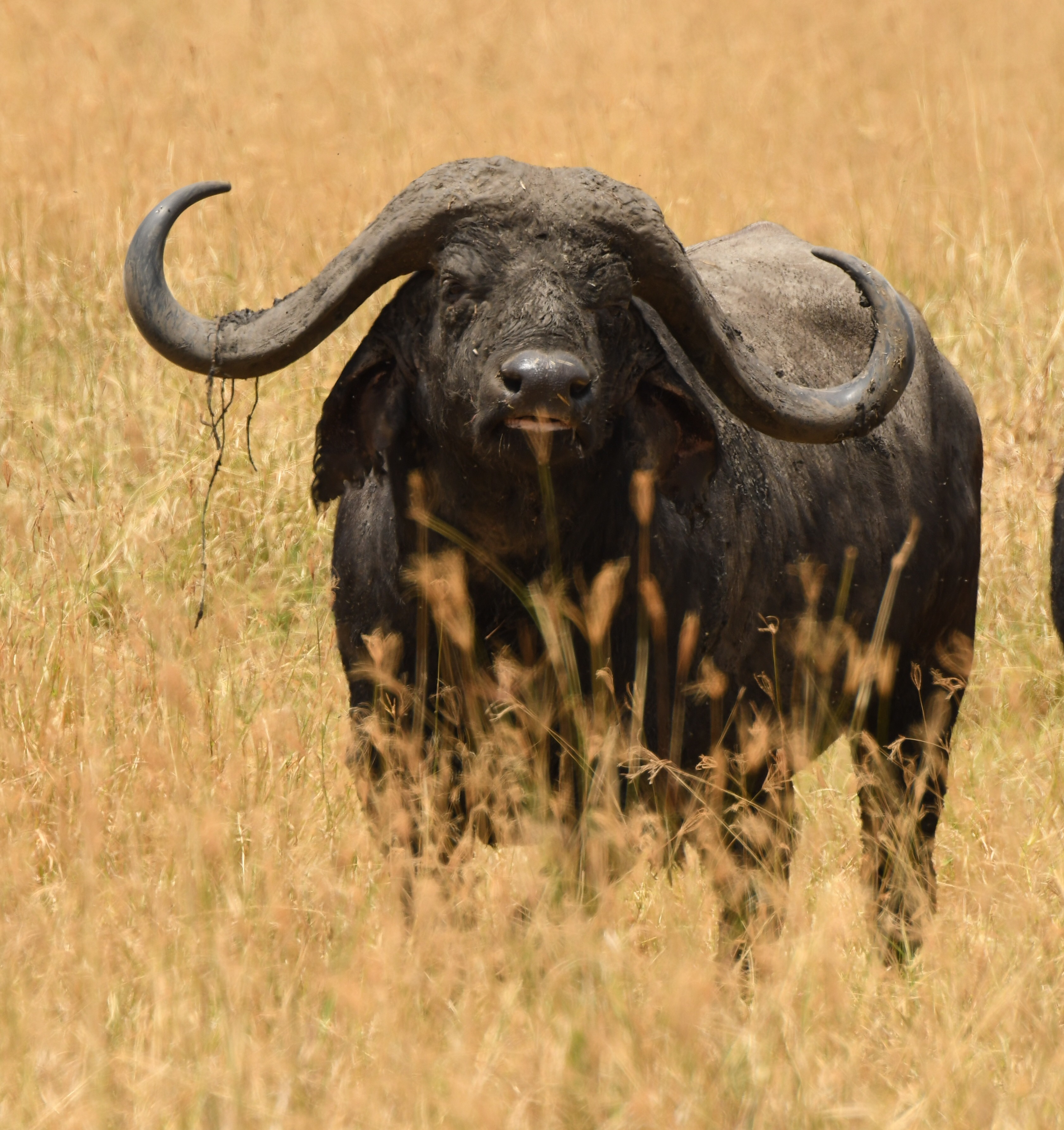
The African, or Cape, buffalo is a very common grazer wherever there is permanent water. The bulls develop a thick and heavy “boss” over time. The females generally have thinner horns and an open space between the horns (on the forehead).
The Grant’s gazelle is a robust antelope with annulated lyre-shaped horns. There are several subspecies of this antelope and the pattern of the horn shape varies one to another. The characteristic used for field identification of this animal is a band of white above the tail. It is the only antelope with this sort of marking. Of course the shape of the horns is also a big help.

I am currently working with a safari tour group and will post as time allows.  I can provide more depth on the subjects when I get home.

Tanzania; Red-headed Malimbe nest

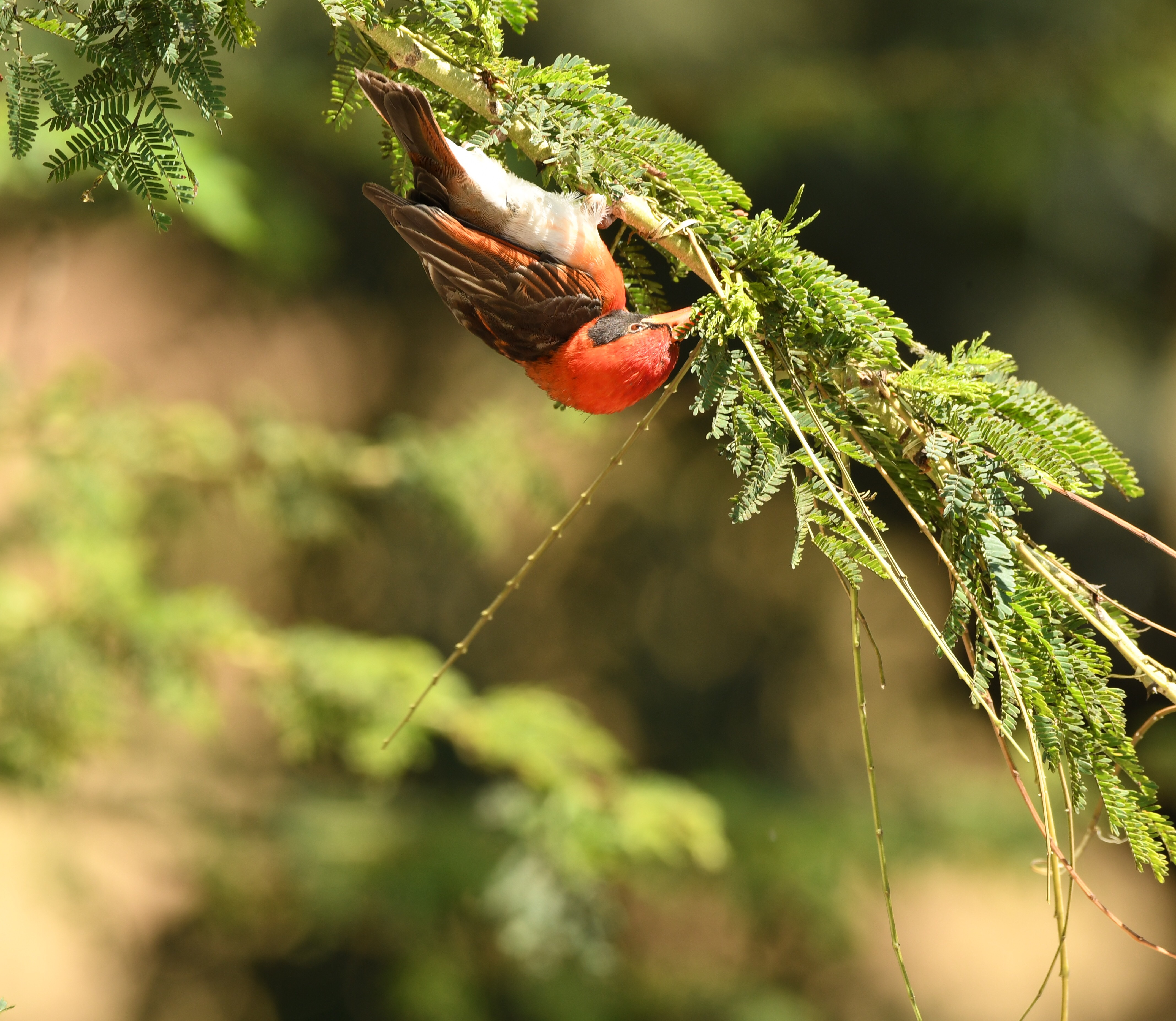
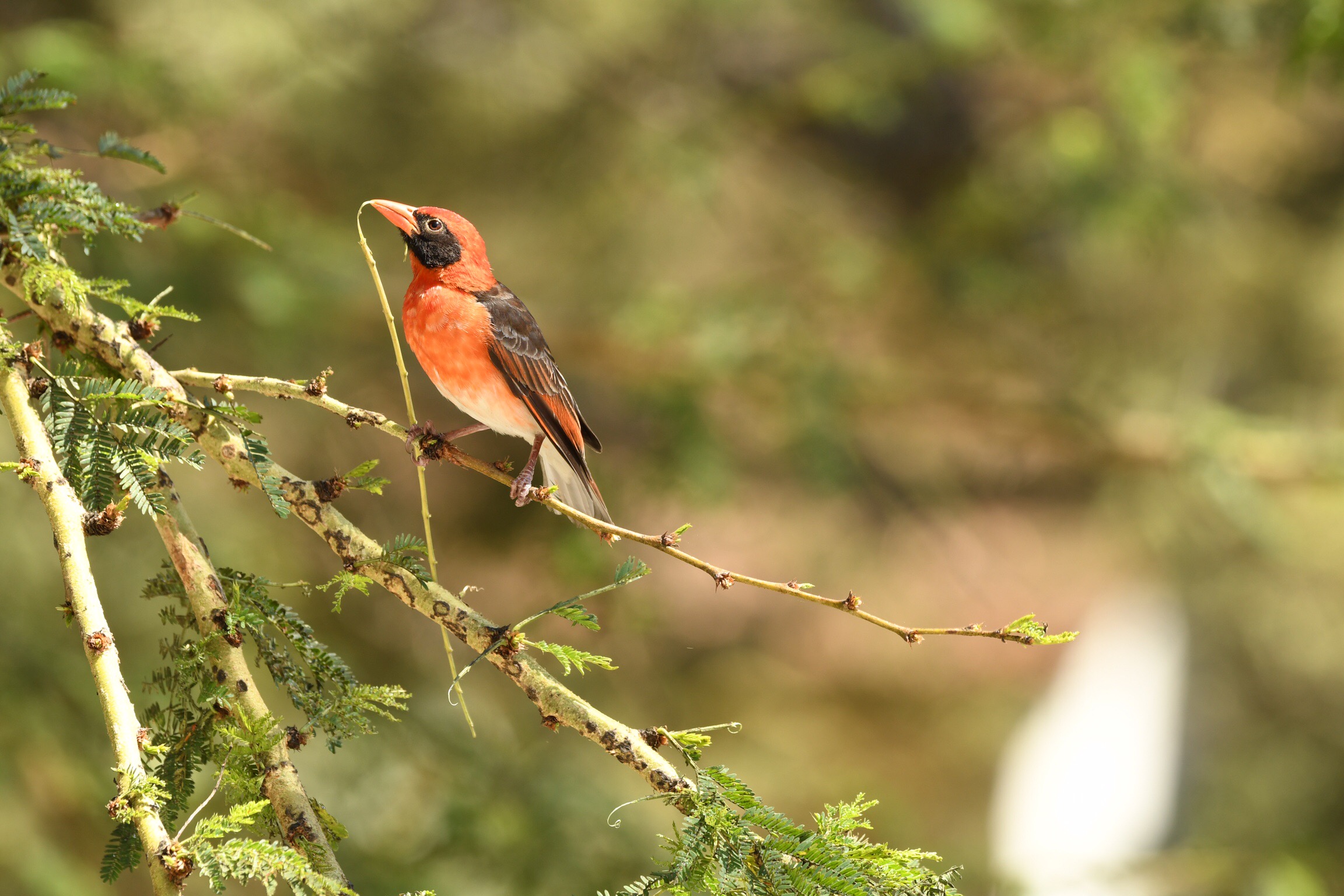
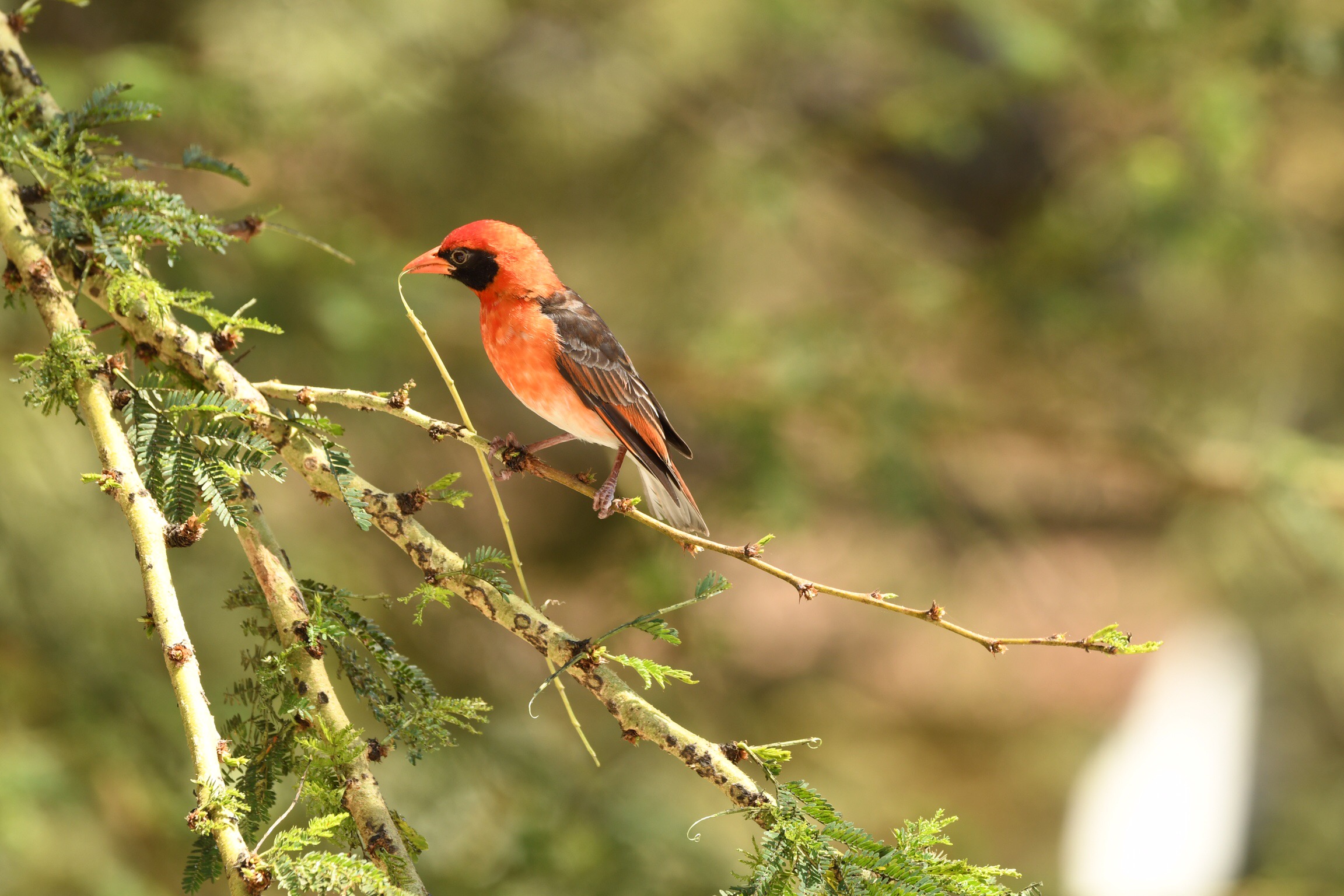
The Red-headed Weaver has several forms. This bird is one of them. It is better called Red-headed Weaver, but one source allowed that this was now grouped with the Malimbe weavers — and I ran with that. As the taxonomy clears I will add/change/corect the terminology.

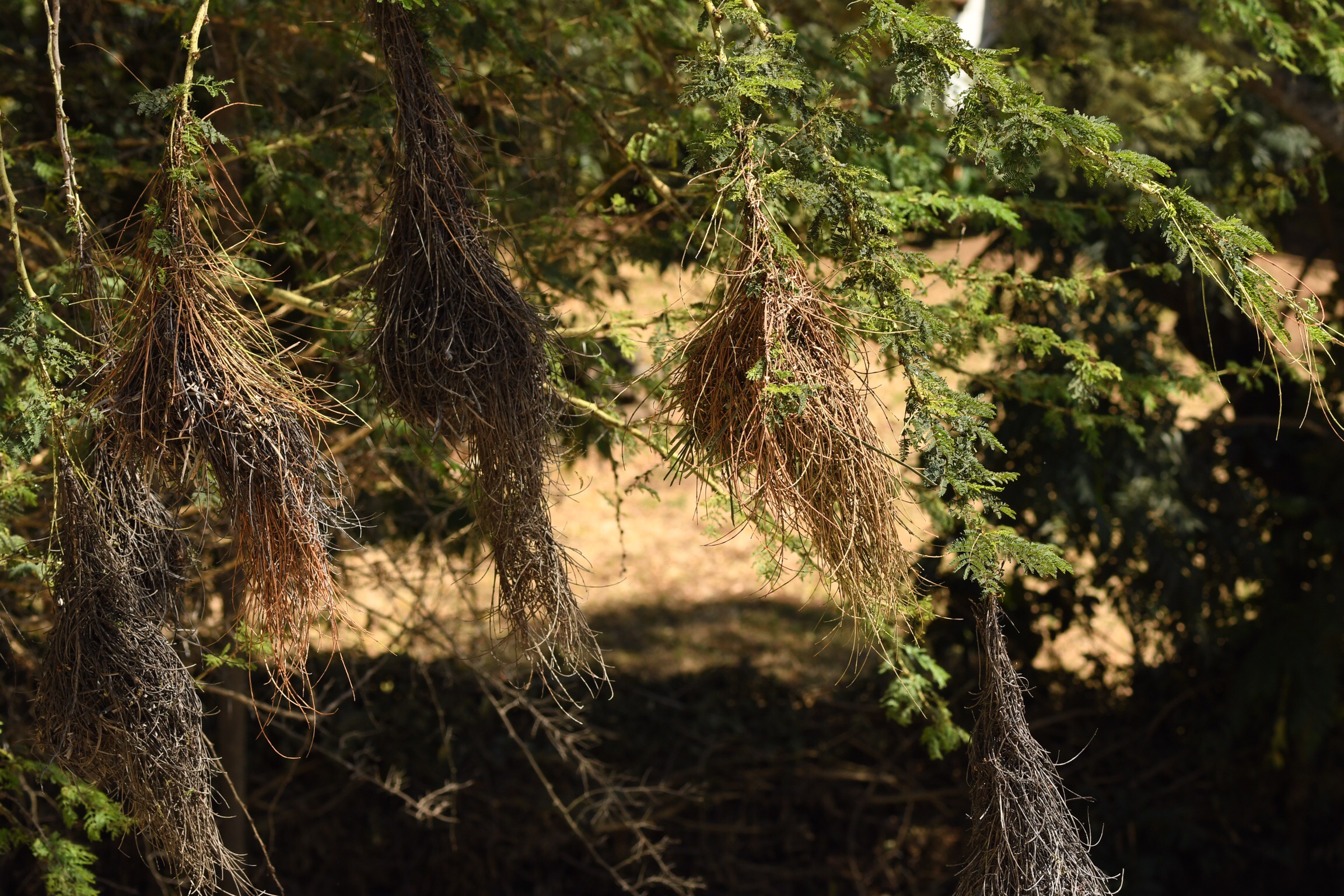
Africa is rich in Weaver birds. At least 56 species have Weaver in their name. The Red-headed Malimbe is one of them. There are five Malimbes amongst the weavers and generally they are black with some red. The one mentioned is mostly red with some black. It happens to be a loose colonial nester. There are a few nests in a Fever Tree (Yellow-barked Acacia) right next to the African Tulip Hotel here in Arusha Tanzania.

This bird is not densely colonial like many of the weavers. The nest is woven with a long tube hanging down as an entrance.
Long pieces of vine or grass or strips of fiber from palms and banana are used by many of the weavers. These pieces are wrapped, folded, twisted, and interlocked to secure them to a twig.
The Malimbes have longish bills and the Red-headed Malimbes seems to be the only Weaver with a light colored beak.
This is my first try at posting on the road with the iPad. I’m hoping this is successful and look forward to posting as I travel…..if this works. The group arrives tonight and I’ll be working soon, but I should be able to some pages posted over the next couple weeks.

New Zealand; endemic birds

Please consider all images as copyrighted and contact me for permission to use or reproduce them. Thank you.

New Zealand was, and still is, a remote set of islands crunched, sunk, and elevated by eons of living on the edge. The islands are along the intersection of the Australian and Pacific plates; great slabs of the earth’s crust that form the western and southern edge of the “ring of fire”. I will do several pages on New Zealand over the next few months and comment on the sad condition of the native animals (birds) of these islands. It is a very lovely place but sadly the native wildlife that so enchanted James Cook and Joseph Banks has been greatly altered by man and beast. The arrival of Polynesians (eventually becoming the Maori) and Europeans marked the beginning of competition for New Zealand’s tame and ground-nesting wildlife. There were no mammals and no real predators prior to the arrival of humans.

I am heading to Tanzania tomorrow and wanted to post something before I left – there will be lots of further background and photo-stories on New Zealand but I do want to get something out tonight. excuse the hasty presentation.

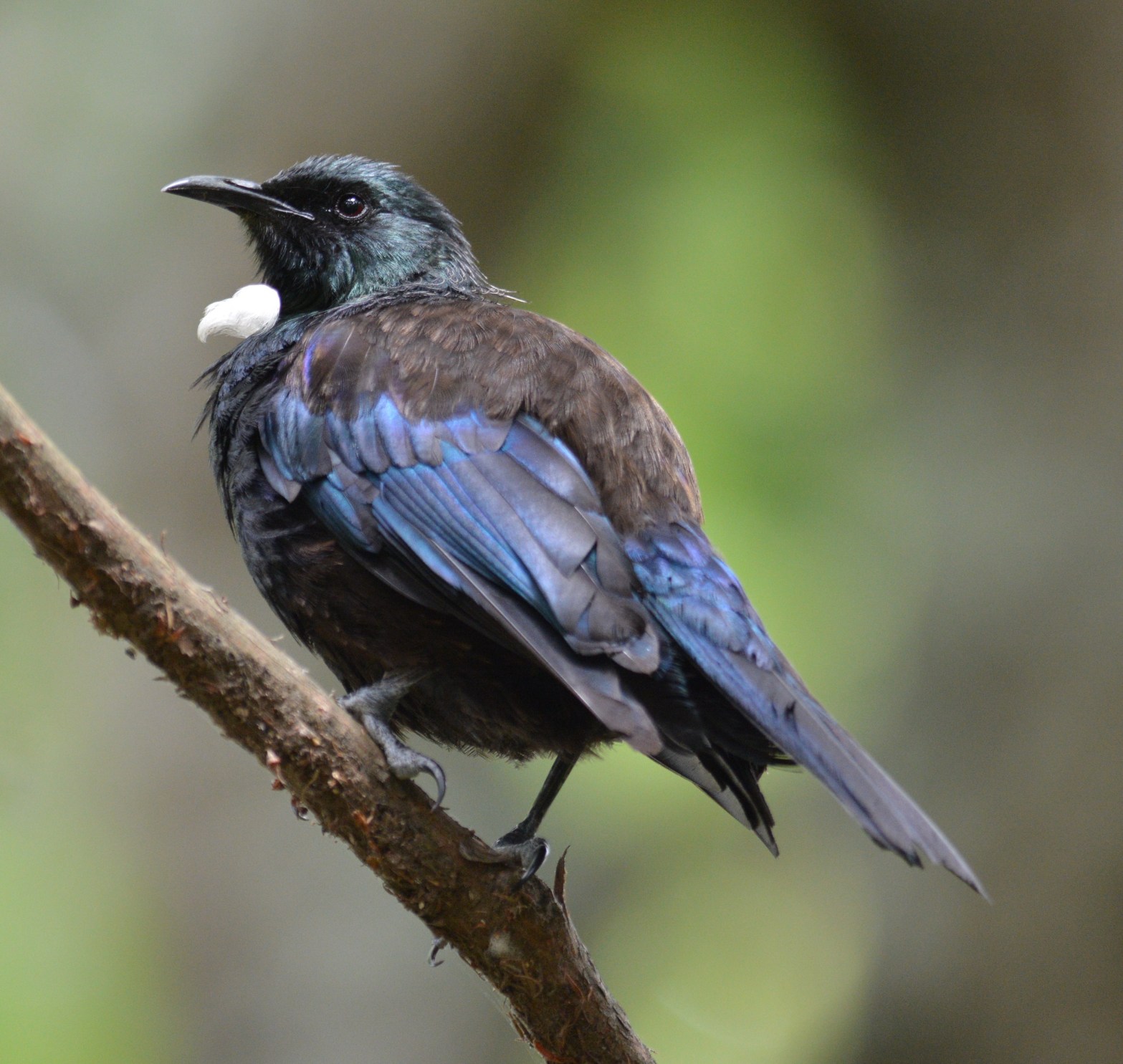
From the Auckland docks you can take a dedicated ferry to Tiritiri Matangi one of many islands that DOC (Department of Conservation) has cleared of invasive mammals (and many invasive plants) and has introduced many native bird species. The bird in the center photo is a Tui. This is one of the few native birds that wasn’t wiped out by cats, rats, weasels, stoats, and brush-tailed possums. Though the bird is abundant on Tiri it is also rather common throughout the North and South Islands. The bird with the funny beak in the lower image is one of the wattle-birds; this is the Saddleback. This bird is not at all common on the big islands but is doing well on the cleared and managed smaller islands. Many of the birds (remember, no mammals) nested on the ground and were easy prey for weasels, cats, rats, and other mammals that arrived with humans.

The birds above are the Stitchbird (Hihi) and the Red-fronted Parakeet (Kakariki). The heavily banded legs display the family history much the way Maori tattoos do for the resident humans. These populations are precious and great care is made to follow their breeding and breeding success. The bands mean very specific things to a researcher; sometimes heritage, other times, fledging year, or even location of the nest site from which the bird fledged. Cats, rats, and stoats have really knocked the parakeet numbers down on the mainland and the island populations are the only stable groups in New Zealand.

These last two birds are quite special; the top one (the Takahe) is one of the rarest birds in the world. It was thought to be extinct until refound in the late 1940’s. There are less than 150m in the wild; all on the South Island.. However, on the remote and cleared islands they are doing rather well. The Takahe is the world’s largest rail.

The last image is one that was sent to me by a very pleasant lady and I use it because my pictures of the Kokako are nowhere near as good. This, like the Riflebird, is one of the wattle-birds. This great looking bird lives only in Kauri and Podocarp forests. The habitat brings tears to the eyes of a naturalist as it also is wonderful, rare, and threatened. To see a Kokako one had best visit Tiri as there are several pairs on the island and are seen almost every visit. When in Auckland be sure to take the ferry ride and get a look at New Zealand as it was three hundred years ago.