The Falklands’ Marine Mammals

Port Stanley is the capital of the Falklands and it is quite a small town.
The islands have fewer than 4,000 residents and nearly half of them live in the city.
The sea-faring heritage of the region is shown in the arch of Blue Whale jaw bones just outside the cathedral. It was whaling, sealing, and penguins that first drew economy to this distant (from Europe) part of the world. The waters here, and on to, and then around, Antarctica were teeming with penguins, seals, and whales. Explorers trying to circumnavigate the planet by sea in the 14th, 15th, and 16th centuries noticed this great abundance of animal life and soon there were expeditions designed to turn all of those creatures into lamp oil.
Whales were harvested and rendered down into wooden casks brimming with whale oil. Penguins were herded up planks where, at the end, they fell into giant cauldrons soon filled with their own oils. Seals suffered similar fates.
It was a bloody difficult life for the sailors and a bloody end for millions of creatures.
Here is a little bit on a couple of the local marine mammal populations……
There were/are whales, dolphins, porpoises, seals, and elephant seals. It is thought that greater than 50% of the world’s marine mammals biomass is in the Southern Ocean.
All the seals are true seals and not sea lions; those with ears and dexterity.
The baleen Cetaceans are well represented with Blue Whales, Humpbacks, Southern Right, Sei, Minke, Fin and several others..
Toothed whales are also widespread in the area; Sperm and Southern Bottlenosed Whales with a range of dolphins including Orca and some of the beaked whales are found throughout the region. Many of these whales are very poorly known and understood as they are only seen when they wash ashore after dying.
A few beaked whales can be spotted in waters all over the world but they are always a surprise and unplanned for.
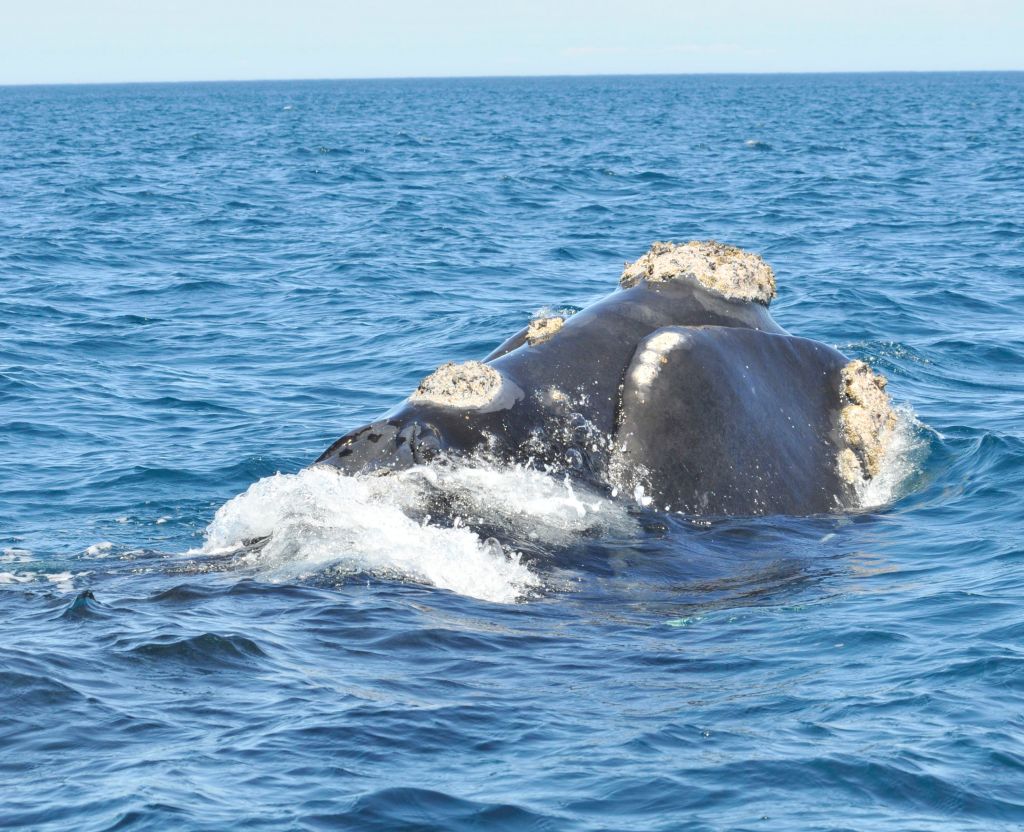
The two images above are of a Southern Right Whale. The big chunks of “stuff” growing on them are callosities; areas of rough calcified skin. The same origin provides us with the word “callous” for an area of hardened skin. In fact the callosities are gray in color but show white due to things that live in and on them; things like parasitic worm, whale lice, and whale barnacles. The original callosity is started as a rough-skin-patch prior to birth and is expanded during a whales lifetime and colored by the other organisms over time.
Southern Right Whales are surface feeding eaters of krill and other floating stuff. They swim along with the mouth half open taking in water through the mouth and allowing the water to exit through a net of baleen. As the water leaves toward the rear of the mouth the krill is caught inside by the porous wall of baleen that hangs inside the mouth like a large rigid (internal) mustache. This is how the Sei Whale also feeds.
As the whale moves forward, the lower jaw drops down a bit and the vertical plates of baleen used as a strainer appear at the water line. This all seems boring both in diet and activity level but is is a remarkably successful technique. There are seals that feed in a similar manner and lots of other whales as well. This is the same capture method, though not the same procedure or prey, as seen in the Humpback Whale and many other baleen whales.
A younger Southern Right Whale has a sparse array of callosity but it is easy to see the two blow-holes (nostrils) that tilt away from each other. This makes the “blow” of a SRWhale a short stubby V. It is easily seen and easy to identify from a great distance. Whale “blows” have different shapes based on the species and the structure of the nasal passages and the location of the blow holes on the head.
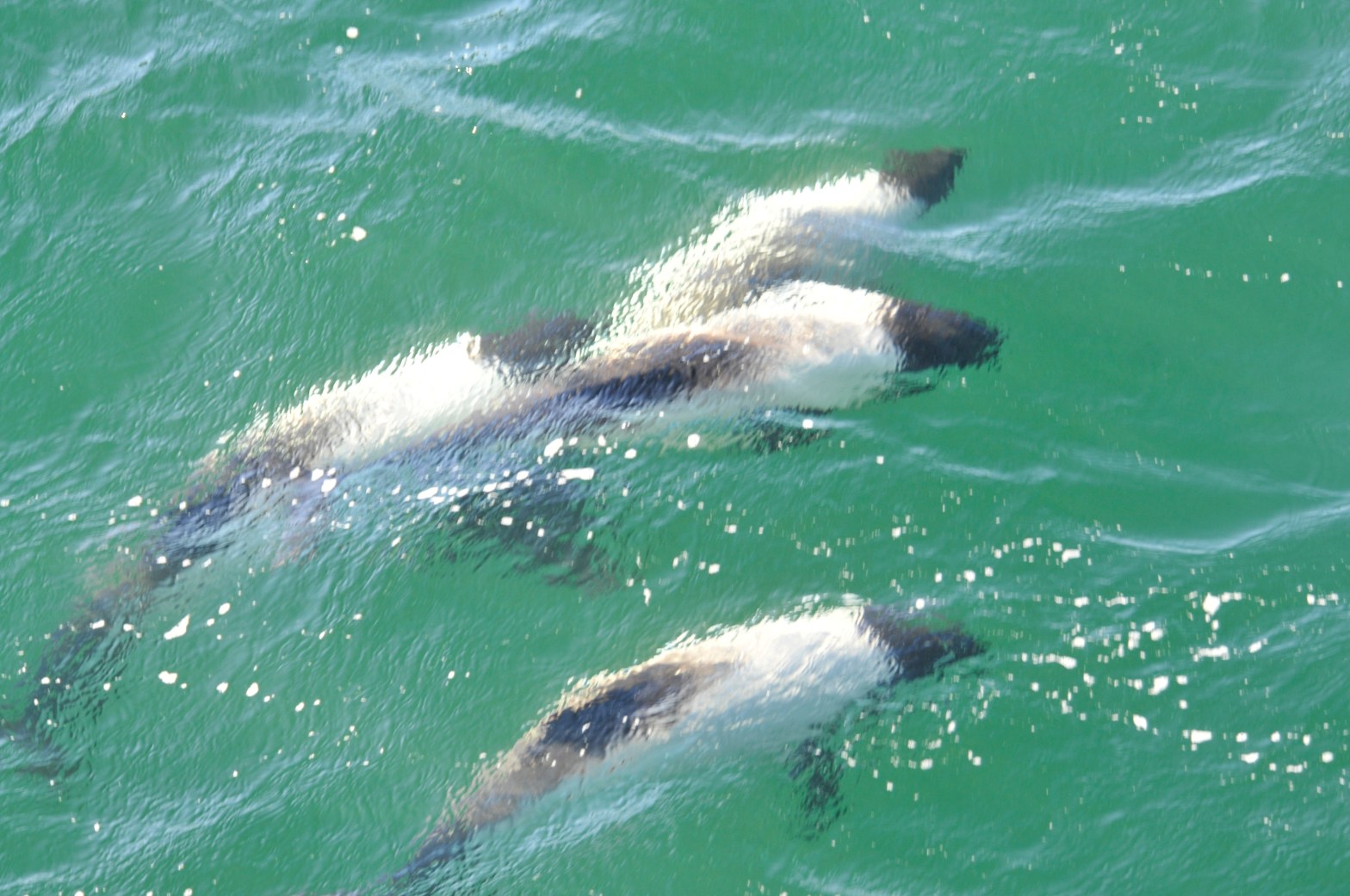
From the deck you may all of a sudden see what look like those “panda cows,” you know… Belted Galloways. They are very appealing cattle and these marine mammals are also very appealing – they are the Commerson’s Dolphin. A big Commerson’s may almost reach 6′ in length and weigh about 160 pounds; but most are a bit smaller and lighter. They can be seen from the deck not only because they are so striking in appearance but because the feed, for the most part, in shallow waters and travel in groups. So you will be going slowly and the water is usually shallow. The diet of these toothed Cetaceans consists of fish, crab, and krill for the most part
This seems a good time to mention krill. Krill are euphausiids, a group of crustaceans. Many of them look like shrimp but are not closely related. Krill have big eyes and dangling legs and thus do look shrimp like. There are about 85 krill species, it isn’t one stuff or one animal. It is a group of related creatures that live in the water column. There are krill all over the world’s oceans but the krill of the Southern Ocean feed the great whales, penguins, and many of the seal in those cold waters. In the Southern Ocean it is figured that the larger marine life consumes more than 125 million tons (yes tons!) of krill each year. Some estimates go as high as 250 million tons. In the northern Pacific it is another 15 million tons or so and the North Atlantic gives up about 20 million tons a year.
Krill are the keystone creature of the oceans. They are essential. Warming waters and harvesting for human use are having a negative impact on krill populations.
So, though animals like the Commerson’s Dolphin may only eat krill at certain times for specific reasons, it is likely that everything they eat, or any other arctic mammal eats, is dependent on krill in one way or another.

I have chosen just a couple of the marine mammals of the Southern Ocean to show and tell; perhaps ones most easily seen near the Falklands or the Argentinean coast. But remember that the Southern Oceans pass under, not only South America but also, Africa, New Zealand and Australia. It is huge and full of life; and windy and rough and cold. The list of marine mammals is quite long. Perhaps I should do a page on the seals of the Southern Ocean. Now there is a group of highly adapted creatures; filter feeders, crab eaters, fish chasers, and heavy duty predators.

Here is a complete (?) list of the marine mammals of the Southern Ocean; whales, dolphins, porpoises, sea lions, and seals. Porpoises: Burmeister’s and Spectacled Dolphins: Bottlenose, Chilean, Commerson’s, Dusky, Havisides, Hector’s, Hourglass,Common Long-beaked, Perale’s, Risso’s, and Common Short-beaked. Whales: Antarctic Minke, Arnoux’s Beaked, Blainville’s Beaked, Bryde’s, Cuvier’s Beaked, Dwarf Minke, False Killer, Fin, Ginko-toothed Beaked, Gray;’s Beaked, Hector’s Beaked, Humpback, Killer, Long-finned Pilot, Pygmy Blue, Pygmy Right, Sei, Shepherd’s Beaked, Sourthern Blue, Southern Bottlenose, Southern Right, Sperm, Strap-toothed, True’s Beaked. Seals: Antarctic Fur Seal*, Australian Fur*, Crabeater, Leopard, New Zealand Fur*, Ross, South African Fur*, South American Fur*, Southern Elephant, Subantarctic Fur*, and Weddell. Sea Lions: Australian Sea, Hooker;’s, New Zealand, South American, and Southern. *these are eared seals or sea lions

The Falklands – Rockhopper Penguins

Please consider these images to be copyrighted and ask permission to use them in any way. Thanks.

After two Falkland posts that repeat Gentoo Penguin images and information it is certainly time to move on.

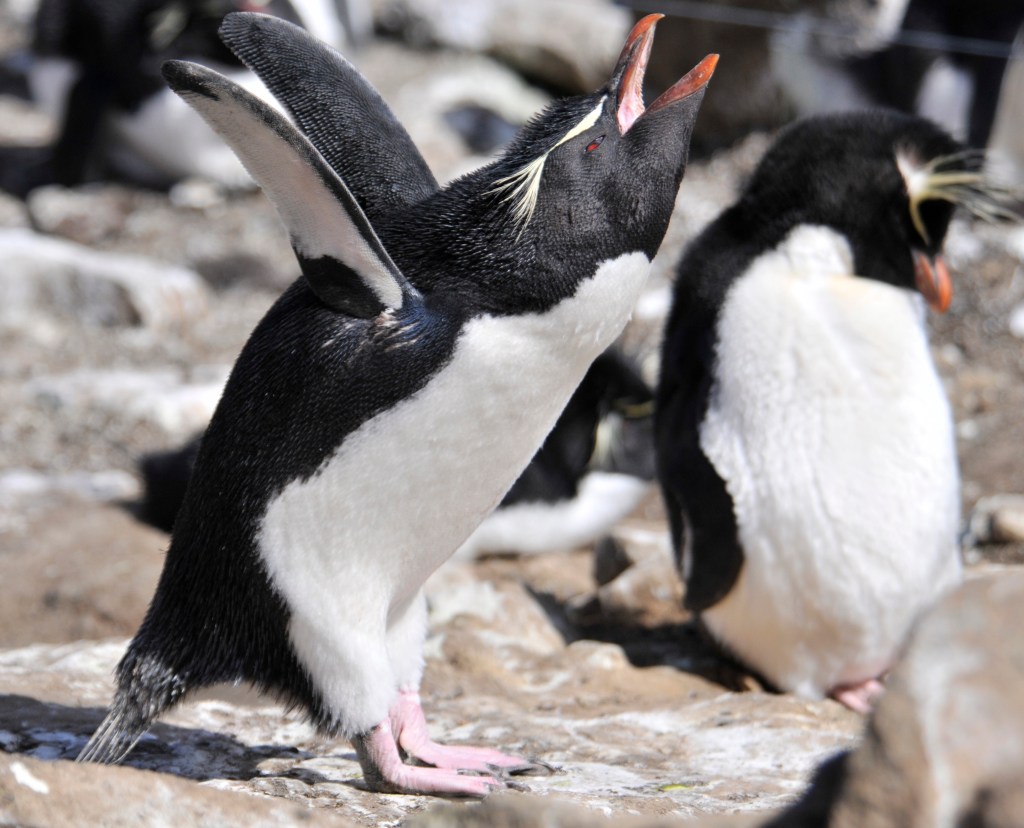
Let’s move to Rockhopper Penguins, another of the smallish penguins. This bird belongs to the “crested penguin” group and is the smallest of those. This group; Rockhopper, Fjoirdland Crested, Macaroni, Erect-crested, and Snares are characterized by a yellow or orange flag of plume-like feathers that arise near the base of the bill and flag out over the side of the head. This is what was called “macaroni” in Yankee Doodle Dandy song. Rockhoppers nest pretty much all around the southern end of our globe; that is they are circumpolar. There are two populations (subspecies) and both of them are found on islands well north of the continental ice of Antarctica.

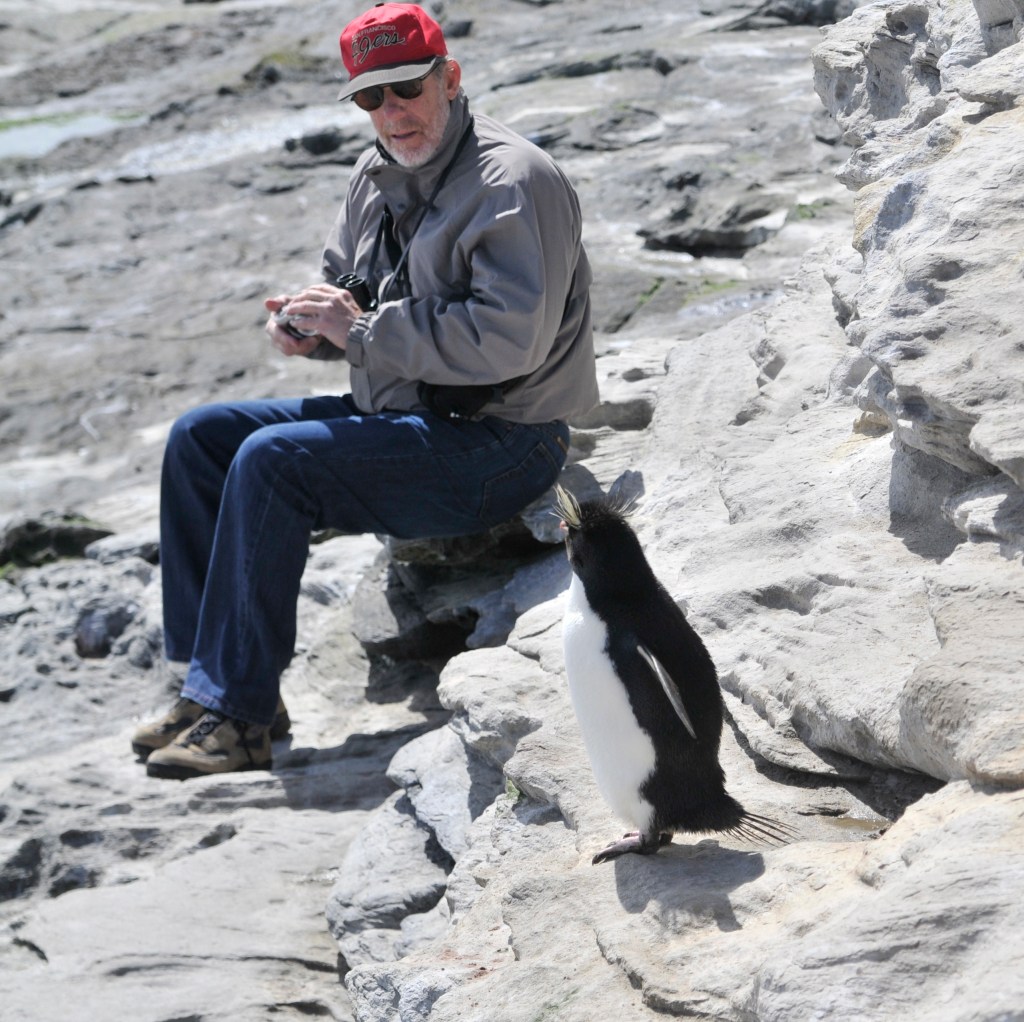
The erect feather give the Rockhopper a bit of a punk look. The bill is dark red and feathered extensively on the underside.
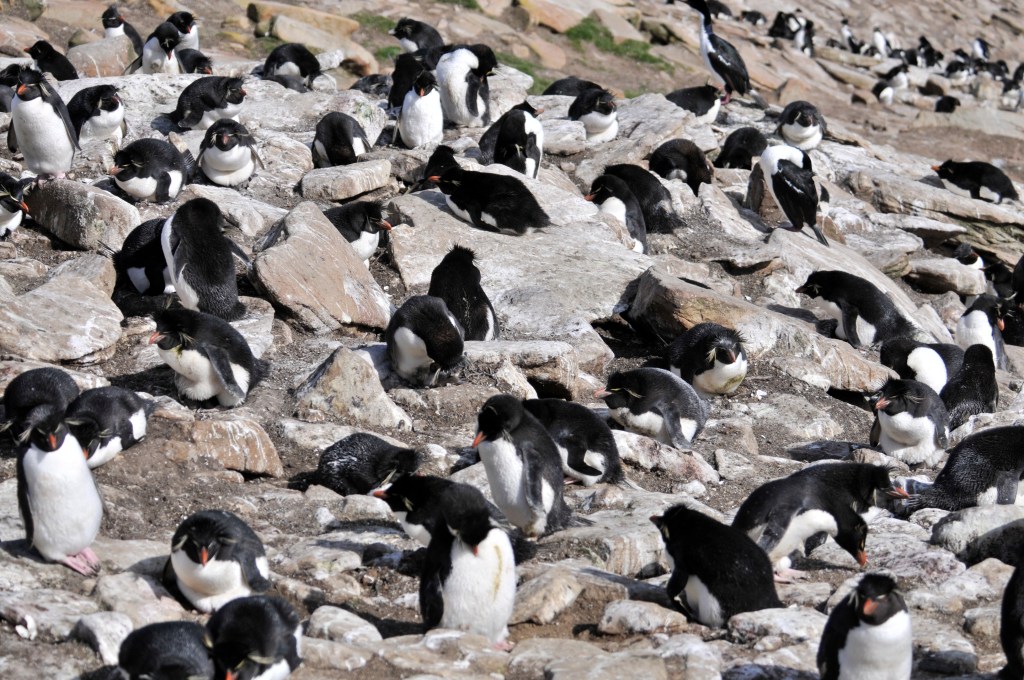
These are noisy birds. The nesting colonies are raucous with calling and braying throughout the day. Incubation takes about 5 weeks, two eggs are laid with the first egg smaller than the second. Invariably the first chick does not survive. The nesting colonies are closely associated with nesting Black-browed Albatross colonies.
Nesting colonies can be quite dense. The birds are just of reach of their neighbor but that doesn’t stop them from stealing nest pebbles from each other – over and over again. The nest sites can be quite some distance inland and upland as well. Many colonies are essentially on cliff faces and the birds have to climb and scramble to and from the nest.
Some paths to the colony are over nice dry and rather smooth rock. Other pathways are battered by waves and replete with near vertical slopes.
Like most penguins fear isn’t apart of their day. They are not land-based but seem just as confident on land as in the water. As a matter of fact land may be safer for them as there are no predators of adult birds on land though there are a few birds that will steal and eat eggs. Once in the water there are a few marine mammals that will chase, catch, and eat penguins.
The extensive human harvesting of krill, squid, and forage fish is having a significant negative impact on these birds.
It is pretty simple; no food, no reproduction.

The Falklands; Gentoo Penguins

Please consider these images to be copyrighted and ask permission to use them in any way. Thanks.

Penguins are represented by 17 species and there are nearly 40 species that are represented by fossils. The evolved from a small tough flying birds that could fly underwater as well. Probably a bit like modern auks like our northern hemisphere Razorbills (RAZO) or murres (Common and Thick-billed). Of the extinct penguins there were at least fourteen that were from New Zealand. New Zealand was historically a bird place – all birds essentially no mammals; certainly none that interacted with the birds.

I’m going to approach The Falklands through the penguins and other specialized bird groups. There are lots of penguins on these islands; penguins from 5 different species with over a million individuals reside here. There are Macaroni, King, Gentoo, Rockhopper, and Magellanic penguins on this lonely rather barren array of islands. Over the next few pages I will present albatrosses, marine mammals, sea birds, as well as the Rockhopper and King Penguins in addition to this page featuring Gentoo Penguins.

Just a brief bit on these islands – yes this is like the last Falklands post but only a short review. The British and Argentinians lay claim to these islands. Britain has wrested complete control through force and population. There its one town, rather birdless, called Stanley where about two-thirds of the 3,400 human residents live. The resident British folks were subsidized by the government (and may still be) as an enticement for staying out there 400 miles east of Patagonia on a small treeless windswept island keeping a British population and presence well away from London. There are two main islands that make up most of the 4700 square mile area – but there are also about 775 small islands and rocky islets upon which birds nest – sheep graze on a few. Boat access is difficult because of the rough seas and the lack of landing places and also there is little reason to go from island to island. 4700 square miles is about 85% the size of Connecticut or Puerto Rico.

There are three related small penguins known as the brush-tailed penguins. they are the Gentoo, Adelie, and Chinstrap. These are birds of the Antarctic land mass for the most part but there are breeding colonies well north (most everything is north of Antarctica isn’t it) of the frozen continent. The Gentoo is the third largest penguin after King and Emperor. It is a medium-sized sort with a pair of white earmuff-shaped patches behind and above the eye. The bill is bright red in breeding adults.

Gentoo Penguins are very social. Breeding is in colonies and pairs are monogamous at least during the breeding season. Most individuals will stay near the nest site throughout the year. Those that live near the Falklands eat mostly forage fish and those closer to Antarctica eat moistly krill and small aquatic crustaceans. They can dive and swim to depths greater than 300 feet. Many of the beaches in the Falklands were strewn with land mines in the Argentinian skirmish; land mines that are still present and unexploded. Humans would explode them but the penguins weigh between 9 and 19 pounds and do not explode the mines. Thus they have no human challenge for beach use.
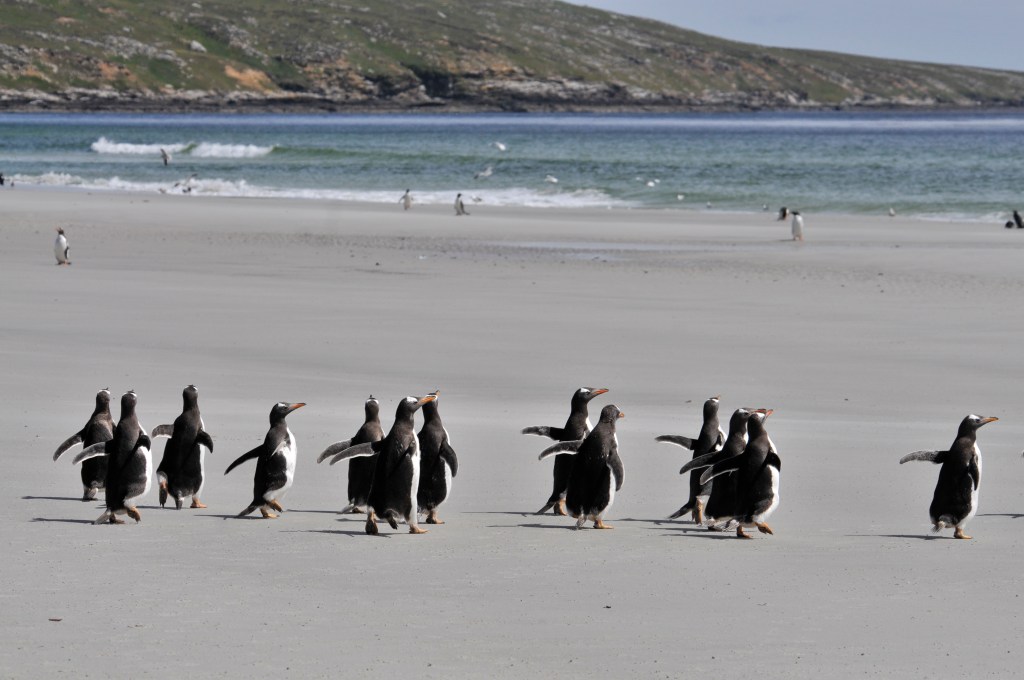
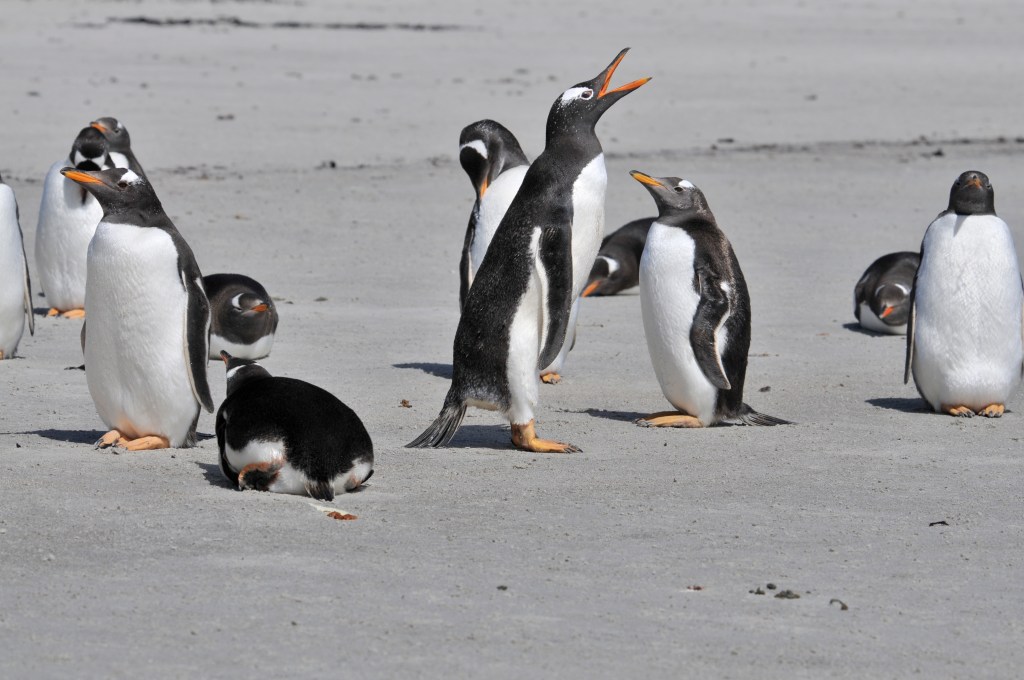
It is no surprise that penguins hang out near the ocean; they live off the oceans largesse and can swim like a feathered dolphin. The Gentoo Penguins wander the beaches and seem to enjoy the company of other Gentoos. The nesting colony can be quite distant from the water’s edge and the birds often create a new path each year to reach the colony. The supposition is that there are parasites surviving along the older paths and the birds avoid them by taking a new route to the colony.
The males are full of themselves. They strut and bray even when no one may be looking or listening. This is a rather widespread avian behavior. Females choose mates based on their perceived ability to provide and protect. Thus males strut and females evaluate.
Sound familiar?
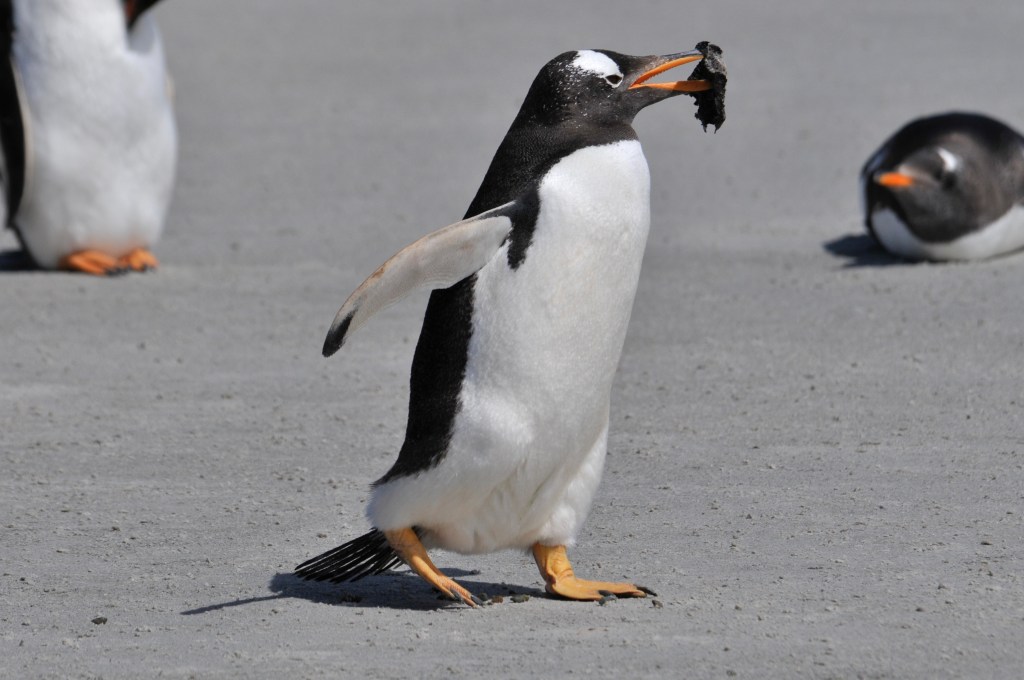
The males are endlessly trying to impress the ladies. The pairs will use pebbles, feathers, albatross bones, and stones to create a nest. While on the beach the males will strut about with shells and sea weed advertising their proficiency and skill at collecting nesting material. Once paired, and established in a nesting colony, they will take turns incubating the two eggs for about 35 day. From hatching it is another 4-5 weeks until the youngsters waddle into peer group creches and hang out together for several more weeks. The birds near the Falklands won’t fledge until the are about 12-15 weeks old. The Antarctic born birds are fledged earlier by a few weeks. They can breed when two years old.

More Yard Birds

Please consider the images to be copyrighted and ask permission to use them in any way. Thanks.

Another apology for another delay – I will get to the Falklands page sooner or later; but the local birds got such a good response the other day I thought I’d put in a few images from a couple days ago shot on the deck. We have had a rather mild and snow free winter in New England so far this season but there hasn’t been much sunshine. So when the sun was out the other day I put out a dish of meal worms and huddled against the camera. There were a few sharp pics and then there are a few from the water dish as well. We have had almost zero in the way of northern winter finches. Canada has not yet shared their bounty of Redpolls, Siskins, Grosbeaks, or Crossbills. There must be a lot of boreal forest cones providing a rich seed crop up there. Sad for us, easier for the birds I guess.

Anyway, here are a few images and notes on birds from the back deck.

The Eastern Bluebirds (EABL) whose image leads this post off started my thinking about using meal worms this winter. The bluebirds came in one day a few weeks ago and I immediately sent away for meal worms. They arrived and I started putting them out on the deck rail. The following images show what happened. It has been fun having the worms and the birds – but those Eastern Bluebirds never returned and never ate a single meal worm.

Our wintering robin population is a mix of northern birds that have dropped down from the Canadian north and some lingering birds from our breeding population. They gather in large number at roosting areas in the evening but scatter across the countryside during the day to feed on berries and fruits that hang on into the winter. It is no surprise then that most of the American Robins (AMRO) in the winter are along the more moderate salt water coast. We have had a single robin at the feeders each of the past four years; a real bully dominating the scene. That is a bit odd because they don’t eat much in the way of seeds and the lard/suet/fat items we offer are not pursued with vigor. But the meal worms are a different story. The robin is first there on the deck in the morning looking for the earliest meal worms to be brought out, often right at sunrise. The big guy then takes and swallows between 17 and 27 worms in a row. I eat popcorn that way sometimes and now have an idea of what I look like as I pop kernel after kernel into my mouth.
Our New England Carolina Wrens (CAWR) are rebounding from a killer-winter four years ago. 108″ (2.74 meters) of snow was to much for these little guys. But now, three breeding seasons later, they are back in reasonably high numbers, singing throughout the winter. They are one of the birds that don’t seem to be bullied by the robin. They just hop up, move in, and take a worm from right under the robin’s red belly. Good food, no fear.
It is good to hear them on a sunny, but cold, winter day. They also come inside the garage if the door is left open for any time. They creep around under shelves and tools looking for comatose spiders and wintering spider eggs – as well as any other arthropods they can find.
Our warblers migrate south. In the winter we often get Pine Warblers (PIWA) and occasionally Orange-crowned Warblers (OCWA) and maybe a few others. The members of this group are small and rather delicate and probably evolved with a migratory pattern allowing access to good safe breeding area in the summer but a habitat that becomes to hostile in the winter. Hence a northward and then southward migration. As I said we do, at least here on the Massachusetts coast, keep our Pine Warblers or at least a few of them. In small numbers they will appear on most eastern Massachusetts Christmas Bird Counts. They are, in fact, birds of the pine woods as the name implies. Ours are in Pitch Pine (Pinus rigida) woodlands as a rule. For the most part the females are gray and rather dull where the males have a variable amount of yellow on them. This is probably a female although a young male can sometimes be pretty gray. Over the past decade or so we have been seeing groups of PIWA in the fall and some groups into the winter. Perhaps there is a change taking place in their behavior.
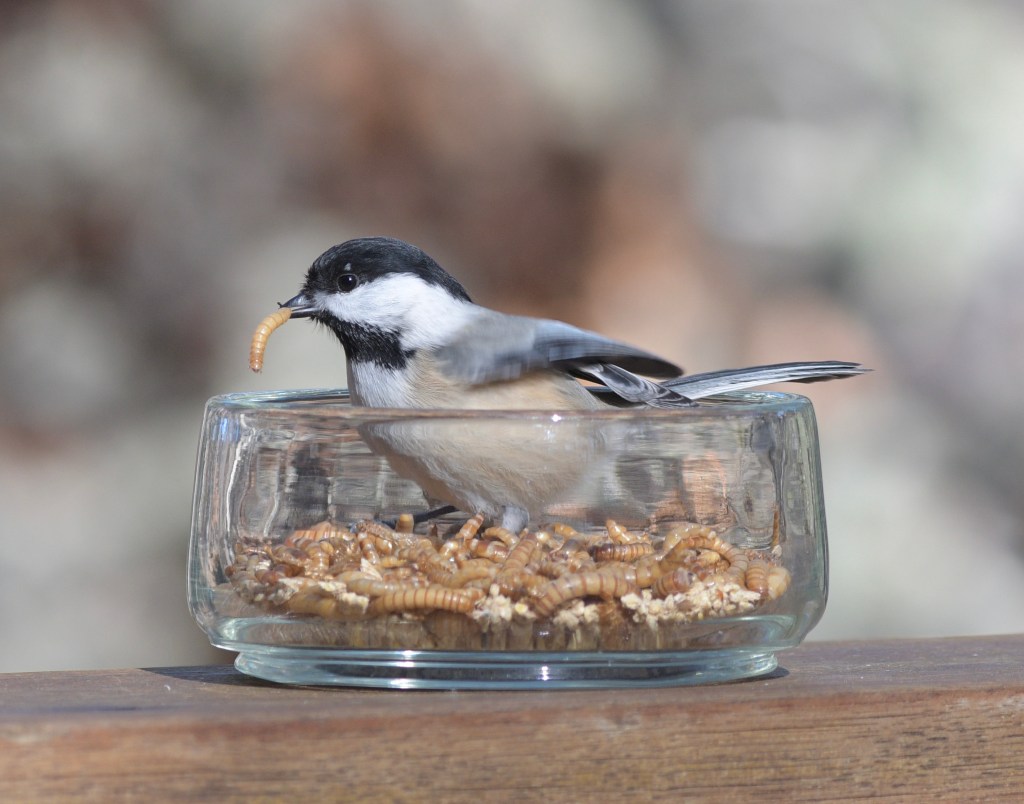
The State Bird of Massachusetts is the small, perky, Black-capped Chickadee (BCCH). They are related to the equally common Tufted Titmouse (TUTI). The titmice have come up from the south where the chickadees as a group are from northern forests. This little guy found it a long way from the edge of the dish to the worms – so it jumped right in.
The robin and the wrens stay in, or at, the dish and eat one after the other. Nuthatches, chickadees, and titmice pick one out and fly off to eat in privacy and safety.

California birds – again….

It has been a couple years since I did a page on California birds and I just bumped into these images and thought what the heck … so here is a very mixed bag of desert, water, and mountain birds of our most western state. The images come from a trip that featured a visit up into the San Jacinto Mountains. Perhaps you have just heard of the town that recently elected a Labrador Retriever as its mayor?

It is a small town in these very same mountains, about two hours out of Los Angeles (well a couple hours if you drive it at 2 or 3 in the morning); and about an hour uphill from the golf course haven called Palm Springs. The town is Idyllwild and it is a lovely mountain village deep in a forest of many pines and cedars. The pines are often the very large Ponderosa, but could be Jeffrey’s, Sugar, Lodgepole, Knobcone, or Single-leaf Pinyon. The Coulter Pine is not the tallest but has a cone the size and weight of a canteloupe! There are also Incense Cedars and Western Junipers.

I have a long time friend who lives in this small community, or communities actually as three or four very small villages are censused together as a single unit, having somewhere around 3000-4000 people in total. The area has long been a getaway spot for Los Angelinos but has somehow kept its quaint small-town look and feel. Like many places people visit, relax, and leave – that must be what it is like in Pine Cove, Idyllwild, and Fern Valley. The nearby San Jacinto Mountain reaches a height of 10,483 feet. There is a funicular, the Palm Springs Aerial Tramway, that lifts you about 6000 from Palm Springs up into the mountains with great views of Chino Canyon and the Palm Springs lowlands – and back down again. The temperature will drop between 20 and 30 degrees from the bottom to the top. Arriving up in the mountains at more than 8500 feet provides a nice break from the desert heat.

We get to visit and to see White-headed Woodpeckers at Humber Park when up in the San Jacintos. The woodpeckers can be found anywhere in the area but there are several parks and nature centers with trails and postings to help newly arrived birders locate the highlights of the area. There are also lots of the comical Acorn Woodpeckers as well as Nuttall’s and Hairy Woodpeckers. There are also a couple sapsuckers (Williamson’s and reds-breasted) and the Red-shafted Flicker rounds out this group.

I start with that anecdote but really want to show a series of images from a lower elevation.

Sparrows are often dismissed as all brown, small, and impossible to identify. I won’t defend all sparrows but certainly the Black-throated Sparrow (BTSP) is easy to figure out. It is often on the ground eating whatever it can find, both seeds and insects. It is a bird of the dry scrub of southern California. They are not found throughout California but are found deep into Mexico, all of Nevada and Utah, and lots of Texas, Arizona, and New Mexico.
The Burrowing Owl (BUOW) is not a very large owl and one that is easily seen in the day time. The do reside in burrows often dug by the owls but sometimes taken over from Prairie Dogs. The male and female are the same size; in most owls and birds of prey the female is larger. They will store food for later use at the nest; smelly perhaps but efficient. They will also bring dung to the entrance to the burrow to attract dung beetle and then use the beetle larvae as food for their youngsters.
The California Quail (CAQU) is a plump bird with very intricate feather markings. It is primarily a California bird but is found north into Washington (and even a bit of Canada) and east into Idaho and Nevada. There are a few scattered incursions into Utah as well. It is well known as a cage bird and often kept for its beauty. They are found west to the coast and east up into the high desert land. Like most quail, grouse, and turkeys, they lay a rather large clutch of eggs, often as many as 16.
Western thrashers are pretty cool. In the east we have only the Brown Thrasher (BRTH) while the west has an array of these alert and secretive birds. The California Thrasher (CATH) shown here represents the more common of the western thrashers. It has a deeply curved bill and is a common resident within chapparal habitat. It is the largest member of the thrasher group.
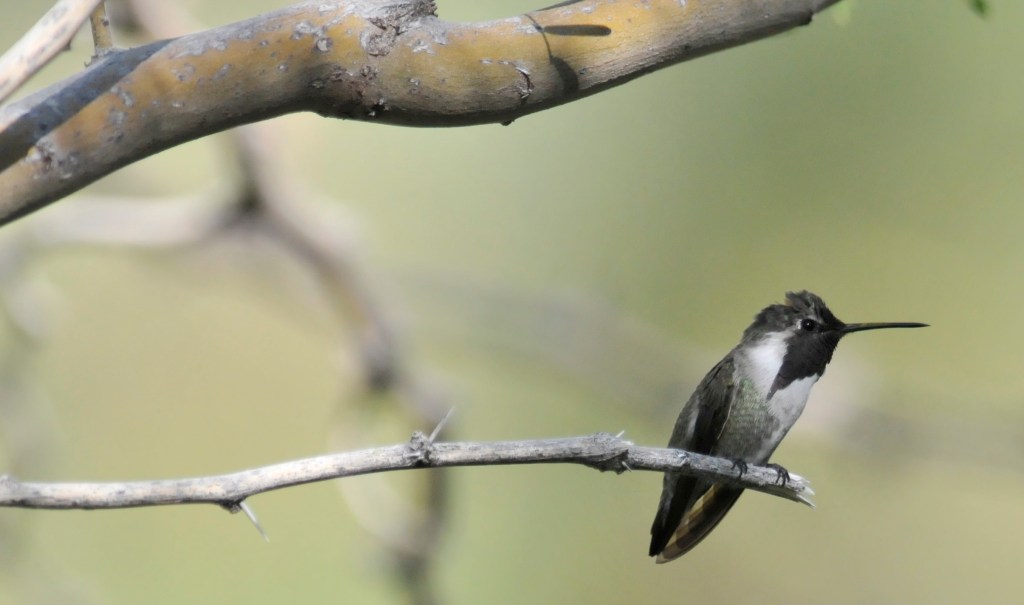
Again, in the east we have only one…one hummingbird species that is. In the west there can be five or six types at a feeder. This is a Calliope Hummingbird (CAHU). It is a long-distance migrant that nests in the Pacific Northwest between 4000 and 11000 foot elevation. Like most hummingbirds they catch flying insects (small ones), collect nectar from flowers, and take sap and insects from sapsucker holes in live trees. Males will agressively defend their breeding area; even to the point of chasing Red-tailed Hawks and other birds many many times their size. This bird weighs about 2.5 grams – that means you could mail 11 of them for a single US postage stamp. There are 28+ grams to the ounce; or eleven Calliope Hummingbirds to the ounce.
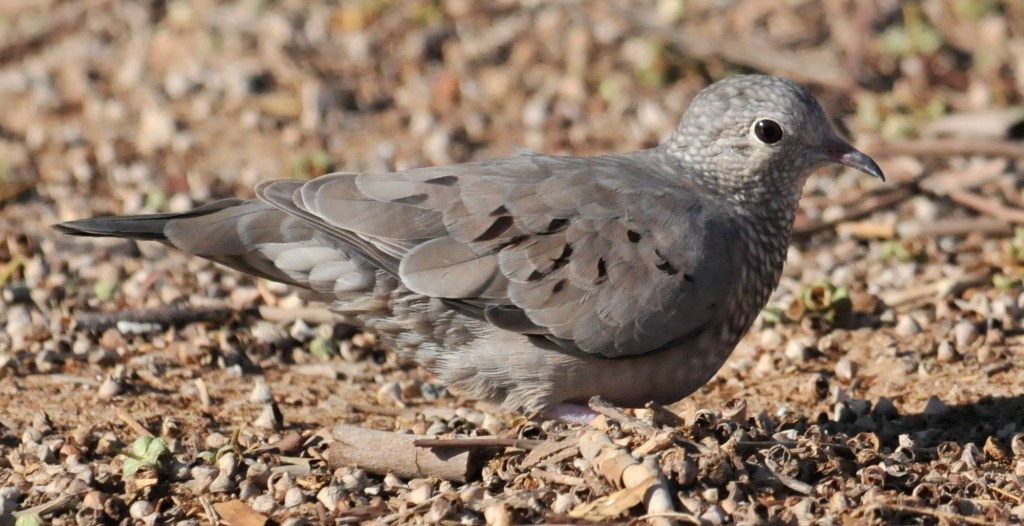
Another instance of westward superiority is the avian fact that in the east we have the Mourning Dove and the feral pigeon where in the west there are several common and a few uncommon doves. This bird is a Common Ground Dove (CGDO) a rather uncommon dove often found on the ground. Though mostly a bird of Central and South America the CGDO can be found along the very southern edge of the US from California to Florida.
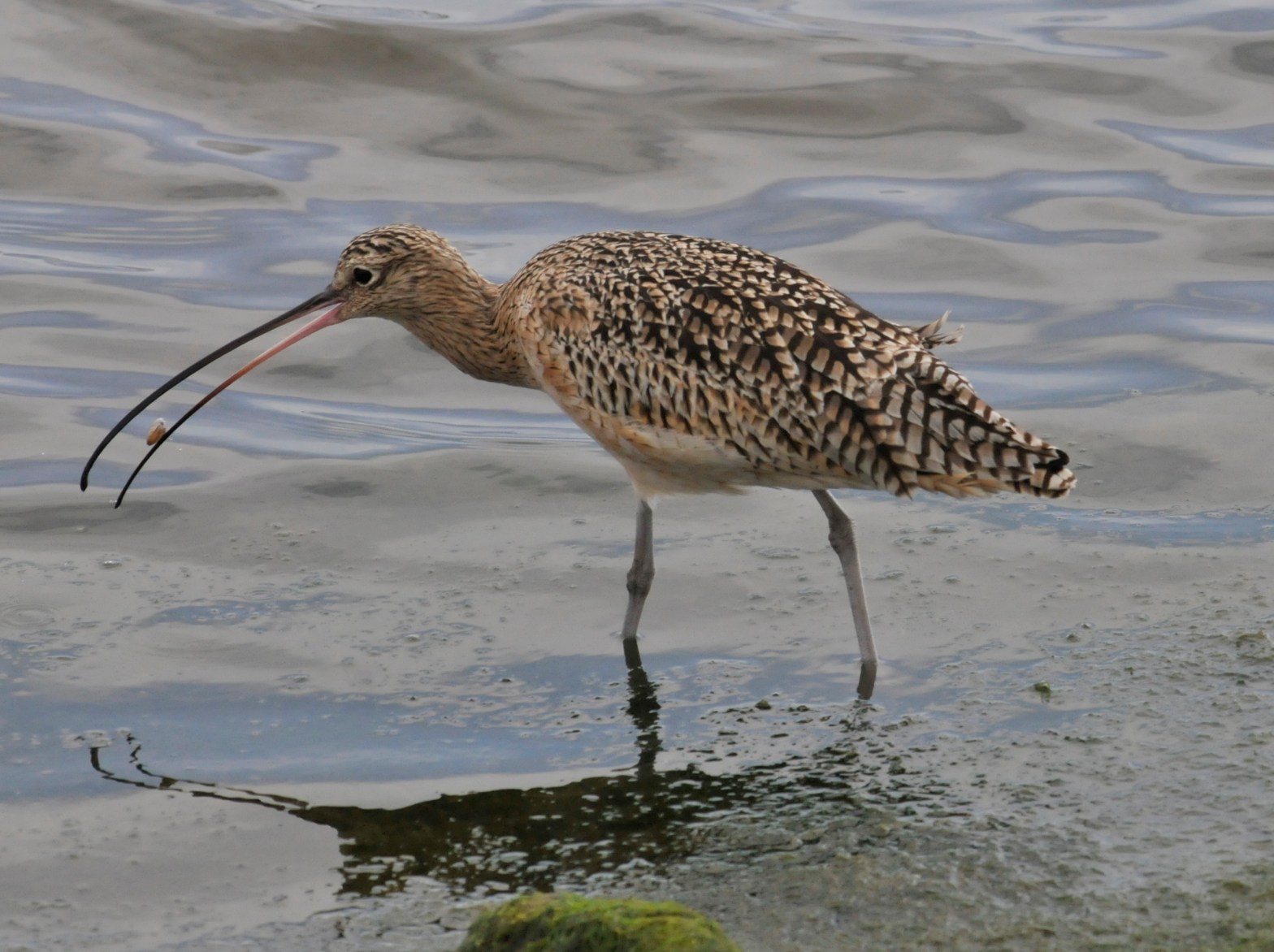
This long-billed beauty is appropriately called the Long-billed Curlew (LBCU). Most of them winter in Mexico after migrating through and over our southwest, and after nesting in the northern west but east of the mountains. In the US the best spot to see them is along the California coast in the winter. Though they nest widely on open ground LBCUs are not colonial and are often difficult to locate.
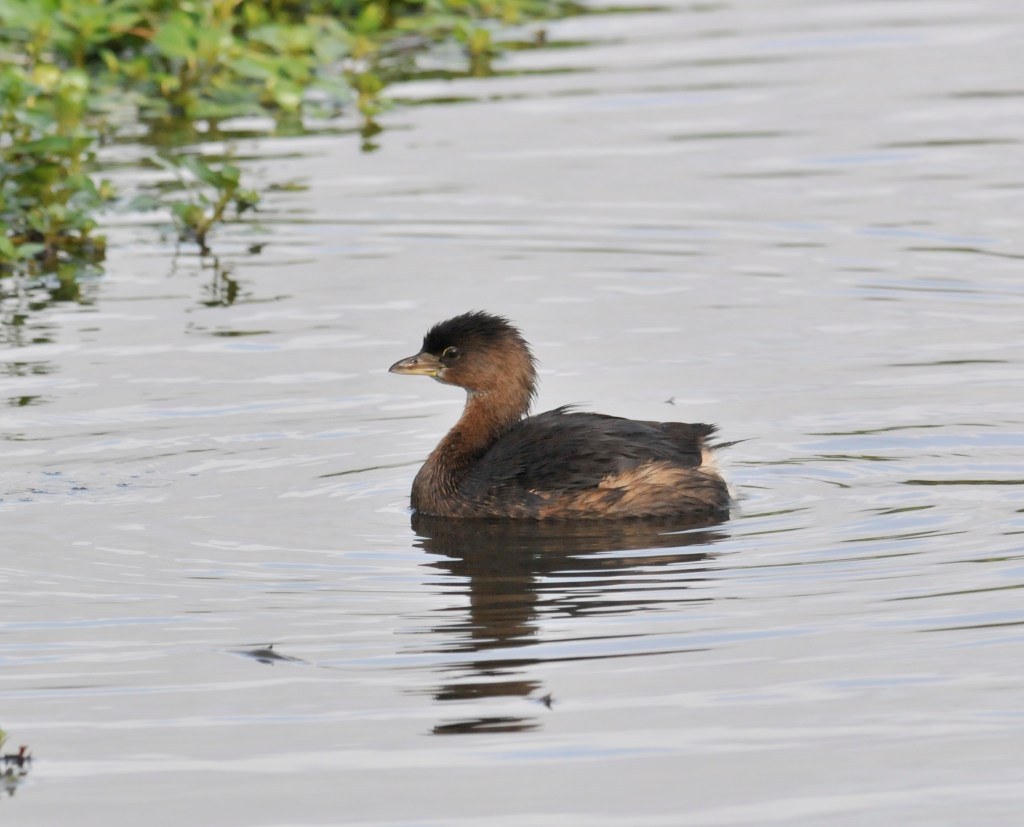
Grebes are small water birds that are more chicken-like than duck-like; but are closely related to neither group. The bird pictured is a Pied-billed Grebe (PBGR). They dive and swim under water catching anything they can, eels, fish, insect larvae, or aquatic worms. In areas where crayfish are common they seem to favor these crustaceans. Though many migrate south of our border they are found in all the continental states throughout the year, leaving some areas only after the ponds freeze. This is a bird found in shallow wetlands from north to south and east to west in the US.
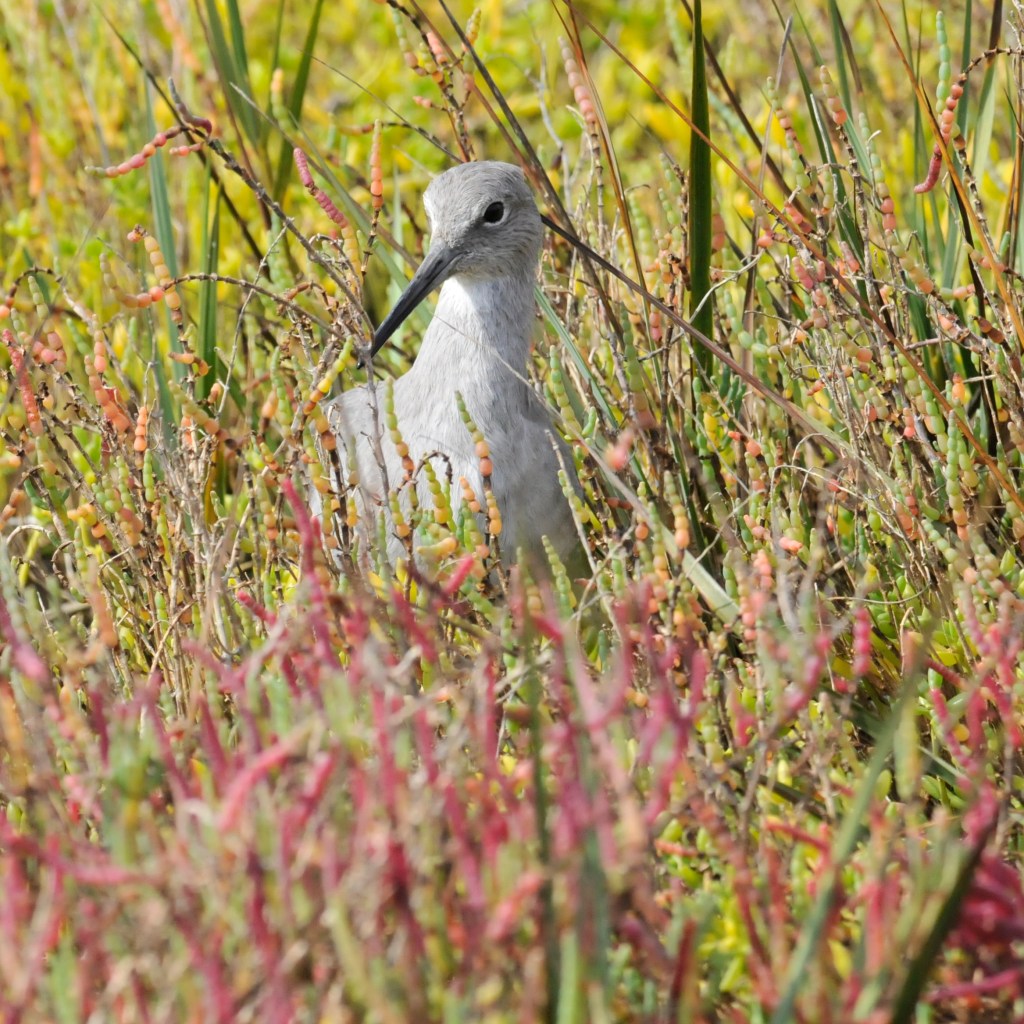
This last bird is a Willet (WILL) a Western Willet to be clear. There are two populations of Willets; east and west. They may be determined to be two species at some point in the future. In the northeast we have had a resurgence of Eastern Willets in the past couple decades. They were shot and eaten (or their feathers were sold) into the 1920s and it has been a long slow recovery. The Western Willet is paler and more lightly barred than its eastern cousin. A few western birds migrate east with some reaching the coast of Massachusetts each fall. Western Willet nest in fresh water pond edges in the north central part of the US and the southern Canadian prairie provinces. The more eastern coastal form nests from Venezuela up into the Canadian Maritimes and is the morph found in N ew England.

Provincetown Visit – owl and oldsquaw

Please consider images to be copyrighted and ask permission (ontheroadwithdec@gmail.com) before using them in any way. Thanks

Oops I said Oldsquaw! Sorry, the appropriate name is Long-tailed Duck (LTDU). They were named Oldsquaw by early observers who heard groups of the birds as they sat, swam, fed, or loafed in large flocks and thought they sounded like a gathering of female indigenous people.

(I know I said I had some more Falklands pages nearly ready but thought I should interject this page. All the Falkland fans will be satisifed in the rather immediate future.)

The Long-tails are a salt water duck in our part of the world. Here on Cape Cod we see them in the winter; they often congregate in both roosting/sleeping areas and then separately in feeding areas. These areas not being in the same location allows you to see flocks of Long-tails flying out in the morning and back in the evening. On some occasions and during some winters these groups can numbers thousands of birds at a time. They are always in groups and are quite noisy.  They nest in northern regions especially around shallow ponds in the tundra.

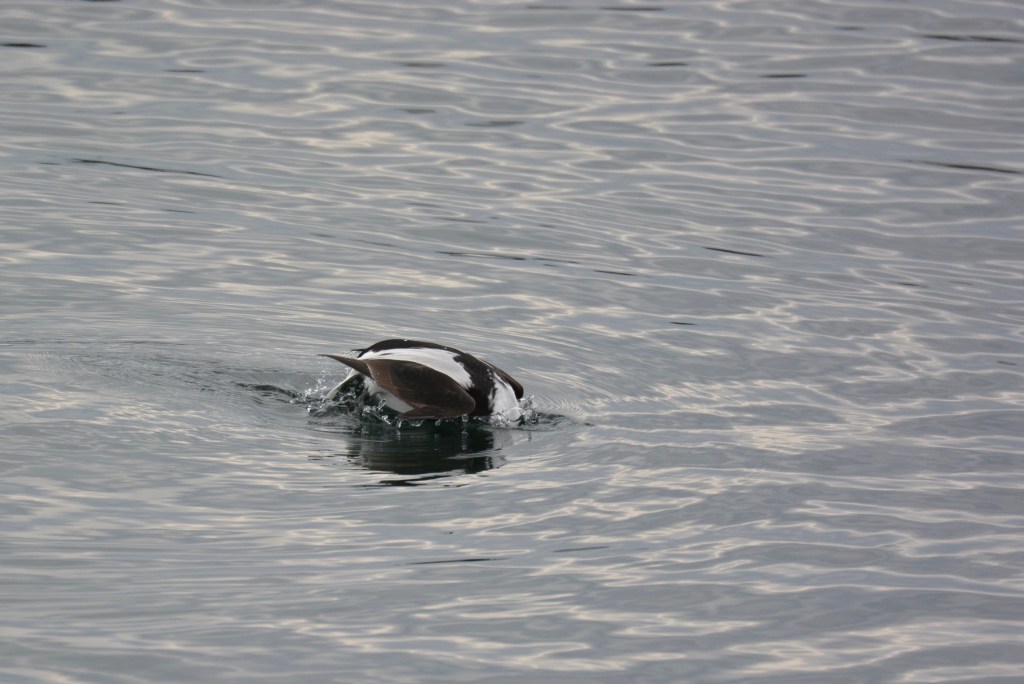
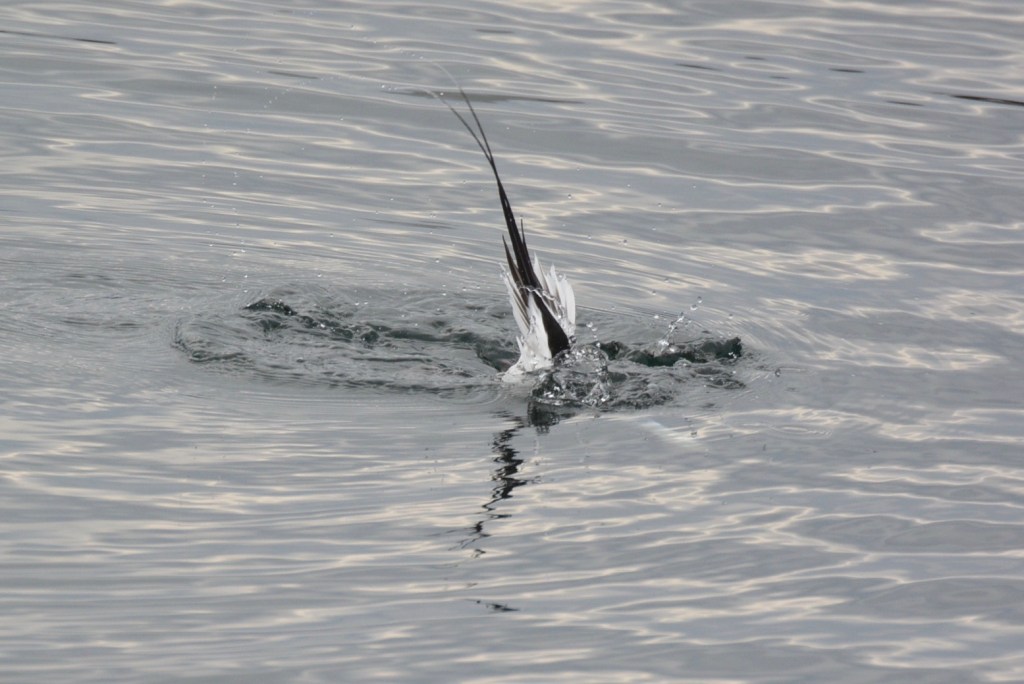
They are rather round bellied birds but fly rapidly and with great dexterity. I think they are a bit pointy looking in flight but that isn’t universally seen. The Long-tails are diving birds and roll frontward into the water; paddle with their feet and can stay underwater longer than any other duck. They will dive and stay under for well over a minute and dive to a depth of 200 feet or more. They eat shellfish and crustaceans that they glean from the rocks on the bottom or from pilings. They are always making new feathers. The molt schedule for a Longtail is quite complex, resulting in three (some references say four) different plumages between April and October.

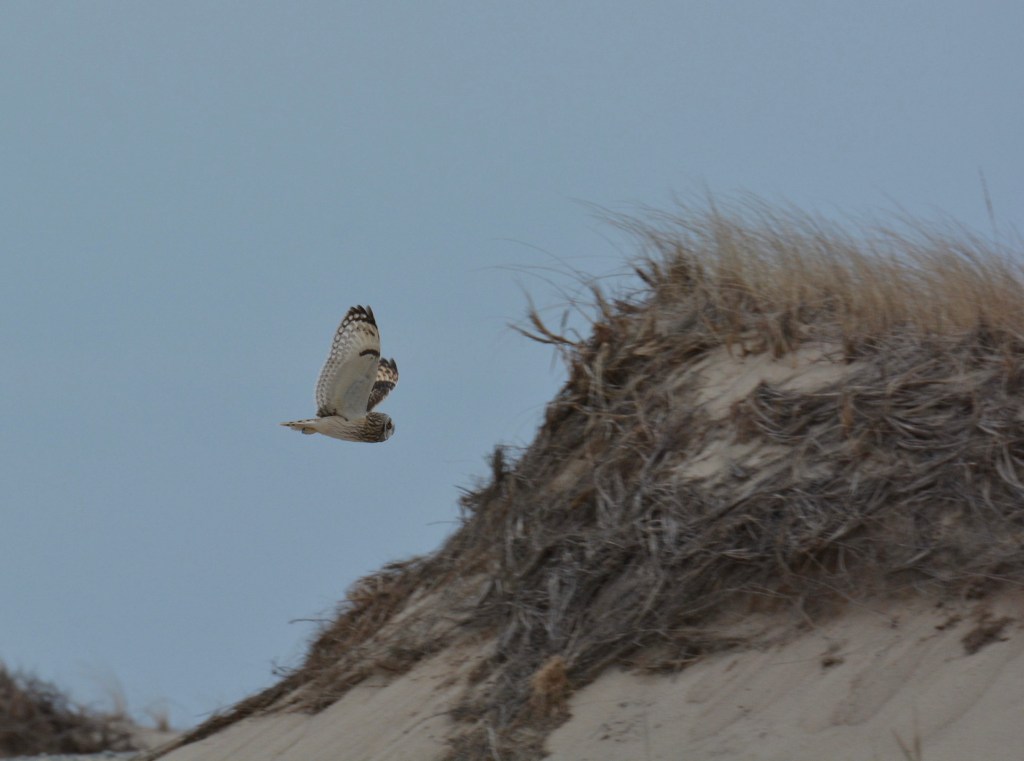
We popped up to Provincetown yesterday to check the area around Macmillan Wharf for alcids and winter ducks. Alcids are those northern hemisphere birds that live and breed mostly in the frigid high arctic and look a bit like small penguins. There have been murres, guillemots, and a dovekie around the wharf during the past week and there is always the chance for a King Eider (KIEI) and perhaps two species of loon. We ran into a cooperative Short-eared Owl (SEOW) that flew around us for a while.

The Long-tailed Duck (LTDU) is quite elegant as the third image shows. But many of the sea birds (ducks, loons, grebes, and mergansers) have to dive into deep water to locate crabs, or fish, or arthropods, or mollusks. Most ducks paddle with their feet when underwater and do not use their wings to “fly” while diving. The Long-tailed Ducks do extend the alula, feathers at the front corner of the wing, which act as does the aileron on a plane; helping with balance and speed, and probably with aspect as well. In a very real sense they are flying when under water.
The name of the duck is derived from the terminal appendages of the male in breeding plumage. It really does have a long tail. There were no females close enough to photograph on this day so I just have these male birds for you. The females have rather usual tail feathers.
As I said they are quite elegant even in non-breeding plumage like this. The chestnut patch on the neck is added as the males approach breeding season. The tail feathers and the elegant gray scapular feathers are reminiscent of the “aigrettes” of breeding-plumaged herons and egrets.
The alcids include puffins, guillemots, murres, razorbills, murrelets, and auklets. The alcids, these holarctic arctic cliff nesters (mostly) were represented this weekend by a guillemot or two and these two (of four near the wharf) Thick-billed Murres (TBMU). They are smallish divers of really cold water but most winters we see a few of them around Cape Cod. There is also a Common Murre which is (most years) less common here in the northeast. They dive deeply for their food and have been known to defend to depths below 650 feet. A trip like that can take three minutes our more. There was a TBMU shot a couple years ago that was banded and known to be almost 29 years old.
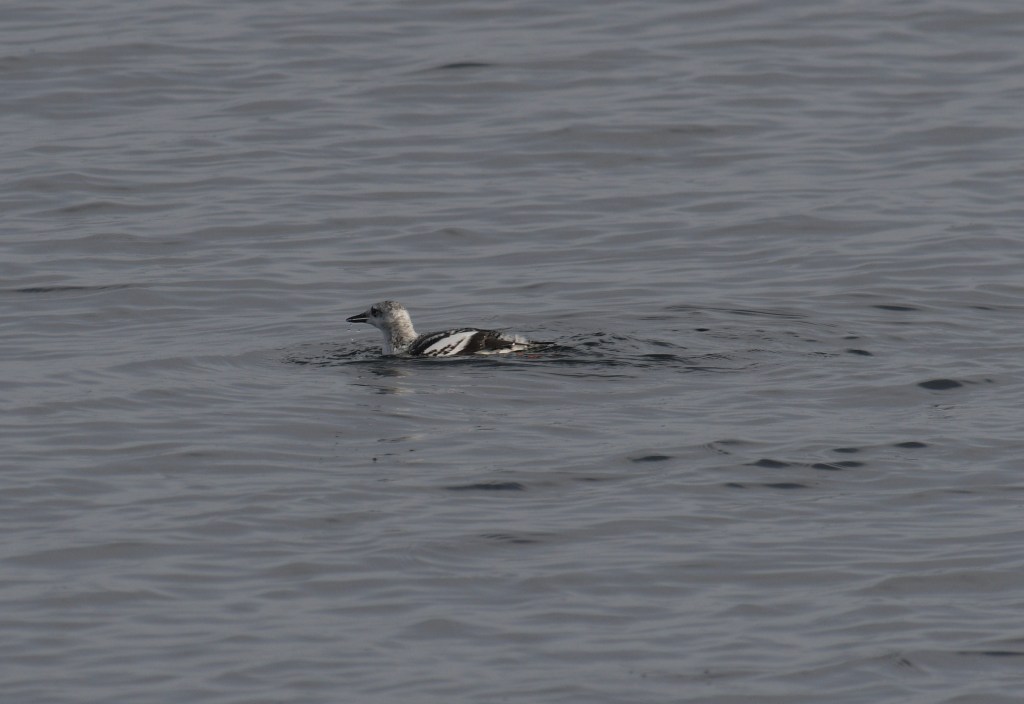
The Black Guillemot (BLGU) is seen in the winter in our waters as a mostly white bird with just enough black so the bright white wing patches can always be discerned. Again there is more than one population and each population has its own characteristics. In the harbor right now are a couple of the “Atlantic” Black Guillemots and one “Arctic” Black Guillemot; a much whiter bird. The west coast has the Pigeon Guillemot which is also a blackish bird much like our “Atlantic” form. The Pigeon Guillemot (PIGU) nest along the coast from central California up and around all of coastal Alaska. Our Atlantic form is found along rocky shores from Maine up through the Canadian Maritimes. The Arctic form is found even further north; into the Elizabeth Islands, including Baffin, Ellesmere, and much of Greenland. Guillemots can dive for over two minutes and will carry fish crosswise in their bills. Banded wild birds have been known to live more than 25 years.
Owls seem so interested as they peer at you with both eyes forward and unblinking. They see things from their heads as we do – eyes front. Perhaps that is why we like them; or maybe it is the early ability to fly, see, hunt, and succeed in the dark of night. Perhaps the hooting and gasping calls they make create some sort of spooky relationship with them. Anyway, for whatever reason, we like owls and are enthralled by their behavior.
At the very tip of Cape Cod’s bended, sandy arm there is a fist-like curl – the Race Point dunes at Provincetown. There is a very small landing field out here, a National Seashore Visitor Center, and lots of sand. Sand with modest vegetation ranging from Beech Forest to Beach Grass covered dunes and miles of beaches which are just plain sand.
In Massachusetts we see lots of Eastern Screech (EASO) and Great-horned Owls (GHOW) . There are quite a few Northern Saw-whet Owls (NSWO) here in migration and in a few wintering pockets. Snowy Owl (SNOW) numbers vary greatly winter to winter. There are some Barred (BADO) and Long-Eared Owls (LEOW) scattered about as well. Most of these are uncommon and very difficult to see. Many species can be heard off and on throughout the year.
One of the favorites is another rather uncommon owl called Short-eared. Though suited to most open areas, we have seen Short-eared decline rapidly in Massachusetts. This year has been rather nice as there are birds on the North Shore, South Shore, and on the Cape. It may not signal a great population increase but it is certainly nice to see them in some of their old haunts. They are often active in the day time. The photo was taken about 3:45 PM on a rather gray and short winters day.

The Falklands Again; Gentoo Penguins

Please consider these images to be copyrighted and ask me before using them in any way.  Thanks.

A few months ago I started to describe the Falkland Islands and said there would be more, finally I’m getting around to it. I’m sure that you are relieved to have the long wait for Chapter Two finally end. Phew. 

 The Falklands are mostly barren, windswept, treeless, gray and stormy, full of birds and surrounded by oceans full of marine life. They are alone at sea; about 300 miles east of Argentina’s Patagonia and 750 miles north of Antarctica. There are less than 4000 people living out there. There are few roads and roadhouses. There are two main islands populated generally by British-heritage people. It is still argued by the British and the Argentinians as to who should own and manage the islands. The islands proximity to Argentina carries modest weight, but as the founders were British explorers and settlers they exert the greatest influence and control. Actually the British ceded the islands to Spain in 1774 but resettled them in 1833. The islands are a British overseas territory  even after a bit of a skirmish in the late 20th century (1982) and much discussion over the decades.

Overall they are a great destination for a nature-oriented traveler.

They also have that mix of colonial, military, and economic history (by 1900 there were thousands of feral cattle and an equal or greater number of sheep, wandering the islands) that drove all of the exploration and knowledge of the 19th century and has lingered into the 20th and now the 21st century. Many of the islands are the sort of uninhabited and windswept islands of movies and documentaries. The heathland vegetation is mixed with native Tussac Grass (a Poa) and a few short woody shrubs and trees only where people have planted them; safely tucked into a ravine or valley. There are no native trees. There is nothing of the South American plant diversity out on these islands. They split from Africa (not South America) some millions of years before the last ice age. The rock that underlays much of the Falkland seascape are the same as those found in southern Africa. The underlying rock is about a billion years old but the chunks that have become the Falkland Islands were attached to Gondwana until about 300 million years ago.
Sorry, this is supposed to be about Gentoo Penguins; but the earth is what it is because of what it was. Geology sets the rules, or at least supports the rules for, everything else.

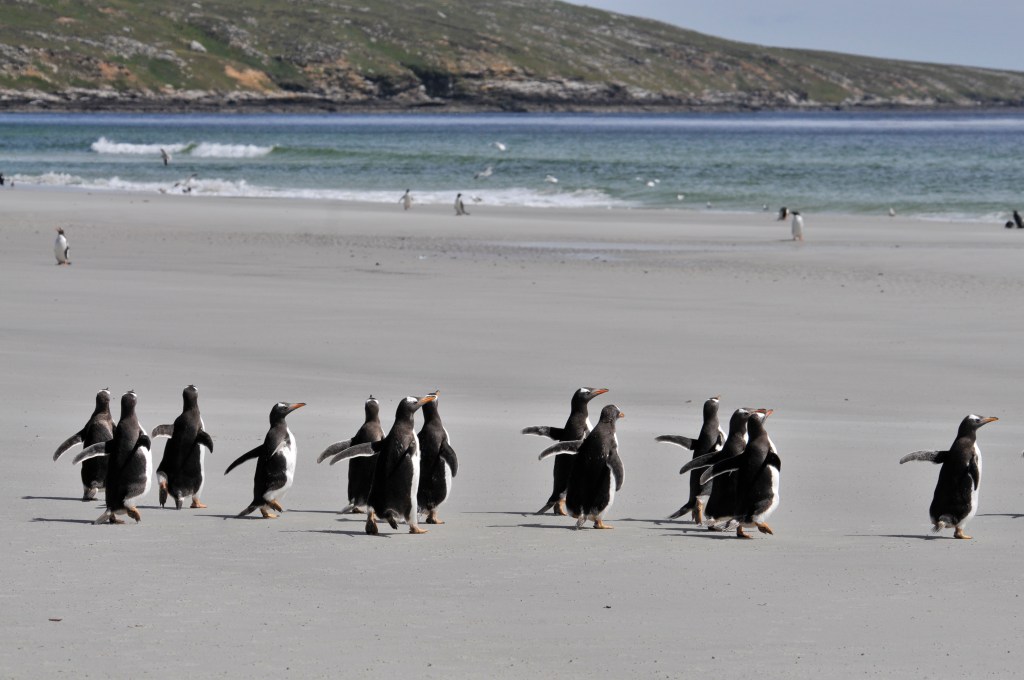
Like many of the penguins Gentoo penguins hang around the shore line. Seemingly they wait to greet returning cohorts and reaffirm friendships with other penguins coming and going from the sea. This is a rather widespread behavior among this group of birds, penguins in general that is. In New Zealand the Yellow-eyed Penguins do the same thing in a most raucous and touching way.
The Gentoo group will build a nest in a colonial nesting area between Tussac grasses or in open areas if need be. They actually build a nest, of stone and shell that can be up to 8 inches in height. In order to find the best habitat, they prefer the grassier areas, they will sometimes walk inland as much as two miles before starting the colony. The colony will have to relocate after a few years as the grasses will be trodden into the mud and droppings after a while.
A new and developing nesting colony is a romantic idyllic treat to behold, and older colony with near-grown chicks will have become unbelievably muddy and smelly- visit early in the season.
The Gentoo Penguins lift their head and lean back a bit when calling; a braying sort of noise. The male will call most anywhere but, in and near the nesting colony seems to be the noisiest place. The males make the most noise. Sometimes when on the beach, especially if the nesting area is close to the shore, they will collect stones to be incorporated in the nest. Otherwise they collect stones wherever they can find them and deliver them with style and display to the female at the nest – or they steal them from another nest.
The underside of most penguin wings is rich in capillary blood vessels and often appeared pink. The birds are so well insulated and protected from the cold that they can overheat quite easily when walking about. The posture assumed when walking; wings out and back, is not so much for balance as it is to help the bird lose some of the building body heat from the exertion. Exertion in cold water is fine; as a matter of fact Gentoo Penguins can swim up  to 22 miles per hour, the fastest of all penguins. The feathers are short and curled making a felt-like nap, that creates an air space between the flesh and the water. This layer of air is what keeps them warm and prohibits water from actually touching the skin. They have downy “plumules” (special feathers) that are very densely arranged and help keep water off and the layer of air in. The feathers are individually small but when looked at closely appear feather-like not hairlike. The feathers do grow in a hairy pattern however; that is they layer over the entire body as fur does. Most birds have feathers that grow in tracts and then spread out to cover the bare skin in between the tracts.
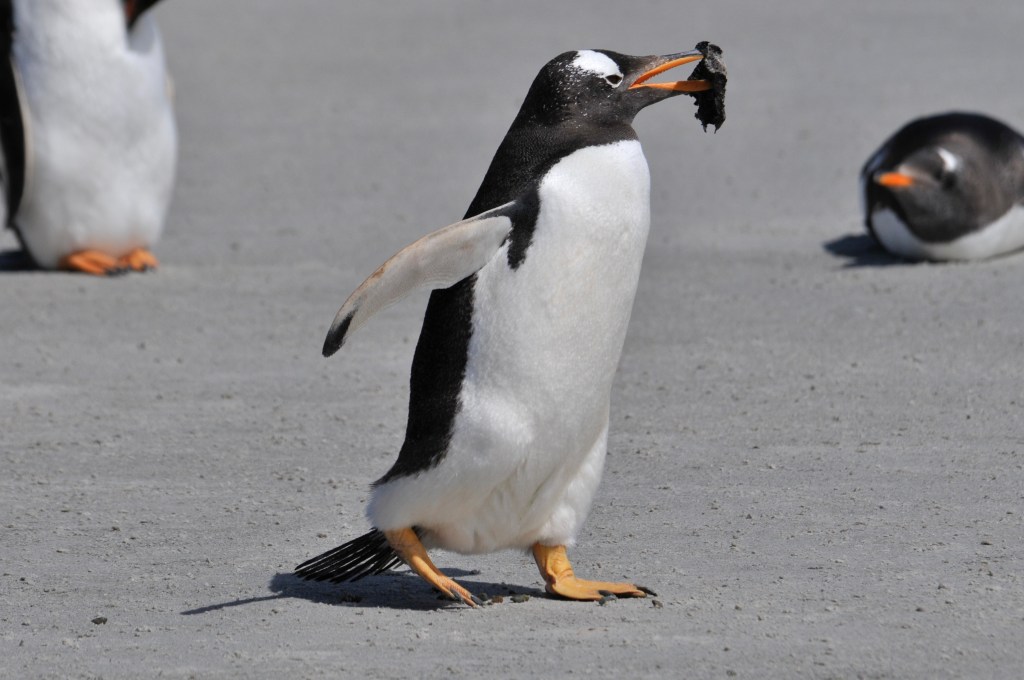
On the beach, or near the colony, male Gentoo Penguins can hardly stop collecting things and walking about showing off. The shells and sea weed of the beach are not anywhere near as valuable as stones are for a nesting female – but they collect and carry most everything they can no matter where they are. The nest is mostly stones and stones are the currency in a penguin colony. As a matter of fact stealing stones from unguarded nests is the cause of most colony mayhem. The presenting of a rather special (whatever that means to a female) stone to a female often opens the door to a physical moment for the two birds. Just carrying stuff around draws attention to a male.

The Gentoo eats mostly crustaceans that they forage from the clouds of krill found in the cold ocean water. However those Gentoo near the Falklands eat about one-third squat lobster, one-third squid, and one-third small forage fish. Squat lobsters are actually an abundant bottom-dwelling crab of the cold waters. It is sometimes harvested for human consumption and sold as “langostino”. In many places and in many restaurants the Squat Lobster is on the menu simply as lobster. 


There will be a few more Falkland pages posted in the very near future. I have them about ready for Rockhopper and King Penguins, marine mammals, sea birds, black-browed albatross, and lastly one on other birds of the islands.

At some point I’ll post a page of older blog pages so you can search backward for posts on the natural history and eco-tourism opportunities of and for; Africa, Australia, New Zealand, the Galapagos, and both North and South America.

A Few Local Birds

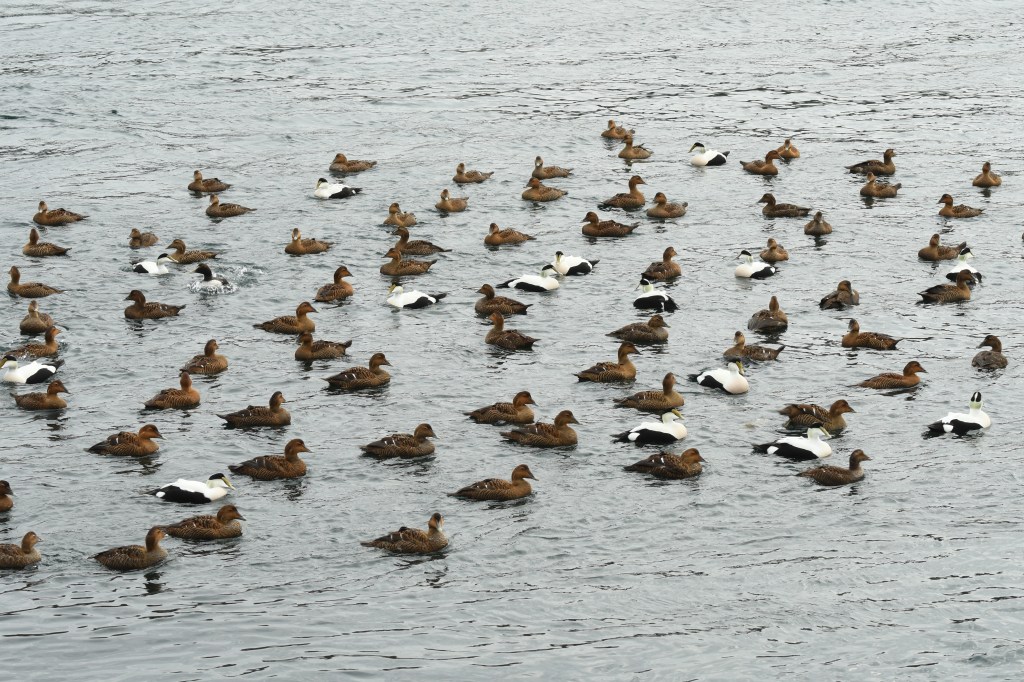
The most common winter bird around Cape Cod is the appropriately named Common Eider. They are a large salt water duck of rather shallow waters where they dive for their food. The dense flocks vary in location depending on the changes in sand and shellfish. After storms the bottom of the ocean is different than it was before the storm. The “prey” items populate new areas and the eider find them.
There are several forms (morphs) of Common Eider and several species within the group of ducks called eider. We get a few King Eider each winter but they are scattered and random. Common Eider are always around and in large numbers each winter. They are nesting birds of the rocky shores of the Canadian Maritimes and have recently begun to nest on the Boston Harbors Islands where there are now about 500 nests each summer.
The eider down of warmth and insulation fame is taken from the breast feathers of the female – or rather collected from their nests. Nowadays the trick is to keep a nesting colony together (a bit like a nesting duck farm) and to take the soft and fluffy down feathers from the nest just before the eggs are laid. The missing down feathers are replaced by fine grasses which seems to satisfy the females. In centuries past the fresh down would be taken early and another harvest of dirty feathers after nesting was over and the nest abandoned. Like all ducks the young are precocious and leave the nest for the water as soon as they are out of the egg and dried off.
Our landfills of the 1960’s, 70’s, and 80′ were, for the most part, “capped” in the 90’s and 2000’s. They had all the donated and stockpiled trash mounded and covered and then the “mountain” was capped with rubber sheeting, covered again with soil, and finally planted with grasses; creating big grassy hillocks.
These hills cannot grow trees as the rubber cap should not be penetrated. Thus many old dump sites have become grassland habitat and recently many have become home to solar panel arrays. One of the birds that seems to benefit from the capped trash piles is the Red-tailed Hawk (RTHA). They choose to feed on small mammals and the grasses produce meadow voles (Microtus pennslyvanicus, also called Meadow Mouse) in pretty good numbers. These small rodents weighs just under 2 ounces but are prolific and abundant. A few squirrels and a rabbit now and then rounds out a pretty substantial Red-tail Hawk diet.
Because there are tons upon tons of composting trash the landfill produces methane and this needs to be vented; in many cases it is vented by burning. In the case above the vent is simply a wind driven fan that helps draw methane from under the surface of the landfill, and it provides a nice observation post for the local Red-tailed Hawk.
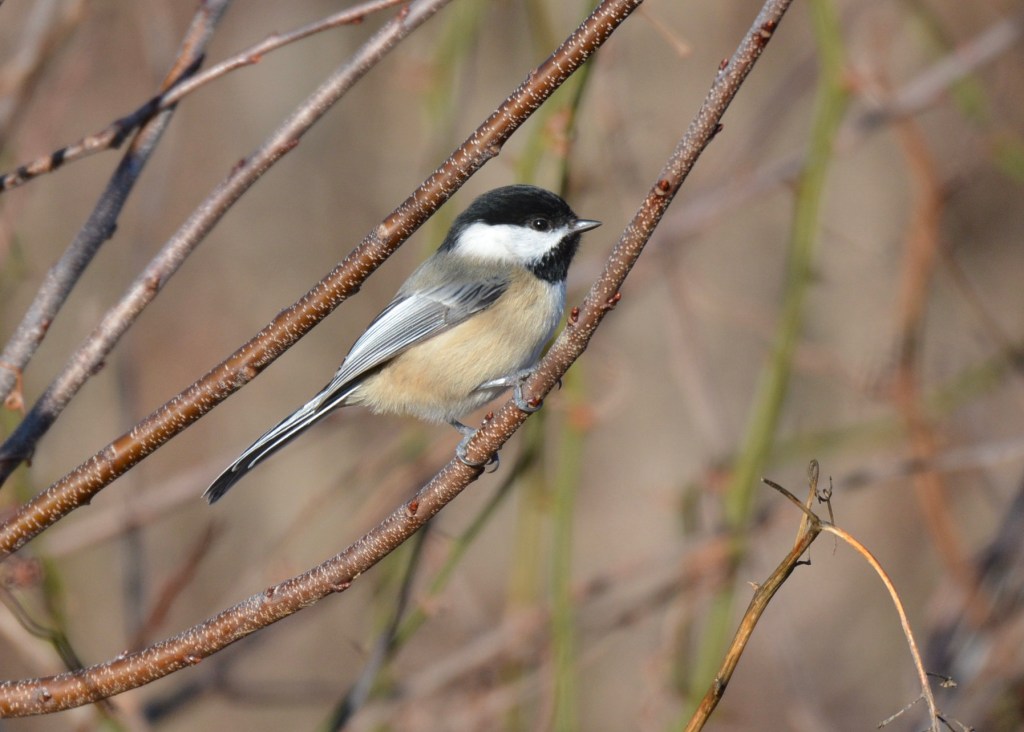
The state bird of Massachusetts (and Maine) is the small, perky Black-capped Chickadee (BCCH). This is a common bird year-round. It is easily drawn to feeders by black oil sunflower seed or hulled sunflower meats and they seem to be a happy visitor even in cold weather. Banded flocks of BCCHs are seen to rotate through a neighborhood with “group A” there for a while and “group B” replacing them and so on. In some areas there are four and five groups (most likely with a family basis) that will visit a feeder during the day. The rest of the day, even in brutally cold weather, they will travel the nearby forests, thickets, and street trees looking for more natural foods.
A bird this size has a very small body weight (mass) and a comparatively large expanse of skin (surface area); this makes it difficult to stay warm as the skin gives off heat and thus cools the body. But these little guys (and kinglets, and creepers, and goldfinches) are able to stay well insulated and well fed. The insulating feathers keep heat from blowing away and lots of food keeps the burning of calories at a high level. It seems that maintaining heat must be a daily challenge in these northern winters; you can imagine the impact of a snow storm or even worse, an ice storm.
Four winters ago we had over 100″ of snow and lost a high percentage of the resident Carolina Wrens (CAWR). The other small birds were less impacted that long winter. Perhaps they were able to move south away from the snow, where the CAWRs were unable to, or just didn’t, move away. It has been three breeding years and the Carolina wrens are back in pre-snowy-winter numbers.
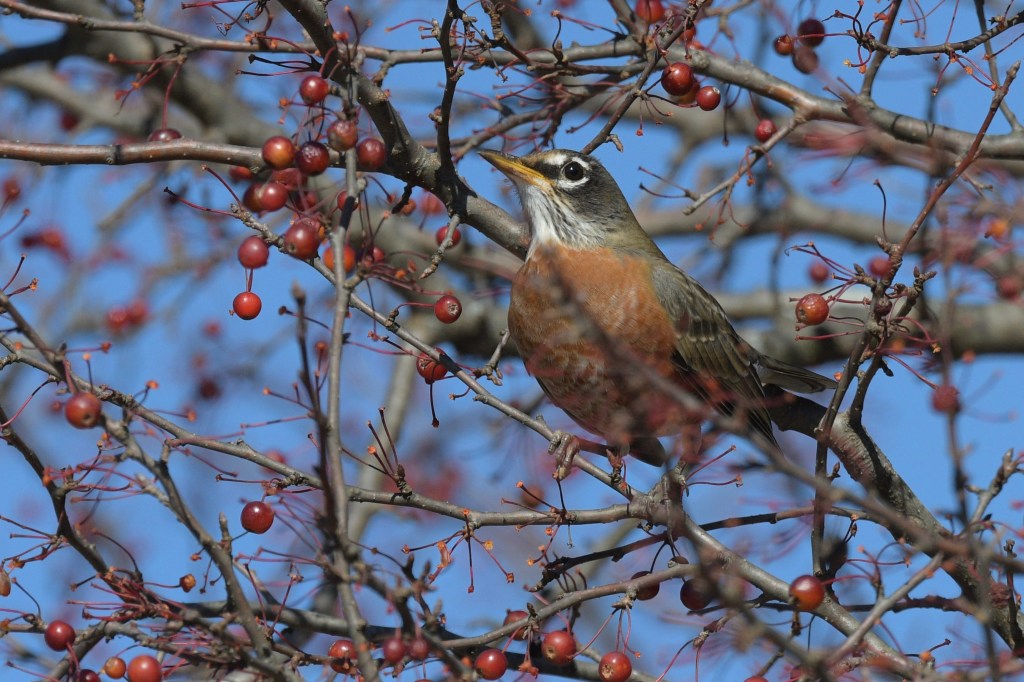
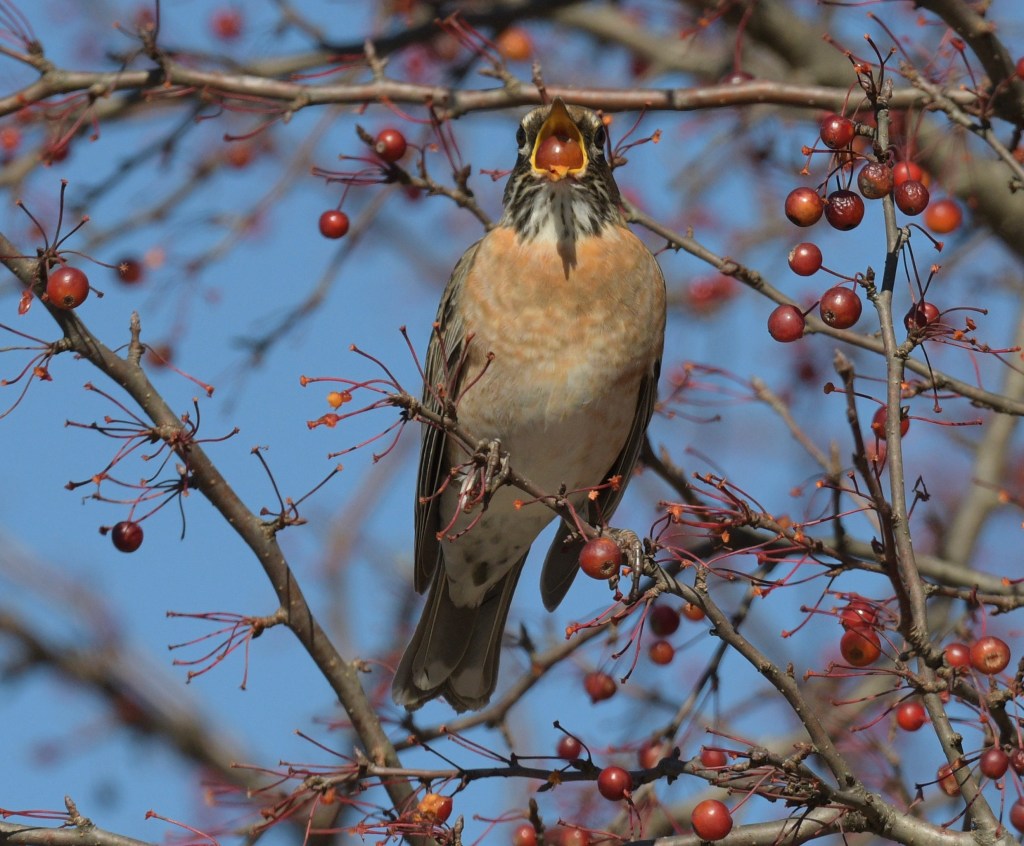
One of the more interesting features of a winter out on Cape Cod is the great numbers of American Robins (AMRO) that winter here. These thrushes are not the same ones that nest here, at least for the most part. Our wintering robins probably nest in the Canadian forests along and inland from the Maritime provinces. In appearance they are darker and more richly colored. Our nesting birds are often a soft brown and charcoal where the northern birds are a rich brown and black.
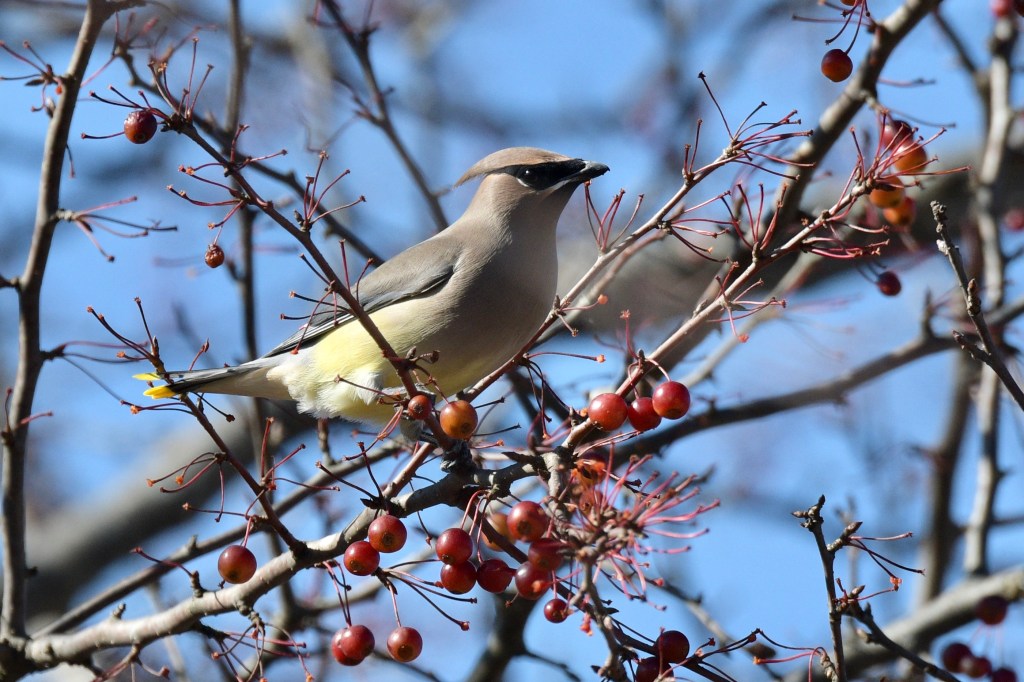
Our robins feed on cedar and holly berries into the winter. They roost in flocks in tall wetland grasses or Red Maple swamps. One of the ways to attract the American Robin is top plant fruiting shrubs; especially shrubs that produce small crabapples. These sorts of shrubs tend not to spread into native plant areas and are relished by the wintering robins, and Cedar Waxwings as well.
Several things about wintering birds has always interested me; two of these things are 1) how they can eat such cold food without effecting their body temperature and 2) the chill factor on the eyes of a bird flying 20-40 miles an hour in cold cold air must be
really really cold – well below zero in many cases. How can eider duck eat 35 degree shell fish scavenged from the ocean floor (crushing the shells in their muscular gizzard) or a gull or raptor fly into the wind without freezing the surface if their eyes?
The soft looking and seeming delicate Cedar Waxwing (CEWA) eats fruits and flowers. In the spring there are few natural sights that are as lovely as a flock of CEWAs eating apple tree flower petals.
This is not an uncommon bird but they are sketchy. Sometimes found in pretty regular numbers and other time really hard to locate. They are named for the “waxy” bubble that forms at the end of the feather shaft that appears to be a small drop of red wax.
For years, and still to some extent, the real function of these waxy droplets was unknown. It still is unknown for sure but more and more evidence points to one of nature’s great evolutionary driver’s – the ladies like it so the male do it!!
The older stronger and healthier males are thought to have more red than younger and less fit birds. So it seems the ladies choose mates by the amount and number of red feather-tips that a male has.

Crossbills – whatever they are

Please consider these images to be copyrighted and contact me for permission to use.

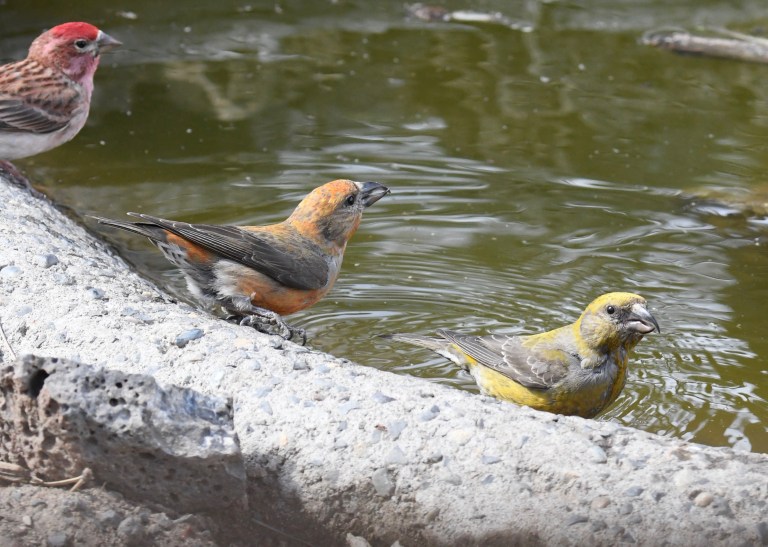
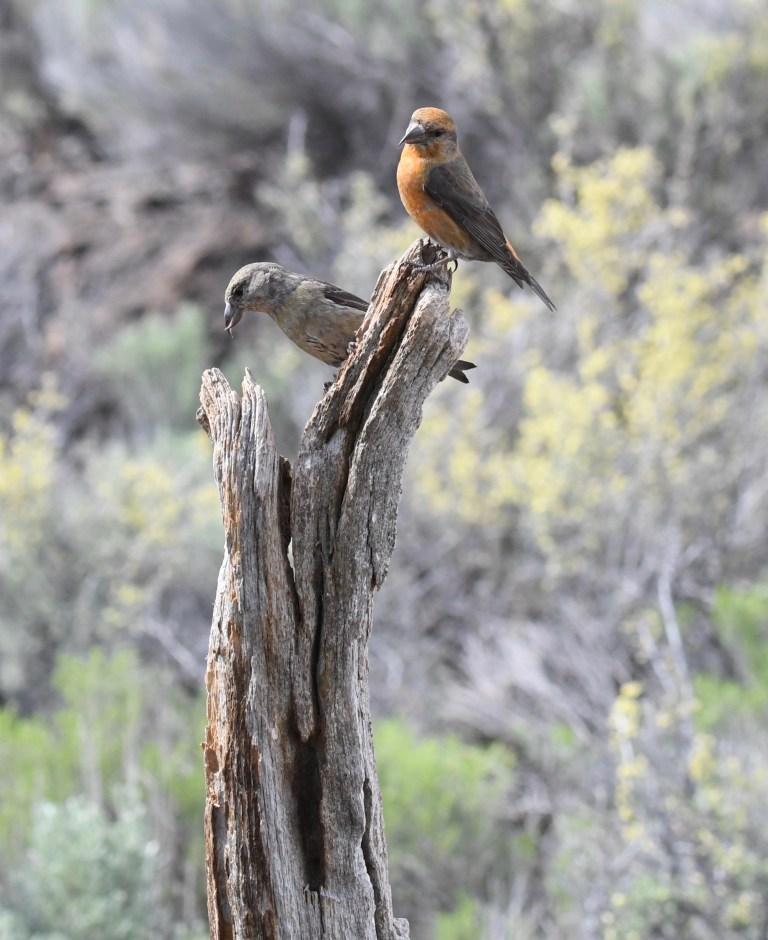
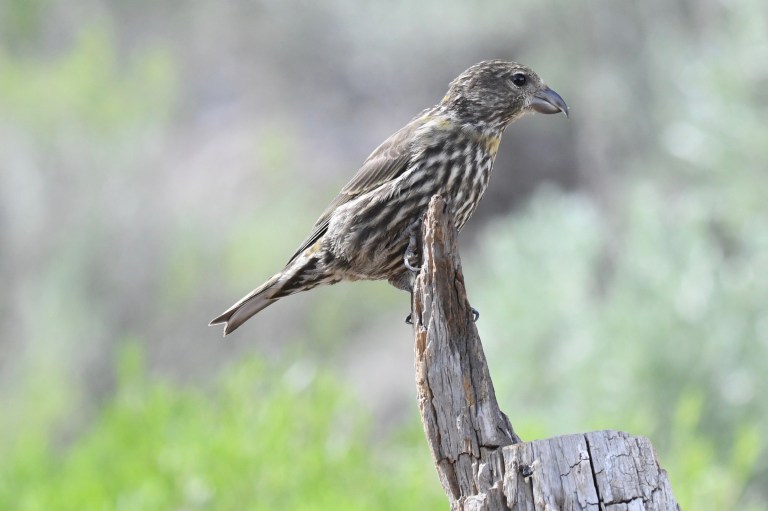
The group of birds called crossbills are a most interesting group of finches. The top and bottom halves of the beak do, in fact, cross. I did an earlier page on crossbills but the taxonomy is so interesting I thought I’d add to the confusion.

There are many populations oof crossbills some called subspecies and several groups that appear to be separate and real species. The definition of species is very fluid; if they can be separated by appearance that is a species according to many people. If they interbreed they are not separate species is another. If the populations do not overlap is another of the way to define species. Whatever a species is, the crossbills mess with your thinking.

The boreal forest is very widely spread. Coniferous trees and vegetation is even more widely spread. The crossed bill of these birds is used to open unopened cones to get at the seeds inside each cone; under the cone scales.

As there are forests and trees of this sort all around the world in the northern hemisphere there are birds that have adapted to survive in such a place; the most successful group are the finches and the most successful of those seem to be the crossbills. The confusion regarding speciation probably centers around group adaptations to differing tree populations and the necessary changes needed/evolved/developed to live within that specific crop. In North America, Canada and the US, there are about nine populations that seem to exist without interbreeding (at least for the most part). One group has already be determined to be a separate species, the Cassia Crossbill found in Idaho mostly. Most of the descriptions of these North American populations is based on the calls the birds make. Genetic studies have shown little to no genetic variation in NA birds – but something going on for sure.
Crossbills have crossed bills even when young; the shape is not seen just out of the shell but develops before the birds fledge. The seeds that form inside evergreen cones are so nutritious that young birds are often fed cone-seeds in the nest. Almost all birds (excepting the dove, pigeon group) feed young exclusively on protein-rich food from the animal kingdom.

Because of the nutrition available in the cone seeds crossbills can nest anytime, as long as there are unopened cones available. Most birds have to wait for insects to hatch or larva to emerge or flies to fly in order to secure enough protein rich food for their young. But crossbills can nest in the coldest weather utilizing the seeds of the evergreens. Evergreens will have bountiful years and less bountiful years – this impacts the breeding and breeding success of the various crossbill groups.