Please consider all images as copyrighted – thank you. Contact me for use… DEClapp
Just to get started let me urge you to buy Louisiana-grown rice. It would be good for their economy and good for birds as well. Send away for it if you have to. A second thing to consider is to attend the Yellow Rails & Rice Festival in early November 2017. We went last year and had 30 Yellow Rails the first day. It is a good program with good birds and very nice people. In addition we had hundreds and hundreds of White-faced Ibis, Skimmers, and various geese. The Louisiana countryside was full of surprise – look back on this blog to a previous post on Louisiana Birds.
Rice trails only sugar cane and corn/maize as an agricultural commodity worldwide. The plant was domesticated about 10,000 years ago (+-2,000 years either way) and is still a staple in the diet of several billion of our world’s people. There are thousands of varieties of rice being grown today. China and India produce about 50% of the annual crop. But, Louisiana has the nicest growers, great rice, and Yellow Rails – can anyone beat that?
The Yellow Rail is a target bird for all list-keeping birders and probably just any sort of birder at all. It is very hard to see. It is small. It is nocturnal. It doesn’t fly much. But there is a way to see them – lots of them as a matter of fact. This is a rewrite of a blog post I did back in November of 2016 – somehow I deleted the original.
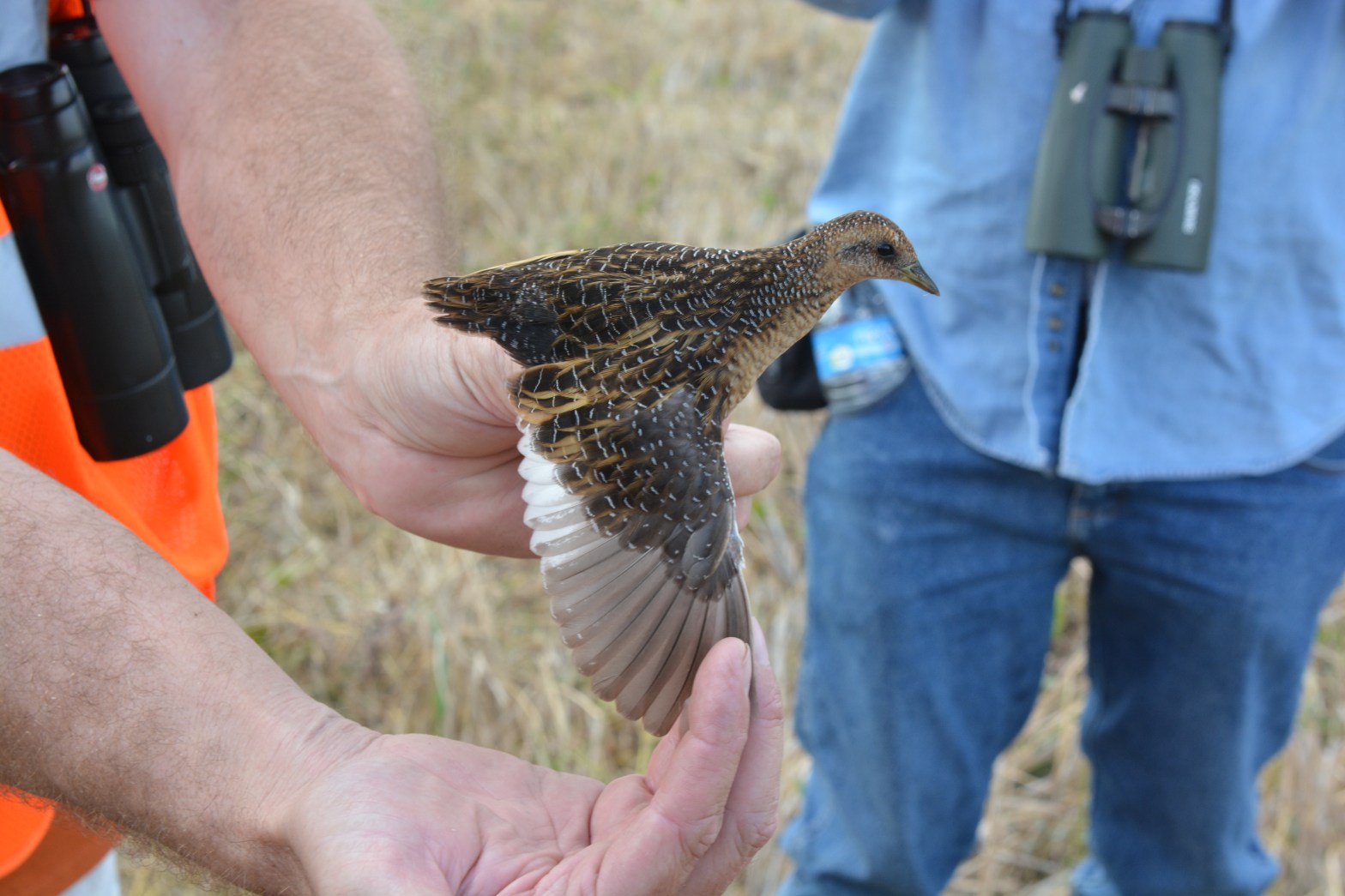
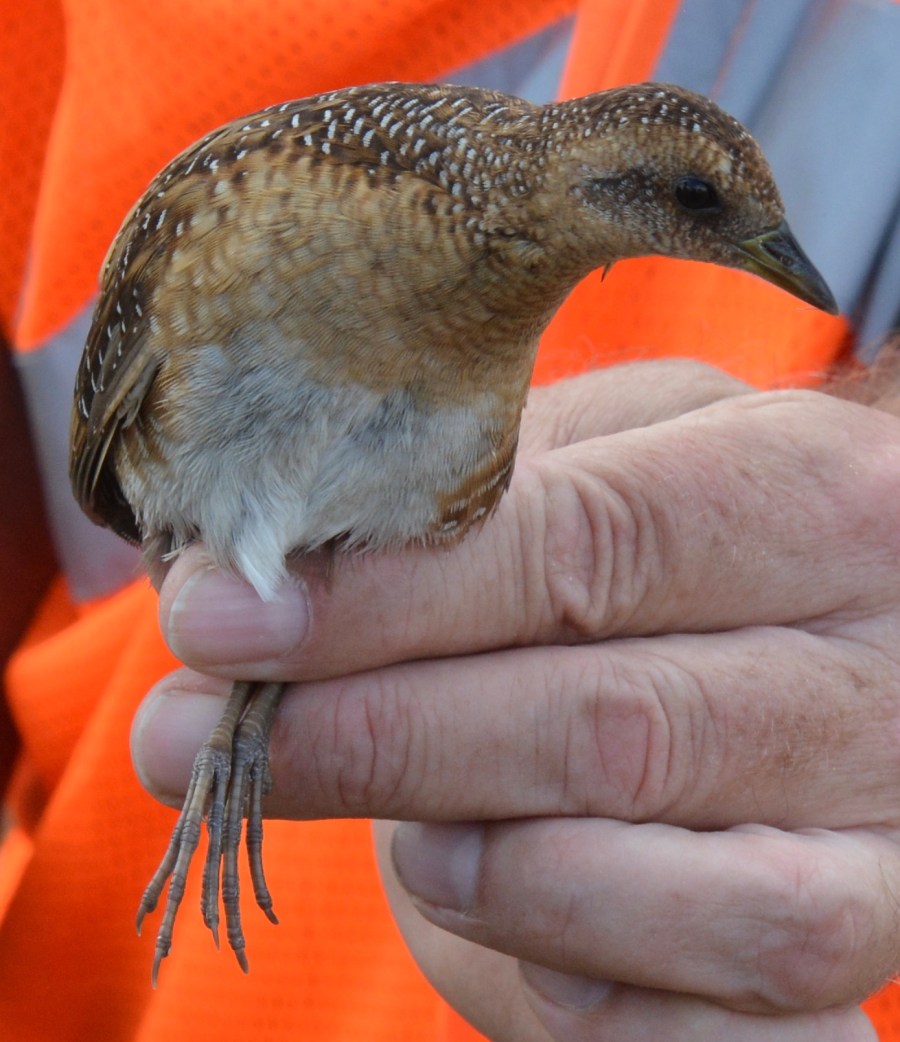
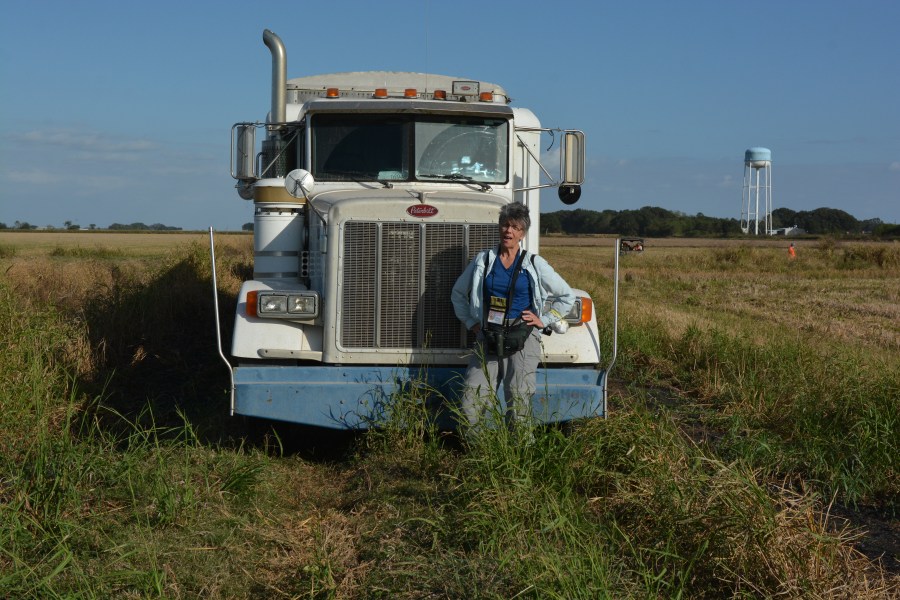
Rails are an odd group of birds and the Yellow Rail is one of the most cryptic and elusive of them. Rails are mostly creatures of the ground, wet ground with thick vegetation seems to their favorite. “Skinny as a rail” refers to their ability to flatten themselves vertically so they can slip between the stalks of emergent wetland vegetation – like cattail stems. Our human ancestors spent a lot of time outside and noticed all sorts of things that nature has allowed/created/evolved – I’ll wager none of you readers have seen a rail flatten itself.The Louisiana rice crop is a boon to Yellow Rails and the harvesting of the rice puts Yellow Rails on display. The fields provide habitat and cover, and maybe makes food more easily accessible. The rice, a grass as you can see, is the smallish seed growing at the end of a 24″ stalk, but is harvested by big equipment at an amazing rate. The harvester speeds (moves, lumbers, roars) around the field cutting the grass stalks and separating the rice (seed) from the grass and tossing up a considerable amount of dust. The rice is collected, more than a ton at a time, in that circular hopper at the top of the machine, and taken to a tractor trailer parked at the edge of the field where that nozzle on the top right spews it into the trailer.Here is my favorite trucker hanging out near her rig. The day was very warm and the harvesting created a lot of dust. Some times when the fields are cut the ground is damper and on those days the fields yield lots of Virginia, King, and Sora Rails as well as Yellows. We had 30 Yellow Rails and one or two King and Virginia.This closeup of the birders on the harvester doesn’t look too dusty but when the machine circles a field it gets in its own dust for at least half the circuit. The filters are a welcome facial adornment. Also, we had ATVs that we drove right next to the rakes of the combine so that when a Yellow Rail flew out from in from of the cutter we could easily relocate it.Several Yellow rails were captured and banded. This allowed for nice close looks at this elusive bird. Once put up by the harvester they usually flew less than 100′ and put down. Often we could see them on the ground in the cut areas.In the very center (center line that is) about a quarter of the way in from the left is a yellow rail — see it? The Yellow Rail is very difficult to see even when you know where it is. Rails, in general, are suffering from habitat loss and loss of water quality. The very tiny Black Rail is now totally missing from many of its traditional breeding areas.
Please consider all images as copyrighted – thank you. Contact me for use… DEClapp
Lions are large. They are smaller than cows it is true, but for an animal with the size and attitude of a lion it should be considered to be very large. They have bulk, strength, teeth, claws, brains, and teamwork. Like pretty much all animals there are two sexes, and like most wild animals there are rather distinct roles that each sex will play. The blog posts that will follow, in a scattered fashion I’m sure, will deal with lions by sexes, by skills, by territories, by behavior, by size and shape, and through human history. Lions are feared and revered in most cultures that have associated with them. The Romans collected them and the Maasai learned to kill them.
This first lion post is about males because I was looking at the differences between bears (from a recent Alaska post) and lions and thinking about teeth, diet, adaptation, hunger, and other stuff. Anyway, lions popped into my head – so here is a blog post on male lions. No animal or plant or anything really, lives alone as an individual. No man is an island in the real world. So it is with lions; there is no separate creature functioning as a “male lion” or a “female lion(ess)”; rather it is simply a way to start on lions and continue posting on with predators. As these posts continue you will see that lions are the most social cat of all cats and that males, females, young, territory, hunting, and family life are complex; and though some roles are specific to a sex or age group, lion life is very much integrated with those other lions in the area.
Generally speaking males are large and solid. They can weigh up to 550 pounds, but generally weigh 375-470 pounds; females are 20-30% lighter. This sexual dimorphism is unusual in cats. The mane is a characteristic of male lions and varies greatly in color and size. Some research in Tanzania has shown that females favor a larger maned male with a mane consisting of darker hair. This condition is usually found in the older and larger of the male lions and the research goes further by saying that these males are often more successful in male-male confrontations. Whatever the reason for the mane, most populations of lions have males with manes though some regions have males with short or minimal manes. The growth of the mane seems to be both genetic and related to an individuals production of testosterone.
I mentioned that male lions can be dethroned by newly arrived males looking for a female group (a pride) and a territory; these are the male-male confrontations that cause a nighttime of roaring and fighting. The roaring and the characteristic spraying on bushes will increase during any confrontation and the males will eventually come to blows. If the new consortium consists of four males will often successfully oust a pair of males from their territory. The new males will then eliminate (yes, that means kill) the young of the previous males and then mate with the females. This sort of interaction is not uncommon and it is very disruptive to breeding success. In order for lions to breed successfully and raise the young to adulthood it is necessary for both the females and the males to rather young (in breeding years) and strong and vigorous in defending their territories. In those cases there might be two or even three litters of young born and raised before age and warfare causes their group strength to wane.
The two males above are older, tired, and have been defeated in male-male contests. You can tell by the look and posture that they are no longer king of the beasts. With broken teeth and spirit they will not do much for the rest of their lives except try to avoid other lions. When they enter the territory of another group they will be chased and battered again – and then again. Sooner or later they will be killed or starve to death as they wander the plains trying to keep a low profile.
On one safari, I think we were in Kenya, the group boarded a very small plane to fly from a remote area back toward town. From just behind me I heard a kind and sweet little old lady mutter “dammit, get up and kill something you lazy @#%&”. I looked out the window and there was a male lion sprawled in the grass at the edge of the dirt runway. We had seen dozens of lions – but they were all sleeping or otherwise lazing around. For a ferocious beast with great strength and a reputation for mayhem lions are perhaps the least showy of the African cats. Most of the wild cats are nocturnal, excepting the diurnal cheetah. So it should be no surprise that they sleep in the day time. But as the lady implied; they sleep all day!
It is always nice when the drivers take pictures to show their families. Just like most of the world Africa is losing its interconnected wild spaces. Migrations, territories, and water sources can be, and are being, impacted by increasing human populations and agriculture. The drivers’ children are not likely to see a lion in or near their community. But when a lion feels at home, as this male demonstrates – he most certainly is at home! The logo on the Land Cruiser is for the Smithsonian Journeys travel program. On a hot windless buggy day the lighter and more lithe female lions may take to the trees to find some peace and perhaps a breeze. But a big male lion does something like this on very rare occasions. I have watched hundreds of lions for hundreds of hours and have seen this only once. This male was with a receptive female and perhaps he was showing off for her or for the other male nearby. Most older males wouldn’t think of climbing a tree. However, as with everything there are exceptions – one population of lions, in Manyara National Park, is known for hanging out in trees, including the males.This is one of my favorite images. There were four males in a dry creek bed when a small pride of ladies walked by. The scent must have been stimulating as all the males got up, growled at each other, and proceeded to spit and spat for about ten minutes. I got the impression they were sorting themselves out as one of the females was coming into oestrus. They were all rather pale and all in the prime of life. It was a grand time for all … except for perhaps numbers three and four. This male walked straight past us without any acknowledgement at all – he was in a macho game that we were not part of.
Please consider all images as copyrighted – thank you. Contact me for use… DEClapp
This blog page is not chronologically in sequence with the previous posts or the posts to follow. However, it seemed like a good time to mention the bears of Alaska. There are both Brown and Black bears in our largest state. Alaska is just right for bears; plenty of space, plenty of food, and few people to mess it up. The Black Bear is the smaller of the two species and the one that seems to interact with humans the most. In 2017 there have already been a few bear-caused deaths in Alaska.
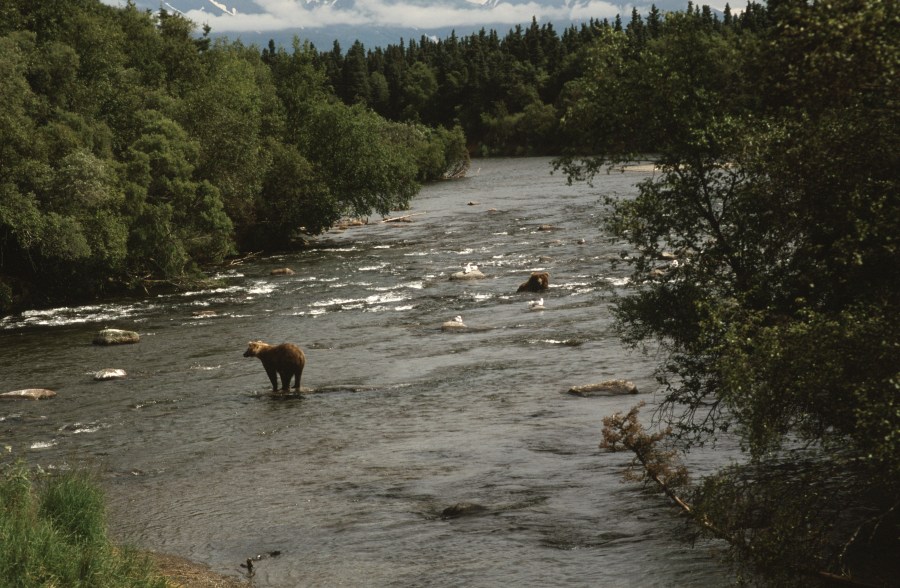
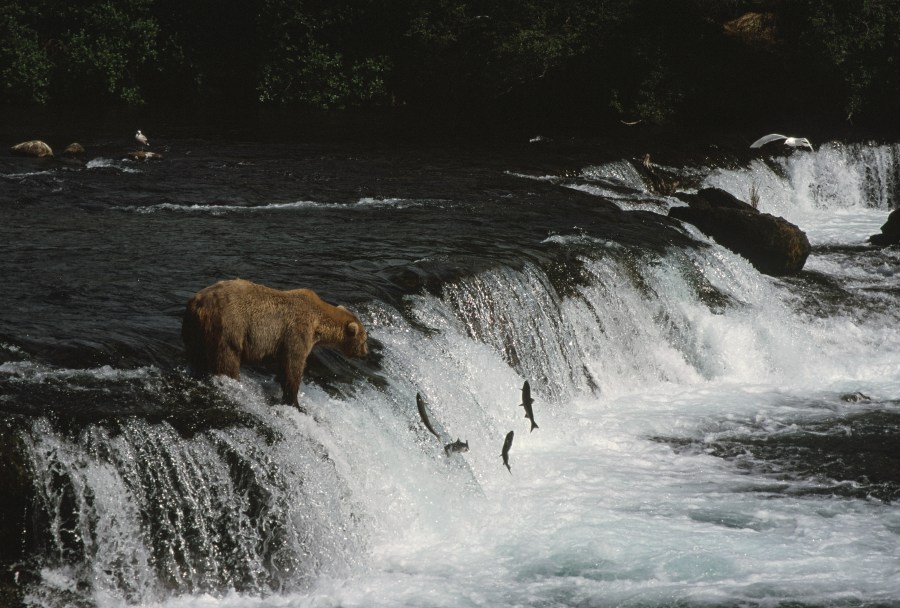
The Grizzly Bear is the more inland of the two forms of the Brown Bear. The coastal bears, called Brown Bears, are larger than those that are well inland. The bears in Denali can be called Grizzly Bears and the bears of the Southeast and Kodiak and the extensive and remote shore lines are referred to as Brown Bears. The coastal bears that get to eat salmon for a couple months each summer, as the various species return to spawn, are the largest overall. The fish always pass through the coastal rivers and the bears are always waiting. The inland bears don’t see this migration.
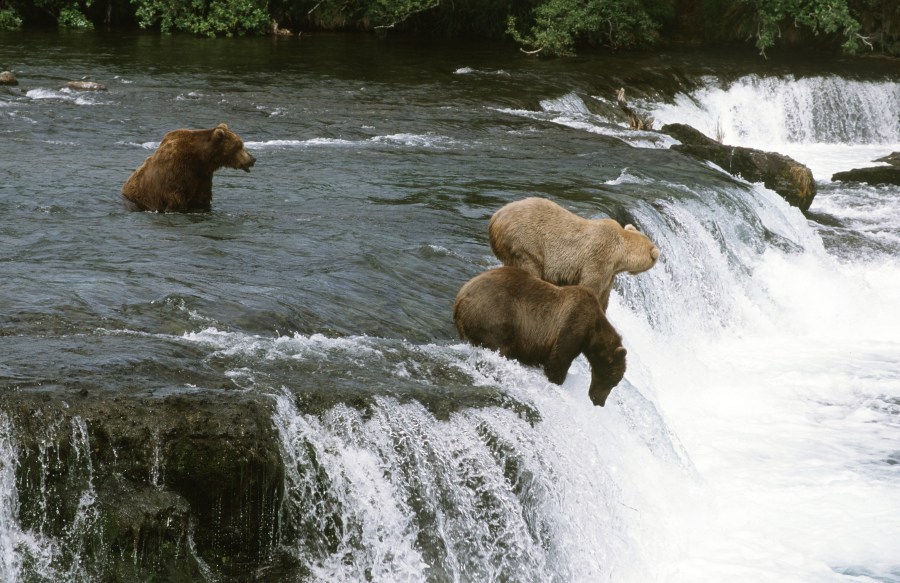
Spots like the one I show are often part of the Alaskan ecotourism trade. You have to go to “Bear School” and then you have to sign the waiver that says if a bear kills you it isn’t the lodge’s fault. You can even fish in the streams – I didn’t as I thought it wise to not look too competitive to the Brown Bears. But at this location I did have a half mile walk from the place where the float plane dropped me off and where the Bear School was located to the place where the bears were lined up on the rocks. There were bears in the woods walking and sleeping. But all they had on their mind was SALMON.
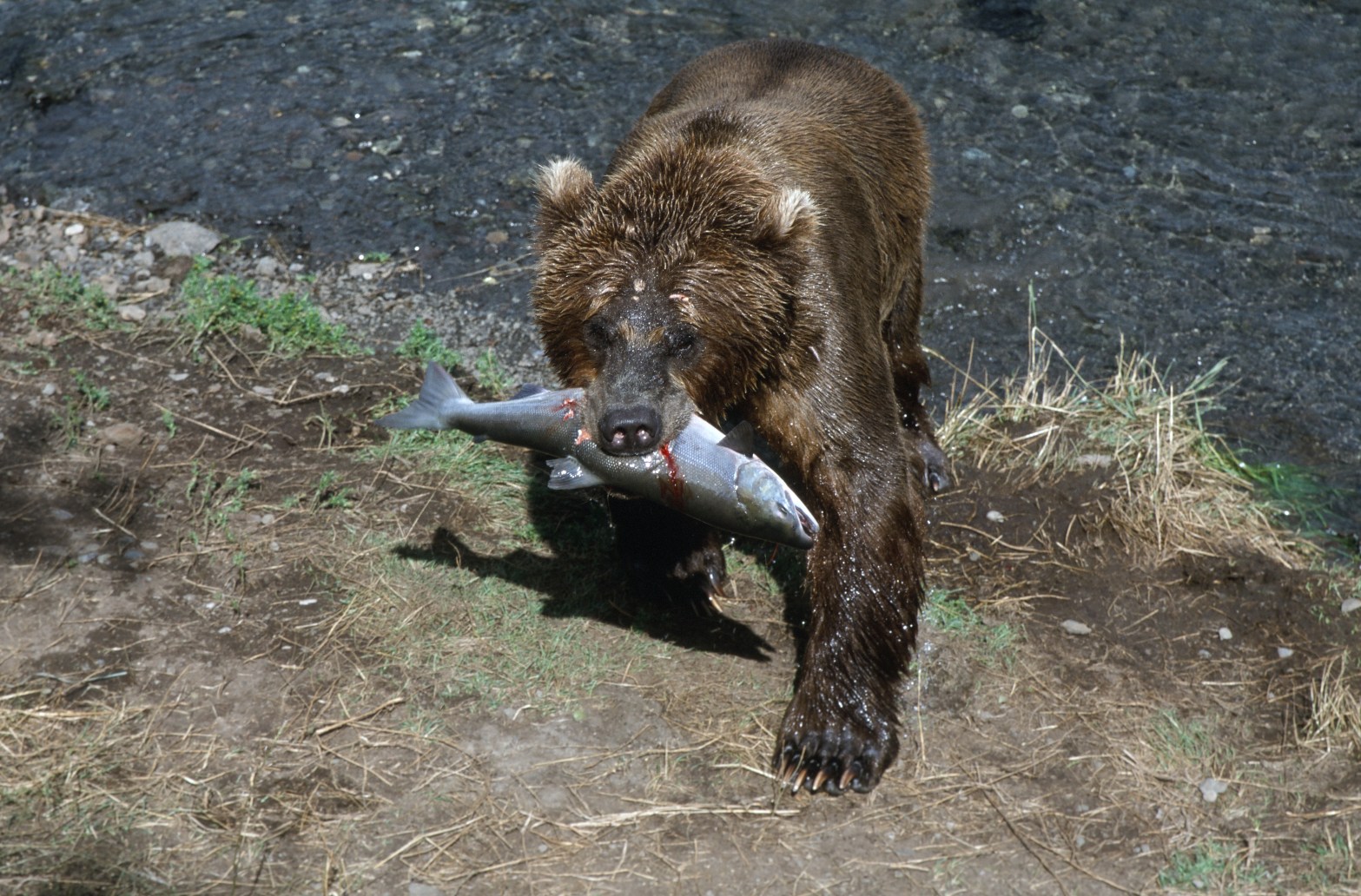
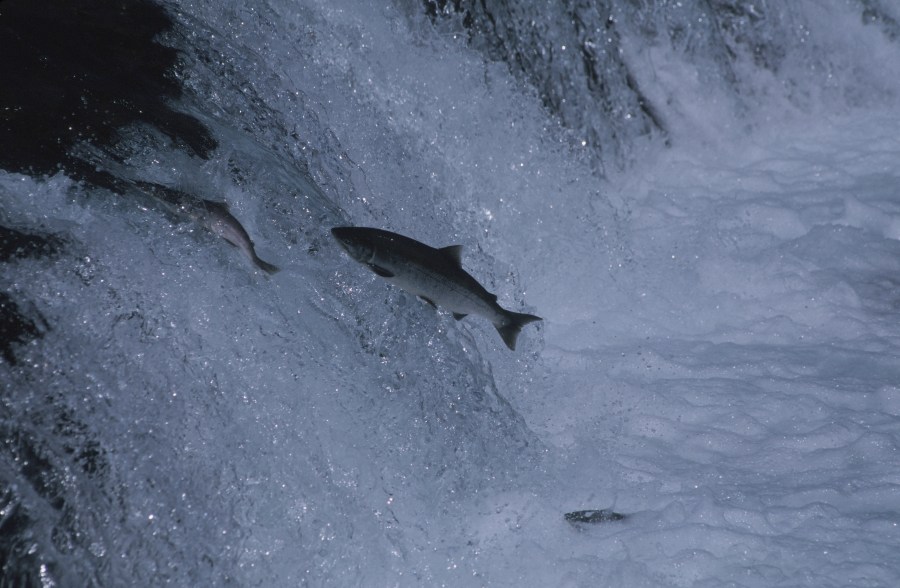
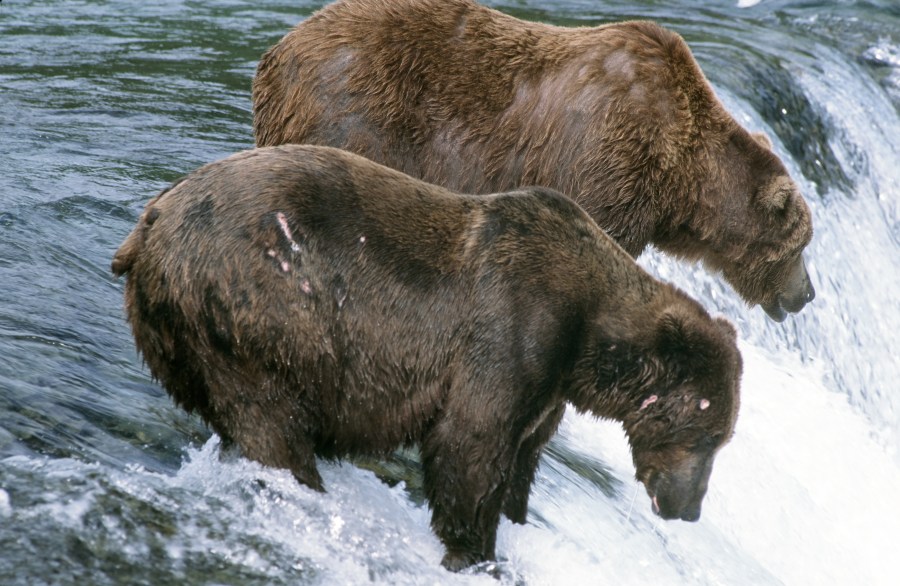
The first salmon begin to move into the streams in early June. Bears arrive and wait – meanwhile they eat buds, roots, shoots, and whatever they can find; knowing that the banquet is about to begin. Often Pink Salmon are first along the shore but King Salmon are also early migrants and are in many of the rivers first. The last salmon are still more than two months away from arriving, as the Chum, or Dog Salmon, are the last to return to the fresh water.The salmon arrive slowly at first and then in a flood. The runoff from the winter snows makes the river boil and make the salmon’s run difficult. But, they are strong swimmers and can make easy work of the current and the waterfalls that are part of their route home.The bears really show up along the river now. The big males reclaim the best spots. The females and especially those females with young from this spring or last spring keep some distance. Males are big, hungry, and a nuisance. Cannibalism is not beyond Brown Bears.
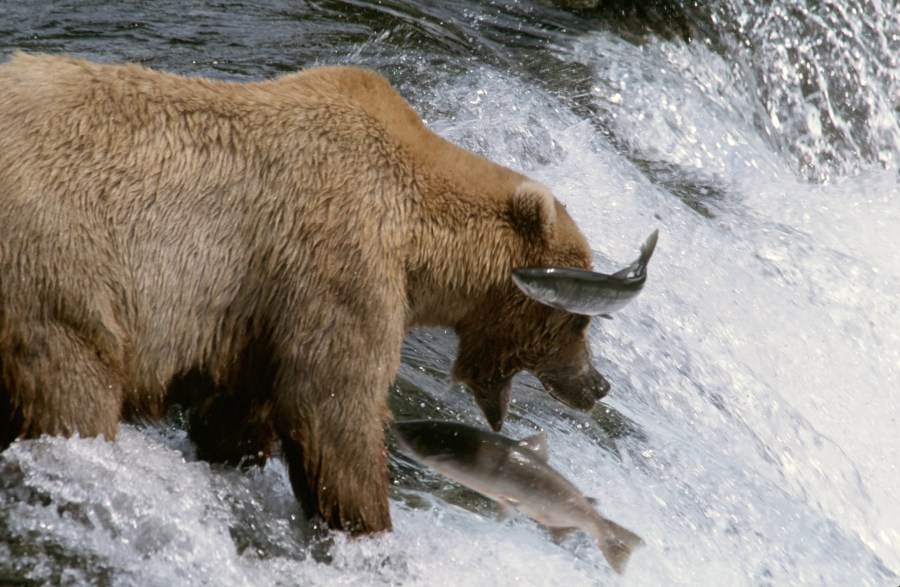
The salmon and bears finally have their annual meeting. The fish are intent on getting upstream to spawn, the females are bursting with packages of rosy red roe, eggs that are eaten by bears and humans alike. The males are literally falling apart and changing shape as they approach the end of their life. But they are equally intent of getting back to their personal headwaters.Sometimes the fish are a bit tricky. One under and one over – maybe the salmon planned this manoever before leaping this low waterfall. The bear is patient as there are thousands of salmon and more than you could possibly eat pass by each hour.
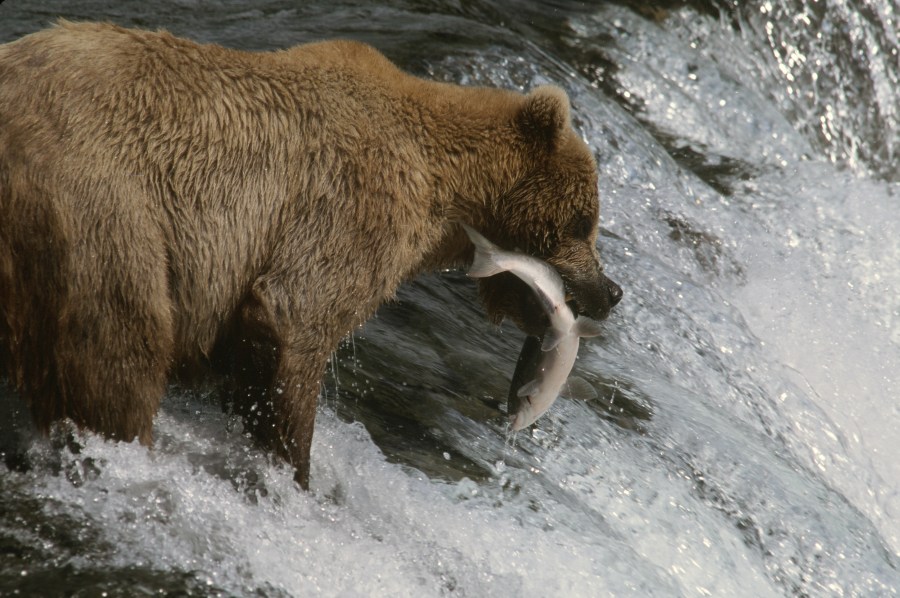
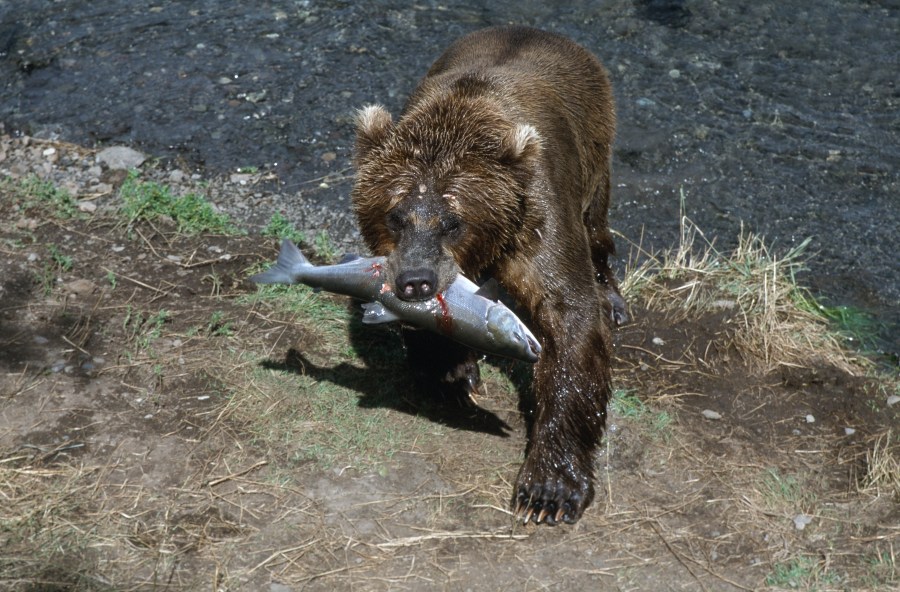
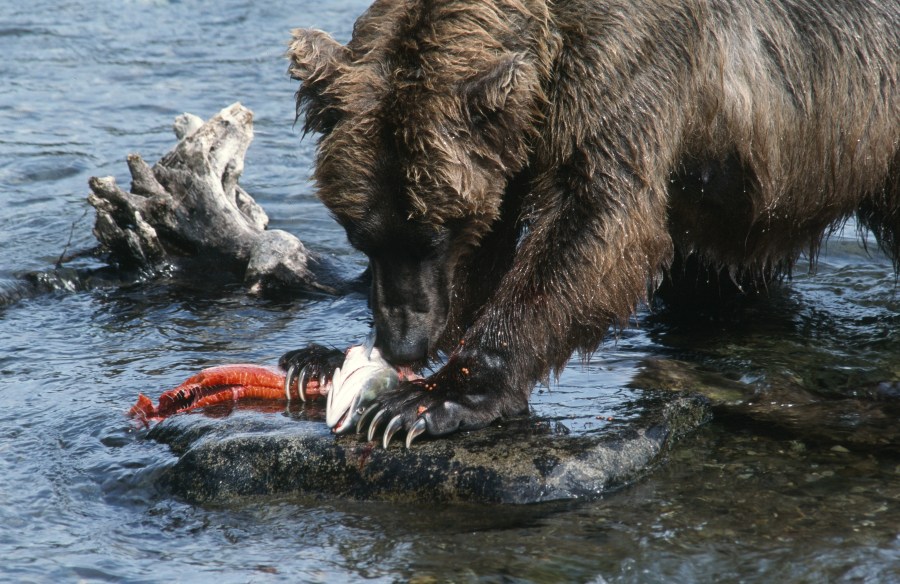
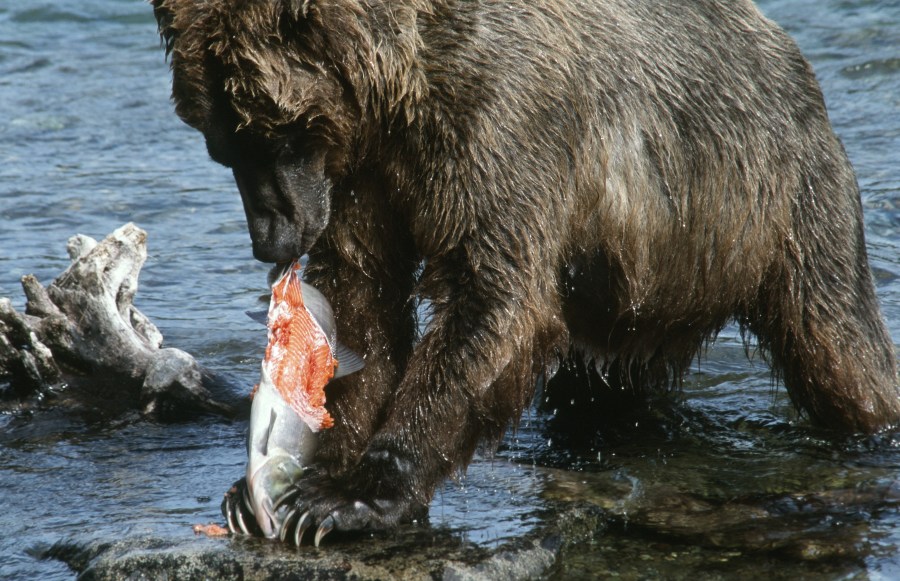
Once a fish is caught the bears head to the shore. Not because the meal will be stolen but because they need an operating table to prepare the meal. We humans eat salmon, lots of salmon. We eat the reddish flesh of the fish. At this time of year the bears are easily sated and are rather choosy about what they will bother to eat. They head to shore to assess the catch and plan the dinner.
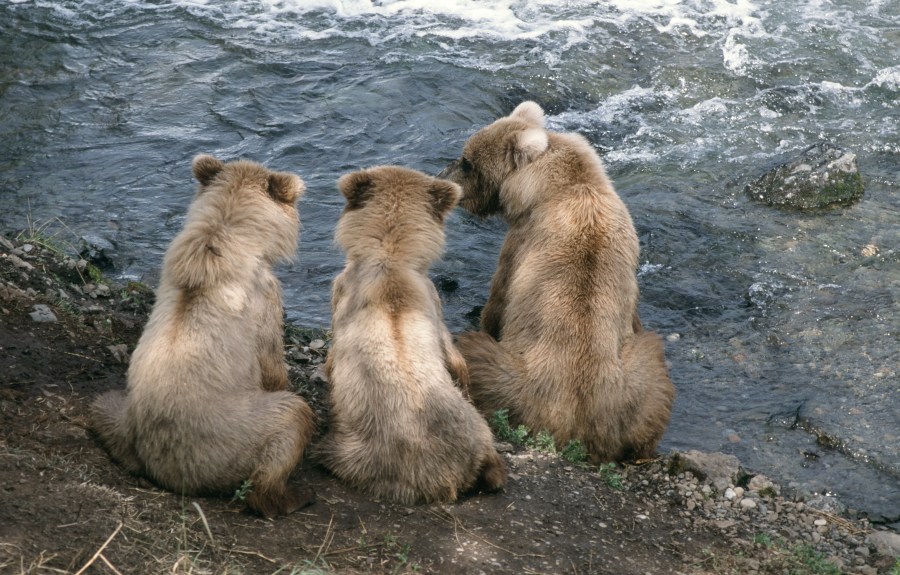
Again, this is a bit seasonal, they eat only what they consider to be the choicest parts in this time of plenty. If you had a hundred butchered cows available to you, you might live only on the filet mignon. Well, at this time of year the bears eat the roe, the fatty skin, and the brain. It is quite odd to us humans to watch them skin a salmon and eat the skin. Then they gut the salmon and eat the roe from the females. A quick bite on the head gets those goodies and the rich red meat is allowed to float downstream. The Glaucous-winged Gulls are quite happy with that arrangement.There is an earlier Alaska blog page that shows a mink dragging half a salmon carcass under some tree roots. The mink will eat what it can and the rest will fertilize the woods. Tons and tons of half-eaten fish and tons and tons of bear droppings* assume the role of soil in these woodlands which are perched on rocky substrate with little real soil. *Answering an age old question about bears toilet use.Spring migration is a time to eat, sleep, and then eat again. After a while the bears are pretty zombied-out. It is the best time of year for these Brown Bears and they are very good at taking advantage of it.Meanwhile, over on the sidelines Momma Bear explains to the little ones about the dangers of taking food from the big boys. Often the females and yearlings are downstream with the gulls looking for leftovers rather than trying to get a place in the stream at a falls where the fish pass in large numbers. Better take the safe alternative when the other choice is life-threatening.
Please consider all images as copyrighted – thank you. Contact me for use… DEClapp
The Bald Eagle is a notorious thief and bully. Benjamin Franklin was quite outspoken about the negative qualities that the eagle harbored and he was not happy with it being made the national bird and state emblem of the new United States of America. Franklin would have favored the canny, and tasty, Wild Turkey. Be that as it may our nation has been represented by the majestic eagle since 1782. Actually, Franklin wrote to his daughter well after the eagle was made the symbol of the United States, regarding the use of the eagle on the logo for an organization called the Society of the Cincinnati, a group of revolutionary war veterans. In that letter he speaks disparagingly of the eagle and rather glowingly of the Eastern Kingbird, Osprey, and (Wild) Turkey. But Mr. Franklin may have understated the case. The eagle is quite a builder with nests often ten feet deep and nine feet across weighing more than 2000 pounds. Nests are almost always within a couple hundred yards of open water. They are good parents and do, in fact, hunt their own food most of the time. The use of the eagle by the 1782 congress was really a carry-over from their admiration of the eagle-festooned Roman Empire. It copied the Romans use of the Golden Eagle rather than specifically glorifying the American Bald Eagle.
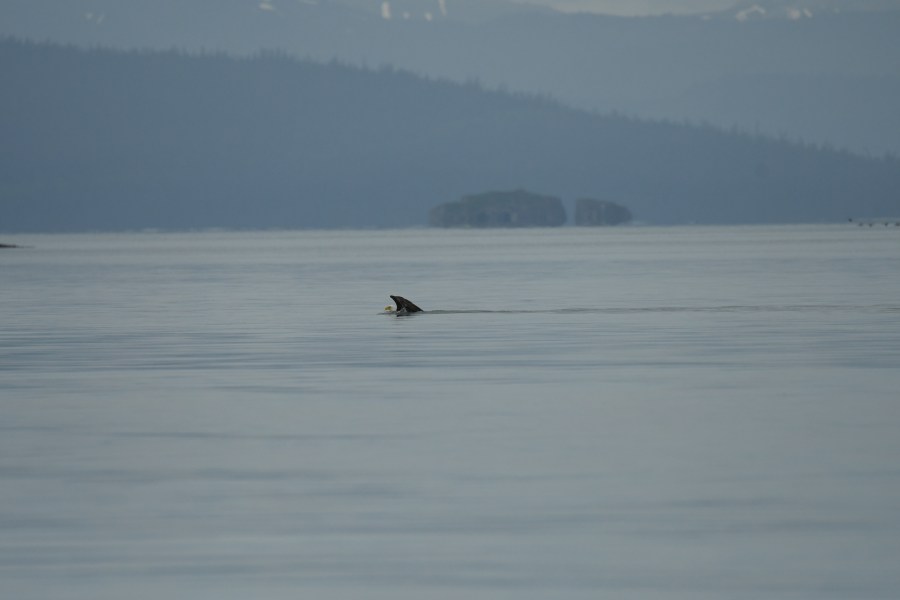
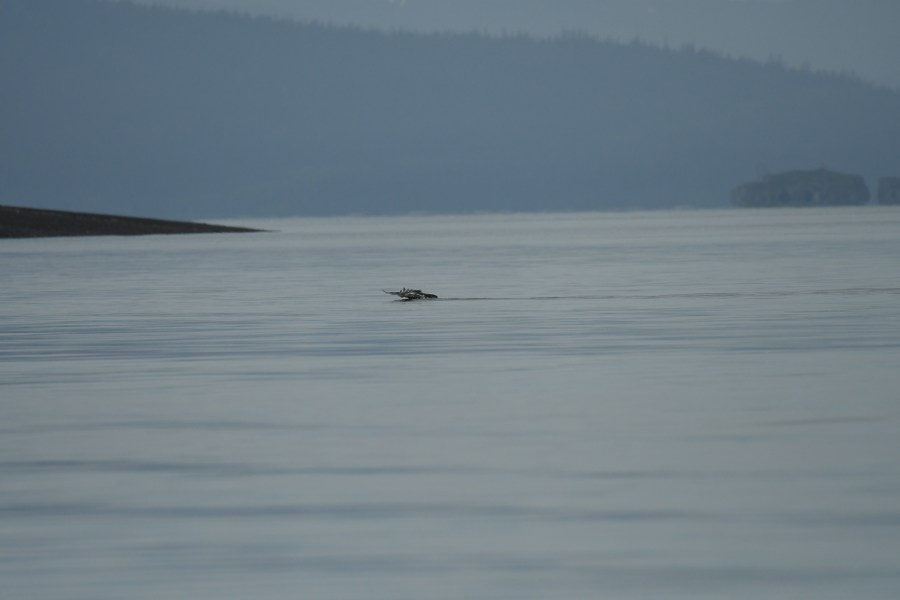
The images above and below show an adult Bald Eagle swimming ashore from the water of Kachemak Bay off the Homer Spit at the end of the Kenai Peninsula. Despite Mr. Franklin’s admonition that the eagle is a thief and rarely hunts its own meals this eagle had just grabbed a very large salmon and either had to drag it ashore, let it go, or drown making up its mind. It swam at least two hundreds yards dragging what we figured was a fifteen pound salmon. I had many questions go through my mind: how often might they do this? how large a fish could he handle? does the fish fight and struggle? could the eagle let go if it wanted to? would there be a bear on shore watching this and waiting for the fish to be delivered to it? and so on….
The Bald Eagle sexes look the same in their plumage but the female is up to one-quarter again the size of a male. That is true in most birds of prey – the female is generally larger. Bald Eagles are widespread over North America. They are in general a fish eagle; with almost 60% of their food being fish. They do eat ducks and geese when they are available and easy to obtain and fish are not readily available. If fish are available they will make up to 90% of the eagles diet. They will collect fish from waterfalls, turbine outflows, shallow waters, and those that swam (too slowly and casually) near the surface – they also collect dead fish anywhere they find them. As fish populations have declined in many coastal areas the opportunity to feed on fish has diminished, especially in areas where there are kelp beds. The eagles have begun to eat cliff and island nesting sea birds in many of these locations. Sea birds, generally pelagic/oceanic birds, such as puffins, guillemots, and especially murres have become a usual prey item now that their standard fish fare has declined. Adults can be taken in the air at the jam-packed nesting sites, tunnel nesters like puffins and shearwaters can be dug out, and fat and oily youngsters can be plucked off the cliff edges with ease. An attack by an eagle at a nesting cliff can cause many young to plummet from the cliffs to the water or rocks below. In many areas this is a new and significant threat to the sea birds.
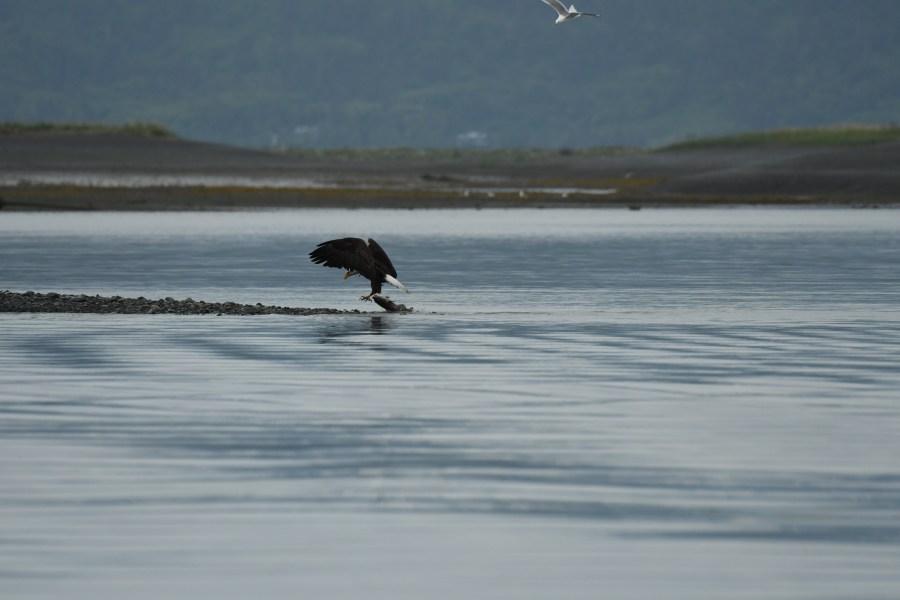
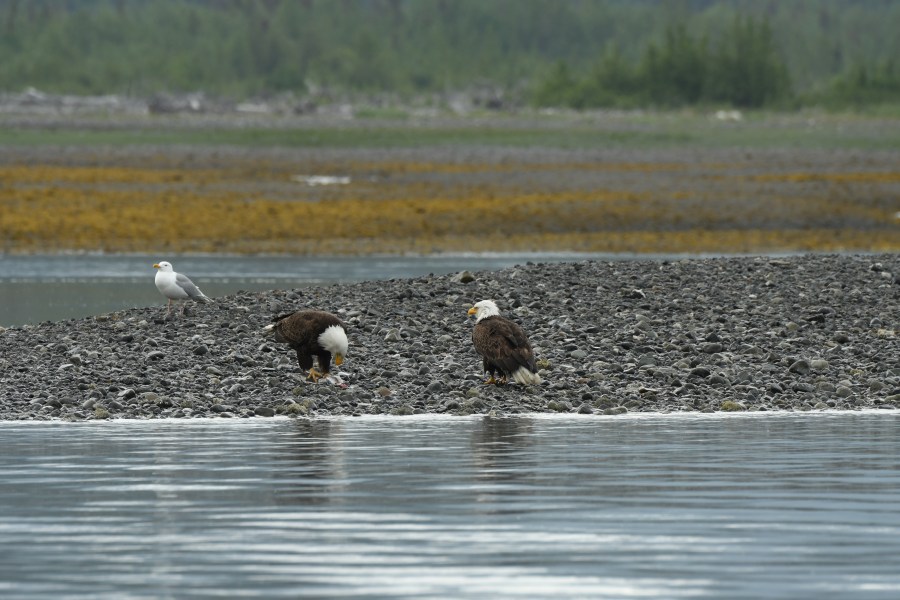
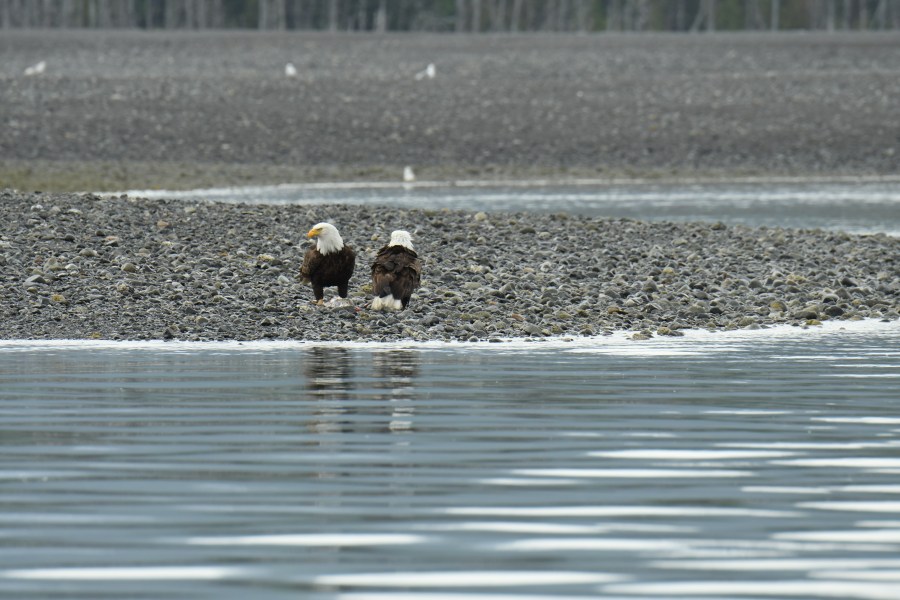
As the eagle reached the shore it was seen to have caught the fish with one foot. Eagles, like Osprey, have spicules on their talons to create a better grip and this bird did just fine with that right leg. Birds maintain their feathers by preening with an oil that, in general, keeps the feathers waterproof. It looks like this bird has feathers that have not become waterlogged. A very helpful procedure isn’t it?The eagle headed for the nearest bit of land which was this small bar that reached out into the water. Once on shore the fisherman had a few bites before the female came down and took her share. An eagle can store about two pounds of food in its crop, an expandable part of the throat, to be swallowed and digested later. They can fly with prey items that equal their own weight*. Once prey items get as heavy as the bird they need a head wind to get into the air. A heavy prey animal needs to be broken down into smaller pieces. Gorging and crop storage are two methods for getting as much food as possible in a short time. Eagles will return to a fish later in the day or the next day if nothing else has scavenged it. *The weight of an eagle will vary throughout the year. It depends on the age and sex of the individual, with females being heavier. The time of the year and the availability of food is another factor, as is the place in the breeding cycle in which they find themselves. A large female in times of the salmon run might weigh as much as 17 pounds and a male in lean times could be as light as 9.5 pounds.He dried off, shook his feathers free of water, and then they seemed to chat over their meal. It’s all in a days work for this eagle pair.
Please consider all images as copyrighted – thank you. Contact me for use… DEClapp
The Bald Eagle has never been uncommon in Alaska. The restoration of the Bald Eagle population has been a success in the lower forty-eight where population declined from east to west and north to south. They really needed help.
But Alaska, well Alaska has all the eagles you can imagine. In the Southeast while aboard the NatGeo/Lindblad Sea Bird with some Smithsonian Journeys travelers we figured that there were a pair of eagles every mile or so along the shore – and there is a lot of shore. When I was in Sitka looking over the inner harbor I had 23 Bald Eagles over the water in one group; and there were others on bridges, building, trees, and on boat masts. They were less common in Nome but seen in the Denali area along the braided glacial rivers.
They like fish: they catch, steal, and scavenge fish. The waters of the Alaskan coast and rivers provide fish pretty much year round but during the early summer through early fall there are tons of fish in the nearby waters and eagles (and bears and mink and gulls, and nearly everything else) can eat their fill. Fish leave the ocean and return to spawn in the inland rivers – and the predators wait.
I am doing two blog pages on Alaska’s Bald Eagles so that I can show off a great spot (Anchor Point in this blog) and a great story (an eagle swimming ashore with a large salmon in the next blog).
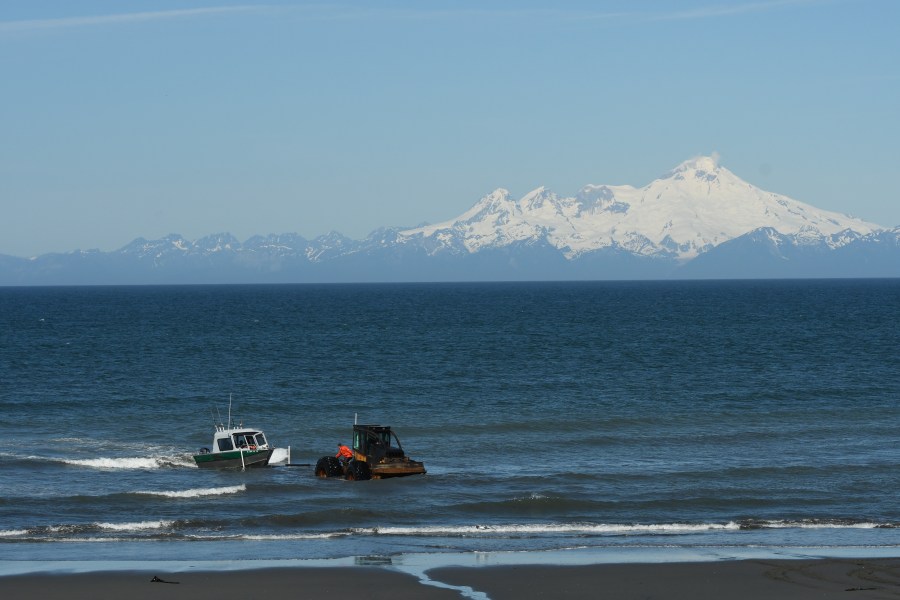
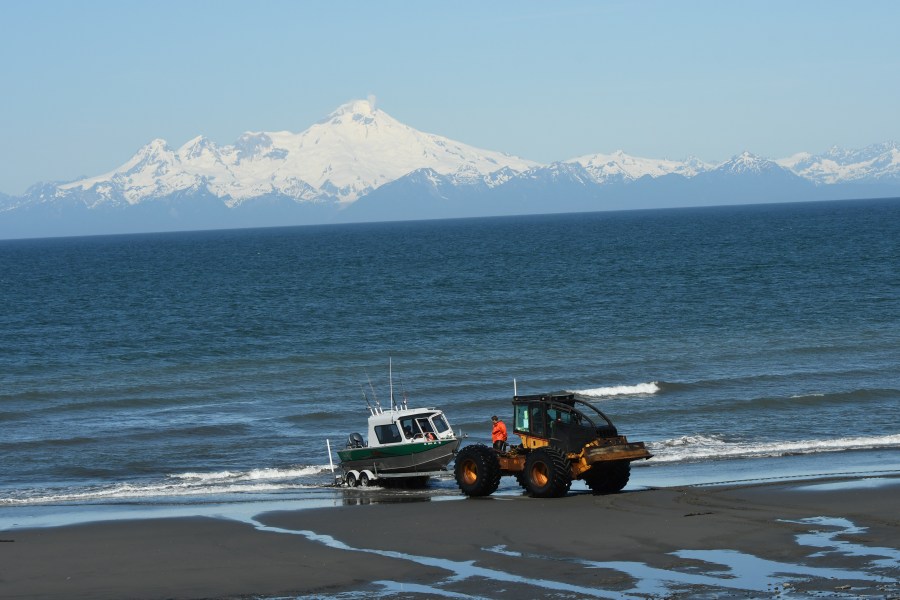
This page will show eagles from Anchor Point on the Kenai Peninsula. Like most of Alaska there are spectacular views here. The mountains across the Cook Inlet from the Kenai are gorgeous and present several of the areas active volcanoes. While we were there Iliamna was spewing steam into the blue sky through it’s snow-covered shoulder while its neighbor Redoubt stood majestically in the same view. These two volcanic mountains rise over 10,000 feet right from the edge of the sea. The island chain heads south and then west leading out to the nearly 1500 mile long Aleutian Island archipelago.
Anchor Point is the location where Captain Cook, while looking for a northwest passage, lost his anchor in the fast and powerful tidal flow of these Pacific waters. Now Anchor Point is a smallish stopping off point for travelers and a place where a tractor will back your boat trailer into the water allowing your boat to float free for a day of halibut fishing; or salmon fishing in the spring. Upon your return they meet you in shallow water and you drive your boat onto your trailer which they have backed into the sea with their machine. The tidal exchange and the strength of the tide water currents, as well as the potential for large storms, prohibit building a pier in this area. But, where there is a will there’s a way – and that way is by tractor not ramp.
The tractor maneuvers a trailer into position for the returning boat to slip into and be pulled onto the shore. It was a procedure that worked two of the three times I watched it. One time the fishermen had to exit the boat and wade ashore. That was probably not in their plans. You can see a small puff of volcanic steam rising from Mount Iliamna just to the right of the peak. It was a spectacular day; great sun, light winds, and an amazing view. And dozens (yes dozens) of American Bald Eagles….as you will see below.
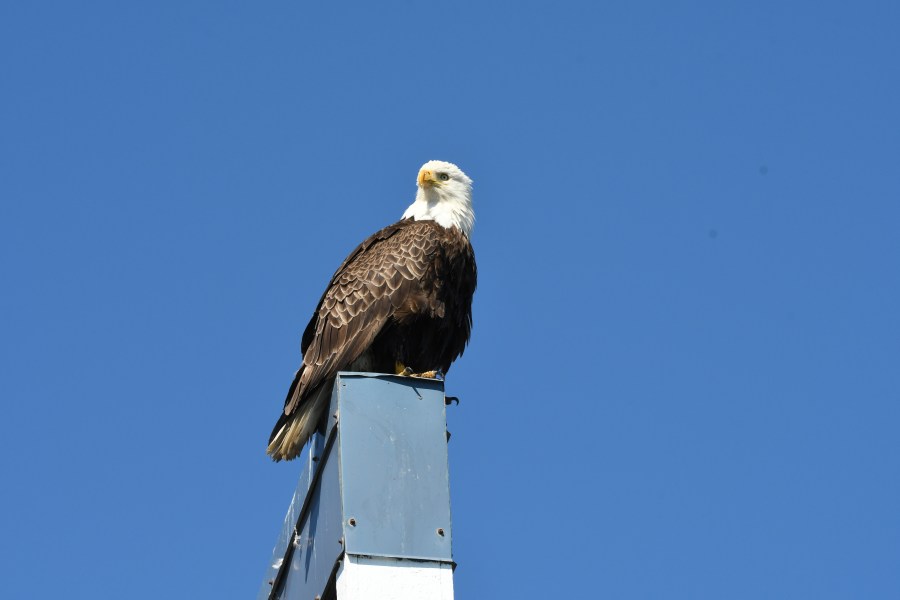
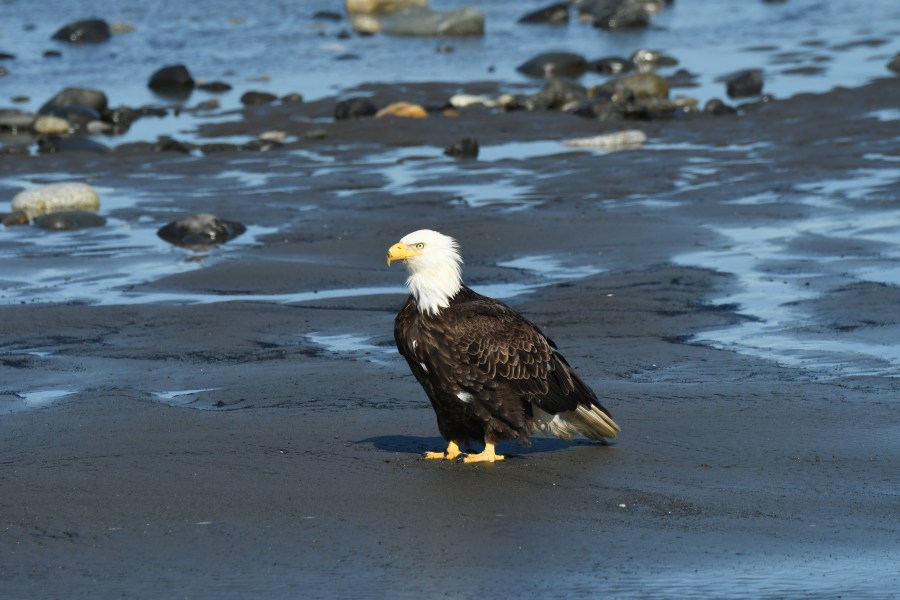
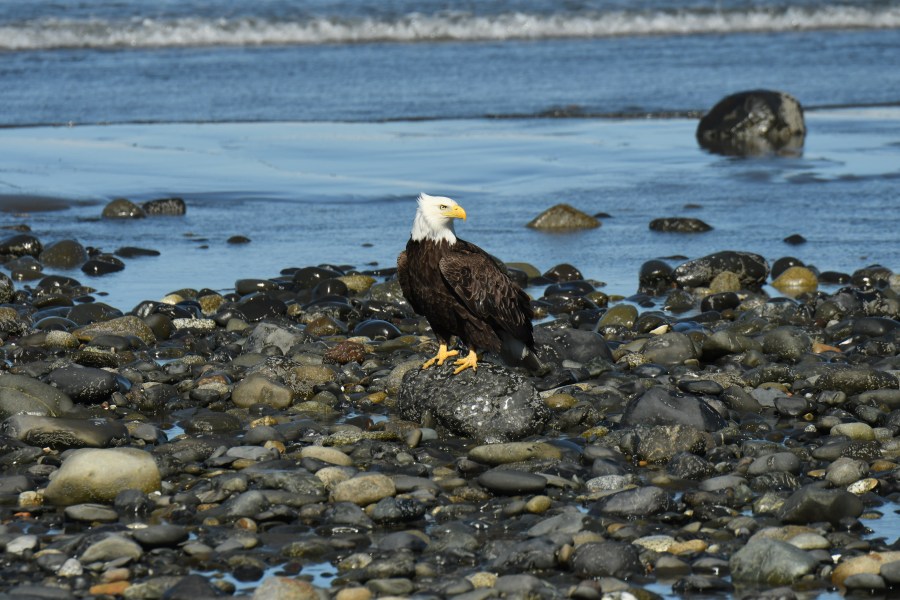
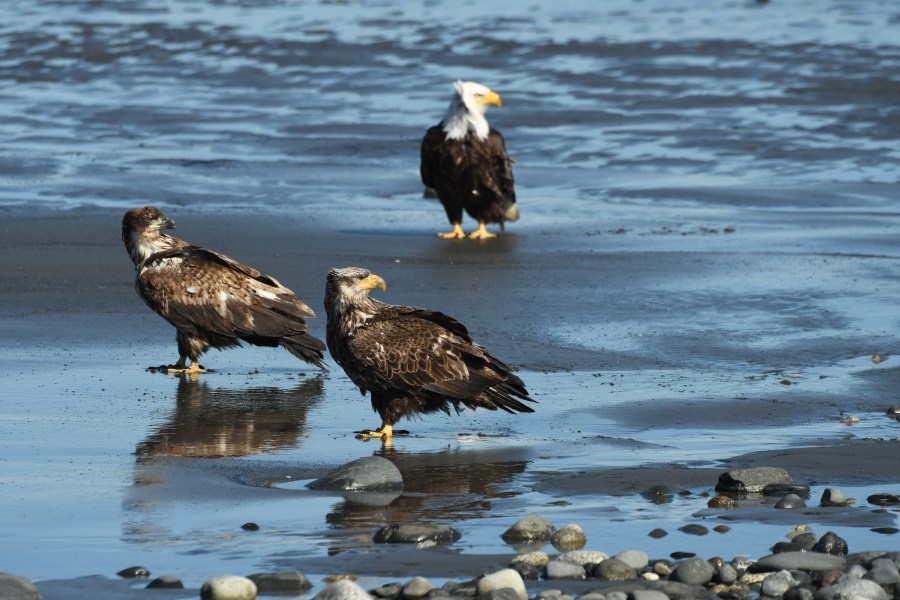
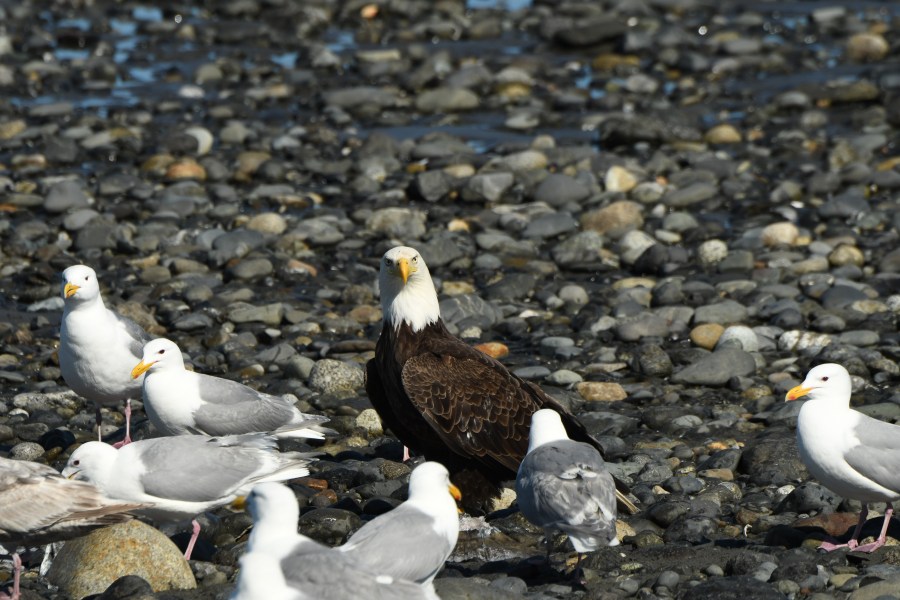
Throughout the Kenai we had eagles in sight where ever we looked. If there was salt water nearby – there were eagles. It was getting to be salmon time and every eagle knew it; the sea was about to return the salmon to the land. The eagles watched from roof tops, electric poles, boat masts, jetty’s, and tree tops. If you were shopping or lunching on The Spit in Homer there were at least ten eagles within a couple hundred yards.At this time of year the adult birds are in full gear. The feathers were brand new earlier in the spring but the plumage is still rich in color and the feathers are barely worn. They do look regal and fierce. The adults are likely to still be feeding young in the nest or have young that are just out of the nest and being fed wherever they happen to have landed. The adult birds above and below are just hanging out on the beach. In the areas where humans fish there are often fish “racks” discarded after the meat is filleted off the bones. Birds and bears will eat the head, skin, fat , and other tidbits as well as the flesh. As boats go in and out of from here and, as many fisherman clean their fish on the way in to shore there are often good pickings (scavenging) on the beaches near the boat launching areas. These guys know the ropes.
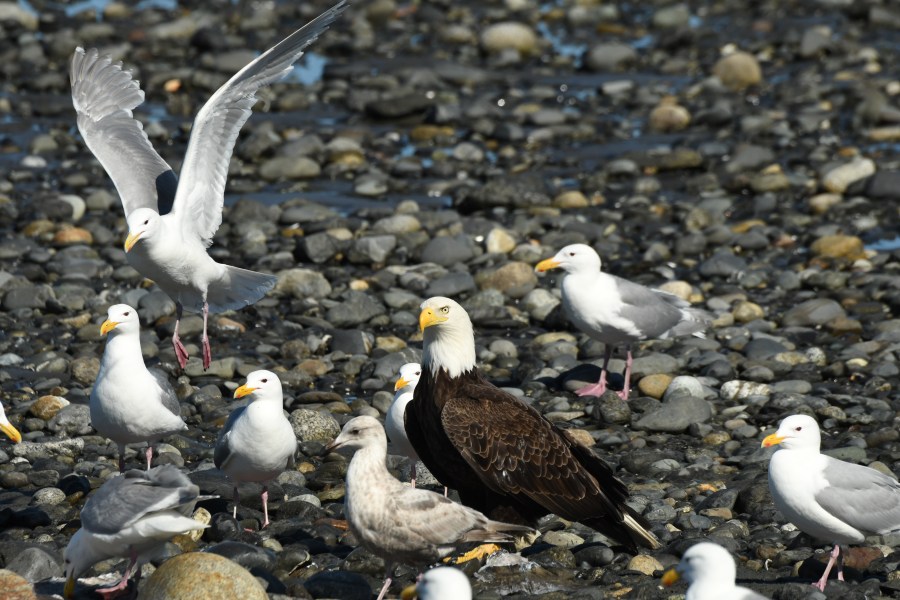
It takes a Bald Eagle about five years to grow old enough to wear the white head and tail of an adult. They start off quite brown and slowly develop the species’ characteristic “bald-headed” pattern . The two young birds above are likely birds of this nesting season. They may be in preschool but they eat like teenagers. The youngsters may look like Golden Eagles at first glance but they always have a larger beak and Golden Eagles are not as common (by a long shot) down on the beach.Though the eagle looks somewhat like the king of the beasts he is rarely alone when dining. In the southern and eastern parts of Alaska the predominant coastal gull at this time of year is the Glaucous-winged Gull. For those looking at this blog, not from Alaska, this gull is a touch larger than a Herring Gull (the widespread gull seen broadly throughout the continental US). The Glaucous refers to a soft luxurious gray color; a bit like a pearl perhaps. The origin of the word “glaucous” refers back into Greek suggesting a blue-gray but through common use, and the lack of any real blue hue, it has become a word usually used referring to a soft gray. This rather attractive gull has no black in the wing tips and dark eyes. The Herring Gull has black in the wings and yellow eyes. Both species develop a red spot on the bill during breeding season.
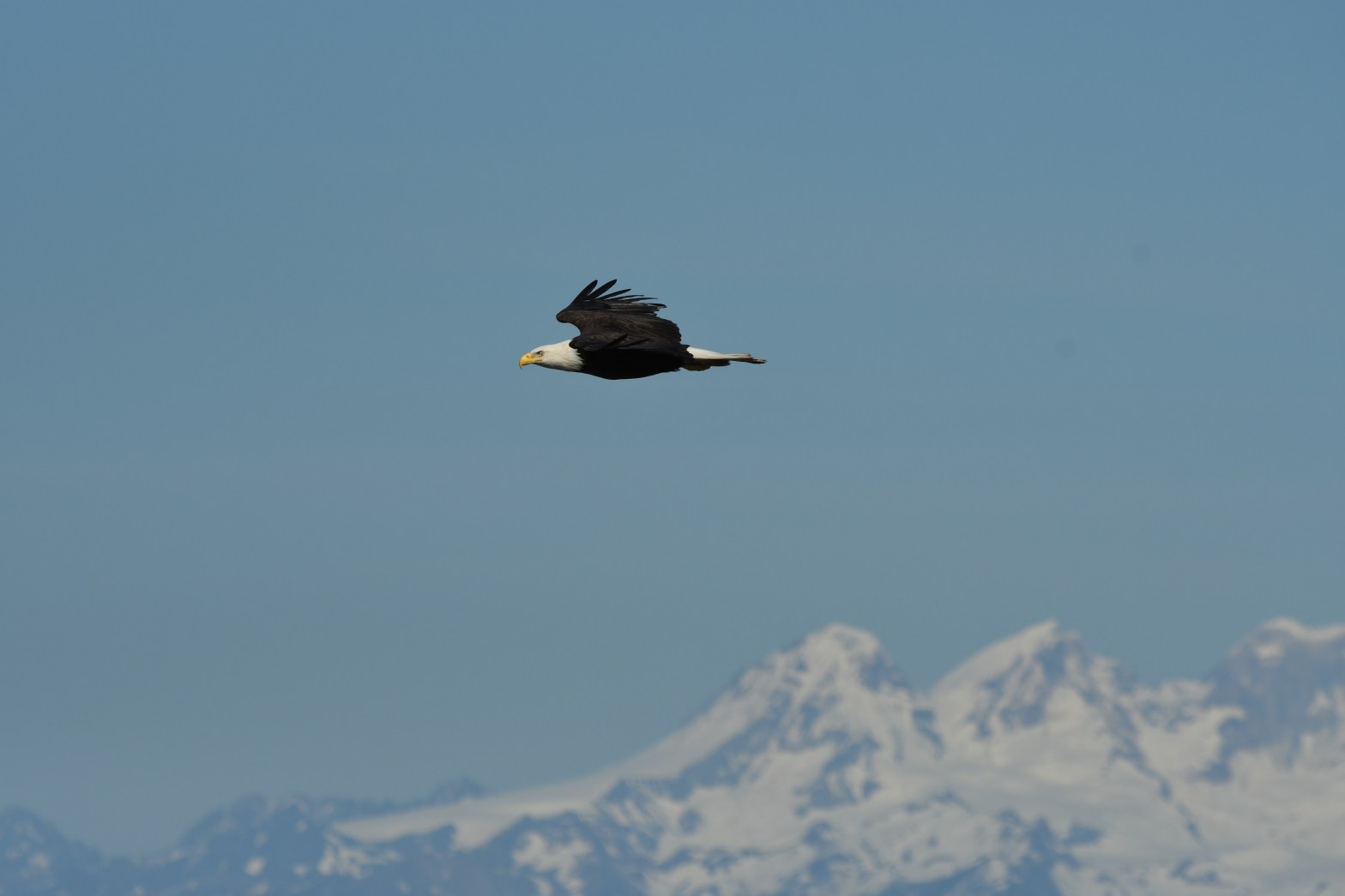
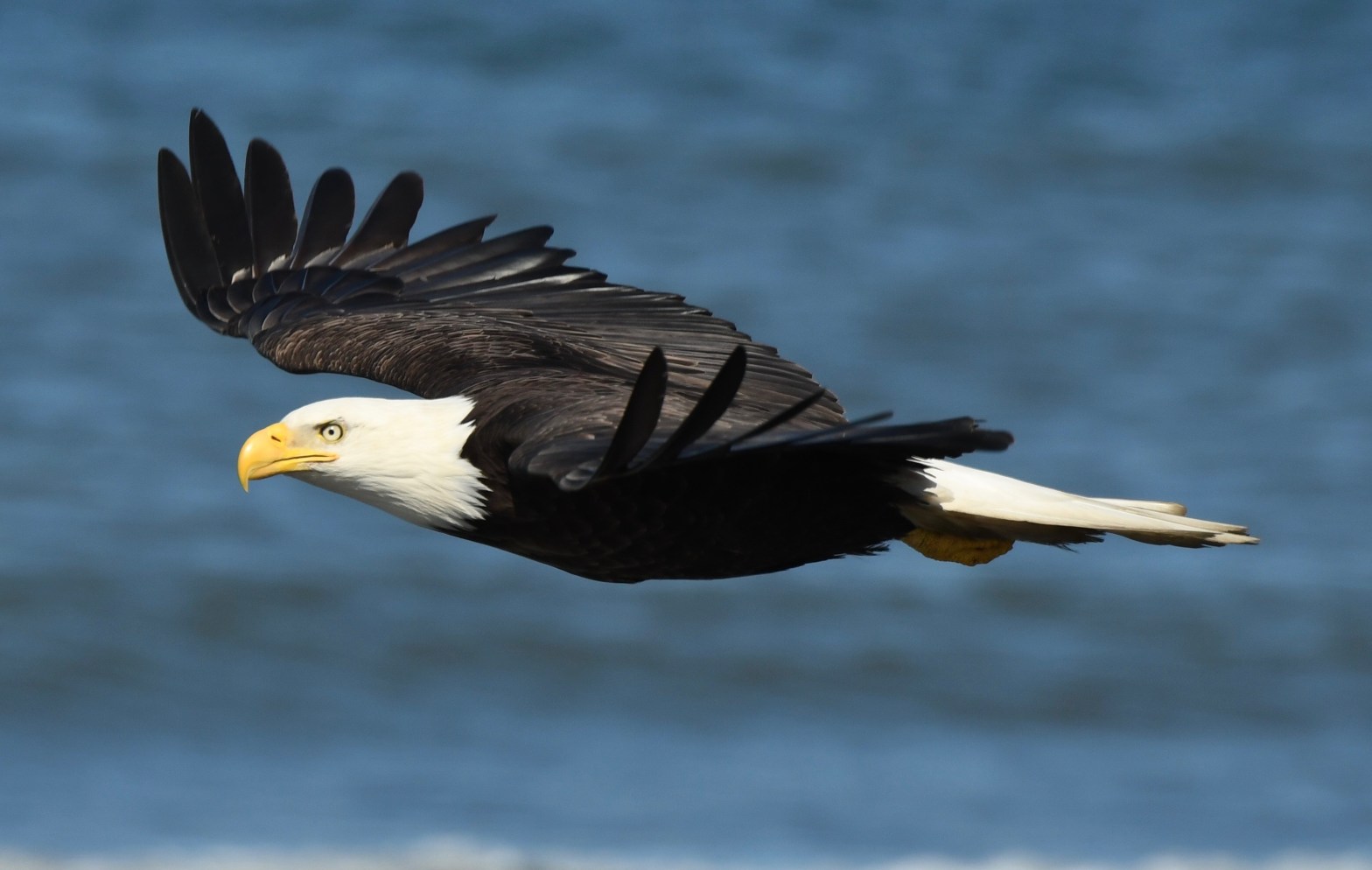
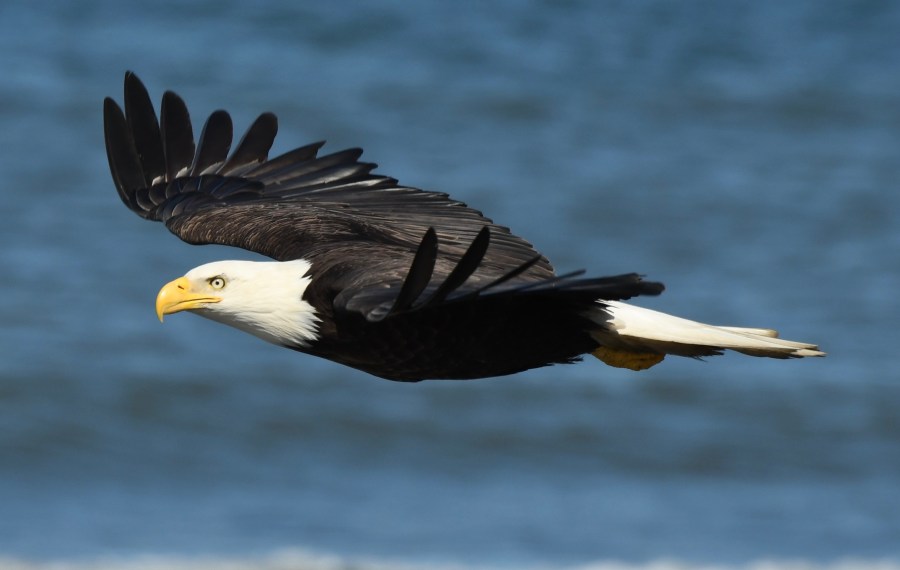
The American Bald Eagle is really pretty impressive when it unfurls its wings – they are about seven-and-a-half feet from tip to tip.
Please consider all images as copyrighted – thank you. Contact me for use… DEClapp
Though Alaska has lots of wet ground there are many areas where your feet can stay dry, at least for most of the day. There are wet patches pretty much everywhere but there are many areas of dry tundra. Even the runoff streams and rivulets have shrubby edges that provide an upland sort of habitat. There are no real trees out on the peninsula but the excavated edges alongside the roads are often edges with the gravel removed to allow for drainage, and the low channels hold enough water, for patches of willow, alder, and (occasionally) poplars to grow. Certainly this is not a forested part of the world but there is a good bit of low cover. It is in that low cover that many birds reside.
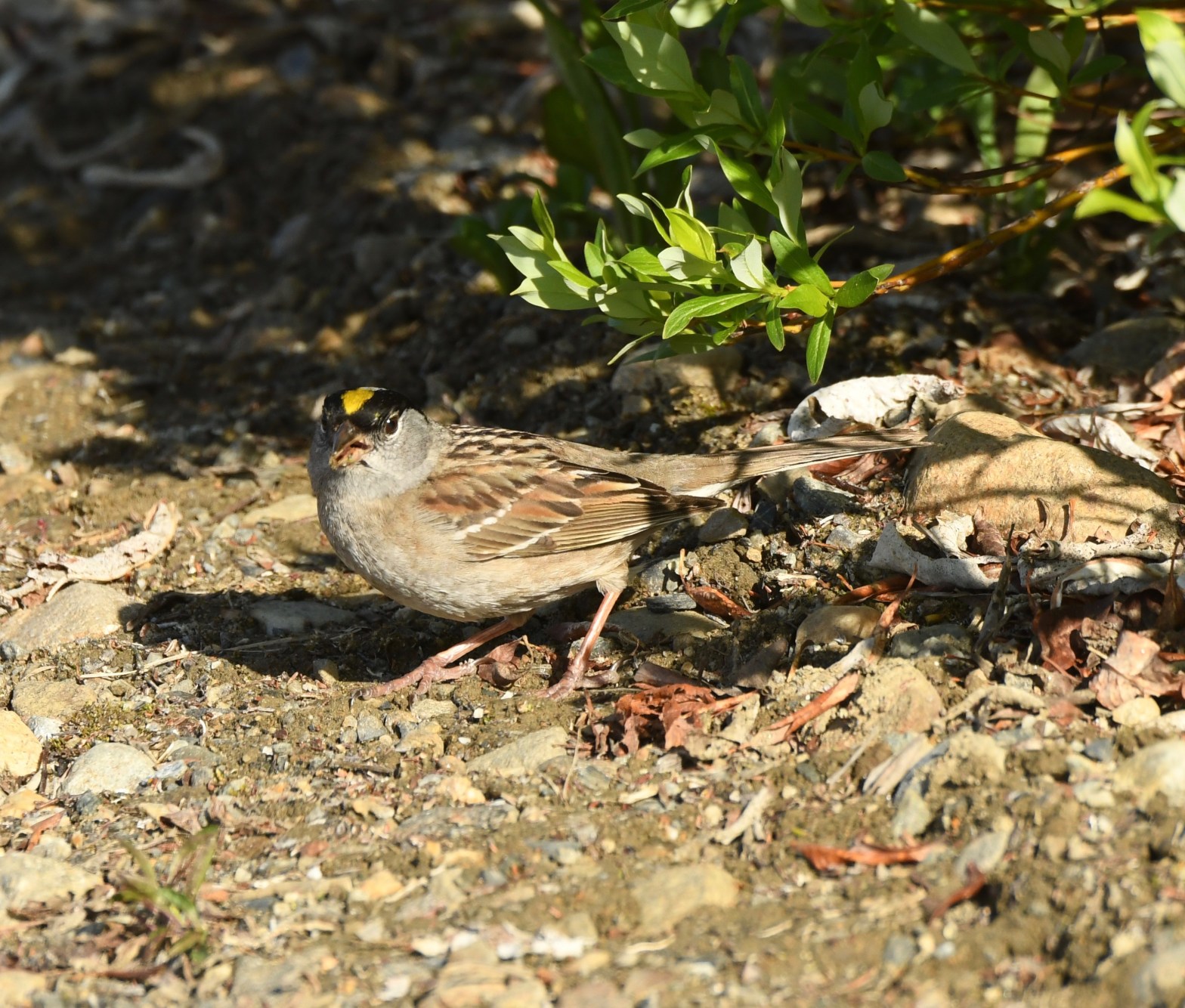
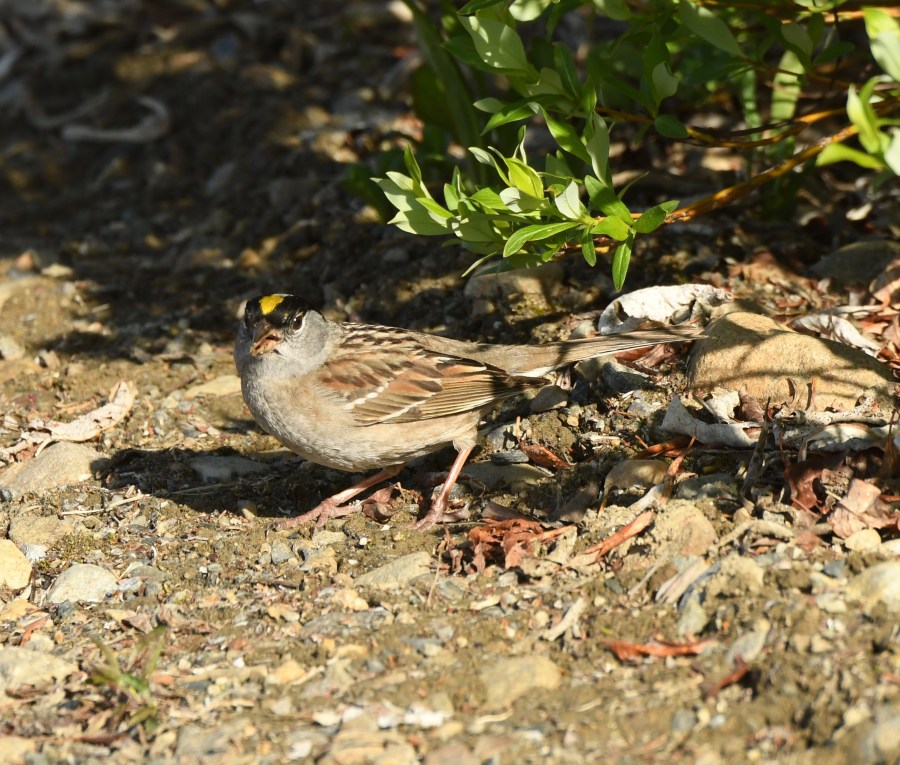
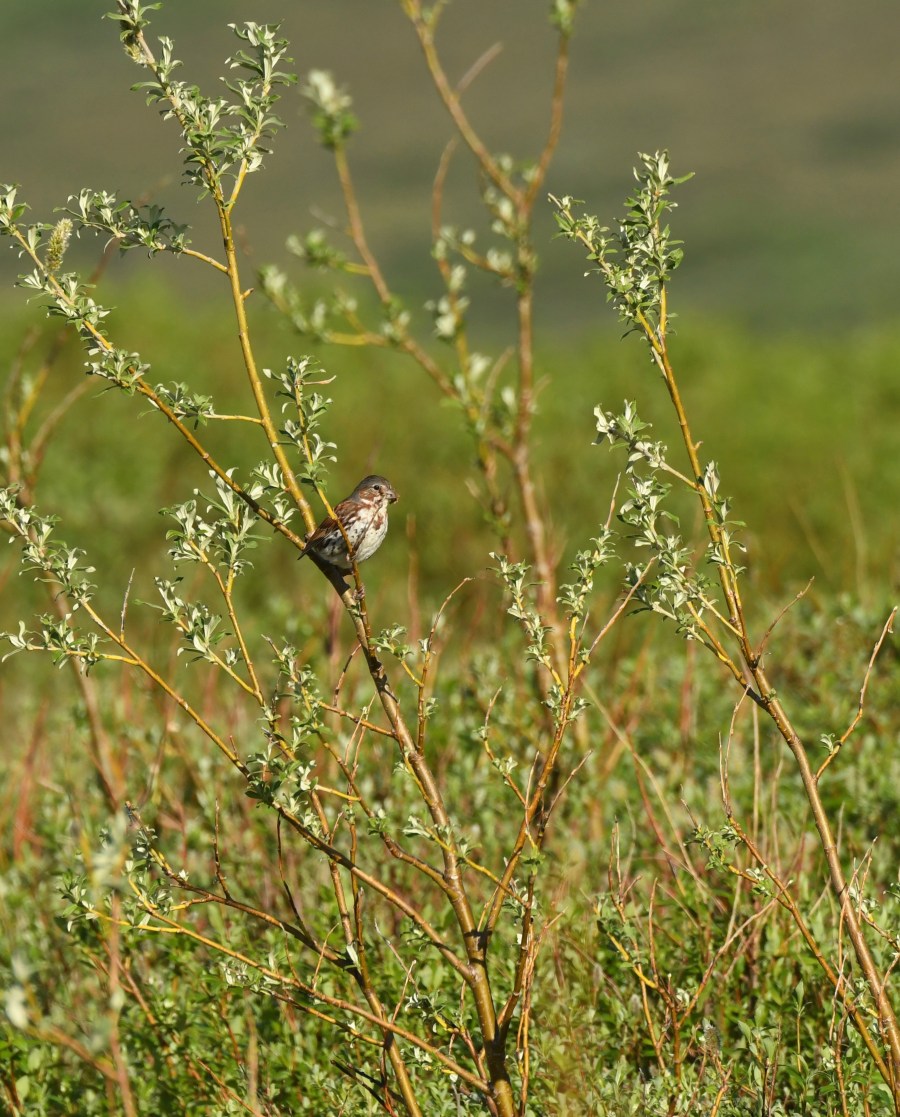
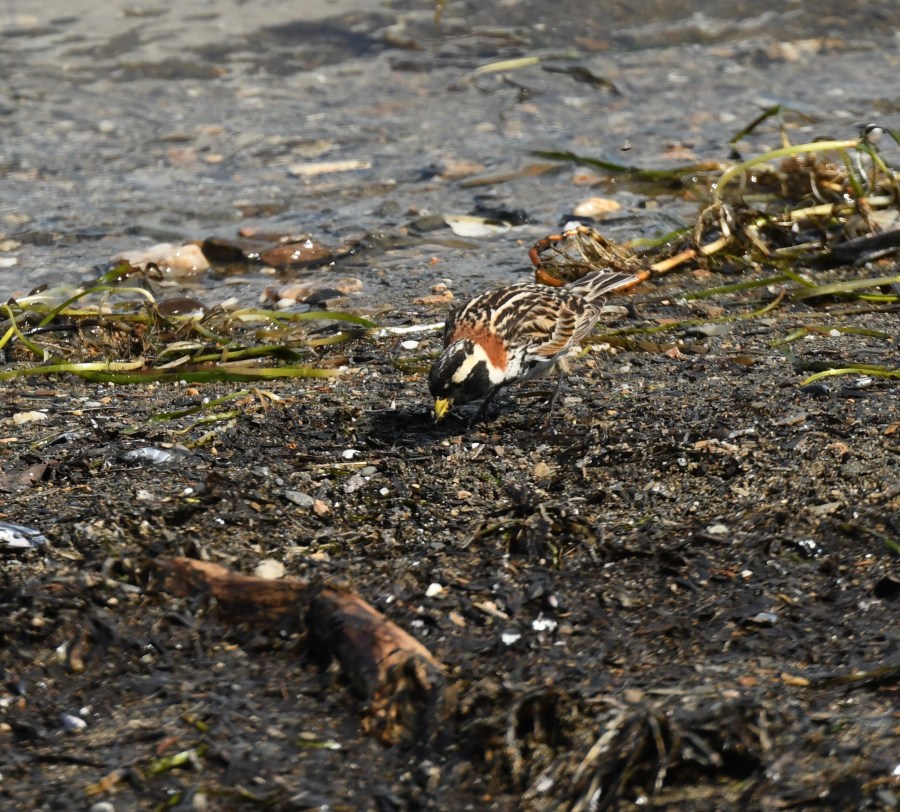
The sparrows of the Nome area are pretty snazzy – yes I know that sounds odd, sparrows and snazzy are not often in the same sentence, but the White-crowned and Golden-crowned Sparrows are really pretty sharp characters. The large reddish Fox Sparrow is also a treat. The American Tree Sparrow and the Savannah Sparrow may be a bit average looking overall, but think of where they are living and what they go through to survive. And, in the same family (Emberizidae) there is the very common and also pretty snazzy Lapland Longspur.
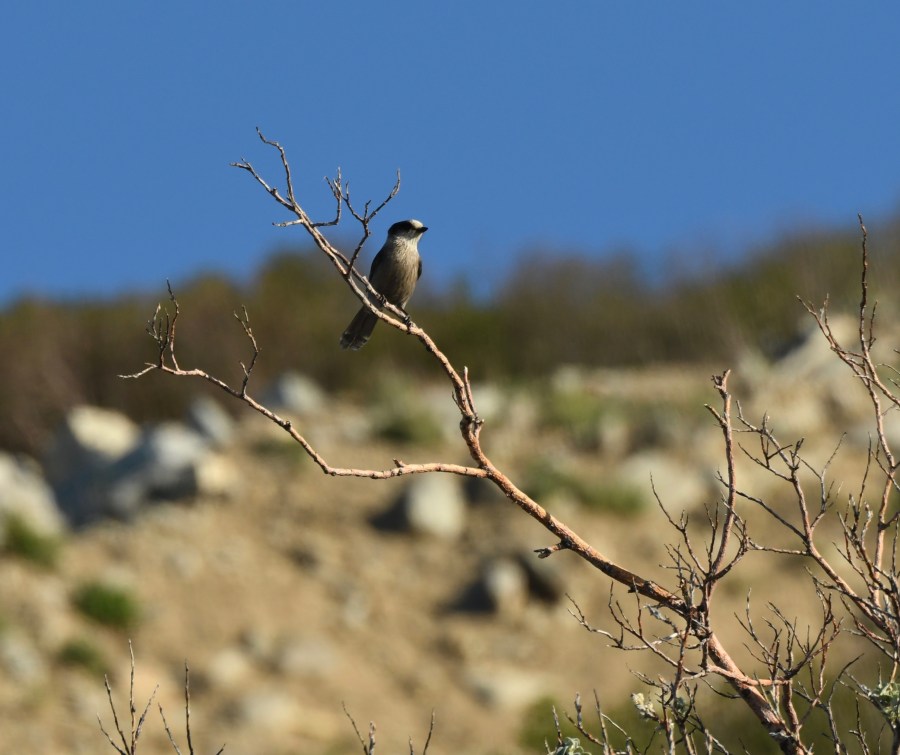
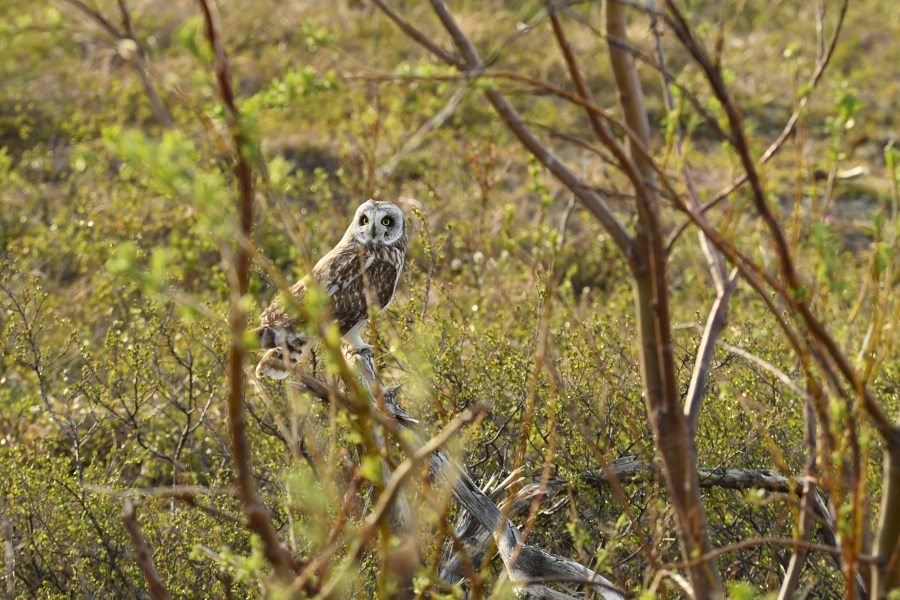
I have also included the Gray Jay and Short-eared Owl on this page as well. The owl is a diurnal (day time) hunter in Alaska in the summer – it has no choice. It cruises moth-like over the tundra hoping to spot a vole or lemming or perhaps a Savannah Sparrow or Lapland Longspur. The last image in this blog, well below, was sitting alongside the Kougaroc Road and all Fran had to do was aim and shoot. Once the bird flew it was over with; it drifted away over the rolling tundra hills.
Golden-crowned Sparrows were everywhere. They are rather solidly built and wear a bright yellow yarmulke (kippah). They are in the same Genus as White-throats, Harris’s, and White-crowned sparrows.We had sunny (and hot) days while in Nome and the birds that were seen were often well seen and well lit.The Fox Sparrow of the Nome area is often referred to as the “Red” Fox Sparrow, It was one of the common songsters of the area. We had the “sooty” or gray Fox Sparrow as well. Like this bird, many of the birds we saw were already feeding young. Birds carrying food were quite common.The Lapland Longspur is a holarctic bird and is named for the location where the first specimen was collected.There is also a Chestnut-collared Longspur – as you can see, the Lapland Longspur also has a chestnut collar. But this is the only longspur in Alaska with this look. This is a very common bird around Nome. They nest on the tundra but after nesting the entire population drops down into the USA and winters in the grasslands of Oregon, Idaho, Montana, the Dakotas, and down through Nebraska and Kansas into northern Texas.While driving out from Nome toward Safety Lagoon we happened on a Gray Jay near the active rock quarry. Gray Jays are quite common throughout most of Alaska (and Canada and the northern USA) but they are not often found in the treeless expanse of the Seward Peninsula. So, this bird was one of those unexpected treats that we hoped for.The Short-eared Owl is a very widespread bird. However, loss of habitat has caused its numbers in the eastern United States to plummet. However, it is still widely spread and not uncommon in Alaska’s open spaces, especially in the tundra-covered portion of the state. It is not a forest owl so the tundra provides a nice homeland for this species. The fact that they are kind of a day-time owl makes them one of everyone’s favorites.
I guess there will be at least one more page on Nome; maybe two. I think we need a scenery page and then there are a bunch more bird images to share. There are a few Alaskan specialities that will be included on that page.
Then we will head for Denali and lastly on to the Kenai Peninsula and the town of Homer. Hmmmm, there are some more things to say about Alaska’s temperate rain forest which sits largely on the coast of Canada…. Why? I think I can answer that in an upcoming page.
Please consider all images as copyrighted – thank you. Contact me for use… DEClapp
Much of Alaska is wet. I’ve said that before but it bears repeating.
Some of the wetness is coastal; tidal creeks and rivers, salt marshes and mud flats, and beaches and the salt water edge. But, much of the water is found inland; there are tens of thousands of ponds and lakes and tens of thousands of square miles of wet tundra, bog, and fen. This means that millions of ducks, swans, and geese return to Alaska (and northern Canada and Siberia) each year for nesting. There are also birds that we associate with the ocean that use Alaska’s hinterlands for breeding but feed on mammals and other inland creatures while in breeding mode. That includes all three species of jaeger.
The ducks and geese have long been a food source for native Alaskans, and remain so today. In Eskimo villages eggs are still collected and some of the these birds are taken throughout the year. Generally the hunting laws of the nation are followed quite closely in Alaska but there are always a few people that have the right or the need to harvest animals to prepare for the long bleak winter.
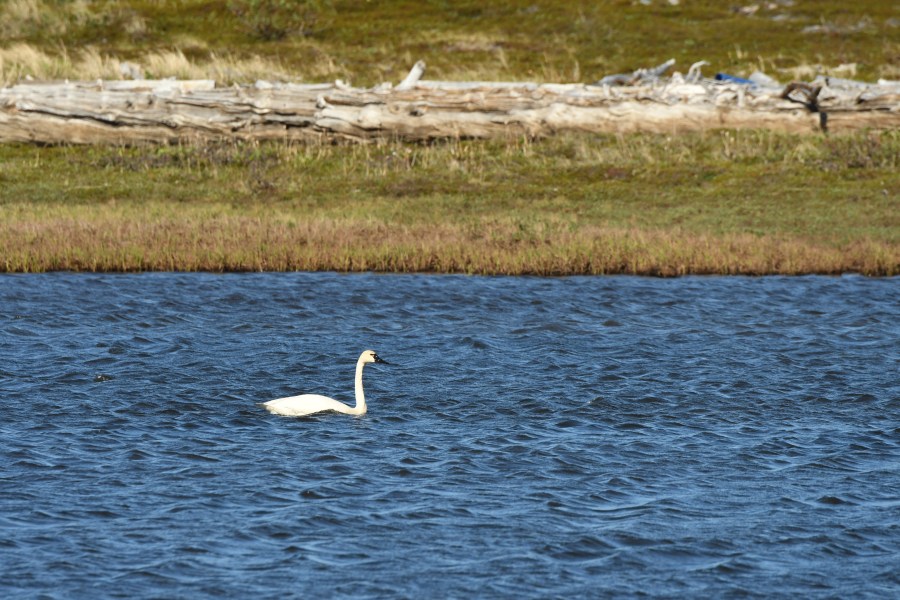
Geese are big and robust and in far northwestern Alaska are represented by several types; Greater White-fronted, Canada, Cackling, Brant, Emperor, and an occasional Snow goose. As for swans there are Tundra, Trumpeter, and the rare Whooper. In most of the eastern United States the only swan you can count on seeing is the introduced Mute Swan along the mid-Atlantic shore and a very occasional Trumpeter, usually in the Great Lakes region. As these are mostly long-distance migrants they are also known in the lower forty-eight states for the occasional bird or two that wanders off the normal route and then entertains birders for a while. On the east coast of North America this can happen with European swans and geese as well. The western birds probably pass along the northern boundary of Canada while the European birds hop from Europe to Iceland to Greenland to the Canadian maritime provinces and so on.
Tundra Swans are the most common in the Nome area and they often appear in small to medium-sized flocks. The small patch of yellow on the bill near the eye is usual, but not specific, to Tundra Swans. We saw them mostly along the coast using the inland lagoons along barrier beaches.
The ducks in Alaska are profuse and quite varied. The freshwater ducks are from all over the North American continent. Nesting success is so important that species will fly hundreds and even thousands of miles to a place where they can be sure that the young have a solid chance of surviving. It seems that no matter where you live in the USA there will be some ducks present, but not as many types or with populations as you will see on the Alaskan breeding grounds. There are a few ducks that are found widespread throughout Alaska but lacking out on the Seward Peninsula. It must be just too far for some species, or they have enough space in other locations for breeding success.
For instance on the freshwater side there are Northern Shovelers, Mallards, Gadwall, Blue-winged Teal, Canvasback, Redhead, Ring-necked Duck, and Lesser Scaup nesting in Alaska but these ducks are rarely seen out on the Seward Peninsula. Even the sea ducks don’t all make it out here; three of the eider ducks (King, Spectacled, Steller’s) are Alaskan breeders but are not often on the peninsula in the spring and summer; only the Common Eider is well, common. The same can be said for Surf and White-winged Scoters, Bufflehead, Common and Barrow’s Goldeneye, and the widespread Common Merganser – these species would be unlikely and unusual out here.
But many of the ducks that do breed here do so in good numbers. Ducks in breeding plumage are usually quite attractive. For people from the eastern half of the lower forty-eight there are few ducks that can be observed nesting: Mallard, Black, and Wood perhaps. In the more elevated and more loosely populated west there are a few more. But in Alaska many of the species are only seen in breeding plumage and acting out breeding scenarios. They arrive, mate, breed, fatten up again, and leave.
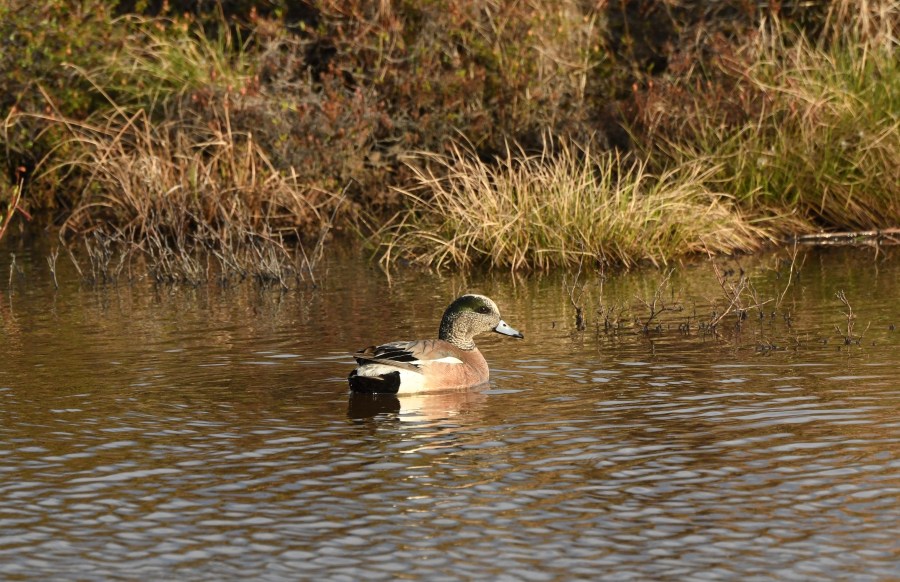
For many generations the Long-tailed Duck would be seen in huge noisy groups on the coastal waters in the winter. They often gathered together prior to migration as well and were always chatting amongst themselves. This earned them the name “Oldsquaw;” a name used for generations but now replaced by the more descriptive (and politically correct) Long-tailed Duck. The original name was one of many that referred to the noises made by groups of this species or perhaps to the pale spot on the head (“old”). Whatever prompted its name doesn’t matter too much – it is a beautiful bird of Alaska’s scattered ponds.The Harlequin Duck is a common bird of the rivers that drain the mountains and the extensive tundra of the Seward Peninsula. It is always a kick to see Harlequin Ducks and Wandering Tattlers ( a Tringa shorebird) along the stony edges of a cold Alaskan stream. The duck has a redundant taxonomical name, Histrionicus histrionicus, probably referring to the rather dazzling feather pattern of the male; like an actor with lots of make-up.The American Wigeon is very widespread in North America. Canadians and Americans can all get a look at this bird with relative ease. This species nests pretty much throughout Canada and is a widespread wintering bird in the continental USA. It was called “Baldpate” by early market gunners with reference to the pale coloring on the top of the head.I am including the Long-tailed Jaeger in this group not because they are a duck or a goose or a swan; but because we associate them with water – excepting during breeding season. Most North American birders see the jaegers (Long-tailed, Pomarine, Parasitic) as migrants following the terns southward migration along both Pacific and Atlantic coastlines in the late summer and fall and stealing from them along the way. (Nothing tastes as good as a purloined Sand Lance or Capelin.) In the Nome area we saw one or two Parasitic Jaegers but the Long-tailed Jaeger, like the one above, was by far the most common. They nest on the tundra in the open and the creamy-white body (belly) can be seen a mile away.
There will be another (maybe two) pages on the birds of Nome – land birds will likely require two pages – stay tuned. Thanks
Please consider all images as copyrighted – thank you. Contact me for use… DEClapp
This is the first of at least three blog pages on the birds of the Nome area. There will also be bird and mammal pages from the Denali (Mount McKinley) area and from the lovely Kenai Peninsula (mostly around Homer).
Nome is very far away and really not much of a tourist town. There are beaches and bars but neither would entice a group getting away for spring break. Why would anyone go to Nome unless they had to? It is the birds mostly and then wildlife in general. Of course I am ignoring the people who are seeking gold or who arrive by dog sled in the middle of the dark and cold winter. Birds are the spring attraction here. Every ecotourism outfit sends at least one group to northern Alaska. It is often Nome but it could be the Pribilof Islands, Adak, Barrow, or Gambell Island. But Nome is pretty easy to get to (in a relative sort of way) and has nice hotel facilities and, most importantly, Nome has tundra on three sides with the Bering Sea on the other.
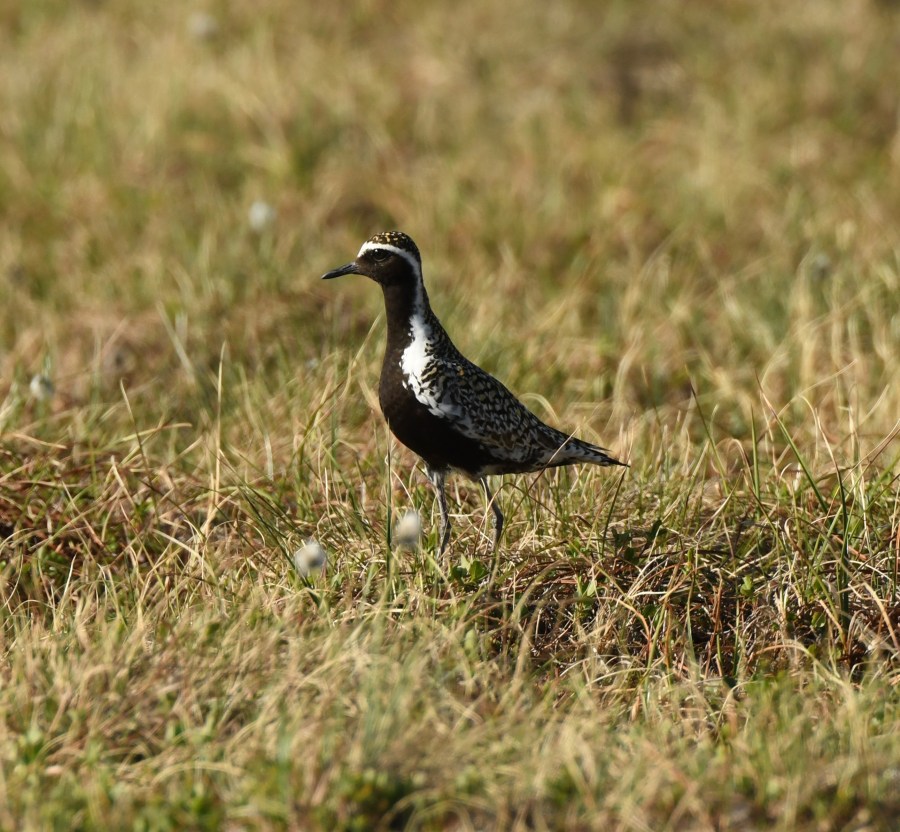
Both the Pacific and American Golden-Plovers nest in the Nome area. And, they are very similar. This bird is likely a Pacific Golden-Plover as there is quite a bit of white flecking under the tail and the white along the neck seems to show along the edge of the wing. But the bit of a bulge in the white at the chest/neck is more characteristic of an American Golden-Plover.
Birds are arriving onto the tundra around Nome from all over the globe. There are land and water birds migrating up from the lower forty-eight, there are Asian birds that arrive after crossing hundreds upon hundreds miles of Russia and Siberia, there are long-distance migrants returning from New Zealand and Australia via the shores of North Korea and China, and there are some that actually wintered nearby and are simply happy to see the sun shine – hour after hour after hour. Birds arrive from the Southern Hemisphere and pretty much every continent. Some birds wintered in forests, others on the ocean, and others on balmy southern beaches. But the northern tundra is where they come to mate, breed, build nests, and have their young.
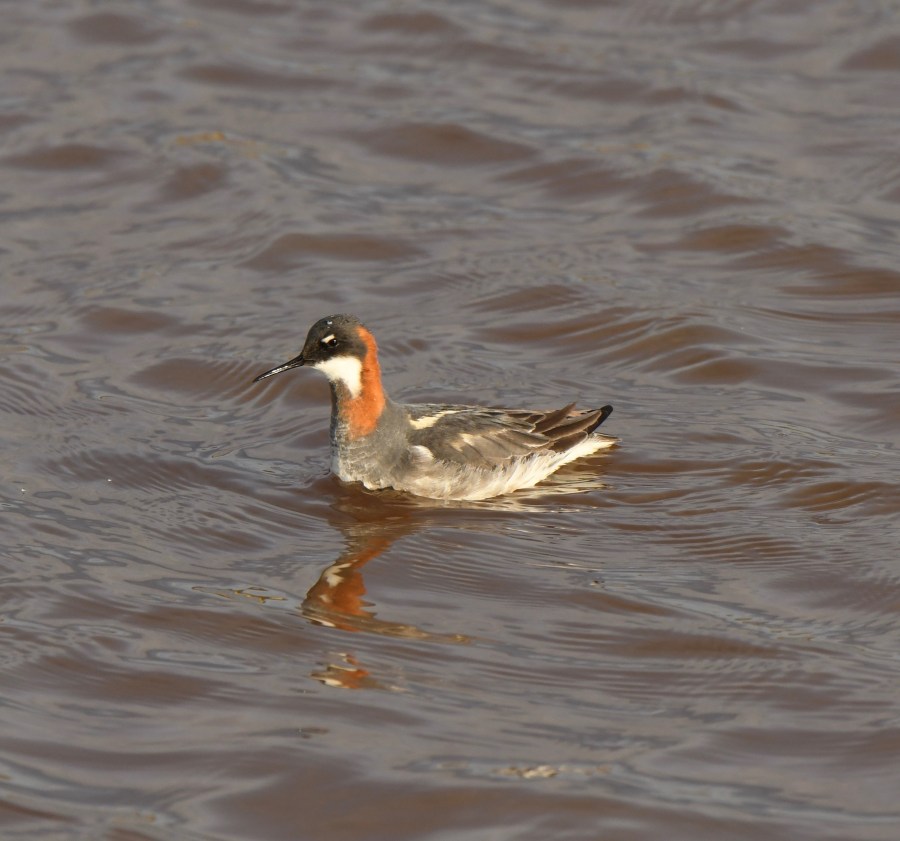
The images above show a Semi-palmated Sandpiper (top) singing from an arial vantage – there are no trees in the tundra and birds that need to show off a bit have to flutter, float, and sing. The lower image is a Red-necked Phalarope, a water-loving sandpiper. The male phalarope incubates and handles domestic chores once the eggs are laid.
Alaska has thousands of square miles of tundra; wet tundra, dry tundra, alpine tundra, and tundra at sea level. The tundra is often wet, especially in the spring, and this is great habitat for insect breeding. Alaska has a well deserved reputation for having large and voracious mosquitoes (35 species – but Massachusetts has 50 species). They also have flies, midges, beetles, bees, wasps, butterflies & moths, crickets, dragon and damsel flies, and treehoppers among many others. The returning birds need a lot of food to develop eggs, raise their young, and then reestablish their own strength and health. The insect larvae and adults provide that sustenance – along with berries, seeds, and buds from the vegetation that bursts forth along with the insect hatches. The adults and young will eat tons of Alaskan insects and berries each year.
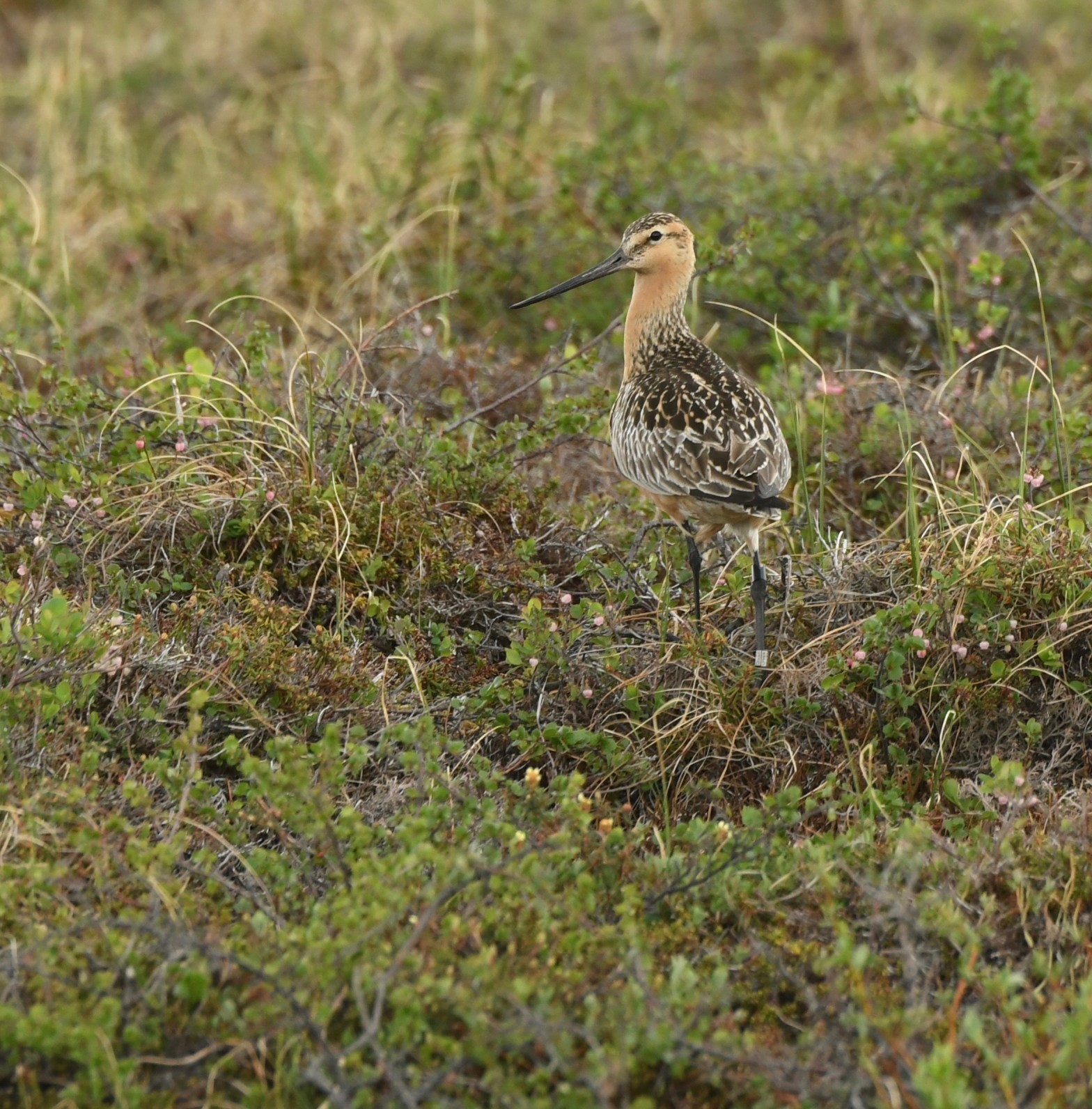
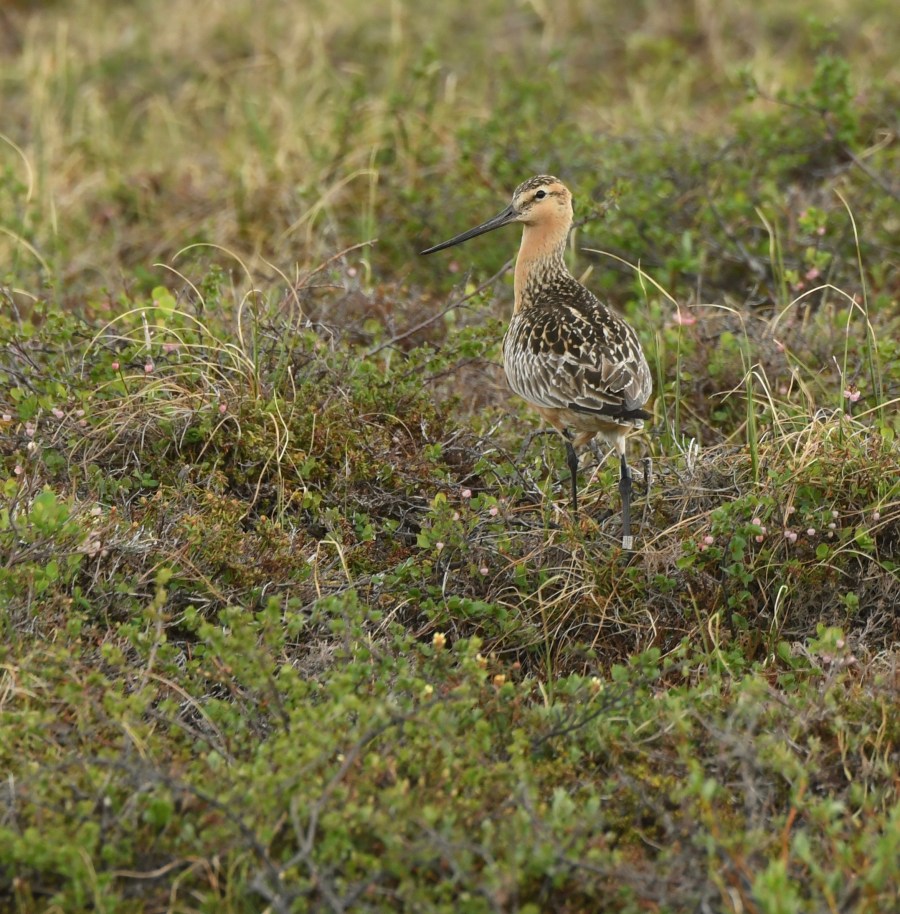
This bird is a Bar-tailed Godwit. You might notice a band on the lower part of the right leg. Though we couldn’t read it it provoked some thought. There is a place in New Zealand called Miranda Beach (see another blog page) where many of the worlds Bar-tailed Godwits winter. There is a fellow there name Keith Woodley who has written a stunner of a book about godwits – Godwits – Long Haul Champions. This bird could have been banded in New Zealand or in Alaska by the US Fish & Wildlife folks who also track these (and other) rare Alaskan nesting birds.There is one road in Nome (of the three roads that exist) that takes you out just over 70 miles to a place where the very rare Bristle-thighed Curlew nests on the tundra covered hills. We went out there and saw and heard two of them. But I didn’t chase them around for a photograph. Instead I settled for the much more common Whimbrel. This bird is also tundra nester but one that is much more easily seen. In Massachusetts they can be readily seen in the late summer in the extensive Spartina marshes at the Wellfleet Bay Wildlife Sanctuary on Cape Cod.
Most of the birds have adapted to a rather short time window for nesting. Pair bonding, nest-building, and egg-laying take the first couple weeks. Incubation will add another 2-4 weeks depending on the species. Then things can start to vary; some young are precocious and can walk and feed themselves within a day or so where others are altricial and need further care by the parents. This will add a couple weeks to the parental chore list. The sandpipers (shorebirds) pretty much all have precocious young. The parents of sandpiper babies can start to feed themselves once the young are free of the egg shell. This allows them to regain strength, fat, and vigor rather quickly; and in many cases allows the older birds to start migrating south before the young are fully grown. On the east coast of the USA we see often southward moving sandpipers in mid-July. Certainly August is a month with lots of southward migration of adult birds. Young sandpipers usually migrate in late August and September. Yes, for those of you thinking “how”, it means the young have no direct leadership or leaders as they head south for the first time. As ten week old birds, many will embark on a migration of 5,000 to 10,000 miles.
We were in Nome about the first week of June, a little later actually. Anyway we missed the great influx of migrant shorebirds. They had, in their millions, passed through and over the extensive coast and on into the unreachable tundra. We did have a few around that nested in and near Nome, and among those were these two Surfbirds. The Surfbird had been in its own Genus for a while but it seems that it is really a knot; like the Red Knot and the Great Knot and is now in the Genus Calidris with the knots. This species was first described from a bird collected in Prince William Sound on Captain Cook’s 1778 voyage to the northeast Pacific.
The images that will accompany this page are all Alaskan sandpipers. They may winter along the Canadian and northwestern United States coast or they may fly over the Pacific Ocean for eight day straight to New Zealand and Australia. Some will swing around and head to Asia, dropping down the coast to Japan or the Korean Peninsula. Wherever they go and whatever route they follow remember that they are always at the edge of danger. Coastal development in South Korea and Asia has eliminated many of the historic stopover spots and additionally, there are storms, hunters both human and otherwise, and dealing with loss of habitat due to environmental contamination by industrial and cultural chemicals, and climate changes.
However spring in the far north is is still an amazing scene; Nome is worth the trip. But it is always tinged with melancholy as bird numbers drop and habitat changes. For birds, the good old days were really the good old days.
But – enjoy the images and donate as much as you can to some conservation effort.
Please consider all images as copyrighted – thank you. Contact me for use… DEClapp
Alaska is huge and most of it is what we would call remote – empty – wild – even unexplored. It is a land of forest, tundra, and rock. Much of it is wet. Lakes and rivers abound. There are fewer than 740,000 people in the state with about 40% living in the one city of Anchorage (about 292,000 residents). Fairbanks and Juneau each have about 31,000 and there are only three other towns with more than 10,000 residents. Nome has just about 3,500 people. In Nome the native population is just a hair over half the residents and about 38% are caucasian. Most of the native people are Inupiat Eskimos.
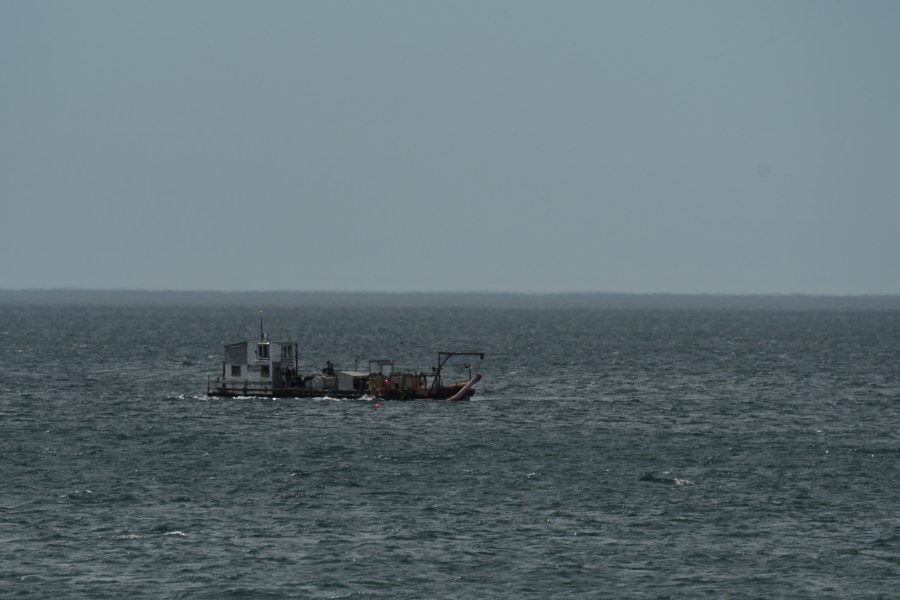
In 1898 gold was found in a creek draining Anvil Mountain (really a hill right in town) and within a year there was a town of 10,000 looking to get rich; eventually the town reached 20,000. Gold is still sought, the old dredges lie in the tundra, new dredges lift sands from the underwater edges of the shoreline and sluice the sands for gold. Large operations brag that they are still getting about an ounce of gold a day. However, before you buy a floating dredge and head north, be advised that most of the land and beach access is in the ownership and management hands of the native peoples. You can’t just drop in and start mining.
Nome is a very small city – a town by most standards. Of the many gold dredges that still lie in the old water courses this one is right in town and easily approached. There is a boardwalk and interpretive materials to help you understand how the dredges worked. They crawled along the river course scooping up large buckets (on a big conveyor belt) of stone and sand at the front end and then ran it through a huge (very noisy) water-washed sluice inside the sluice’s body. The gold (hopefully) settled to the bottom of the sluice and the washed stone was conveyed out the back by a second conveyer belt. This one was built well into the 20th century and wasn’t abandoned until the mid-1950’s.This image shows The Lovely Frances sitting in one of the scoop buckets that used to loop around, like a giant chain saw, scooping potentially gold-bearing material from the creek bottom to be washed by the sluice.When a large storm roils the sands of Nome’s beachfront people rush down to see if a new gold-bearing strata has been exposed. In the real sense of exploration and mining a new toy/machine has appeared. The small floating sluice pump allows its owner to float along on the surface of the calm waterfront (it is not always calm – or warm) and suck up sand that has run into the ocean over the centuries. Perhaps there is gold in those sands – more and more people are trying this method. It helps to have a cold-water diver move the suction hose around exploring and investigating likely spots for sand and gold to have accumulated. The image below shows an optimistic operation under way.
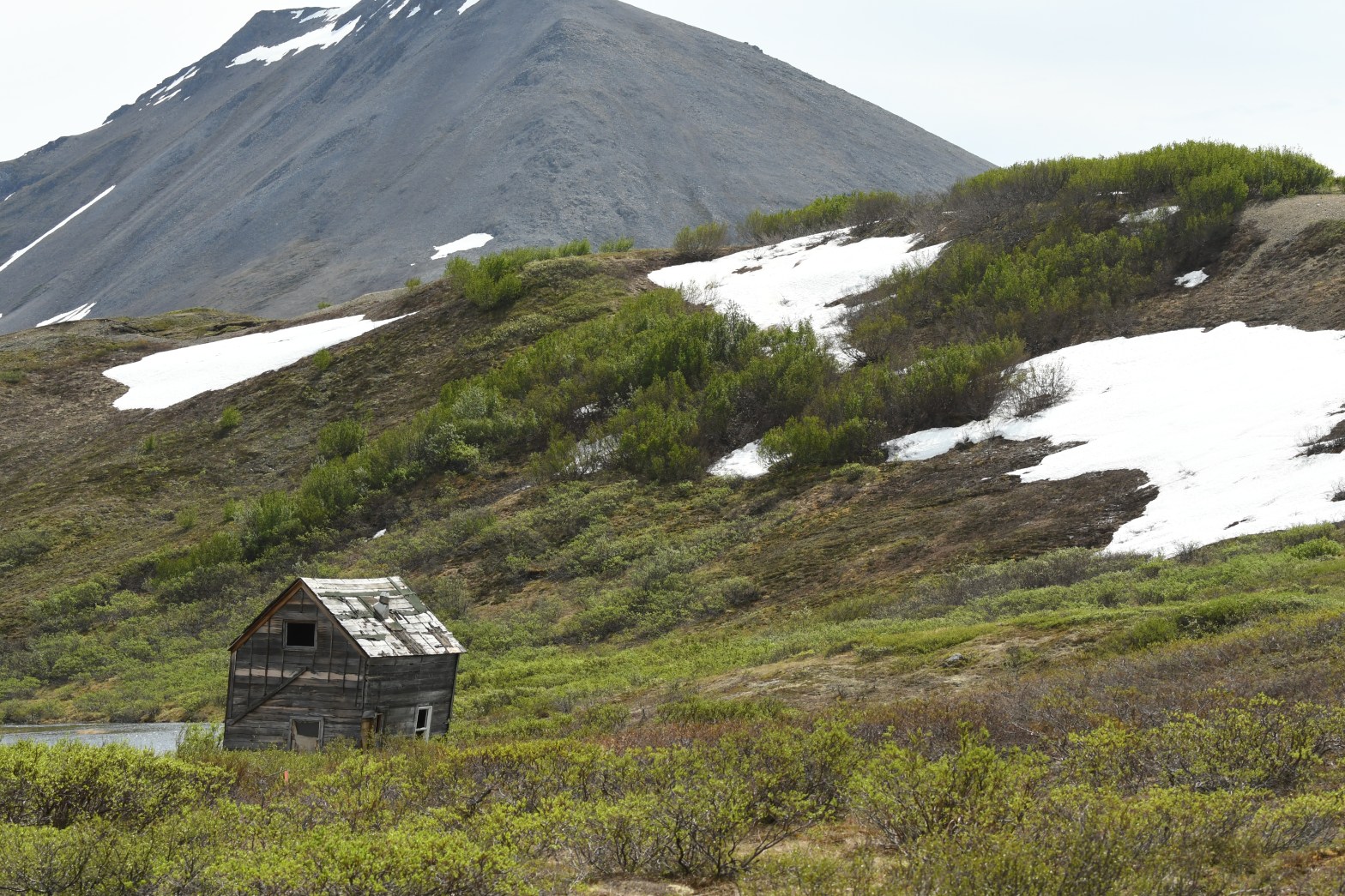
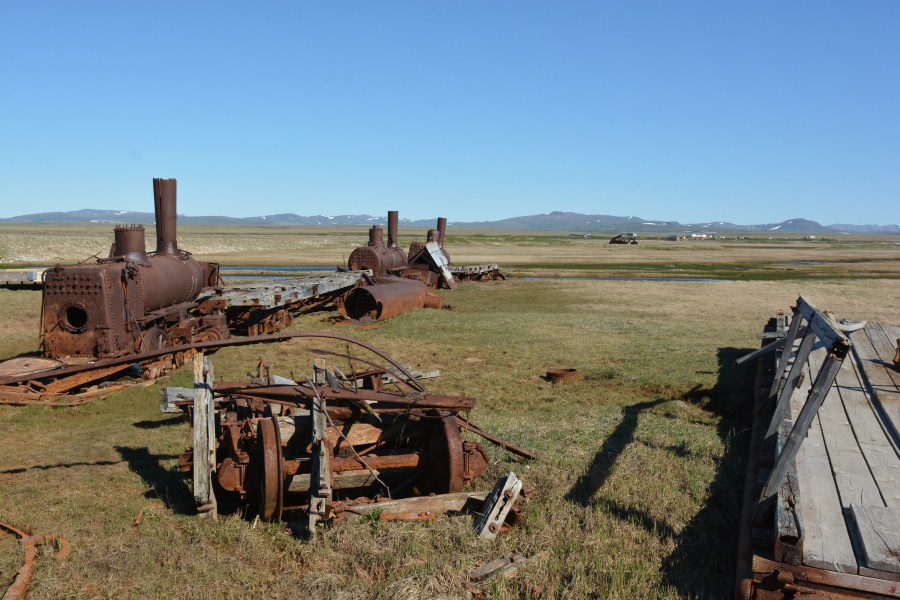
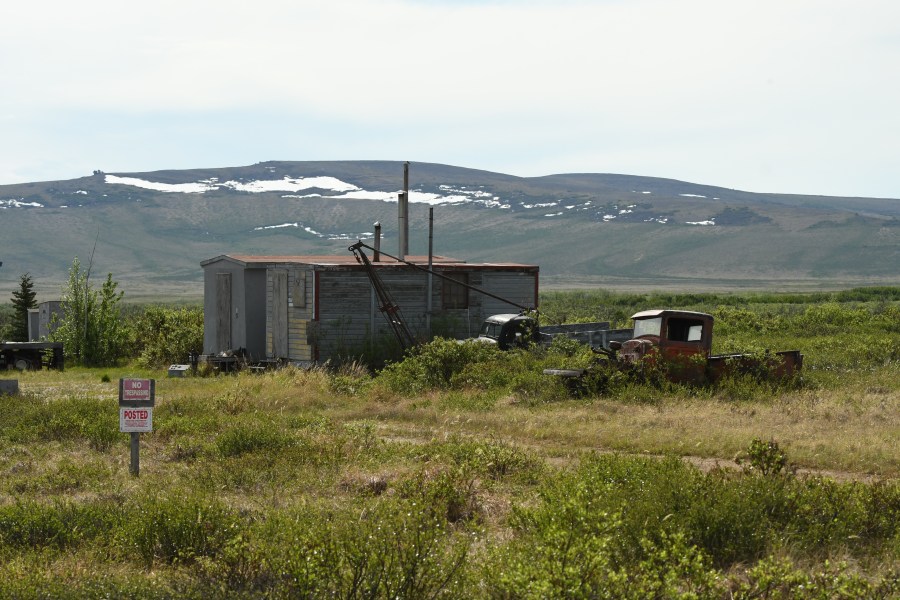
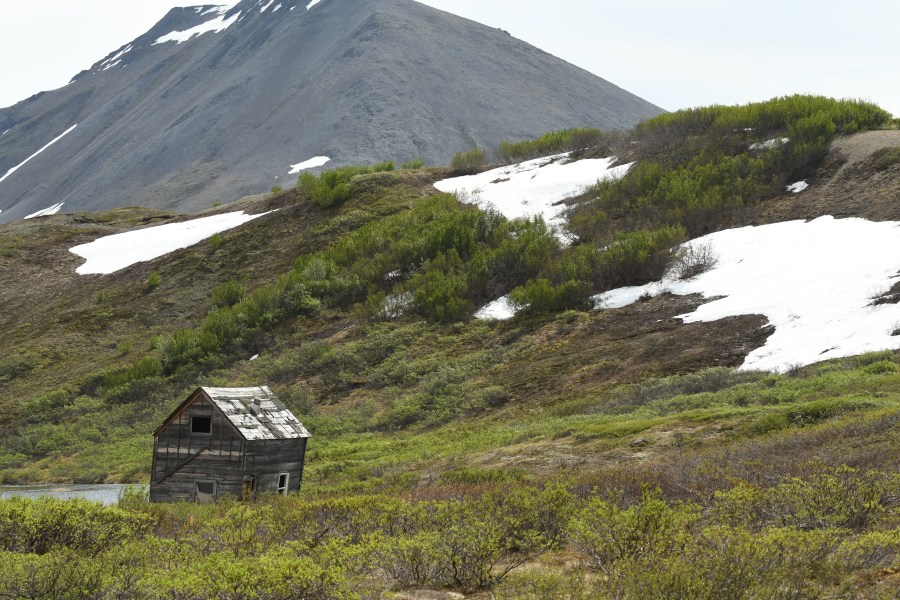
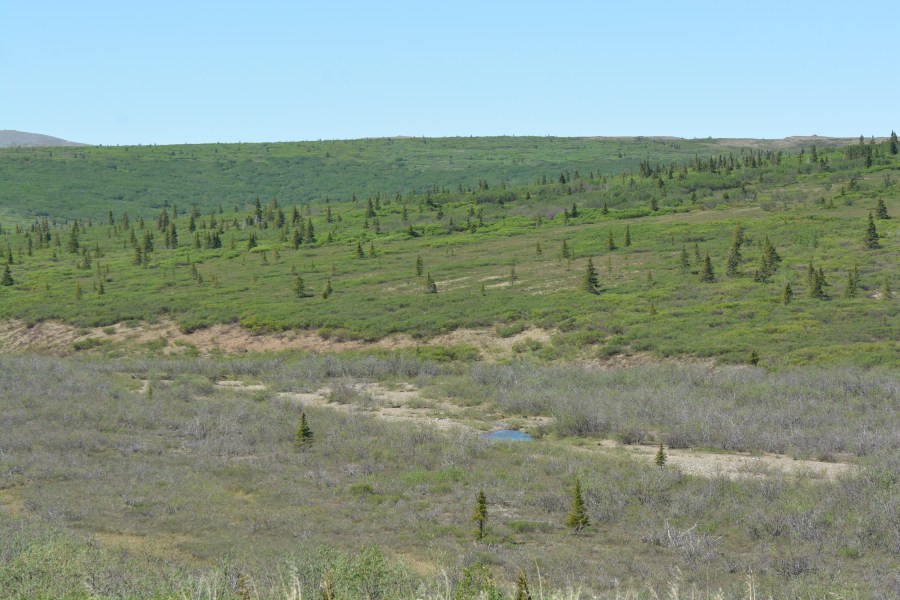
Nome is very remote – but a railroad line from New York City was brought here to move mining materials into Nome from the hinterlands. Can you believe it? It wasn’t a great success as you might imagine; building on the tundra hundreds of miles from any resources was not something easily accomplished and when the economy went bust the miners headed for New Zealand and Australia. Gold was truly a boom and bust operation. Mostly bust from what you see in this area. In the tundra there is not much in the way of bacterial or fungal life to begin to break things down. Wood lasts for decades and metal for centuries.Modern mining still persists here on the Seward Peninsula. This is a stone and gravel operation right outside Nome at Nome Point. Additionally a new lease has been granted for a very large graphite mine just 37 miles outside of town. The graphite is of good quality and is probably destined for the world’s increasing use of batteries. As a strong and stable form of carbon, graphite is one of the best non-metal conductors and is used as one terminal of lithium-ion batteries. The Canadian company (Graphite One Resources) has 165 mineral claims covering about 15,000 acres just outside Nome.In the countryside camps and abandoned camps are seen. There are only three roads in Nome, each just about 70-80 miles long. Two roads head toward smaller towns (Taylor, Teller and Council). The Kougarok Road (also called the Nome-Taylor Road or the Beam Road) ends at the Kougarok Bridge leaving about 25 miles to get to Taylor. This distance can be done on foot, by snow machine, or by a rugged ATV. Birders use this road to reach the one accessible place in North America where the rare Bristle-thighed Curlew nests. The Council Road is about 72 miles long and reaches the small village of Council. Council had 15,000 people during the gold rush and now has no one living there in the winter and maybe a hundred or so in the summer. This road has trees as you reach the far end – trees are pretty rare in the Nome area. The Council Road has two locations that are worth a stop. Both the Safety Lagoon and the Safety Roadhouse are featured on the Iditarod Dogsled Race itinerary and the lagoon is good for birds and icebergs. The Road House is a good stop for food and drink. Very nice home-made breads are a feature. The third road is the Teller Road which runs about 73 miles north toward the Bering Sea. Teller is a small, 300 people, mostly Inupiat, village at the end of the road. Like other towns or locations in the area it was heavily populated during the gold rush days (with about 5000 people).And there are few roads; often old camps and machinery to be seen. This picture, from June 6th, 2017 shows patches of snow. The temperature on this day was between 75 and 80!Heading out of Nome on the Council Road you have tundra and willow-lined streams for the first 60 miles or so. Then you can see the march of the spruces begin. Adventurous trees have begun to move into the tundra. The boreal forest is looking to take over the north lands. With warming temperatures inroads will certainly be made.In North America we often refer to the area where trees reach into the tundra as taiga. In most of the northern hemisphere the word taiga refers directly to the boreal forest. I like the two meanings as we use them. It allows for a coniferous forest (boreal) and an area of intrusion or blending (taiga). Here on the Council Road in Nome we have more than a simple soil-based in-road. We have a huge habitat expanding into the domain of another huge habitat. Of course the understory plants come along as do forest specific insects, birds, and mammals.






 The Bald Eagle sexes look the same in their plumage but the female is up to one-quarter again the size of a male. That is true in most birds of prey – the female is generally larger. Bald Eagles are widespread over North America. They are in general a fish eagle; with almost 60% of their food being fish. They do eat ducks and geese when they are available and easy to obtain and fish are not readily available. If fish are available they will make up to 90% of the eagles diet. They will collect fish from waterfalls, turbine outflows, shallow waters, and those that swam (too slowly and casually) near the surface – they also collect dead fish anywhere they find them. As fish populations have declined in many coastal areas the opportunity to feed on fish has diminished, especially in areas where there are kelp beds. The eagles have begun to eat cliff and island nesting sea birds in many of these locations. Sea birds, generally pelagic/oceanic birds, such as puffins, guillemots, and especially murres have become a usual prey item now that their standard fish fare has declined. Adults can be taken in the air at the jam-packed nesting sites, tunnel nesters like puffins and shearwaters can be dug out, and fat and oily youngsters can be plucked off the cliff edges with ease. An attack by an eagle at a nesting cliff can cause many young to plummet from the cliffs to the water or rocks below. In many areas this is a new and significant threat to the sea birds.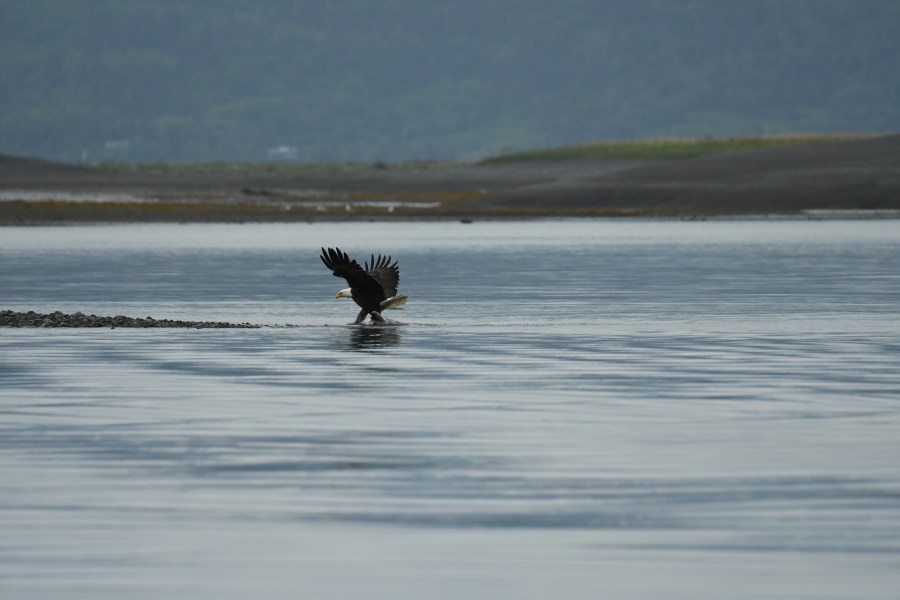












 On The Road With DEC