Please consider the images to be copyrighted and ask permission before using them for any purpose. Thank you. DEClapp
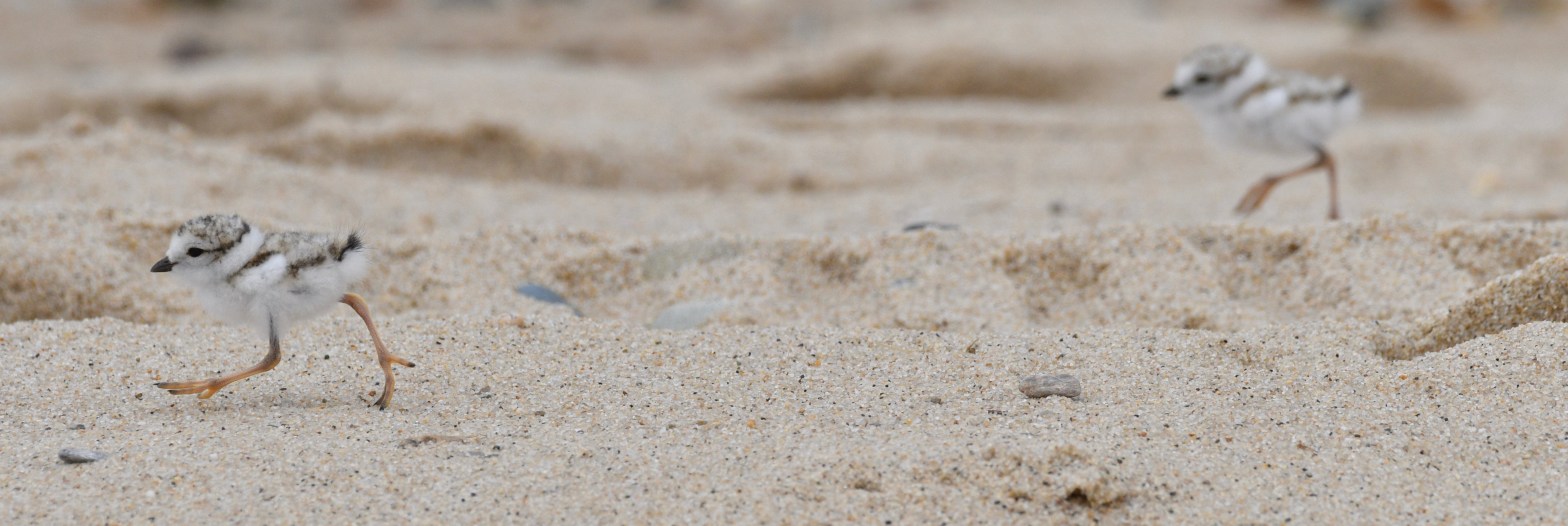
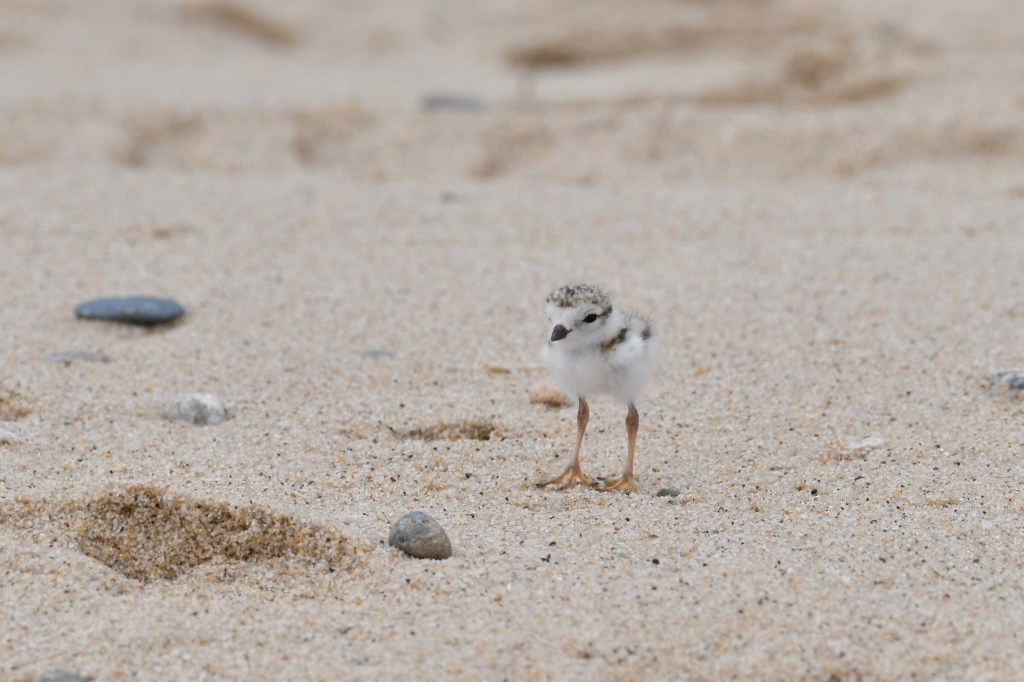
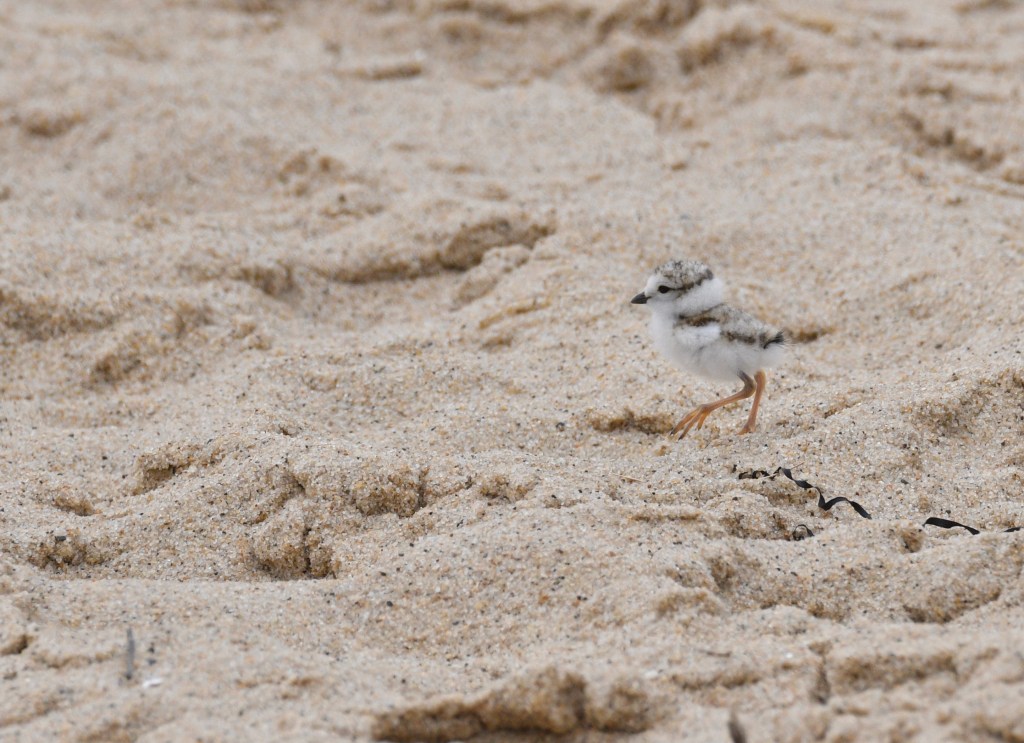
I know it was less than a month ago that I included a Piping Plover (PIPL) in with a collection of local shorebirds. But I had the chance to get some (pretty average) photos of baby plover chicks yesterday and just had to do another post on them. They are tiny and cute – and we walked about six hours in soft sand and a fog to get them!!
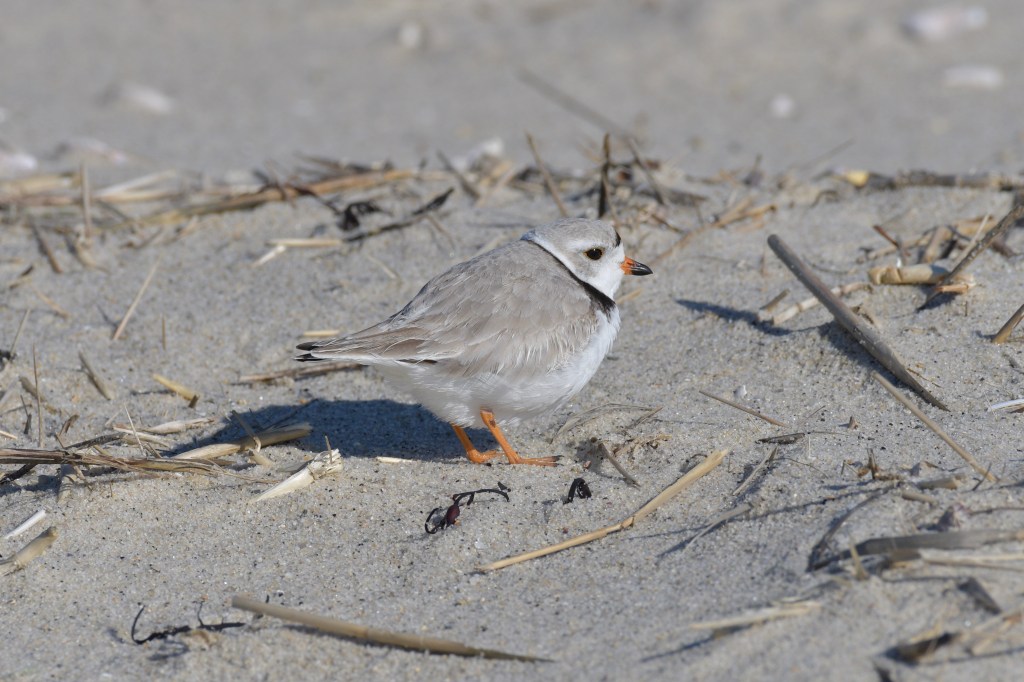
The Piping Plover is a small, short-billed, little plover of the sandy beach; a group often considered by casual observers to be sandpipers. They nest in much of the southern Canadian grain provinces and down through the Dakotas into Nebraska. But we see them here along the northern Atlantic coast as the beach-nesting little gray ghost that can stop off-road traffic in its tracks (often deep sandy tracks which is where the baby plovers like to hang out). The Piping Plover is light gray on the back and most of the head and they blend in easily with the quartz rich sand of our shoreline. Due to its modest numbers to start with and its use of a highly sought after human resource (the beach) they have been negatively impacted by an ever increasing human population and its recreational activities all along these Atlantic coast beaches – and by agriculture in the west.
There are several plovers in the USA; Killdeer, Black-bellied, Semipalmated, Wilson’s, the three Golden-Plovers, Mountain, Snowy, and the Piping. They do not all live along the ocean but they generally use a wet edge of lakes, ponds, or streams. The Killdeer is the only one that stays away from wet areas (nearly) exclusively. A regular beach-goer might learn the Black-bellied Plover but most plovers are quiet and cryptic and easily overlooked.
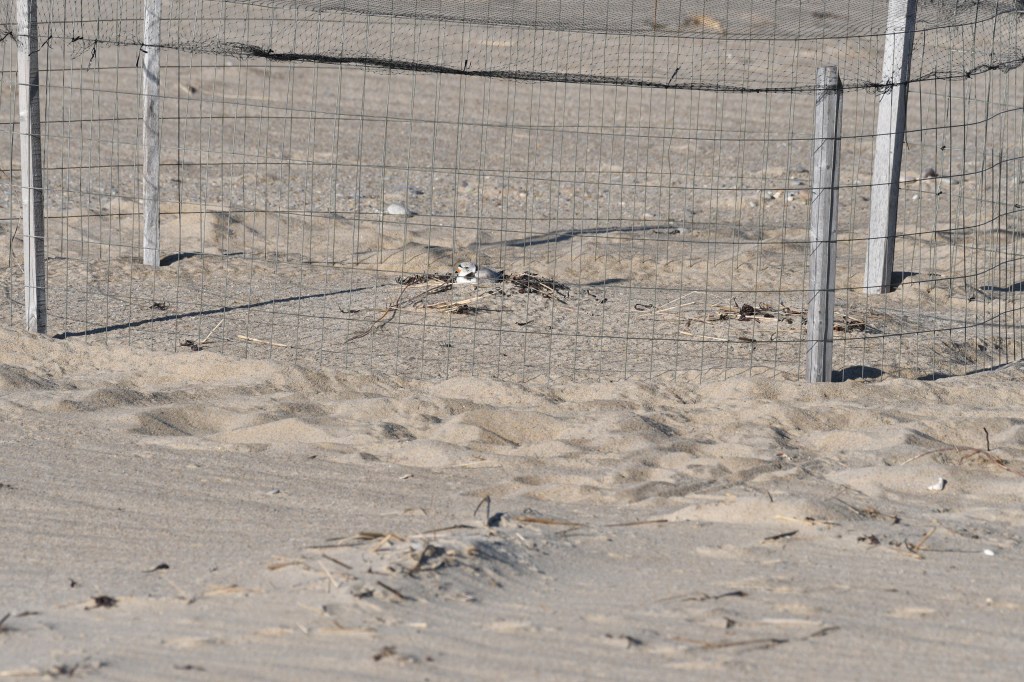
The pictures that follow show how they nest, a few adult birds , and the young downy chicks that leave the nest within an hour or two after hatching. The nest itself isn’t much of anything. They never went to architectural school. They will scrape out a depression large enough for the females belly and then lay eggs on the sandy bottom of the scrape. That’s it. There may be bits of shell or small pebbles added to the nest perimeter as the incubation period passes – but it really isn’t much of a nest. Much like the adult birds themselves, the nest blends in. The eggs look like sandy pebbles and they are hard to notice even when you know where they are. All in all a bird that tries not to be noticed.
Fitting in – that is how they survive. They are small and fairly quiet. They have to blend in in order to last through the breeding season. They arrive back in the northeast in March and April and nest from May into June. If all goes well the chicks emerge in mid to late June and fly by mid -July. The sexes are similar; both being gray with an orange bill and a neck band. The female of a pair is usually discernible by being a bit less obviously marked around the neck and maybe a bit drabber overall. But sometimes it is a guess as to which its the male or female. From some angles it isn’t easy too tell drabber from non-drabber. The neck band is usually bolder in males and more complete. The pair stays together through the nesting season and both follow the precocious chicks around the beach after they hatch. They will make a flopping and noisy display to lure predators and visitors from the area where the chicks are located. They defend the territory and advise the chicks through chirps and whistles.Because beaches are heavily used by people there is often a good deal of waste food for gulls, foxes, coyotes, and crows to glean. The presence of these scavengers increases the pressure on the Piping Plover. So, the beach managers in New England (management is less attentive on many more southern beaches) will use what we first called an “enclosure” to protect the nest. But as the whole idea is for the plovers to be able to come and go it really doesn’t enclose much of anything. It really is an “exclosure” that repels crows, foxes, skunks, and other beach predators. This gives the birds the advantage of, at a minimum, hatching a full clutch.There are two kinds of bird babies: altricial and precocial. The altricial babies are hatched blind, featherless, and helpless. The familiar yard birds need parental care in the nest for a couple weeks. The precocious youngsters can walk or swim or both right after hatching. The obvious precocious young include ducks, grouse, shorebirds, and others like ostrich and tinamous. The parents may brood them in chilly or rainy weather and oversee the activities that the little ones undertake, but precocious young can feed themselves, and or swim, just after hatching. This little guy may be two days old but is still nothing but a bit of fluff on the beach.At this young age they are feeding themselves. Most plovers eat what they see. They follow motion and chase it down. The youngsters are born with this skill and are on the chase right away. The adults do not show them food nor bring them food. The parental role at this point is to keep predators and trouble away from the hatchlings. The male will assume most of this role after the first four or five days. Like many of the plovers the adults will chirp and walk obviously to attract the attention of a predator (or human pedestrian). If need be they will fake a broken wing and flop along the sand. A fox will be enticed and then disappointed when the “injured” bird flies away.
Please consider the images to be copyrighted and ask permission before using. Thank you; DEClapp
People along the coast see terns quite often – if they look. Yet many people never see what is surrounding them. At the beach there may be fish, whales, seals, gulls, terns, sandpipers and mollusks as well as sand, water, blankets, and people. Look around!! Gulls are pretty common on most salt water beaches and many fresh water beaches as well. They get a bad rap as “flying rats” and scavengers that might steal a sandwich from you or your child. In most places our rubbish is now collected and buried (big picture comment) and the loss of this easy food supply has been part of the reason for a decline in gulls over the past decade or two – and they seem to be less of a beach nuisance unless people are feeding them. The gulls are the most usual of beach wildlife sightings. But, terns are there – just off shore cruising over the water..
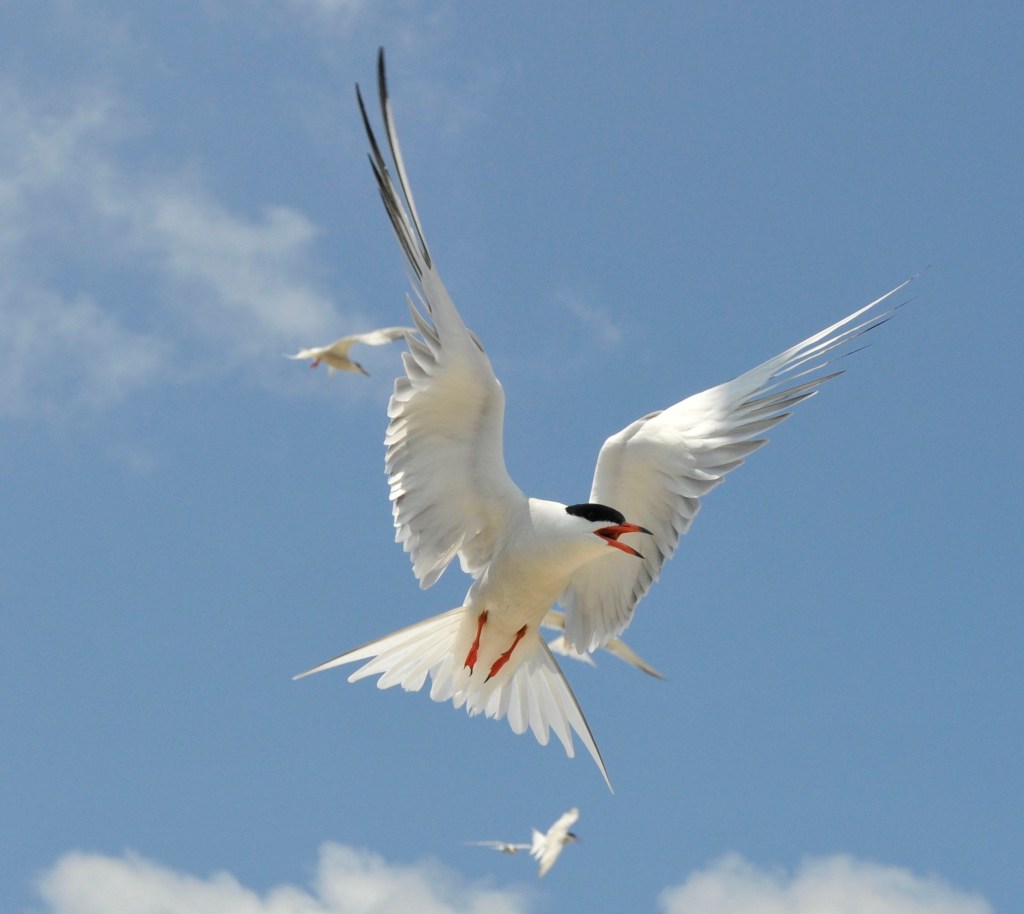
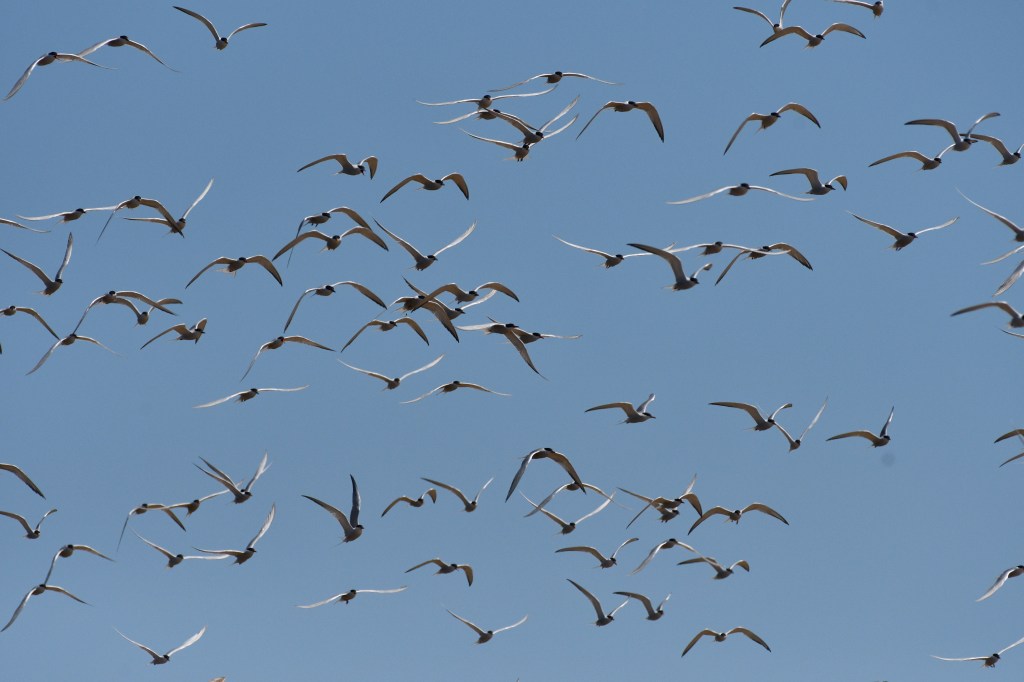
In many cases where there are gulls there are terns. This is a group of slight, delicate, pale birds that fly with ease. They migrate long distances and live twenty or more years. In the western north Atlantic (Gulf of Maine) we have the Common Tern (COTE), Roseate Tern (ROTE) and the Least Tern (LETE) as summertime breeding birds. The Common Terns nest in large colonies usually on predator-free islands. The Least Terns nest in loose, smallish, colonies wherever they want – often on beaches where people and off-road vehicles might find them. Roseate Terns nest only on a couple small islands deep in Nantucket Sound, but after fledging the young they will stage out on the Atlantic beaches before migrating south. August and September can be a time were 20-40,000 terns can be in the Monomoy/Chatham area. Though this sounds great for birders, the ability to get out to the sand bars and islands where the birds are is now very limited due to the erosion of the sandy cliffs and the creation of great shoals that make boat travel near impossible throughout this area. For instance what was once called South Beach, and allowed for access to miles of sand spit, now has been broken and flattened by the sea, no longer providing access or the right conditions for birds. Things change very rapidly along this sandy coast.
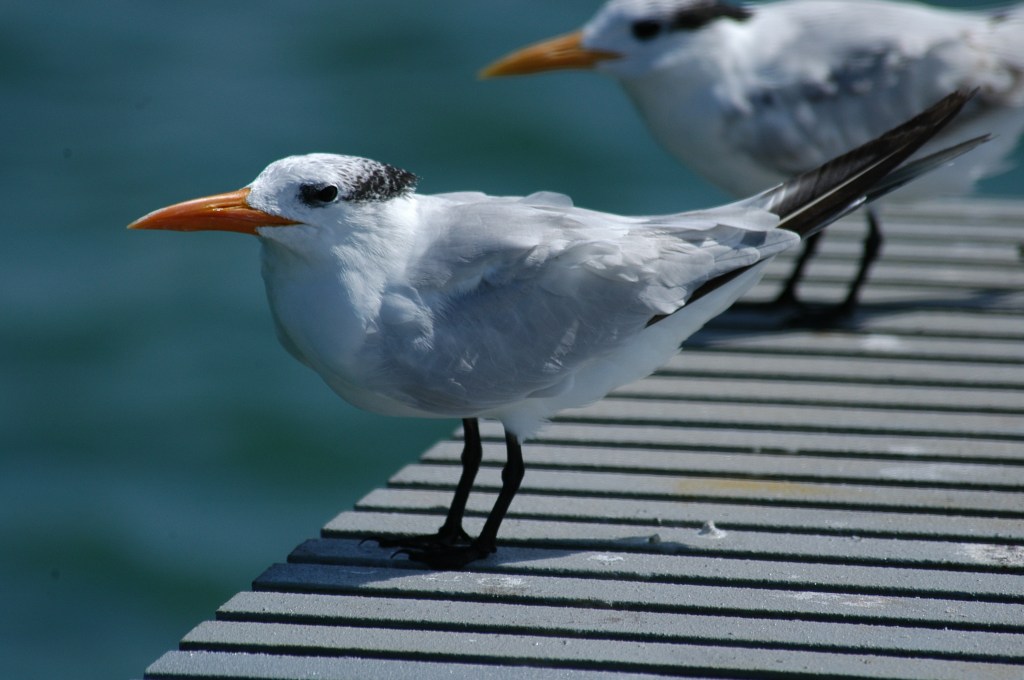
In the spring, during migration, we see a few Arctic Terns (ARTE), Black Terns (BLTE), and Caspian Terns (CATE). Scattered throughout the warmer weather we will have very occasional reports of Sandwich Tern (SATE), Royal Tern (ROTE), and Forster’s Tern (FOTE). A Massachusetts birdwatcher with modest dedication will see five or six species of tern; listers and chasers might see seven or eight species.
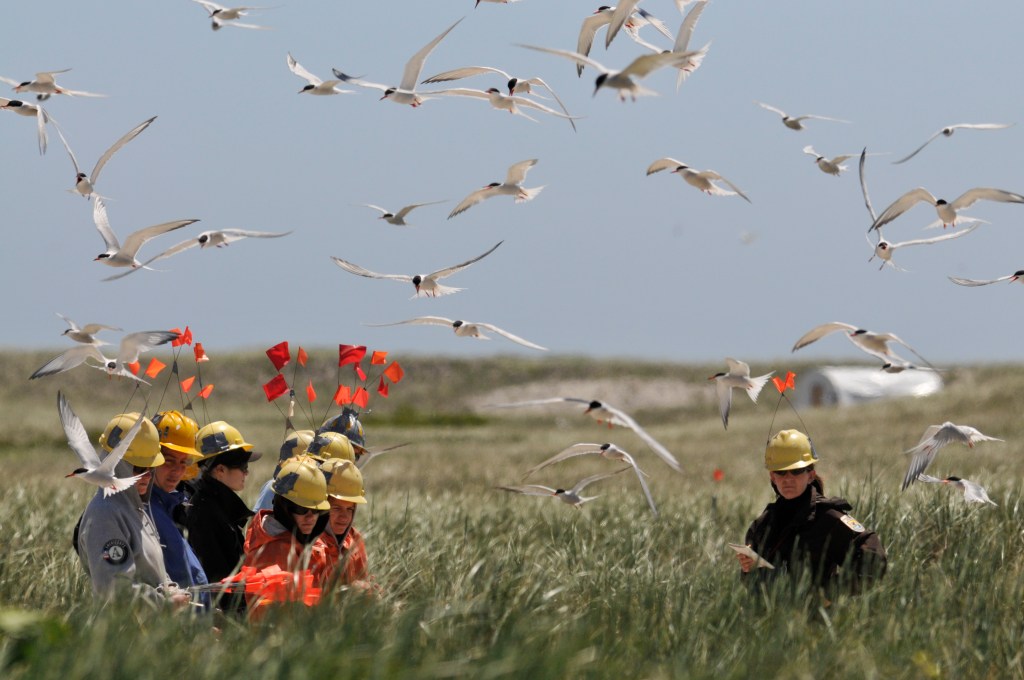
The following images are of several species but feature the Common Tern colony on Monomoy Island. It is closed to visitation this year through the impact of the COVID-19 troubles – usually there is a US Fish and Wildlife team out there monitoring the colony from a permanent tent-based camp. But not this year. There are about 11,000 pairs of Common Terns out there with some Laughing Gulls and maybe a few Roseate Tern pairs as well. The most common nesting sandpiper type is a large and rather plain (until it flies) bird called Willet (WILL).
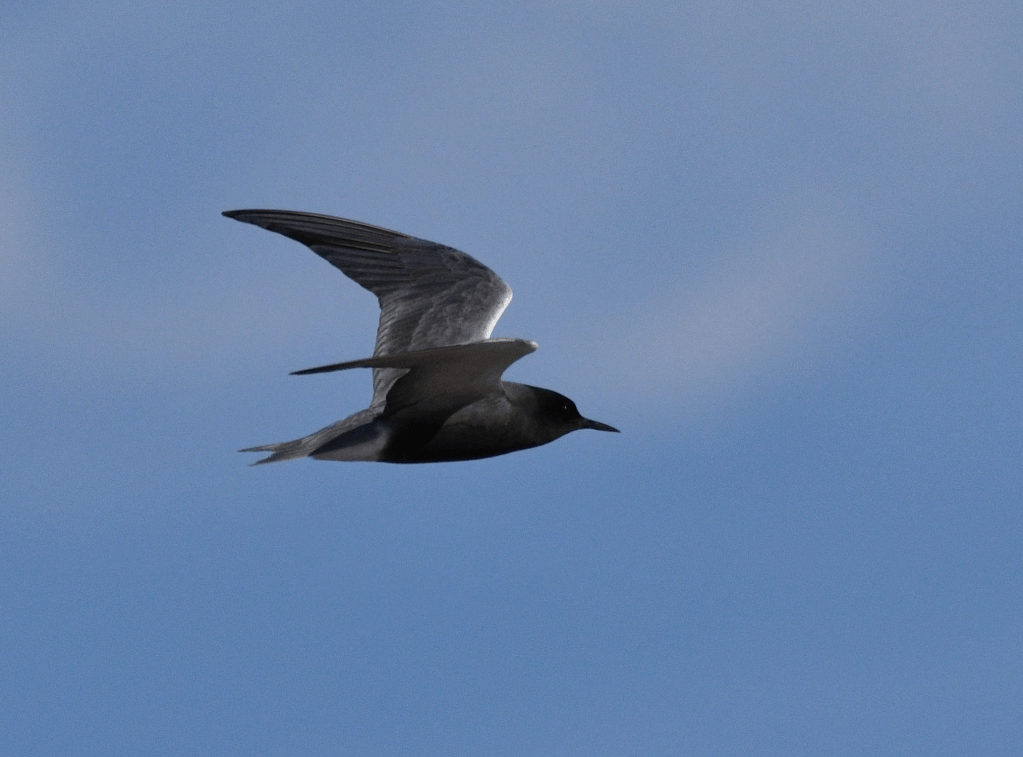
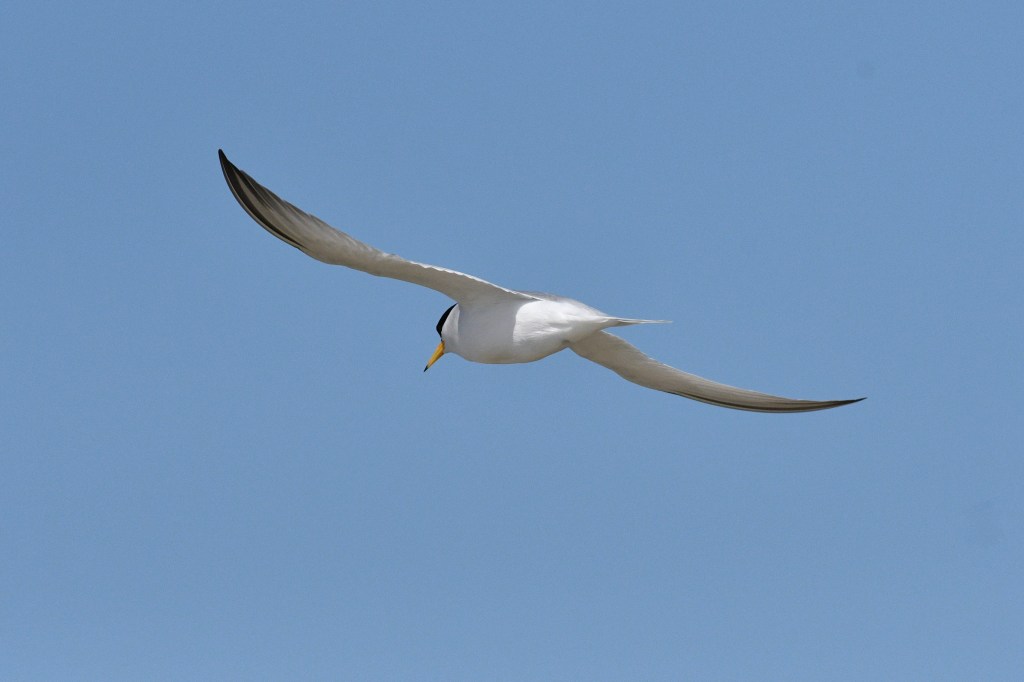
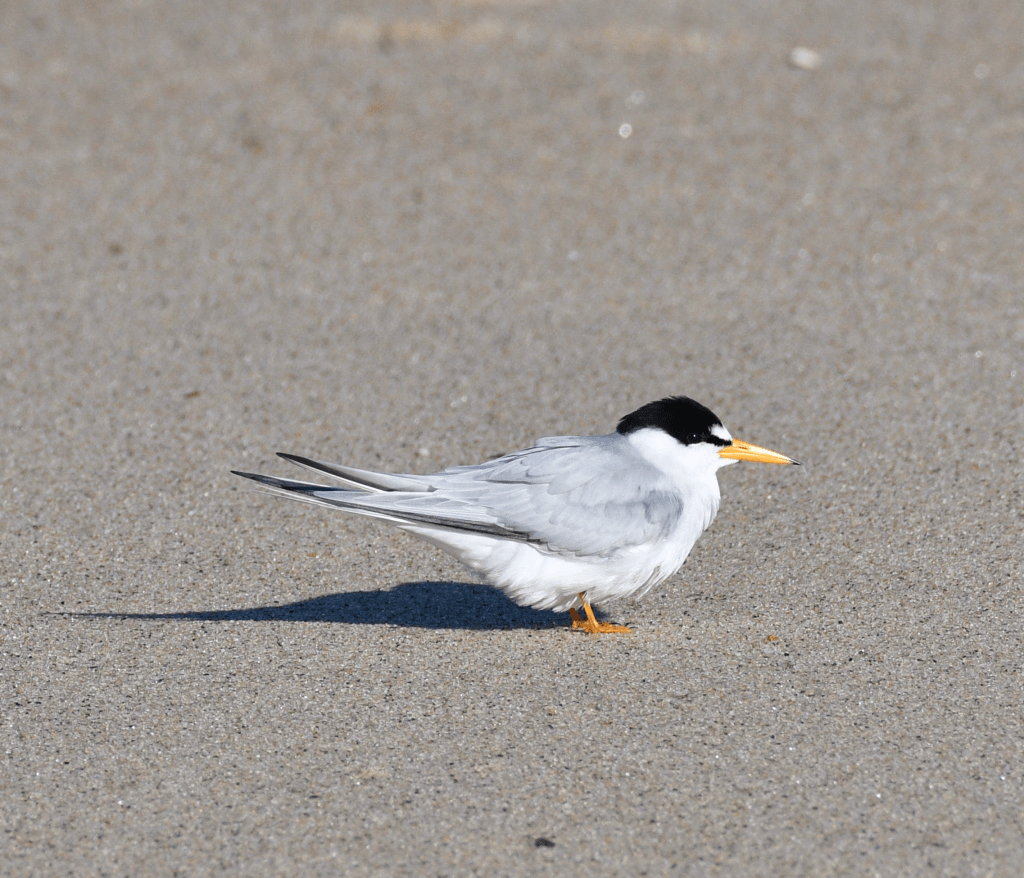
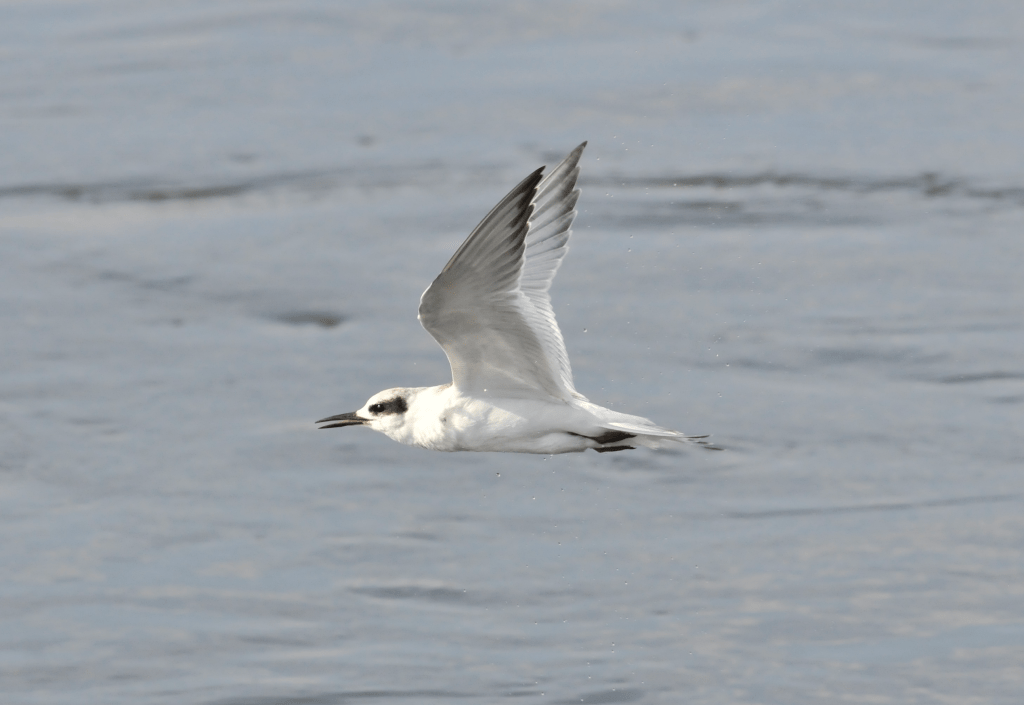
The Black Tern nests in marshes and swamps. It is a light flier and very buoyant as it goes about its work. Even though they nest over fresh water they are regularly seen migrating over salt water, very often well off shore.The Least Tern is about the size of a Northern Cardinal; smaller than an American Robin. In addition to the Atlantic coast population they are found inland along the main rivers of the US and there is a population on the west coast as well. The inland and western populations have been listed as “threatened” and the eastern population as a “species of concern”. This circumstance occurs because they invariably choose beaches where humans recreate. The birds often come out on the short end of the stick when off-road vehicles, beach-goers, and dogs are involved. They are a delicate bird but with a direct and strong flight. The yellow bill with a black tip is diagnostic when seen on a small tern.They have rather long wings for a small bird and are strong fliers. They feed by plunge diving for fish, small fish as you might imagine, in shallow water usually over sand flats.They are quite common throughout New England beaches now as the Park Service, Fish & Wildlife, and many towns and private agencies have protected their nesting sites along with the protection given to the diminutive Piping Plover (PIPL).The most common tern is the Common Tern. Like all the terns this is a migrant with many miles under its feathered belt. The orange bill with a black tip is characteristic and often easy to see. They nest in large colonies and are most successful when nesting on islands where predators are limited. In many colonies Great-horned Owls (GHOW) and Black-crowned Night-Herons (BCNH) are the greatest threat as they can fly in from offshore. When they nest in main land colonies they will abandon if something like a Red Fox begins to take eggs or chicks (or perhaps a weasel or mink or coyote or gray fox or raccoon or skunk, etc…).They are very similar to the Arctic, Roseate, and Forster’s terns in appearance. It seems the gray mantle with light colored wings with darker tips to the flight feathers is a very workable design for doing what terns do. They nest inland as well as coastal. The young leave the shallow scrape of a nest after a couple days but hang around near the nest site for 3-4 weeks. After fledging the young will follow the adults for another 6-8 weeks.The colonial birds will rise up in a “fright flight” at the mere presence of something odd. In some cases it seems that if one bird sees a shadow they all will bolt into the sky. When something, or someone, actually enters the colony they will fly at the intruder, calling loudly, and try to drive it away by constantly bothering it. It is usually a noisy and often smelly trip through a tern colony.The largest colonies are all well managed and protected. The US Fish and Wildlife Service manages the colony nearest to me. They census and monitor the colony throughout the nesting season. As the Roseate Tern is a listed bird there can be some management of predators in order to allow the Roseates the best chance of nesting success.Counting nests and eggs is a tedious job; walking shoulder to shoulder through the colony locating, avoiding, counting, and recording the many thousands of nests.The Roseate Tern is similar to Common and Arctic. It has a longish black bill and flight feathers that are quite pale. It may be hard to perceive from the pictures but it is lighter overall when standing with a bunch of Common Terns. The youngster has a scalloped pattern to the back feathers, a characteristic of the young roseate.The general pattern of “tern-ness” carries over to this larger tern; the Royal Tern. This its mostly a southern coast and Gulf of Mexico resident but we see them every year up in New England. They are generally gray and white like so many other terns. By the way a few of the pure oceanic (pelagic) terns are not gray and white. The two types of noddies, the bridled, and the Sooty terns are strikingly different looking; noddies are brown all over and the bridled and sooties are black and white with lots of black.There are a couple terns that have a distinct winter plumage. They all change “headgear” for the winter but the Forster’s Tern develops a mask and loses the black cap. In breeding plumage it has an orange bill with a black tip and a full black cap. It is a bird that nests on inland wetlands west of the Mississippi River and up into southern Canada. We see it here in the east after breeding. They are one of the few terns that can be found along our coast (usually well south of New England) in the winter.
Please consider the images to be copyrighted and ask permission to reuse any of them. Thank you. DEClapp
The spring is bird migration time – hence all the bird-related blogs. The peak is May with a bit of April and June thrown in. So I’ve been posting a good bit of bird stuff – some day, perhaps next week even, I will get back and finish the Falkland Islands posts and start in on more Australia and Africa. But for now there are a few relevant bird posts to finish; the always entertaining sparrows will be stunning I’m sure, the elegant array of terns might be more colorful or at least a bit more jazzy, and today will shine some light on the denizens of our wetlands, thick with emergent vegetation. These birds slither and skulk, They are noisy but but not songsters. Most people go an entire lifetime without seeing any of them.
Let’s take a look at the rails; king, clapper, Virginia, sora, and yellow (in descending size). They are shy and secretive as a rule but it may be that the vegetation they live in is not at all transparent. They can be just a few feet away from you and fully out of sight. The phrase “skinny as a rail” originated back when wildlife was an essential part of everyones daily life. People in the bush noticed that rails could squeeze between things by becoming narrowing in width. They became “skinny as a rail” to squeeze through their habitat.
They are all possible here in Massachusetts but the Yellow Rail (YERA) is very hard to find and identify though it is a regular passage bird. They mostly nest in Canada and winter in the wetlands (stopping in old rice fields along the way) of the Gulf Coast. The Virginia Rail (VIRA) is the most common of our rails and along with the Sora (SORA) is the most widespread. The larger rails are the Clapper and the King. This group is found worldwide and is one of the birds that often become flightless over time when they get to a predator-free island. But they are often wiped out quickly when humans, dogs, cats, weasels, stoats, and rats arrive on the island. There are still flightless rails on a few Islands and in New Zealand as well.
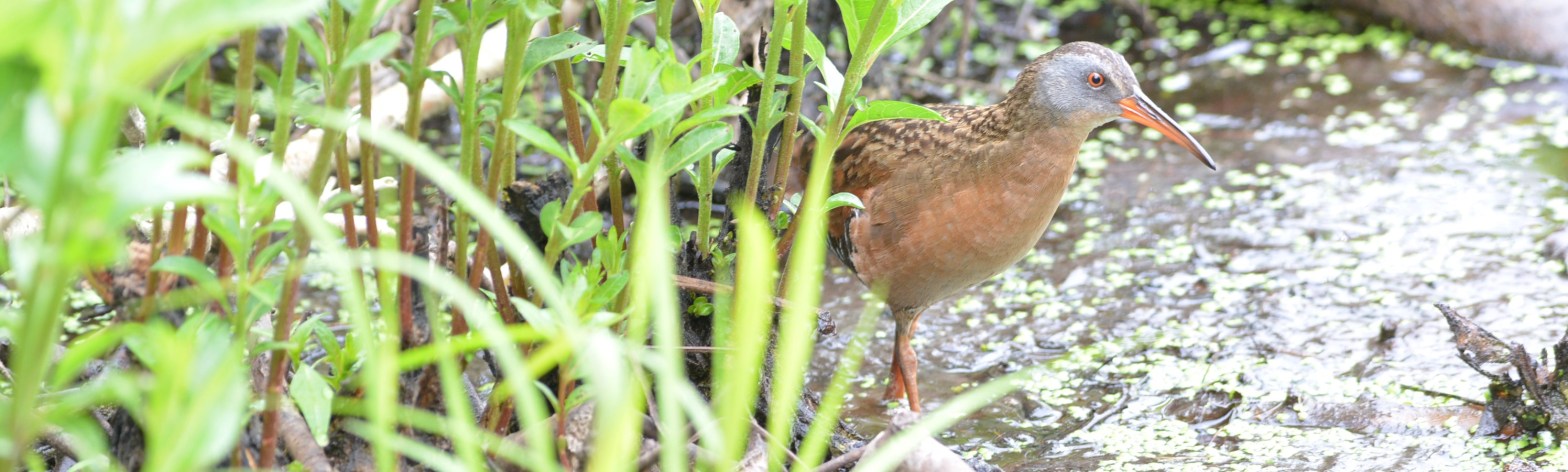
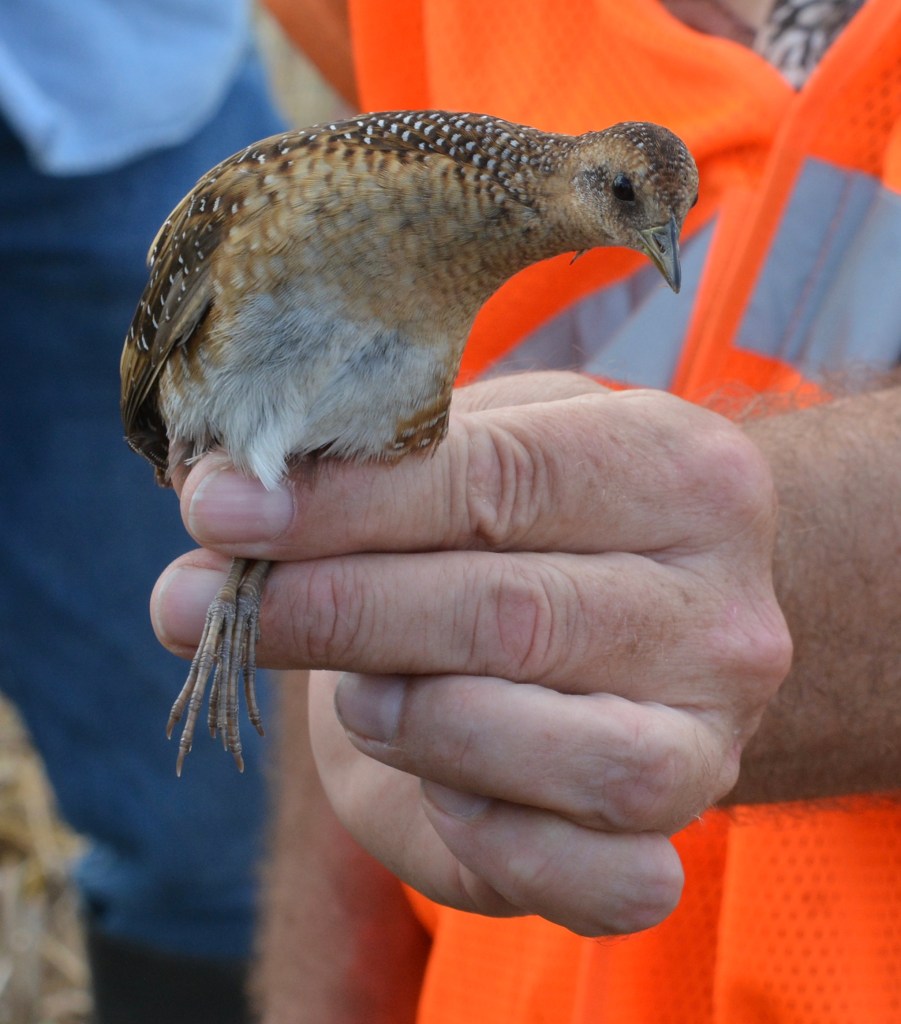
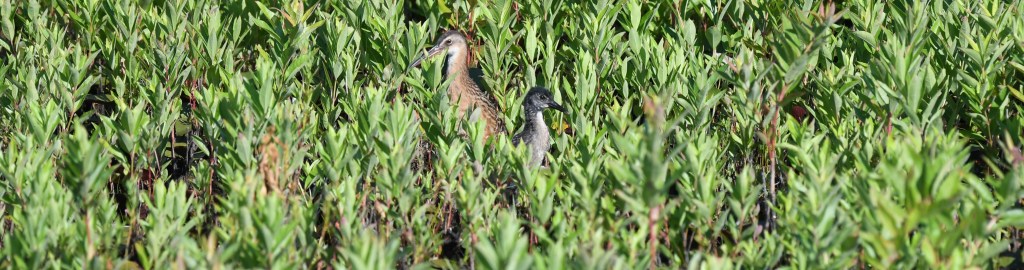
The other day Fran and I were out walking and I stepped into a small slot cut into the vegetation along the edge a large marsh. The slot had been cut by the Massachusetts Mosquito Control people in order to access mosquito traps that they use to look for insects carrying troublesome illnesses. I was only ten to fifteen feet off the trail and trying to stay dry when I noticed motion near my feet. It was this Virginia Rail. I took about 20 photos but the bird was too close for most of them to be in focus. I did get a few that are pretty good. The banner image at the head of this post is the same bird in a different spot. Mostly dumb luck – but you had to be standing in a swamp to be treated to this good luck. The Virginia Rail (VIRA) is widespread and mostly in freshwater wetlands. This bird was in the fresh edge of what probably is a lightly brackish swamp though fed by ground water in the dunes. The longish bill is a characteristic of many rails, but the gray face and smallish size separate this from the King Rail (KIRA) which is similar.This little rail is a Yellow Rail (YERA). This is an uncommon bird in my area. It probably migrates through here, both north and south, annually but is a very secretive and short term resident in the coastal grasses. It breeds widely across southern Canada and winters along the southeastern coast of the US. One autumn after the rails had migrated to the south Fran and I went to western Louisiana to the Rails and Rice Festival.This is an annual event that allows birdwatchers to see these hard -to-see birds up close. A few of the rice farmers cooperate by harvesting their rice fields during the festival. The harvesting combines are huge, noisy, and rugged machines. They charge over the landscape cutting the seed heads from the grass (rice) and process it somewhat and then catch the rice kernels in a giant hopper all the while kicking up a tornado of dust. They start cutting on the outer edge of the field and circle around inward and inward again. Pretty soon the spiral leaves only a small section of uncut grain in the center of the patch. There are a few birders up on the combine wearing masks for the dust, others walking the field with cameras, and some in 4×4 carts driving just outside the cutting wheels. The rails soon pop out from the remaining area and they often just fly a few feet and drop down. They are easy to see and the bird banders that are set up in the field catch and band quite a few, sometimes using a butterfly net. Yellow Rail is the target bird in the rice fields, but there are also Virginia, King, Clapper, and Sora. It is quite an outing.The small bird in the center of this image has a short bill, like the Yellow Rail, But its black face, the yellow bill, and small size mark it as as a Sora (SORA). They have a whinny like call and whistled notes as well. The alarm call is strong for such a small bird. Like all rails they walk unnoticed through the reeds; but if one were to fly up in front of you, you would see a white rear edge to the wing feathers and a longish pointy tail – on a smallish bird that just surprised you. This is also a very common rail and widespread across North America and Mexico. It is just hard to see and (remember) you need to be out at night near a wetland to hear it calling.This Clapper Rail is pretty uniformly gray in color. It is restricted for the most part to coastal marshes in the eastern part of the US, though there is a west coast population – which may actually be closer to King Rail than Clapper. This rail is about 14.5 inches long (compare to a Mourning Dove at 12″). It is a salt marsh bird and again, widespread but not often seen – the mantra pretty much for all rails I guess. The male is very very similar to the female King Rail and the two species (?) can and do hybridize. Our birds here in the northeast are pretty gray but as you move south you see them becoming more and more reddish. The Gulf Coast population is very much like the King Rail.This image of a female King Rail scooting across a wetland (actually a pond edge) doesn’t show much reddish color. The King Rail is large, like the Clapper, and this image doesn’t do justice to the streaks and striping of the back and tail. The populations that look alike (between Clapper and King) can be identified often by the contrast and intensity of these marks. A male Clapper, especially in the Carolinas and south, will look much like this bird. I know this to be a female because she was nesting in this area and was the adult bird in the next image.The female is the bird to the left in the image. The other bird is a youngster still flightless but able to get around the wetlands with ease. Both the Clapper and the King make kek kek noises that are diagnostic after listening and thinking for a while. The King Rail is generally a bird of freshwater wetlands.
Please consider all images as copyrighted and ask permission to use for any reason. Thanks, DEClapp
Gulls are found worldwide; mostly in the Northern Hemisphere but still worldwide. Many are related to salt water and pretty much all of them are related to water. Those that may nest in the continental interior usually fly to the coast for the non-breeding part of their year. Some migrate, many don’t. Some are very large and a few are quite small. Many are white-headed and others are black-headed. There is not such thing as a “sea gull”. They are all gulls and some do live near the sea – are usually seen by the sea – but the phrase “sea gull” is really quite meaningless to a birder or naturalist.
These are obvious and gregarious birds. They nest in colonies and on the ground. Because they are large and noisy they can drive off many predators; in fact they can be quite predatory themselves. They prefer open areas where they can take advantage of winds and are often found gathering at places where humans deposit waste materials. As a matter of fact the most significant management action taken by humans that impacted gulls was the closing of open dumps and trash pits. Gulls are opportunistic feeders and the open dumps provided easy food. Over the past decade or two landfills have been covered and capped and wintering gulls have had a harder time finding food.
An interesting thought regarding gulls at this moment; they are evolving as we watch. The average gull may be white-headed and gray (or black) backed and seen most anywhere in the world. But the reality is that they range in size and color pattern in a step by step by step way from small and light to large and dark. Many of them (are they all species really?) can interbreed with other gull types.
The standard north American gull may be what we call the Herring Gull (HEGU), but it has nearly identical genetic cousins in the Mew Gull (MEGU), the Heermann’s Gull (HEEG), the Ring-billed Gull (RBGU), the California Gull (CAGU), the Thayer’s Gull (THGU), the Iceland Gull (ICGU), the Glaucous-winged Gull (GWGU), and the Glaucous Gull (GLGU)– and these are just its gray-backed relatives. There are another cadre of five types of near-Herring Gulls that are black-backed. That means that there are 15 types, or species, that are all cast from the same mold; or have descended from the same gull ancestor. There is another group of gulls that have black heads and are closely related to each other and less closely to these 15 species; these are the Little (LIGU), Bonaparte’s (BOGU), Black-headed (BHGU), Franklin’s (FRGU), and Laughing Gulls (LAGU). Then there are five species of Arctic gulls that we see infrequently. But it is very exciting to see when we do see them (Sabine’s (SAGU), Ross’s (ROGU), Red- (RLKI) and Black-legged Kittiwakes (BLKI), and Ivory (IVGU)). And this is just in North America – phew.
So let’s take a look at some assorted gulls – mostly US gulls. I won’t cover the various age plumages that gulls pass through but let me just say that what makes them troublesome is that there are many different plumage arrays as they age toward maturity. The larger gulls usually take four years to reach that adult plumage and the smaller gulls take two or three years. That creates a big mess of plumage stages that gulls go through. It isn’t always easy to age an individual – but as I said, we will look only at adults. There is one from outside North America included – but there are a few gulls in New Zealand, Australia, and southern South America. Maybe we will look at those family members some day.
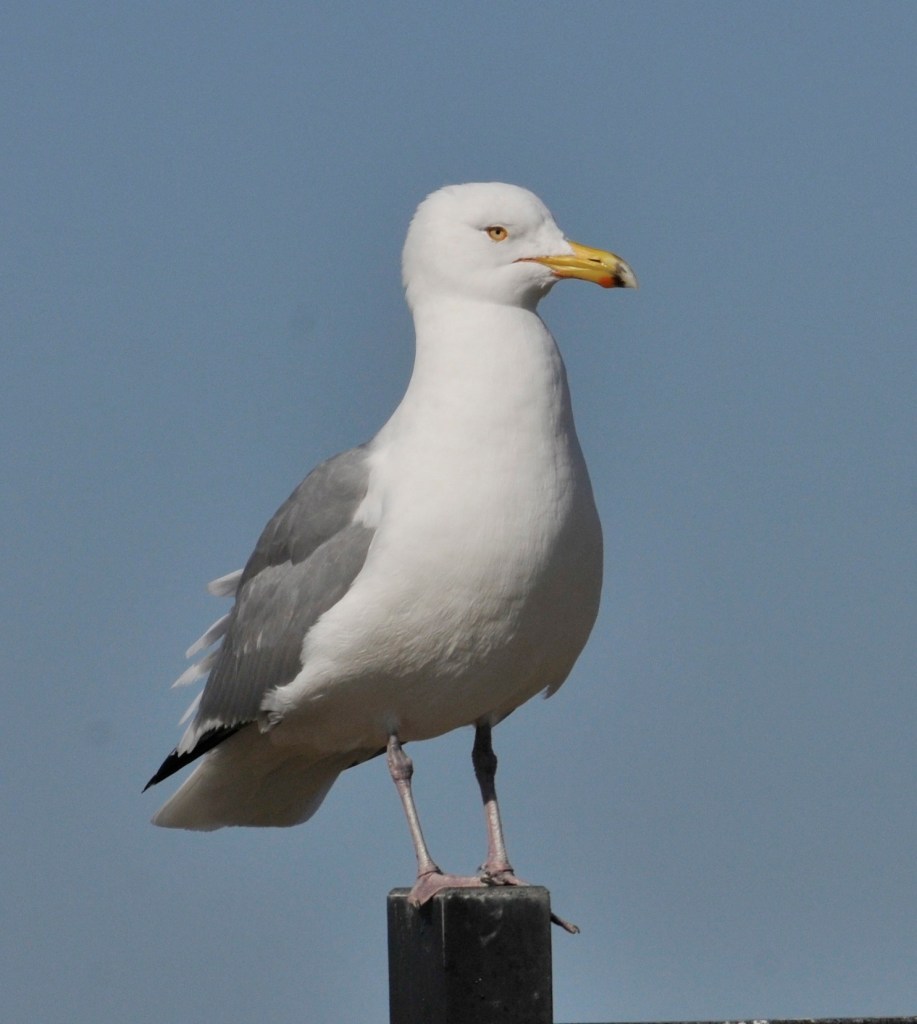
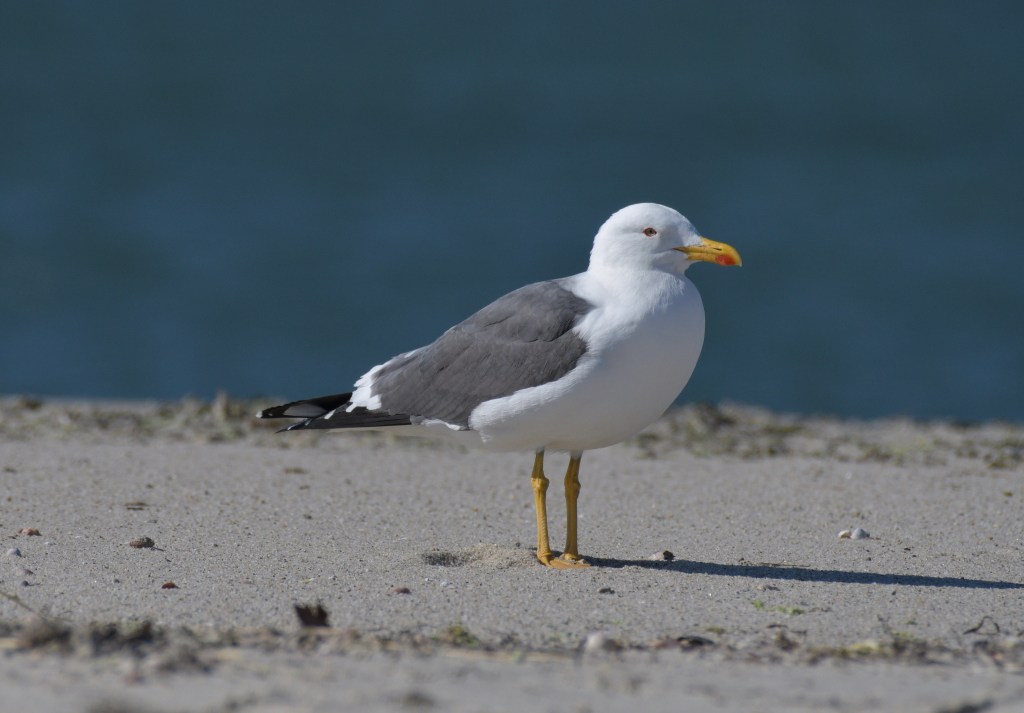
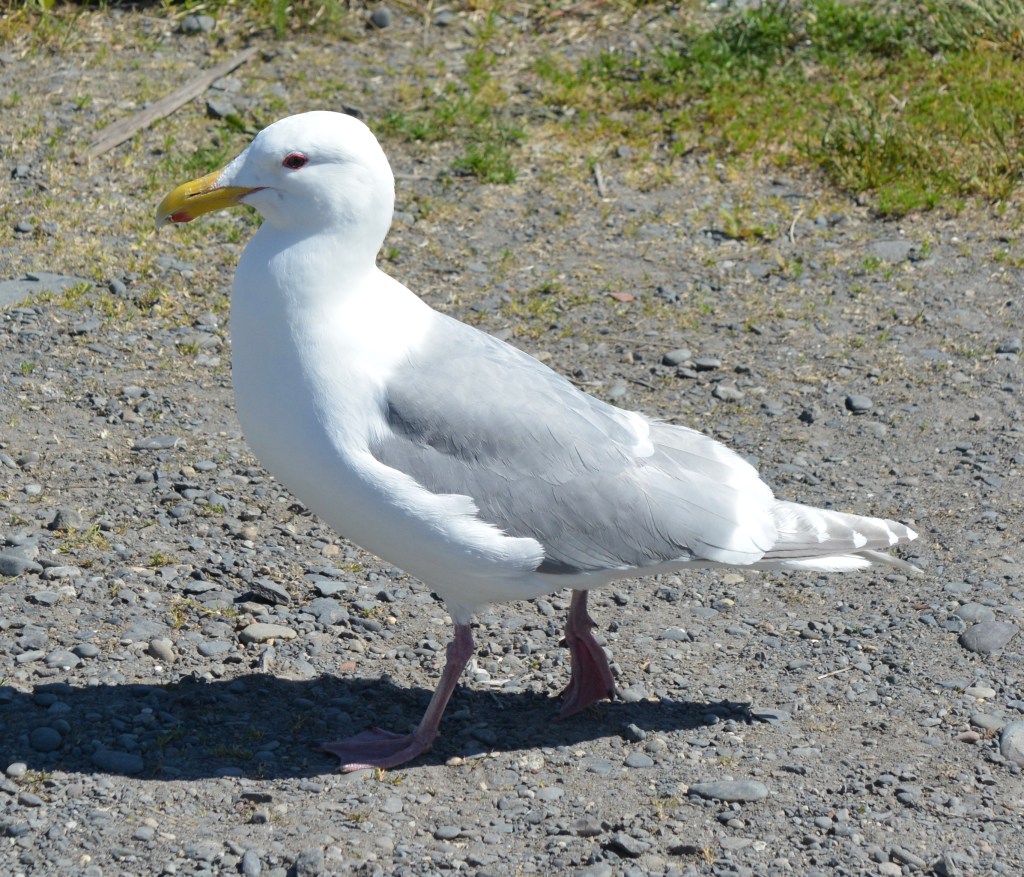
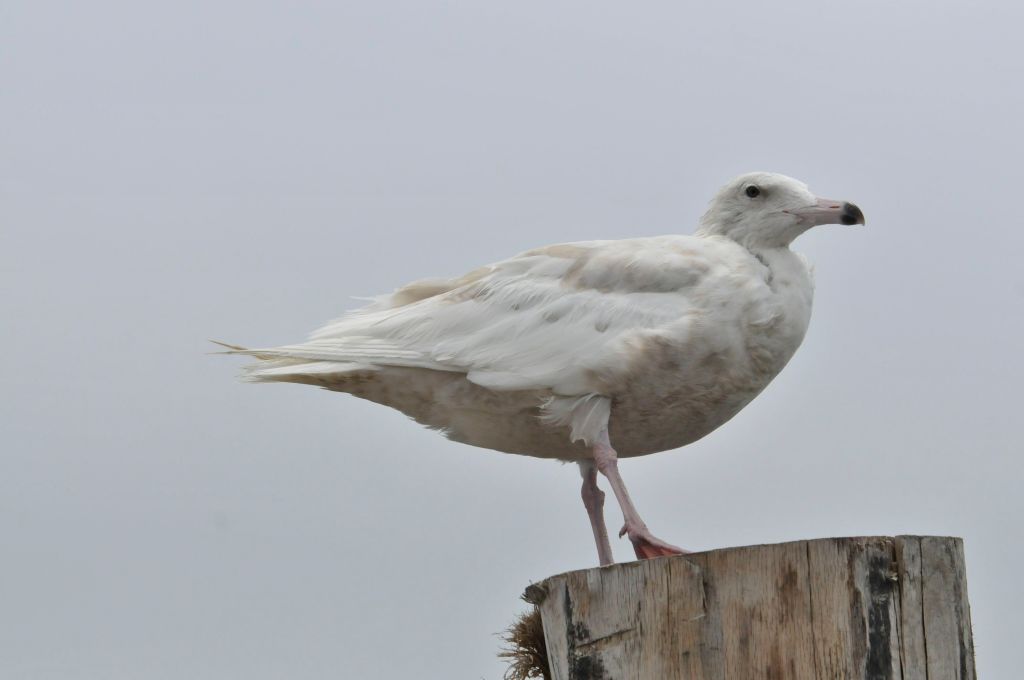
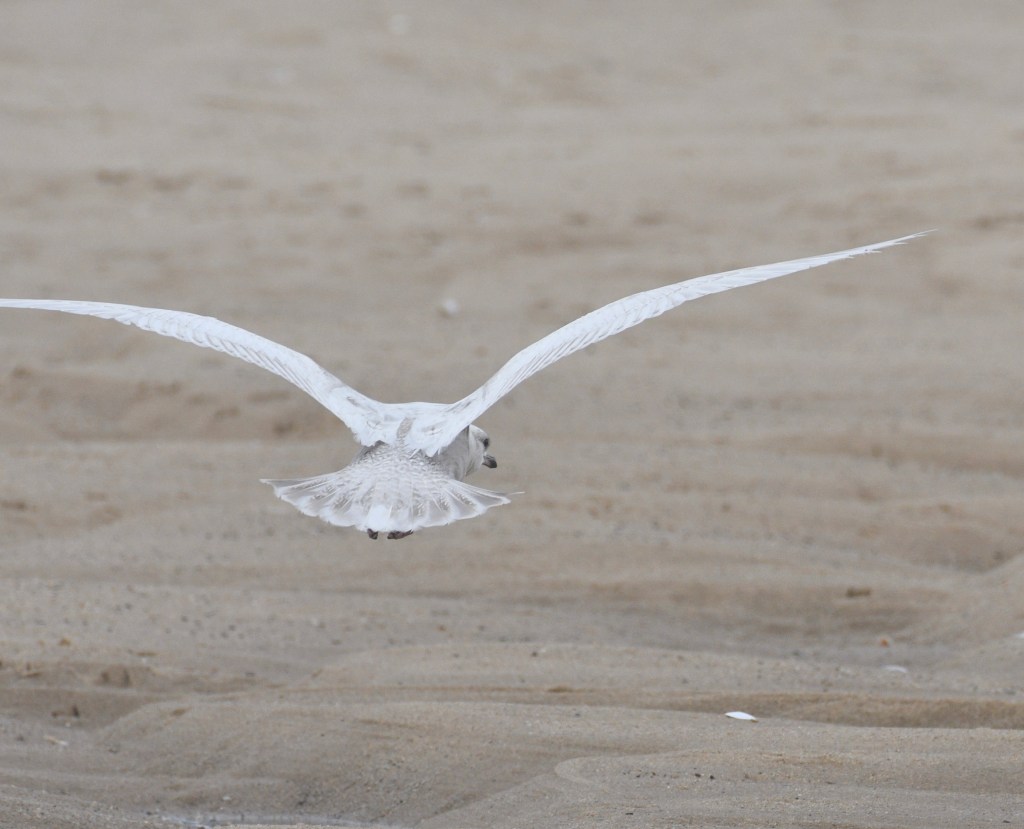
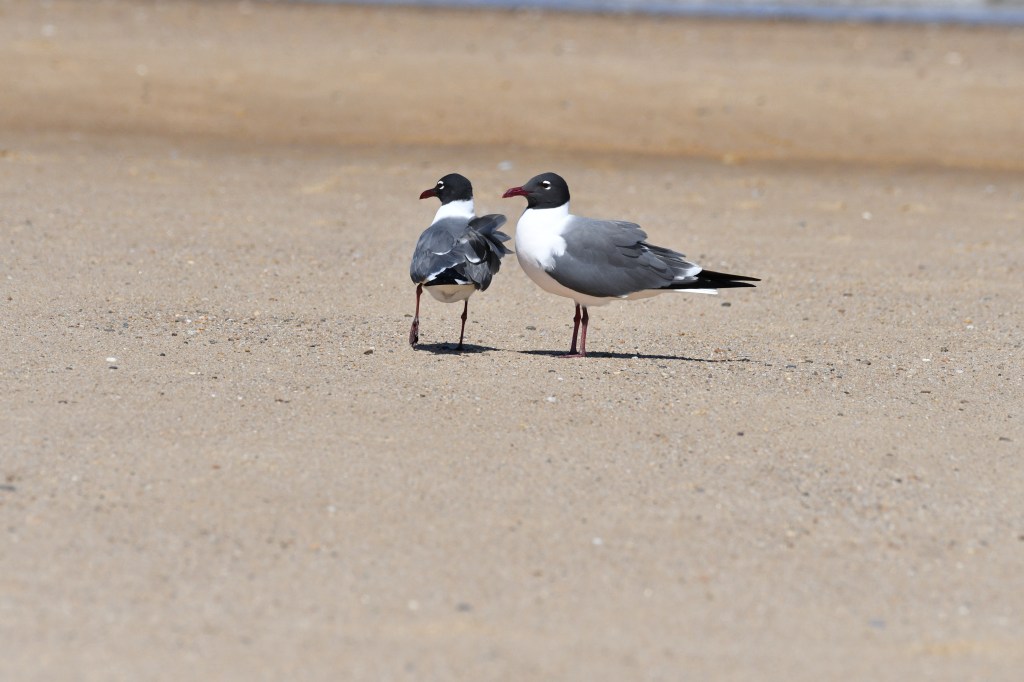
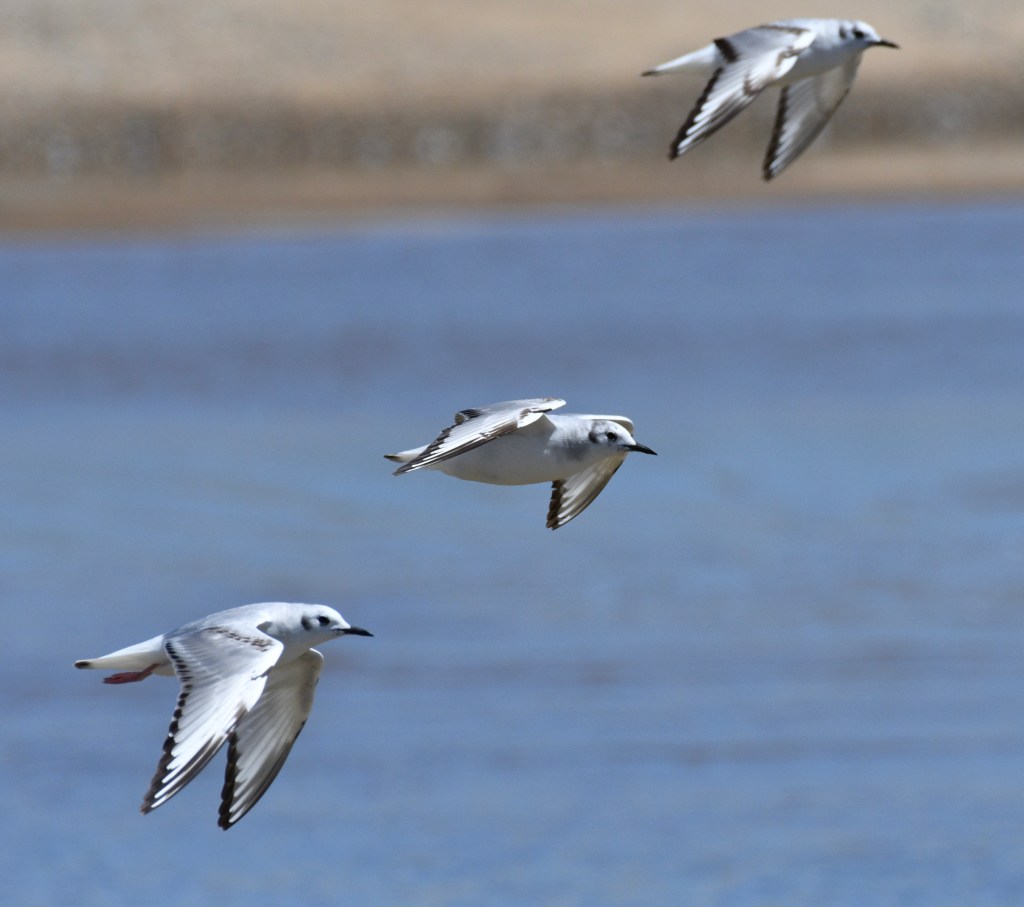
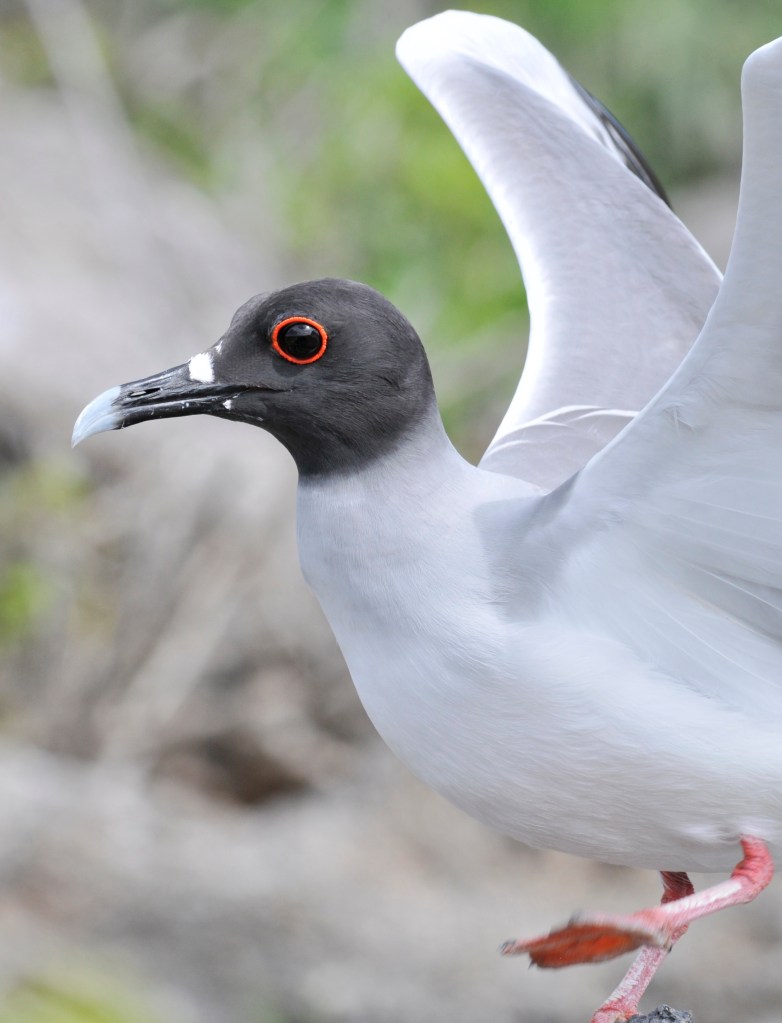
Let’s start off with the standard North American gull – the Herring Gull. If you get the chance to visit a herring run (a stream) in April in Massachusetts you can be enthralled by the migrating fish and auditorially assaulted by the Herring Gulls that are looking to grab a migrating herring. The fish are 11-12 inches long and these birds can gulp one down in a flash. This is a four-year gull and offers a confusing test for gull watchers as it passes through varying brown and grayish plumages before coming iconic in appearance. They can be found all along the Mexican coast and throughout the USA and Canada. There are also Siberian and European populations. This is a very successful creature living in and adapting to all sorts of coastal and inland habitats.A very similar gull is the Lesser Black-backed Gull. It is small and more charcoal on the back (mantle) than the herring gull and not as large or as black as the Great Black-backed Gull. The yellow legs are characteristic of this type. It is primarily a European bird but spreading into the Canadian Maritimes and on south from there. It is mostly a visitor from Iceland and Britain but it is likely to become a scarce breeder very shortly. As they say – wait ’til next year.In the Pacific Northwest and down along the California coast we have the Glaucous-winged Gull It is obviously of the same heritage as the others but was separated by the ice age (or ice ages) and form a distinct population that is able to hybridize readily with other gulls of the region (Herring, Glaucous, and Western). The flight feathers (primaries) are tipped in gray not black as seen in most other species.This gull is quite white overall – it is a Glaucous Gull the largest of the white-winged gulls This individual was on a post near the Long Island ferry dock at Orient Point but could have been coastally anywhere from Washington DC up and around the top of Canada and then down as far as Seattle. Yet like most gulls they could turn up just about anywhere. The two-tone bill on this bird shows it to be a juvenile born earlier in the same year I photographed it. They breed well above the tree line in very northern Canada.Obviously this is another white-winged gull, the Iceland Gull. It is smaller than the Glaucous and more likely to be seen in the northeast. This is a smaller gull with the same sort of white or dusky plumage that you see the the Glaucous Gull. In general the Iceland is a species of Northeast USA and the similar Thayer’s Gull a species of the Pacific Northwest. But they overlap and may simply be two populations of the same bird. Perhaps separated for a few thousand years (generations) allowing the Thayer’s group to become a bit darker especially in juvenile plumage.The Ivory Gull is one of the deep Arctic gulls. It is pure white and a very rare visitor to the USA. This is a bird of the pack ice and gets its food from Polar Bear scraps and droppings. Aside from the diet, it is quite elegant and strikingly white. The bird above with the orange-tipped bill and deep black legs and eyes is an adult. Then there are the black-headed gulls. Many of them will lose the black head feathers in a post-breeding molt and regain them the next breeding season. These two birds are Laughing Gulls, the most common of the black headed gulls on the east coast of North America. There is a similar cousin, the Franklin’s Gull, which is very similar and significantly more inland in nature.Here is a quiz. What difference do you see in these three birds? They are about the same shape and size. The two on the left look like Laughing Gulls. The one on the right doesn’t have a full black hood and the back is much lighter. As a matter of fact if you draw the hood onto the right hand bird it will be a different shape than the hood on the Laughers. It is actually a winter-plumaged Black-headed Gull.These three are Bonaparte’s Gulls; named for Napoleon’s nephew who was one of Europe and North America’s great ornithologists a couple hundred years ago. These are smallish gulls that often look like terns as they skim and cavort over the water. They can be found all over the US during the winter but breed well north into Canada and Alaska. They will develop black hoods as the breeding season approaches. They can be confused with Black-headed and Little Gulls as well as wintering Black-legged Kittiwakes.One last gull, there are many more really, is the Swallow-tailed Gull from the Galapagos Islands. It has big eyes and a rather long thin bill. It is nocturnal and flies out from the islands at night to feed in the open ocean. It is a very attractive gull and always a highlight when in the eastern Pacific. The Galapagos offer all sorts of rare and unusual things but always in moderation. There are a few reptiles, a few birds, and so on. The reef fish can be a bit daunting but there are only a couple gulls.
Please consider all images as copyrighted and ask permission to use for any reason. Thanks, DEClapp
As the last few posts have shown we have been walking the great outer beach around Race Point a lot. Actually a whole lot! Just ask my hips and knees. Four or five miles in soft sand that slopes sharply to the sea is testing. It wears a person out but it is the only way to get to certain places where the ocean wildlife meets the shore. There is a strong and rather permanent “race” where the Atlantic waters and the water leaving Cape Cod Bay brush against each other. Brush is a gentle word for a strong interface that roils the water and creates upwellings that enrich the area. Enriched water attracts fish, birds, and marine mammals. It is worth the walk.
We have done this walking/hiking/toiling mostly for the birds; often wintering birds that otherwise cannot be easily seen in our area. This group of unusual cold weather visitors includes Black-legged Kittiwake (BLKI), Little Gull (LIGU), and Pacific Loon (PALO). There are always our wintering ducks and grebes out there as well; birds like Red-breasted Merganser (RBME), all three scoter species, and lots of Common Eider (COEI) and Common Loon (COLO). In the summer it is possible to see four pelagic (purely oceanic) birds called shearwaters (Cory’s, Sooty, Manx, Great) looking out from this part of the Cape. These birds soar over the waves day after day and night after night, no matter the weather. Some migrate from near Antarctica in a giant circle that takes them all around the Atlantic; up the South American and North American coast and the under Greenland to Europe and then back down the African coast and our to Antarctica again.
Race Point is a destination with the Cape Cod National Seashore but most visitors look out into the vast sea toward Portugal and maybe sit in the sand for a while. From shore the wildlife mentioned above is often visible if you look hard and long enough, as are the Humpback Whales that are very common in the summer. The Northern Right Whale is an early season visitor and the Fin and Minke Whales can be seen in the summer as well. Not to mention the very common Gray Seal and the (now) less common Harbor Seal.
But the migrants in this area are not all birds or mammals – there are two very important fish that arrive here and depend on a third migratory fish (actually a group of smallish migrants) called Alewives, Herring, and Menhaden. These are the staple fish of our sea. They are the forage fish that feed the bigger fish. In some parts of the world there are Capelin, Sardines, and Sand Lance that do much the same thing. Here in the northeastern corner of the US we have Sand Lance (good whale food) as well as herring and pogeys, or menhaden. These fish are plankton eaters and are consumed by Striped Bass, Bluefish, Tuna and many other predators of the ocean.
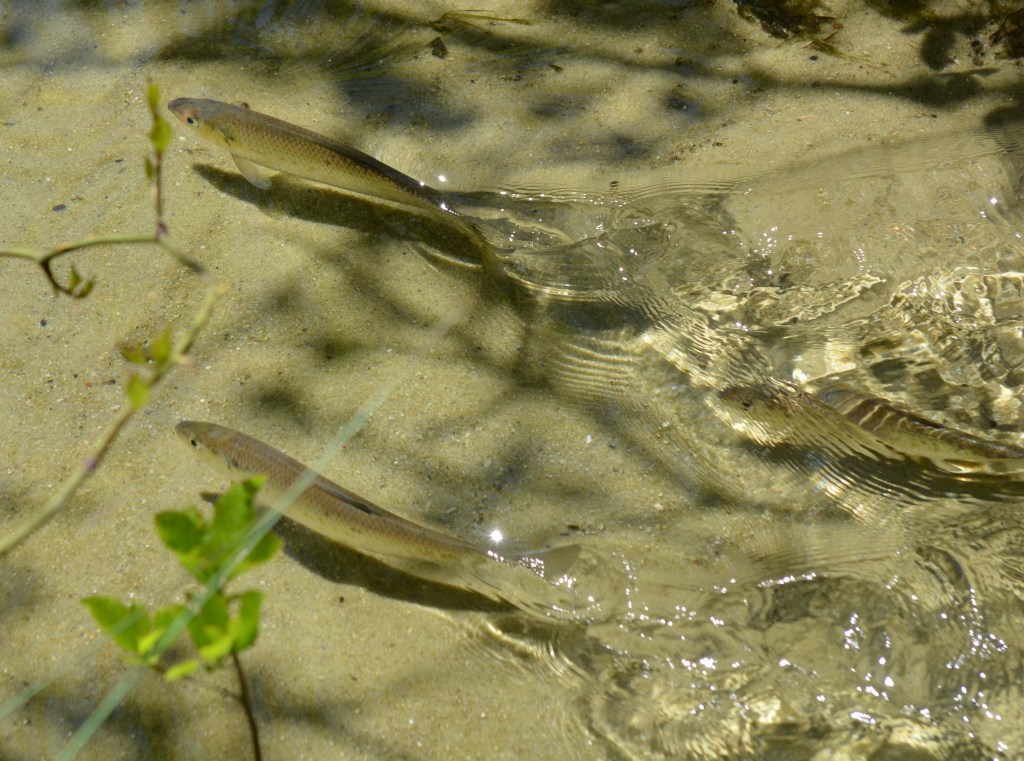
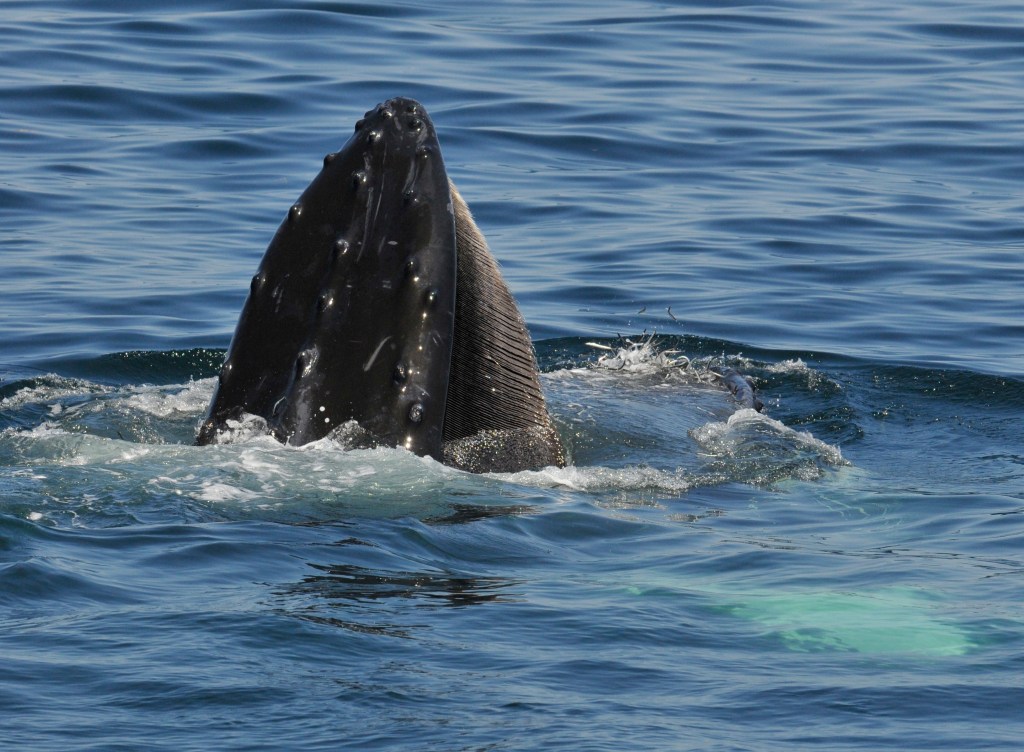
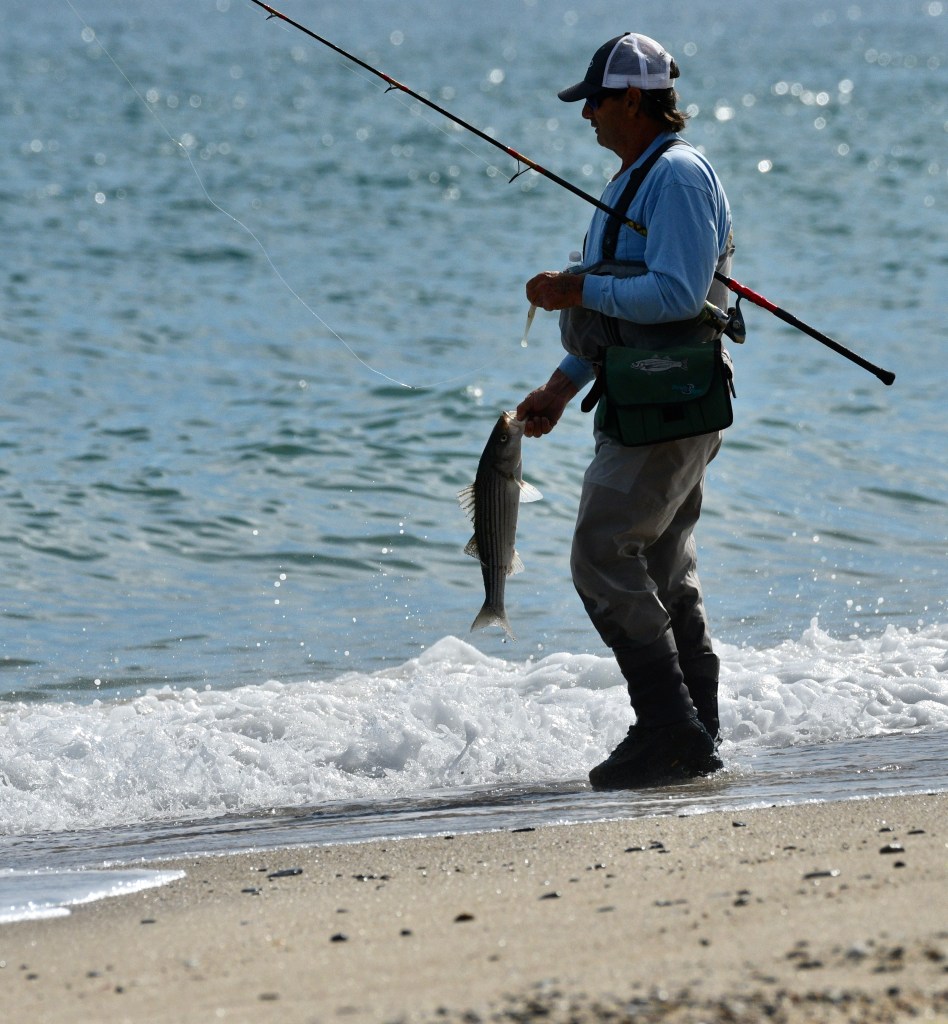
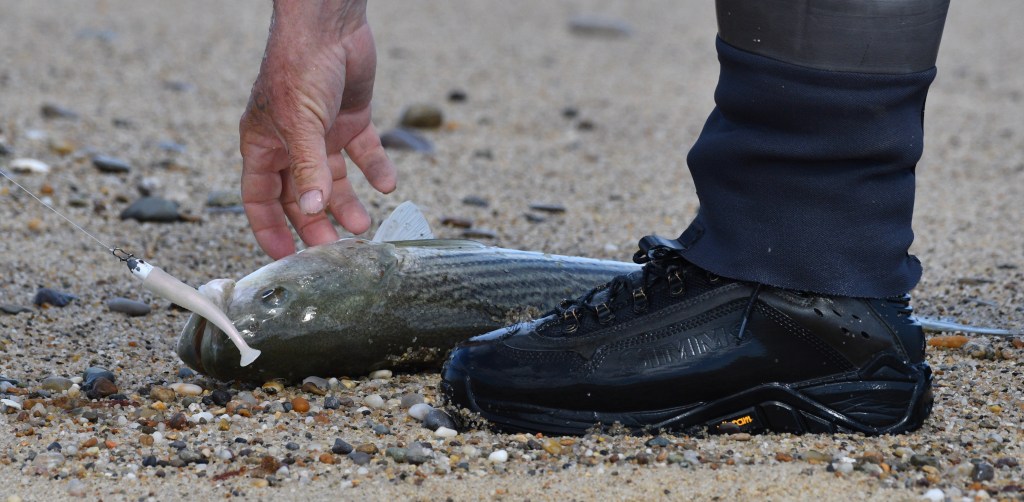
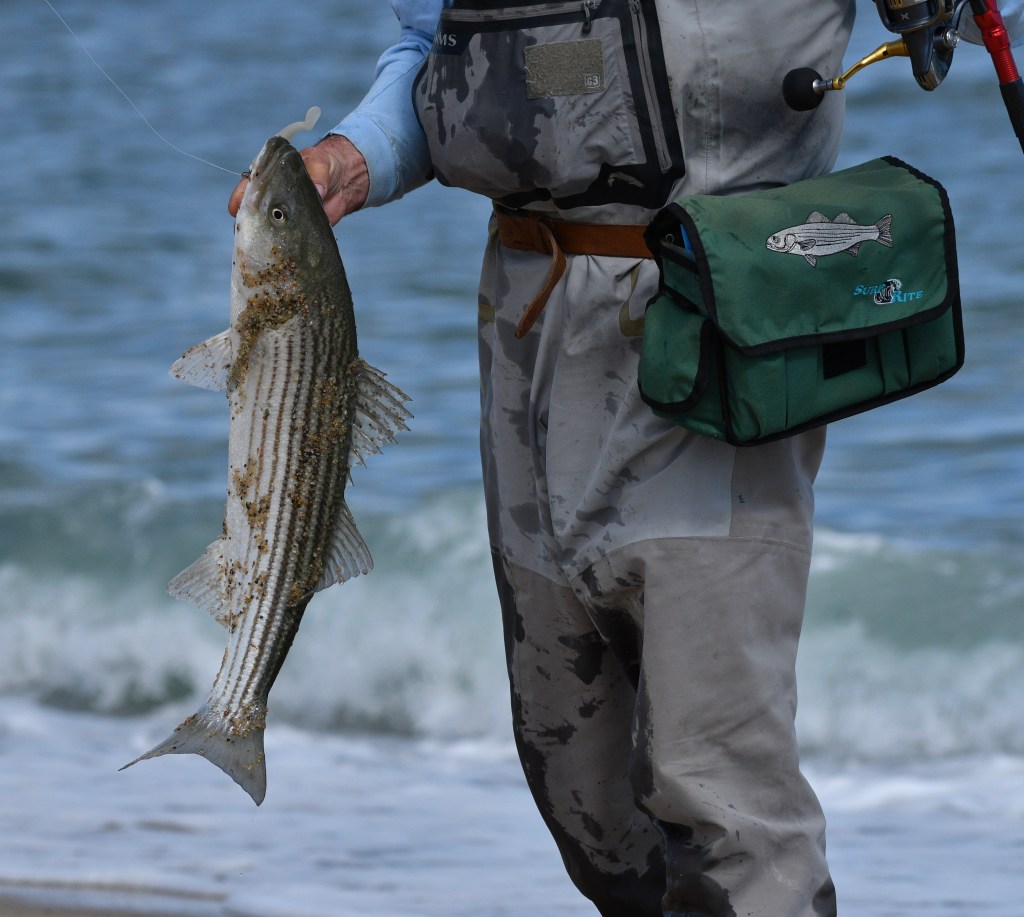
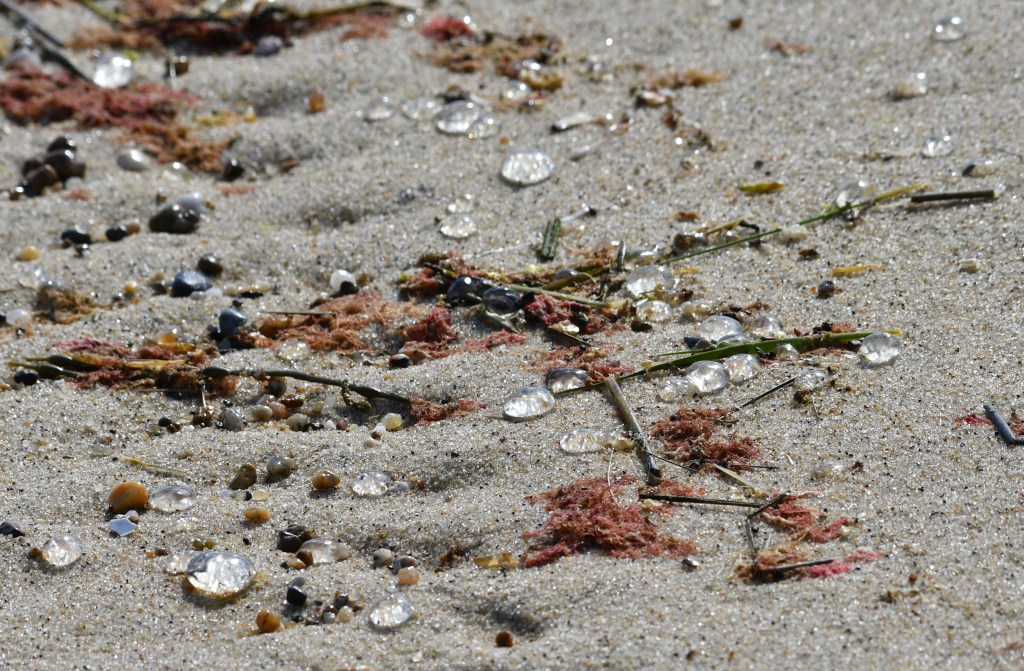
Herring and Alewives have been harvested (that is harvested not fished) for a couple centuries. They have been ground into fertilizer and pet food by the ton year after year. The billions of herring recorded in old books and ledgers are all gone. However, for the last decade or so they have been left alone. There is a moratorium on their harvest right now and the numbers are rebounding a bit. Not so that the ocean is teeming with them but there are more and more each year. They are Plankton eaters and leave the sea to move into fresh water ponds to deposit eggs. They are eaten by mammals, gulls, and marine mammals as they make this migration. Those that survive head back to the sea. In September, or so, the creeks turn silver as tens of thousands of youngsters swim downstream and into the salt water looking for the next phase in their metabolically complex life.The Humpback Whales that summer along our shores are primarily feeding on forage fish; in our case that is the Sand Lance. Look in the lower jaw of this feeding whale and your can see a couple dozen small fish leaping out of the whales maw. It may be a bit hard to grasp but these huge creatures eat lots and lots of very small creatures. When forage fish or krill are harvested by commercial means they have a significant impact on the natural balance in the ocean. You cannot have a system without a foundation. Krill and forage fish are very important items within the middle of the foundation. Fishing has been a staple of the diet and economy in this area since the Basques first took cod from these waters 500 years ago. Well the cod are depleted pretty much beyond sustainability but there are a few game and food fish still here. As spring arrives the birders are getting out every day as are the fishermen. This fellow is about to return a small Striped Bass to the water. The first stripers to arrive are the “schoolies” and most of them are undersized. By the end of May there are larger bass along the shore. The next fish was larger and a keeper. I am not sure if he actually kept it but it was legal. Many fishermen go fishing to get outdoors. It is like walking, hiking, birding, kayaking, and so on – a chance to be alone in nature surrounded by wonders beyond comprehension; deep within the ebb and flow of evolution. Of course there is always the challenge of figuring out what the fish or bird is going to do and where it will be or the challenge of a longer or faster walk. But it’s the outdoors that calms our nature. Nature calming nature – try it.What else would you call it? Striped Bass for sure. This is now a highly managed species and its population has had its ups and downs. This year, 2020, has seen a severe restriction on the harvest of Striped Bass. The numbers have dropped again and management is being initiated. They do not spawn in most of the Atlantic coast rivers as they did in the past. They spawn in fresh water and the Hudson River is one of its last spawning rivers; although there are populations in Cape Cod Bay, Chesapeake Bay, and the Delaware River as well. Nowadays a 25 pound fish is pretty good size but there are a few above 50 pounds caught every year. Both small and large fish have to be released.,These last two images are of another beach creature that a birder may notice – or maybe not. The shiny blobs are salps. Salps are gelatinous creatures that simply drift in the ocean waters. They don’t have stingers and they don’t swim. They are like soft squishy jelly beans that merely pump water through themselves and extract tiny bits of plankton. They are a macro-plankton animal. When the winds blow them in from the edges of the Gulf Stream and there is plenty of food (and hence plenty of reproduction) they can “wreck” on the shore. In long lines of shiny blobs – interesting, sort of pretty, and kind of sad.
Please consider all the images as copyrighted and ask permission to use them for any reason. Thanks, DEClapp.
There are a grand assortment of birds that use the edges of wet areas. They nest and feed in swamps, bogs, and wet meadows. They travel along the ocean edge while undertaking some of the longest migration known. And then there are those that swim, pluck, and dive in fresh, brackish, and salt water. Many will nest in forests or up north in tundra pools – very few stay within the confines of the USA. For many species the US is a piece of land that is in the way as they travel from their real homes to the south and their breeding territories to the north. The land between the tropics (Capricorn and Cancer) is where many of them reside for most of the year. This group is pretty much wholly migratory and what you see in the US and most mid-latitude countries is a seasonal passage. Birders and naturalists anticipate this and spend a lot of time during the month of May in the field. Birds, leaves, flowers – everything is breaking free from winter’s grip.
This is the time of year when I/we see lots of birds. They are often transient and only around for a day or two. In some cases they may nest and stop singing or calling after finding a mate. In any case birds get harder to see as June starts up. May is, and has been, our most exciting avian time.
I have several posts ready to write and they will be on shorebirds, gulls, terns, and a few other creatures of the coast. So let’s get started…… Oh, yes; the heading image is a breeding plumage Sanderling (SAND). This is a very pale sandpiper most of the year and one of the few that frequents ocean-side beaches. In breeding plumage, a short-lived phenomena, it is quite reddish.
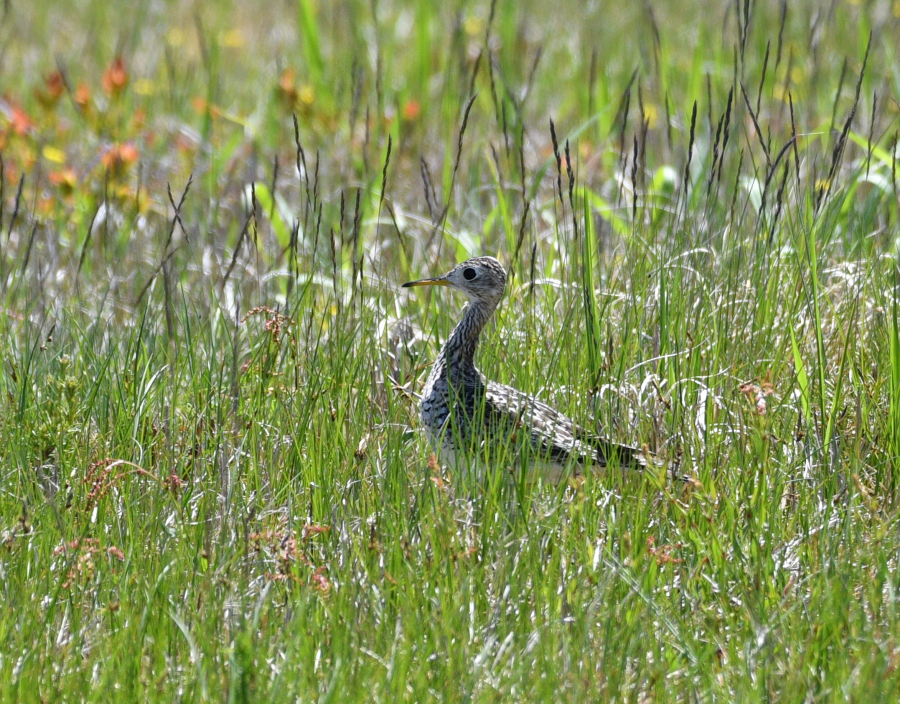
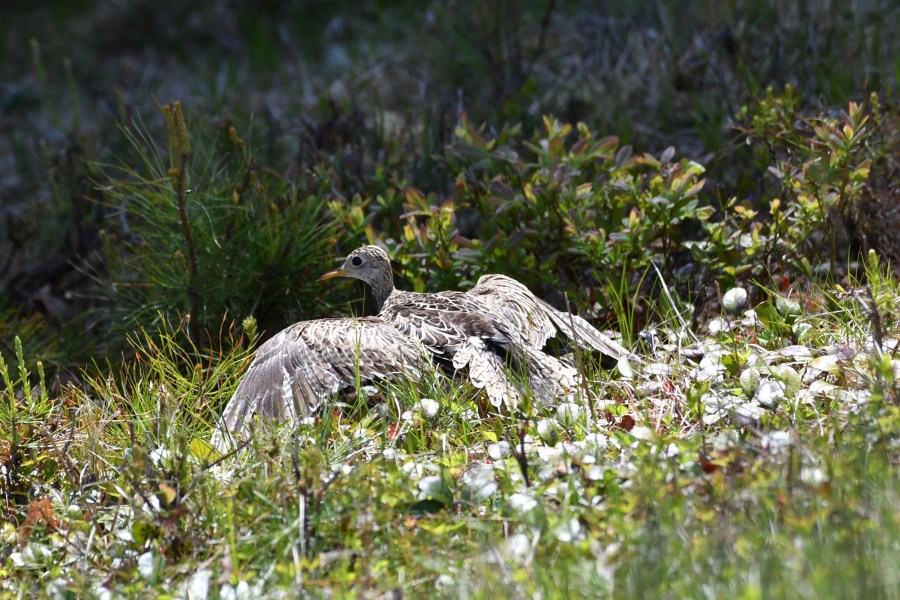
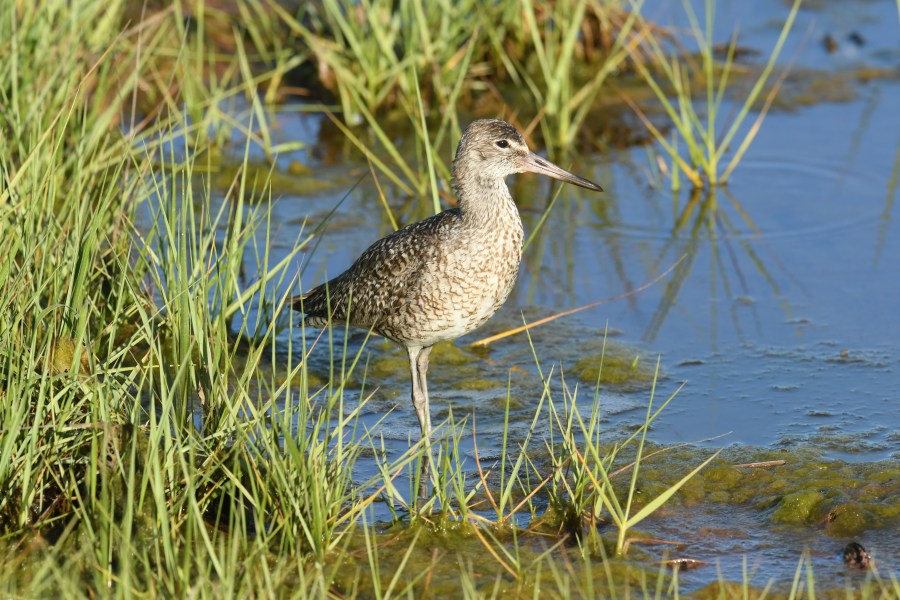
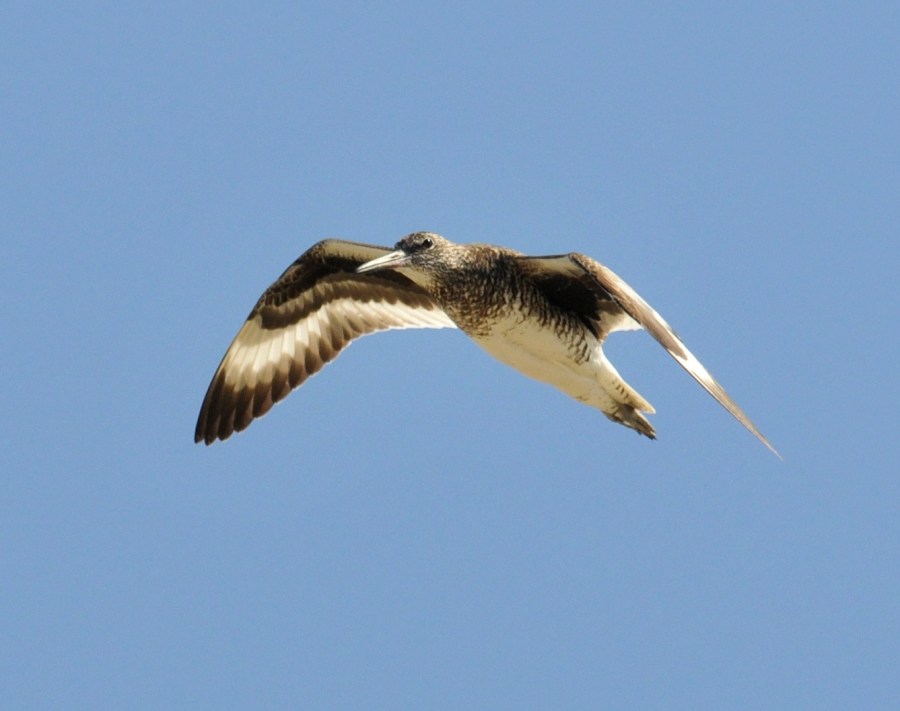
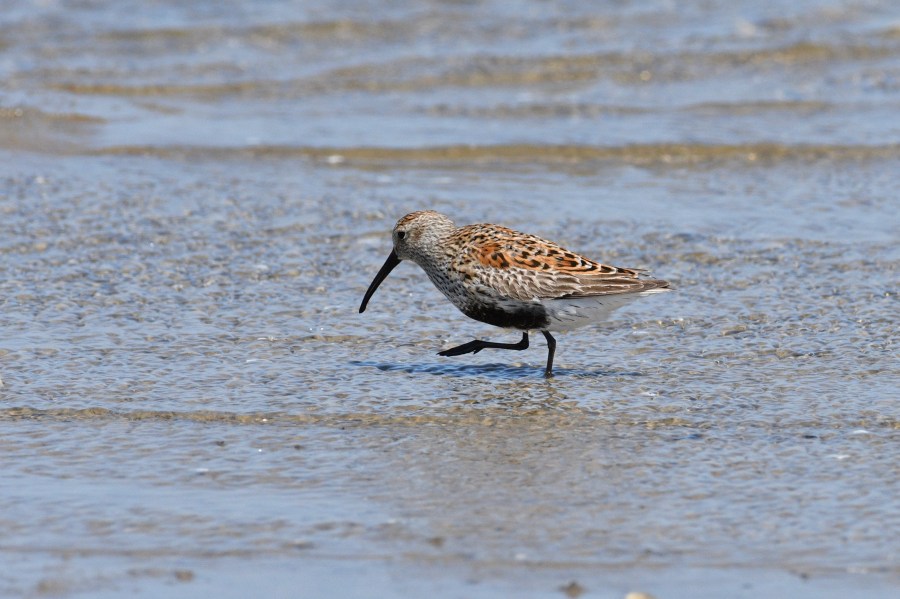
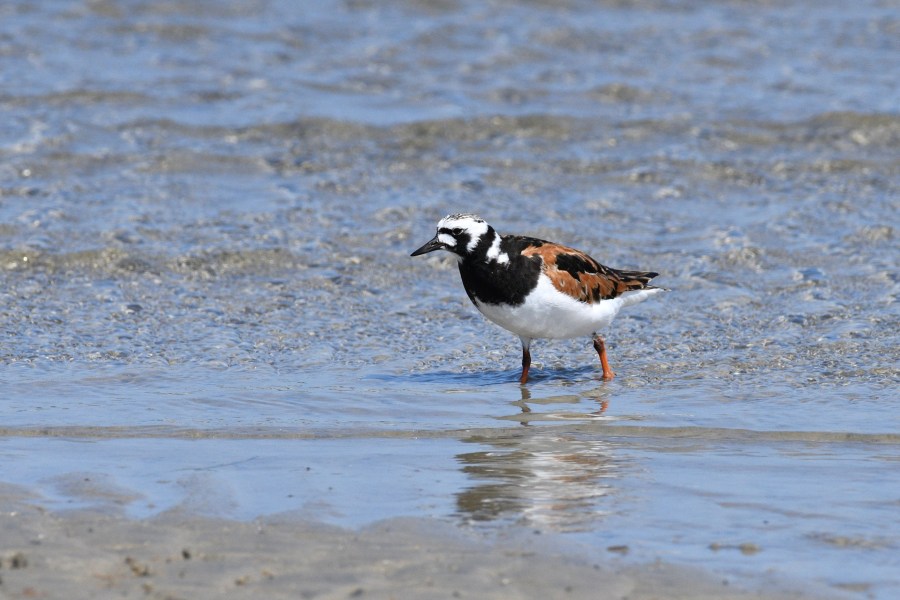
One of the oddities of the sandpiper group is that there are several that are more “grasspipers” than sandpipers. They once dominated prairies and grasslands. Several are from the wet edges of pond, stream, and lakes. They consist of creatures like the American Woodcock, Long-billed Curlew, American Golden-Plover, Spotted Sandpiper, Killdeer and the bird in the images above and below, the Upland Sandpiper (UPSA). The Upland Sandpiper is now a bird of airports and large managed grasslands. They were killed by the tens of thousands in the early 1900s and nearly wiped off the face of the earth. They are no where near as common as they once were.Many of the upland sandpipers (and plovers) have a distraction display that will draw predators away from the nest, eggs, or young. The bird in the image above is not static it is actually fluttering and sort of dragging itself along the ground – in an effort to get me away from the nest. Upland Sandpipers are quite uncommon now as they are limited to dry open grasslands and this is not a common habitat. These next two images are of the Willet (WILL). There is an eastern and western form; the eastern is a coastal bird and the larger western form breeds in inland areas but winters along the coast. The Willet is a large, stocky shorebird (sandpiper or wader) that has a surprise in its unfurled wing pattern. Ta Da! Here is a Willet in flight. That stocky dull bird does have some flair after all. The black and white wing pattern and their noisy calls make them an easy bird to locate and identify. In the early 1900s there was a huge market for shore birds. They were shot coastally both spring and fall in great numbers and sent to city restaurants by the barrel-full. Millions were killed. Many species have never recovered. The Willet is now rapidly expanding back into the salt marshes of the northeast United States. They were not nesting in Massachusetts when I was a boy but they are now widespread throughout the state. Good for them!Plovers are a group of 12 birds that are widespread across America. The Killdeer is the most widespread and the most commonly observed. The bird pictured above is the Piping Plover (PIPL) – named for it soft piping call. They are found on sandy beaches where they both feed and nest. It is a bird that has lost a great deal of its preferred habitat to human uses of the ocean beaches. They are easily disturbed when nesting, killed by animals both domestic and wild, run over by off-road vehicles and often see their nests destroyed by storms during periods of full moon high tides. They have been listed as “endangered” in the Great Lakes Region and “threatened” throughout its range. Thus those who want to drive the beaches in 4x4s are often disadvantaged by beach restrictions and closures put in place to allow the populations to successfully breed. Most beaches will open again sometime around the 4th of July but nest failures often see birds still nesting through July and into early August (occasionally). Plovers have a short stubby bill and pick at food rather that probe for food the way many sandpipers, godwits, and curlews do. The bird above is a mid-plumage example of the Black-bellied Plover (BBPL). In breeding plumage it has a coal-black belly. In non-breeding plumage it is pretty much a speckled gray bird overall. The Europeans call this bird the Gray Plover for the plumage its in for 8-9 months of the year, where we use the Black-belly name for the plumage of those other 3-4 months. Both names can be defended. In flight this rather common plover always shows black “wing-pits”.The bird above is the Dunlin (DUNL). Named for its non-breeding rather dull brown plumage. In breeding season they become the rather brightly colored sandpiper shown above. In the olden days of birding it was called the Red-backed Sandpiper after this bright breeding plumage. The longish bill is used for poking and probing. Part of the scientific name for this bird is “alpine” and refers to the fact that these guys fly well north into the tundra oof Canada, Alaska, and Siberia. They will then fly south to the tip of South America, southeast Asia, and even on down to northern Australia. The Ruddy Turnstone (RUTU) is reddish (hence ruddy) and does in fact turn over stones (and shells and sea weed and more) on the beach to expose food items. They go through a significant plumage change as do many shore birds. They are always looking like Ruddy Turnstones but the sharp face pattern becomes muffled and the bright colors become drab. But the pattern remains and the small pointy bill stays they same. They are also far-northern nesters and then long distance migrants to the south. In fact they are not uncommon all around Australia and New Zealand after nesting on the Bering Sea in Siberian Russia. The birds I see in migration heading north may breed in far northeastern Greenland and then pass by again in August and September heading for Tierra del Fuego thousands of miles to the south.Sometimes birds appear that are a bit of a surprise. The two birds above are Wilson’s Phalarope (WIPH) in the foreground and Lesser Yellowlegs (LEYL). The Phalarope shouldn’t be here. But something happened to get it off course during a migratory flight and it ended up out on Cape Cod. Perhaps it got caught up in rather strong winds up high while migrating and just kept going. Or perhaps its internal compass is broken. The phalarope is a western bird but isn’t really uncommon as a vagrant. Phalaropes as a group (three species total) have lobed toes. Not webbed feet and not skinny little toes; they have flap-like lobes on each toe. Their feeding habit is to swim in a tight circle drawing water critters to the surface where they pick them off the water’s surface. The lobed toes help in creating the currents and eddies that move the water.This last one is the partially web-footed Semipalmated Sandpiper. It does have partially webbed toes. This allows it to walk easily over wet surfaces without sinking – kind of like snow-shoes for the wet shore line. This is also one of the birds that cause many beginning birders to become exasperated with shore birds. It is one of the 4-5 “peeps”; small gray or brownish sandpipers that have to be studied a bit in order to tell them apart. There is the Least Sandpiper (LESA), the White-rumped Sandpiper (WRSA), Baird’s Sandpiper (BASA), Western Sandpiper (WESA) and the Semipalmated Sandpiper shown here. They are all quite similar but size, color, habitat, geography, and the calendar can all help make identification easier.
Please treat all images as copyrighted and ask permission to use them for any reason. Thanks.
I am fully aware that even with the more drab birds their mothers are proud of them and they are lovely, not drab, in her eyes; but there really are certain birds that are brownish or grayish and just don’t sparkle. Here are a few of those, along with a compensatory bright bird or two. It is the month of May and we are deep into the season of northward migration. All the birds that wintered in Mexico, Central and South America, or the southern USA are making that long flight back to their northern breeding areas. There are even a couple that come up from Tierra del Fuego!
All in all this is pretty remarkable – many of the warblers weigh less than half-an-ounce and many of them will fly more than 3000 miles each way. The great boreal forests of the northern hemisphere (holarctic – including Siberia as well as Canada) will be the destination for many of the warblers and flycatchers. The sandpipers, jaegers, and some terns will fly even further, up into both dry and wet tundra, well above the Arctic tree line. Many of our sea and bay ducks are already up in the north country nesting alongside tundra pools or in boreal forest trees.
So here are a few images with captions. These are neighborhood birds; nothing was sought out to be photographed, they just happened by. You can see them and record them as well. Look into eBird; a great free data base and information service regarding birds…really you should look it up and enjoy. Some day I will do a page on sparrows as people often ask about them – they are also drab and brown; but show much more variation than you first imagine.
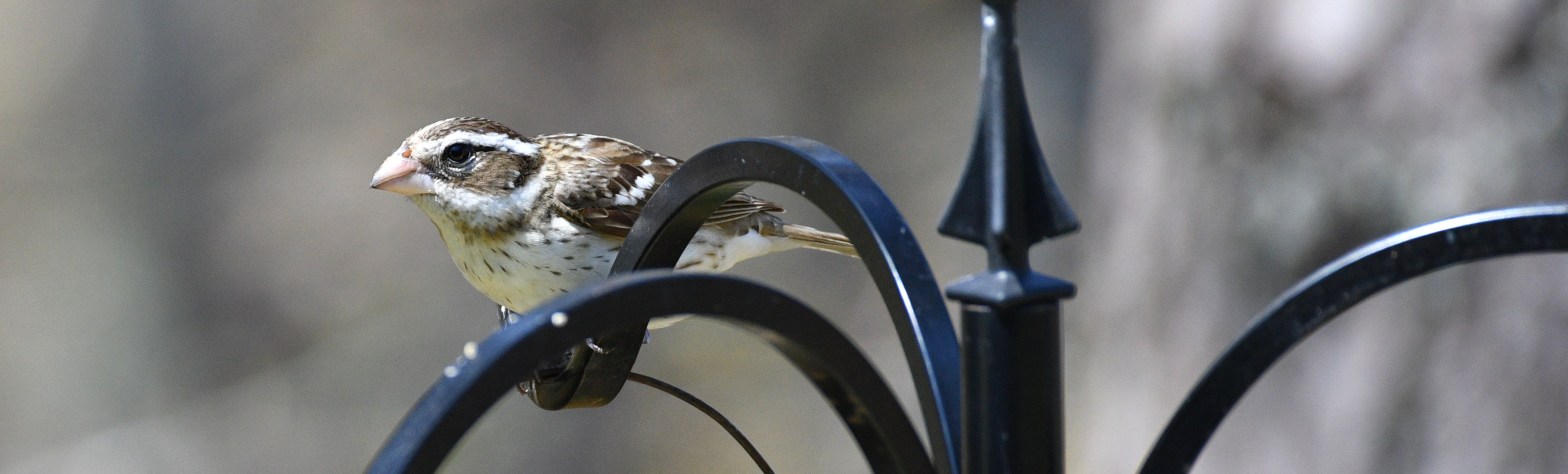
The bird in the header image is a female Rose-breasted Grosbeak (RBGR). The male is black, white, and has a bright red bib; quite eye-catching he is. It looks like he is wearing a tuxedo with a red ascot. The female is like a big chunky sparrow. The large beak is very much a characteristic of Grosbeaks as the name announces, but otherwise she is well designed for remaining out of sight on a nest up in the trees and is not dressed to walk the catwalk with her splashy mate.
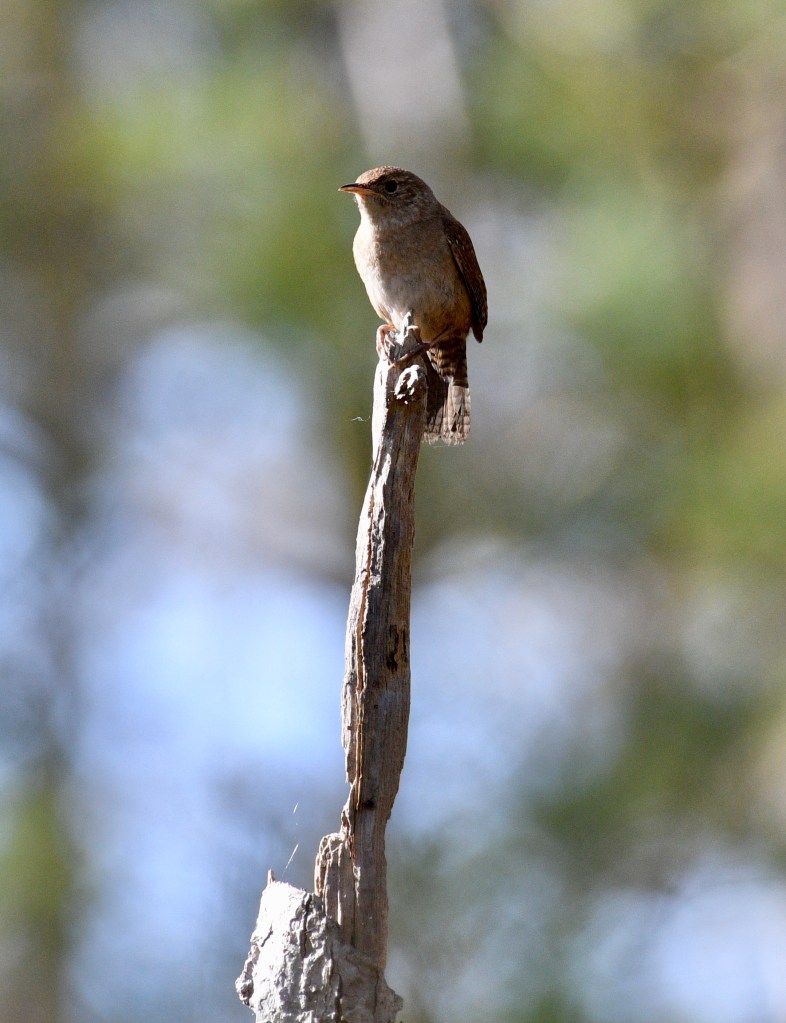
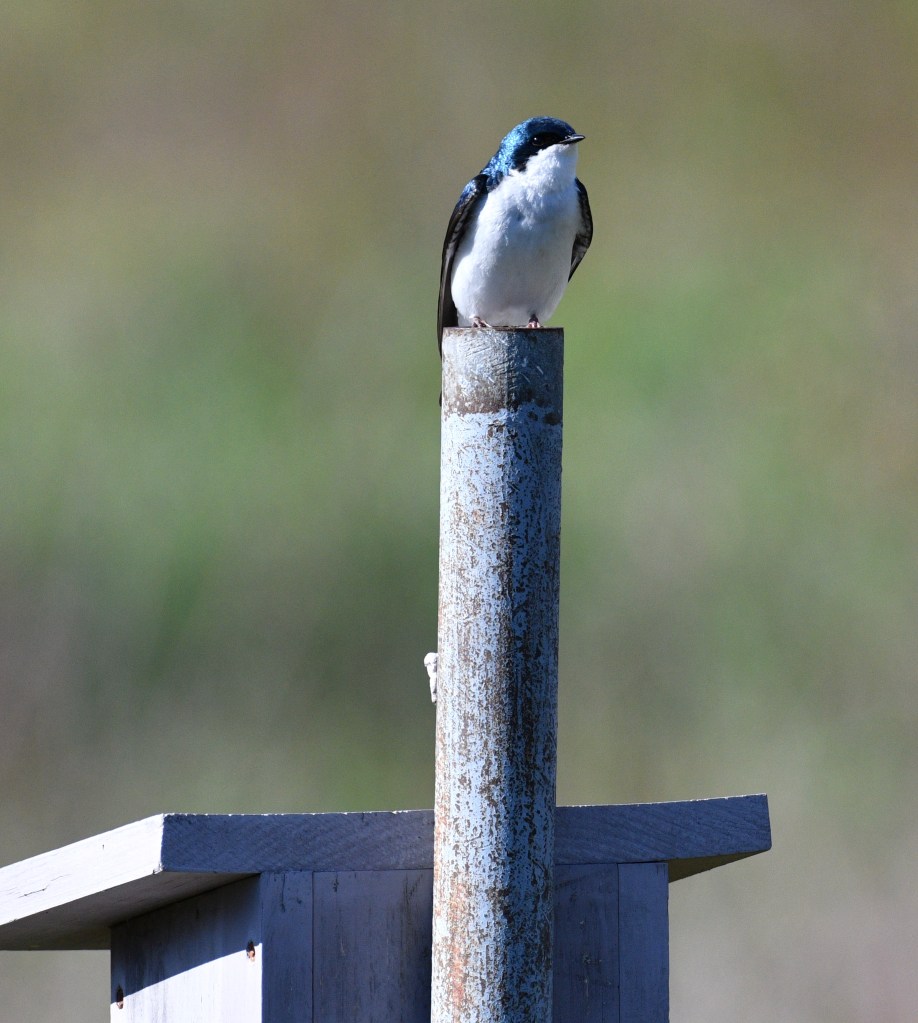
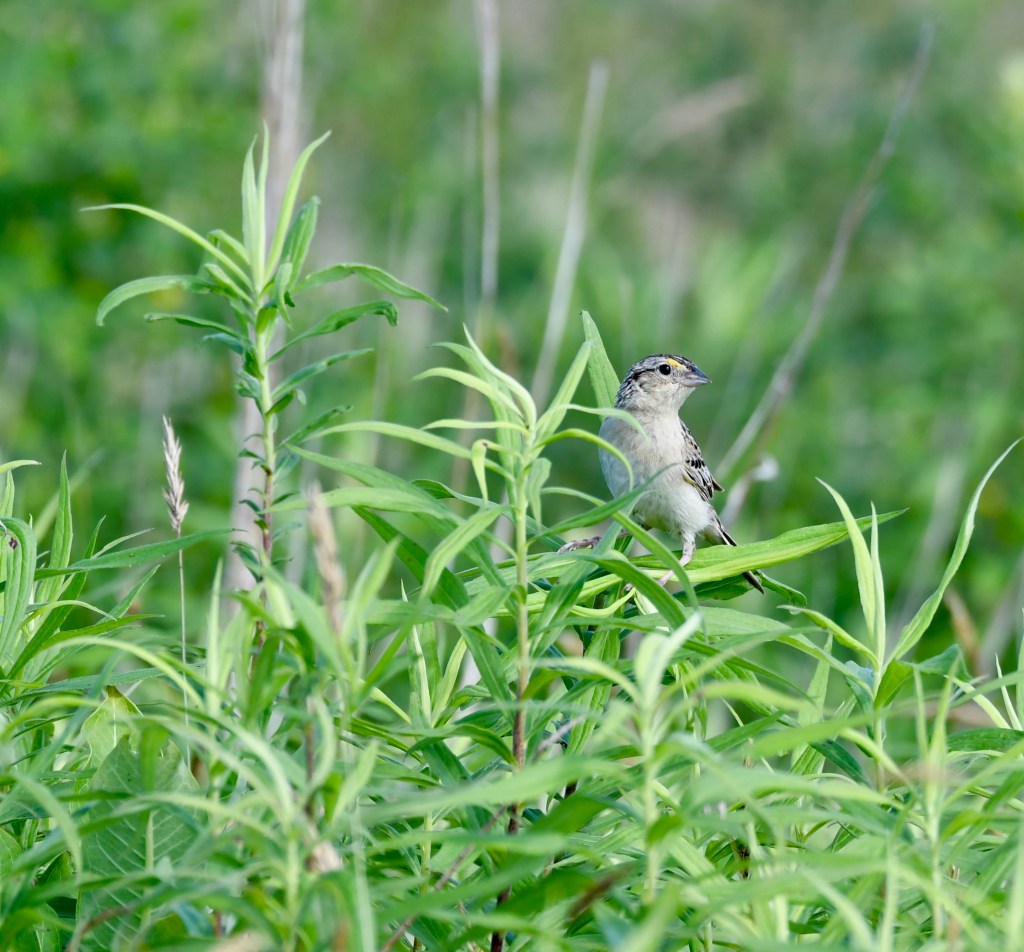
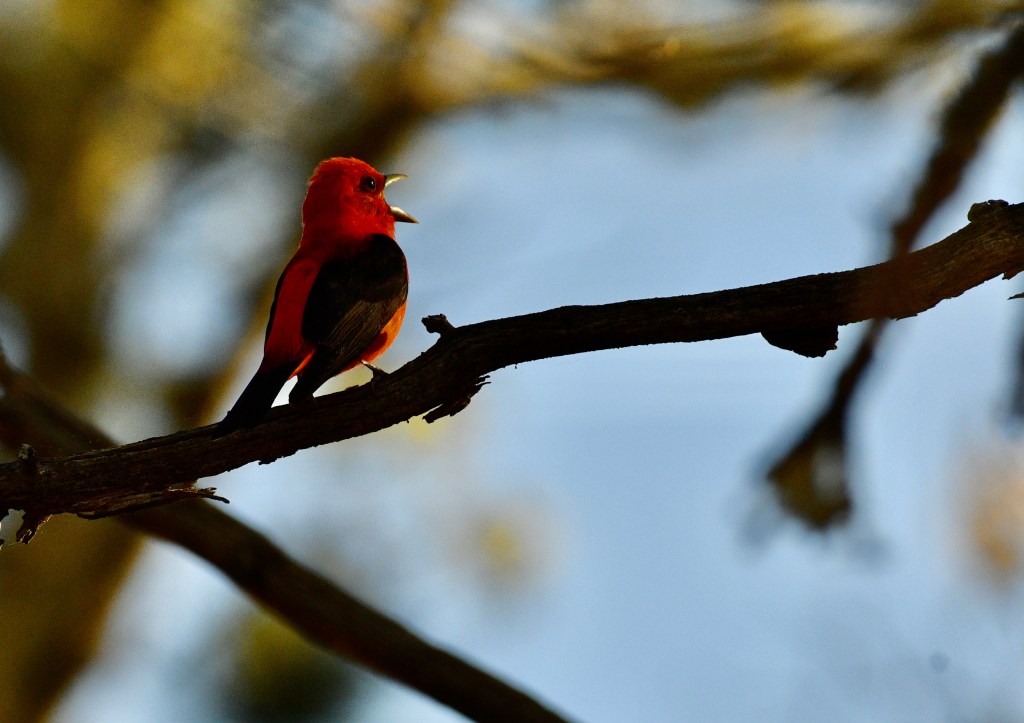
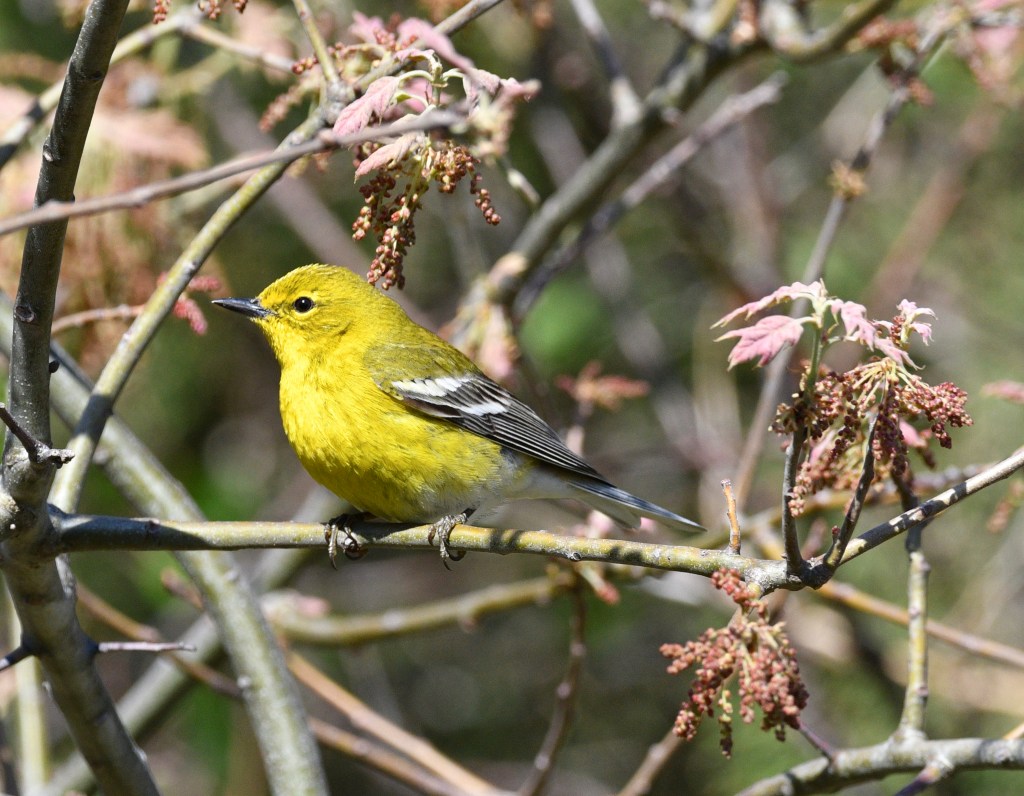
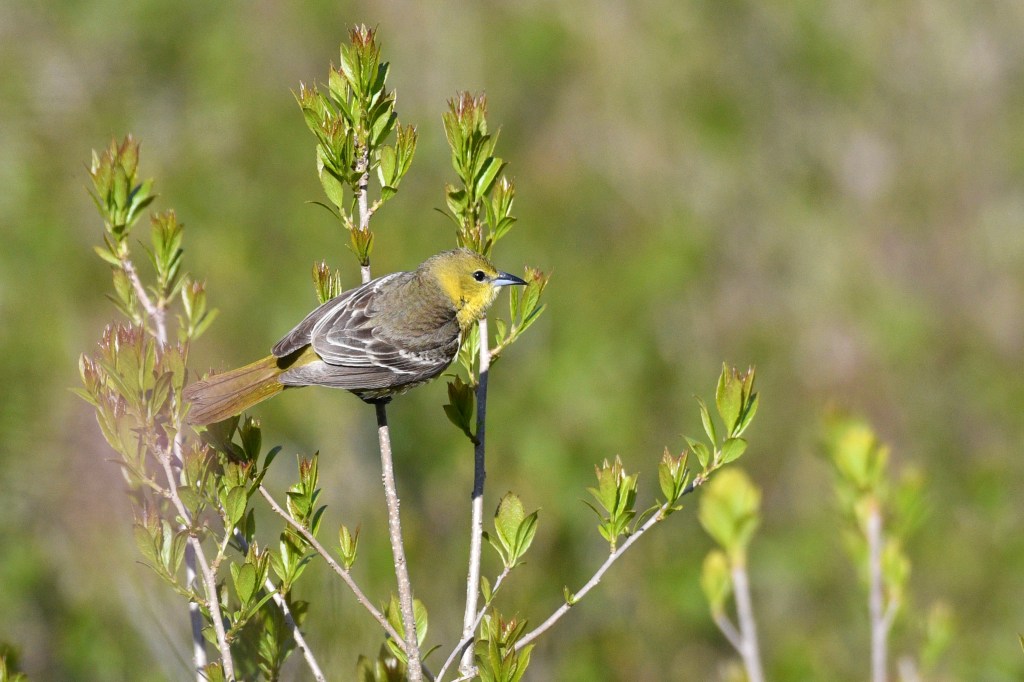
The House Wren (HOWR) is a very widespread and common bird. Out here on Cape Cod it is not very common but there are more now than there were ten years ago They will nest in bird boxes in your yard and are a busy and entertaining addition. But they are notorious for destroying Tree Swallow (TRES) and Eastern Bluebird (EABL) nests by piercing and removing the eggs. They do not make good neighbors. There are several kinds of wrens across the USA. Here in the east we also have the noisy and curious Carolina Wren and the secretive Marsh Wren. In the midwest the Bewick’s Wren (BEWR) can be added and further west the Cactus (CACW), Rock (ROWR), and Canyon Wrens (CANW) join the list.One of the more common nes-box birds is the Tree Swallow (TRES). Tree Swallows prefer open areas and the boxes ought to be away from the tree line as that is where the infamous House Wren hangs out. The males and females are both gun-metal blue on top and white underneath – though it takes a female two years to develop that plumage. The one-year old females are a dusky brown not blue. They will lay up to 8 eggs per grassy nest (in the box) and fledge the young in about 14 days after 14 days of incubation.This is a Savannah Sparrow. The SAVS is a grassland bird found widely through North America wintering into Mexico and breeding into northern Canada pretty much from coast to coast. As with most creatures that live over a wide range there are geographically different populations. There are several slightly different groups found in the US, here in the east we have the good old savanna savanna, a sort of base line type. There have been over 20 sub-species named at one point and there are now 17 listed forms. This is much to complex to discuss – or even understand. Anyway it is a common bird, not very shy, with a lousy sort of squeaky hissy song, and great yellow eyebrows (lores actually).This is a Grasshopper Sparrow (GRSP). It is another one with yellow eyebrows. It also has a very hissy song and is easy for us humanly-eared creatures to overlook. It has a flat-headed profile with a warm buffy underside. This is another migrant that returned to our grasslands in mid-May. They winter in warmer areas including our southeast, along the Rio Grande River, and in southwestern Mexico. The best guess would be that those nesting in the northeast migrate south into Georgia and Florida and that the mid-west population stays in Texas and northern Mexico and the western birds head down along the west Mexico coast. It is a declining species as are many of our grassland birds.The Scarlet Tanager (SCTA) is a bright bird of the woodlands. It sings from the tops of trees and nests in the same place. It is stunning in the sunlight and not very hard to find – you just have to go out and listen. This is a long distance migrant and like most tanagers it really is a bird of the southern tropics. Our SCTAs leave in September and fly to NW South America spending several months on the east side of the Andes in Columbia, Peru, Ecuador, or Brazil where they join a couple dozen of their tanager cousins. It is a widespread and colorful group of birds in the South American tropical forests.Then there its a Northern Cardinal (NOCA). This one is trying out a new hairdo; the swept-back look. Cardinals are loud and common and certainly not a drab brown. There is a female in a prior blog post for comparison. She is softer and grayer, but otherwise most definitely a cardinal; kind of drab I guess..Just for color I’ll add these last two; this is a Pine Warbler (PIWA) a rather common nesting (and occasional wintering) bird here in the northeast. The males can be very yellowish and second year females have a good splash of yellow as well. The first year females are quite gray. Many of the males will have dark olive striping on the sides of the breast – this one has very light striping.This is a female oriole; it isn’t easy to tell a female Baltimore Oriole (BAOR) from the female Orchard Oriole (OROR). So with that in mind I’ll mention that the male Orchard Oriole is a rich chestnut brick color and really handsome in the sunshine – though a bit dark overall when perched in the shade. The orange-yellow Baltimore needs little introduction or description. (You can look back a couple posts for male orioles at the jelly dish.) The two species pretty much leave the US in the winter and spend their time in Central America for the most part, though the Baltimore Oriole population oozes through Panama into Columbia. I am not sure – and others who have seen the image are not sure – but we think this oriole is a female Orchard Oriole because it is so yellow in the throat, the lower mandible is so bright, and there’s a good sized patch of almost-yellow (a new color) on the “neck” behind the eye. In order to be sure the undersides need to be seen and then it is still somewhat of a judgement call as to how much yellow there is and how bright it is. The females of each species tend to mate with the appropriate males and the males do the same – so at least they can tell which species is which.
The phrase: “birds of prey” usually brings up images of hawks and falcons and maybe eagles as well. But in reality if you are an earthworm the American Robin bob-bob-bobbin’ in the yard is a real predator. I guess that “birds of prey” might include thrushes, flycatchers, loons, all diving ducks, sandpipers, and most other birds as well. Very few eat only fruits, grains, or vegetables. But here we will look at some of the hunters, the killers, the swift, and merciless. Perspective is always important – remember that there is no right or wrong way to live or behave; opportunity and the resultant evolution drives and determines behavior. Those best adapted and most able, survive to breed. If you see the world from a plants perspective (and we will look at that in upcoming posts) almost everything seems to be a threat or a predator. But, again, perhaps as usual, I digress.
The images below are of a few local birds of prey – many of the images were taken in our yard and many of them, as well as a few others, are likely to be part of your daily life as well. Look around, you’ll see things.
There are several major groups of hunting birds; those with tearing beaks and sharp talons. The owls and hawks and falcons and osprey and eagles are very similar in many ways and different enough to be individually recognized by a third grader and separated by experienced taxonomists.
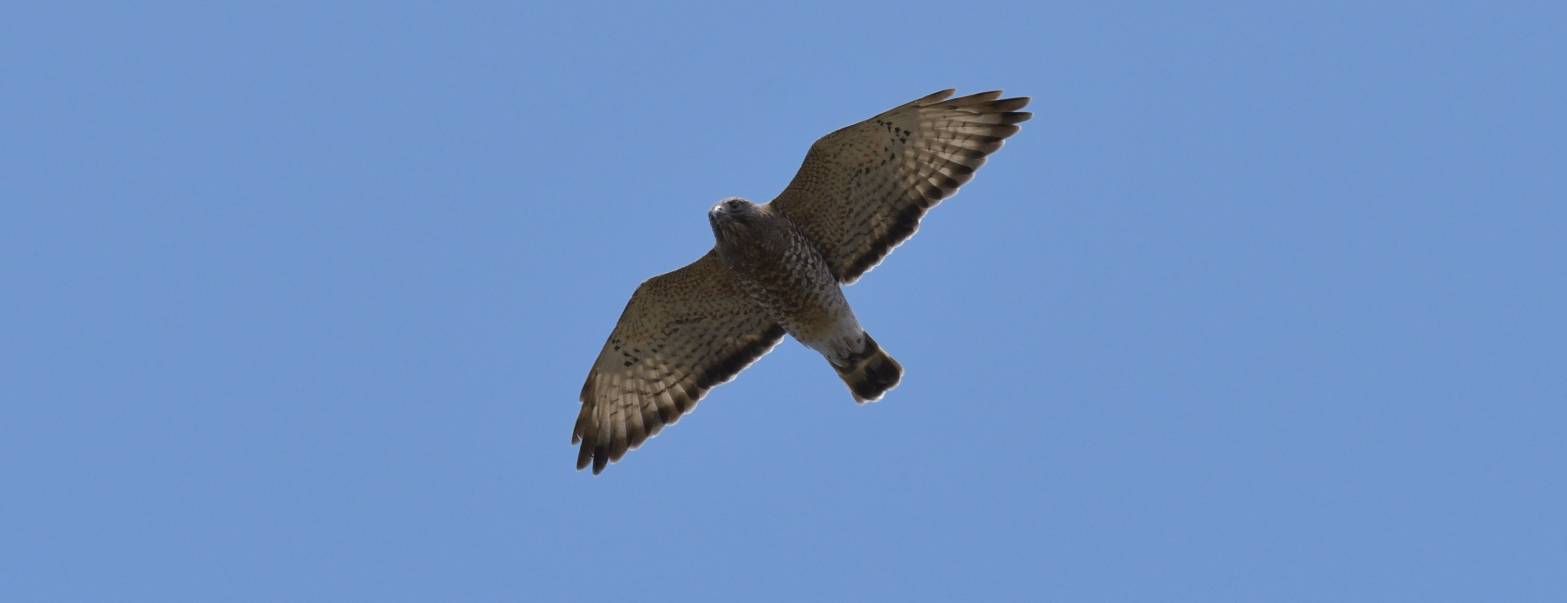
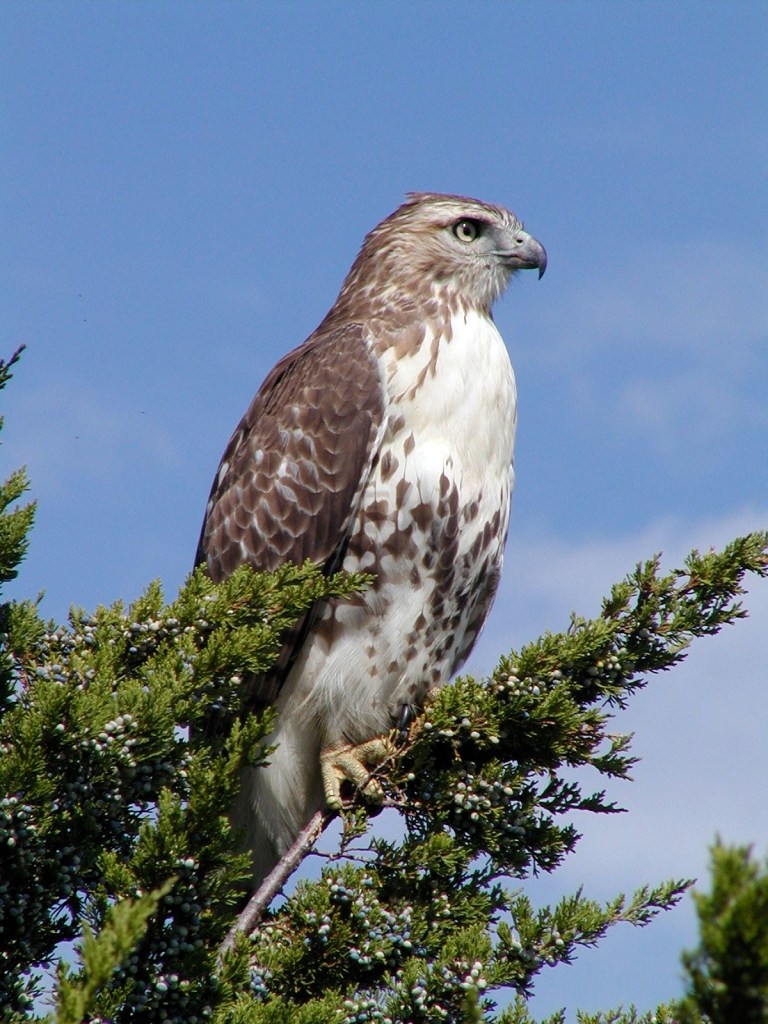
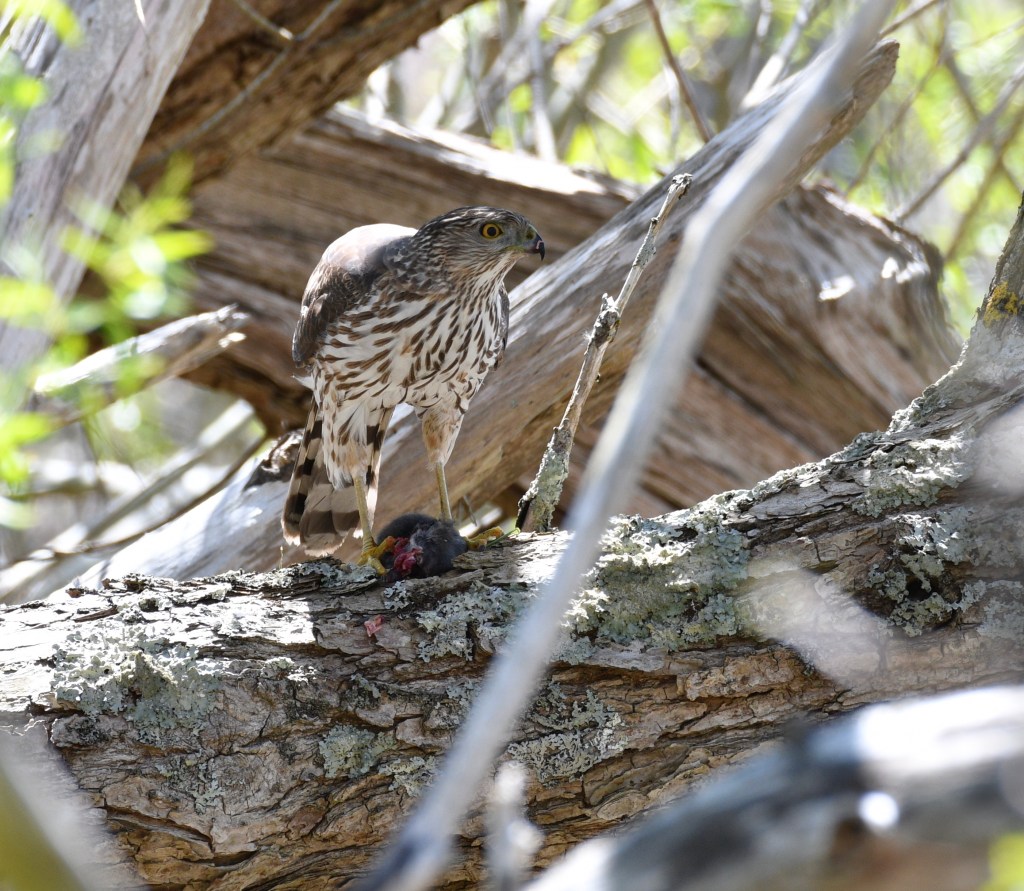
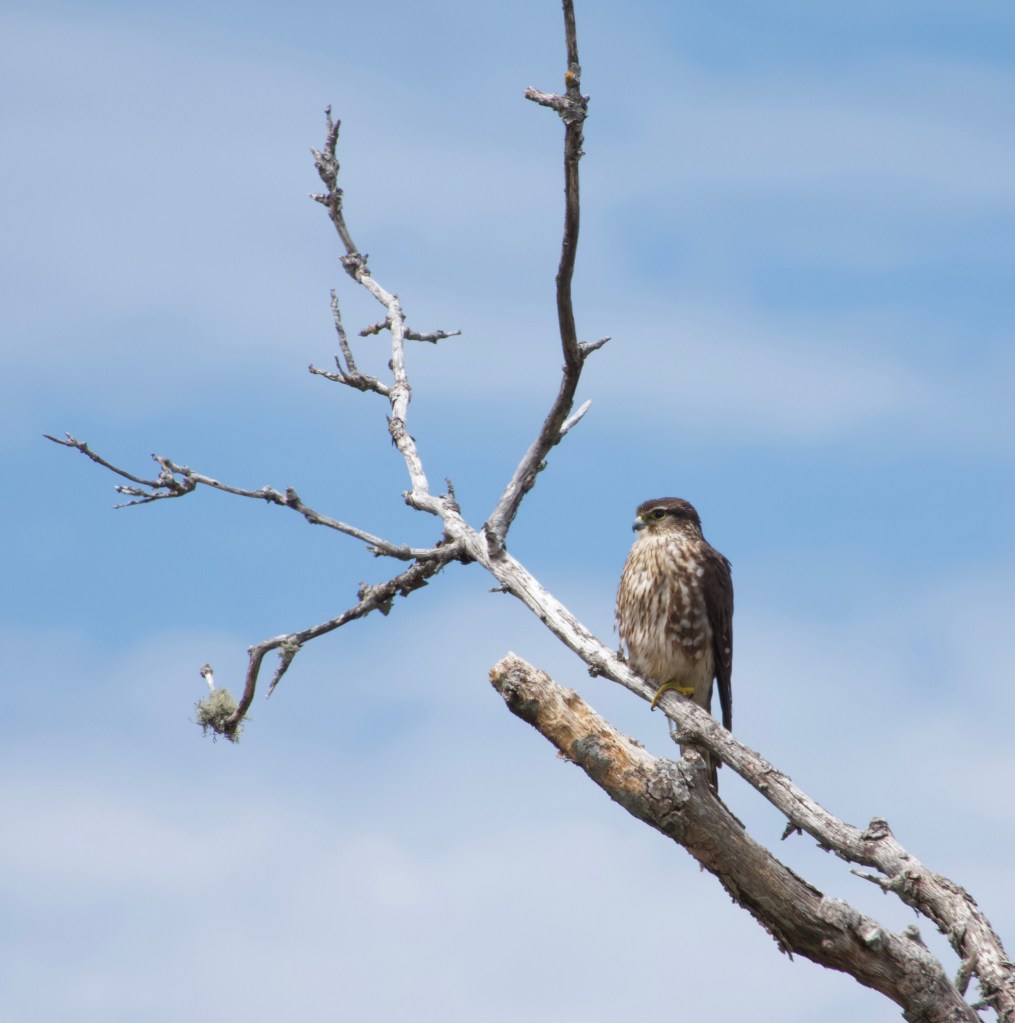
The first two images are of a Red-tailed Hawk (RTHA). This is a Buteo and is one of the most common birds of prey in North America. There are many populations across the continental US (and in to both Canada and Mexico) and most are recognizable by plumage differences; lighter colored birds here in the east and various darker groups to the west.Like many of our hawks they are largely, but not universally, migratory. Though they will often “rebond” with the same bird at the nest site in the spring. They do not migrate together nor winter together in the south. In many species the females are larger and the males smaller. This is true with the Red-tails. When seen soaring together in the spring as they court and prepare to nest, the male is obviously smaller.Another of the Buteo hawks is the smaller Broad-winged Hawk (BWHA). This is a bird of the woodlands and is both a nesting species and passage migrant here in northeastern USA. They migrate in dense flocks and high numbers into Central and South America in the fall and return to the US over the Texas border in mid to late April. Many years ago while leading a birding tour for Mass Audubon, along with the great Jim Lane, I once saw tens of thousands of Broad-wings returning into the US on the southerly wind. They were hung in the sky, traveling on the wind, in such numbers that they appeared as do the Northern Lights. The sky was draped with them. Obviously a memorable occurrence. The lead image of this post is of a Broad-wing overhead here at the house – a pair was scouting a yard tree for a nest. They chose somewhere else.This lean bird of prey belongs to another group, the Accipiters. This is a group that hunts other birds. To that end they had shortish broad wings and a long tail. These features allow them to fly into and through woodlands turning and wheeling as they must in order to chase down smaller birds. This image and the one below are of a Cooper’s Hawk (COHA). This bird has become quite common in the east. It’s smaller cousin, the Sharp-shinned Hawk, was very common until about 30 years ago and in the last few decades the Cooper’s has increased and the Sharpies have declined. They have a larger cousin called the Goshawk and that bird can catch and kill birds as large as chickens – a feature that has made them persona non grata in farmland.This Cooper’s Hawk is on a limb with a bit of food between its feet. I am not sure what it has caught but it looks like a young crow that it took from a nest. I see these Accipiters zipping past the bird feeders a couple times a week. They may do it every day for all I know. In the past three weeks we have had Mourning Dove (MODO), Downy Woodpecker (DOWO), and Northern Cardinal (NOCA) feathers strewn about.The Peregrine Falcon is a living icon. Conservation, speed, and skill all have peregrine references. It is a sleek and powerful bird. It will eat a variety of things but it is another bird-catching specialist. It will rise up and dive down in a blinding stoop (dive) taking birds near the ground. It is said that their diving speed can approach 200 miles per hour!! Hard to imagine – until you see one chasing a flock of Red Knots (REKN) or Green-winged Teal (GWTE). Wow.This last image is of a tiny falcon, the Merlin (MERL). It is a bird that nests in the northern forests and migrates deep into the south. It measures only 9″ (22cm) and is fearless. This particular one let Fran walk up to it and take a series of images. They are bird and insect eaters and take their prey by flying straight at it and catching it with a final flourish. They are bold little guys unafraid of any other bird and will harass peregrines, eagles, and hawks. The belly often appears dark both in flight and when perched.
Again, please treat all images as copyrighted and do not copy or use without permission. Please share this blog site. Thanks, DEC.
These last few days are the middle, the peak, of the northward migration of neotropical wintering birds as well as those that have wintered in southeastern USA. Mid-May in New England can be quite wonderful; full of noise and color and optimism.
However, out on Cape Cod we almost never get huge numbers of birds as they usually fly up the mainland. Once out here they are a bit stuck as they either have to retrace their steps or fatten up locally and then cross the Gulf of Maine. Yet, there are always a few ways for me to pass the time until something special arrives. Here are a few of those time-passing moments.
The lead image at the top of the blog page, “featured image” as WordPress calls it, is a tiny little bird called Blue-gray Gnatcatcher. They are very numerous this year and always a springtime treat.
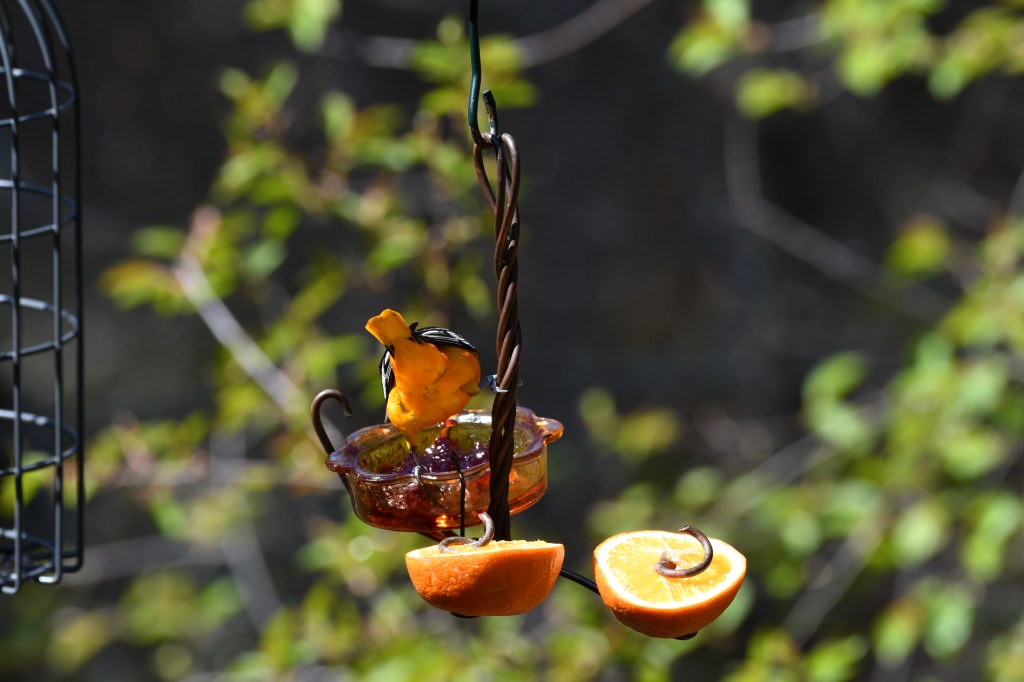
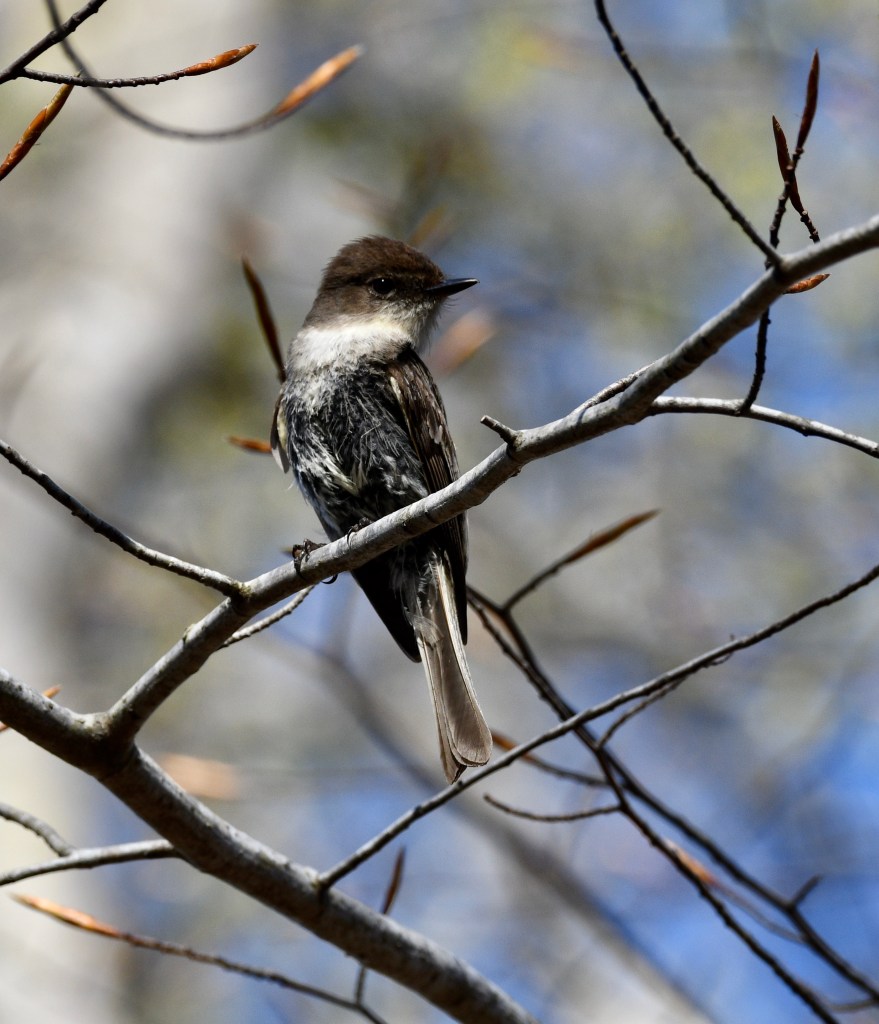
I will start with simple honesty – I take a lot of pictures that are something like this. In the olden days of 20th century we would spend about 50¢ per slide to get our photos. It was expensive to take ten or twenty images and hope to get one that was really good some two weeks later when Kodak had developed the roll of film and returned the 36 slides in a yellow box. The wonders of digital cameras!! I now can take thirty-six images and review them in seconds. Still many of the images are pretty much like this posterior shot of a Blue Jay (BLJA).One of the common birds of shrubby growth in our world is the Gray Catbird (GRCA). This is a perky, seemingly confident bird that mumbles and warbles most of the day. In the late summer the adults and new young are very, very common and visible. This is a typical look: black cap, gray body, and distinct eye. However there is a bit more……The Gray Catbird has a bright cinnamon-colored array of under-tail coverts – rump feathers that is. Many birds seem to develop breeding plumages that help to attract the opposite sex and repel competition from members of the same sex. This seems an odd way of showing dominance or strength or breeding capabilities. But, it is a great color isn’t it?Here is another butt-shot. This is a Baltimore Oriole (BAOR) showing the yellow-orange sides and the even yellower undertail feathers.There are at least four orioles (and a couple catbirds) that are eating the grape jelly. This is a bird that (for the most part) winters in Mexico and Central America and seems to enjoy the more tropical food offerings when it first returns up here in the north country.This bird box was installed to lure in Great-crested Flycatchers (GCFL). It did, but they haven’t nested in it. We even put a camera in it to record the inner workings of a nest – but the squirrels (this time probably a Red Squirrel) chewed through the wires. The box has had Tufted Titmice (TUTI), both White-breasted and Red-breasted Nuthatches (WBNU & RBNU), and the ubiquitous Gray Squirrel showing interest. Anyway, the latest use is by this Red-bellied Woodpecker (RBWO) who drums on it using it as an amp or reverberation chamber, to make him sound bigger and better. Don’t be fooled by big talk ladies……This last photo is a sad story — I almost led with it to get it over with, but decided to finish with it. The belly feathers on this Eastern Phoebe (EAPH) are not full or fluffy; they are spare and very worn looking. The best researcher in the northeast on migratory birds is a chap named Trever Lloyd-Evans and he has banded and recorded birds in Plymouth, Massachusetts for some thirty plus years – he has seen it all. Well, Trevor tells me that this bird is likely to be suffering the aftermath of being wet, or even soaked, with an oil. Perhaps bathing in a puddle of oil that looked like water or water that was polluted by oil. The bird then trys to preen the feathers and they pull apart and the bird ingests the oil. It is feathering like this that is washed and cleaned on birds after an oil spill – but many (perhaps most) die. Incidentally our flycatchers, and many other birds, are being dramatically impacted by the use of nicotine-based insecticides.





























 On The Road With DEC