Hippos, Rotund African “River Horses”

Please consider the images to be copyrighted and use only with my permission.
Thank you. DEClapp.

The hippopotamus is a chunky animal with a wide body and short legs. They can weigh up to two tons and big males often more than that. An average weight might be about 3300 pounds (about 1500 kilograms). They are chunky; have short legs, a short neck, a big head, with a cylindrical body and an arched back. One of the in-the-field characteristics of hippo country are the neat little trails they use to get from the water to the grazing areas. The chubby body and short legs means that they cannot step their own toes or cross their legs, nor can they trample a wide swath as they walk. The left legs make a narrow trail and the right legs make a separate narrow trail. For a big animal they seem to walk delicately through the bush. The two lane trails are obvious once you know what to look for.

They also make exit trails from the water where they spend the day. They leave the river via the same path each evening and break down the sandy edges of the river bank. These sloping trails to and from the water are what the migrating wildebeest and zebras use when crossing rivers. They descend along the hippo paths and hopefully they find another path, on the far side, that offers them an escape from the river (and the hungry crocodiles that just wait for the migration). The migratory beasts don’t plan well and sometimes get stuck against the far bank; sometimes with dire consequences.

hippo
Hippos spend the day in water. They actually produce a viscous fluid that protects them from the sun, but staying in water is most helpful in keeping their body temperature even. They are in smallish family groups for the most part. However, in the dry seasons when the casual water dries up they will be found in larger groups in the remaining permanent water holes. Most of the time there is a dominant male and a group of females with a scattering of younger animals. The water is usually filthy and quite fetid as these large animals process a great deal of vegetation and have rather casual bathroom habits. You would never drink from a hippo pool.

Hippos are quite dangerous especially in the dark. They travel long distances from the water and they can panic if they feel separated from the water. Most people are hit by the large and heavy head of the hippo or are trampled as the hippo bolts for the water. It is an unpredictable animal, and very widespread, making it one of the most dangerous animals on the continent.
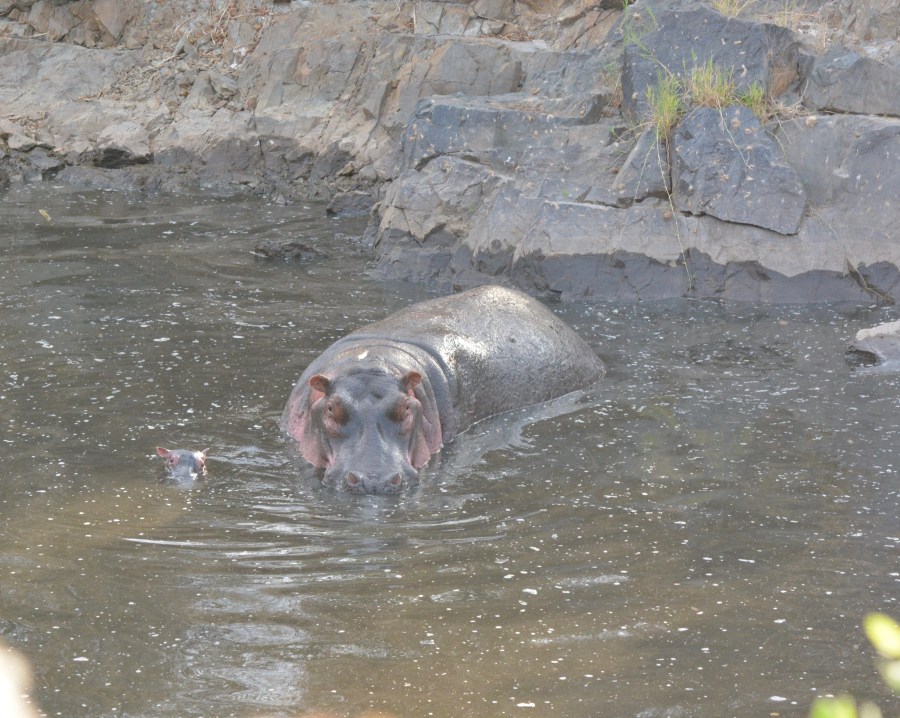
2018 serengeti hippo baby
Babies are quite small and can be rolled and drowned when the males cause a rumpus in the loafing pod. Thus the females move off from the group to give birth and then keep the babies away from the group until they master the holding-your-breath aspect of living in the water. Once capable they will be able to hold their breath for 5-6 minutes and often drop to the bottom and slowly bounce back to the surface. They are generally in very shallow water. The female above had just given birth to the tiny baby just off her right jowl. The baby was able to move in the water but stayed within a couple of feet of the mother the whole time I watched it. It will be a few weeks before the babe is brough back to pod.
hippo
Once they can swim and hold their breath the young join the main group. But like most creature they enjoy the company of others within their own age bracket. When the older youngsters wander about they are often with others of their own age class and somewhat separate from the bigger adults.
hippo
There are some places where the river banks are not sandy but quite rocky and don’t slope very much. In these areas the hippos are very careful when coming and going. They walk very slowly and are sure of their footing along the way. These two just came down the sandy path in the upper left and then carefully picked their way across the rock shelves and finally back to their spot; a shallow bay along the river’s edge. This image is from the Rufiji River in the Selous NP in southern Tanzania.

Hippos have an even number of toes; four on each foot. That is important as grazing animals, most land mammals, are divided into two groups – those with an even number of toes and those with an odd number of toes. The even-toed are the Artiodactyla and the odd-toed are the Perissodactyla. The latter group, odd-toed, contains the horses, rhinoceroses, and tapirs who balance on their hoof-covered, third digit. The former group, even-toed, contains the hippo, deer, goats, camels, pigs, bison, giraffe, antelope, and llamas and they walk on their third and fourth toes, often fused. This divergence in hand/foot structure goes back about 53 million years when the even-toed animals first appear in the fossil record. By the way, the word ungulate isn’t really a good taxonomical word; it usually refers to hoofed animals although it is often used to refer to the cud-chewing animals. And further by the way; a hoof is merely a modified toenail.
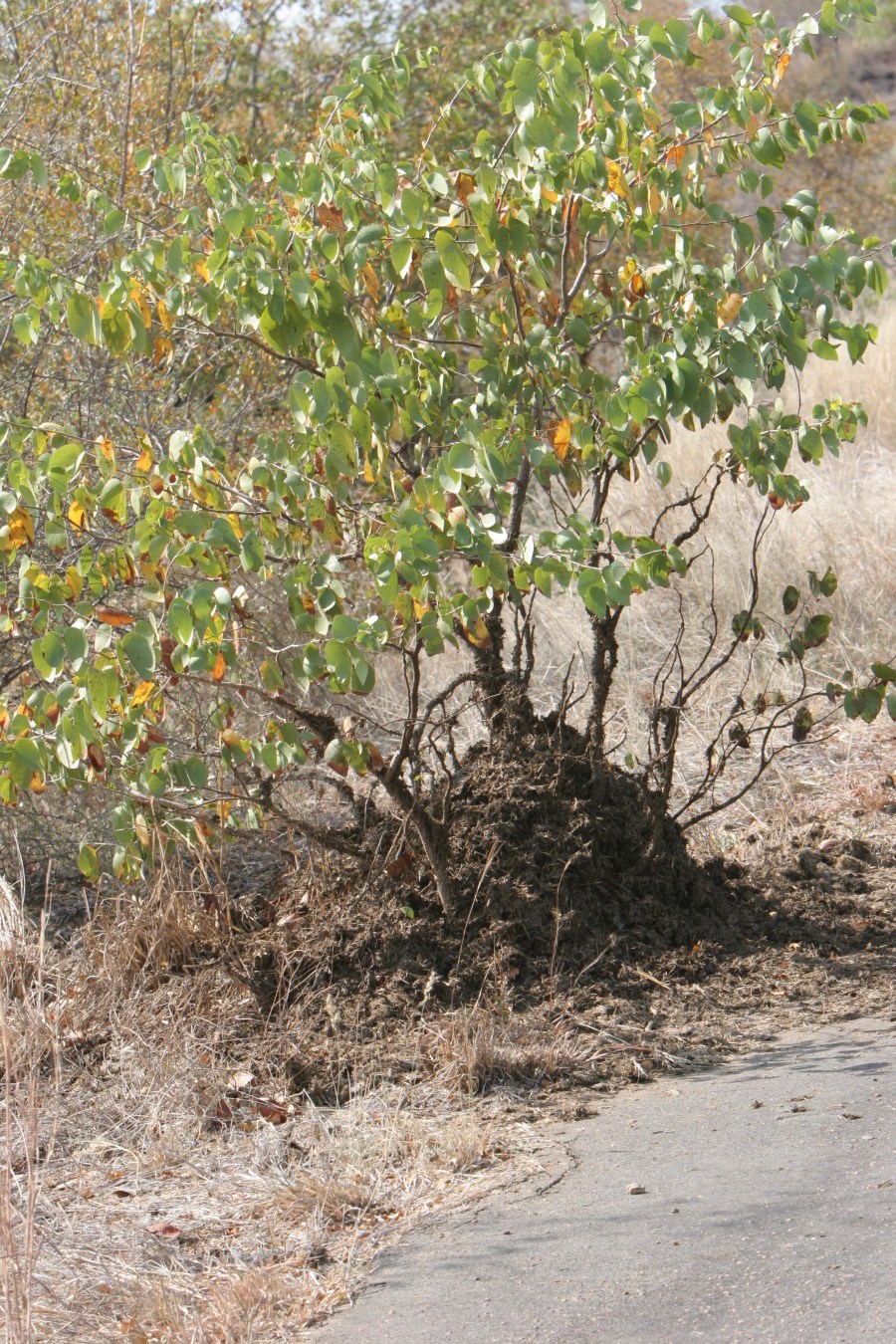
Bob-S.Africa1 121
This is a very nice picture of a rather significant hippo behavior; however odd we may think it to be. When leaving the water the male will defecate on a shrub or bush and splatter the feces with his short flat tail. This will serve as an olfactory memo to other hippos that he is still in residence and still in charge. Scent is an important part of the world beyond humans. Reproductive readiness is usually announced by pheromones and discovered by the sensitive noses of the males; female lions, elephants, gazelles, and many other animals announce their health and state of fertility by leaving scent clues for the males

Like elephants, hippos are declining rapidly because of poaching. The large teeth are sought after for carving and for a wrongly presumed to have a medicinal value. Loss of wetlands and grazing habitat (mostly to farming) also is having an impact.

The hippo’s nearest evolutionary relative is an aquatic or semi-aquatic creature from which evolved the cetaceans and the hippos. The shared relative existed about 60 million years ago and the splitting of the ancestor into the two groups (whales and hippos) happened about 54 million years ago. You might Google Pakicetus to get a look at one of the earliest forms that is in the whale/dolphin/porpoise (cetacean) line. The hippo’s evolutionary relationship with cetaceans has been solidified with blood protein analysis and even more recent DNA work.
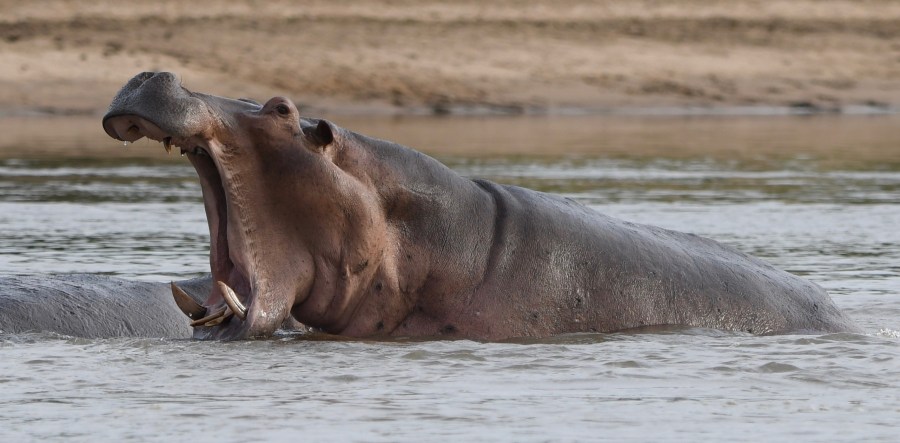
Tanzania 2018 hippo – Version 2
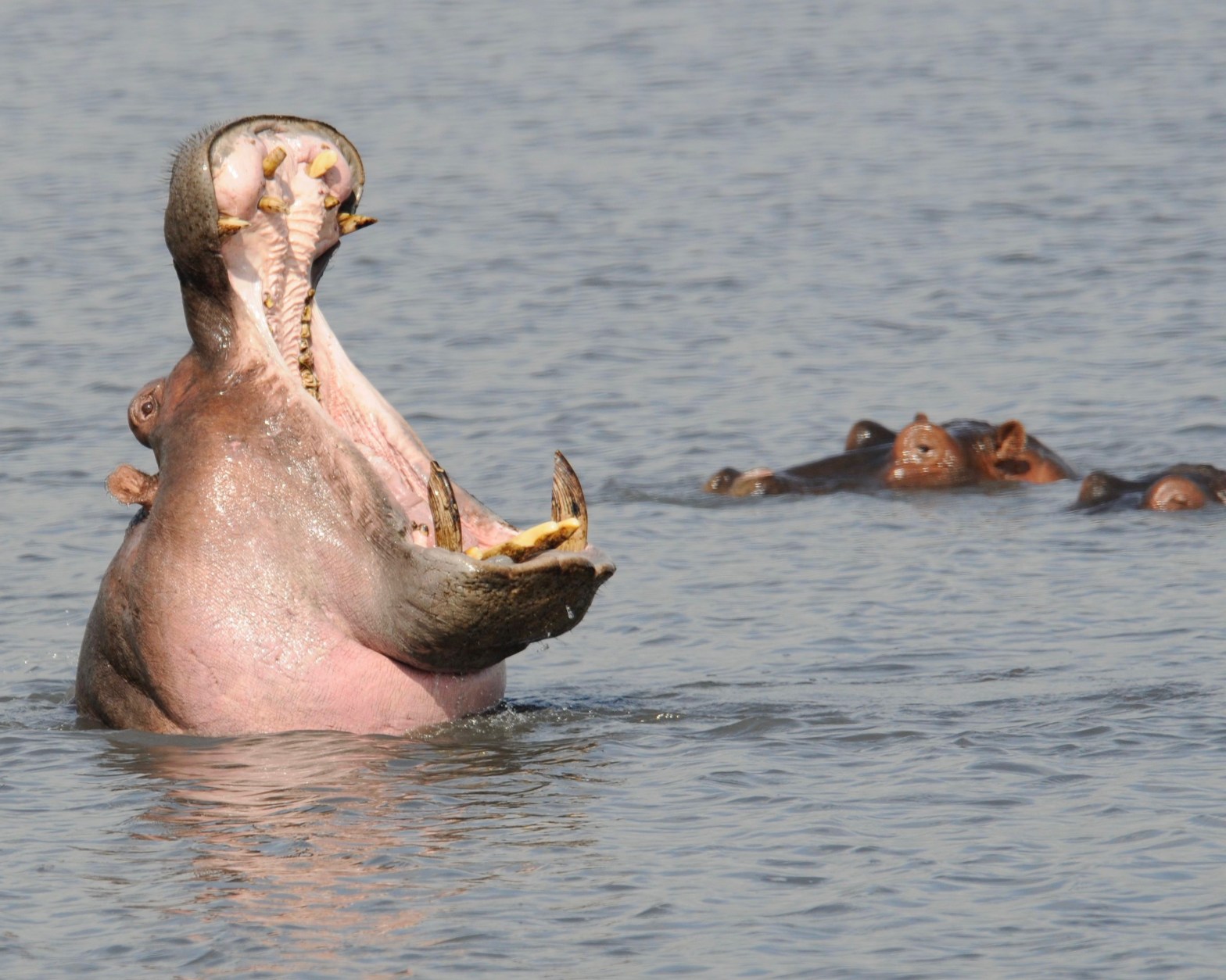
Hippos are large, territorial, unpredictable, and quite dangerous when on land. In the water they are rarely a problem as they can easily sink and scoot away. But on land they can be quick and intent. Note that the eyes, the ears, and the nostrils have moved to the top of the head (over tens of thousands of generations – not in each animal) allowing the animal to breath, see, and hear while almost all the body remain under the water. It is a bit like being able to use a snorkel, a periscope, and sonar while remaining hidden. Neat, huh?


Victoria Falls

There are few things as humbling as seeing how water, over time, can shape the earth. The Zambezi River passes over a cracked and crazed bit of old volcanic rock and eats its way through these cracks to shape and reshape itself. The floor of this part of the world was a smear of lava. Not an atmosphere jarring explosion but a slow oozing of molten earth until the region was frosted like a chocolate cake. It has taken half a million years to create the Victoria Falls – that is because there were eight locations for this cataract before today’s gorge was formed and today’s rim was accepted by the river. And, it is quite visible today that the river is on the move again; eating away at the weakest point of its rocky edge and creating a deep gash that will eventually gather all the water and become a new and spectacular cataract.

When on tour I think our (Smithsonian Journeys) itineraries are good enough – I don’t try to sell add-ons to our travelers. But, at Victoria Falls I do mention that the view of the falls and the ancient gorges below the current waterfall is best seen during a helicopter ride. It is money well spent. It displays the eons that the planet has been here. It shows the tens of thousands of years that the river has worn its way to the sea. It is a sobering look into time – and yet it also gives you an idea of what is ahead for the river and rock.

victoria falls
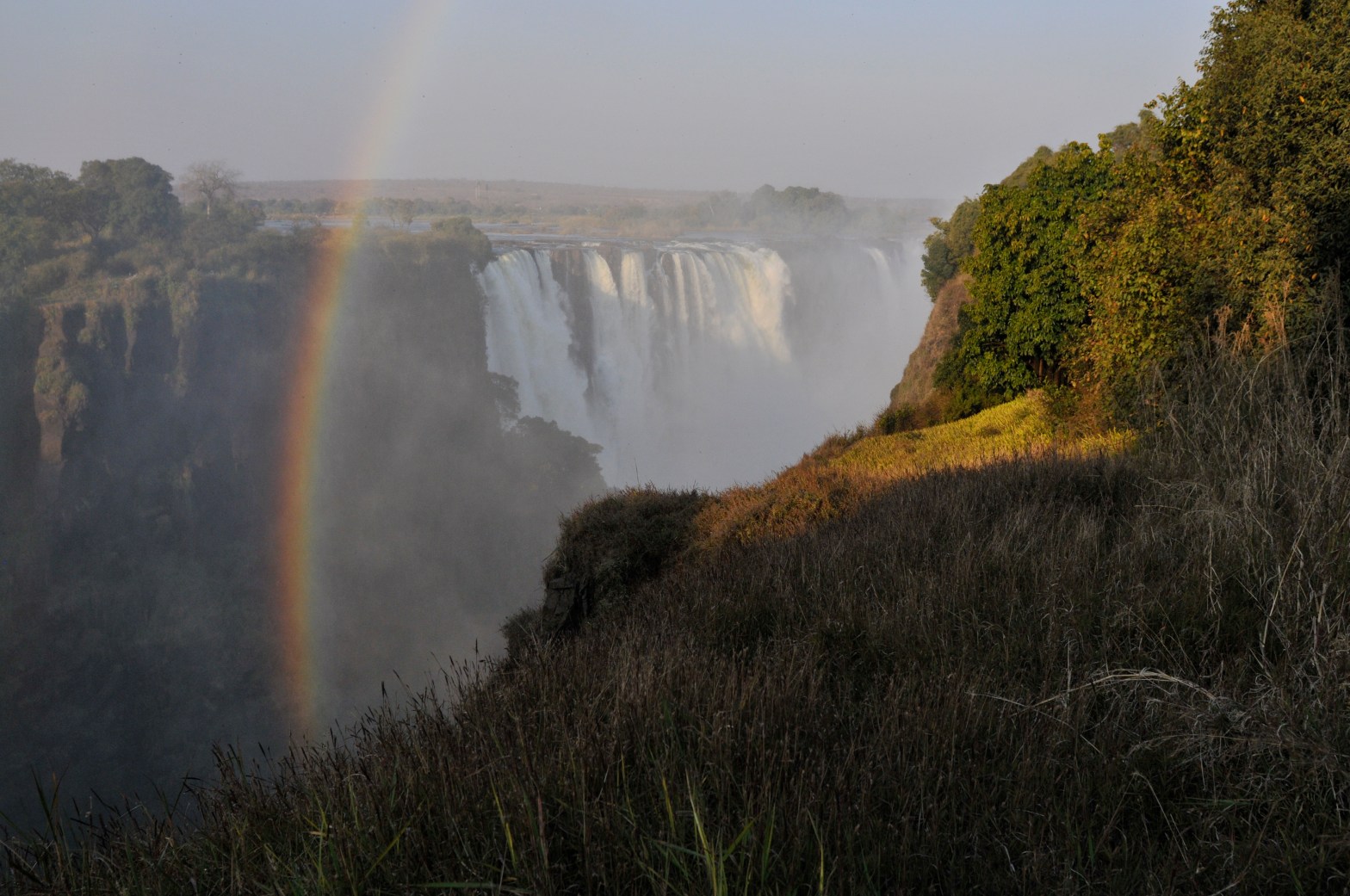
Looking from upstream the gash in the stone the is the falls is best told by the spray rising up from the crashing water. The width of the waterfall, in full flow, is about one mile. It is the widest  of the great waterfalls, by all usual measures.
victoria falls
Once at the edge of the falls it becomes obvious that the river has eaten its way down some sort of seam in the rock; the seams actually crisscross all over the surface. The ancient wet lava hardened and shrunk, creating this crisscross of cracks in the material. Over the centuries these cracks have filled with sands and clay and hardened into mudstone or shale. But, these soft rocks are no match for the power and energy of the Zambezi. It will wear them down and create a new lip, a new edge, and eventually a new waterfall. As a matter of fact the Devil’s Cataract, in the very lower edge of this image (above), has already dropped almost 20 feet below the normal and original edge of the falls. Sooner or later this groove will deepen, collect more water, and steal the flow from the rest of the river. The new waterway will eat back until it finds a soft crosswise seam and then that seam will be lowered until it forms a new gorge and another new waterfall.
victoria falls
In the top image the river is flowing from right to left. In the picture below it is flowing from left to right. The bridge that was built under the rule of Cecil Rhodes is in both photos. The lower one shows several of the ancient gorges – earlier locations of the same waterfall we now see as Victoria Falls. The river above the falls is rather flat and filled with unworn rocks that still rise above the flow and often have trees and animals on them.
victoria falls
This is a dramatic picture that shows hundreds of thousands of years of erosion and patience – water often works slowly, but it is persistent.
DSC_1737
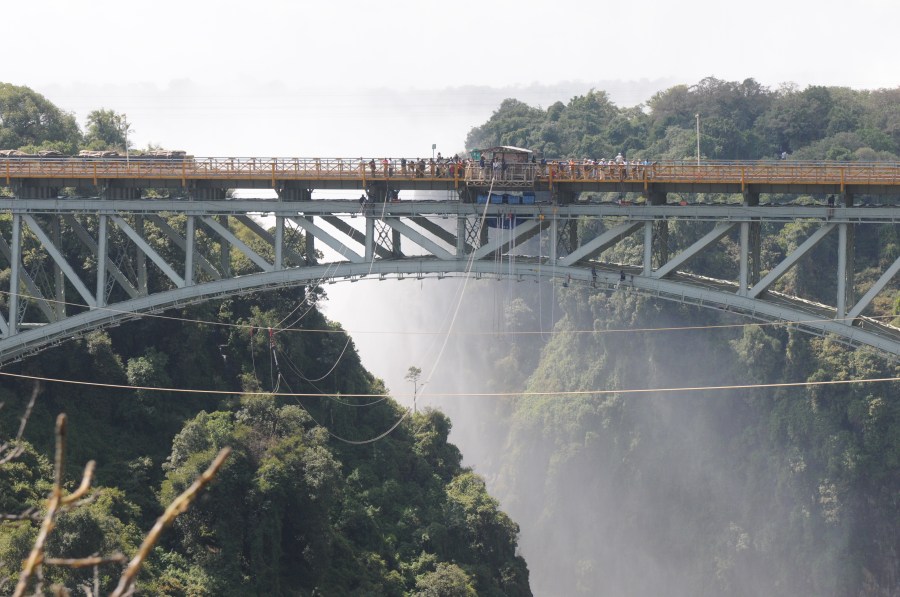
The bridge was built to accommodate the Cape to Cairo dream of Cecil Rhodes. It was a Herculean task and was designed to carry trains – there were no roads anywhere near this area at the time of construction. Now the bridge handles cars, buses, trains, and heavy trucks carrying copper ingots out of Zambia. It also has a bungy jump, a giant swing, and a zip line. I am sure that Mr. Rhodes would have liked that; he knew that the falls, and the bridge itself, would attract tourists.

The famous explorer and missionary (not very succesful at either) David Livingstone was the first European to hear and see the falls. He arrived at low water and was brought to the top edge by local fisherman. For many years after seeing the falls he tried to develop a river-based economy in the region. He brought boats from England and found another thing he wasn’t good at … however, he did a great deal to slow and stop the slave trade. The image on the right shows two of the men, Sussi and Chuma, who traveled with Livingstone for many years and eventually carried his body to the coast, about 1000 miles from where he died, so he could return to England to be buried among other great men. Their choice to carry him to his people is a story of friendship and hope. Imagine what would have happened to two black Africans found carrying the folded and wrapped body of a white man in the 1870s. It is a great story.

Wetland Creatures of the Zambezi

Please treat the images as copyrighted and do no use them without my permission. Thank you.

The fourth largest river in Africa flows from northwest Zambia and Angola to the Indian Ocean; creating portions of the borders of Angola, Namibia, Botswana, Zimbabwe, Zambia, and Mozambique. Along its 2200 mile run to the sea the Zambezi (also Zambesi) River is held back by two large dams; the Kariba Dam in Zambia and the Cahora Bassa Dam in Mozambique. In both cases great amounts of hydro-electric power is produced. Also, the level of the river past the dams is regulated by the amount of water allowed to pass through or over the dam(s). In many places the river flows languidly with large shoals of sand and is edged with emergent wetland vegetation. In other places it crashes over great clefts in the substrate creating marvels such as Victoria Falls or running fast through narrow scarps in the ancient lava floor of the region. There are many stretches of narrow these turbulent rocky rapids. The river has a maximum flow in March or April and then diminishes until in October or November the river has lost about 90% of its high-water flowage. March and April are very noisy months at the Victoria Falls and the spray rising from the narrow gorge below the falls often makes viewing and photographing the falls impossible. It truly become “the smoke that thunders” as the Lozi people called it. Locally it is still referred to as Mosi-oa-Tunya.

But in such a variable river there are dozens of animals and plants that live near or in the river and find it a suitable home. Below are a few of the animals most likely to be seen along the river. The images are from Botswana and Zambia for the most part. I will do a couple of blog pages on the Victoria Falls area next – so I am not emphasizing the Falls region here. As a matter of fact some of the images are from Chobe NP which is an area on the Chobe River just above its confluence with the Zambezi. As there is a long overdue bridge being built where Namibia, Zimbabwe, Zambia, and Botswana come together (a very rare occurrence in political geography) I will also do a page on the new bridge and its profound impact on the area.

DSC_6590
Where the river broadens and the flow slows a great deal of silt and sand is dropped from the water. As time passes this will form great marshes and sand islands. There are many islands that have been around long enough to have large trees and termite mounds on them. In many cases the wetlands are shallow and grassy and just right for birds like lapwings, ducks, herons, egrets, storks, and shorebirds. These areas also provide grazing areas for mammals like waterbuck, hippopotamus, puku, red lechwe, African (Cape) buffalo, and impala. Of course wetlands are just right for many reptile forms and certainly Monitor Lizards and Nile Crocodiles are common.
DSC_6043
The great Victoria Falls is seen and enjoyed by tourists from near and far. The falls will be featured in the next blog – stay tuned. An afternoon view in August and September will always have rainbows.
DSC_6440
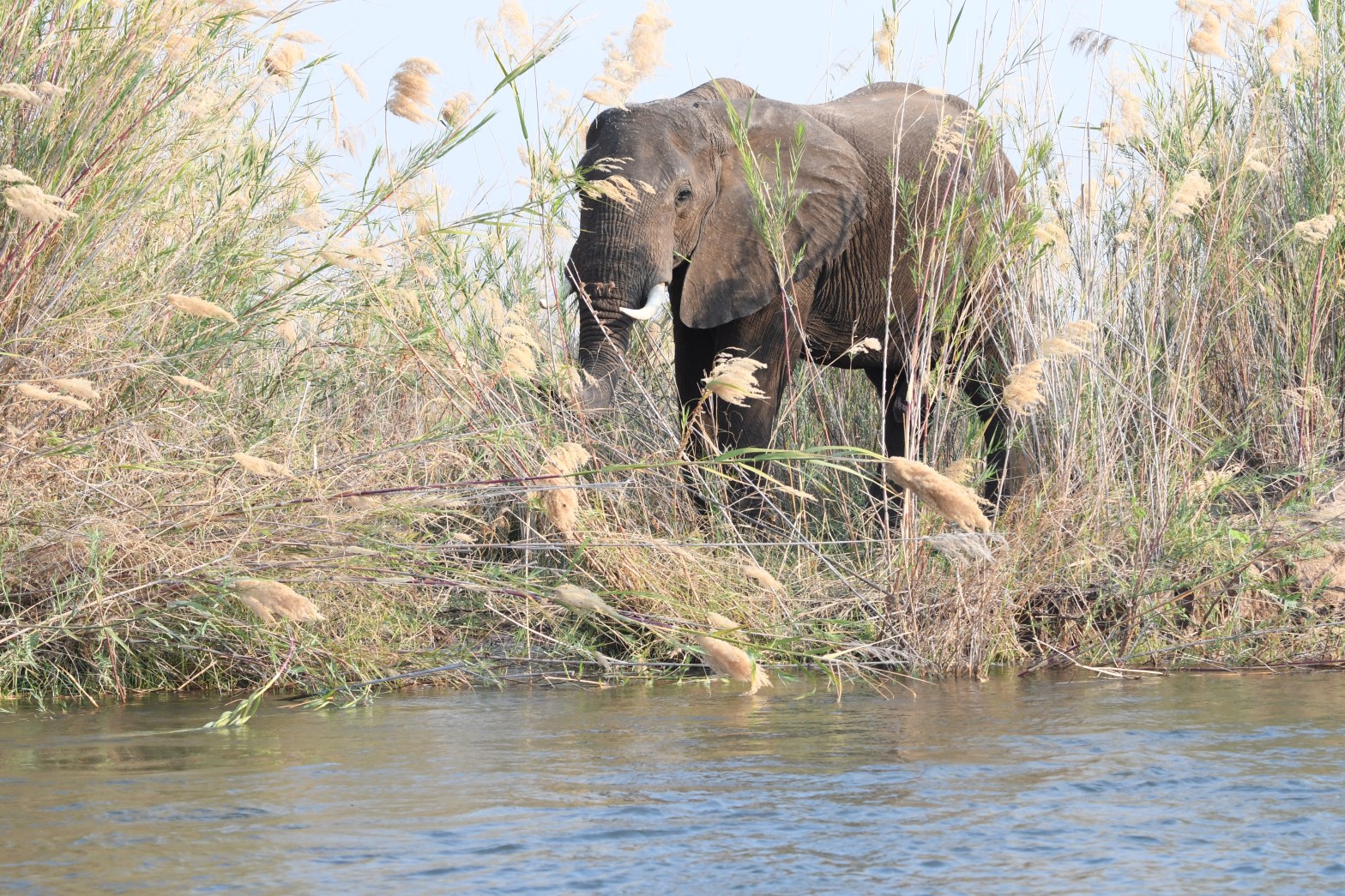
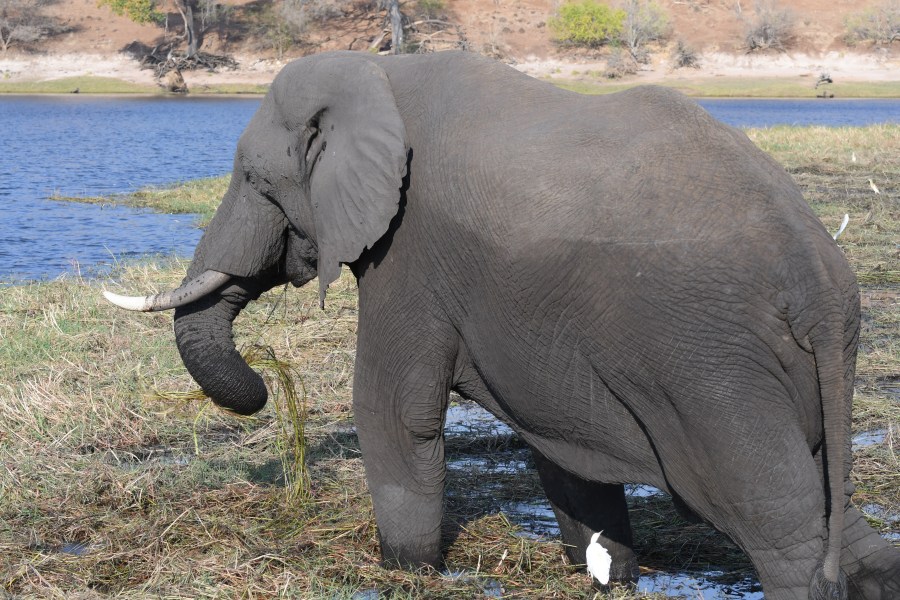
Elephants need water every day; lots of water. So it is likely that you will see elephants all along the Zambezi and its tributaries. In many cases it is the usual matriarchal family groups coalescing at the river before climbing back uphill and into the low forest for the night. However a few old males, with their teeth worn down from fifty plus years of grinding sandy vegetation, who will stay close to the river and its wet succulent plants all day and sometimes through the night.
DSC_6808
The Zambezi River is simply full of hippos. Small groups scattered along the shore and tucked away in a small bay are so common that you kind of stop looking for them. Their honking laughter echos all day and most of the night whenever you are near the river or when they leave the river and pass by your room/tent/lodge. They leave the shallow water each evening and delicately walk, sometimes for miles, to a grazing area where they eat grass all night.
DSC_7036
Nile crocodiles are merely a fact of life for those who live along the river. They are the Great White Sharks of the African rivers. Eating when they need to and loafing most of the time in the warm sun is about all they do. Most of their food is fish but they certainly have no trouble with the occasional large bird or small ungulate. In the national parks they are quite relaxed and allow a close approach by a boat. There are no alligators or caimen in Africa.
DSC_6803
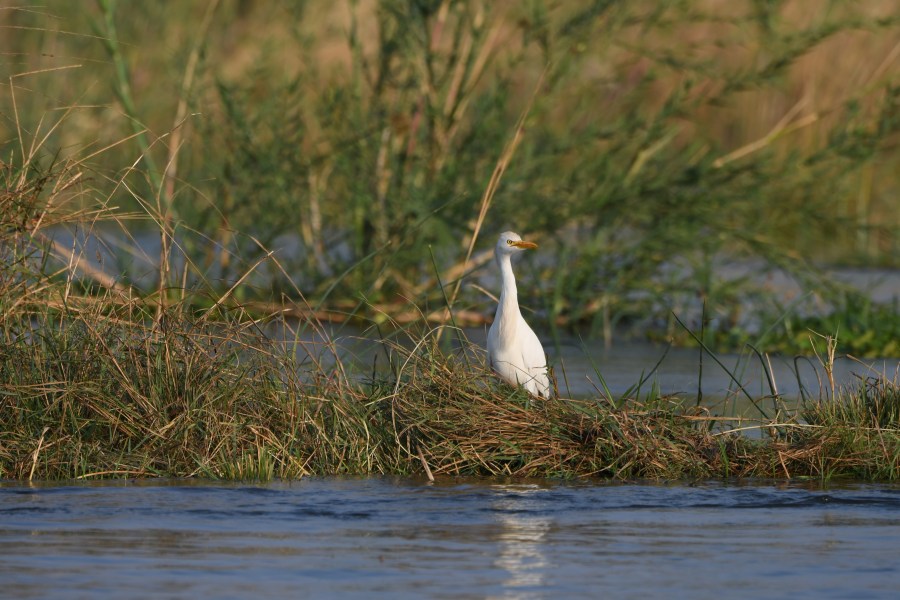
In an area where there are lots of buffalo and other grazers it is no surprise to find the ubiquitous cattle egret. You may have noticed one with the elephant in the image above.
DSC_6837
Sandpipers, plovers and other “shorebirds” have adapted and evolved to a wide range of habitats. In the US we have the American Woodcock living in damp fields and nesting along the edges of Red maple swamps. There is also Wilson’s Snipe, and the widespread Killdeer that are  “shorebirds” but not usually near the shore. In Africa there is a group of large plovers (now called Lapwings) that have, for the most part, moved into the savannahs and grasslands. But the bird above is the wetland associated African Wattled Lapwing.
fish tiger
In the river there are, of course, fish as you might suspect; a million crocodiles can’t be wrong. The tourist sport fisherman is often looking for the Tiger Fish. This is a fish totally unrelated to the South American piranha, but it also has sharp interlocking teeth and is known to hunt in packs. It is a wild fish to catch and bring to the boat. The fish in the image was released and lived on ready to harass other fish and baby crocs as well.


Tanzania, Ruaha, & Jabali Ridge

I have been to Africa many many times and to East Africa at least forty times. I have now found the best lodge ever; really! Now you must remember that nothing is cheap in East Africa because of the difficulty in building, locating materials, training staff, and solving a myriad of logistical problems. You can’t just open a store or hotel or restaurant and call for supplies – it is not easy to do a good job and very difficult to do a wonderful job. The usual safari route, and perhaps the best one for game viewing, is the northern route. This will start in Arusha and then to Tarangire, the Ngorongoro Crater, Olduvai Gorge, and the Serengeti. Some itineraries will spend time in Lake Manyara NP as well; especially photographic outings.

You will occasionally hear the names of other locations; perhaps Ruaha and the Selous. The Lovely Frances and I had the chance to visit these two locations in the southern part of Tanzania last month and we learned a great deal. For instance the Selous has really rough roads and locomotion is done at a snail’s pace. There are tsetse flies all over the place in the Selous, or at least when and where we were, they were also. The Selous id a huge Game reserve, not at National Park. Perhaps TZ will gazette it as a park and improve the travel. We were in one spot and did not see the whole reserve so what we saw is limited and my observations also limited. We had a great boat ride on the Rufiji River as the sun went down; lions, crocodiles, civet, leopard, and lots of birds made that outing very memorable. However it was Ruaha and the Jabali Ridge Lodge that really made the trip! Ruaha is a national park and the roads are pretty good. The scenery varies from great flat expanses of baobab forest to red rock cliffs.

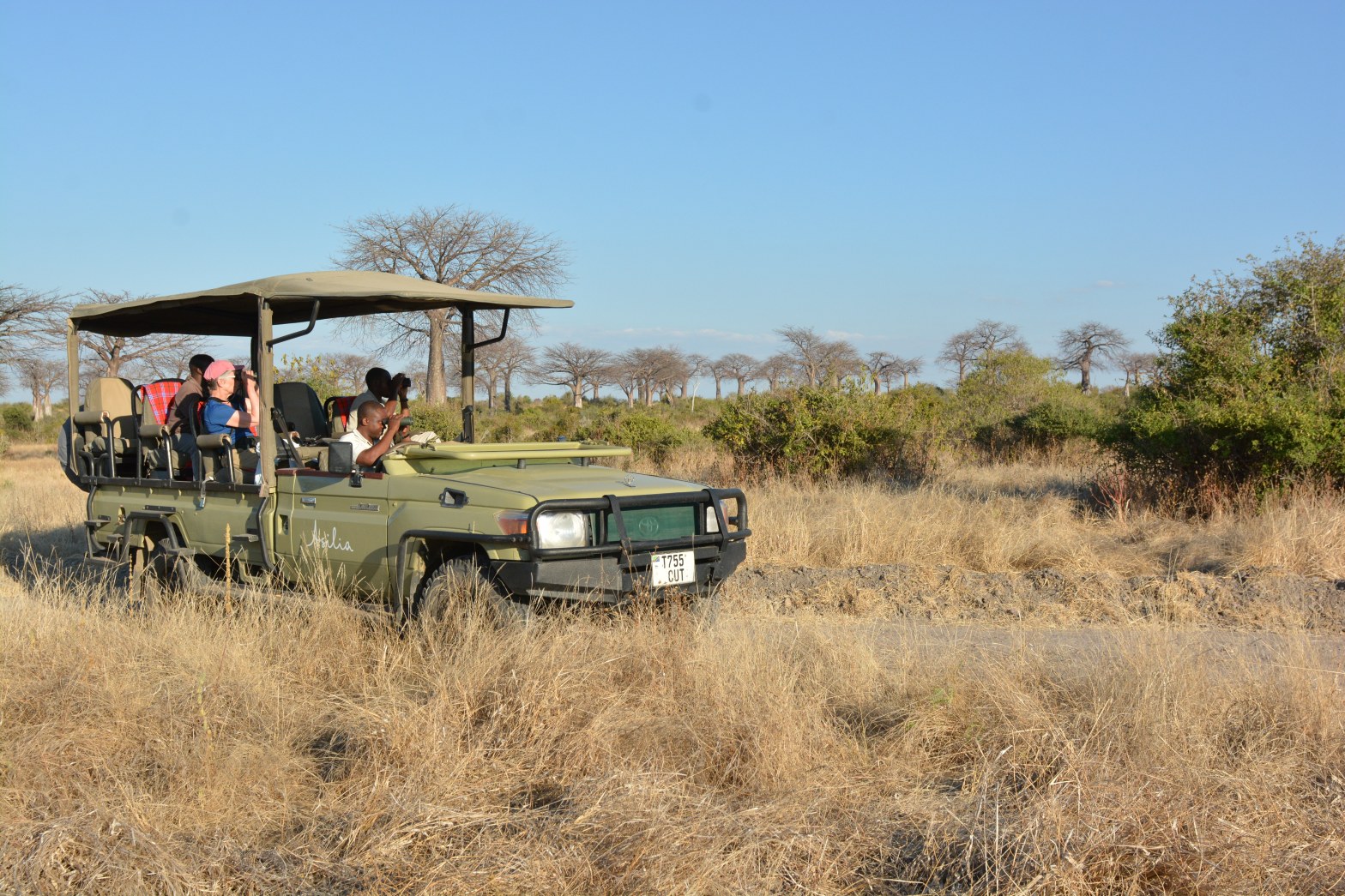
Below are a few images from Ruaha and the Jabali Ridge camp. The lead in picture shows Joseph and Fran with Mustapha (and a trainee game spotter) on a game drive. The staff is very good; both indoor and outdoor people were knowledgable and well taught. For instance, I feel that Mustapha could work/teach/drive anywhere in Africa.

DSC_3403
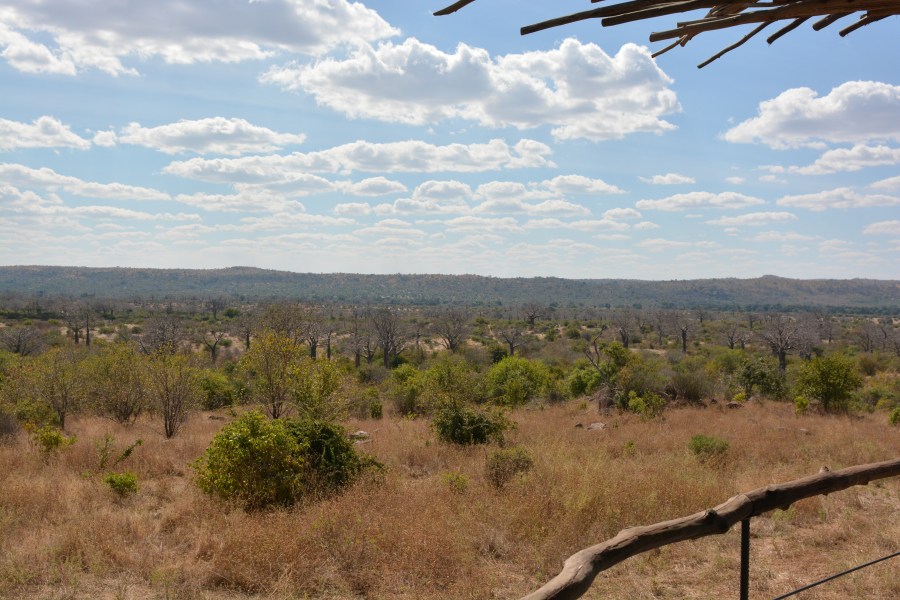
The vistas from the camp, anywhere in the camp, are wonderful. Great views of Africa as you always imagined it would be.
DSC_3412
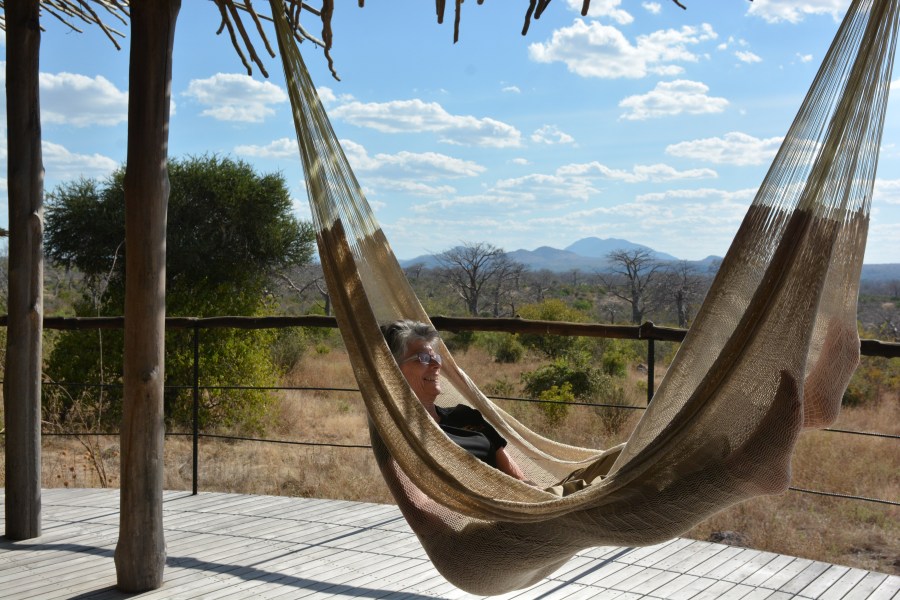
In between birding bouts and game drives a quick nap on the mosquito-free porch might re-energize you.
DSC_3444
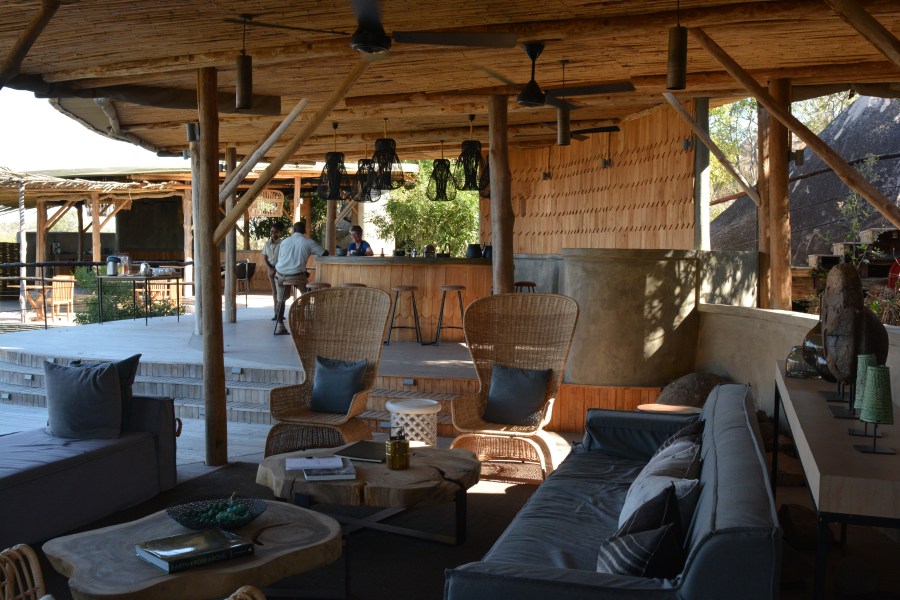
The reception area, lounge, and dining tables are on a complex of decks and patios that just might entice you to stop and rest. The wi-fi access is limited to the rooms so  that conversation and human interactions can take place untethered by electronics while in the communal area.
DSC_3450
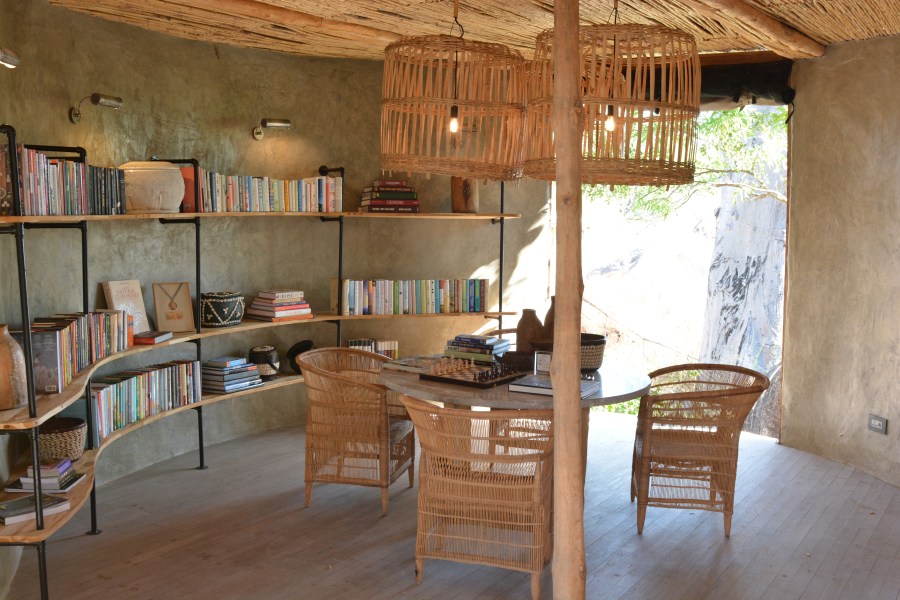
I like books and have a rather significant library of nature books. However, Jabali Ridge has a library full of good books, new books, and important general science writings from the past decade. It is an enviable place to browse and read; and like the entire site it is built and outfitted with care and style. 
DSC_3430
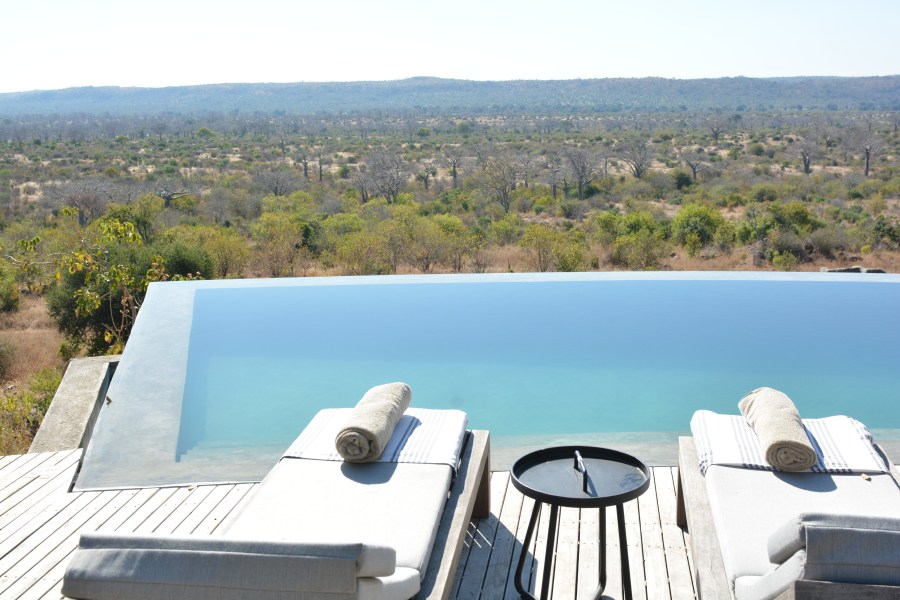
The pool is high in the kopje providing lots of sunshine and great vistas.
DSC_3426
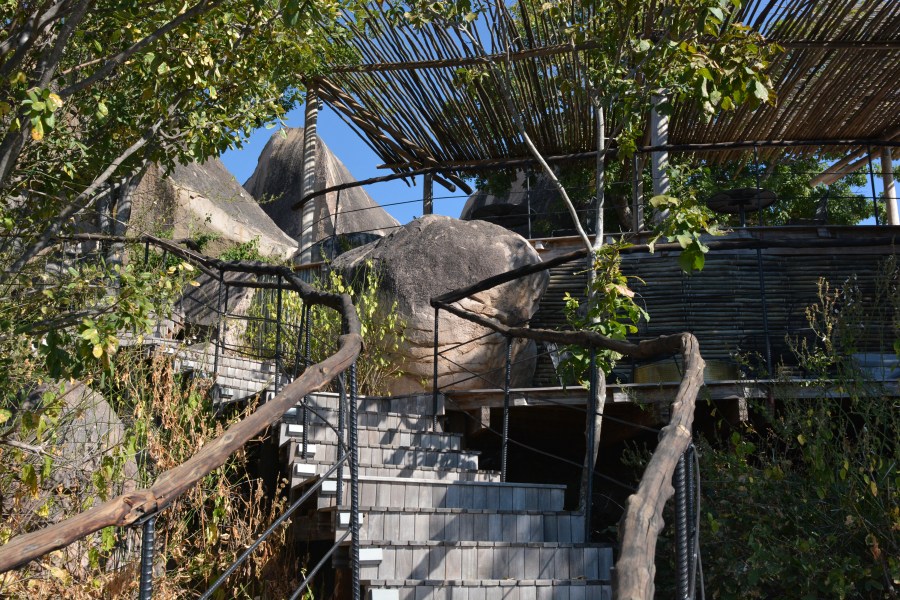
The decks and  werwalkways were built by skilled carpenters and craftsmen after being desinged by a thoughful architect. The decks and stairways reminded me of the woodworking done within the Sydney Opera House. There are no 2×6 slabs of wood for the decks, rather each small piece is fitted into a kind of parquet arrangement. I was impressed.

Tanzania, The Selous, & The Rufiji River

I am a bit pressed for time but wanted to at least put out a teaser blog about this latest trip to Tanzania. Finally I have reached the Selous Game Reserve and the Ruaha National Park. Fran has been able to accompany me and we’ve had a ball. We have had typically (or better than typically I guess) spectacular safari accommodations with great landscapes, lodging, food, staff, and wildlife. There will be much more on this outing in the next few weeks, but let me get started with a few images and comments. Comments first; there are lots of tsetse flies in the Selous and the rugged terrain makes travel very difficult and slow – but certainly not all bad. Ruaha was a special treat; maybe the best outing I’ve had in years and years. Great accommodations here (Google Jabali Ridge in Ruaha) with wonderful guides, drivers, and game.

Here are three images and, as I said, more to follow after I get home. Fran leaves after two weeks and I stay on to take a Smithsonian group through the Tanzanian Northern Safari Route. This route starts in Arusha town and includes Arusha NP, Tarangire NP, Olduvai Gorge, Ngorongoro Crater, and the Serengeti – and sometimes Lake Victoria. (Another set of blogs for another day.)

DSC_3452
The Rufiji River in the Selous was full of lapwings (like this White-headed Lapwing), crocodiles, and hippos. On one boat ride we had about 120 hippos and 50-80 big crocs.
DSC_3434
This is one of them. From snout to tail tip this animal and many others measured 12 feet or more. A huge crocodile can weigh up to a ton but most are in the 400-750 pound range. Males are larger than females by about 30%. Here in the Rufiji, and on most lakes and rivers, they generally eat fish … but we didn’t drag our hands in the water.
Version 2
We found three lions along the sandy edge of the river and approached quietly and quite closely. This youngish, maneless male kept an eye on us the whole time. These three animals were young adults and in great shape. These two were in the sand and the other in the adjacent rocks.

Tanzania; safari fun and a Maasai market

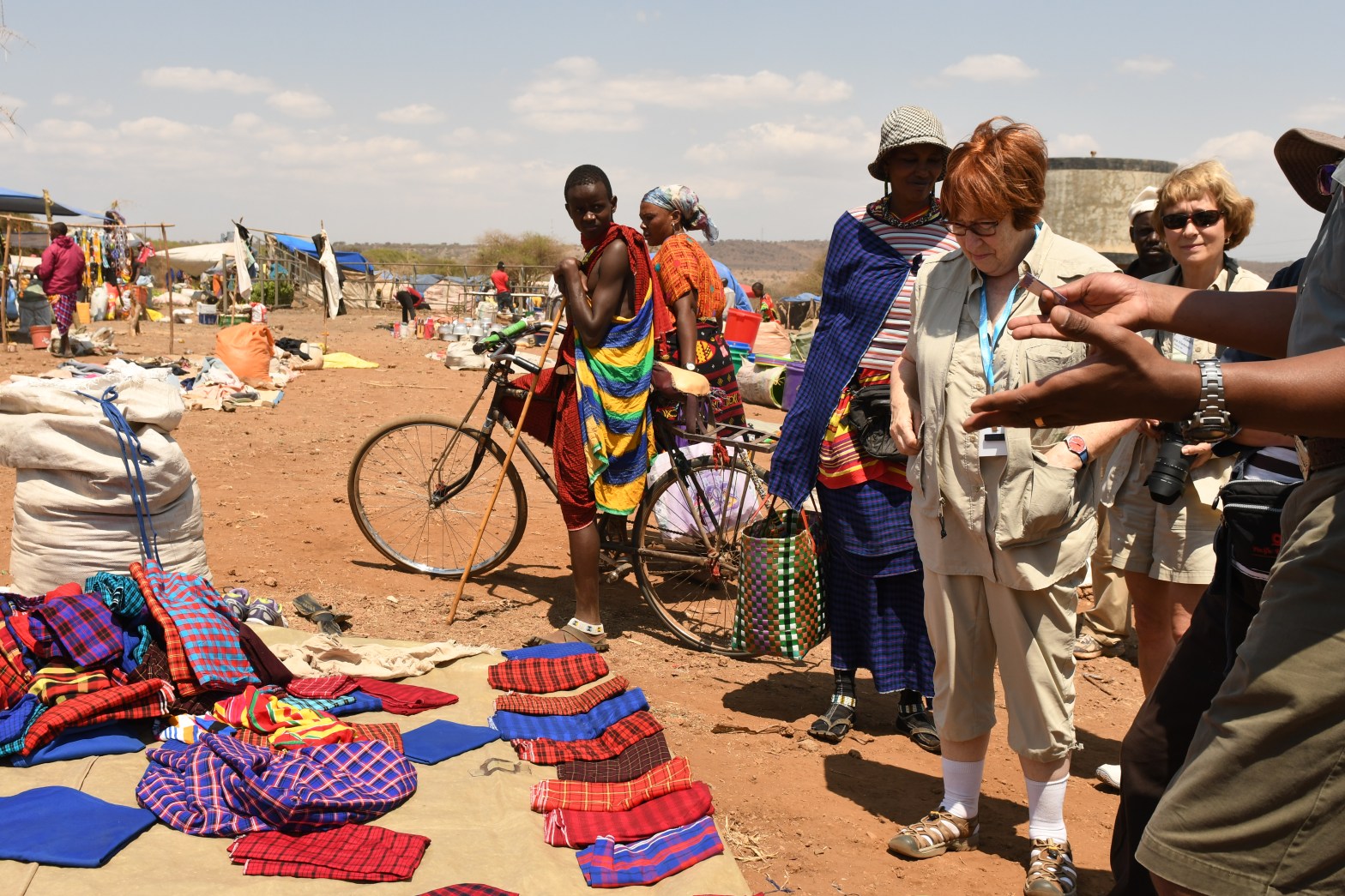
Well, let’s go back to East Africa, along the northern Tanzania safari route. This won’t be your usual animal parade, it will be a bit more earthy than that. It will show a few safari moments and then the same for a Maasai market which occurs weekly near Tarangire National Park; at the corner where you turn from the Arusha road toward Ngorongoro Crater. The safari highlights will be those things that just happen… and you just roll with them. The market is a cultural highlight in that we have nothing quite as entertaining; although some of our fresh food open air farmer’s markets are a bit similar. Here you could barter for cattle or goats or buy tethers for either. In addition there were sandals cut from old motorcycle tires (or tyres as they say), various food items, previously worn clothing in bales imported from the US or Europe, and a chance to buy herbs or get a tooth pulled.

DSC_4171
The section of the market dealing with cattle was much as you might imagine; a bit odoriferous, a bit dusty, and a bit noisy. We couldn’t understand the discussion but assume that it was an intersection between what was needed to sell a cow and the reason that it was worth much less than that. There seemed to be a lot of standing around but I figured that was like when guys go to an old car show and just hang around talking cars – maybe they just like the energy of the market and the sense of being a cow-guy.

A safari vehicle, mostly Toyota Land Cruiser modified for the job, has to be well maintained and yet be ready for anything that goes wrong. Black roads, hot sunny weather, tires with tubes, and lots of driving often cause a brief delay in the trip. Flat tires are not uncommon. The driver-guides are trained to deal with the mishaps but hot lug nuts and cumbersome jacks make every tire-change a bit of a challenge.

DSC_4149
When one vehicle has a problem others gather to help. Thus we have one driver with two others from other vehicles helping. We were soon being carefully and quietly observed by Maasai kids who were watching their goats and cattle nearby and were drawn to the distraction. Many of the roads in Tanzania are in good shape. They have been built over the past twenty years by Japan and Canada for the most part. China is a big player in Africa at the moment. These countries actually design and complete projects like roads and bridges rather than sending aid money. Thus there is little to point to from American aid as much of it never gets to the target. By the way; the Chinese are very good at this and are building bridges and soccer stadiums and everything in between throughout the African continent.
TZ 2017 lion sex
Safari vehicles are safe havens for the most part. In areas where lions need shade they often wander over and lie next to or under a vehicle. This means that other vehicles come to look and the shade-provider has to stay put until the lions move off. These two lions, a male and a female, were not seeking shade however. They were mating and just happened to use the shade in between amorous moments. It is very rare that a lion will seem to notice what is inside a vehicle; but if you stepped out it is likely that you would regret it in matter of seconds.
DSC_4183
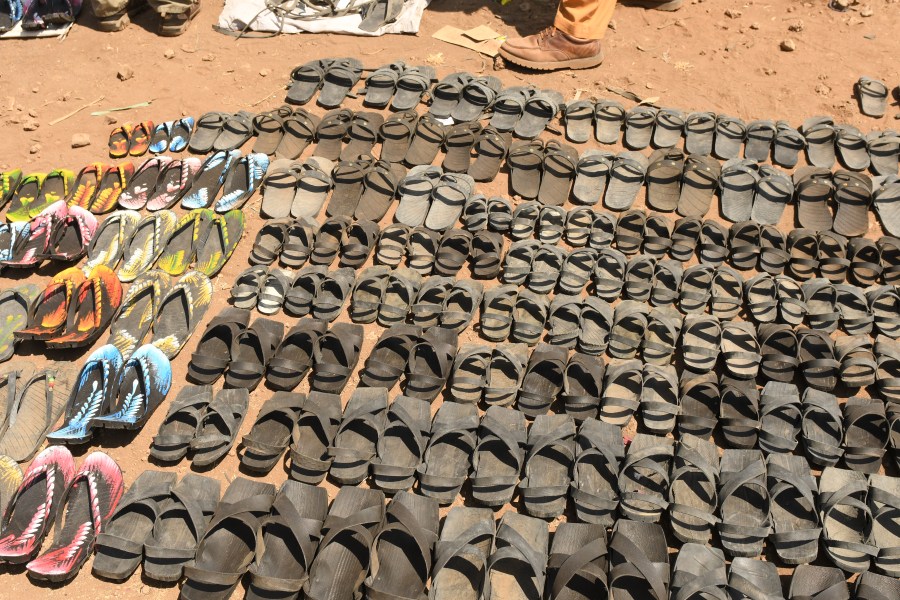
Meanwhile back at the market There was a shoe sale going on. The majority of the shoes above are merely section of motorcycle tire fitted with rubber straps. They last nearly forever and are replaced only when the straps fail.
DSC_4184
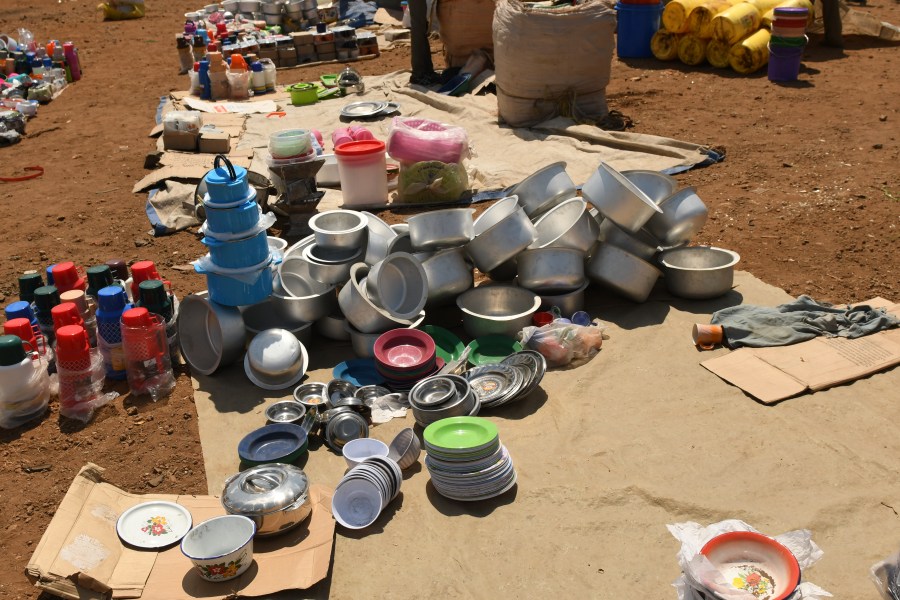
Pots and pans are an essential item even if your kitchen is a small wood fire against a few stones near the entrance to your house. The fire is often near the entrance to keep both vermin and hyenas outside. Many of the items are previously used but others are new.
DSC_4182
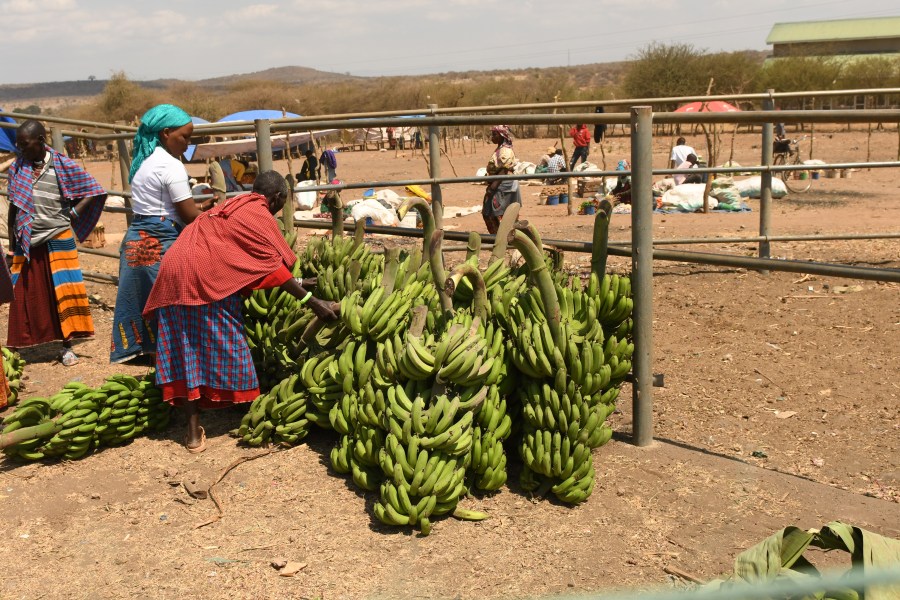
Both bananas and plantain are available at the market or most any roadside vendors table. They are bought in small bunches at very low prices.
TZ 2017 maasai market
The same with onions or tomatoes. The Maasai are not farmers and many of the crops are grown by neighboring tribes and sold at the markets. That being said, I would add that cultures are blending more and more all the time.
DSC_4165
The goats and cattle are the men’s business. They demean those they might need to buy and laud the ones they are selling. It is busy, noisy, and hard to decipher.
DSC_4196
A scene more and more common each year is portrayed by this woman, selling potatoes and keeping track via cell phone. Much of East Africa was without landline telephone. Thus the cell phone and cell towers arrived and made life much easier. There are few lines, either electrical or telephone, away from the cities. 
medecines002
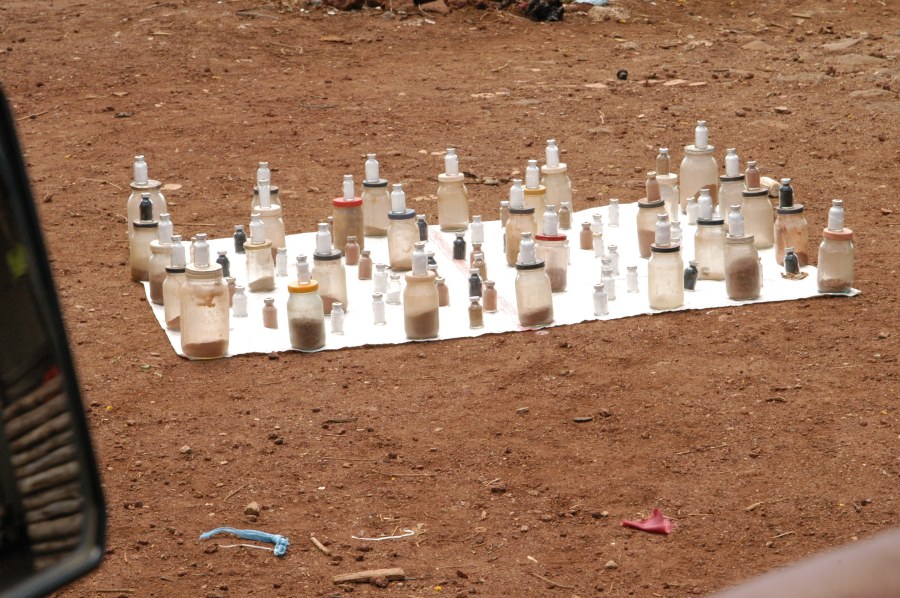
I don’t think CVS, Rite-Aid, or Walgreen’s have much to worry about from the Maasai Market apothecary shops. These are local herbs and minerals that are meant to cure something or other. Shop at your own risk – or buy whatever you want and do the research to what active ingredient may actually do the job.


Norwegian Salmon

Aquaculture is huge business; salmon, oysters, shrimp, catfish, and dozens of other edible species are raised by the ton all over the world. Norway has become something of a specialist-nation when it come to raising Atlantic salmon. They say that over 14 million Norwegian salmon meals are eaten every day around the world; that requires a lot of salmon and that in turn requires an efficient method of farming. In total more than two million tons of salmon are raised around the world annually.

The young fish are hatched and raised in large indoor facilities. They are transferred to large outdoor pens to mature into 15+ pound marketable fish. In the places where you can tour the growing pens you can see the automatic feeders, underwater cameras, thermometers, and all sorts of things to insure that the water and fish are ideal. At the site we visited, the nuisance creatures (sea lice primarily) were controlled by “cleaner fish” (wrasse) rather than by chemicals. But in a sense of balance I must say that there are articles on the use of chemicals in Norwegian (and all the others as well) salmon farms. Some skeptics say there is some chemical use and others say that any country that still kills whales should be boycotted – this is a bit of apples and oranges for most people.  It is broadly perceived that Norway, despite whatever it uses to protect fish from parasites and to foster growth, uses significantly fewer chemicals than does any other major producer.

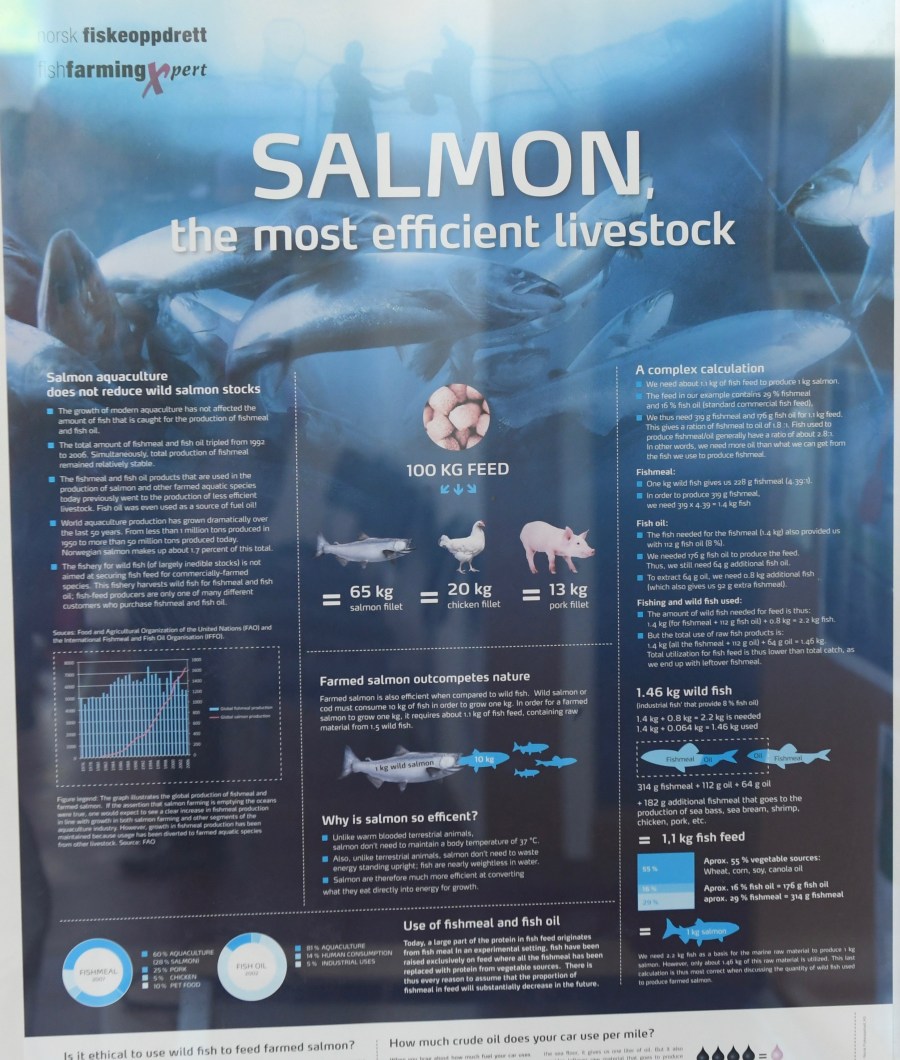
The information available from various sources is not at all similar when it talks about salmon production. One source, a Norwegian poster, says that Norway produces 63% of the penned salmon and that North America and Chile each produce about 9%. Other source only a decade ago cited both Chile and Norway with about 30+% of the production. The latest comparisons (two source) I could find says that Chile produces about 600 metric tons and Norway about 1,300 tons of Atlantic salmon annually. As salmon aquaculture has become large and international business, the companies from Norway, the United States, Scotland, and Chile and elsewhere, are now growing fish outside their original national waters. Much of the Scotland fishery is owned by Norwegian companies and so on. One company, Marine Harvest, kills/processes well over 380,620 tons of salmon annually; 7,000 tons or so a week or about a ton of salmon processed each day; nearly half the world’s production.

Anyway here is a quick walk through a floating salmon farm. Most actual growing areas are kind of stand alone feature (floating pens) out in the deep water of a fjord. This one is designed as an educational site.

DSC_2160
Safety first; flotation devices are worn and railings line the floating walkway. Here we are heading out to the floating building adjacent to the growing pens.                                                                     The staff will wear the red and yellow survival suits in the top image when working over the water. Immersion can be deadly when the air and water temps, when added together, are less than 100 Fahrenheit (about 35 degrees Celsius). The fjords are deep and the temperatures are quite constant as is the salinity; this make for good growing conditions.
DSC_2163
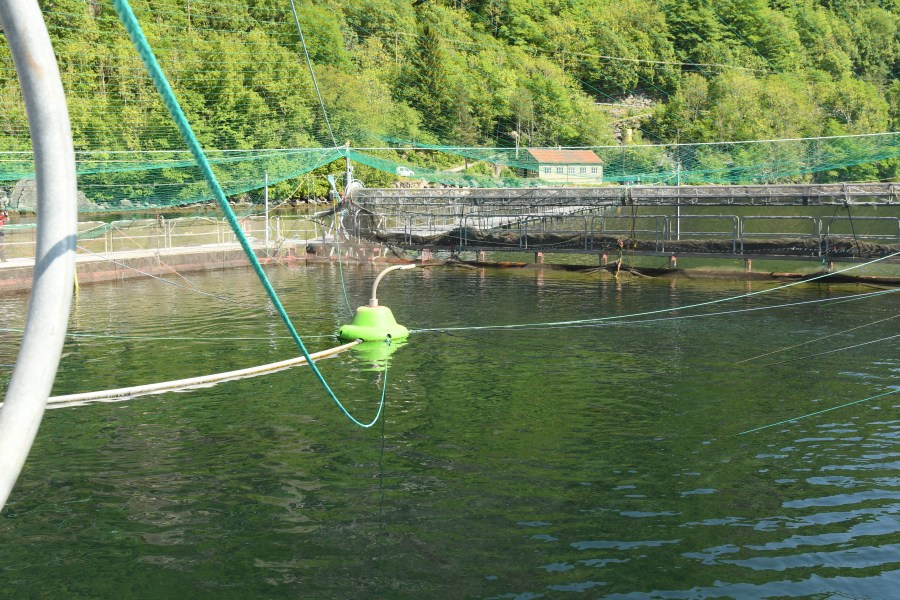
In the pens floats a feeding device with a crooked neck that spins and sends out a scattering of pellets. In this case the fish are already at about 15 or more pounds and break the surface and leap when food is flung to them. They didn’t seem terribly hungry and they were not at or near the surface most of the time. The pens are about 10 meters (33 feet) deep and the volume of fish to water is legislated in Norway. Fish can only take up 2.5% of the volume of the pen – plenty of room to swim and less homogenous environment for parasites and disease to latch onto.
DSC_2171
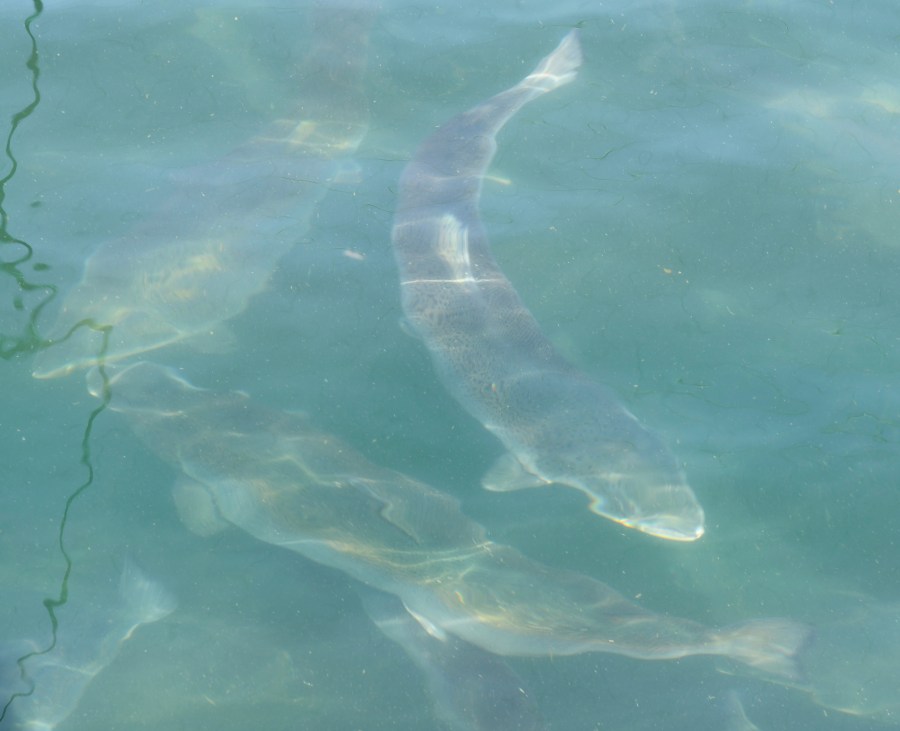
These fish are mature and could be, probably will be, sent to market and replaced with smaller fish. The display is impressive in that the fish are lively and large and the floating boardwalk brings you right up to the pens.
DSC_2174
The ability of a cold-blooded, essentially weightless (they float, sort of) animal to turn food into body mass is impressive. You get three times more salmon meat from the same amount of  food when compared to chicken and about 25 times as much production when compared to porkers. In this sort of comparison cattle are a real waste of food, water, and space.

Norway; remote and comfortable

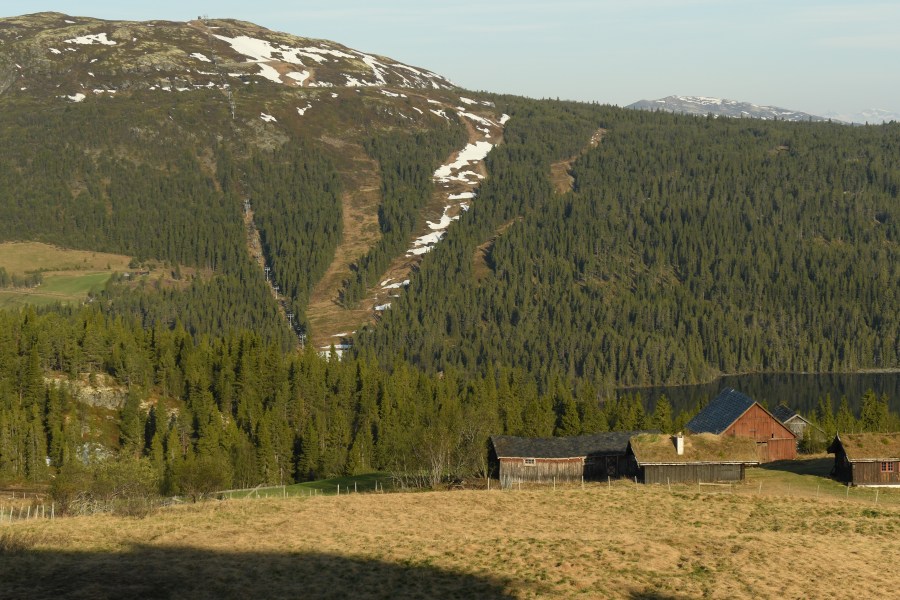
Much of Norway is rural. Quite rural in most areas. The second home boom that has infiltrated untracked forests and coastal headlands in the US has been accomplished differently in Norway. Most of the second homes are clustered around ski areas and places where winter sports are enjoyed. A second home just for the view is not as common as here. Many rural people will have a time share or small apartment in the city in what seems a kind of contrary move. And, like most countries (think USA and Australia) the larger portion of the human population is coastal. So it is in Norway and this means that much of the interior is rolling moorland. Further north and this might be tundra but without permafrost it is heath and moor; or perhaps bogland and muskeg. Snow covered for six or seven months and wet underfoot the rest of the year.

This creates good land for migratory shorebirds Birds that winter in the tropics or even deep into the Southern Hemisphere and return to Scandinavia or Siberia or northern Canada to breed in the time of plenty – plenty of insects that is.  The vegetated landscape varies due to elevation and the aspect of the slope (N, S, E, or West facing); south-facing land get warmer than north facing and higher elevations lose tree life at about three thousand feet. Over all the forests in Norway are largest in the southeast toward Oslo. The central portion of the country is to high for trees, though 2000′ lower than Denver, and the western side is quite rocky and cut by fjords, though there are many smaller bits of forest land on the west side. The northern lands are rugged in the winter and usually have acidic sphagnum based soils.

DSC_1730 3
But, wherever you got in the areas of habitation there are always ski slope and cross-country trails. I am sure the Norwegians would ride bicycles like the Copenhagen Danes if the land were flatter; they love their outdoor sports. Many hotels have a small lift and ski slope out back. Some roads are closed in the winter but many areas remain open and well attended through the cold er snowy season.
DSC_1774 2
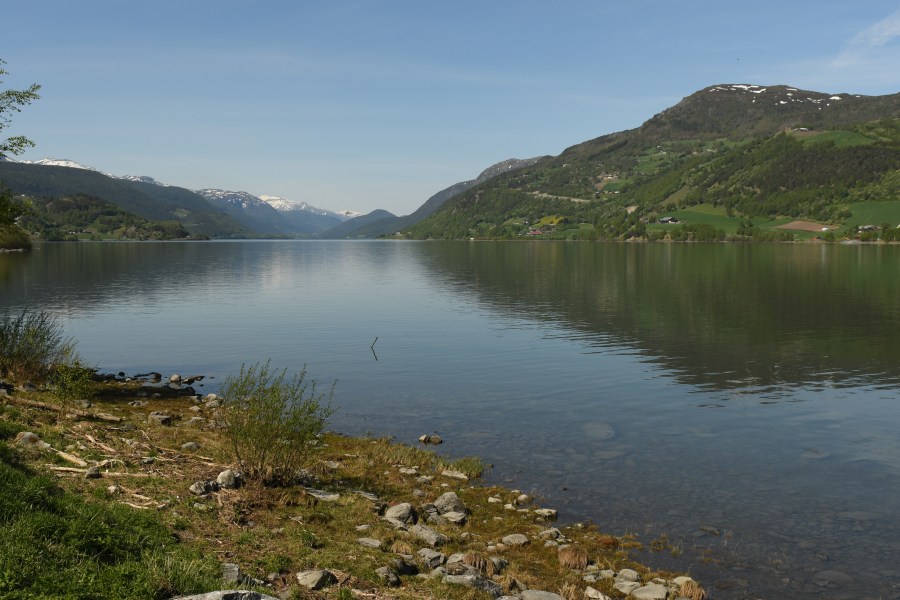
There are lakes, lots and lots of lakes. Norway has fresh water for drinking and creating power. It is a country that plans on banning internal combustion engines in cars by 2025 and looks to be largely powered by natural sources in the same era. There is a bit of irony here as much of the affluence that the country has is based on its sales of oil and gas from north sea reserves.
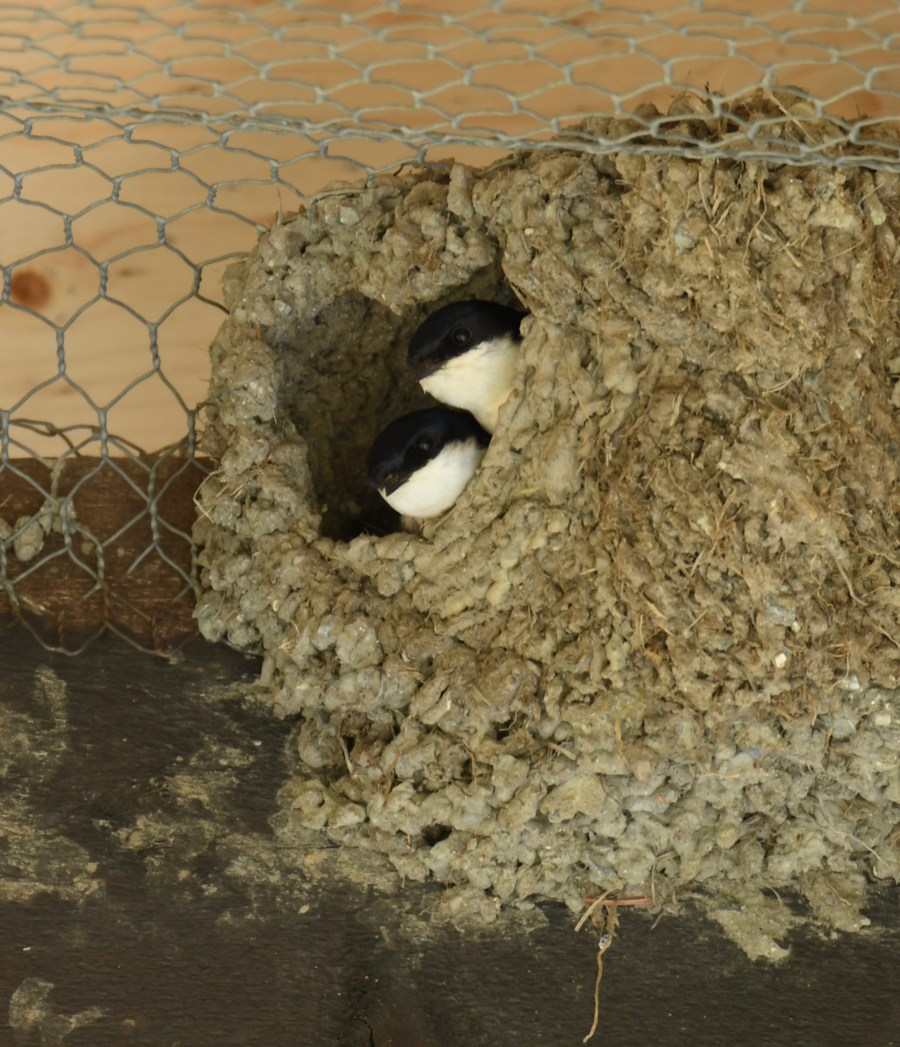
Norway 2018 house martin
Under the eaves of many hotels there were the mud nests of the House Martin. This is a swallow that looks very much like the North American Tree Swallow but builds a hanging/self-supporting mud nest like Cliff Swallows (our barn Swallows use a lot of mud also but their nests sit in a beam or board)
Norway 2018 fieldfare
Our American Robin is a thrush and for the most part a woodland thrush. In Norway the Fieldfare is the robin – or maybe its the European Blackbird – I guess there are two thrushes that will remind you of our robin.  The Fieldfare is a robust bird that wanders the lawns and fields garnering whatever but can in an omnivorous sort of way.
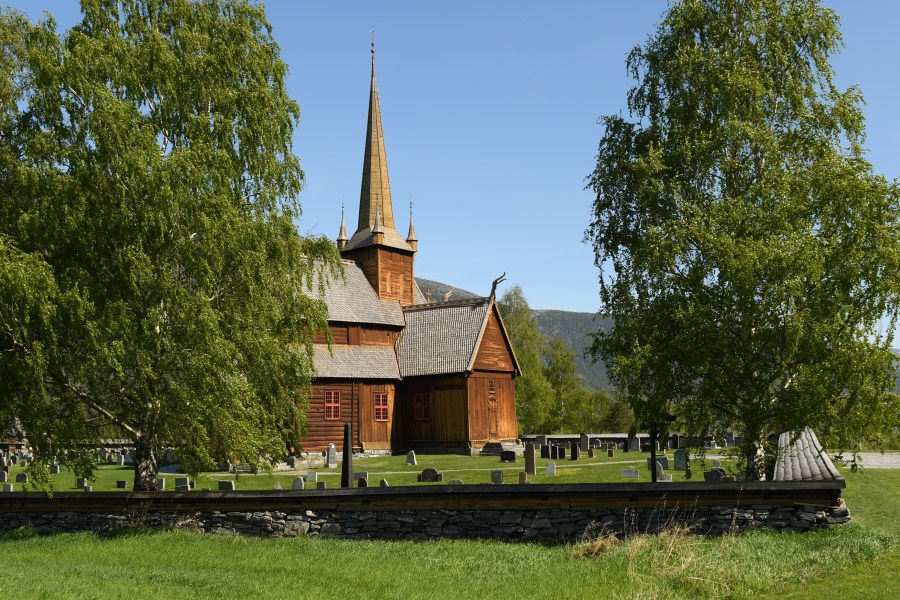
DSC_1786
There are about thirty (most references say 28) “stave” churches left in Norway. Made of local wood and in and out of vogue many have burned and, if rebuilt, have been replaced by more modern construction. Fire was one primary cause of the disappearance of these Medieval buildings (most built between 1150 and 1350, but other causes were the Black Death that swept the country starting in Bergen in 1349 and the Reformation which altered the outlook on religion continent-wide. The Europeans to the south were using stone to make castles and gray homes while the Norwegians used wood. Stave churches are almost always carved in intricate and meaningful ways and represent both Christian and Viking aspects of the culture. The doors and the finials are carved and the eaves and peaks often harbor dragon heads to keep bad spirits at bay. The presumed prince of evil spirits was the reasoning behind having a side door for women to enter and leave the church. The large corner posts are the staves and the plank walls that run atop a sill from stave to stave are called stave walls. Thus the name stave is imbedded in the structure and the name has persisted. The image above is of the Lom Stave Church and is in the small town (aren’t they all) of Lom.
DSC_1800
This was snapped out the window – sorry for the reflections. As you get higher and more central in Norway the trees have stopped being part of the landscape and the mountains are often not vegetated or perhaps sparsely vegetated. The snow and ice linger into early June and wet ground replaces that. It isn’t the most inviting place for tourism in this season but it is quite lovely. By the way, Norwegian road-builders are in class of their own. The switch back roads and tunnels are unequaled anywhere in the world. As we descend into the fjord lands on the west coast we will see some of the achievements of these engineers and craftsmen. 

A Couple Cape Cod Birds; ghosts reborn

The dietary and millenary habits of those living in the United States from 1870 to 1920 killed off millions of sandpipers, herons, cranes, and water birds. They were sold to restaurants and turned into fancy hats. It was hunting with scatter-shot cannons and decoying with live geese. It had a huge impact. The extinction of the Passenger Pigeon and the dramatic decline in the American Bison (buffalo) are well documented, but many of the birds that suffered the same fate are rarely mentioned. Sandpipers were shot at migratory stopovers and duck eggs taken from nests. It was an untenable approach to wildlife. And, to a large extent, in many countries but not all, it has stopped.
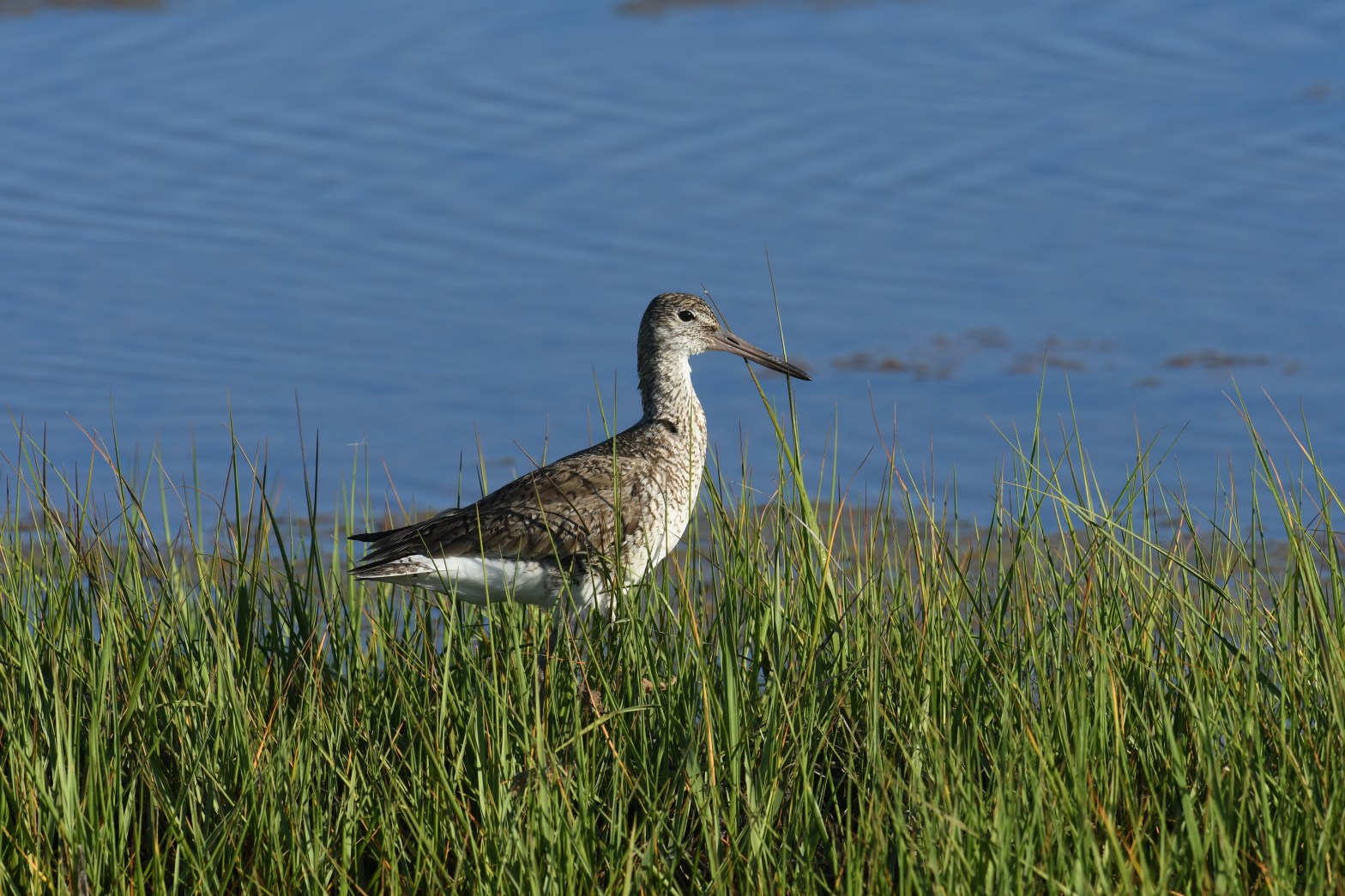
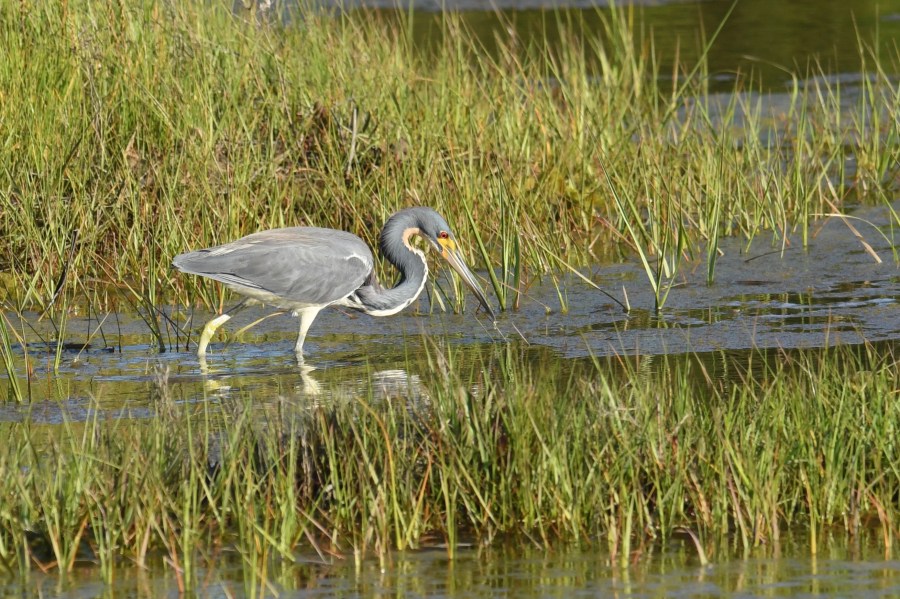
Two of the birds impacted are shown below; the Tricolored Heron (or Louisiana Heron in many older books) and the Willet. One heron and one shorebird or .

The white egrets (herons) were terribly impacted by the millinery trade in the late 1800 and early 1900s. The sandpipers were food well before that period but the Industrial Revolution and its resulting increase in the human population didn’t immediately have people change their ways; they stayed on that “shoot and eat” diet into the early 1900s.

DSC_3030 2
The Willet didn’t nest in Massachusetts for a century; from 1877 to 1976. It has rebounded quite well, especially in the last twenty years. There are now several hundred pair nesting in the salt marsh edges along the coast from Maine to Florida. In Dennis, Massachusetts, at West Dennis Beach, I had about twenty birds on June 25th. That is a big deal and a rather good sign for this species.
DSC_2912
Being a bird of the salt marshes the Willet can be seen perched on any smallish tree or shrub or on the edge of a dune to grass clump. A rather dull bird, as seen in the top image, when it spreads its wings a bold pattern of black and white appears.
DSC_2910
Upon landing or in flight this pattern is very conspicuous. They are also a noisy bird near their nesting sites.
Version 2
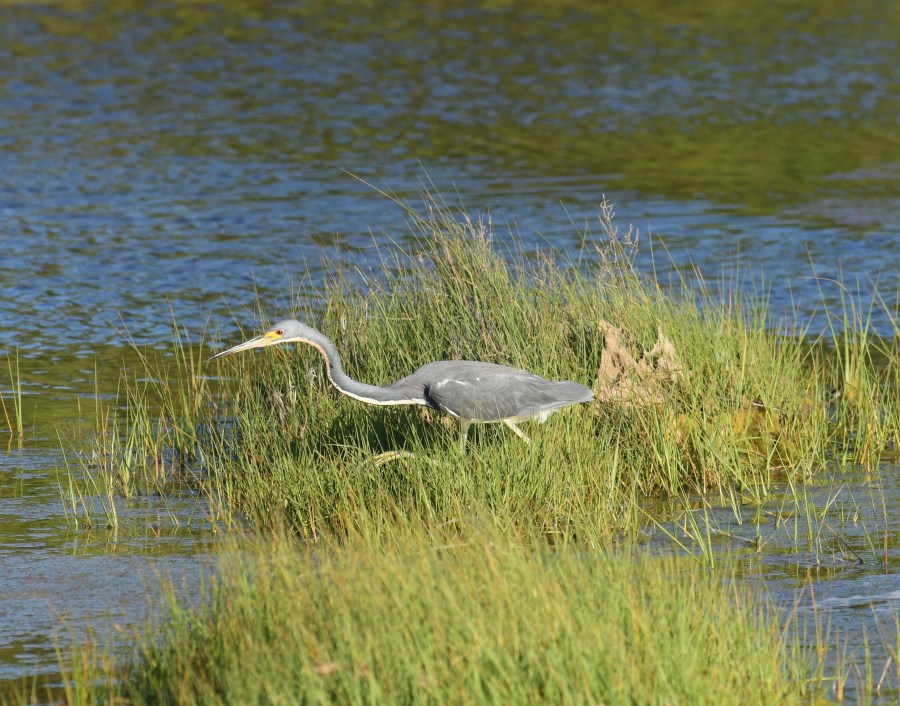
A much less common bird in Massachusetts is the Tricolored Heron. It is a bird of the coast as well as the Willet but it still lingers mostly to our south. They were not killed off as fast or as thoroughly as the Snowy and Great Egrets were, but when a heronry was hunted, everything was killed and the Tricolor was decimated as well.
Version 2
When the Tricolored heron does appear in Massachusetts birders hurry to the spot as they are annual visitors but uncommon, and they don’t stay for a long time – usually. This bird in on Cape Cod and has been here for a week. It is feeding voraciously in a shallow pool and might stay until the food runs out. 
Version 2
The “mane” of feathers along the very narrow neck rises when the bird strikes at a fish. Pretty cool.