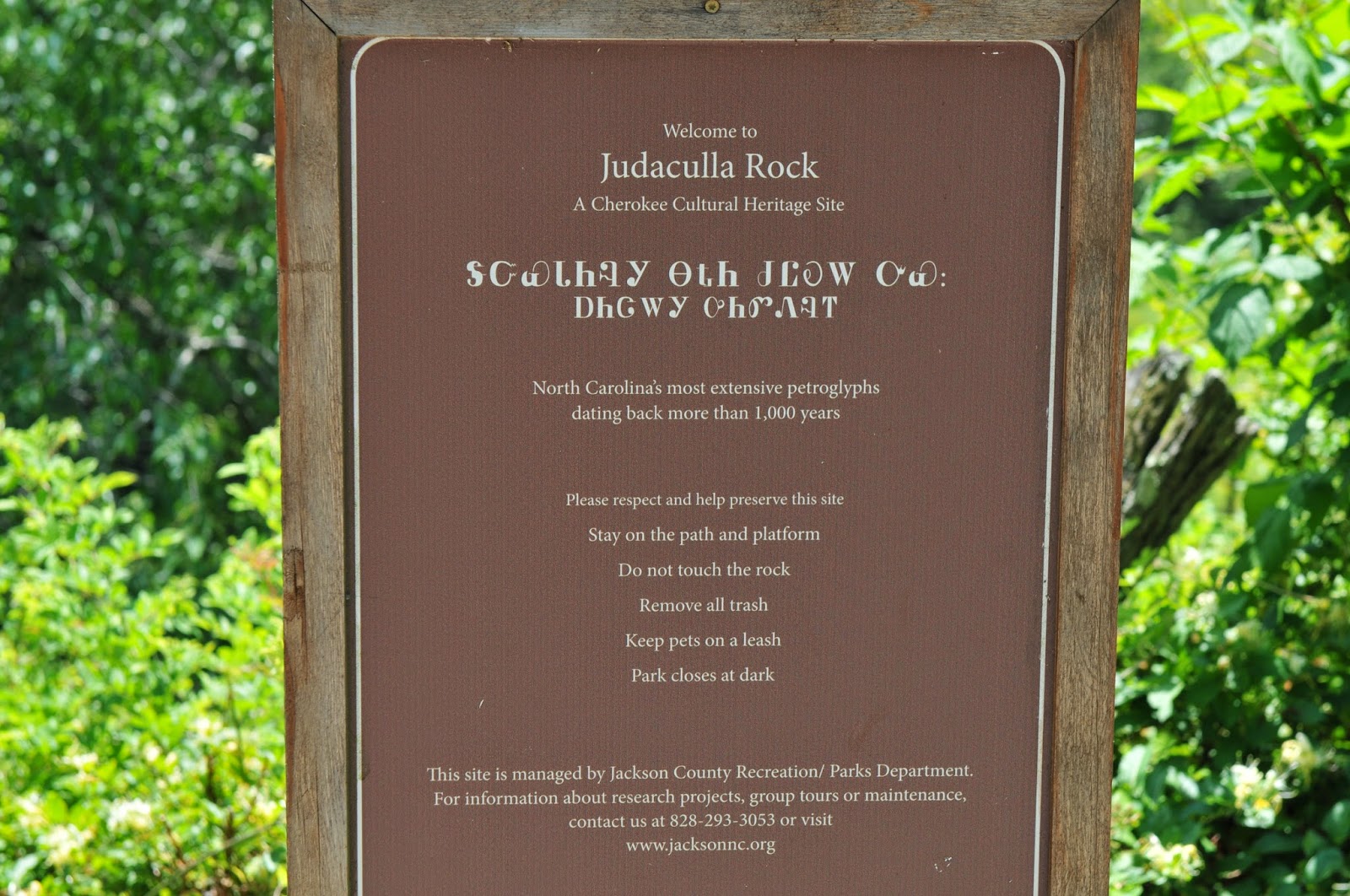
Judaculla Rock, Sylva, NC

On our first visit to North Carolina many years ago the Lovely Frances (Gramma Fran to the North Carolina children) was struck by the Cherokee Indian story and purchased a book called The Trail of Tears. She has yet to finish it. However we still visit North Carolina and travel throughout the state though mostly in the western mountains. The towns of Asheville and Waynesville are better known than the town just to the west, Sylva. But Sylva is where we hang out.

We visit family and look at the sprouts that are grandchildren. We also drive around and walk around a lot. One day we were in the Information Center in Sylva and saw a flyer describing Judaculla Rock a petroglyph site right here in town; now who could pass that up? So off we went on one of our shorter forays.

The town of Sylva, like most of western North Carolina towns, is located on a road that heads for a mountain pass or follows a stream-lined valley floor; in this case both. The flat land is limited to small flood plains and the hillsides become rocky rather quickly. Such was the land we crossed to reach Judaculla Rock just past Caney Fork Creek.
The Cherokee Nation has been in this area for hundreds of years.
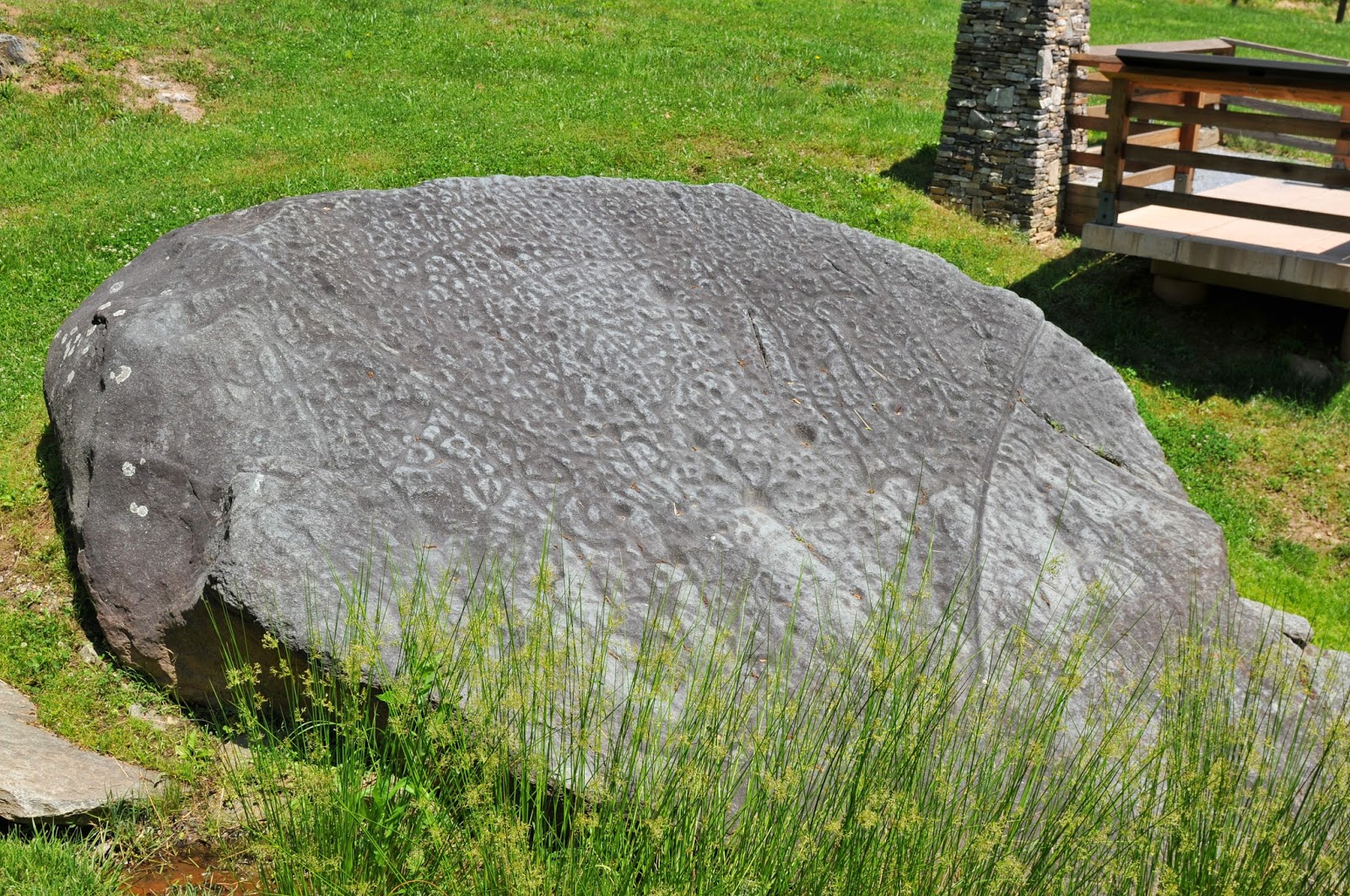
The large soapstone rock was the source of pipes, beads, and bowls for centuries.
At some point, perhaps as much as three thousand years ago, it become a petroglyph site. The dates suggested for the petroglyphs range from about 4000 to 2200 bp (before present). As with all neolithic cultures we know almost nothing of the true meaning of the marks or the reason they were created or of the people who did the work.
(There are sites like Skara Brae, Stonehenge, Callanish, Brodgar,  Zim, and many others that just beg to be understood and all we can do is surmise, conjecture, and guess. They are very intriguing.)

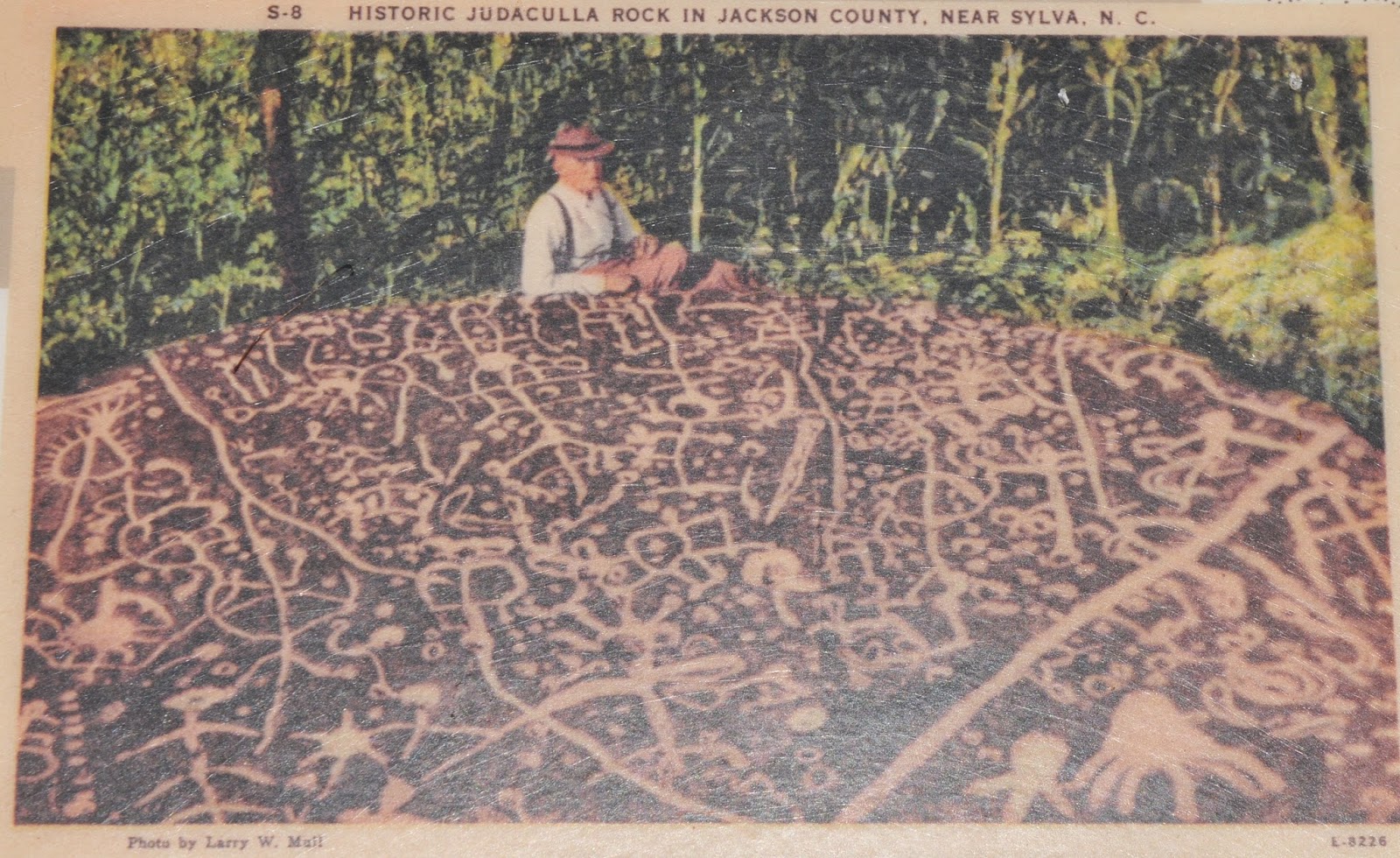
The rock was etched and marked over many centuries (probably). There seems to be no specific language or pattern to the marks though many seem similar. As a matter of fact there is nothing in the markings, as seen better below, that even comes close to something we might recognize. Usually petroglyphs have birds or mammals, prey or predator, weapon or tool, or some sort of reproductive characteristics – these marking are very uninformative. Or, perhaps they are very informative and we simply don’t know what they say.

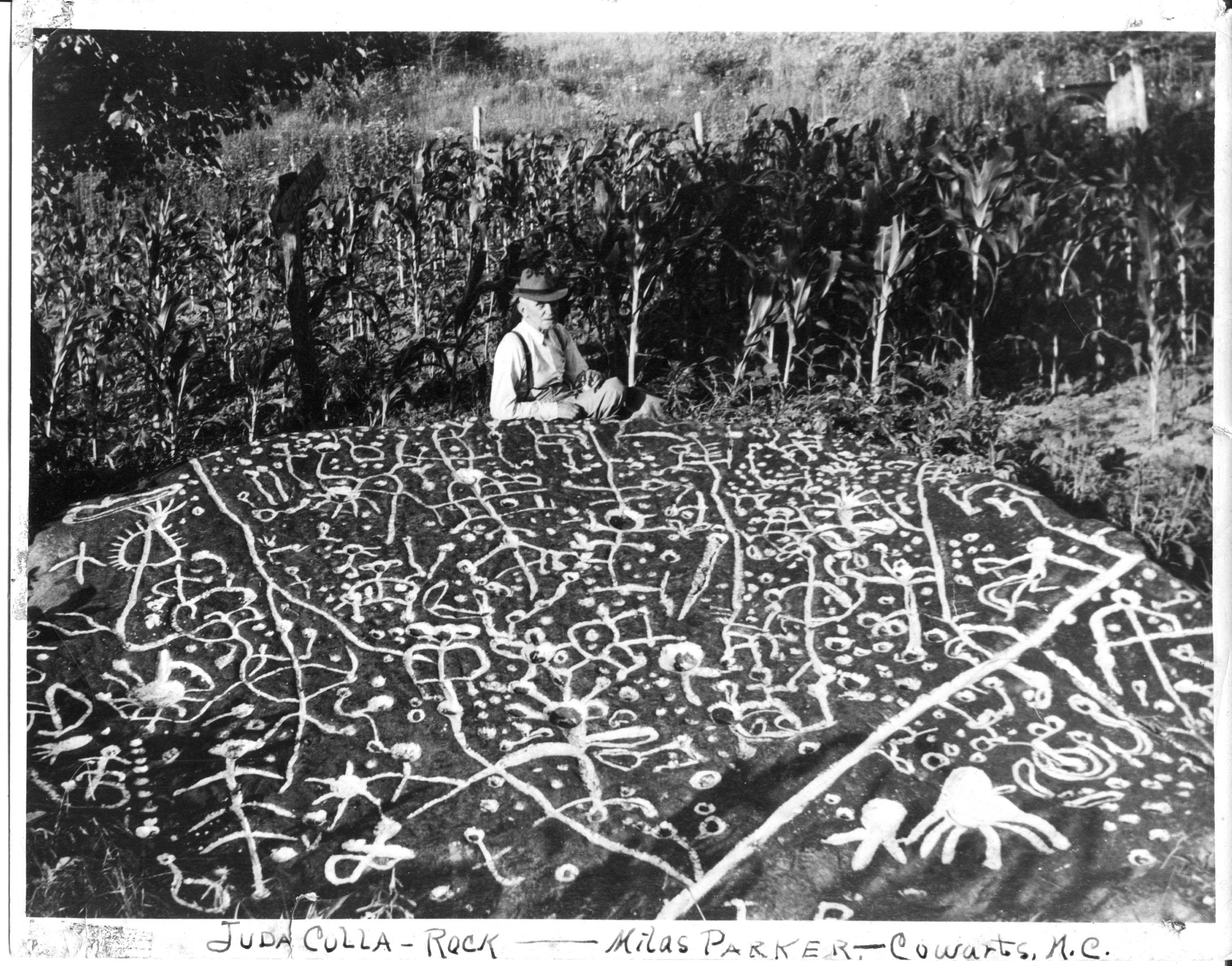
The image below is on an old post card showing how the individual marks can be outlined in chalk. This sort of treatment is no longer allowed and this is the only information that I have found showing the markings. They could be most anything but I fear the meanings are well lost to the passage of time and the changes that all cultures undergo.

The post card is colored and a bit more fuzzy than the black and white image below. It is the image but the lower copy is from  the  photo itself. The photo is undated but is most likely from the 1930s. I found this on a (sort of paranormal leaning) website that can be found at: http://shadowboxent.brinkster.net/images4/JudacullaRockPhoto.jpg
The website which had the black and white image suggests that the depictions are of microscopic life forms not seen by the western world until after van Leeuwenhoek invented the microscope in the 1670s. Perhaps someone, some group, or some visitor had a microscope in the mountains of North Carolina a few thousand years earlier.
There are no other petroglyp sites with so many markings or any sites with similar markings. They mystery is deep, eh?
It is assumed that the etching predate the arrival of the Cherokee and that the rock was there when they arrived in the valley. There is a legend that Judaculla (a Cherokee mythical character known as a slant-eyed Master-of-the Game) somehow was involved in the marks on the rock. The site is on a trail that connected the Cherokee townhouse at Cullowhee with a reputed townhouse in Tannasee Bald that was “Judacullah’s Place”. None of this made much sense to me so I can’t present it very well.
I spoke with this tourist too see if there was anything that she detected about the site that curled her hair or gave her goose bumps. She had heard nothing, seen nothing, and had had no visceral reactions. I am hoping that she will spend both a moonlit and moonless night out there to see if anything eery happens. So far she is unwilling.
The rock is at lower-center-left mostly hidden by the boardwalk’s decking.

Whales, Dolphins, and Basking Sharks

June 8th, 2014 was quite a lovely day. On a sunny June day with flat seas and gentle breezes what better thing is there to do that spend about eight and a half hours at sea looking for those migratory giants our marine mammals and the feathered assemblage of creatures that also migrate here to join the whales at the great smorgasbord of forage fish that the Gulf of Maine offers each year. I can tell you there are few things that can compare to looking over a sea with twenty or thirty feeding whales bedecked with garlands of shearwaters and gulls. Let alone the 200 or so dolphins we had and the three basking sharks. Whew, what a day.

The opportunity for this trip was provided by NECWA (New England Coastal Wildlife Alliance) under the tireless leadership of Krill Carson (Carol). Her crew (Tammy, Lea, Michael working with data) and the kitchen crew (making sandwiches and serving chili and chowder) was again hard working, interested, and fun. The boat held about 100 travelers with a few bird guide types and the NECWA mammal people. We do this twice a year so check out the NECWA website for information on future trips.

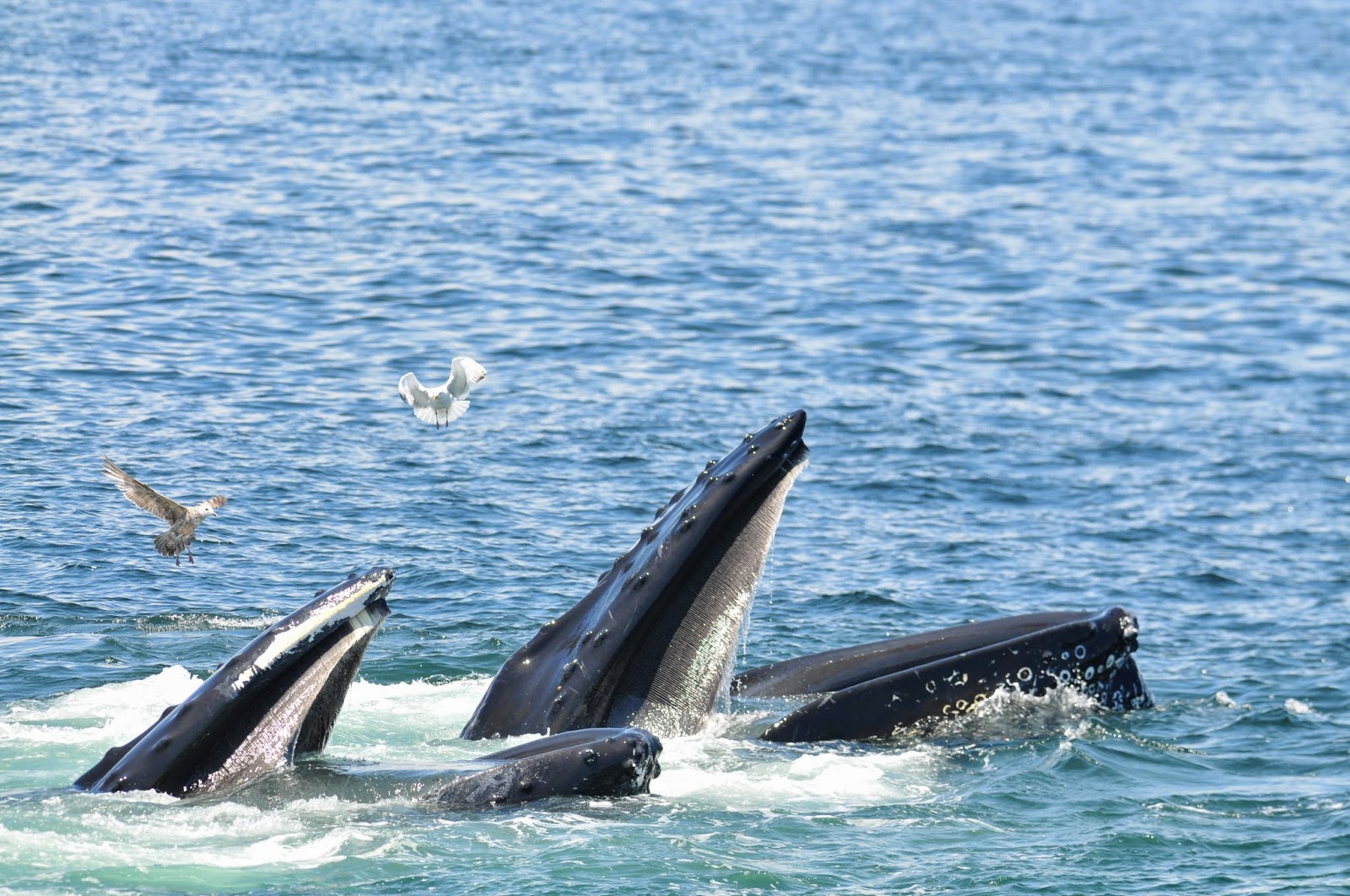
The reason birds, dolphins, fish, and marine mammals come north each year is that we have a forage fish called Sand Lance that occurs by the billions some years. This is a big year for these finger-sized fishes. A close look at the image above will show about thirty small fishes at the front end of the whales’s maw. They are trying to escape from the cavernous lower jaw and swollen rorquals of the whale. The whale will then strain of the water and swallow the fish that remain in the mouth. 
These whales have just broken the surface of the water with the baleen-draped upper jaw open and the bowl-shaped lower jaw distended with water and fish. The will close their mouths and swim slowly forward forcing the water out through the baleen and back into the sea. The fish remain. The whale is (of course) a mammal and the few remaining hairs are in the bumps that you can see on the upper surface of the top jaw.

We had a Minke Whale and a few Fin Whales as well as 50+ Humpback Whales. (The NECWA crew identified thirty by tail pattern. The Fin Whales were lunge-feeding and the Grand Dame of the Atlantic (Salt) was among them. This time she was accompanied by her eleventh calf named Epsom.)

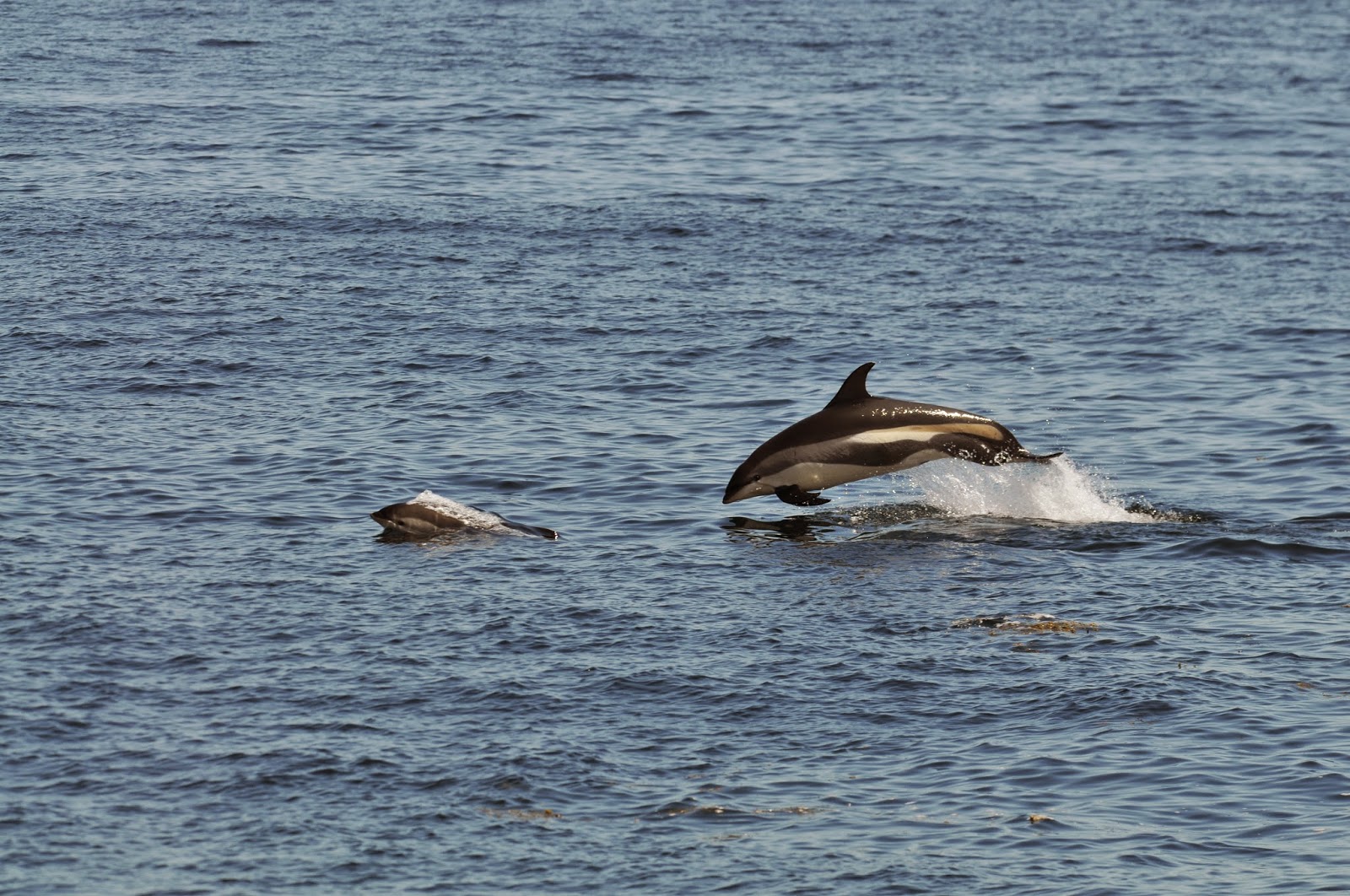
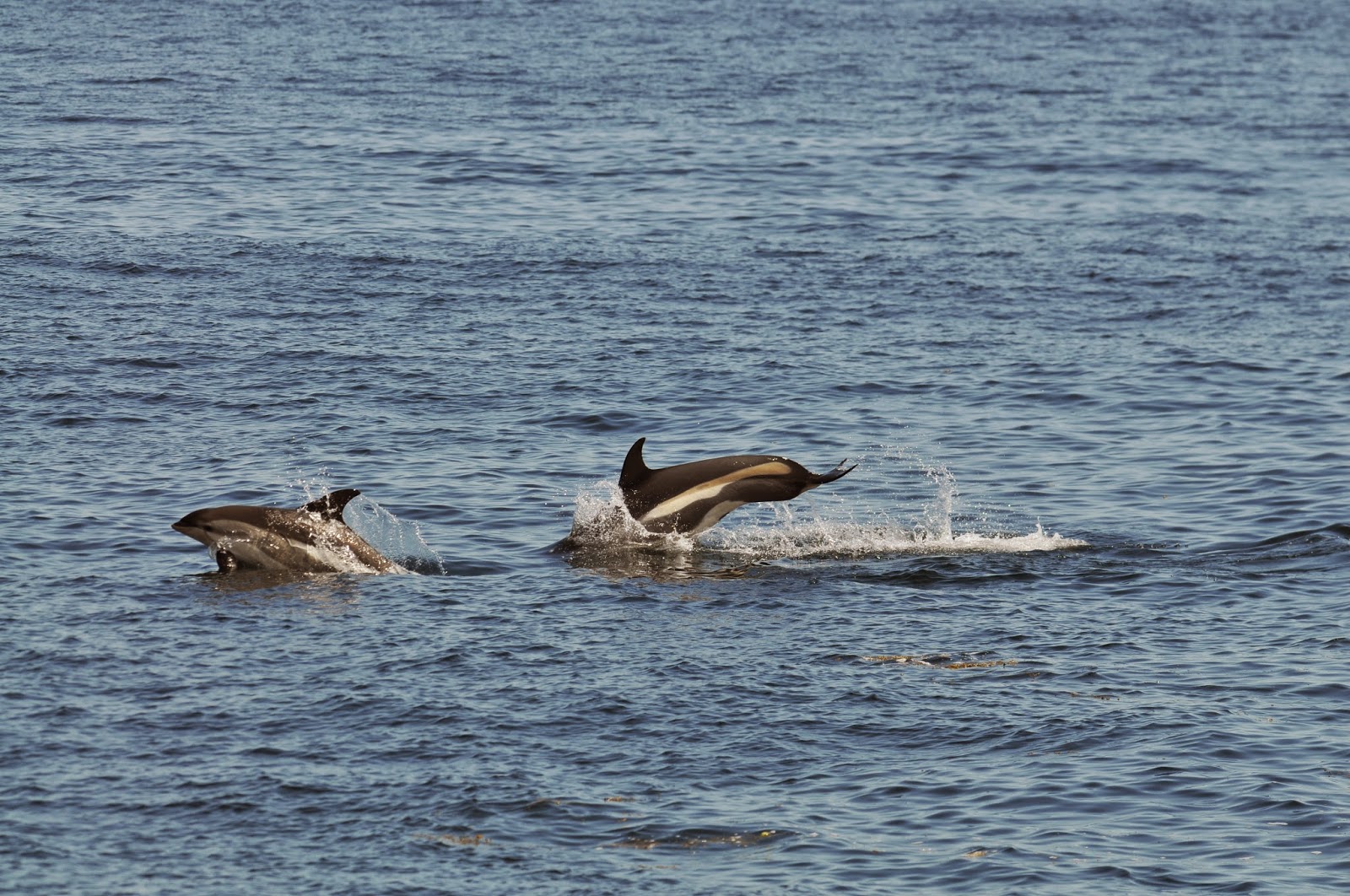
All these mammals were feeding on the swarms of Sand Lance. The Fin Whales were accompanied by more than 100 Atlantic White-sided Dolphins.

The abundance of phytoplankton and their predators, the copepods, allow for huge numbers of small fish. These fish feed the birds, mammals, and many of the migratory fish that arrive in the western North Atlantic each summer. The White-sided Dolphin is 6.5 to 9.5 feet along and weights range from 150 to 225 pounds. They are active and seem exuberant. Most of the European names relate to their obvious and repetitive jumping as they travel. In the above image the front animal is smaller and probably a youngster. We saw many calves in this group. Calving is a springtime thing so the young we saw may be only a couple months old.

The first sign of a Mola Mola or large ray or shark is often the dorsal fin. This fin belonged to one of the three Basking Sharks we saw.
The Basking Shark is a placid monster. A slow-moving plankton eater it is one of three plankton feeding sharks; Megamouth and Whale Sharks are the other two. They are found worldwide and can grow to be twenty-five feet long. Most Basking Sharks are found in the shallower warmer waters of the continental shelves as these waters are the most likely to be rich in plankton. They will weigh up to 6 tons. A rather floppy dorsal fin and occasional point of the tail fin help locate the shark, especially in flat water. They are slow moving but will drop deeper as a boat approaches. We saw three of them on Sunday the 8th of June. A polarizing filter might have helped with the photo – but this is the best I got.
The birds of the ocean are all well adapted for long distance flight, feeding in rough water, and maintaining bodily salt levels. At this time of year most of the adults (gulls, terns, gannets, loons, auks, and sea ducks) are on nesting grounds. A few gulls and many terns nest in Massachusetts but most of the sea birds we saw all winter are long gone. The bird above is a Northern Gannet; a non-breeding young bird. It takes about four years for a Northern Gannet to reach adult plumage and maybe longer to become a capable breeder. They start off dark like this youngster and eventually end up almost pure white as adults. So, this is probably last years baby; an elven month old bird that is returning from the Caribbean perhaps. In June we rarely see full adults in Massachusetts waters.

However, the bird below nests in the Southern Hemisphere and is on a great winter circle of the Atlantic Ocean. The Sooty Shearwater nests on islands down near the Southern Ocean and various parts of the population fly a loop around the the Pacific and others circle the Atlantic, covering thousands and thousands of miles before returning south to breed during our winter and the austral summer.

Gorges State Park, North Carolina

While taking a week in the mountains of western North Carolina Fran and I had a chance to get down to one of the states newest parks; Gorges State Park down near the Georgia state line in the town of Sapphire. This is a large park along the edge of the east-west running escarpment that catches the moist air coming north from the Gulf. The southern edge of the park usually receives about 100 inches of rain where the north side get 40 inches or less. In between these two circumstances are waterfalls, rolling mountains, diverse forests, and lovely vistas.

We went there because when in North Carolina I always head for a road south of Cashiers (cashers not cash-ears) to pause along rhododendron lined streams where Swainson’s Warblers (SWWA) breed. As Fran wanted the SWWA for a life bird and as I like the habitat and bird, we went looking for them and then traveled on to the nearly 7,500 acre park.

Many nature centers around the countryside are modest show and tell set-ups; some very educational, some merely entertaining. The nature center at Gorges brings education and a local natural history experience to a new level. It starts with the geology as I think all natural history education must. There is a discussion of the mountains, the escarpment, the rocks and their patterning, the water and runoff and the habitat type that follows on the heels of those circumstances. The slow changes that have been wrought by the passage deep and ancient time create the short moment during which our lives occur. Understanding the immensity of this time provides us with the educational foundation for all of science and most of our cultural activities as well.

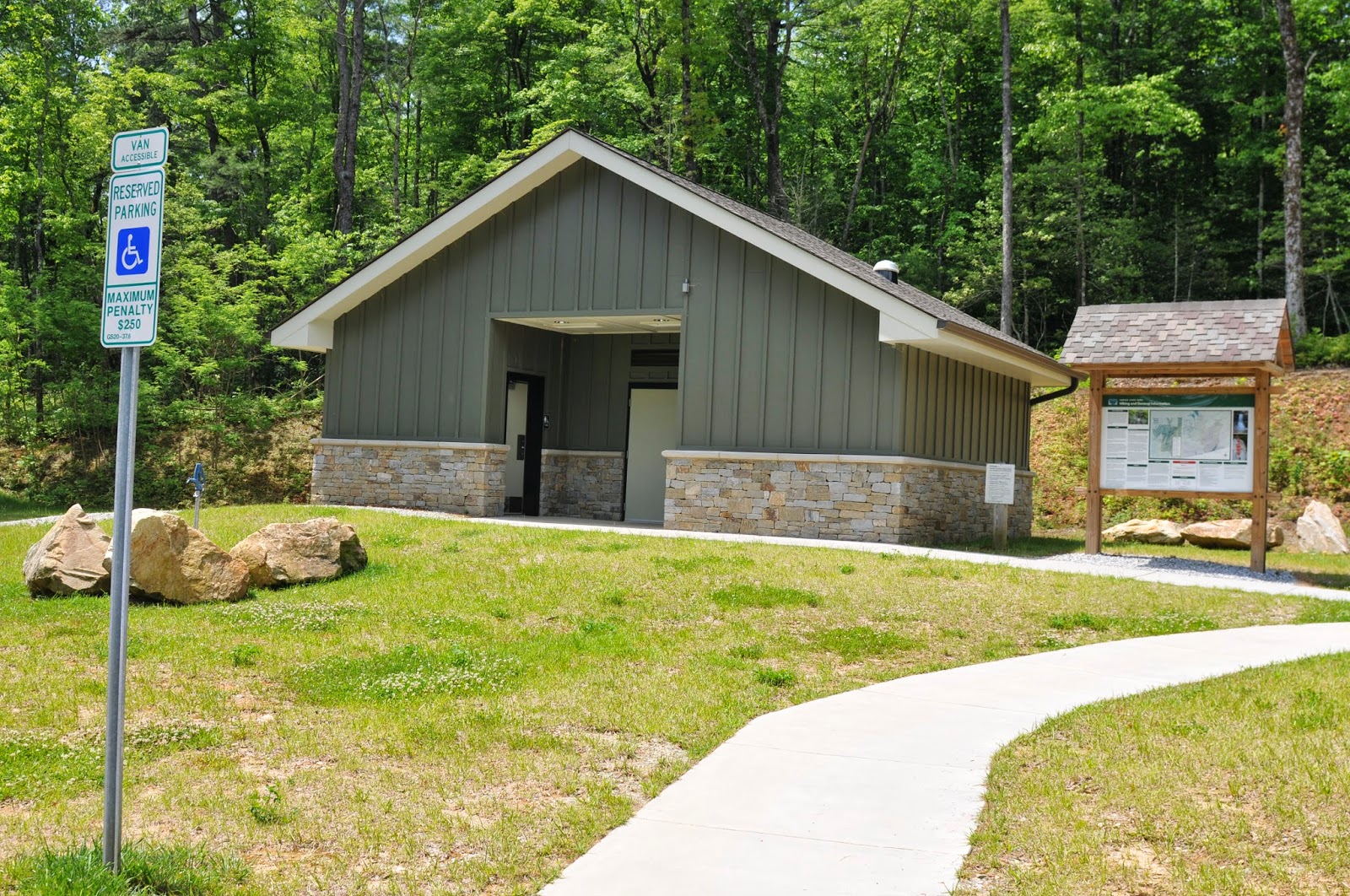
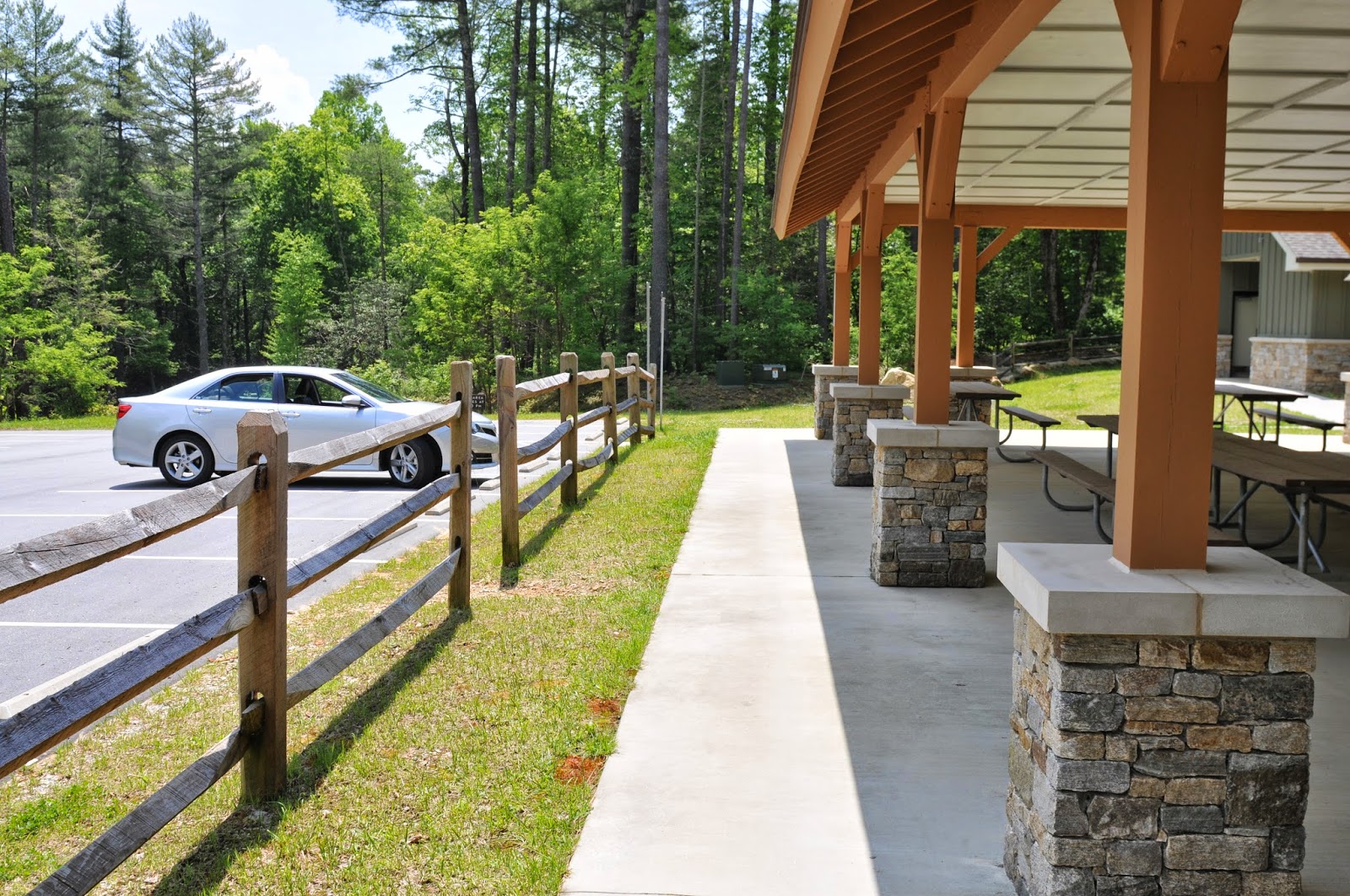
The picture above and the one below show one of the trail heads and picnic areas. At each parking lot is a bathroom (top) picnic pavilion (below) and interpretive trail information. Most of the trails ares short enough for family hiking but there are longer trails for people who may choose to stay in the well-designed and located camping site. 

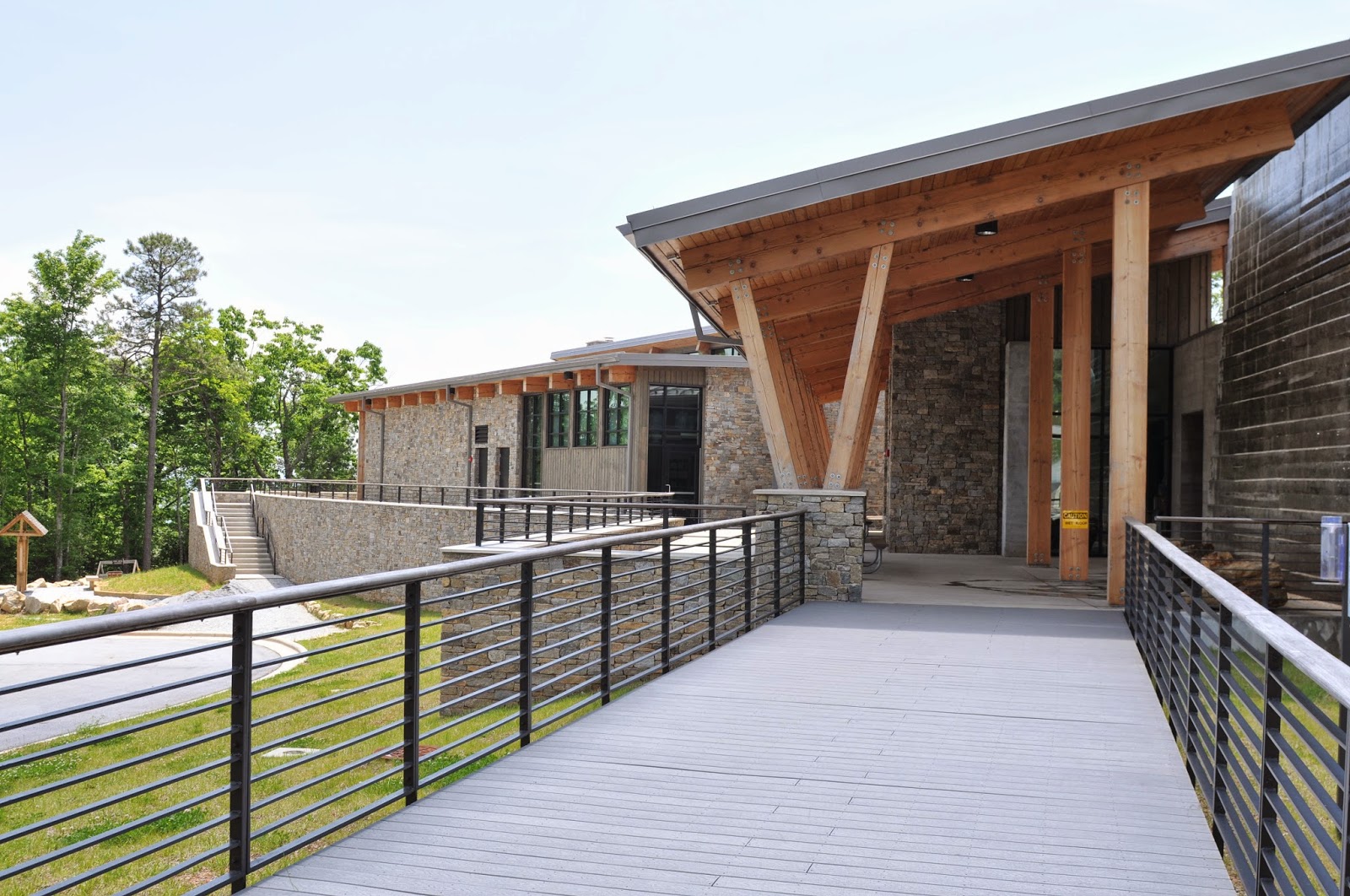
The visitor center is shown in these last images. It is a LEED Building (Leadership in Energy and Design) and will likely be a benefit to the citizens of the state. These buildings are built of previously used materials and deigned to require minimum energy to operate. 
The entrance takes you through a modest gift shop that sells appropriate books, pamphlets, maps, and trinkets; it is not a junk shop. This part of North Carolina is largely an upscale retreat and escape location for Floridians. Mountain getaway homes are what the Floridians do to escape the summer’s heat and humidity(or so I was told several times). There are dozens of gated communities and golf courses in the area. So that means two things; the mountain locals have a hard time finding a place to live nowadays and there are plenty of trinket and useless-souvenir shops in the area. It is nice that the State Park hasn’t developed another.
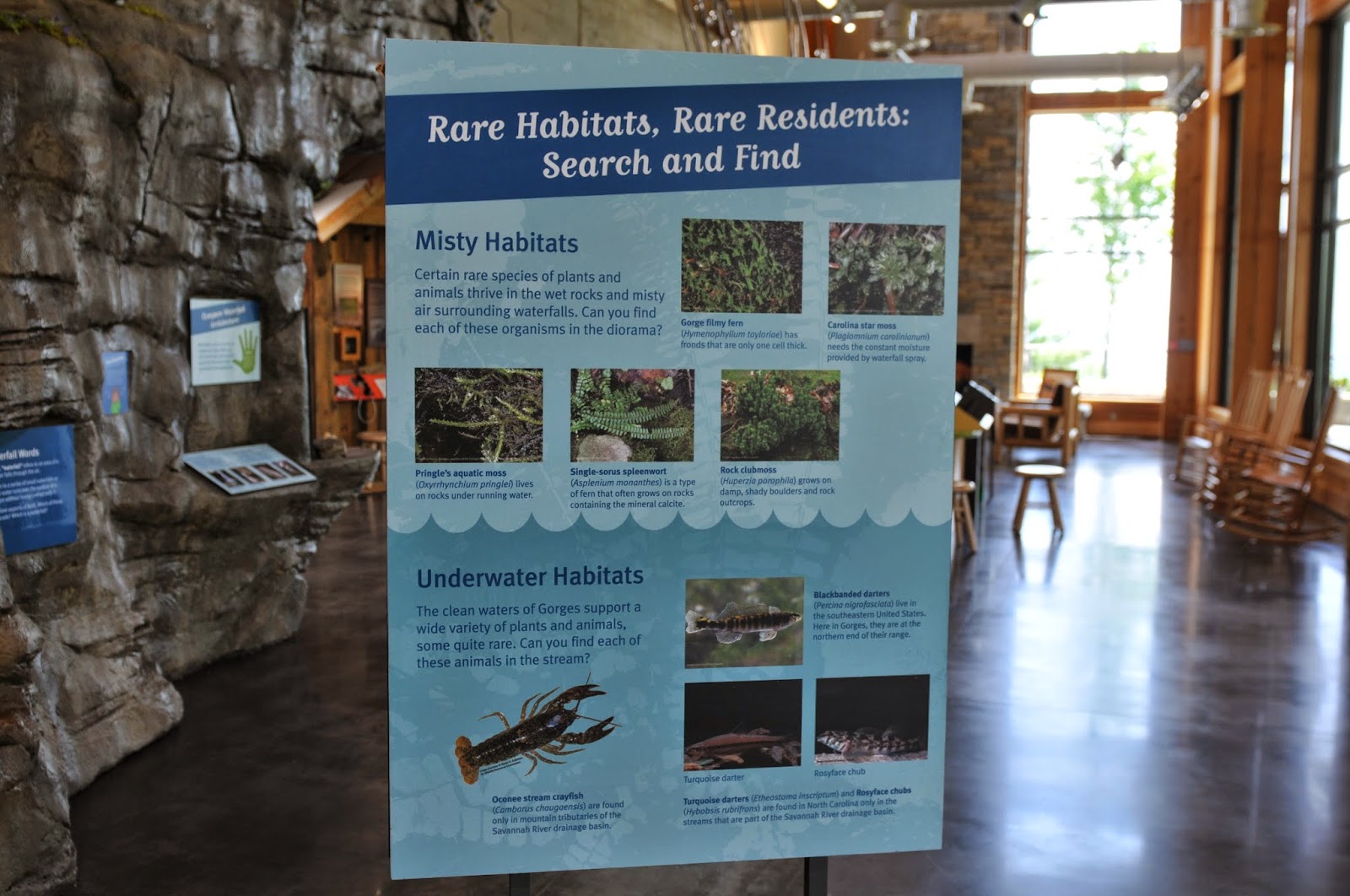
The educational information is well designed and displayed. A flow of lights and copper wire, displays of waterfalls, and rock formations and depictions of floral communities are done well enough to hold the attention of fourth graders – a difficult target audience. 

By the way; a 2014 fourth grader’s abilities probably overlap (or maybe exceed) ours in the areas of geology and Appalachian forest diversity; at least that may be true with many of us who went to school thirty, forty or fifty years ago. Don’t think I am disparaging those of us who are older than fourth graders – its just that we are often in the same boat as far as science education goes.

Tall ceilings, full windows, tables and chairs, a fireplace, a theatre (75 people) and education room (40 people) are all part of the inside of the building.
The interpretive displays are all new and crisp. There are Park Service staffers who can lead outings on the trails for visiting school groups. The staff mentioned that there is a “Friends” group that can provide small grants to help fund drivers and school buses to bring children and teachers to the site. This is a nice classroom away from the school building and teachers will learn that it may not be a great place for simply a day off as the kids live in these mountains. It is a science lab and classroom waiting to be used. 
The paths, decks, and travel ways encroach on only a small portion of the park. Gorges State Park is well done and thorough yet leaves most of the property to the whims and whiles of nature. I was impressed and pleased with the facility and the planning involved.
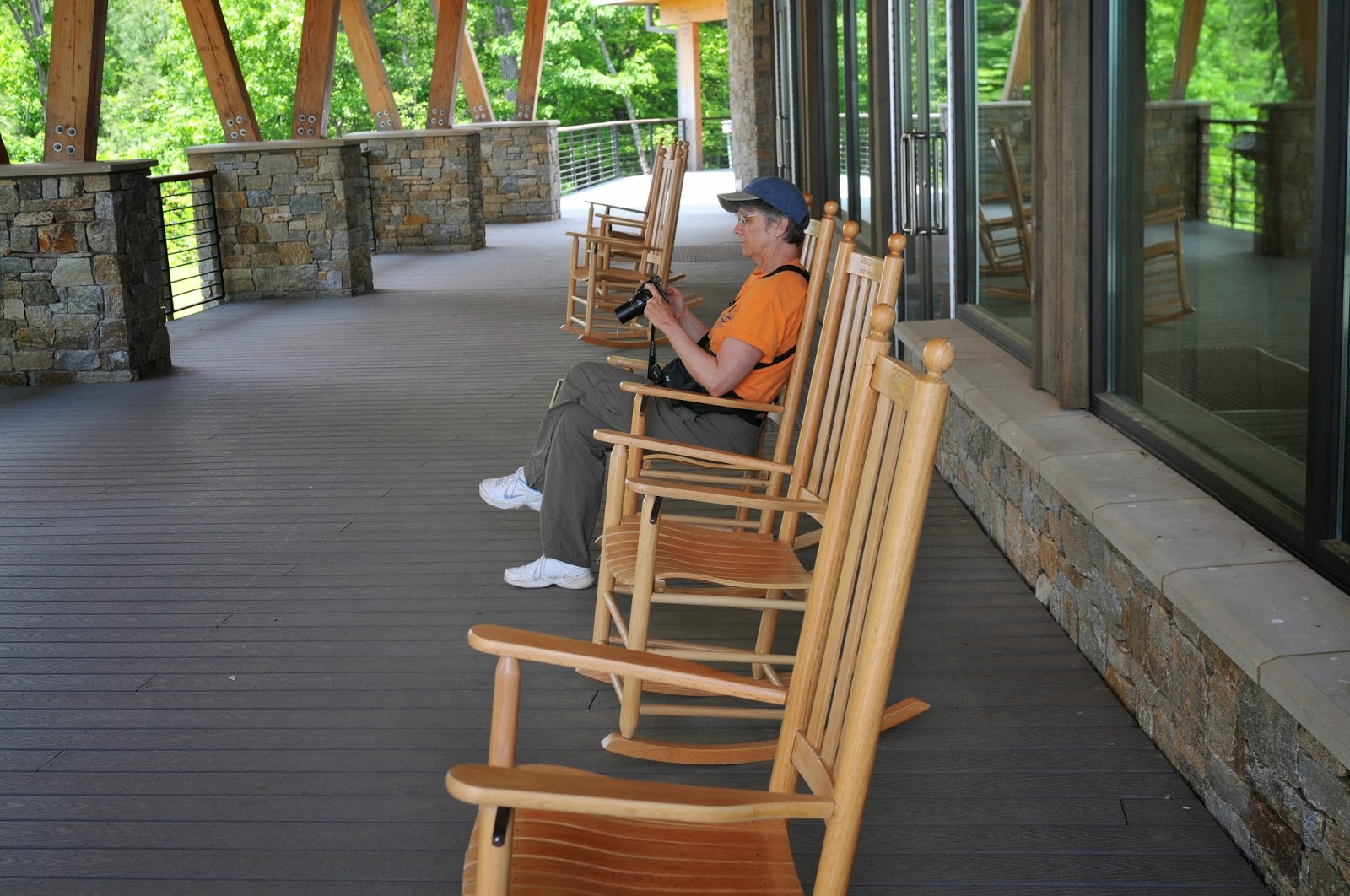
Here we see an average tourist from out-of-state looking at her images taken while on one of the trails.

Albatross are Amazing

The waters surrounding New Zealand, whether north or south – cool or equatorial, are full of marine life. I’ll start with the sea birds and finish with other vertebrates on another page.

The sea birds run the gamut from petrels to albatrosses to terns to gulls to jaegers to shearwaters to prions; and most of them are common and easily seen if you are there at the right time of the year. In the following images I will show some of the albatrosses that give size and power to these waters.

But first it should be mentioned that the taxonomy of this group is a bit sketchy, a work in progress. There are several breeding groups of large albatross y=that have great site fidelity and act as separate species what with no interbreeding. But the birds seem too be the same species from all signs. Thus they mat be undergoing speciation right now based on geographical separation and the lacking of population interbreeding – but taxonomists don’t agree on when one species begins and where its closes cousin’s group ends. DNA can do some things but in many cases it shows that life is a continuum of genetic change with no clear and decisive demarcation between on creature and the next.
Thus there are books that speak of albatrosses non anywhere from 14 (the old number) to as many as 27 separate species. I am using names from Onley and Scofield (Albatrosses, Petrels and Shearwaters of the World – both Princeton and Helm, 2007). They recognize 21 species of albatross.

In Kaikoura we went out with a company called albatross encounter which is part of the Encounter Kaikoura operation. We were part of very small groups and had a skilled and knowledgeable boat lady (Tracy). The trips are not long as the birds are just off shore and getting to them is not at all time consuming. The whole operation is geared to showing you birds in the open ocean and is very well done.

The reason they are here is that the floor of the ocean changes just off Kaikoura. There is a deep water canyon (Kaikoura Canyon) that reaches right in toward shore and creates an upwelling of cold and rich water that provides a great deal of small edible sea life. Thus the area is rich in foods and rich in predators as well.

We will look at petrels, shearwaters, and diving-petrels on other blog pages.

So here they are; big beautiful and glorious masters of the wild winds of the southern hemisphere.

The islands that make up New Zealand run from sub-equatorial to nearly antarctic. the water temperatures vary tremendously. The phyto- and zoo-plankton are equally varied and support a great array of sea life. But the top of the line predator, at least in the air, are the large seabirds. To see them you must head out to the ocean. Though they nest on land and can be seen coming and going in many parts of the world they are best seen and understood as pelagic animals; creatures of the great oceans. New Zealand offers many opportunities to see many types of sea bird. The most spectacular perhaps are the albatrosses.  There are about fourteen species that can be seen in the waters of New Zealand. There are specific areas where the oceanic conditions are best suited to provide calories to sea birds; the ocean is not an equal-opportunity buffet table. Rather it is a series of patches of food separated from other areas by much less productive waters. Thus we head to Kaikoura on the eastern side of the South Island and again to the Hauraki Gulf just north of Auckland on the North Island. Of course the smaller islands and island chains to the south of the South Island (Stewart, Chathams, Antipodes, Aucklands, and Campbells have birds and endemic populations.) 
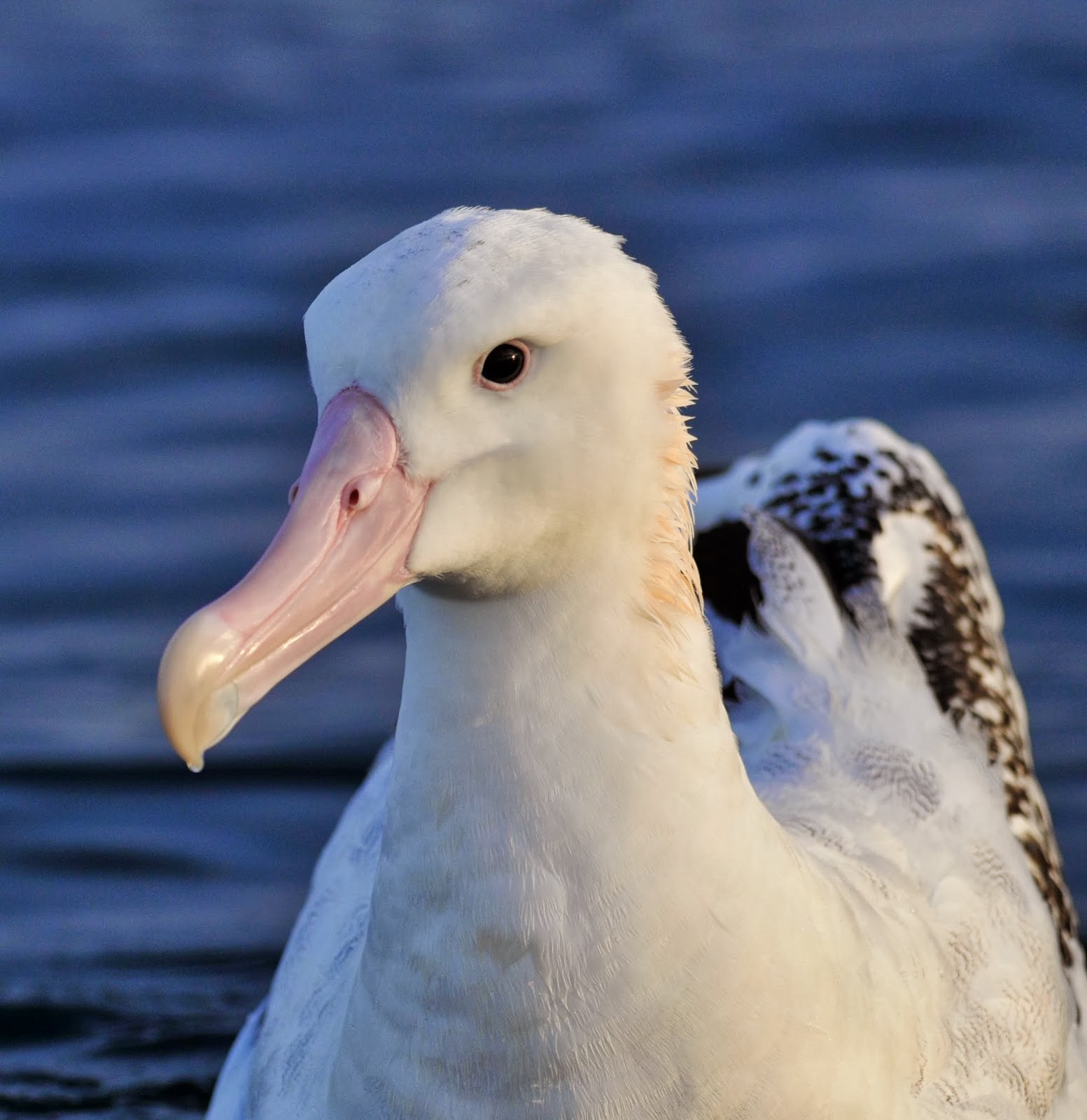
The two large (traditional) albatrosses are the Wanderer and the Royal. The wanderer is in the midst of extensive taxonomical study and the number of species is still undetermined; probably there is no definitive answer as populations seem to be isolated today (on islands) but certainly share a rather recent common ancestor. The bird above is rather typical of a Wandering Albatross in that it has a pinkish bill with a cream colored tip. The hue on the nape is from either algae or bacteria or something else. It is a rather common occurrence but not well explained as of today.

The bird below is quite similar to the bird above. The next bird down however is a Northern Royal Albatross another very large bird but with a black cutting edge to the beak.

This Royal Albatross is about as large as a Wanderer; a ten to 11 foot wing span and a weight of fourteen to twenty pounds. Actually the Wanderer averages a good deal lighter than the Royal. The black line where the edges of the mandibles meet is characteristic for Royal Albatross. The amount of black on the back and wings varies and changes with age in both groups. The Royals are now divided into two types (maybe species) and the Wanderers are divided into three and maybe four types. 
There are quite a few albatross that have a gray or sooty head and neck. The Buller’s Albatross (above and below) is one of the loveliest of them. This is a medium-sized bird with a wingspan about seven feet and a weight of four and a half to seven pounds or so. Like so many oceanic creatures we only have a vague idea where they go when at sea. These birds seem too be NZ birds for the most part though one population wanders eastward all the way to the Chilean coast on occasion. The use of radio and satellite transmitters is providing much more information annually than all the information that has been gathered by anecdote and banding over the past decades.

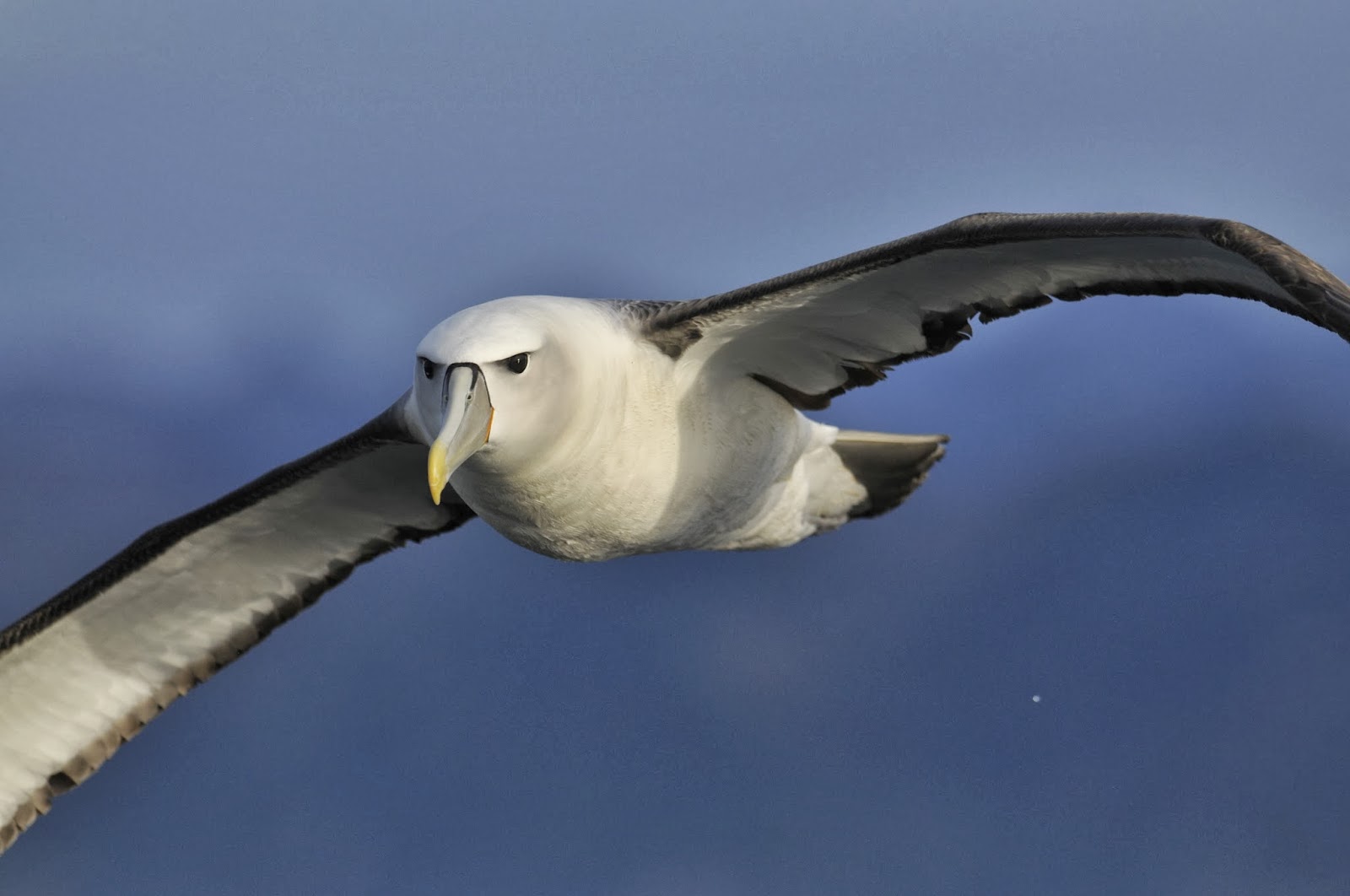
The Shy Albatross was another of the regulars around our boat. The eyebrows are similar to the Black-browed Albatross and the bill is a mix of characteristics from other birds; but it is a singular beauty. This is a bird of the waters around Australia and New Zealand though is it ranges out to sea as well. There is a breeding population in the Bass Straits near Tasmania and another on the islands off New Zealand. Some books separate them as identifiable populations if not as species. Most books however do not separate them. These middle-sized birds are in the Genus Thalassarche. This entire group of (probably) nine species are often called Mollymawks. 
Spectacular aren’t they?

If you would like to use an image for reproduction
please contact me at:
declapp@me.com

The More Local Galapagos Geology

The previous page looked a bit at the origin of the Galapagos archipelago. This page will look at some of the features that are approachable and intriguing. Volcanic debris is highly variable. the flowability (viscosity) of the material varies with chemistry and temperature. Some volcanoes explode others ooze. Some make solid mountains other collapse in one way or another. Volcanoes, like water and wind, are constantly reshaping the surface of the earth. Geology in action is an awesome thing.

In some cases the volcanic activity is more of a blurp that an explosion. This is a spatter cone or mud cone that forms (most likely) from gases venting through a semi-solid. The surrounding material is hard on your perhaps but it is not really igneous rock.
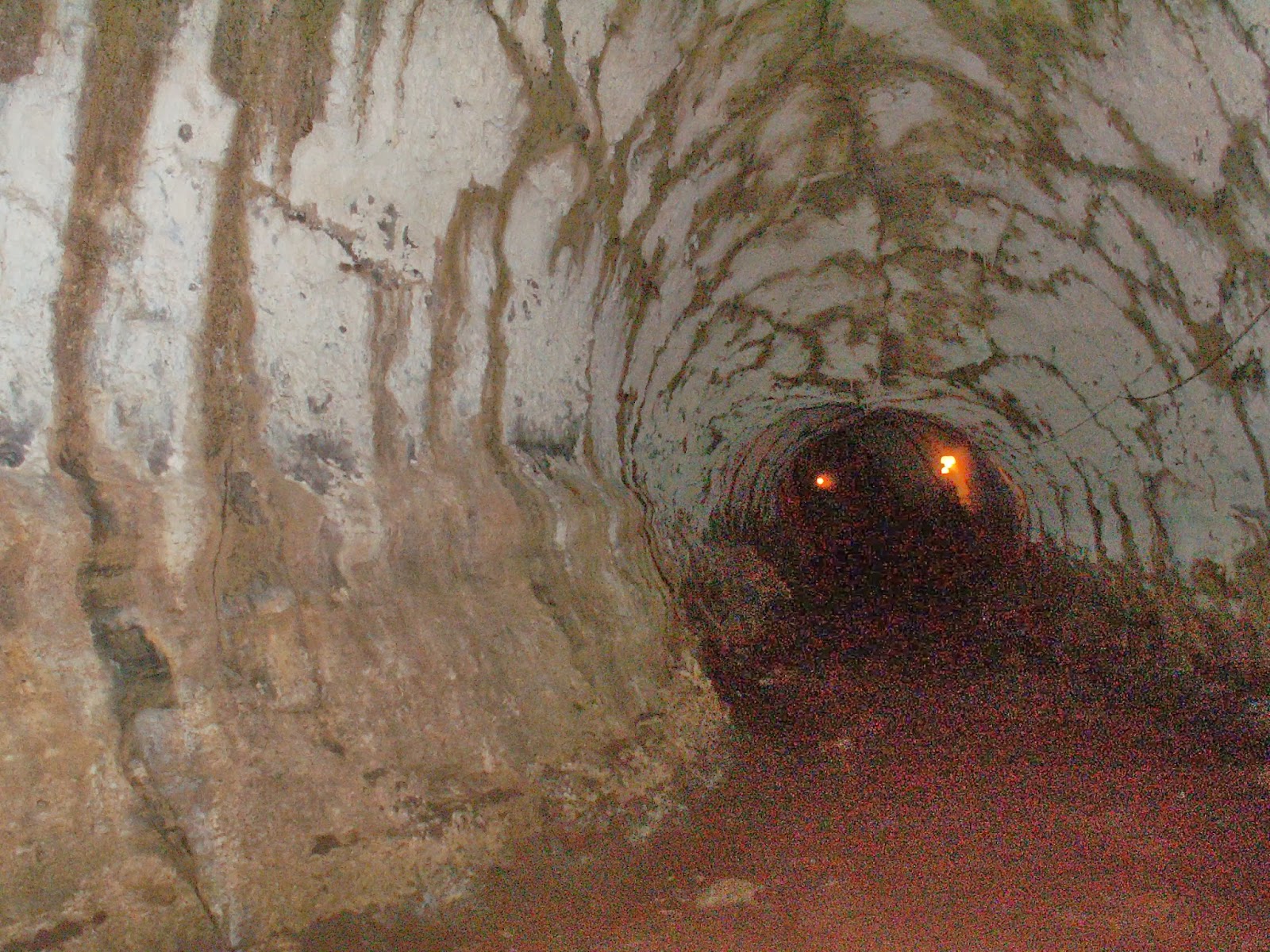
The image above and the three below show a lava tube or the remains of a collapsed lave tube. When hot lava flows it stays warmest in the center of the flow. Thus the outside can cool and harden and the inside might still flow. In some cases this happens and the result is a hollow tube formed by a hot flow of lava. A few of the larger lava tubes have been made available (usually through private landowners) for public visitation.
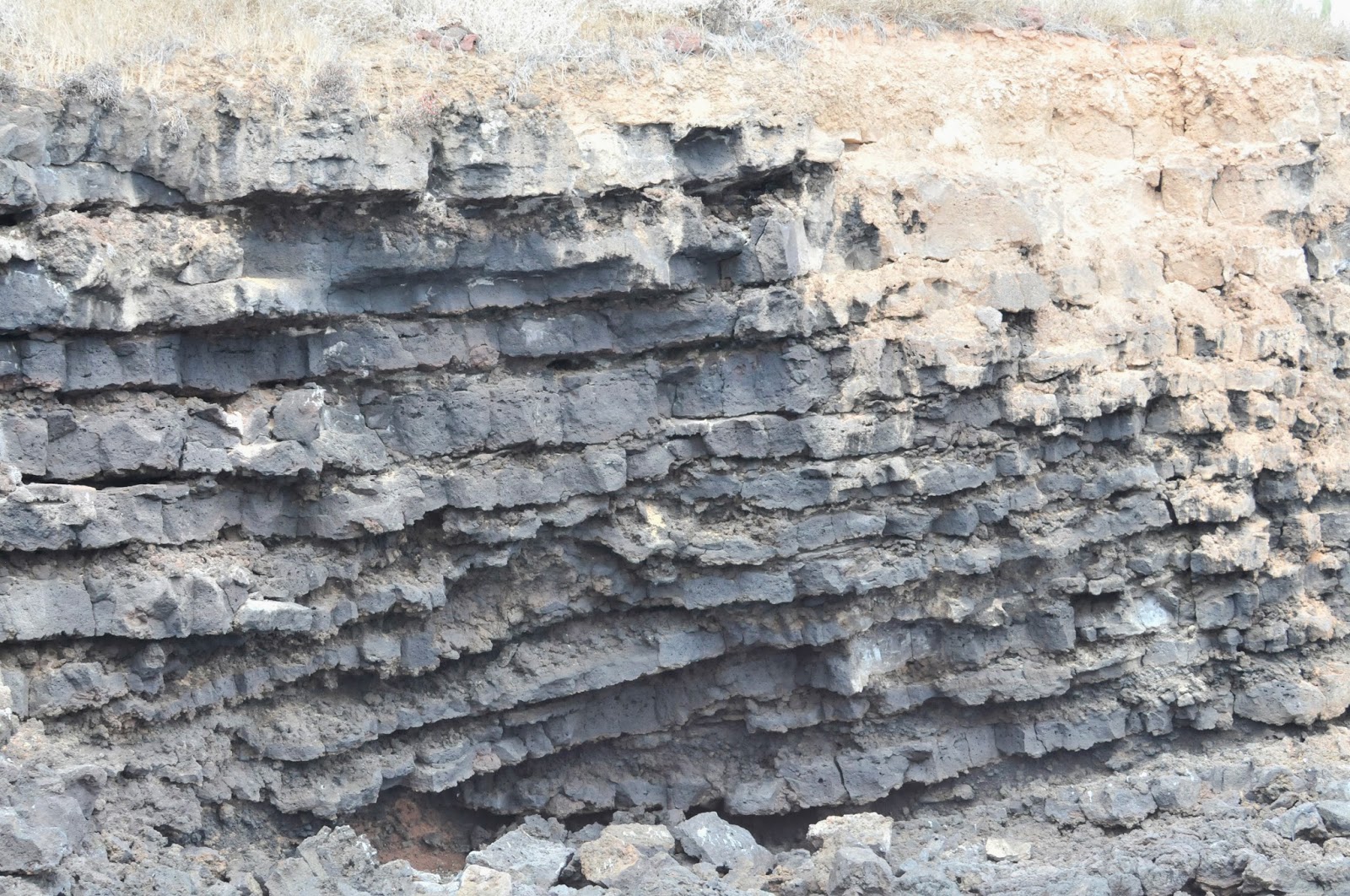
The large pit shown is one of two pits (Los Geminos, the twins) on the island of Santa Cruz on the cross-island road from the ferry to town. (Planes land on the small island of Baltra and many people are bussed to a ferry that takes them to Santa Cruz and then another coach to Puerto Aroyo where the tourist boats are often waiting.) The best conjecture now seems to say that there was a large lave tube here and the roof(s) collapsed creating open pits. They could have been some sort of lava bubble I suppose. I have always been interested in the layered look of the edges as I think of a lava tube being formed in a more homogeneous sort of situation rather than within a sedimentary matrix. 

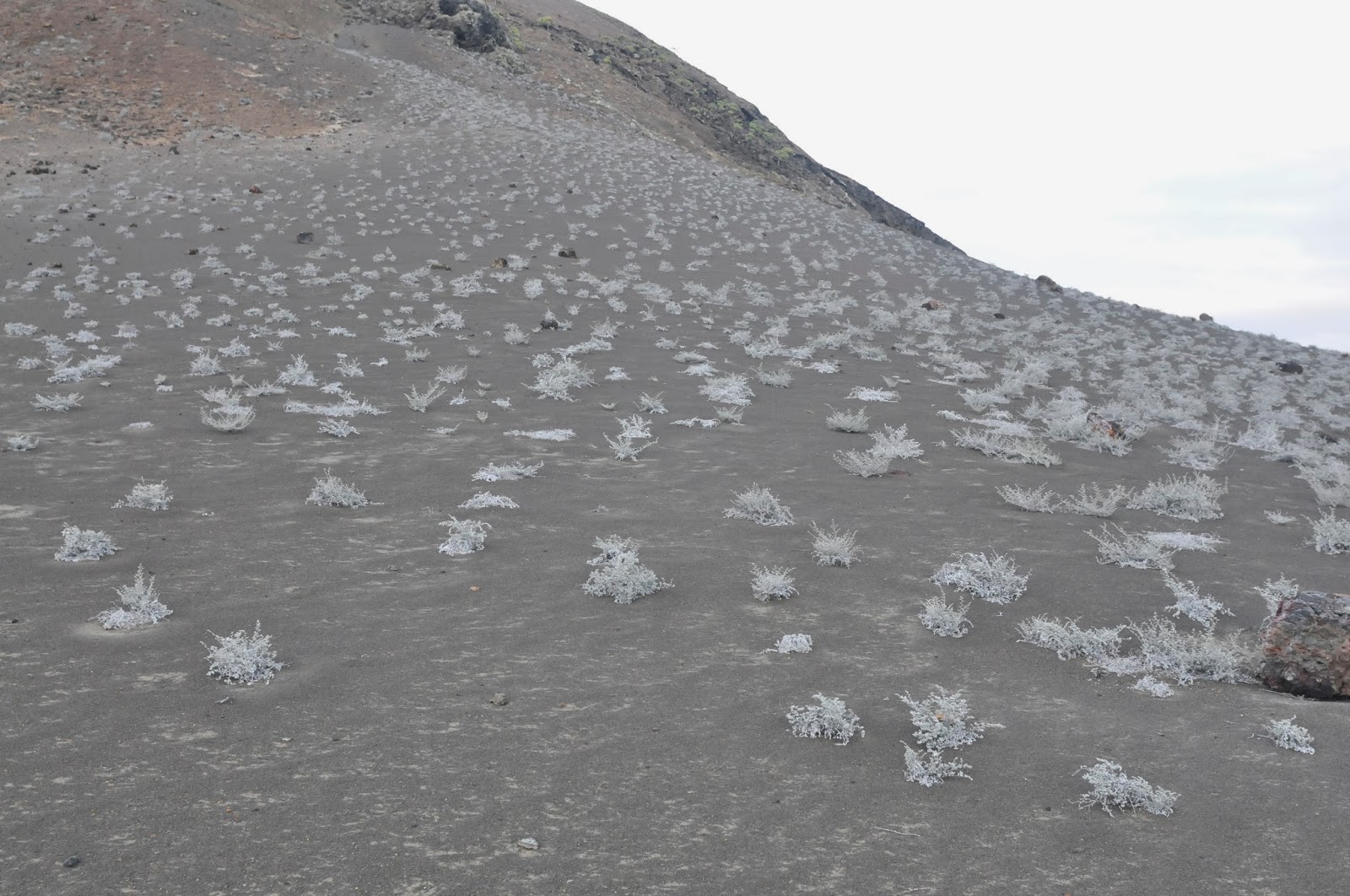
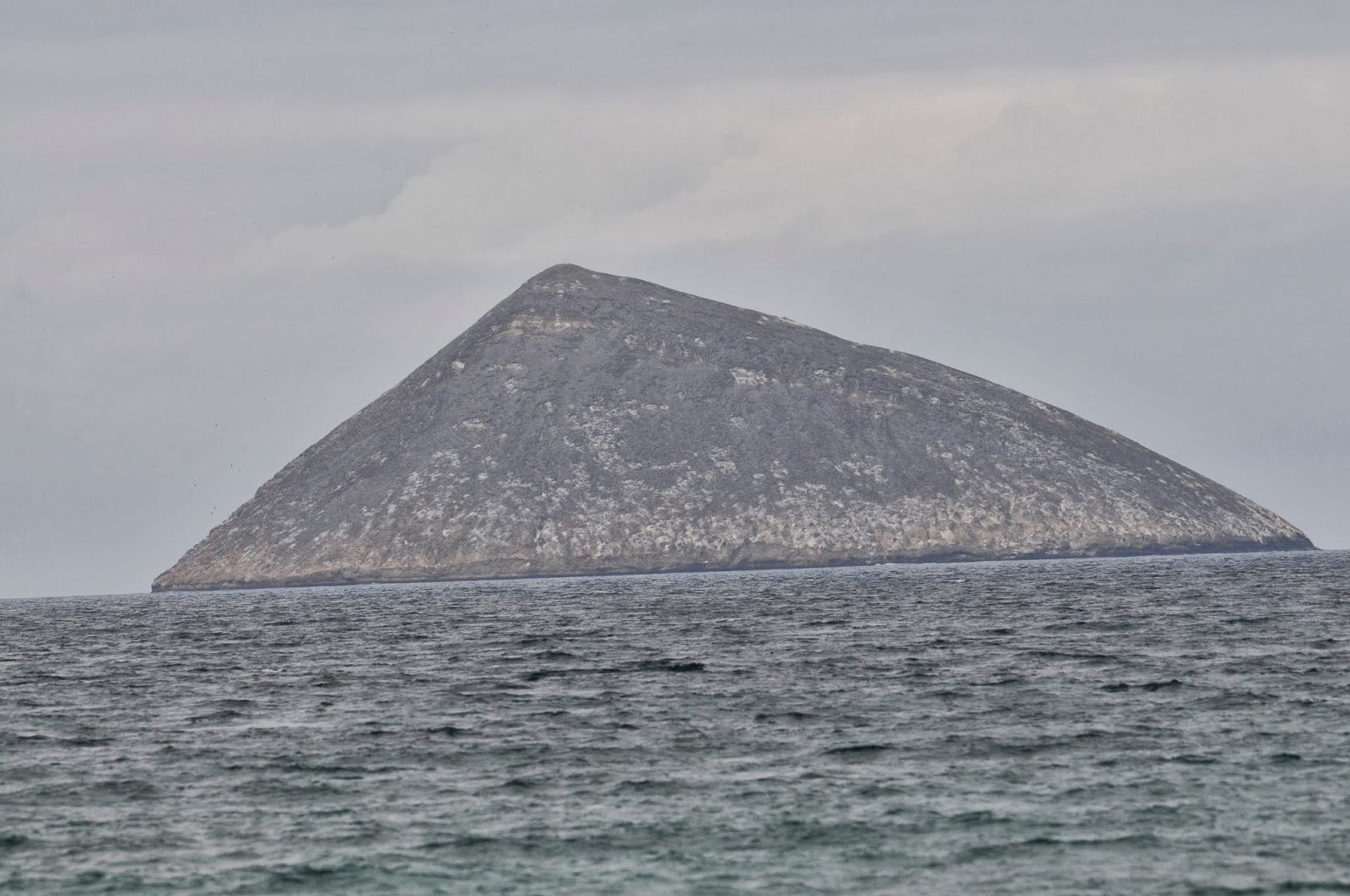
Ash and volcanic debris can take many forms. A hard gray hillside with very limited vegetation and few animals is one form and the sedimentary layers below speak to many ash-laden eruptions.
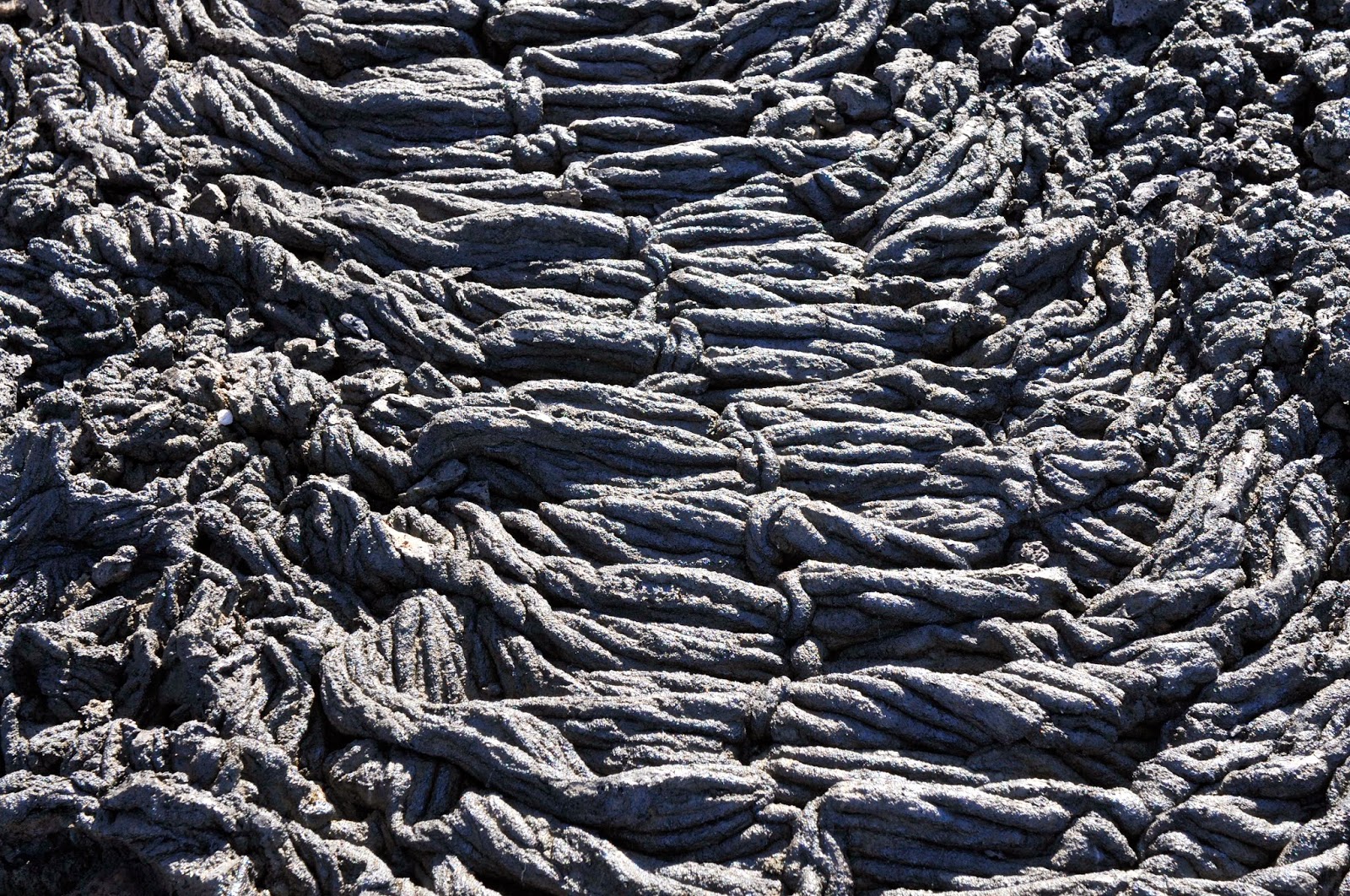
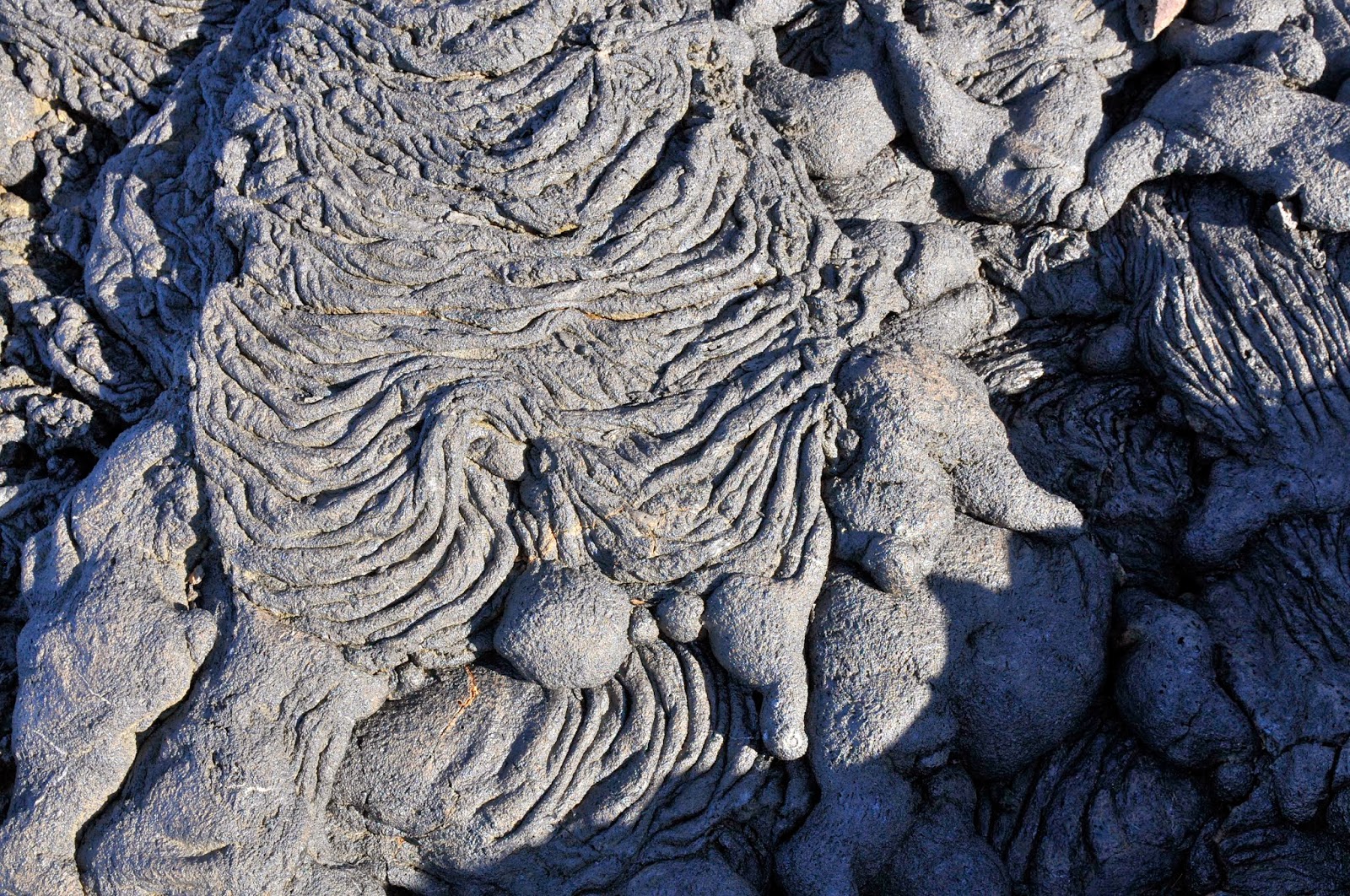
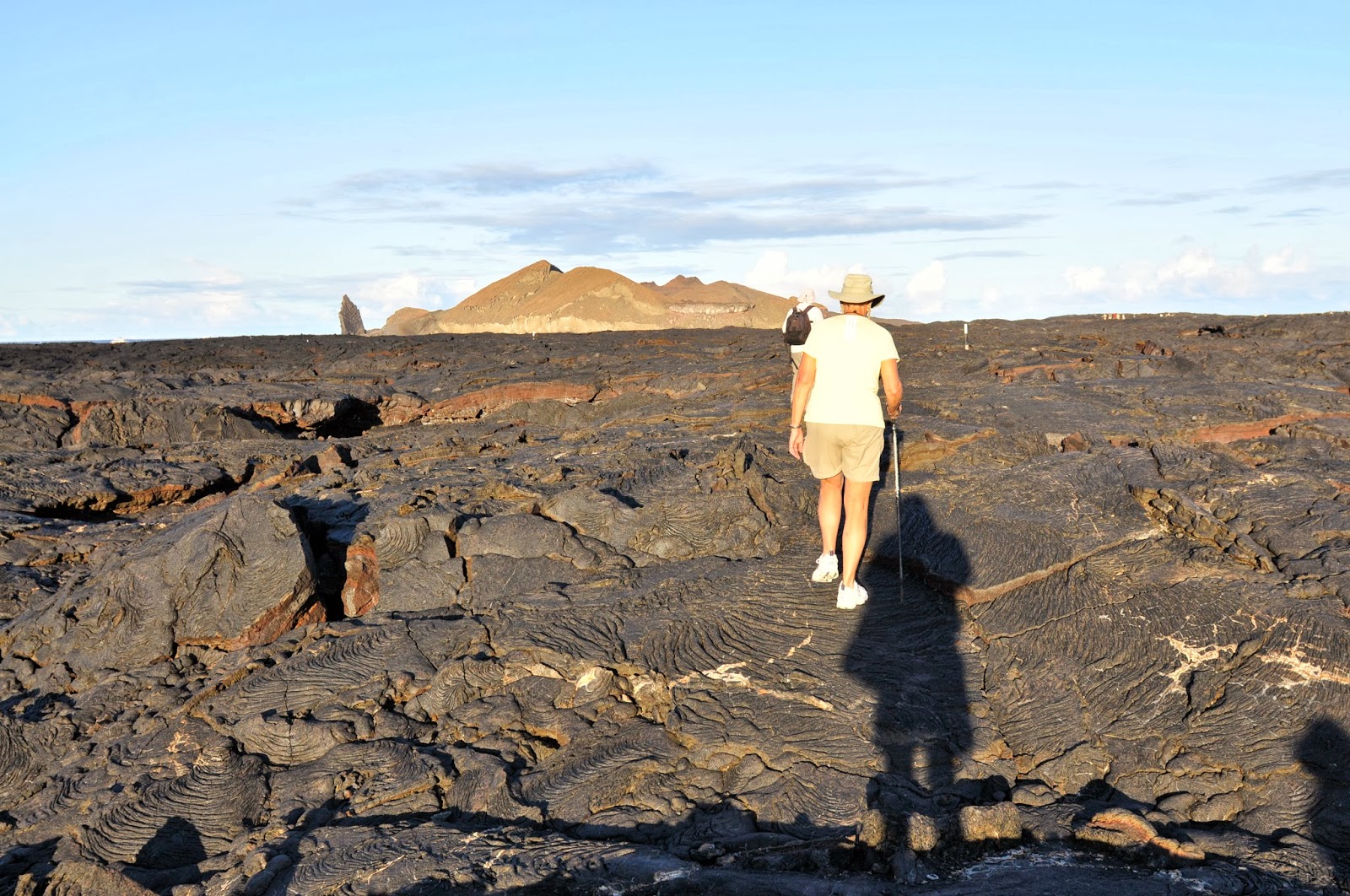
But it is lava that we usually associate with volcanos and the Galapagos Islands are rich in lava as well. There are two types of lava, both given Hawaiian names. The smooth ropey-looking lava is called pahoehoe, The sharper, more brittle-looking lava is called ‘a’a. The viscosity of the lava is dependant on the mineral make-up of the stuff and the temperature is has reached.
There are several forms of lava that are dependent on the mineral makeup of the flow. Felsic lava is high in silica, aluminum, potassium, sodium, and calcium. Intermediate lava is usually richer in iron and magnesium but lower in aluminum and silica. Mafic lavas are hotter and also are rich in iron and magnesium. 

Cooling can cause crack is any direction. This pahoehoe probably cracked when cooling. This could have been amplified by the substrate shape over which the lava flowed. (There is almost always another possibility.) 
Many lava flows are recent, within the past few hundred thousand years that is. It takes a while for plants to become established and to start the chemical processes needed to break down the lava and to add organic material in order to make soil. This lava flow looked like this when Darwin was here and perhaps when the first finches arrived as well.
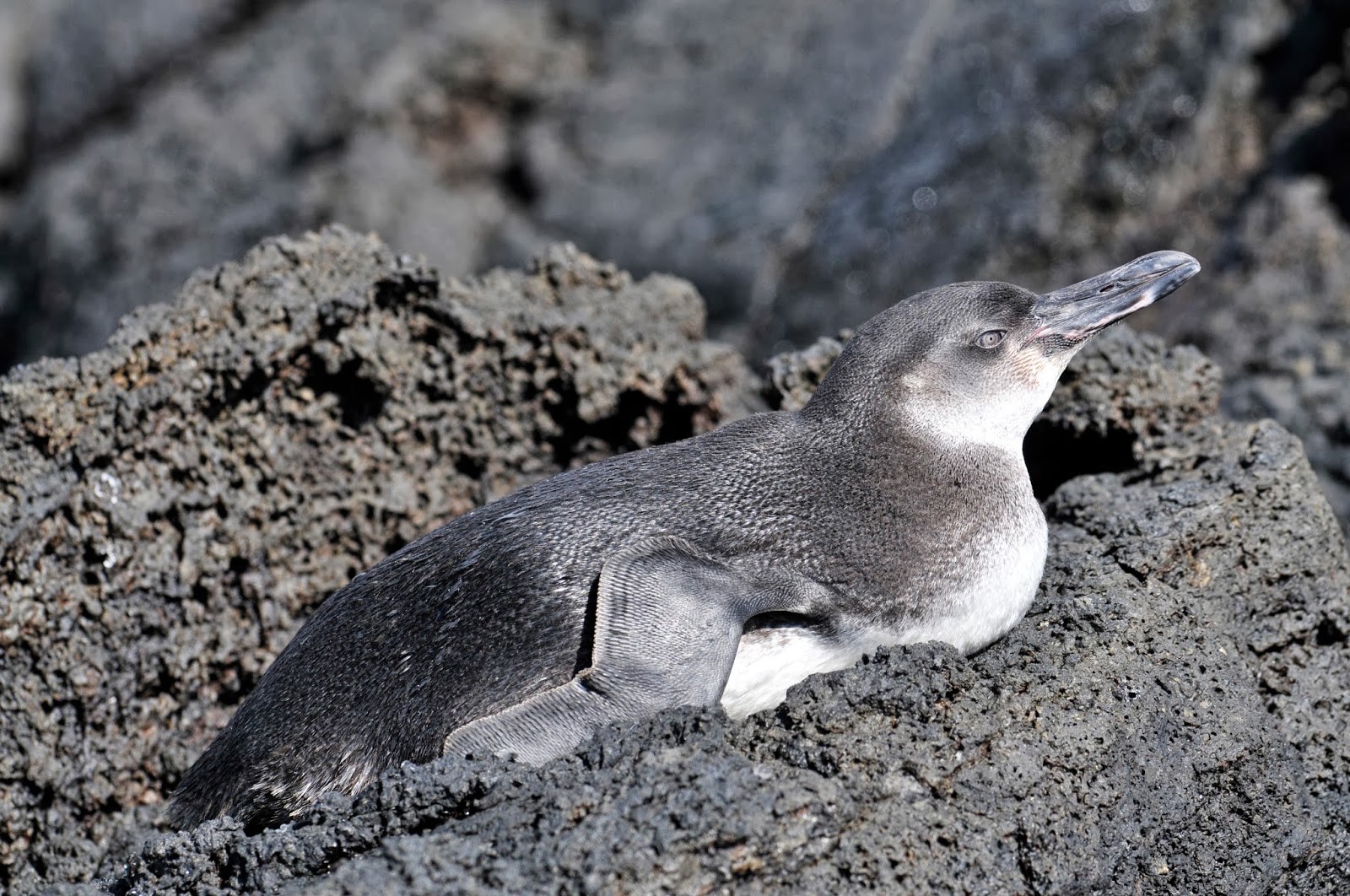
The lava flows often reach the sea. The Flightless Cormorant and the Galapagos Penguin often are creatures of old seaside lava flows. 
Some of the lava flows will form chunks or blocks instead of a smooth liquid-like flow. In many cases this sort of flow shows the blocks on the outer surface but the inner flow stay hotter and is actually quite liquid. The measure of a substances viscosity describes its “runnyiness”. A high viscosity will seem almost solid like tar or pitch. The lower viscosity fluids seem thinner. In the hot southwest autos will use a thicker (higher viscosity) motor oil that in the cooler northeast.

A Look at the geology of the Galapagos Islands

There are a few things that you might want to look up as you peruse this page: hot spot, tuff, lava, uplift, and plate tectonics come quickly to mind. However, once you start on these topics and begin to see the earth’s surface as a living, moving, dynamic skin you may not find time to return to this page – so hold off a minute.

The Galapagos Islands are located above a hot spot; a place in the earth’ surface where (for some reason not well understood) molten material streams upward and oozes through the harder drier surface of the earth’s crust. This may be easy to understand as we are all familiar with volcanoes; those outward expressions of the inner-earth’s energy. But the plot thickens when you factor in the continually (slowly but continually) moving plates that make up the surface of the earth the way scutes cover the shell of a turtle (or tortoise). the plate moves, the hot magma flows upward, the resulting volcanoes, over time, get strung out like beads on a necklace.

The Hawaiian Islands are also hotspot islands. In the case of the Hawaiian Islands the tectonic plate that they are riding on is moving to the northwest making the easterly islands the youngest and the low islands in the west the oldest. As you will see the plate the Galapagos are riding on is moving to the southeast making the easterly islands the oldest. Read on.

Flying in to the Galapagos from the South American mainland the first islands appear low and flat. Being about 600 miles off the coast of Ecuador you might think that the only way they got there was through volcanism. It is unlikely that they would be built from glacial rubble or a broken-off edge of a continental land mass. They are volcanic. Why are they low and flat if they are volcanic? Lava is forced upward from the inner earth in many ways. It moves upward through a single channel spurting  lave from the top end creating a typical cone-shaped volcanic hill or mountain. But, it can also ooze up through an array of cracks, eventually seeping out over the ground in a low flat flow. Many of the lava seeps never reach the surface but are stopped for one reason or another deep in the ground; these are plutonic plumes that are occasionally exposed by subsequent erosion. (The koppjes in the Serengeti are such granitic plumes.)

So, why are the eastward islands low and flat? They are old and wearing down. The signs of their volcanic origins have eroded away leaving a slowly decayed landmass that sooner or later will be claimed by the sea and disappear below the ocean’s surface.

The volcanic origin of the Galapagos can still be seen as you move westward. The tectonic plate is sliding to the east over a hot spot that remains stationary. Thus the newer, more volcanic looking, islands are in the west near the hot spot. The large island (Isabela) is pocked with five large volcanos and the westernmost island (Fernandina) consists almost entirely of the volcano called La Cumbre.
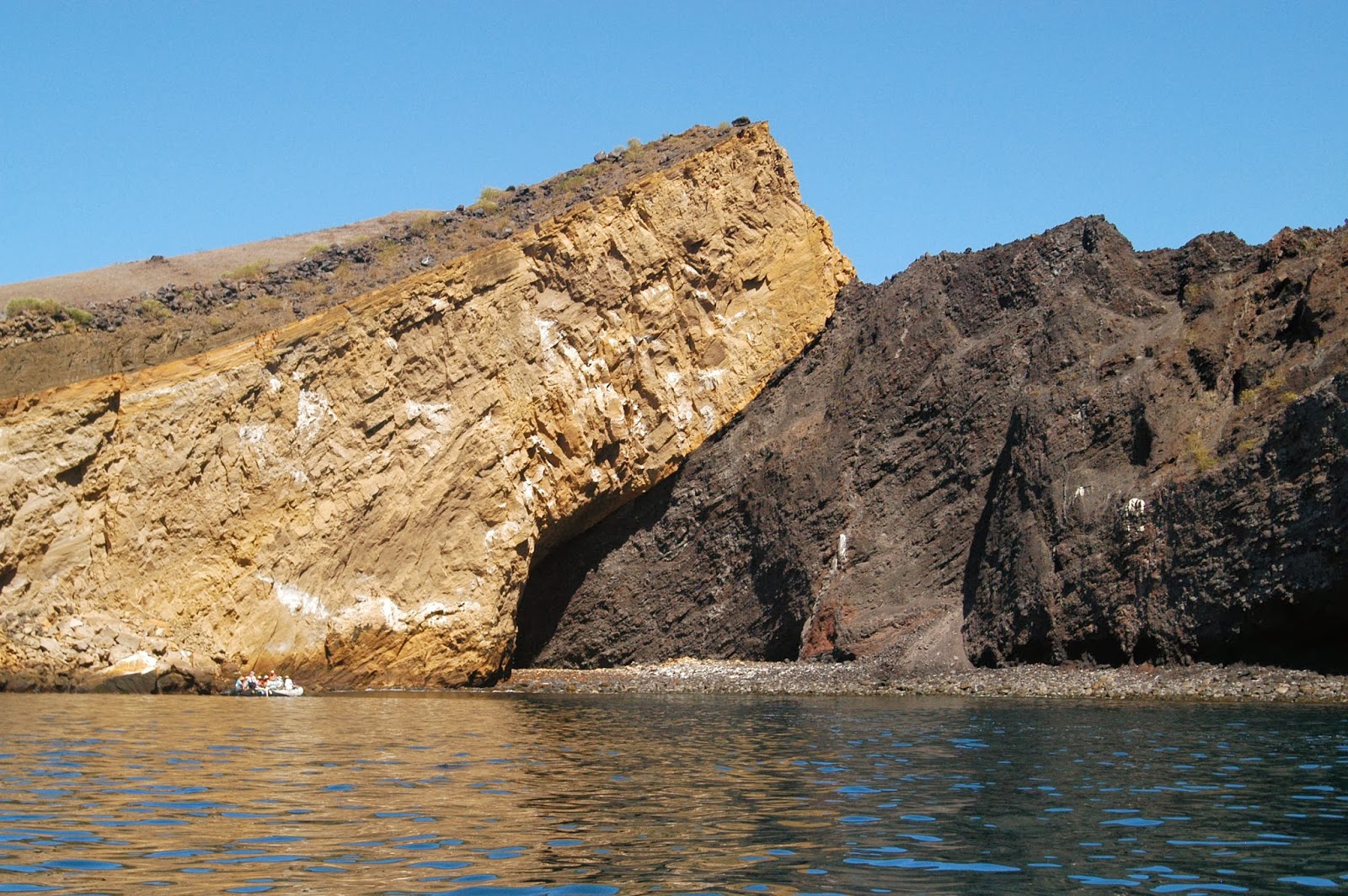
Not all volcanos exude lava, some blow molten spatter into the air and others give of huge bursts of ash. This view of Bartolome shows a remnant bit of a tuff cone. Once there was the footprint of volcanic activity shown by a ring made up of spatter and ash. This cone fell apart leaving only this iconic spire behind. It is hard and holds its shape but it isn’t a lava rock.
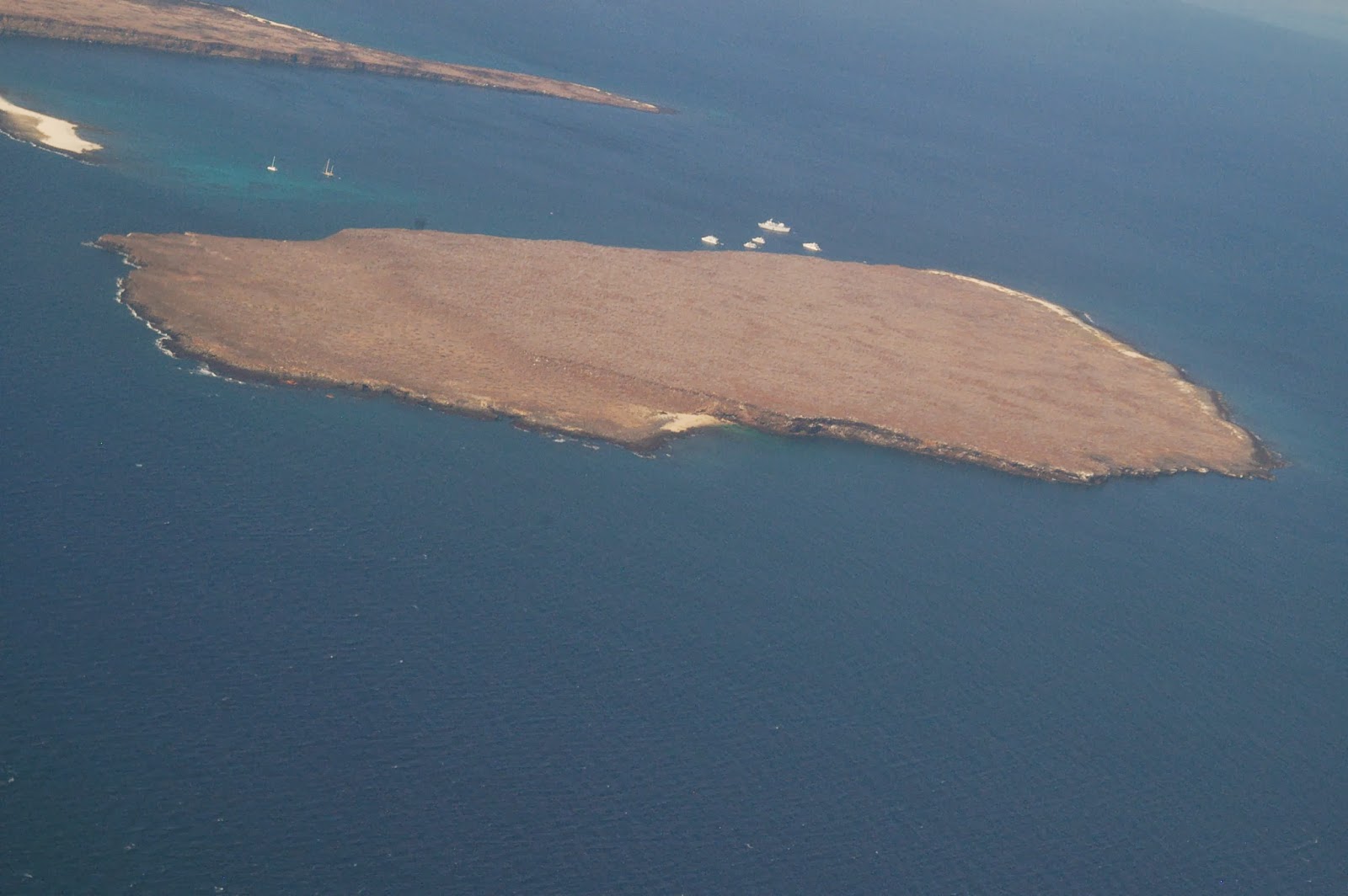
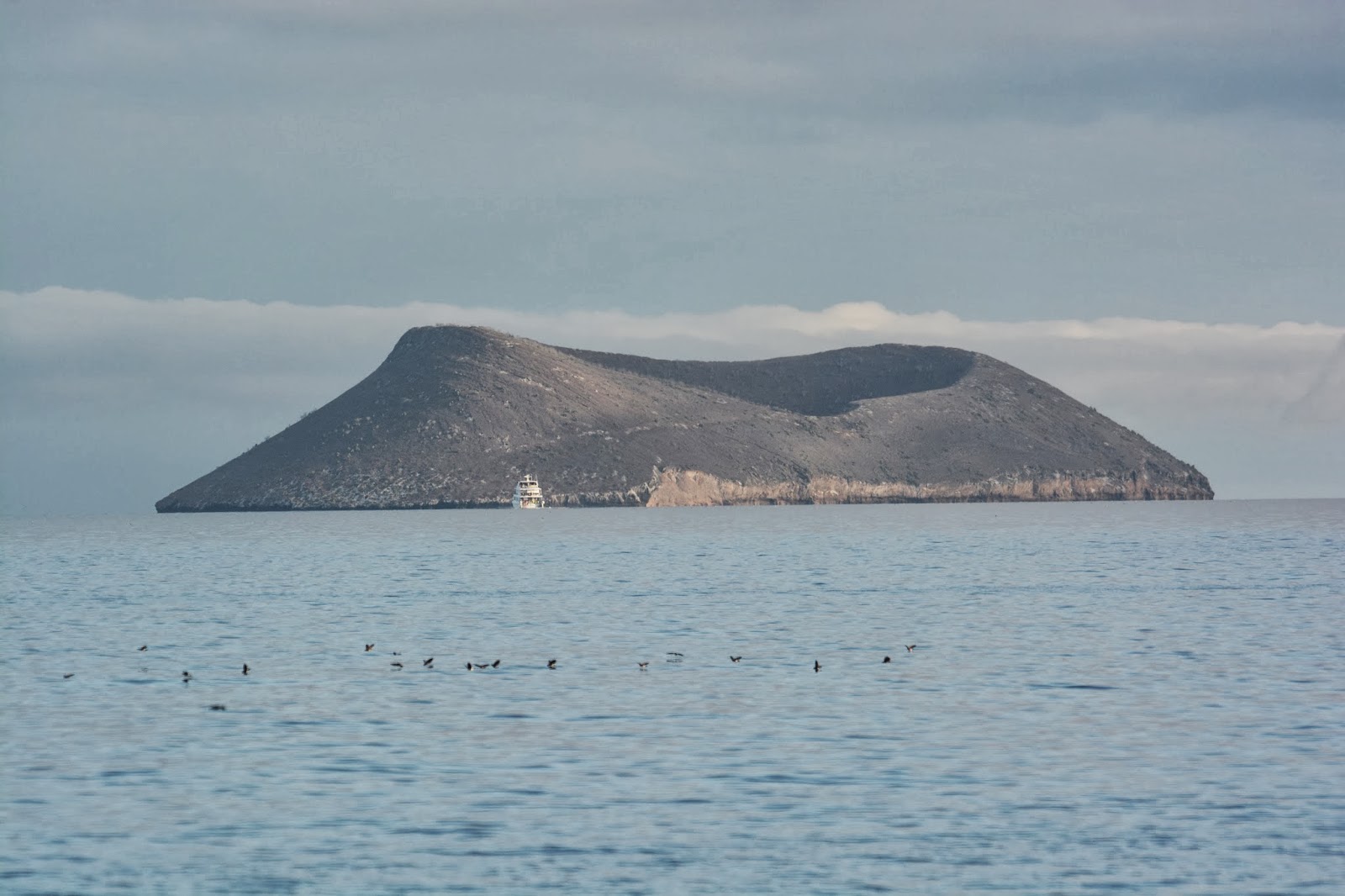
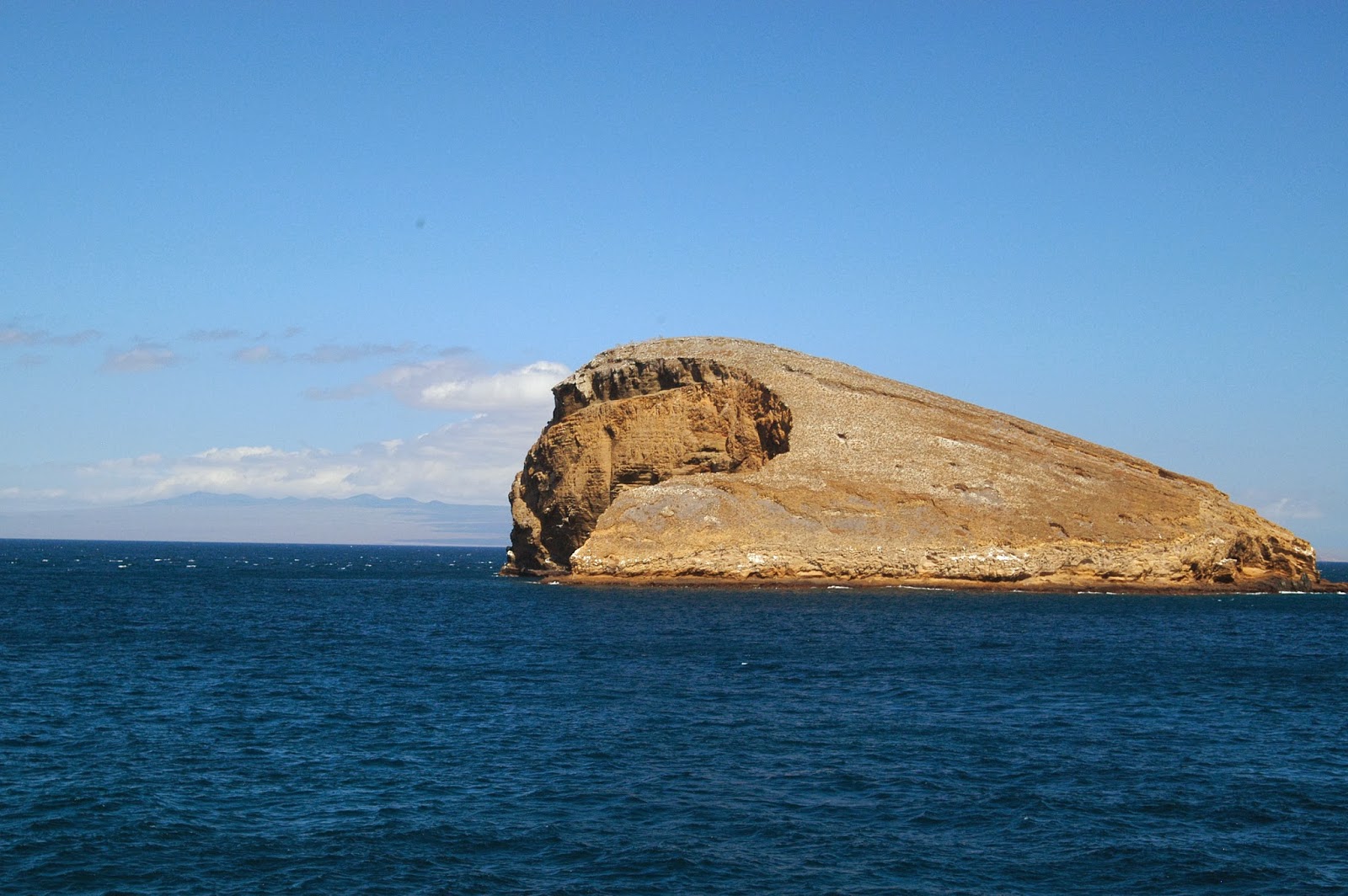
The Daphnes are best known as the finch research site of Rosemary and Peter Grant who have studied bird populations on Daphne for decades. However, keeping with the geologic tone of this page, it is easy to see that Daphne Major is a large hollowed out volcanic remnant. The collapse into itself that creates the vast interior can happen in a few ways; inner collapse back into the lava tube that once fed the volcanic buildup and an explosive finish to volcanic activity are two of the most likely ways. Daphne Major is a very nice looking caldera. (There are about 18 Galapagos Shearwaters in the foreground water. This is a very common bird of the islands but they are rarely seen away from the archipelago.)
The images above and below show layers of ash. A volcano can exude lava which flows downhill until it hardens. Those sorts of volcanoes are rather clean overall. On other occasions volcanoes blow tiny shards of rock into the area which descends according to its weight; larger chunks fall near the source and lighter smaller particles can drift on the jet stream. We call this stuff ash but in reality it is mineral and often a gritty sharp mineral. It is not ash you can blow off your car it is more akin to a carbide dust that will easily remove the finish from your car if you try to wipe it off.
Ash varies in color depending on its mineral makeup. Lava is usually a dark gray or black and ash is usually gray but can be a tawny brown as well.
Much the way ash colors vary the size and shape of volcanic features vary as well. Not all are explosive. Not all give off ash. Not all originate in the same place in the hot spot. Not all bring the same minerals (gasses and water vapor) to the surface. Thus there are many many different forms and shapes to be seen in a hot spot array. The bottom line is that they originate from the depths of the earth and the keep their heads above water for a while and then they slowly decay until they surface is below sea level.

More mammals of Southern Africa #2

Mammals make the top ten list, or at least the African Big 5 list. The lion, leopard, rhinoceros, elephant, and African buffalo are the usual animals listed as the Big 5. No one ever puts ostrich or crocodile on those lists. Nope they are dominated by mammals. The list was contrived by the great white hunters who felt the need to hunt the biggest and most dangerous animals of Africa. There are other big animals but most are relatively docile. For instance the rhinoceros mentioned in the Big 5 is the Black Rhinoceros or Hook-lipped Rhinoceros. The more docile White Rhinoceros was left off; perhaps it was number 6. This may also have been partly because the list was developed for Europeans visiting East Africa (Kenya and Tanzania) not Southern Africa (South Africa, Botswana, Zimbabwe, & Zambia).

The next couple blogs will look at some of the larger mammals whether they are in the official Big 5 or not.

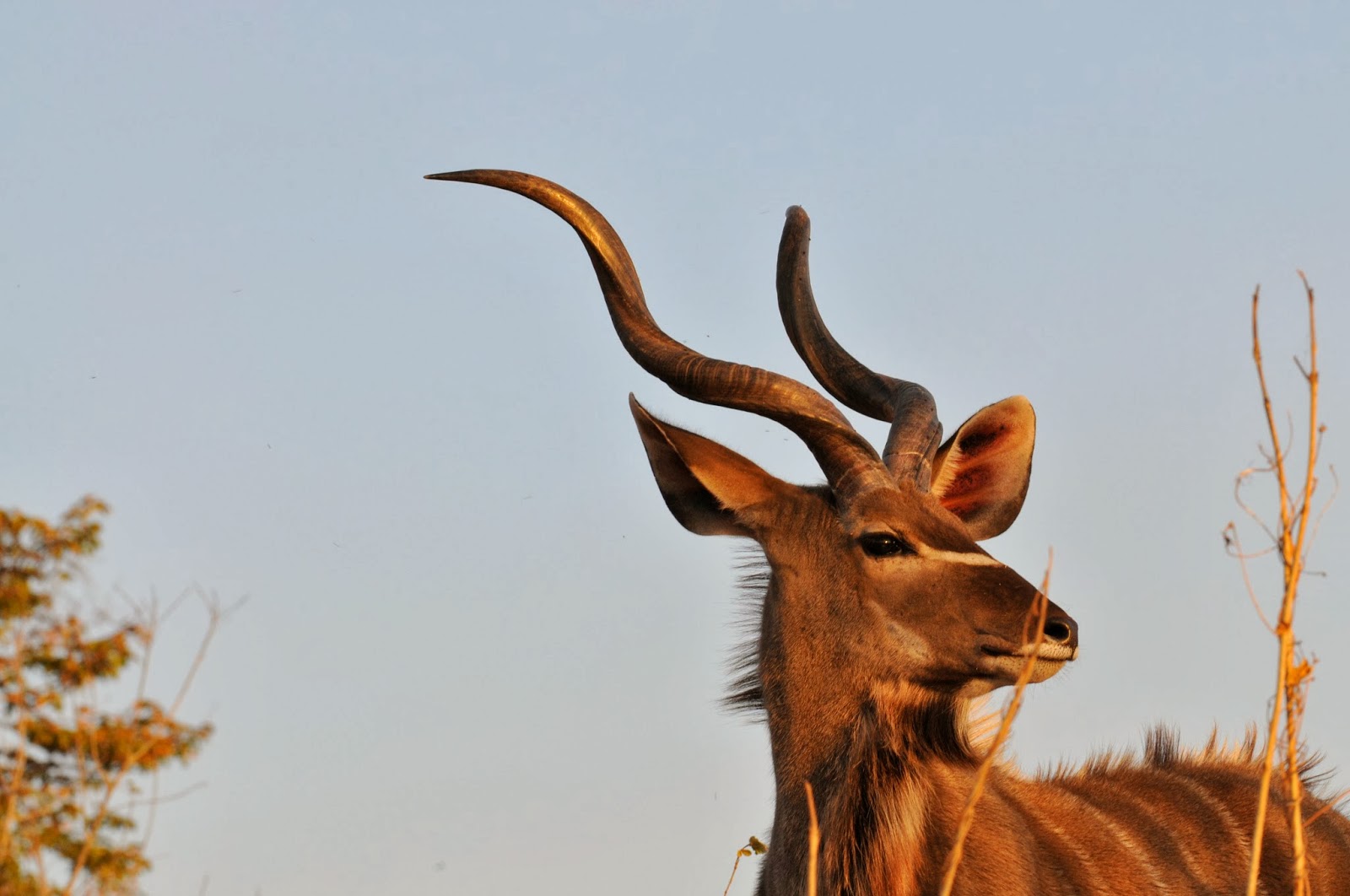
The male Greater Kudu is an elegant antelope. Only the Eland is taller and heavier. Only the Impala has similar lines and grace. Where the Eland is more bovine-like, the kudu is sleek and bedecked with natures most elegant horns. Perhaps it is that the Impala is like a ballerina, the kudu like a world-class track and field athlete, and the Eland more like a heavyweight boxer; all has style and all vibrate with muscular potential, but they are all different. It needs cover and thus lives in areas where there are trees and shrubs. Because it can survive in very dry areas it is quite widespread. It can be found in riverine locations as well as wooded savanna.
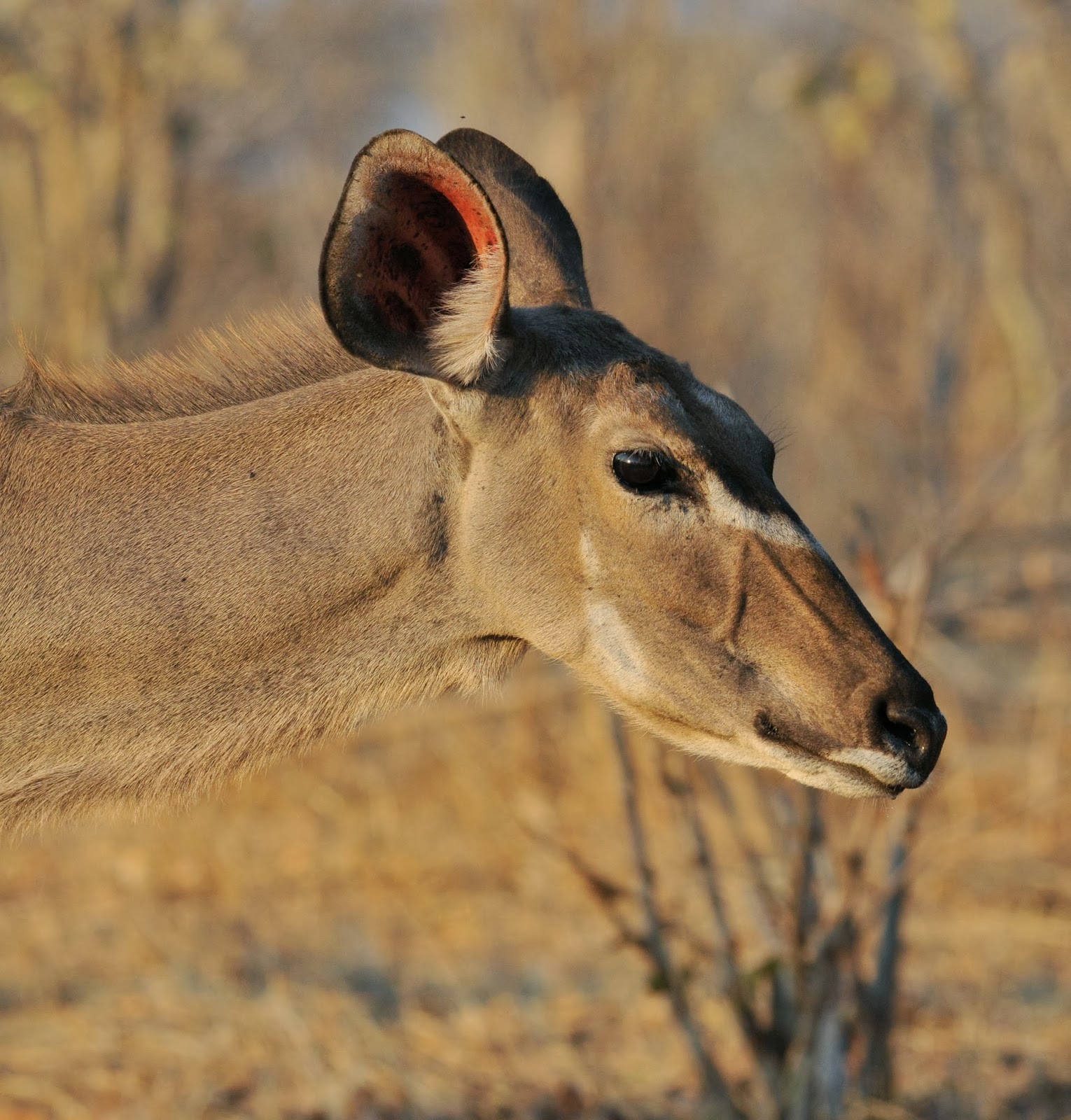
The female Greater Kudu is smaller and lighter than the male. But she has a sense of style as well. In addition to the ear and face markings these antelope have thin white stripes (6-10) running from the spinal (dorsal) crest (mane) down to the belly.
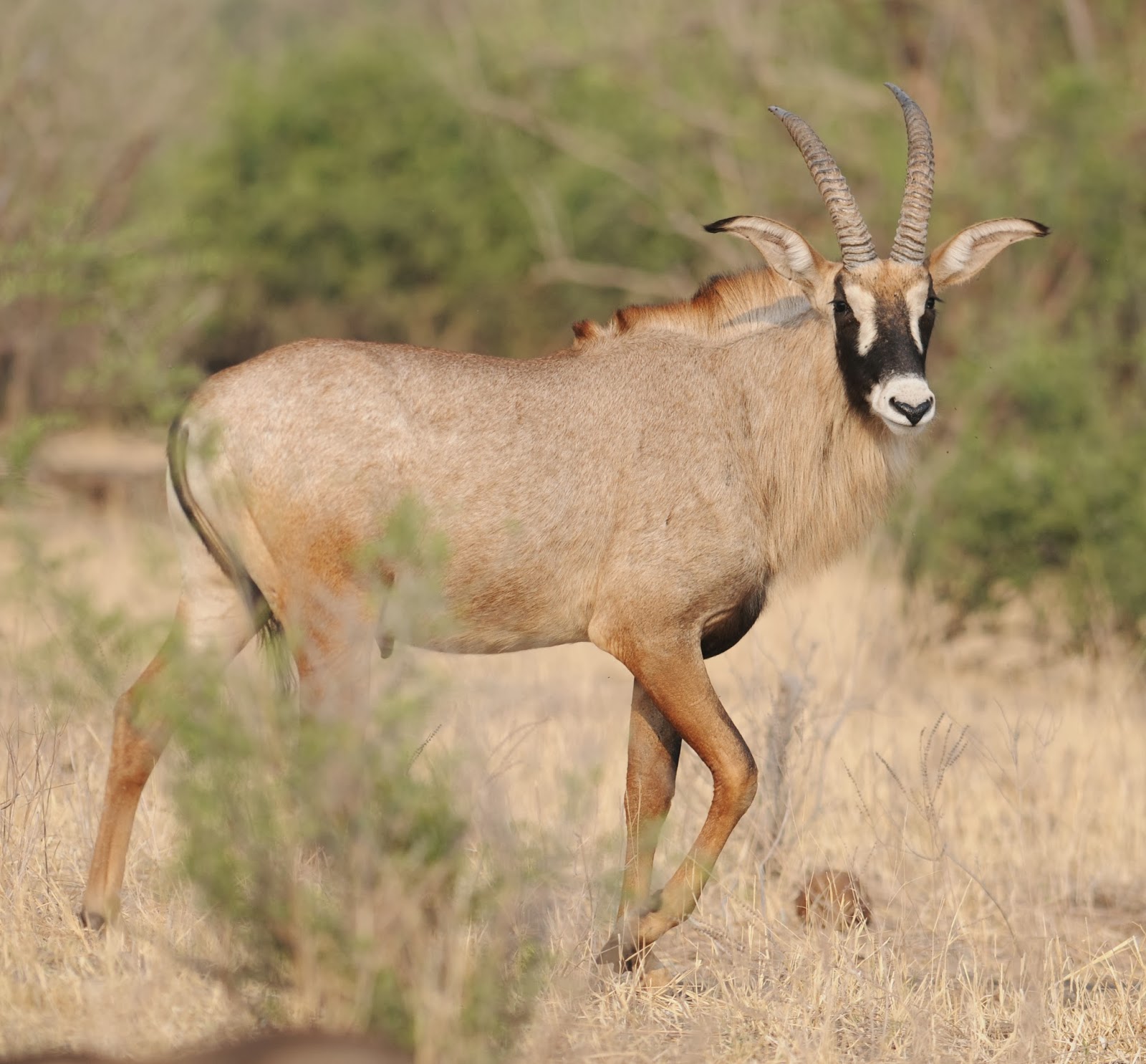
This was my first sighting of Roan Antelope. It was a kind of tough-luck creature for me but we ran into a group of eleven one evening and the next day found them again. Southern Africa has two of the more stylized antelope; the Sable and the Roan. I was a bit surprised to see how solid the Roan were but the face patterns, annulated (ringed) horns, long fringe-tipped ears, and the sheer size of the animals was compensation. The upstanding mane on the neck is a distinctly Roan characteristic.
Of course no look at big animals would be complete without a mention of the huge sausage called Hippopotamus. This mostly aquatic creature can exceed three tons in weight; to 7000 pounds in a large male and 5000 pounds in a mature female. The dominant male oversees a pod of females. When a female gives birth she moves away from the group and keeps her young away from the milling mob for a few weeks. Males that have reached adulthood try to establish their own group of females in their own section of river/pond/lake. In many cases males fight to establish dominance and to take or retain territory.
These young males are jousting for no good reason, at least yet. As they age the fights will become serious and the results more meaningful. This jousting is both practice for future contests and a way to create a pecking order. The lower canines will be as much as twenty inches long in an adult and they are kept sharp by wearing against the upper teeth. As grazers of grasses they sweep across grasslands during their nocturnal feeding forays. Adults will eat about 90 pounds of grass each night. They will tear a swath of grass almost twenty inches wide with their broad lips.
The White Rhinoceros is another grazer of grasses. It has a mostly diurnal pattern of feeding. The White Rhino is the largest land mammal excluding the elephant (see next blog page). A large male will be just short of 5000 pounds and a female can tip the scales at 3500 pounds. They will feed about twelve hours a day and spend eight hours resting. The balance of the day is spent moving about. The rhinoceroses are but a tiny remnant of a great group of herbivores that dominated the earth a few million years ago. The odd-toed group of animals had been widely replaced by even-toed grazers like the antelope. The only other groups that remain of the odd-toed animals are the horses and the tapirs.
Zebra in Southern Africa have a smudgy stripe in between the black stripes. This gives these animals a rather dusky look. The zebra of East Africa are much more crisp and sharply patterned. In the dry lands north of the equator the Grevy’s Zebra is a narrowly striped zebra quite a bit larger than the typical Plains Zebra as both East African and Southern African populations are called. The hoof is the extended middle digit.

The Mammals of Southern Africa – #1

Mammals are the second most attractive group to travelers – well, maybe the first – I favor birds but most people want to see cats and hyenas, and antelope and elephants. Birds are everywhere and they are quite stunning in many cases. In other cases they are rather utilitarian, but still cool.

Okay, back to the mammals. There are several groups that fall out neatly: predator and prey, carnivore and herbivore and some of the obvious groupings. But there are also primates, bats, antelope, and some furry oddities. I will do a few pages on the mammals without developing distinct categories – if I can help myself avoid the biologists tendency toward classification.

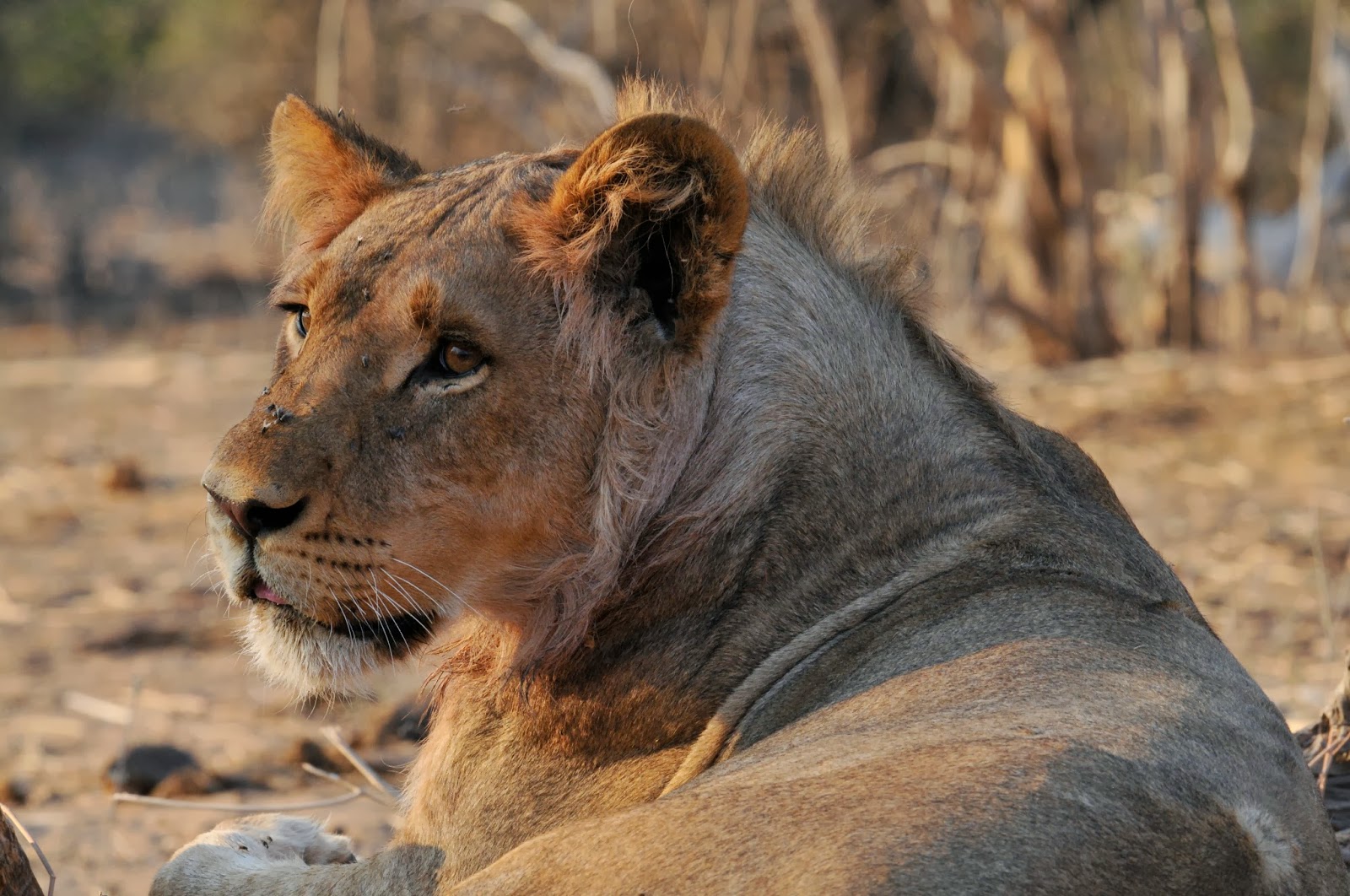
Lions are, at the same time, the most satisfying African mammals and the most disappointing. In the great majority of sightings the pride (or coalition) are doing nothing but lying around sleeping. Lions sleep a lot. The pride consists of the adult females and their young. A pride can be made up of any number of individuals, but rarely exceed fifteen to twenty. The leaders of the group are females; sisters or cousins that were raised in the same pride. They can maintain control of their territory for several years if they remain healthy and learn to work together. 
The pride will hunt, kill, eat, and sleep. Most of the time the hunting is in the early darkness or at dawn. In some cases they hunt in the day time. The females are capable of hunting on their own without any help from the males. A group of females can be mated at about the same time and then have their litters at about the same time. This is the best way for a new cadre of females to arise; sisters and cousins from healthy females of the same pride.
Young males will stay with the pride for about two years. The males, brothers or cousins, go off as a pair or small group and try to find a territory where they can dominate, thus become the mating male(s) to a pride of females. In many cases they challenge existing males; sometime defeating them and taking of a territory with females and other times being beaten and hurt. The injuries in these confrontations often result in the displacement and eventual death of the losers.
Males develop into animals that are much thicker and heavier than the females. They can weigh 50% more than a female; though the males are usually around 400 pounds and the females just under 300 pounds. In most cases the males patrol the territory hanging out with the females and youngsters only when they hunt big animals or when a female is ready to be mated. Often they are apart for days and days at a time. A pride, with associated males, can bring down prey items as large as the African (Cape) Buffalo. The larger the pride the more likely the animals are to hunt large game. Where they are common, zebra and wildebeest are a significant prey item. 
As much fun as being a lion may be – being a youngster often means boredom.
Young lions are in danger of being killed by roaming males or males that challenge and take over a territory. The new males will want to eliminate the youngsters so the females will mate with them and they will have youngsters with a genetic tie to the new males. 
Leopards are less common, though very widespread, and more difficult to locate. They are strong cats and can carry prey weighing almost their own weight into a tree. They do this to keep prey from being taken away by opportunistic lions and hyenas. Most leopards are solitary with females and young the only dependable association. Though ranges of individuals will often overlap they remain solitary. Most youngsters are independent before they are two years old but are allowed to remain in the mothers range as they develop hunting skills. They are rather catholic feeders; eating from about 30 different species, where lions rarely exceed ten species. Leopards eat birds, small mammals, and insects in addition to the mainstay of small antelope and the young of larger antelope.

Stanley & Livingstone – Private Game Reserve

As much as those names conjure up an image of 19th century colonial explorations in Africa and the discovery (and eventual manipulation) of the dark continent, I am referring to a lodge where we stay. This is a most relaxing location with game and acres and acres (or hectare and hectares) of private game reserve. The Stanley and Livingstone is ten minutes or so from Victoria Falls but is a million miles from the paved streets and tourism of downtown Livingstone.

See for yourself at http://www.stanleyandlivingstone.com.

The entrance to the Stanley and Livingstone is very welcoming. The ride out to the lodge is through park and game reserve and it is common to see wildlife both coming and going. Elephants may be the most common mammal seen but sable and roan antelope are possible as are greater kudu and wild dog.
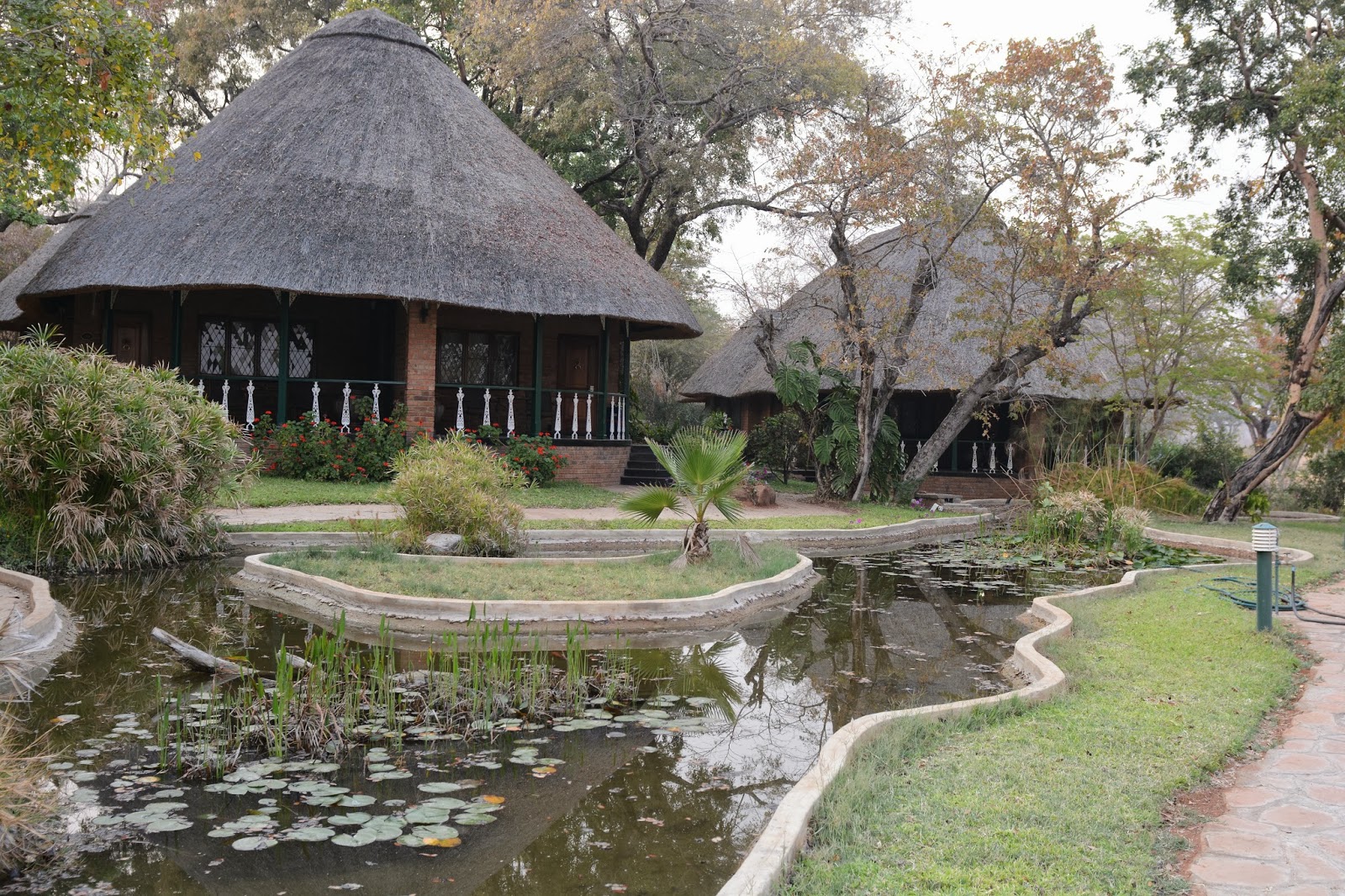
The rooms are two-to-a-bungalow and are really suites not merely rooms. There is a living room with desk, couches, chairs and a place to make tea. And a porch upon which to drink your tea. The bedroom is spacious with more furniture than the average visitor will ever use. The bathroom is off the bedroom and is nearly the same size. The tub is a claw-footed beauty that Napoleon probably once found Josephine in. The shower is a large pan-headed affair with plenty of water. There are sinks, vanities, a bidet, and all the accoutrements that one might need. Nice rooms to say the least.
Africa is a treat. Africans are very nice people. I am always asked if I am afraid to travel to Africa (or most anywhere). My response is that when I read the newspapers in the US I read about some pretty significant tragedies and some disconcerting behavior. In my opinion these activities are much less frequent overseas and especially in Africa. (I say this even as the Nairobi mall tragedy is just ending.) When traveling in Africa you are on a safari route; a circuit that means a great deal to the economy of the country. These areas are managed by the governments and kept safe for the tourists.

Anyway, the food is great here and the ambiance is just right. Relaxing, reading, photographing, exploring, and game viewing can be part of the scene.

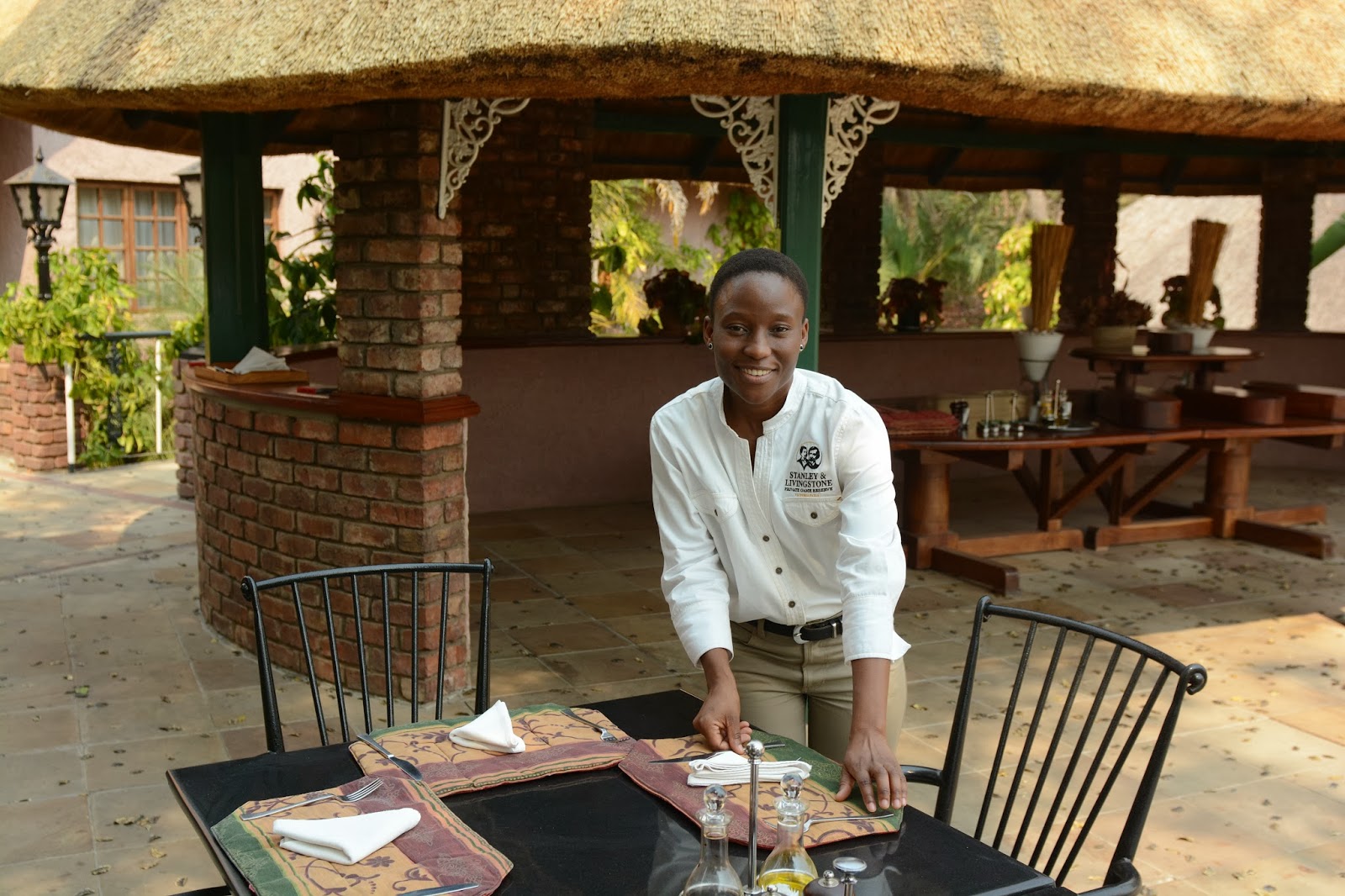
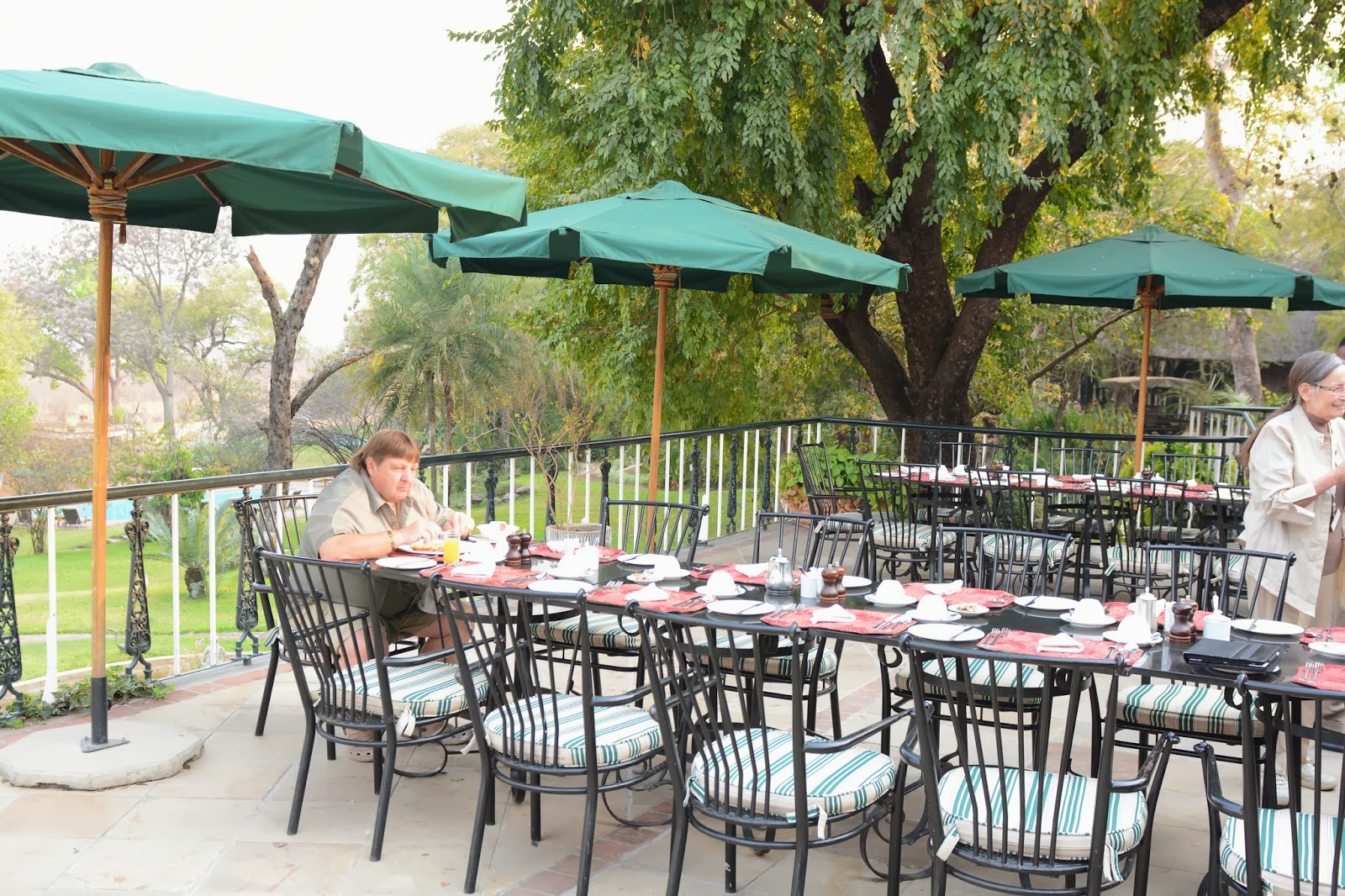
Like most African hotels and lodges meals can be (and often are) taken out doors. The Stanley & Livingstone is no exception.
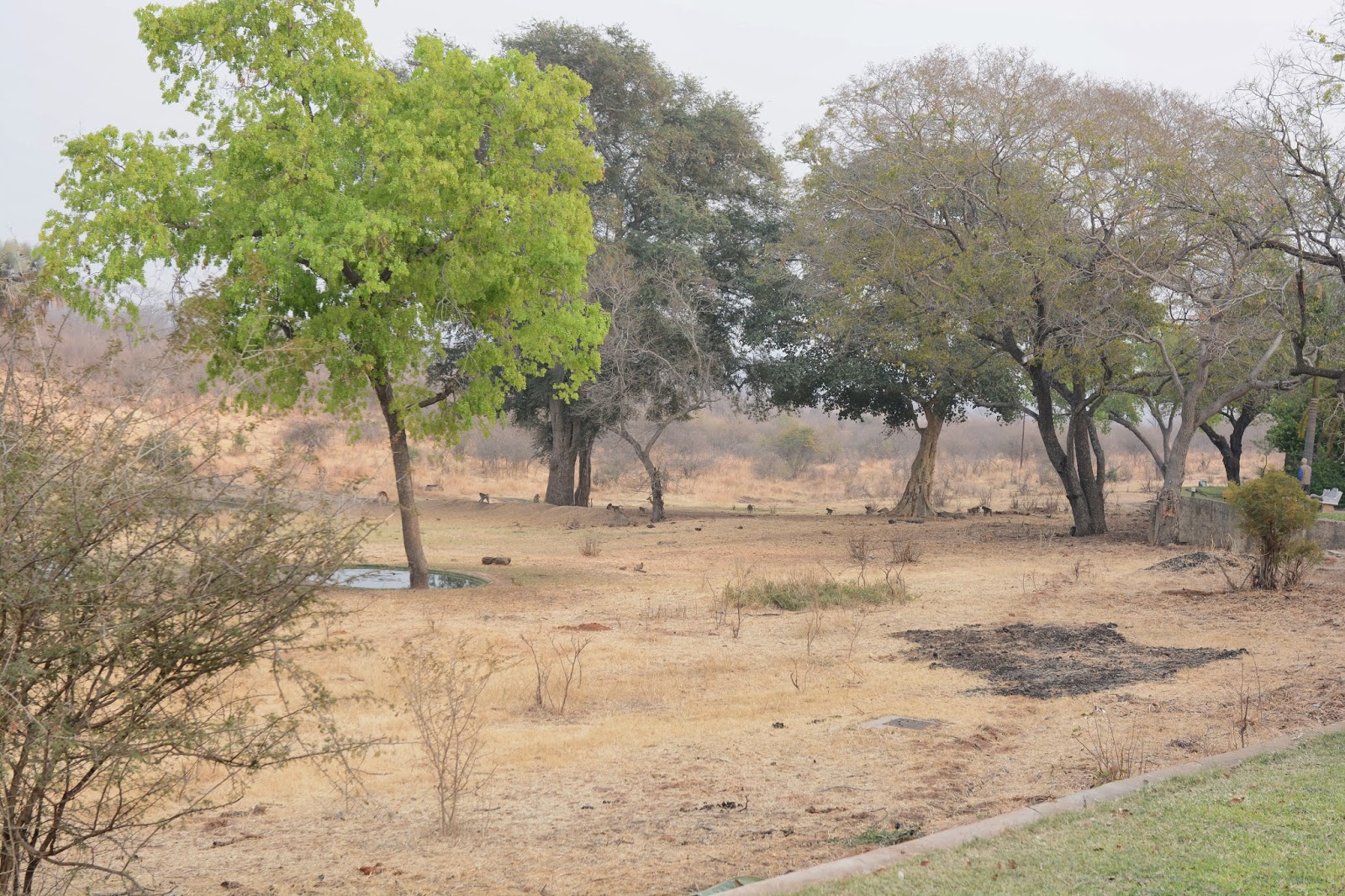
From the dining deck a view of the waterhole draws your eye. In this image there are a dozen or so baboons (Chacma) under a fig tree. When the figs ripen there are antelope, elephants, warthogs, and lots of birds in with the baboons enjoying the fruit. This area also has waterbuck, kudu, and bushbuck. At night there is a wood owl that uses the trees as a hunting perch.
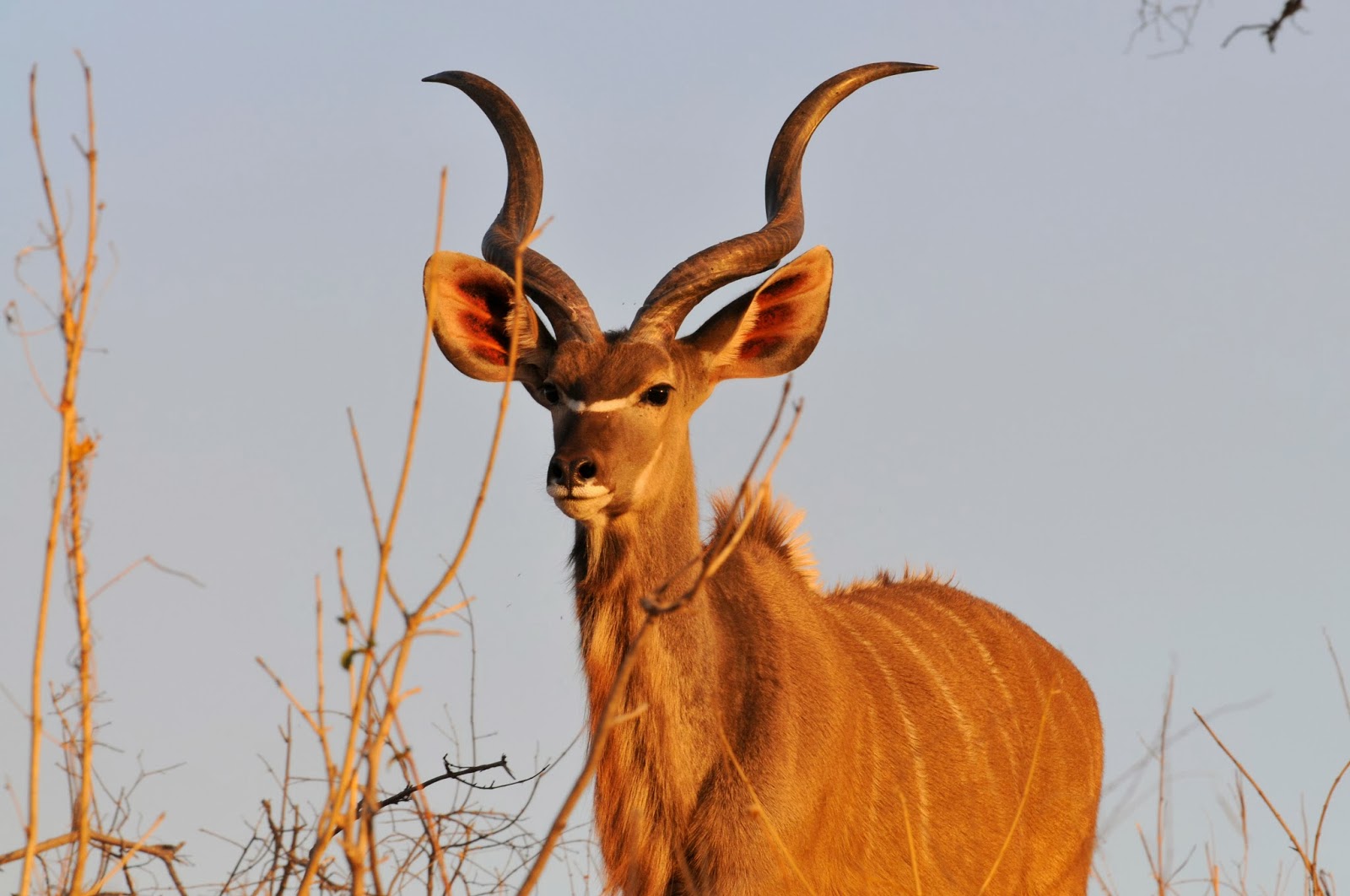
The greater kudu is (perhaps) the most elegant of the antelope. The eland is a bit larger and the roan  about the same size – but none have the style and looks of this guy. The ears of antelope have patterns on the inside and there is often a mane along the spinal ridge.